Analysis of Strategies for Promoting Positive Behaviour in Healthcare
VerifiedAdded on 2020/06/06
|10
|2271
|82
Report
AI Summary
This report delves into the crucial aspects of promoting positive behavior within health and social care environments. It begins by identifying relevant legislation concerning restrictive interventions, emphasizing the importance of health and safety regulations, common law, and the Mental Capacity Act 2005. The report then explores various intervention strategies designed to foster positive behavior, including the use of behavior intervention plans and the implementation of least restrictive interventions. Safeguards for restrictive interventions are also discussed. Furthermore, the report distinguishes between reactive and proactive strategies, highlighting the significance of maintaining a child and person-centered approach. Best practices for promoting positive behavior, types of challenging behaviors (self-injury, verbal, and physical aggression), and steps for maintaining respect and dignity are outlined. Finally, the report provides steps for checking individual behavior to ensure the provision of quality services. The report's findings underscore the importance of effective communication, training, and a holistic approach to managing challenging situations in healthcare.
PROMOTE POSITIVE
BEHAVIOUR
BEHAVIOUR

Paraphrase This Document
Need a fresh take? Get an instant paraphrase of this document with our AI Paraphraser
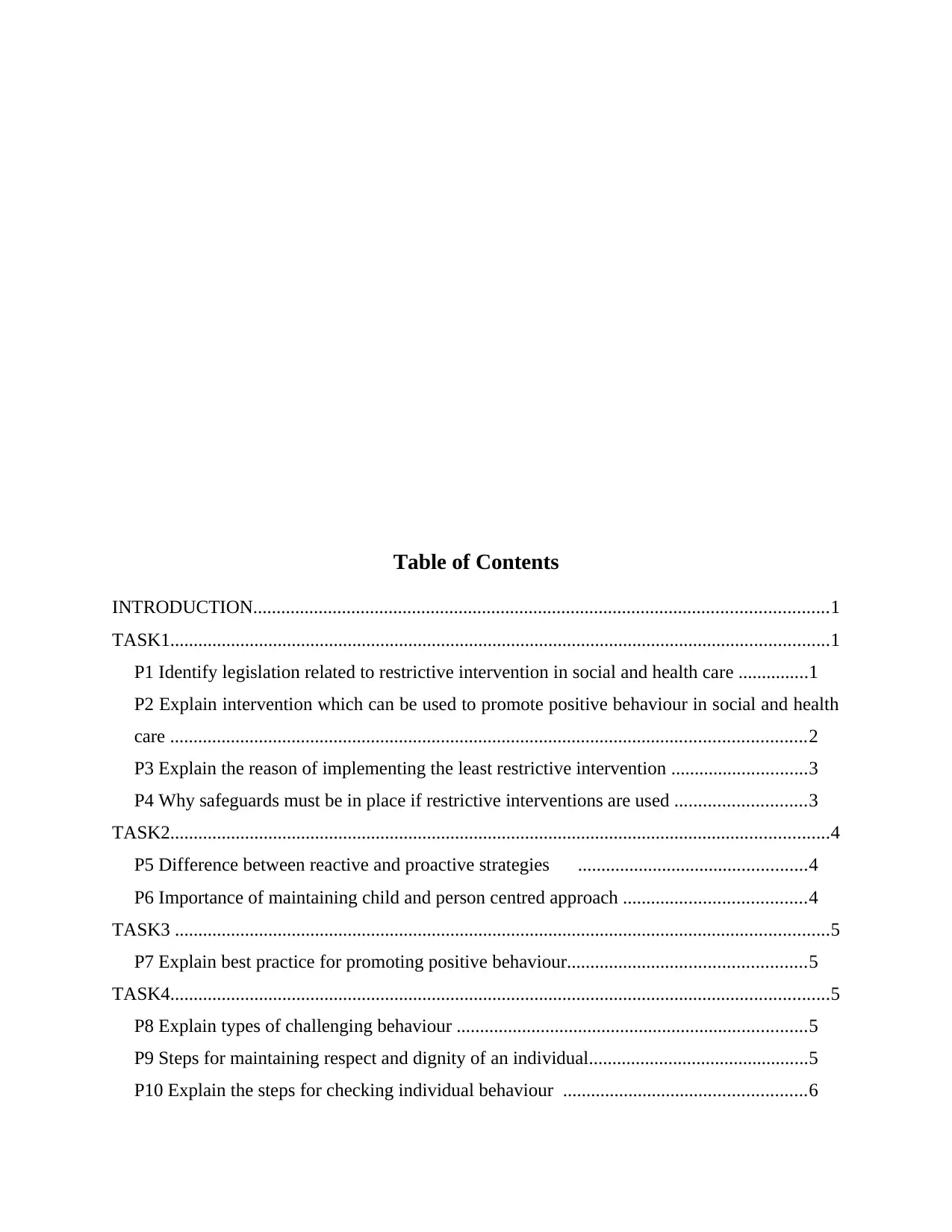
Table of Contents
INTRODUCTION...........................................................................................................................1
TASK1.............................................................................................................................................1
P1 Identify legislation related to restrictive intervention in social and health care ...............1
P2 Explain intervention which can be used to promote positive behaviour in social and health
care ........................................................................................................................................2
P3 Explain the reason of implementing the least restrictive intervention .............................3
P4 Why safeguards must be in place if restrictive interventions are used ............................3
TASK2.............................................................................................................................................4
P5 Difference between reactive and proactive strategies .................................................4
P6 Importance of maintaining child and person centred approach .......................................4
TASK3 ............................................................................................................................................5
P7 Explain best practice for promoting positive behaviour...................................................5
TASK4.............................................................................................................................................5
P8 Explain types of challenging behaviour ...........................................................................5
P9 Steps for maintaining respect and dignity of an individual...............................................5
P10 Explain the steps for checking individual behaviour ....................................................6
INTRODUCTION...........................................................................................................................1
TASK1.............................................................................................................................................1
P1 Identify legislation related to restrictive intervention in social and health care ...............1
P2 Explain intervention which can be used to promote positive behaviour in social and health
care ........................................................................................................................................2
P3 Explain the reason of implementing the least restrictive intervention .............................3
P4 Why safeguards must be in place if restrictive interventions are used ............................3
TASK2.............................................................................................................................................4
P5 Difference between reactive and proactive strategies .................................................4
P6 Importance of maintaining child and person centred approach .......................................4
TASK3 ............................................................................................................................................5
P7 Explain best practice for promoting positive behaviour...................................................5
TASK4.............................................................................................................................................5
P8 Explain types of challenging behaviour ...........................................................................5
P9 Steps for maintaining respect and dignity of an individual...............................................5
P10 Explain the steps for checking individual behaviour ....................................................6

CONCLUSSION ...........................................................................................................................6
REFERENCES ...............................................................................................................................7
REFERENCES ...............................................................................................................................7
⊘ This is a preview!⊘
Do you want full access?
Subscribe today to unlock all pages.

Trusted by 1+ million students worldwide
INTRODUCTION
The health and social care departments are working in order to provide best and effective
services to all the customers so they can recover from their diseases. This is the most challenging
task for the professionals of health care department to understand behaviour of clients. The
undermentioned report is based on laws and regulations which are formulated by government to
provide best health and social care services, different intervention tools are also evaluated and
also best practices are applied on the customers in order to provide them effective services and
also challenging behaviour of customers at health care department (Alfes and et. al., 2013).
TASK1
P1 Identify legislation related to restrictive intervention in social and health care
Services provider are influenced consumers life by both ways positive as well as
negative. Restrictive intervention are referred to as involvement of services provider in
consumer's life. The several laws related to restrictive intervention are as follows:
Health and safety at work 1974: This law ensure about safety and health of the clients which
provided by an organisation services. This is a very important legislation. Management of an
organisation has provide healthy and safety environment to their employees to carry out their
duties and task in an effective manner. They are equipped with training, information and
instruction which provide help to deal with services users, so that intervention are carry out in a
ethical manner at market place.
Common law: This is a another important law of intervention. Common law is define, services
provider consider their duty related to care of their customers thus help to improve quality of
service. This is the obligation and responsibility of the service provider to maintain confidence
and thrust among themselves in order to achieve set goals. Any participation in lives of
customers must be for welfare of the services user.
Mental capacity act 2005: This law is related to intervention. Person those face problem related
to medical illness are not able to take their own decision in a right way. They want help to
develop decision in order to complete task and work. Many service provider firms are help them
to solve this issue in a very effective manner (Burford, Lucassen and Hamilton, 2017). Mental
capacity act 2005 are protect the interest of these people. The treatment offered freedom to
encourage mentally disable person in a positive way.
1
The health and social care departments are working in order to provide best and effective
services to all the customers so they can recover from their diseases. This is the most challenging
task for the professionals of health care department to understand behaviour of clients. The
undermentioned report is based on laws and regulations which are formulated by government to
provide best health and social care services, different intervention tools are also evaluated and
also best practices are applied on the customers in order to provide them effective services and
also challenging behaviour of customers at health care department (Alfes and et. al., 2013).
TASK1
P1 Identify legislation related to restrictive intervention in social and health care
Services provider are influenced consumers life by both ways positive as well as
negative. Restrictive intervention are referred to as involvement of services provider in
consumer's life. The several laws related to restrictive intervention are as follows:
Health and safety at work 1974: This law ensure about safety and health of the clients which
provided by an organisation services. This is a very important legislation. Management of an
organisation has provide healthy and safety environment to their employees to carry out their
duties and task in an effective manner. They are equipped with training, information and
instruction which provide help to deal with services users, so that intervention are carry out in a
ethical manner at market place.
Common law: This is a another important law of intervention. Common law is define, services
provider consider their duty related to care of their customers thus help to improve quality of
service. This is the obligation and responsibility of the service provider to maintain confidence
and thrust among themselves in order to achieve set goals. Any participation in lives of
customers must be for welfare of the services user.
Mental capacity act 2005: This law is related to intervention. Person those face problem related
to medical illness are not able to take their own decision in a right way. They want help to
develop decision in order to complete task and work. Many service provider firms are help them
to solve this issue in a very effective manner (Burford, Lucassen and Hamilton, 2017). Mental
capacity act 2005 are protect the interest of these people. The treatment offered freedom to
encourage mentally disable person in a positive way.
1
Paraphrase This Document
Need a fresh take? Get an instant paraphrase of this document with our AI Paraphraser
P2 Explain intervention which can be used to promote positive behaviour in social and health
care
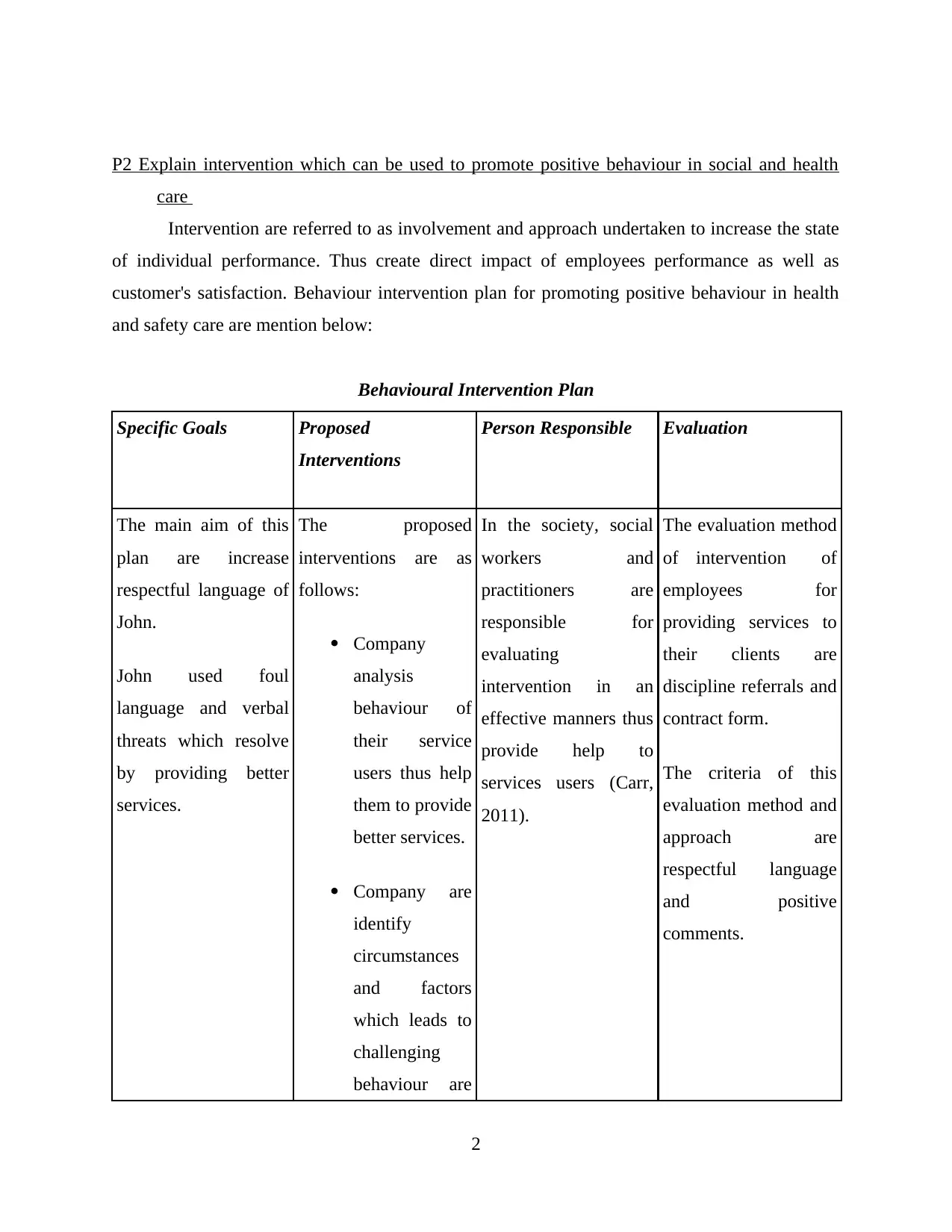
Intervention are referred to as involvement and approach undertaken to increase the state
of individual performance. Thus create direct impact of employees performance as well as
customer's satisfaction. Behaviour intervention plan for promoting positive behaviour in health
and safety care are mention below:
Behavioural Intervention Plan
Specific Goals Proposed
Interventions
Person Responsible Evaluation
The main aim of this
plan are increase
respectful language of
John.
John used foul
language and verbal
threats which resolve
by providing better
services.
The proposed
interventions are as
follows:
Company
analysis
behaviour of
their service
users thus help
them to provide
better services.
Company are
identify
circumstances
and factors
which leads to
challenging
behaviour are
In the society, social
workers and
practitioners are
responsible for
evaluating
intervention in an
effective manners thus
provide help to
services users (Carr,
2011).
The evaluation method
of intervention of
employees for
providing services to
their clients are
discipline referrals and
contract form.
The criteria of this
evaluation method and
approach are
respectful language
and positive
comments.
2
care
Intervention are referred to as involvement and approach undertaken to increase the state
of individual performance. Thus create direct impact of employees performance as well as
customer's satisfaction. Behaviour intervention plan for promoting positive behaviour in health
and safety care are mention below:
Behavioural Intervention Plan
Specific Goals Proposed
Interventions
Person Responsible Evaluation
The main aim of this
plan are increase
respectful language of
John.
John used foul
language and verbal
threats which resolve
by providing better
services.
The proposed
interventions are as
follows:
Company
analysis
behaviour of
their service
users thus help
them to provide
better services.
Company are
identify
circumstances
and factors
which leads to
challenging
behaviour are
In the society, social
workers and
practitioners are
responsible for
evaluating
intervention in an
effective manners thus
provide help to
services users (Carr,
2011).
The evaluation method
of intervention of
employees for
providing services to
their clients are
discipline referrals and
contract form.
The criteria of this
evaluation method and
approach are
respectful language
and positive
comments.
2
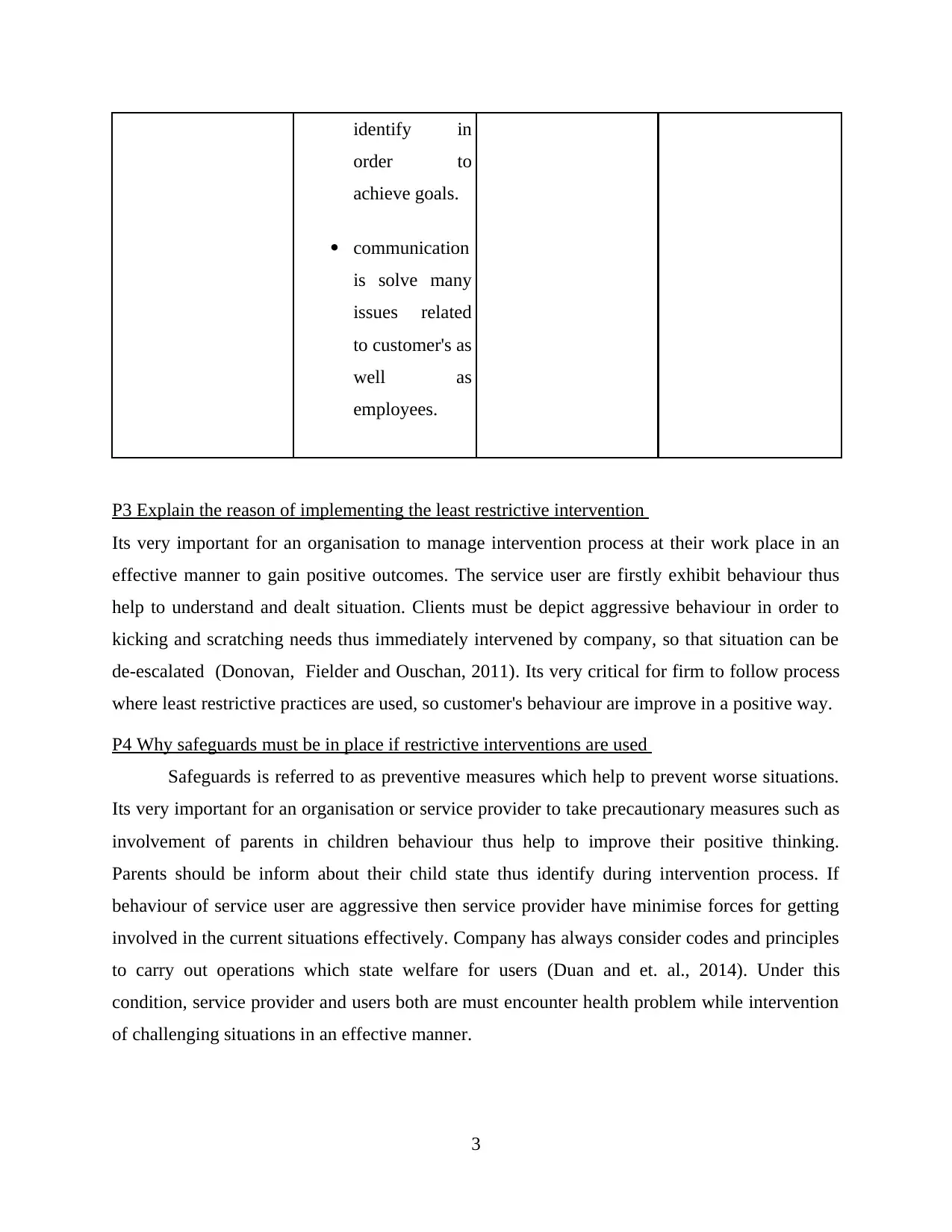
identify in
order to
achieve goals.
communication
is solve many
issues related
to customer's as
well as
employees.
P3 Explain the reason of implementing the least restrictive intervention
Its very important for an organisation to manage intervention process at their work place in an
effective manner to gain positive outcomes. The service user are firstly exhibit behaviour thus
help to understand and dealt situation. Clients must be depict aggressive behaviour in order to
kicking and scratching needs thus immediately intervened by company, so that situation can be
de-escalated (Donovan, Fielder and Ouschan, 2011). Its very critical for firm to follow process
where least restrictive practices are used, so customer's behaviour are improve in a positive way.
P4 Why safeguards must be in place if restrictive interventions are used
Safeguards is referred to as preventive measures which help to prevent worse situations.
Its very important for an organisation or service provider to take precautionary measures such as
involvement of parents in children behaviour thus help to improve their positive thinking.
Parents should be inform about their child state thus identify during intervention process. If
behaviour of service user are aggressive then service provider have minimise forces for getting
involved in the current situations effectively. Company has always consider codes and principles
to carry out operations which state welfare for users (Duan and et. al., 2014). Under this
condition, service provider and users both are must encounter health problem while intervention
of challenging situations in an effective manner.
3
order to
achieve goals.
communication
is solve many
issues related
to customer's as
well as
employees.
P3 Explain the reason of implementing the least restrictive intervention
Its very important for an organisation to manage intervention process at their work place in an
effective manner to gain positive outcomes. The service user are firstly exhibit behaviour thus
help to understand and dealt situation. Clients must be depict aggressive behaviour in order to
kicking and scratching needs thus immediately intervened by company, so that situation can be
de-escalated (Donovan, Fielder and Ouschan, 2011). Its very critical for firm to follow process
where least restrictive practices are used, so customer's behaviour are improve in a positive way.
P4 Why safeguards must be in place if restrictive interventions are used
Safeguards is referred to as preventive measures which help to prevent worse situations.
Its very important for an organisation or service provider to take precautionary measures such as
involvement of parents in children behaviour thus help to improve their positive thinking.
Parents should be inform about their child state thus identify during intervention process. If
behaviour of service user are aggressive then service provider have minimise forces for getting
involved in the current situations effectively. Company has always consider codes and principles
to carry out operations which state welfare for users (Duan and et. al., 2014). Under this
condition, service provider and users both are must encounter health problem while intervention
of challenging situations in an effective manner.
3
⊘ This is a preview!⊘
Do you want full access?
Subscribe today to unlock all pages.
Trusted by 1+ million students worldwide
TASK2
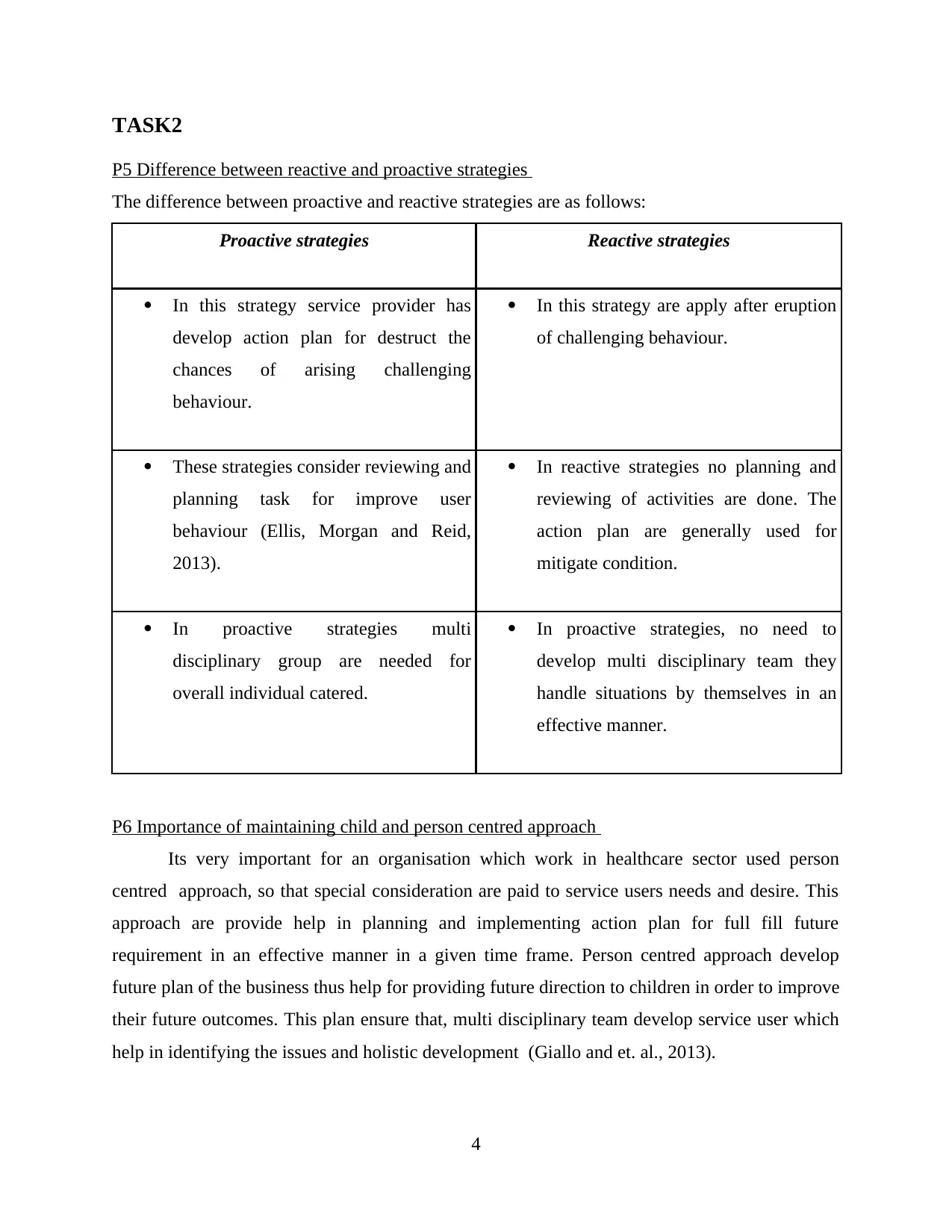
P5 Difference between reactive and proactive strategies
The difference between proactive and reactive strategies are as follows:
Proactive strategies Reactive strategies
In this strategy service provider has
develop action plan for destruct the
chances of arising challenging
behaviour.
In this strategy are apply after eruption
of challenging behaviour.
These strategies consider reviewing and
planning task for improve user
behaviour (Ellis, Morgan and Reid,
2013).
In reactive strategies no planning and
reviewing of activities are done. The
action plan are generally used for
mitigate condition.
In proactive strategies multi
disciplinary group are needed for
overall individual catered.
In proactive strategies, no need to
develop multi disciplinary team they
handle situations by themselves in an
effective manner.
P6 Importance of maintaining child and person centred approach
Its very important for an organisation which work in healthcare sector used person
centred approach, so that special consideration are paid to service users needs and desire. This
approach are provide help in planning and implementing action plan for full fill future
requirement in an effective manner in a given time frame. Person centred approach develop
future plan of the business thus help for providing future direction to children in order to improve
their future outcomes. This plan ensure that, multi disciplinary team develop service user which
help in identifying the issues and holistic development (Giallo and et. al., 2013).
4
P5 Difference between reactive and proactive strategies
The difference between proactive and reactive strategies are as follows:
Proactive strategies Reactive strategies
In this strategy service provider has
develop action plan for destruct the
chances of arising challenging
behaviour.
In this strategy are apply after eruption
of challenging behaviour.
These strategies consider reviewing and
planning task for improve user
behaviour (Ellis, Morgan and Reid,
2013).
In reactive strategies no planning and
reviewing of activities are done. The
action plan are generally used for
mitigate condition.
In proactive strategies multi
disciplinary group are needed for
overall individual catered.
In proactive strategies, no need to
develop multi disciplinary team they
handle situations by themselves in an
effective manner.
P6 Importance of maintaining child and person centred approach
Its very important for an organisation which work in healthcare sector used person
centred approach, so that special consideration are paid to service users needs and desire. This
approach are provide help in planning and implementing action plan for full fill future
requirement in an effective manner in a given time frame. Person centred approach develop
future plan of the business thus help for providing future direction to children in order to improve
their future outcomes. This plan ensure that, multi disciplinary team develop service user which
help in identifying the issues and holistic development (Giallo and et. al., 2013).
4
Paraphrase This Document
Need a fresh take? Get an instant paraphrase of this document with our AI Paraphraser
.. Its a recommended for healthcare company they use person cantered approach at their work
place to provide better services to their customer's and promoting positive behaviour.
TASK3
P7 Explain best practice for promoting positive behaviour
Some of the practices which promoting positive behaviour of an individual are as follows:
For full fill needs and wants of an individual in a best possible manner its very important
for an organisation or service provider to possess background knowledge and information
about users. Thus help in developing strategies for eliminating challenging behaviour.
An organisation develop plan for reduce negative behaviour of an individual to carry out
whole action strategy in right direction.
The service provider is engage in policy formulation and implementation that create
positive impact on delivery of services to clients (Shapiro, 2011).
An organisation conducting training and development program at their work place, so
they equipped with right technique and tools for minimizing challenging behaviour.
TASK4
P8 Explain types of challenging behaviour
The challenging behaviour can be categorized mostly in three segment those are as
follows:
Self-injury: Self injury referred to as withering and disturbing behavioural which dispirited by
services user. They main type of self injury are rubbing, head banging and scratching etc.
Verbal aggression: In this behaviour, persons have can not express their thinking and
communication them in destructive form. That can be illustrated by service user in an effective
manner. Some example are appearance attacks, competent and character etc.
Physical aggression: In this behavioural, person physically harm to others. Physical aggression
are referred to as harming themselves and institution property thus create negative impact on
their behaviour (Strachan, MacDonald and Côté, 2016). They can not control their behaviour and
feel disable. The main types of physical aggression are pushing, kicking and hitting etc.
P9 Steps for maintaining respect and dignity of an individual
Step for maintaining respect and dignity are as follows:
5
place to provide better services to their customer's and promoting positive behaviour.
TASK3
P7 Explain best practice for promoting positive behaviour
Some of the practices which promoting positive behaviour of an individual are as follows:
For full fill needs and wants of an individual in a best possible manner its very important
for an organisation or service provider to possess background knowledge and information
about users. Thus help in developing strategies for eliminating challenging behaviour.
An organisation develop plan for reduce negative behaviour of an individual to carry out
whole action strategy in right direction.
The service provider is engage in policy formulation and implementation that create
positive impact on delivery of services to clients (Shapiro, 2011).
An organisation conducting training and development program at their work place, so
they equipped with right technique and tools for minimizing challenging behaviour.
TASK4
P8 Explain types of challenging behaviour
The challenging behaviour can be categorized mostly in three segment those are as
follows:
Self-injury: Self injury referred to as withering and disturbing behavioural which dispirited by
services user. They main type of self injury are rubbing, head banging and scratching etc.
Verbal aggression: In this behaviour, persons have can not express their thinking and
communication them in destructive form. That can be illustrated by service user in an effective
manner. Some example are appearance attacks, competent and character etc.
Physical aggression: In this behavioural, person physically harm to others. Physical aggression
are referred to as harming themselves and institution property thus create negative impact on
their behaviour (Strachan, MacDonald and Côté, 2016). They can not control their behaviour and
feel disable. The main types of physical aggression are pushing, kicking and hitting etc.
P9 Steps for maintaining respect and dignity of an individual
Step for maintaining respect and dignity are as follows:
5
Assess current situation before involvement of themselves in those condition.
Its very important to behave calmly while dealing with current condition.
The comfort which provided to person are enhanced so that participation in activities are
improve (Alfes and et. al., 2013).
The petulant and isolation factor are reduce so that person can calm down.
Its very important to emphasized communication for these circumstances.
P10 Explain the steps for checking individual behaviour
Service provider has identify individual behaviour for provide satisfaction and quality of
services. For the they used several steps those are:
Identify customer's needs and wants for provide better services to them.
Know their behaviour toward things.
Determine gap between actual and desire behaviour.
Take appropriate action to full fill these gap.
CONCLUSSION
In the above report, health and social care strategies are very important for an
organisation to provide better services to their customer's. Service provider are influenced
customer's behaviour. In an organisation effective communication are used at work place in
order to control all the difficult situation and provide treatment to their customers. They
implementing strategies for control mental illness of an individual. In this report, mention the
major challenging behaviour those are self-injury, physical and verbal aggression.
6
Its very important to behave calmly while dealing with current condition.
The comfort which provided to person are enhanced so that participation in activities are
improve (Alfes and et. al., 2013).
The petulant and isolation factor are reduce so that person can calm down.
Its very important to emphasized communication for these circumstances.
P10 Explain the steps for checking individual behaviour
Service provider has identify individual behaviour for provide satisfaction and quality of
services. For the they used several steps those are:
Identify customer's needs and wants for provide better services to them.
Know their behaviour toward things.
Determine gap between actual and desire behaviour.
Take appropriate action to full fill these gap.
CONCLUSSION
In the above report, health and social care strategies are very important for an
organisation to provide better services to their customer's. Service provider are influenced
customer's behaviour. In an organisation effective communication are used at work place in
order to control all the difficult situation and provide treatment to their customers. They
implementing strategies for control mental illness of an individual. In this report, mention the
major challenging behaviour those are self-injury, physical and verbal aggression.
6
⊘ This is a preview!⊘
Do you want full access?
Subscribe today to unlock all pages.
Trusted by 1+ million students worldwide
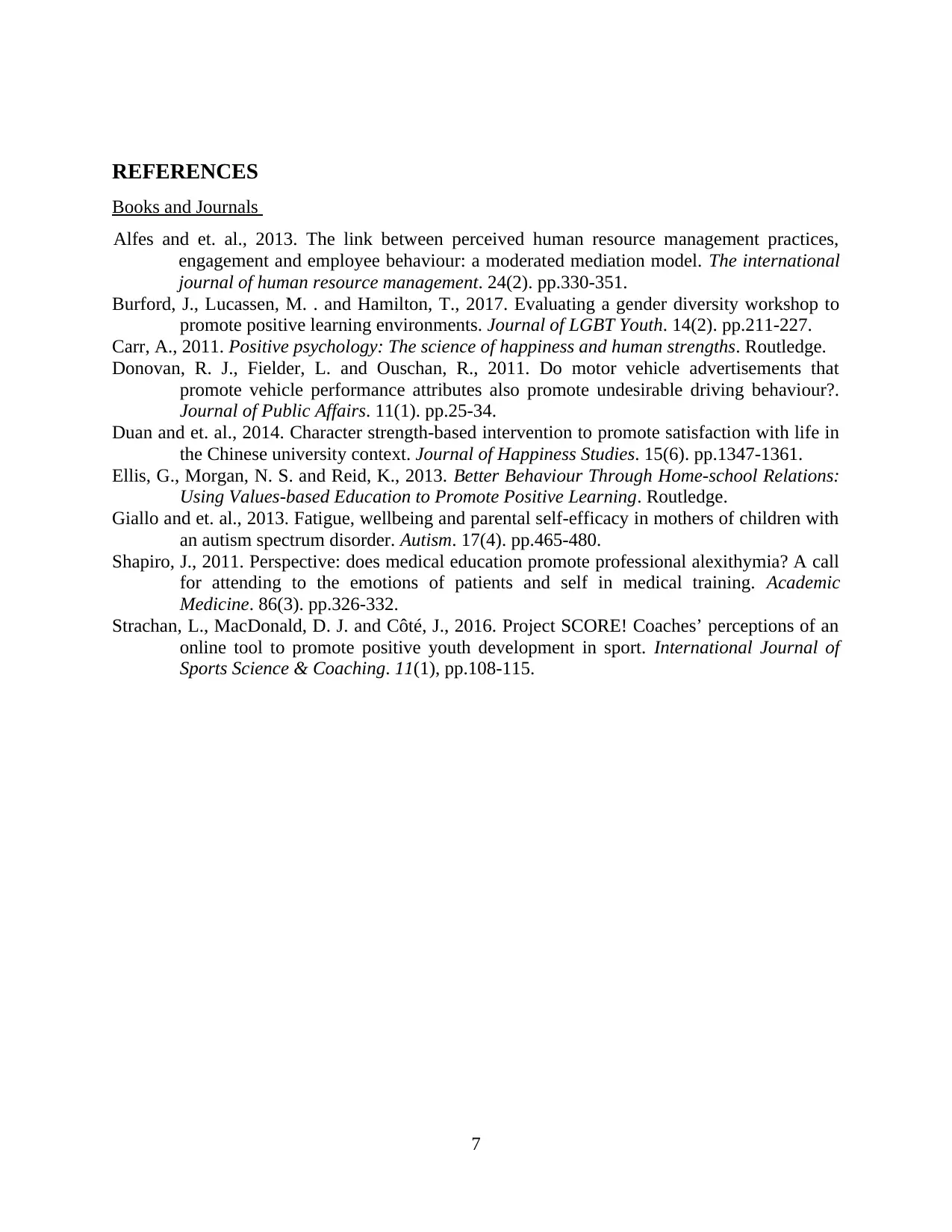
REFERENCES
Books and Journals
Alfes and et. al., 2013. The link between perceived human resource management practices,
engagement and employee behaviour: a moderated mediation model. The international
journal of human resource management. 24(2). pp.330-351.
Burford, J., Lucassen, M. . and Hamilton, T., 2017. Evaluating a gender diversity workshop to
promote positive learning environments. Journal of LGBT Youth. 14(2). pp.211-227.
Carr, A., 2011. Positive psychology: The science of happiness and human strengths. Routledge.
Donovan, R. J., Fielder, L. and Ouschan, R., 2011. Do motor vehicle advertisements that
promote vehicle performance attributes also promote undesirable driving behaviour?.
Journal of Public Affairs. 11(1). pp.25-34.
Duan and et. al., 2014. Character strength-based intervention to promote satisfaction with life in
the Chinese university context. Journal of Happiness Studies. 15(6). pp.1347-1361.
Ellis, G., Morgan, N. S. and Reid, K., 2013. Better Behaviour Through Home-school Relations:
Using Values-based Education to Promote Positive Learning. Routledge.
Giallo and et. al., 2013. Fatigue, wellbeing and parental self-efficacy in mothers of children with
an autism spectrum disorder. Autism. 17(4). pp.465-480.
Shapiro, J., 2011. Perspective: does medical education promote professional alexithymia? A call
for attending to the emotions of patients and self in medical training. Academic
Medicine. 86(3). pp.326-332.
Strachan, L., MacDonald, D. J. and Côté, J., 2016. Project SCORE! Coaches’ perceptions of an
online tool to promote positive youth development in sport. International Journal of
Sports Science & Coaching. 11(1), pp.108-115.
7
Books and Journals
Alfes and et. al., 2013. The link between perceived human resource management practices,
engagement and employee behaviour: a moderated mediation model. The international
journal of human resource management. 24(2). pp.330-351.
Burford, J., Lucassen, M. . and Hamilton, T., 2017. Evaluating a gender diversity workshop to
promote positive learning environments. Journal of LGBT Youth. 14(2). pp.211-227.
Carr, A., 2011. Positive psychology: The science of happiness and human strengths. Routledge.
Donovan, R. J., Fielder, L. and Ouschan, R., 2011. Do motor vehicle advertisements that
promote vehicle performance attributes also promote undesirable driving behaviour?.
Journal of Public Affairs. 11(1). pp.25-34.
Duan and et. al., 2014. Character strength-based intervention to promote satisfaction with life in
the Chinese university context. Journal of Happiness Studies. 15(6). pp.1347-1361.
Ellis, G., Morgan, N. S. and Reid, K., 2013. Better Behaviour Through Home-school Relations:
Using Values-based Education to Promote Positive Learning. Routledge.
Giallo and et. al., 2013. Fatigue, wellbeing and parental self-efficacy in mothers of children with
an autism spectrum disorder. Autism. 17(4). pp.465-480.
Shapiro, J., 2011. Perspective: does medical education promote professional alexithymia? A call
for attending to the emotions of patients and self in medical training. Academic
Medicine. 86(3). pp.326-332.
Strachan, L., MacDonald, D. J. and Côté, J., 2016. Project SCORE! Coaches’ perceptions of an
online tool to promote positive youth development in sport. International Journal of
Sports Science & Coaching. 11(1), pp.108-115.
7

1 out of 10


Related Documents


Your All-in-One AI-Powered Toolkit for Academic Success.
+13062052269
info@desklib.com
Available 24*7 on WhatsApp / Email
![[object Object]](/_next/static/media/star-bottom.7253800d.svg)
Unlock your academic potential
Copyright © 2020–2026 A2Z Services. All Rights Reserved. Developed and managed by ZUCOL.