Strategic Management Process Analysis: Action in Strategy - 368SAM
VerifiedAdded on 2022/11/28
|13
|3116
|162
Essay
AI Summary
This essay analyzes the strategic management process, focusing on the framework proposed by Johnson et al. (2017) to reduce complexity and assist managers in ensuring future prosperity. The essay begins by introducing the strategic management process as a method to lead a sustainable business organization and increase competitive advantage, encompassing initial assessment, analysis, strategy formulation, implementation, and evaluation. It then delves into the Exploring Strategy Framework, highlighting its three interrelated elements: strategic position, strategic choices, and action. The essay applies this framework to an organization that manufactures and designs specialist robots, emphasizing the importance of innovation, initial assessment of the organization's mission and goals, business situation analysis, and strategy formulation, including the use of tools like PEST and SWOT analysis. The essay discusses strategic implementation, which includes setting annual objectives, revising policies, allocating resources, changing organizational structure, and managing resistance to change. The essay also discusses the importance of strategic monitoring and evaluation, including the need for continuous monitoring of the business environment, the need for taking corrective actions, and measuring the performance of the organization against set goals and objectives. The essay concludes by emphasizing the need for strategic choices, including diversifying new products, radical innovation, and transforming existing products, for the success of the business.
Running head: ACTION IN STRATEGY
ACTION IN STRATEGY
Student’s Name
University Name
Author note
ACTION IN STRATEGY
Student’s Name
University Name
Author note

Paraphrase This Document
Need a fresh take? Get an instant paraphrase of this document with our AI Paraphraser
1ACTION IN STRATEGY
Introduction
The strategic management process is considered to be a method which is used by the
managers of the organization implements a strategy which will help them to lead a sustainable
business organization and increase their competitive advantage. The process of strategic planning
is a systematic way of performing the strategic planning which involves initial assessment,
proper analysis, formulation of strategy, implementing the formulated strategy and evaluating the
process. This entire process creates a complete strategy for the organization (David and David
2013). The strategic planning process implies the ways in which the strategy can be implemented
successfully. The strategy implementation and the framework vary with different organization.
The models depend upon the organization’s culture, the style of leadership implemented by the
company and the experience the firm has in establishing strategies and implement them. The
implementation of strategy involves various forms of organizational efforts for transforming the
strategic intentions into the actions. Implementation of strategy involves undertaking ideas,
policies, plans and objectives of the organization and implementing them into action. The
business organization must take advantage of the opportunities in the business environment and
utilize the organizational resources of the organization in an effective way. The purpose of this
essay is to analyze the ways that strategic management process to reduce the complexity and use
it by the managers to ensure future prosperity.
Discussion
Introduction
The strategic management process is considered to be a method which is used by the
managers of the organization implements a strategy which will help them to lead a sustainable
business organization and increase their competitive advantage. The process of strategic planning
is a systematic way of performing the strategic planning which involves initial assessment,
proper analysis, formulation of strategy, implementing the formulated strategy and evaluating the
process. This entire process creates a complete strategy for the organization (David and David
2013). The strategic planning process implies the ways in which the strategy can be implemented
successfully. The strategy implementation and the framework vary with different organization.
The models depend upon the organization’s culture, the style of leadership implemented by the
company and the experience the firm has in establishing strategies and implement them. The
implementation of strategy involves various forms of organizational efforts for transforming the
strategic intentions into the actions. Implementation of strategy involves undertaking ideas,
policies, plans and objectives of the organization and implementing them into action. The
business organization must take advantage of the opportunities in the business environment and
utilize the organizational resources of the organization in an effective way. The purpose of this
essay is to analyze the ways that strategic management process to reduce the complexity and use
it by the managers to ensure future prosperity.
Discussion
2ACTION IN STRATEGY
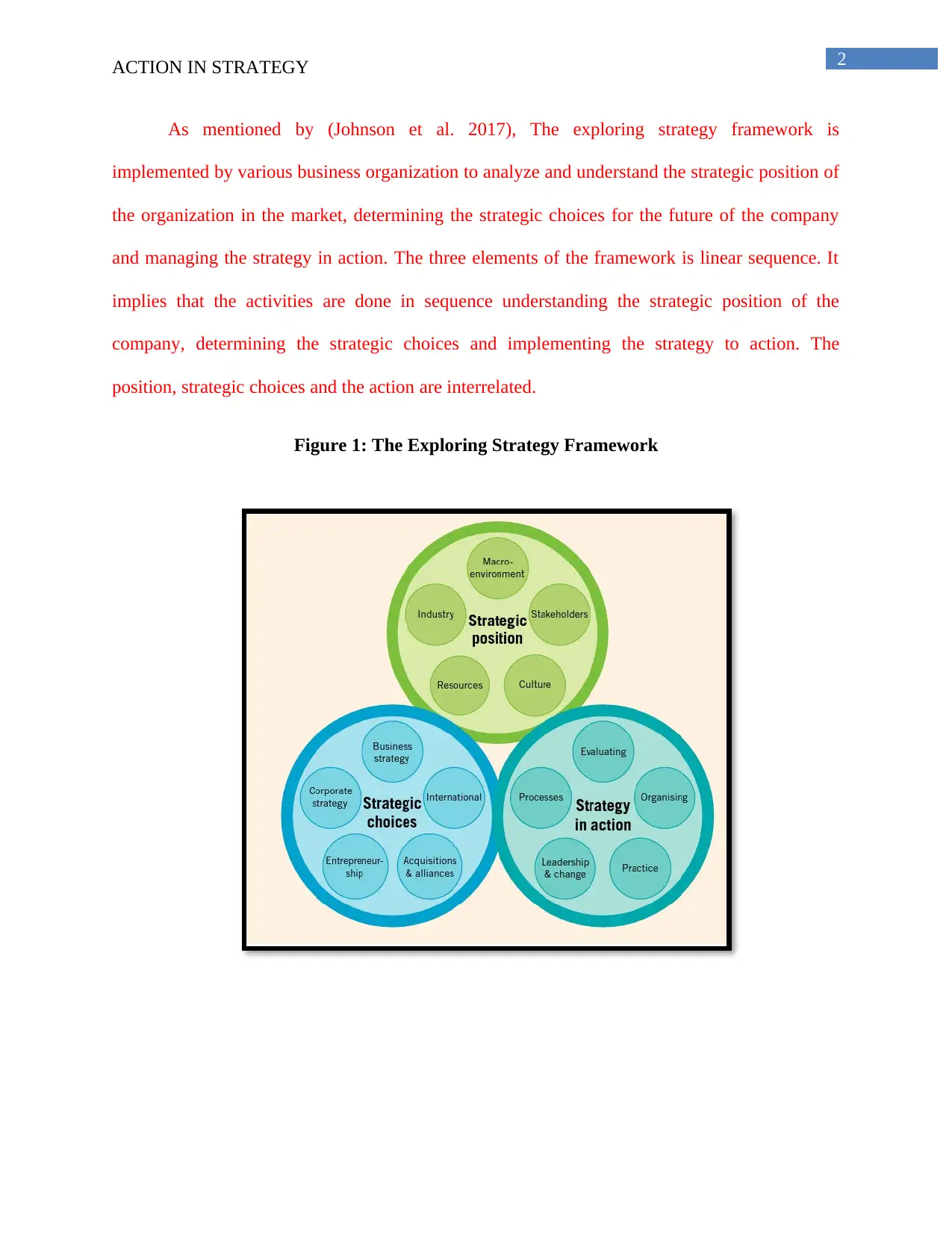
As mentioned by (Johnson et al. 2017), The exploring strategy framework is
implemented by various business organization to analyze and understand the strategic position of
the organization in the market, determining the strategic choices for the future of the company
and managing the strategy in action. The three elements of the framework is linear sequence. It
implies that the activities are done in sequence understanding the strategic position of the
company, determining the strategic choices and implementing the strategy to action. The
position, strategic choices and the action are interrelated.
Figure 1: The Exploring Strategy Framework
As mentioned by (Johnson et al. 2017), The exploring strategy framework is
implemented by various business organization to analyze and understand the strategic position of
the organization in the market, determining the strategic choices for the future of the company
and managing the strategy in action. The three elements of the framework is linear sequence. It
implies that the activities are done in sequence understanding the strategic position of the
company, determining the strategic choices and implementing the strategy to action. The
position, strategic choices and the action are interrelated.
Figure 1: The Exploring Strategy Framework
⊘ This is a preview!⊘
Do you want full access?
Subscribe today to unlock all pages.

Trusted by 1+ million students worldwide
3ACTION IN STRATEGY
According to Chang (2016), for the firm that manufactures and designs specialist robots
needs to review its strategies in order to gain competitive advantage and remain sustainable in
the market. The strategy of the organization needs to be implemented in such a way that it can
initiate innovation within the organization. For the strategic planning process, in the initial stage
the company must start up with the initial assessment of the organization. The managers of the
organization need to assess the mission and goals of the business organization and by visualizing
the future of the company, the managers need to assess what it wants to achieve. As stated by
David and David (2013), the ultimate goal of the organization guided by the vision of the firm
will be the guide for the employees of the organization to work and perform the business
organization as per the goal of the organization. The business goals and mission of the company
must be communicated to the potential stakeholders of the organization. The information to be
provided by the stakeholders must be about the robotics and products manufactured the target
customers, market value and the employees of the organization. Therefore, the mission statement
of the firm acts like a guide to the managers of the firm.
According to Frankenberger et al. (2013), the second stage of strategic process involves
analysis of the business situation. After assessing the mission and vision of the organization the
firm needs to assess the current situation that is prevailing in the market. The firm needs to
evaluate the business environment including the external, internal business environment and
analyze the business competitors present in the market. While analyzing the external business
environment, it needs to consider the macro environmental factors which directly or indirectly
influence the business organization in the global business environment. It also needs to consider
the micro environmental factors that affect the business functions and operations. The
competitive factor of the organization is highly uncontrollable which influences the business
According to Chang (2016), for the firm that manufactures and designs specialist robots
needs to review its strategies in order to gain competitive advantage and remain sustainable in
the market. The strategy of the organization needs to be implemented in such a way that it can
initiate innovation within the organization. For the strategic planning process, in the initial stage
the company must start up with the initial assessment of the organization. The managers of the
organization need to assess the mission and goals of the business organization and by visualizing
the future of the company, the managers need to assess what it wants to achieve. As stated by
David and David (2013), the ultimate goal of the organization guided by the vision of the firm
will be the guide for the employees of the organization to work and perform the business
organization as per the goal of the organization. The business goals and mission of the company
must be communicated to the potential stakeholders of the organization. The information to be
provided by the stakeholders must be about the robotics and products manufactured the target
customers, market value and the employees of the organization. Therefore, the mission statement
of the firm acts like a guide to the managers of the firm.
According to Frankenberger et al. (2013), the second stage of strategic process involves
analysis of the business situation. After assessing the mission and vision of the organization the
firm needs to assess the current situation that is prevailing in the market. The firm needs to
evaluate the business environment including the external, internal business environment and
analyze the business competitors present in the market. While analyzing the external business
environment, it needs to consider the macro environmental factors which directly or indirectly
influence the business organization in the global business environment. It also needs to consider
the micro environmental factors that affect the business functions and operations. The
competitive factor of the organization is highly uncontrollable which influences the business
Paraphrase This Document
Need a fresh take? Get an instant paraphrase of this document with our AI Paraphraser
4ACTION IN STRATEGY
organization and its activities (Hax and Majluf 2018). The firm needs to use the competitors
profile matrix and benchmarking while analyzing and evaluating the strengths, weakness,
opportunity and threats as well as determine its level of performance. Further, the firm
manufacturing robots and its managers needs to have an assessment of the available resources of
the company, the core competencies of the company and the business activities. The managers
need to manage the organizations resources both tangible and intangible in an effective manner.
As mentioned by Hax and Majluf (2018), the culture of the workplace, the land, capital,
equipments, machinery, brand equity, goodwill and knowledge present in the organization must
be assessed effectively. By analyzing the internal analysis of the organization and the external
analysis, the company can have the idea about the market position of the company. For
determining the internal and external analysis, the company can implements various tools and
models such as the PEST analysis (Political, Economic, Social and Technological), the SWOT
analysis, Porter’s five force analysis.
According to Hax (2017), after having an idea about the market position of the
organization and the situational analysis, the company needs to formulate the strategy and create
a long term objectives for the organization guided by the goals. By proper formulation of the
objectives and strategies for the firm, it can improve its competitive position in the long run.
Strategic formulation involves the process in which the company chooses the most appropriate
course of action that is suitable for the company to achieve the pre-set goals and objectives of the
organization. The process of strategic formulation provides a framework for the business for the
selected course of action which will lead the business towards achieving the goals and objectives
of the organization (Jeston 2014). The strategic plan formulated by the company needs to be
effectively communicated to every levels of the business organization formulation of strategy
organization and its activities (Hax and Majluf 2018). The firm needs to use the competitors
profile matrix and benchmarking while analyzing and evaluating the strengths, weakness,
opportunity and threats as well as determine its level of performance. Further, the firm
manufacturing robots and its managers needs to have an assessment of the available resources of
the company, the core competencies of the company and the business activities. The managers
need to manage the organizations resources both tangible and intangible in an effective manner.
As mentioned by Hax and Majluf (2018), the culture of the workplace, the land, capital,
equipments, machinery, brand equity, goodwill and knowledge present in the organization must
be assessed effectively. By analyzing the internal analysis of the organization and the external
analysis, the company can have the idea about the market position of the company. For
determining the internal and external analysis, the company can implements various tools and
models such as the PEST analysis (Political, Economic, Social and Technological), the SWOT
analysis, Porter’s five force analysis.
According to Hax (2017), after having an idea about the market position of the
organization and the situational analysis, the company needs to formulate the strategy and create
a long term objectives for the organization guided by the goals. By proper formulation of the
objectives and strategies for the firm, it can improve its competitive position in the long run.
Strategic formulation involves the process in which the company chooses the most appropriate
course of action that is suitable for the company to achieve the pre-set goals and objectives of the
organization. The process of strategic formulation provides a framework for the business for the
selected course of action which will lead the business towards achieving the goals and objectives
of the organization (Jeston 2014). The strategic plan formulated by the company needs to be
effectively communicated to every levels of the business organization formulation of strategy
5ACTION IN STRATEGY
helps the business organization to assess the changing business environment and evaluate the
business resources, allocate the budgets of the organization and determine the best effective plan
for maximizing its return on investment. The process of strategic formulation includes defining
the strategies of the organization, the mission, objectives, and competitive strategy and evaluates
the progress and performance of the organization. As stated by Johnson (2015), in order to
formulate the strategy, the company must evaluate the overall market plan and its position in the
market by assessing the external and internal analysis. The company needs to determine the
strategy in such a manner that it encourages innovation in the organization rather than just
increasing the profit of the firm. The tools and techniques required for strategy formulation
includes scenario planning, Porter’s generic strategies, QSP matrix and others (Chang 2016).
According to (Johnson et al. 2017), the strategic position of the company is highly
impacted by the influences of the macro business environment, the internal environment of the
company and the strategic capability of the company. The managerial skills are highly required
for implementing this strategy. The managers of the organization need to implement a
communication strategy so as to gain the support of every department in the organization. This is
essential for successful implementation of strategy. The implementation of strategy requires the
following steps that are setting annual objectives for achieving the goals and objectives of the
organization. As mentioned by Rosemann and vom Brocke (2015), the policies and existing
objectives of the organization need to be revised in order to meet the new objectives of the
objectives. The resources of the organization needs to allocated strategically in the important
areas of the business. For the revised policies and procedures of the organization, the company
needs to change the organizational structure in order to meet the new strategies of the
organization. For initiating change in the organization the company needs to manage the
helps the business organization to assess the changing business environment and evaluate the
business resources, allocate the budgets of the organization and determine the best effective plan
for maximizing its return on investment. The process of strategic formulation includes defining
the strategies of the organization, the mission, objectives, and competitive strategy and evaluates
the progress and performance of the organization. As stated by Johnson (2015), in order to
formulate the strategy, the company must evaluate the overall market plan and its position in the
market by assessing the external and internal analysis. The company needs to determine the
strategy in such a manner that it encourages innovation in the organization rather than just
increasing the profit of the firm. The tools and techniques required for strategy formulation
includes scenario planning, Porter’s generic strategies, QSP matrix and others (Chang 2016).
According to (Johnson et al. 2017), the strategic position of the company is highly
impacted by the influences of the macro business environment, the internal environment of the
company and the strategic capability of the company. The managerial skills are highly required
for implementing this strategy. The managers of the organization need to implement a
communication strategy so as to gain the support of every department in the organization. This is
essential for successful implementation of strategy. The implementation of strategy requires the
following steps that are setting annual objectives for achieving the goals and objectives of the
organization. As mentioned by Rosemann and vom Brocke (2015), the policies and existing
objectives of the organization need to be revised in order to meet the new objectives of the
objectives. The resources of the organization needs to allocated strategically in the important
areas of the business. For the revised policies and procedures of the organization, the company
needs to change the organizational structure in order to meet the new strategies of the
organization. For initiating change in the organization the company needs to manage the
⊘ This is a preview!⊘
Do you want full access?
Subscribe today to unlock all pages.
Trusted by 1+ million students worldwide
6ACTION IN STRATEGY
resistance to change (Rothaermel 2013). In order to ensure proper implementation of the
company’s revised strategies and goals, it needs to introduce a reward system for its employees.
This implies that the employees performing the operations of the business efficiently, they would
be given rewards and incentives to further influence their performance. For setting the annual
objectives of the organization, it needs to make smaller objectives for different departments in
the organization including finance, marketing, human resource and operations of the
organization. Therefore, As stated by Bolisani and Bratianu (2017), in order to meet the goals
and objectives f the organization, it needs to consider revising polices and strategies and
introduce new strategy which would in turn act as a guidance to the company for successful
implementation objectives. The most important part of strategic implementation process is
changing the organizational chart of the organization. The robotics manufactured by the
organization requires new machinery and innovation to perform better and in an enhanced way.
The company needs to consider a product diversification strategy and its innovation strategy
must be included in the organizational chart (Hax and Majluf 2018). For the market development
strategy, it requires additional division to incorporate the same marketing strategies.
Implementing a new strategy in the organization needs a change in the organizational structure,
as mentioned above in the essay. The responsibilities of the organization must be redistributed
among the departments in the company and the managers (Jeston 2014). However, the company
can face various resistances to change, which can be managed in an efficient manner.
According to Rosemann and vom Brocke (2015), the last step for strategic management
process involves strategic monitoring and evaluation. After implementing the revised strategy in
the organization, it must be monitored and properly evaluated in order to be successful. The
external business environment is highly dynamic and ever changing. Therefore the business
resistance to change (Rothaermel 2013). In order to ensure proper implementation of the
company’s revised strategies and goals, it needs to introduce a reward system for its employees.
This implies that the employees performing the operations of the business efficiently, they would
be given rewards and incentives to further influence their performance. For setting the annual
objectives of the organization, it needs to make smaller objectives for different departments in
the organization including finance, marketing, human resource and operations of the
organization. Therefore, As stated by Bolisani and Bratianu (2017), in order to meet the goals
and objectives f the organization, it needs to consider revising polices and strategies and
introduce new strategy which would in turn act as a guidance to the company for successful
implementation objectives. The most important part of strategic implementation process is
changing the organizational chart of the organization. The robotics manufactured by the
organization requires new machinery and innovation to perform better and in an enhanced way.
The company needs to consider a product diversification strategy and its innovation strategy
must be included in the organizational chart (Hax and Majluf 2018). For the market development
strategy, it requires additional division to incorporate the same marketing strategies.
Implementing a new strategy in the organization needs a change in the organizational structure,
as mentioned above in the essay. The responsibilities of the organization must be redistributed
among the departments in the company and the managers (Jeston 2014). However, the company
can face various resistances to change, which can be managed in an efficient manner.
According to Rosemann and vom Brocke (2015), the last step for strategic management
process involves strategic monitoring and evaluation. After implementing the revised strategy in
the organization, it must be monitored and properly evaluated in order to be successful. The
external business environment is highly dynamic and ever changing. Therefore the business
Paraphrase This Document
Need a fresh take? Get an instant paraphrase of this document with our AI Paraphraser
7ACTION IN STRATEGY
organization needs to continuously monitor the business environment as well as the internal
conditions of the business and assess it strengths, weakness, opportunities and threats (Hax and
Majluf 2018). Upon analyzing the threats or opportunity in the business environment, it needs to
take corrective actions and implement changes in the organization as per the changing business
environment. As mentioned by Bolisani and Bratianu (2017), the tactics and policies of the
organizations need to be changed in order to meet the new changing conditions upon facing
severe external changes. Further, the performance of the organization needs to measured and
evaluated. The performance of the organization must be measured with the set goals and
objectives of the organization. This will assess the progress of the company and the extent to
which the organization to going in the right direction (David and David 2013). Measuring the
performance of the organization is essential for monitoring and evaluating the strategies of the
organization. The pre set goals and objectives of the organization must be set in such as way that
they can be easily measured and compared. The actual results of the organization need to be
measured with the estimated results. This will enable the business organization to analyze the
present business scenario and determine its success in achieving the goals and objectives. In
order to achieve the present objectives of the organization, the managers of the organization
needs to take imitative to ensure better performance by tactics and policies such as changing the
reward system, introducing a new or revised policies or strategies. As stated by (Johnson et al.
2017), the strategic choices involves diversifying the new products, radical innovation,
transforming the existing products. The company needs to consider the business strategy and
models, corporate strategy and diversification, innovation and mergers and acquisitions for the
success of the business.
organization needs to continuously monitor the business environment as well as the internal
conditions of the business and assess it strengths, weakness, opportunities and threats (Hax and
Majluf 2018). Upon analyzing the threats or opportunity in the business environment, it needs to
take corrective actions and implement changes in the organization as per the changing business
environment. As mentioned by Bolisani and Bratianu (2017), the tactics and policies of the
organizations need to be changed in order to meet the new changing conditions upon facing
severe external changes. Further, the performance of the organization needs to measured and
evaluated. The performance of the organization must be measured with the set goals and
objectives of the organization. This will assess the progress of the company and the extent to
which the organization to going in the right direction (David and David 2013). Measuring the
performance of the organization is essential for monitoring and evaluating the strategies of the
organization. The pre set goals and objectives of the organization must be set in such as way that
they can be easily measured and compared. The actual results of the organization need to be
measured with the estimated results. This will enable the business organization to analyze the
present business scenario and determine its success in achieving the goals and objectives. In
order to achieve the present objectives of the organization, the managers of the organization
needs to take imitative to ensure better performance by tactics and policies such as changing the
reward system, introducing a new or revised policies or strategies. As stated by (Johnson et al.
2017), the strategic choices involves diversifying the new products, radical innovation,
transforming the existing products. The company needs to consider the business strategy and
models, corporate strategy and diversification, innovation and mergers and acquisitions for the
success of the business.
8ACTION IN STRATEGY
According to Johnson et al. (2017), the strategic management process needs to be
properly implemented in the business organization. It needs to consider strategy in action,
strategic performance and evaluation, the process of development, organizing and leading the
strategic change. The firm manufacturing robots needs to further bring up its culture of
innovation in the organization. Presently, the company is focusing on profit maximization; this
might not be profitable for the business in long run. As mentioned by Jeston (2014), the business
environment is consistently changing and so are the advancements in technology. Therefore, in
order to survive itself in the market place, it needs to bring innovation in its products and launch
new products in the market which will be of utility to the target customers. The company needs
to also conduct a competitor analysis to analyze the competitive position in the market. On the
basis of the external and internal business analysis the firm can formulate its strategy and initiate
change in the organization. In order to initiate change in the organization, it needs to encourage
the employees to bring up new ideas and creativity in the organization. This will help the
business organization to increase the level of innovation and creativity in the organization. This
strategy if implemented by the company, the business will be successful in the long run.
Conclusion
Therefore, from the above analysis, it can be concluded that there are various problems,
obstacles and hindrances that affect strategy formulation and implementing the strategic
implementing process. In order to be successful in the constantly changing and dynamic business
environment, the company must implement the strategic management process. It has been
analyzed that it is a step by step process which is needed to be implemented by the company
progressively to develop a competitive advantage and maintain its position in the market.
According to Johnson et al. (2017), the strategic management process needs to be
properly implemented in the business organization. It needs to consider strategy in action,
strategic performance and evaluation, the process of development, organizing and leading the
strategic change. The firm manufacturing robots needs to further bring up its culture of
innovation in the organization. Presently, the company is focusing on profit maximization; this
might not be profitable for the business in long run. As mentioned by Jeston (2014), the business
environment is consistently changing and so are the advancements in technology. Therefore, in
order to survive itself in the market place, it needs to bring innovation in its products and launch
new products in the market which will be of utility to the target customers. The company needs
to also conduct a competitor analysis to analyze the competitive position in the market. On the
basis of the external and internal business analysis the firm can formulate its strategy and initiate
change in the organization. In order to initiate change in the organization, it needs to encourage
the employees to bring up new ideas and creativity in the organization. This will help the
business organization to increase the level of innovation and creativity in the organization. This
strategy if implemented by the company, the business will be successful in the long run.
Conclusion
Therefore, from the above analysis, it can be concluded that there are various problems,
obstacles and hindrances that affect strategy formulation and implementing the strategic
implementing process. In order to be successful in the constantly changing and dynamic business
environment, the company must implement the strategic management process. It has been
analyzed that it is a step by step process which is needed to be implemented by the company
progressively to develop a competitive advantage and maintain its position in the market.
⊘ This is a preview!⊘
Do you want full access?
Subscribe today to unlock all pages.
Trusted by 1+ million students worldwide
9ACTION IN STRATEGY
Efficient implementation of strategic management process helps the business organization to
reduce complexity in the business. The essay has applied the strategic management process
framework to the organizational scenario. The essay has provided detailed description about the
strategic formulation process and strategic implementation process, the importance of monitoring
and effective evaluation of strategies.
Efficient implementation of strategic management process helps the business organization to
reduce complexity in the business. The essay has applied the strategic management process
framework to the organizational scenario. The essay has provided detailed description about the
strategic formulation process and strategic implementation process, the importance of monitoring
and effective evaluation of strategies.
Paraphrase This Document
Need a fresh take? Get an instant paraphrase of this document with our AI Paraphraser
10ACTION IN STRATEGY
References
Andersen, T.J., 2014. Integrating the Strategy Formation Process:: An International
Perspective. European Management Journal, 22(3), pp.263-272.
Bolisani, E. and Bratianu, C., 2017. Knowledge strategy planning: an integrated approach to
manage uncertainty, turbulence, and dynamics. Journal of Knowledge Management, 21(2),
pp.233-253.
Chang, J.F., 2016. Business process management systems: strategy and implementation.
Auerbach Publications.
David, F.R. and David, F.R., 2013. Strategic management: Concepts and cases: A competitive
advantage approach. Pearson.
Dearfield, K.L., Gollapudi, B.B., Bemis, J.C., Benz, R.D., Douglas, G.R., Elespuru, R.K.,
Johnson, G.E., Kirkland, D.J., LeBaron, M.J., Li, A.P. and Marchetti, F., 2017. Next generation
testing strategy for assessment of genomic damage: A conceptual framework and
considerations. Environmental and molecular mutagenesis, 58(5), pp.264-283.
Frankenberger, K., Weiblen, T., Csik, M. and Gassmann, O., 2013. The 4I-framework of
business model innovation: A structured view on process phases and challenges. International
Journal of Product Development, 18(3/4), pp.249-273.
Hax, A.C. and Majluf, N.S., 2018. The concept of strategy and the strategy formation
process. Interfaces, 18(3), pp.99-109.
References
Andersen, T.J., 2014. Integrating the Strategy Formation Process:: An International
Perspective. European Management Journal, 22(3), pp.263-272.
Bolisani, E. and Bratianu, C., 2017. Knowledge strategy planning: an integrated approach to
manage uncertainty, turbulence, and dynamics. Journal of Knowledge Management, 21(2),
pp.233-253.
Chang, J.F., 2016. Business process management systems: strategy and implementation.
Auerbach Publications.
David, F.R. and David, F.R., 2013. Strategic management: Concepts and cases: A competitive
advantage approach. Pearson.
Dearfield, K.L., Gollapudi, B.B., Bemis, J.C., Benz, R.D., Douglas, G.R., Elespuru, R.K.,
Johnson, G.E., Kirkland, D.J., LeBaron, M.J., Li, A.P. and Marchetti, F., 2017. Next generation
testing strategy for assessment of genomic damage: A conceptual framework and
considerations. Environmental and molecular mutagenesis, 58(5), pp.264-283.
Frankenberger, K., Weiblen, T., Csik, M. and Gassmann, O., 2013. The 4I-framework of
business model innovation: A structured view on process phases and challenges. International
Journal of Product Development, 18(3/4), pp.249-273.
Hax, A.C. and Majluf, N.S., 2018. The concept of strategy and the strategy formation
process. Interfaces, 18(3), pp.99-109.
11ACTION IN STRATEGY
Jeston, J., 2014. Business process management. Routledge.
Johnson, M.P., 2015. Sustainability management and small and medium‐sized enterprises:
Managers' awareness and implementation of innovative tools. Corporate Social Responsibility
and Environmental Management, 22(5), pp.271-285.
Johnson, Whittington, Scholes, Angwin &Regner (2017) Exploring Strategy (11th ed.).
Pearson
Whittington, R., Johnson, G., Scholes, K., Angwin, D. and Regnér, P., 2017. Exploring strategy.
Pearson.
Kallio, H., Pietilä, A.M., Johnson, M. and Kangasniemi, M., 2016. Systematic methodological
review: developing a framework for a qualitative semi‐structured interview guide. Journal of
advanced nursing, 72(12), pp.2954-2965.
Khanagha, S., Volberda, H. and Oshri, I., 2014. Business model renewal and ambidexterity:
structural alteration and strategy formation process during transition to a C loud business
model. R&D Management, 44(3), pp.322-340.
Rosemann, M. and vom Brocke, J., 2015. The six core elements of business process
management. In Handbook on business process management 1 (pp. 105-122). Springer, Berlin,
Heidelberg.
Rothaermel, F.T., 2013. Strategic management: concepts. New York, NY: McGraw-Hill Irwin.
Schaltegger, S. and Burritt, R., 2014. Measuring and managing sustainability performance of
supply chains: Review and sustainability supply chain management framework. Supply Chain
Management: An International Journal, 19(3), pp.232-241.
Jeston, J., 2014. Business process management. Routledge.
Johnson, M.P., 2015. Sustainability management and small and medium‐sized enterprises:
Managers' awareness and implementation of innovative tools. Corporate Social Responsibility
and Environmental Management, 22(5), pp.271-285.
Johnson, Whittington, Scholes, Angwin &Regner (2017) Exploring Strategy (11th ed.).
Pearson
Whittington, R., Johnson, G., Scholes, K., Angwin, D. and Regnér, P., 2017. Exploring strategy.
Pearson.
Kallio, H., Pietilä, A.M., Johnson, M. and Kangasniemi, M., 2016. Systematic methodological
review: developing a framework for a qualitative semi‐structured interview guide. Journal of
advanced nursing, 72(12), pp.2954-2965.
Khanagha, S., Volberda, H. and Oshri, I., 2014. Business model renewal and ambidexterity:
structural alteration and strategy formation process during transition to a C loud business
model. R&D Management, 44(3), pp.322-340.
Rosemann, M. and vom Brocke, J., 2015. The six core elements of business process
management. In Handbook on business process management 1 (pp. 105-122). Springer, Berlin,
Heidelberg.
Rothaermel, F.T., 2013. Strategic management: concepts. New York, NY: McGraw-Hill Irwin.
Schaltegger, S. and Burritt, R., 2014. Measuring and managing sustainability performance of
supply chains: Review and sustainability supply chain management framework. Supply Chain
Management: An International Journal, 19(3), pp.232-241.
⊘ This is a preview!⊘
Do you want full access?
Subscribe today to unlock all pages.
Trusted by 1+ million students worldwide

1 out of 13


Related Documents


Your All-in-One AI-Powered Toolkit for Academic Success.
+13062052269
info@desklib.com
Available 24*7 on WhatsApp / Email
![[object Object]](/_next/static/media/star-bottom.7253800d.svg)
Unlock your academic potential
Copyright © 2020–2026 A2Z Services. All Rights Reserved. Developed and managed by ZUCOL.