Stress Analysis: Techniques, Applications, and Material Properties

Verified

Added on  2022/12/26

|1
|412
|20
Report
AI Summary
This report provides a comprehensive overview of stress analysis, focusing on both experimental and computational techniques. It discusses the importance of stress analysis in mechanical engineering, emphasizing the need to understand and predict stress and strain in materials. The report highlights the application of finite element analysis (FEA) as a computational method and references studies on the stress analysis of car bodies and other mechanical components. It also covers experimental methods, such as non-destructive testing, and their role in evaluating material properties. The report examines the significance of stress analysis in determining material properties like tensile strength and in selecting appropriate materials for different applications. The study explores the application of different techniques for different fields. The report concludes by emphasizing the importance of stress analysis in ensuring the integrity and reliability of engineering designs. This report is a valuable resource for students looking to understand the principles and applications of stress analysis, offering insights into both theoretical concepts and practical applications.
Document Page
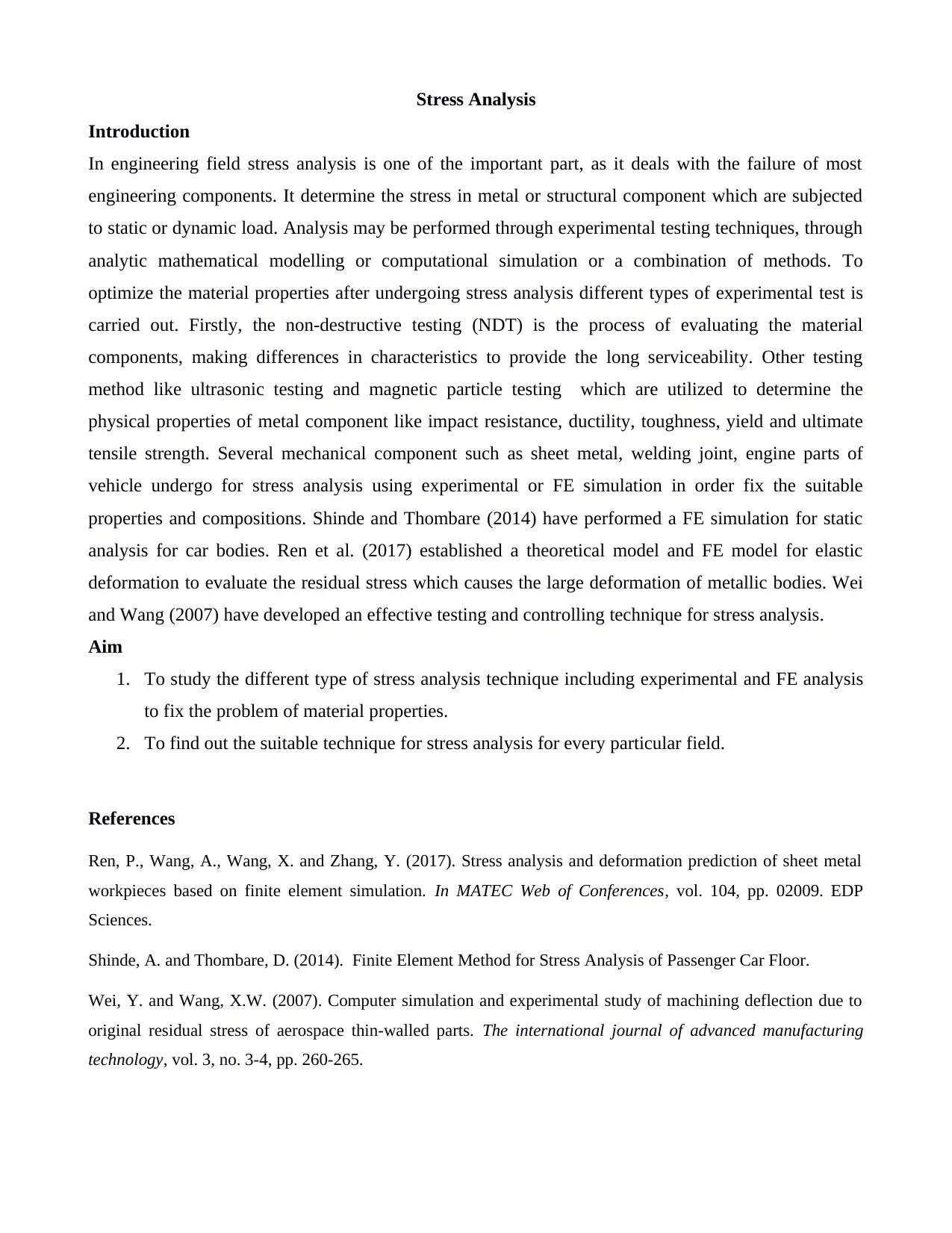
Stress Analysis
Introduction
In engineering field stress analysis is one of the important part, as it deals with the failure of most
engineering components. It determine the stress in metal or structural component which are subjected
to static or dynamic load. Analysis may be performed through experimental testing techniques, through
analytic mathematical modelling or computational simulation or a combination of methods. To
optimize the material properties after undergoing stress analysis different types of experimental test is
carried out. Firstly, the non-destructive testing (NDT) is the process of evaluating the material
components, making differences in characteristics to provide the long serviceability. Other testing
method like ultrasonic testing and magnetic particle testing which are utilized to determine the
physical properties of metal component like impact resistance, ductility, toughness, yield and ultimate
tensile strength. Several mechanical component such as sheet metal, welding joint, engine parts of
vehicle undergo for stress analysis using experimental or FE simulation in order fix the suitable
properties and compositions. Shinde and Thombare (2014) have performed a FE simulation for static
analysis for car bodies. Ren et al. (2017) established a theoretical model and FE model for elastic
deformation to evaluate the residual stress which causes the large deformation of metallic bodies. Wei
and Wang (2007) have developed an effective testing and controlling technique for stress analysis.
Aim
1. To study the different type of stress analysis technique including experimental and FE analysis
to fix the problem of material properties.
2. To find out the suitable technique for stress analysis for every particular field.
References
Ren, P., Wang, A., Wang, X. and Zhang, Y. (2017). Stress analysis and deformation prediction of sheet metal
workpieces based on finite element simulation. In MATEC Web of Conferences, vol. 104, pp. 02009. EDP
Sciences.
Shinde, A. and Thombare, D. (2014). Finite Element Method for Stress Analysis of Passenger Car Floor.
Wei, Y. and Wang, X.W. (2007). Computer simulation and experimental study of machining deflection due to
original residual stress of aerospace thin-walled parts. The international journal of advanced manufacturing
technology, vol. 3, no. 3-4, pp. 260-265.
tabler-icon-diamond-filled.svg

Paraphrase This Document

Need a fresh take? Get an instant paraphrase of this document with our AI Paraphraser
[object Object]