Mechanical Engineering Report: Stress Intensity Factor Analysis

Verified

Added on  2020/02/24

|3
|448
|39
Report
AI Summary
This report focuses on the stress intensity factor (SIF) and its application in mechanical engineering. It begins by defining the SIF as a measure used to quantify parameters and predict crack growth, explaining its significance in understanding the stress state at a crack tip. The report then explores the theoretical background, referencing the work of Westergaard and Irwin, and detailing the use of SIF analysis within the Linear Elastic Fracture Mechanics framework. It differentiates between 2D and 3D analysis methods, highlighting the importance of the latter for practical applications. The report also touches upon the use of finite and boundary element methods for 3D surface crack analysis. Overall, the report provides a concise overview of SIF analysis, its underlying principles, and the methodologies used to assess the behavior of materials under stress.
Document Page
NAME
ASSIGNMENT
UNIT
ASSESSMENT NUMBER
tabler-icon-diamond-filled.svg

Paraphrase This Document

Need a fresh take? Get an instant paraphrase of this document with our AI Paraphraser
Document Page
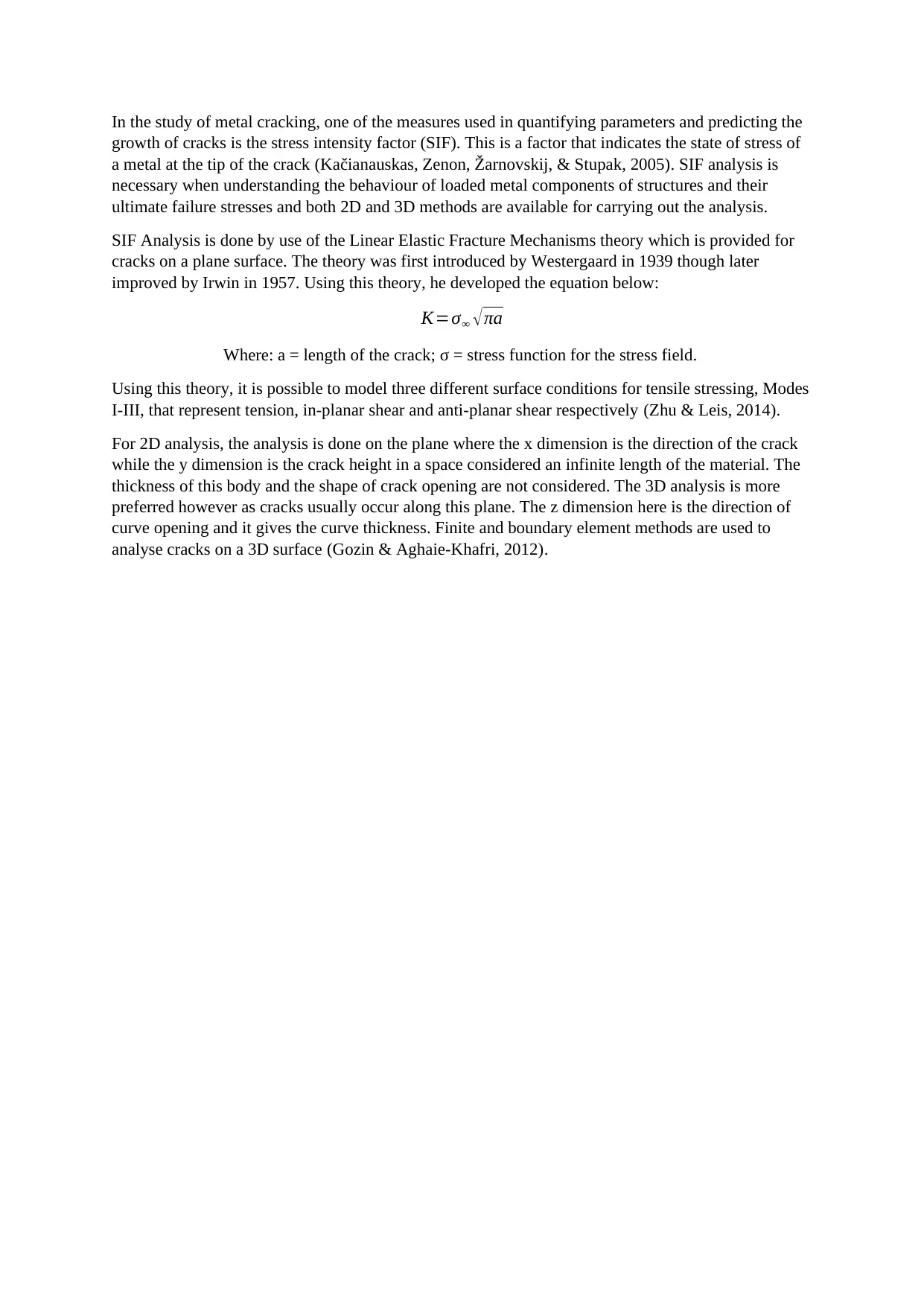
In the study of metal cracking, one of the measures used in quantifying parameters and predicting the
growth of cracks is the stress intensity factor (SIF). This is a factor that indicates the state of stress of
a metal at the tip of the crack (Kačianauskas, Zenon, Žarnovskij, & Stupak, 2005). SIF analysis is
necessary when understanding the behaviour of loaded metal components of structures and their
ultimate failure stresses and both 2D and 3D methods are available for carrying out the analysis.
SIF Analysis is done by use of the Linear Elastic Fracture Mechanisms theory which is provided for
cracks on a plane surface. The theory was first introduced by Westergaard in 1939 though later
improved by Irwin in 1957. Using this theory, he developed the equation below:
K=σ πa
Where: a = length of the crack; σ = stress function for the stress field.
Using this theory, it is possible to model three different surface conditions for tensile stressing, Modes
I-III, that represent tension, in-planar shear and anti-planar shear respectively (Zhu & Leis, 2014).
For 2D analysis, the analysis is done on the plane where the x dimension is the direction of the crack
while the y dimension is the crack height in a space considered an infinite length of the material. The
thickness of this body and the shape of crack opening are not considered. The 3D analysis is more
preferred however as cracks usually occur along this plane. The z dimension here is the direction of
curve opening and it gives the curve thickness. Finite and boundary element methods are used to
analyse cracks on a 3D surface (Gozin & Aghaie-Khafri, 2012).
Document Page
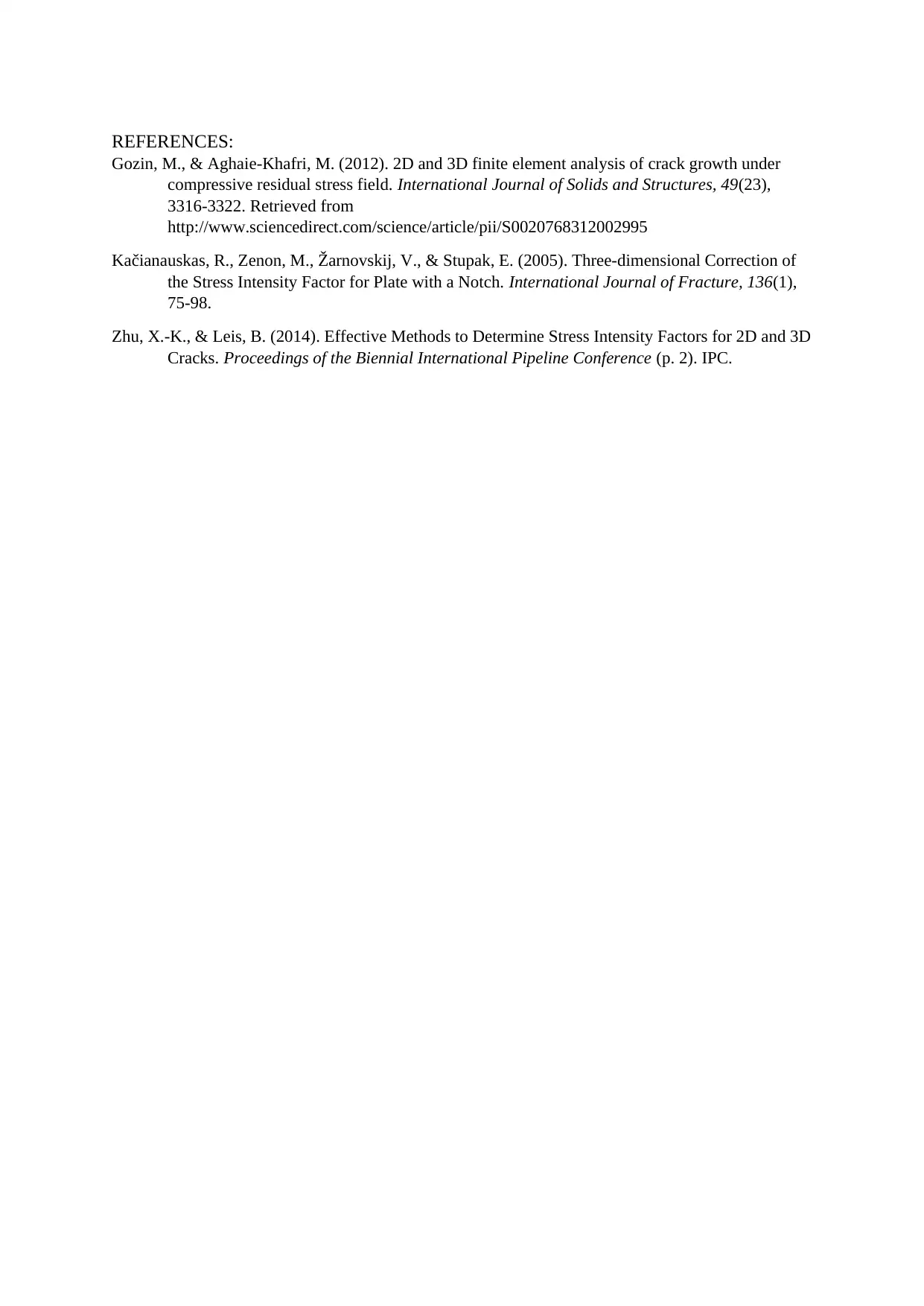
REFERENCES:
Gozin, M., & Aghaie-Khafri, M. (2012). 2D and 3D finite element analysis of crack growth under
compressive residual stress field. International Journal of Solids and Structures, 49(23),
3316-3322. Retrieved from
http://www.sciencedirect.com/science/article/pii/S0020768312002995
Kačianauskas, R., Zenon, M., Žarnovskij, V., & Stupak, E. (2005). Three-dimensional Correction of
the Stress Intensity Factor for Plate with a Notch. International Journal of Fracture, 136(1),
75-98.
Zhu, X.-K., & Leis, B. (2014). Effective Methods to Determine Stress Intensity Factors for 2D and 3D
Cracks. Proceedings of the Biennial International Pipeline Conference (p. 2). IPC.
chevron_up_icon
1 out of 3
circle_padding
hide_on_mobile
zoom_out_icon
[object Object]