Analysis of Stretching and Vertical Jump Height (VJH) in Football
VerifiedAdded on 2023/01/10
|11
|2642
|93
Report
AI Summary
This report presents a research study investigating the relationship between stretching and vertical jump height (VJH) in football. The study employed both correlational and experimental research designs, involving 30 participants. The methodology included pre-intervention and post-intervention vertical jump measurements using the My Jump 2 phone app. The results section presents statistical data on participant demographics, including age, weight, and BMI, and compares pre- and post-stretching vertical jump heights. The findings indicate a decrease in vertical jump height after stretching, supported by t-test results, which failed to reject the null hypothesis of no significant difference, concluding that there is a significant difference. The discussion highlights the implications of stretching on muscle strength and vertical jump performance, and the conclusion summarizes the key findings, emphasizing the negative impact of stretching on VJH. The report also includes a comprehensive list of references to support the research.
STRETCHING AND VERTICAL JUMP HEIGHT (VJH) IN FOOTBALL
1
ANALYSIS OF THE RELATIONSHIP BETWEEN STRETCHING AND VERTICAL JUMP
HEIGHT (VJH) IN FOOTBALL
Research Study Skills: Term 2 Assessment
Name of Student:
Name of Institution:
Date of Submission:
1
ANALYSIS OF THE RELATIONSHIP BETWEEN STRETCHING AND VERTICAL JUMP
HEIGHT (VJH) IN FOOTBALL
Research Study Skills: Term 2 Assessment
Name of Student:
Name of Institution:
Date of Submission:

Paraphrase This Document
Need a fresh take? Get an instant paraphrase of this document with our AI Paraphraser
STRETCHING AND VERTICAL JUMP HEIGHT (VJH) IN FOOTBALL
2
Contents
Contents...........................................................................................................................................2
Introduction......................................................................................................................................3
Methodology....................................................................................................................................5
Results..............................................................................................................................................6
Discussion of Results.......................................................................................................................9
Conclusion.......................................................................................................................................9
References......................................................................................................................................10
2
Contents
Contents...........................................................................................................................................2
Introduction......................................................................................................................................3
Methodology....................................................................................................................................5
Results..............................................................................................................................................6
Discussion of Results.......................................................................................................................9
Conclusion.......................................................................................................................................9
References......................................................................................................................................10
STRETCHING AND VERTICAL JUMP HEIGHT (VJH) IN FOOTBALL
3
Introduction
This research was undertaken to investigate whether stretching affects vertical jump height in
football. The major aim of the research is to investigate the relationship between stretching and
vertical jump height. In order to achieve this objective, participants were required to jump before
exposure to stretching (pre- intervention) as well as after jumping (post- intervention). The
research revolved around investigating any significant change in vertical jump height in the two
interventions.
There are several research studies that have been conducted on subject of stretching and vertical
jumping. For example, a research study by (Hough, et al., 2009) focused on the effects of dynamic
and static stretching on vertical jump performance and electromyography activity. The results
shown that statistic stretching has a negative influence on the vertical jump and muscle
performance. The results demonstrated that static stretching reduces the performance of the
muscle (Hough, et al., 2009). A reduction in the performance of the muscle results into a reduction
in the vertical jump height. Therefore, the researchers indicated that individuals who are
subjected to static stretching will always experience a reduction in the vertical jump height
(Hough, et al., 2009).
The research by (Haddad, et al., 2019) focused on investigating whether dynamic stretching alone
can impair slower velocity isokinetic performance of young handball players for at least twenty
four hours. The researcher demonstrated that dynamic stretching induced knee extensor
isokinetic impairments (Haddad, et al., 2019). The hip flexion dynamic stretching produced a
minor muscle damage for at least twenty four hours. The minor damage of the muscle caused a
decrease in the knee flexor forces and power (Haddad, et al., 2019). Therefore, the research
3
Introduction
This research was undertaken to investigate whether stretching affects vertical jump height in
football. The major aim of the research is to investigate the relationship between stretching and
vertical jump height. In order to achieve this objective, participants were required to jump before
exposure to stretching (pre- intervention) as well as after jumping (post- intervention). The
research revolved around investigating any significant change in vertical jump height in the two
interventions.
There are several research studies that have been conducted on subject of stretching and vertical
jumping. For example, a research study by (Hough, et al., 2009) focused on the effects of dynamic
and static stretching on vertical jump performance and electromyography activity. The results
shown that statistic stretching has a negative influence on the vertical jump and muscle
performance. The results demonstrated that static stretching reduces the performance of the
muscle (Hough, et al., 2009). A reduction in the performance of the muscle results into a reduction
in the vertical jump height. Therefore, the researchers indicated that individuals who are
subjected to static stretching will always experience a reduction in the vertical jump height
(Hough, et al., 2009).
The research by (Haddad, et al., 2019) focused on investigating whether dynamic stretching alone
can impair slower velocity isokinetic performance of young handball players for at least twenty
four hours. The researcher demonstrated that dynamic stretching induced knee extensor
isokinetic impairments (Haddad, et al., 2019). The hip flexion dynamic stretching produced a
minor muscle damage for at least twenty four hours. The minor damage of the muscle caused a
decrease in the knee flexor forces and power (Haddad, et al., 2019). Therefore, the research
⊘ This is a preview!⊘
Do you want full access?
Subscribe today to unlock all pages.

Trusted by 1+ million students worldwide
STRETCHING AND VERTICAL JUMP HEIGHT (VJH) IN FOOTBALL
4
demonstrate that dynamic muscle stretching reduces muscle activities that may intern cause a
decrease in the vertical jump (Haddad, et al., 2019).
Evidence from previous research demonstrate that prolonged stretching can lead to a shift in the
paradigm of routine warm- up and vertical jumping abilities (Reid , et al., 2018). The researchers
demonstrated that short term statistic stretching may have little effect on the vertical jumping
abilities. However, long- term or prolonged statistic and vertical stretching may have a
significant effect on the vertical jumping height. The study also demonstrated that there was a
significant change in the average vertical jumping heights of the participants.
A hypothesis is a statement that outlines that researcher’s point of view before the research is
actually conducted (Gottfriend, et al., 2009). The truth value of a hypothesis can only be known
though statistically acceptable hypothesis testing techniques (Lin, et al., 2015). A hypothesis is
developed in line with the research topic and research problem (Mearsheimer & Walt, 2013). The
major focus of this research is to find out whether stretching have effects on vertical jumping
height in football. The null and alternative hypothesis were developed (Morrison & David, 2014). A
null hypothesis represents the view of the researcher and it is stated negatively (Zhu, et al., 2017).
However, the alternative hypothesis negates the null hypothesis and thus, it is stated positively
(Palinkas, et al., 2015). The conventional way of denoting a null hypothesis is H0 while the
conventional way of representing an alternative hypothesis is H1 (Qi, et al., 2018). The null and
alternative hypotheses for this study are outlined below:
H0: There is no significant difference between the average vertical jumping height of pre-
intervention (pre- stretching) and the vertical jumping height of post- intervention (post-
stretching) in football.
4
demonstrate that dynamic muscle stretching reduces muscle activities that may intern cause a
decrease in the vertical jump (Haddad, et al., 2019).
Evidence from previous research demonstrate that prolonged stretching can lead to a shift in the
paradigm of routine warm- up and vertical jumping abilities (Reid , et al., 2018). The researchers
demonstrated that short term statistic stretching may have little effect on the vertical jumping
abilities. However, long- term or prolonged statistic and vertical stretching may have a
significant effect on the vertical jumping height. The study also demonstrated that there was a
significant change in the average vertical jumping heights of the participants.
A hypothesis is a statement that outlines that researcher’s point of view before the research is
actually conducted (Gottfriend, et al., 2009). The truth value of a hypothesis can only be known
though statistically acceptable hypothesis testing techniques (Lin, et al., 2015). A hypothesis is
developed in line with the research topic and research problem (Mearsheimer & Walt, 2013). The
major focus of this research is to find out whether stretching have effects on vertical jumping
height in football. The null and alternative hypothesis were developed (Morrison & David, 2014). A
null hypothesis represents the view of the researcher and it is stated negatively (Zhu, et al., 2017).
However, the alternative hypothesis negates the null hypothesis and thus, it is stated positively
(Palinkas, et al., 2015). The conventional way of denoting a null hypothesis is H0 while the
conventional way of representing an alternative hypothesis is H1 (Qi, et al., 2018). The null and
alternative hypotheses for this study are outlined below:
H0: There is no significant difference between the average vertical jumping height of pre-
intervention (pre- stretching) and the vertical jumping height of post- intervention (post-
stretching) in football.
Paraphrase This Document
Need a fresh take? Get an instant paraphrase of this document with our AI Paraphraser
STRETCHING AND VERTICAL JUMP HEIGHT (VJH) IN FOOTBALL
5
H1: There is a significant difference between the average vertical jumping height of pre-
intervention (pre- stretching) and the vertical jumping height of post- intervention (post-
stretching) in football.
Methodology
This chapter explains the design of the study, the material used for the study and how the study
was conducted (research method). A research design is a systematic technique that the researcher
follows in order to complete the study (Su, et al., 2012). The common research designs that are
widely used by most of the researchers are: Correlational research design, experimental research
design, descriptive research deign and the quasi-experimental research design (Rutledge &
Douglas, 2018).
A correlational research design is a technique that researchers use in scenarios where the aim of
the study is to investigate the relationship between the variables or parameters of the subject
matter. An experimental research design is a technique that the researchers use in scenarios
where the aim of the study can only be achieved by conducting an experiment (Su, et al., 2012). A
descriptive research design is a technique that the researchers use in scenarios where the aim of
the study is to provide an explanation or description of the subject matter or phenomena (why
they act they act, or what constitutes their action or behavior) (Rutledge & Douglas, 2018).
The choice of a research design is dependent on the nature of the study. The purpose of this
research is to provide an analysis of the association between stretching and vertical jump in
football (Su, et al., 2012). Therefore, the study design is both correlational and experimental. The
design of this study is experimental because an experiment had to be conducted to obtain the data
(Rutledge & Douglas, 2018). Similarly, the research design is correlation because the research aims
5
H1: There is a significant difference between the average vertical jumping height of pre-
intervention (pre- stretching) and the vertical jumping height of post- intervention (post-
stretching) in football.
Methodology
This chapter explains the design of the study, the material used for the study and how the study
was conducted (research method). A research design is a systematic technique that the researcher
follows in order to complete the study (Su, et al., 2012). The common research designs that are
widely used by most of the researchers are: Correlational research design, experimental research
design, descriptive research deign and the quasi-experimental research design (Rutledge &
Douglas, 2018).
A correlational research design is a technique that researchers use in scenarios where the aim of
the study is to investigate the relationship between the variables or parameters of the subject
matter. An experimental research design is a technique that the researchers use in scenarios
where the aim of the study can only be achieved by conducting an experiment (Su, et al., 2012). A
descriptive research design is a technique that the researchers use in scenarios where the aim of
the study is to provide an explanation or description of the subject matter or phenomena (why
they act they act, or what constitutes their action or behavior) (Rutledge & Douglas, 2018).
The choice of a research design is dependent on the nature of the study. The purpose of this
research is to provide an analysis of the association between stretching and vertical jump in
football (Su, et al., 2012). Therefore, the study design is both correlational and experimental. The
design of this study is experimental because an experiment had to be conducted to obtain the data
(Rutledge & Douglas, 2018). Similarly, the research design is correlation because the research aims
STRETCHING AND VERTICAL JUMP HEIGHT (VJH) IN FOOTBALL
6
at demonstrating the relationship between stretching and vertical jump height- does stretching
increase, decrease or has no effect on the vertical jump height?
The experiment had a total of thirty (30) participants of a wide range of ages and weight. After a
5 min of a lead warm-up 3 maximal vertical jumps were performed, with a 30 second rest period
between jumps. The jump height was determined by the My Jump 2 phone app. The intervention
was performed (stretching, strength or Plyometric drills. The 3 maximal jumps were repeated
after the stretch and the results recorded.
Results
This chapter outlines the results of the analysis that was conducted to meet the aim of the study.
The table below shows the summary statistics of the participants. The experiment involved a
total of thirty (30) participants. The average age of the participants was 20.9 years old while the
standard deviation of their ages was 3.57. The average age demonstrate that most of the
participants were young and able to play football. The average weight of the participants was
75.66 Kilograms while the standard deviation of their weight was 26.566 indicating that majority
of the participants weighed above 70 kilograms. The average body mass index (BMI) of the
participants was 25.17 while the standard deviation was 4.9.
Participant Data
Participant # Age Weight (Kg) Height (M) BMI
Mean 20.9 75.66 1.73 25.17
SDEV 3.57 16.24 0.08 4.9
The table below shows the summary statistics values of vertical jump height (both pre-
intervention and post- intervention). The average vertical jump height for the pre- intervention
6
at demonstrating the relationship between stretching and vertical jump height- does stretching
increase, decrease or has no effect on the vertical jump height?
The experiment had a total of thirty (30) participants of a wide range of ages and weight. After a
5 min of a lead warm-up 3 maximal vertical jumps were performed, with a 30 second rest period
between jumps. The jump height was determined by the My Jump 2 phone app. The intervention
was performed (stretching, strength or Plyometric drills. The 3 maximal jumps were repeated
after the stretch and the results recorded.
Results
This chapter outlines the results of the analysis that was conducted to meet the aim of the study.
The table below shows the summary statistics of the participants. The experiment involved a
total of thirty (30) participants. The average age of the participants was 20.9 years old while the
standard deviation of their ages was 3.57. The average age demonstrate that most of the
participants were young and able to play football. The average weight of the participants was
75.66 Kilograms while the standard deviation of their weight was 26.566 indicating that majority
of the participants weighed above 70 kilograms. The average body mass index (BMI) of the
participants was 25.17 while the standard deviation was 4.9.
Participant Data
Participant # Age Weight (Kg) Height (M) BMI
Mean 20.9 75.66 1.73 25.17
SDEV 3.57 16.24 0.08 4.9
The table below shows the summary statistics values of vertical jump height (both pre-
intervention and post- intervention). The average vertical jump height for the pre- intervention
⊘ This is a preview!⊘
Do you want full access?
Subscribe today to unlock all pages.
Trusted by 1+ million students worldwide
STRETCHING AND VERTICAL JUMP HEIGHT (VJH) IN FOOTBALL
7
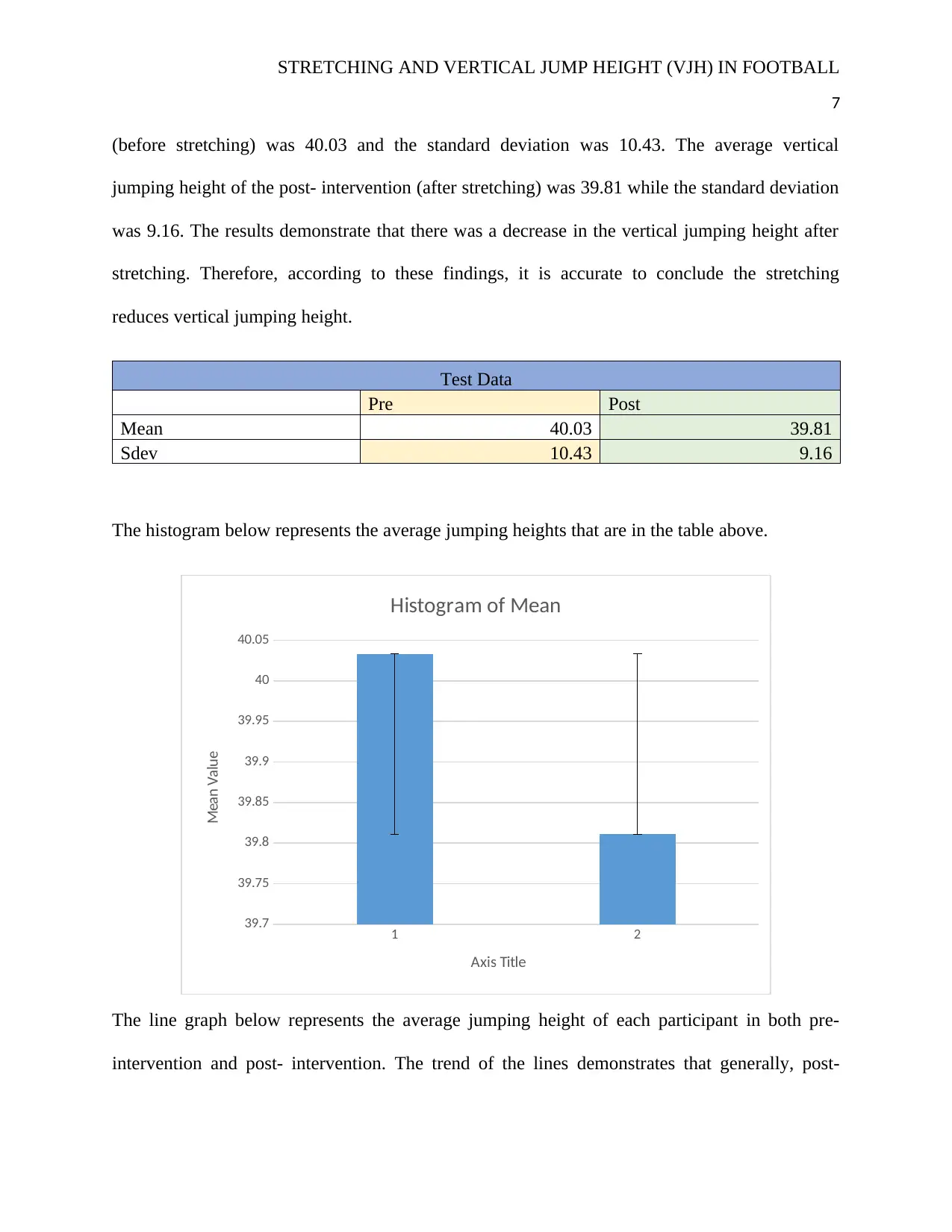
(before stretching) was 40.03 and the standard deviation was 10.43. The average vertical
jumping height of the post- intervention (after stretching) was 39.81 while the standard deviation
was 9.16. The results demonstrate that there was a decrease in the vertical jumping height after
stretching. Therefore, according to these findings, it is accurate to conclude the stretching
reduces vertical jumping height.
Test Data
Pre Post
Mean 40.03 39.81
Sdev 10.43 9.16
The histogram below represents the average jumping heights that are in the table above.
1 2
39.7
39.75
39.8
39.85
39.9
39.95
40
40.05
Histogram of Mean
Axis Title
Mean Value
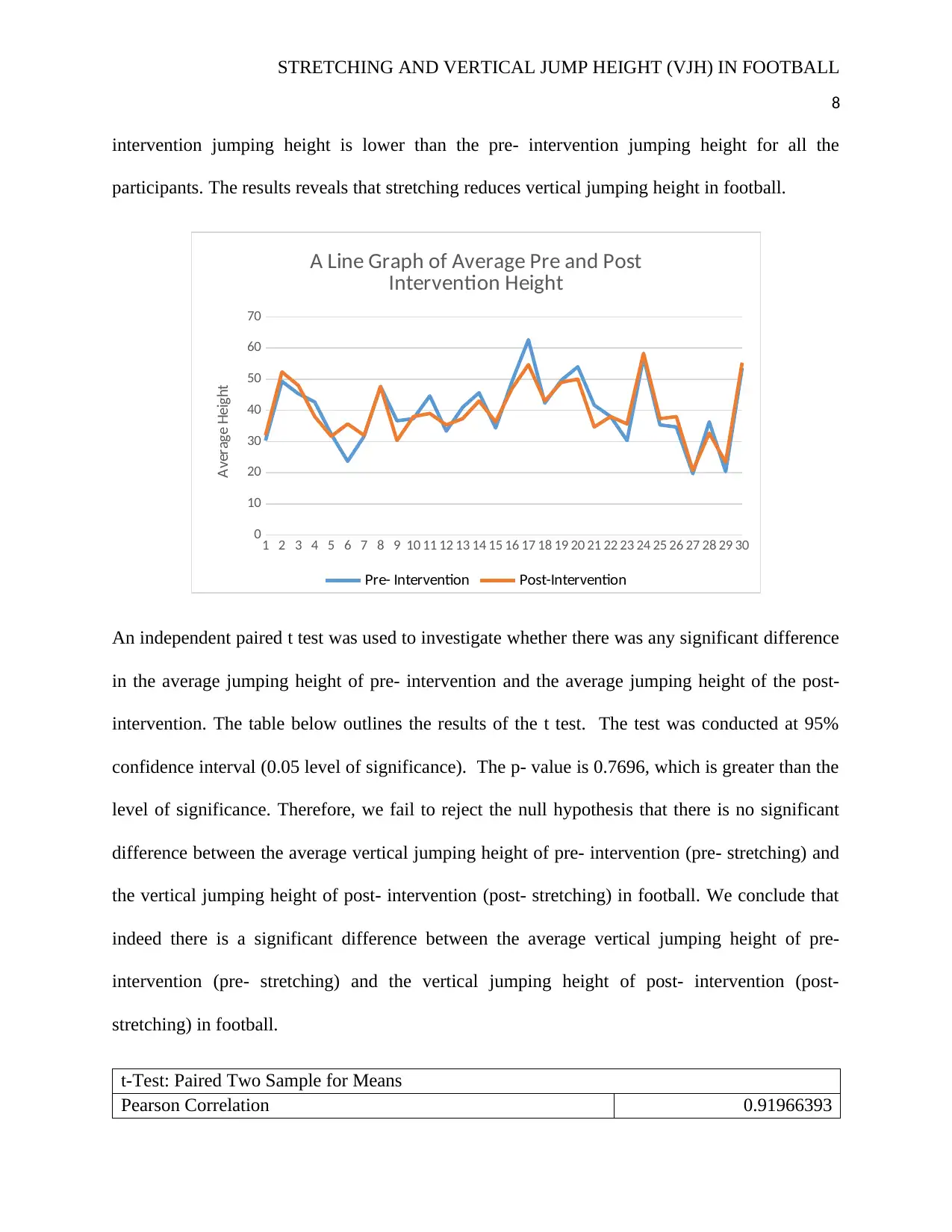
The line graph below represents the average jumping height of each participant in both pre-
intervention and post- intervention. The trend of the lines demonstrates that generally, post-
7
(before stretching) was 40.03 and the standard deviation was 10.43. The average vertical
jumping height of the post- intervention (after stretching) was 39.81 while the standard deviation
was 9.16. The results demonstrate that there was a decrease in the vertical jumping height after
stretching. Therefore, according to these findings, it is accurate to conclude the stretching
reduces vertical jumping height.
Test Data
Pre Post
Mean 40.03 39.81
Sdev 10.43 9.16
The histogram below represents the average jumping heights that are in the table above.
1 2
39.7
39.75
39.8
39.85
39.9
39.95
40
40.05
Histogram of Mean
Axis Title
Mean Value
The line graph below represents the average jumping height of each participant in both pre-
intervention and post- intervention. The trend of the lines demonstrates that generally, post-
Paraphrase This Document
Need a fresh take? Get an instant paraphrase of this document with our AI Paraphraser
STRETCHING AND VERTICAL JUMP HEIGHT (VJH) IN FOOTBALL
8
intervention jumping height is lower than the pre- intervention jumping height for all the
participants. The results reveals that stretching reduces vertical jumping height in football.
1 2 3 4 5 6 7 8 9 10 11 12 13 14 15 16 17 18 19 20 21 22 23 24 25 26 27 28 29 30
0
10
20
30
40
50
60
70
A Line Graph of Average Pre and Post
Intervention Height
Pre- Intervention Post-Intervention
Average Height
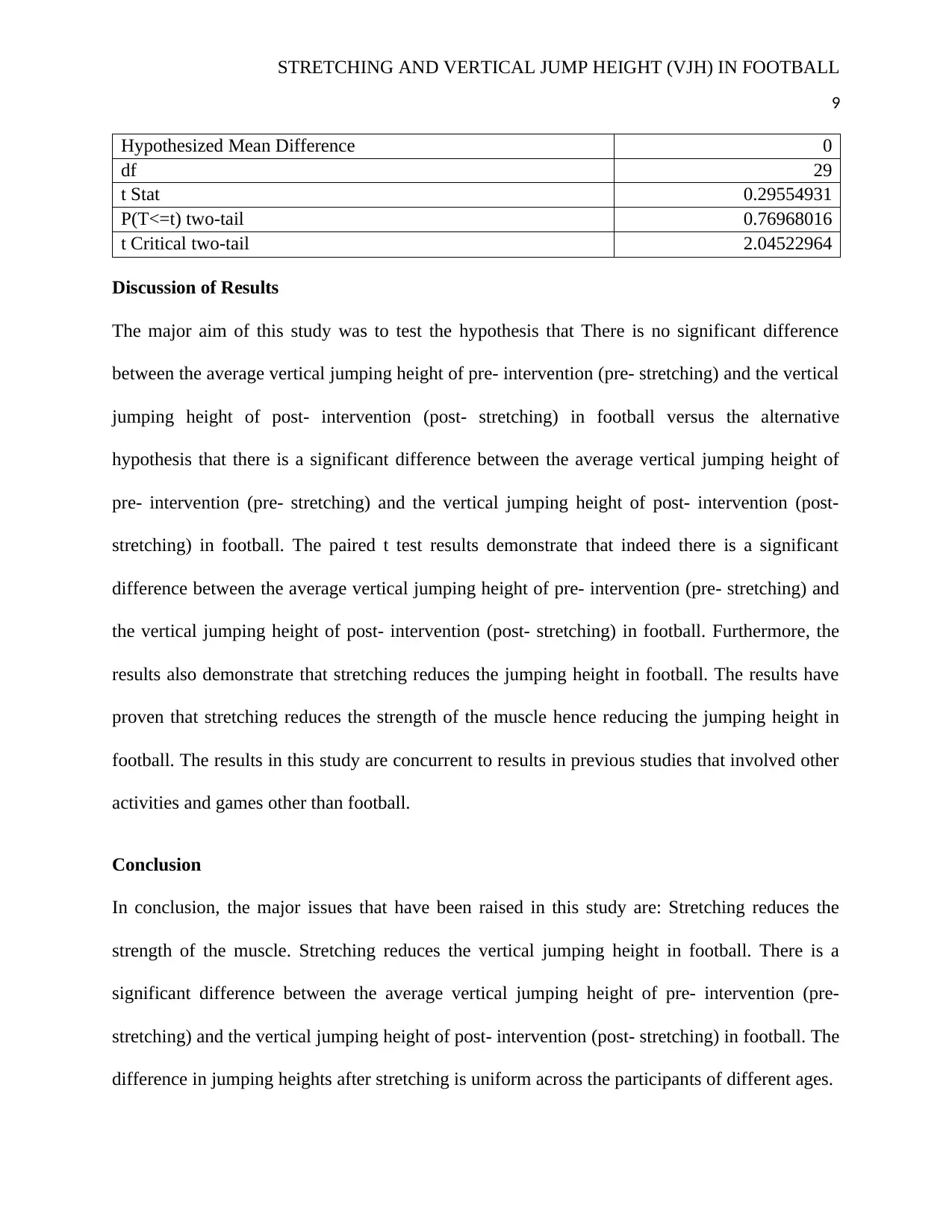
An independent paired t test was used to investigate whether there was any significant difference
in the average jumping height of pre- intervention and the average jumping height of the post-
intervention. The table below outlines the results of the t test. The test was conducted at 95%
confidence interval (0.05 level of significance). The p- value is 0.7696, which is greater than the
level of significance. Therefore, we fail to reject the null hypothesis that there is no significant
difference between the average vertical jumping height of pre- intervention (pre- stretching) and
the vertical jumping height of post- intervention (post- stretching) in football. We conclude that
indeed there is a significant difference between the average vertical jumping height of pre-
intervention (pre- stretching) and the vertical jumping height of post- intervention (post-
stretching) in football.
t-Test: Paired Two Sample for Means
Pearson Correlation 0.91966393
8
intervention jumping height is lower than the pre- intervention jumping height for all the
participants. The results reveals that stretching reduces vertical jumping height in football.
1 2 3 4 5 6 7 8 9 10 11 12 13 14 15 16 17 18 19 20 21 22 23 24 25 26 27 28 29 30
0
10
20
30
40
50
60
70
A Line Graph of Average Pre and Post
Intervention Height
Pre- Intervention Post-Intervention
Average Height
An independent paired t test was used to investigate whether there was any significant difference
in the average jumping height of pre- intervention and the average jumping height of the post-
intervention. The table below outlines the results of the t test. The test was conducted at 95%
confidence interval (0.05 level of significance). The p- value is 0.7696, which is greater than the
level of significance. Therefore, we fail to reject the null hypothesis that there is no significant
difference between the average vertical jumping height of pre- intervention (pre- stretching) and
the vertical jumping height of post- intervention (post- stretching) in football. We conclude that
indeed there is a significant difference between the average vertical jumping height of pre-
intervention (pre- stretching) and the vertical jumping height of post- intervention (post-
stretching) in football.
t-Test: Paired Two Sample for Means
Pearson Correlation 0.91966393
STRETCHING AND VERTICAL JUMP HEIGHT (VJH) IN FOOTBALL
9
Hypothesized Mean Difference 0
df 29
t Stat 0.29554931
P(T<=t) two-tail 0.76968016
t Critical two-tail 2.04522964
Discussion of Results
The major aim of this study was to test the hypothesis that There is no significant difference
between the average vertical jumping height of pre- intervention (pre- stretching) and the vertical
jumping height of post- intervention (post- stretching) in football versus the alternative
hypothesis that there is a significant difference between the average vertical jumping height of
pre- intervention (pre- stretching) and the vertical jumping height of post- intervention (post-
stretching) in football. The paired t test results demonstrate that indeed there is a significant
difference between the average vertical jumping height of pre- intervention (pre- stretching) and
the vertical jumping height of post- intervention (post- stretching) in football. Furthermore, the
results also demonstrate that stretching reduces the jumping height in football. The results have
proven that stretching reduces the strength of the muscle hence reducing the jumping height in
football. The results in this study are concurrent to results in previous studies that involved other
activities and games other than football.
Conclusion
In conclusion, the major issues that have been raised in this study are: Stretching reduces the
strength of the muscle. Stretching reduces the vertical jumping height in football. There is a
significant difference between the average vertical jumping height of pre- intervention (pre-
stretching) and the vertical jumping height of post- intervention (post- stretching) in football. The
difference in jumping heights after stretching is uniform across the participants of different ages.
9
Hypothesized Mean Difference 0
df 29
t Stat 0.29554931
P(T<=t) two-tail 0.76968016
t Critical two-tail 2.04522964
Discussion of Results
The major aim of this study was to test the hypothesis that There is no significant difference
between the average vertical jumping height of pre- intervention (pre- stretching) and the vertical
jumping height of post- intervention (post- stretching) in football versus the alternative
hypothesis that there is a significant difference between the average vertical jumping height of
pre- intervention (pre- stretching) and the vertical jumping height of post- intervention (post-
stretching) in football. The paired t test results demonstrate that indeed there is a significant
difference between the average vertical jumping height of pre- intervention (pre- stretching) and
the vertical jumping height of post- intervention (post- stretching) in football. Furthermore, the
results also demonstrate that stretching reduces the jumping height in football. The results have
proven that stretching reduces the strength of the muscle hence reducing the jumping height in
football. The results in this study are concurrent to results in previous studies that involved other
activities and games other than football.
Conclusion
In conclusion, the major issues that have been raised in this study are: Stretching reduces the
strength of the muscle. Stretching reduces the vertical jumping height in football. There is a
significant difference between the average vertical jumping height of pre- intervention (pre-
stretching) and the vertical jumping height of post- intervention (post- stretching) in football. The
difference in jumping heights after stretching is uniform across the participants of different ages.
⊘ This is a preview!⊘
Do you want full access?
Subscribe today to unlock all pages.
Trusted by 1+ million students worldwide
STRETCHING AND VERTICAL JUMP HEIGHT (VJH) IN FOOTBALL
10
References
Gottfriend, H., Roger, M. & Tobias, D., 2009. The relationship between socio-sexual behavior
and salivary cortisol in bonobos: tests of the tension regulation hypothesis. American Journal of
Primatology, 71(3), pp. 1-10.
Haddad, . M., Prince, M. & Zarrouk, N., 2019. Dynamic stretching alone can impair slower
velocity isokinetic performance of young male handball players for at least 24 hours. Journal of
Medical Studies, 18(1), pp. 1-14.
Hough, P. et al., 2009. Effects of Dynamic and Static Stretching on Vertical Jump Performance
and Electromyographic Activity. Journal of strength and conditioning research / National
Strength & Conditioning Association, 507(12), pp. 2-23.
Lin, et al., 2015. A Revisit to Contingency Table and Tests of Independence: Bootstrap is
Preferred to Chi-Square Approximations as Well as Fisher’s Exact Test. Journal of
Biopharmaceutical Statistics, 25(3), p. 2.
Mearsheimer, J. & Walt, S. M., 2013. eaving theory behind: Why simplistic hypothesis testing is
bad for International Relations. European Journal of International Relations, 19(09), pp. 1-6.
Morrison & David, A., 2014. Phylogenetic networks: a new form of multivariate data summary
for data mining and exploratory data analysis. Wiley Interdisciplinary Reviews: Data Mining and
Knowledge Discovery, 4(07), pp. 1-4.
Palinkas, et al., 2015. Purposeful Sampling for Qualitative Data Collection and Analysis in
Mixed Method Implementation Research. Administration and Policy in Mental Health and
Mental Health Services Research, 42(5), pp. 1-7.
Qi, et al., 2018. Limiting distributions of likelihood ratio test for independence of components
for high-dimensional normal vectors. Annals of the Institute of Statistical Mathematics, 5(1), p.
4.
Reid , . J. et al., 2018. The effects of different durations of static stretching within a
comprehensive warm-up on voluntary and evoked contractile properties. European Journal of
Applied Physiology, 118(3), pp. 1-18.
Rutledge & Douglas, N., 2018. Comparison of Principal Components Analysis, Independent
Components Analysis and Common Components Analysis. Journal of Analysis and Testing,
9(1), pp. 1-3.
Su, Jen- Je, Roca & Eduardo, 2012. Examining the power of stochastic unit root tests without
assuming independence in the error processes of the underlying time series. Applied Economics
Letters, 19(04), p. 2.
Zhu, Yinchu, Bradic & Jelena, 2017. Linear Hypothesis Testing in Dense High-Dimensional
Linear Models. Journal of the American Statistical Association, 1(08), p. 12.
10
References
Gottfriend, H., Roger, M. & Tobias, D., 2009. The relationship between socio-sexual behavior
and salivary cortisol in bonobos: tests of the tension regulation hypothesis. American Journal of
Primatology, 71(3), pp. 1-10.
Haddad, . M., Prince, M. & Zarrouk, N., 2019. Dynamic stretching alone can impair slower
velocity isokinetic performance of young male handball players for at least 24 hours. Journal of
Medical Studies, 18(1), pp. 1-14.
Hough, P. et al., 2009. Effects of Dynamic and Static Stretching on Vertical Jump Performance
and Electromyographic Activity. Journal of strength and conditioning research / National
Strength & Conditioning Association, 507(12), pp. 2-23.
Lin, et al., 2015. A Revisit to Contingency Table and Tests of Independence: Bootstrap is
Preferred to Chi-Square Approximations as Well as Fisher’s Exact Test. Journal of
Biopharmaceutical Statistics, 25(3), p. 2.
Mearsheimer, J. & Walt, S. M., 2013. eaving theory behind: Why simplistic hypothesis testing is
bad for International Relations. European Journal of International Relations, 19(09), pp. 1-6.
Morrison & David, A., 2014. Phylogenetic networks: a new form of multivariate data summary
for data mining and exploratory data analysis. Wiley Interdisciplinary Reviews: Data Mining and
Knowledge Discovery, 4(07), pp. 1-4.
Palinkas, et al., 2015. Purposeful Sampling for Qualitative Data Collection and Analysis in
Mixed Method Implementation Research. Administration and Policy in Mental Health and
Mental Health Services Research, 42(5), pp. 1-7.
Qi, et al., 2018. Limiting distributions of likelihood ratio test for independence of components
for high-dimensional normal vectors. Annals of the Institute of Statistical Mathematics, 5(1), p.
4.
Reid , . J. et al., 2018. The effects of different durations of static stretching within a
comprehensive warm-up on voluntary and evoked contractile properties. European Journal of
Applied Physiology, 118(3), pp. 1-18.
Rutledge & Douglas, N., 2018. Comparison of Principal Components Analysis, Independent
Components Analysis and Common Components Analysis. Journal of Analysis and Testing,
9(1), pp. 1-3.
Su, Jen- Je, Roca & Eduardo, 2012. Examining the power of stochastic unit root tests without
assuming independence in the error processes of the underlying time series. Applied Economics
Letters, 19(04), p. 2.
Zhu, Yinchu, Bradic & Jelena, 2017. Linear Hypothesis Testing in Dense High-Dimensional
Linear Models. Journal of the American Statistical Association, 1(08), p. 12.
Paraphrase This Document
Need a fresh take? Get an instant paraphrase of this document with our AI Paraphraser

STRETCHING AND VERTICAL JUMP HEIGHT (VJH) IN FOOTBALL
11
11

1 out of 11


Your All-in-One AI-Powered Toolkit for Academic Success.
+13062052269
info@desklib.com
Available 24*7 on WhatsApp / Email
![[object Object]](/_next/static/media/star-bottom.7253800d.svg)
Unlock your academic potential
Copyright © 2020–2026 A2Z Services. All Rights Reserved. Developed and managed by ZUCOL.