HWEL2002 Health Assignment: Strong Fathers Strong Families Program

Verified

Added on  2022/09/18

|5
|1465
|19
Report
AI Summary
This report provides a descriptive analysis of the Strong Fathers Strong Families (SFSF) program, a health promotion initiative implemented by the Australian government. The program aims to encourage the active participation of fathers, partners, uncles, and grandfathers in the lives of Aboriginal and Torres Strait Islander families, particularly during the antenatal period and early childhood development. The report explores the program's objectives, which include increasing access to culturally appropriate health services, improving the ability of males to contribute to the health and well-being of pregnant mothers, and fostering supportive family environments. The analysis highlights the program's focus on addressing social determinants of health, such as employment and coping skills, and how it utilizes activities like cooking classes to enhance fathers' social skills and knowledge of nutrition. The report concludes that the SFSF program has a positive impact on the community by supporting fathers and other male figures to create a healthy family environment, ultimately promoting the well-being of children, mothers, and other family members. The program also contributes to improved health outcomes, literacy rates, and overall community development.
Document Page
Running head: STRONG FATHERS STRONG FAMILIES
STRONG FATHERS STRONG FAMILIES
Name of Student:
Student Number:
Name of Lecturer:
Word count: 1037
tabler-icon-diamond-filled.svg

Paraphrase This Document

Need a fresh take? Get an instant paraphrase of this document with our AI Paraphraser
Document Page
STRONG FATHERS STRONG FAMILIES
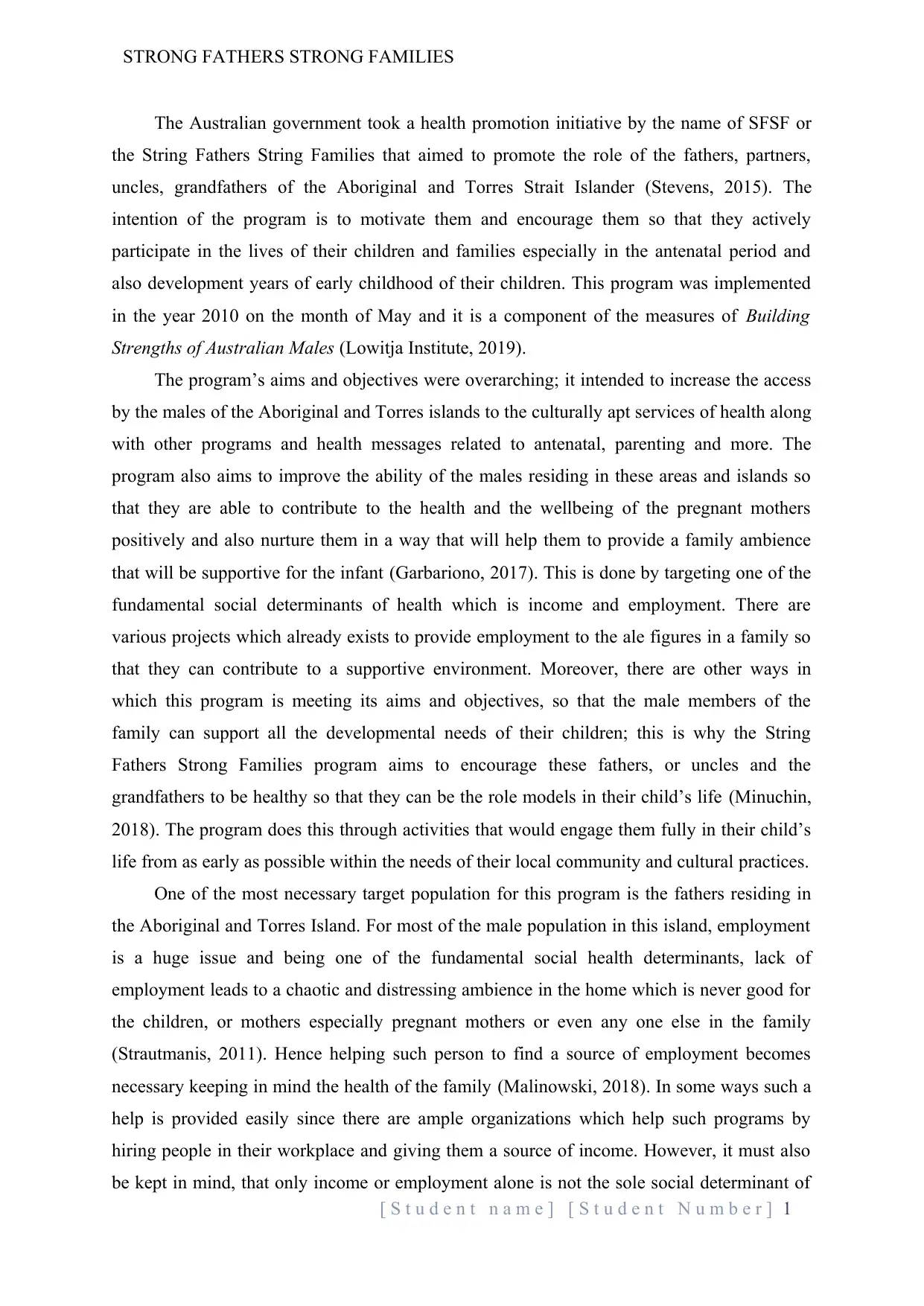
The Australian government took a health promotion initiative by the name of SFSF or
the String Fathers String Families that aimed to promote the role of the fathers, partners,
uncles, grandfathers of the Aboriginal and Torres Strait Islander (Stevens, 2015). The
intention of the program is to motivate them and encourage them so that they actively
participate in the lives of their children and families especially in the antenatal period and
also development years of early childhood of their children. This program was implemented
in the year 2010 on the month of May and it is a component of the measures of Building
Strengths of Australian Males (Lowitja Institute, 2019).
The program’s aims and objectives were overarching; it intended to increase the access
by the males of the Aboriginal and Torres islands to the culturally apt services of health along
with other programs and health messages related to antenatal, parenting and more. The
program also aims to improve the ability of the males residing in these areas and islands so
that they are able to contribute to the health and the wellbeing of the pregnant mothers
positively and also nurture them in a way that will help them to provide a family ambience
that will be supportive for the infant (Garbariono, 2017). This is done by targeting one of the
fundamental social determinants of health which is income and employment. There are
various projects which already exists to provide employment to the ale figures in a family so
that they can contribute to a supportive environment. Moreover, there are other ways in
which this program is meeting its aims and objectives, so that the male members of the
family can support all the developmental needs of their children; this is why the String
Fathers Strong Families program aims to encourage these fathers, or uncles and the
grandfathers to be healthy so that they can be the role models in their child’s life (Minuchin,
2018). The program does this through activities that would engage them fully in their child’s
life from as early as possible within the needs of their local community and cultural practices.
One of the most necessary target population for this program is the fathers residing in
the Aboriginal and Torres Island. For most of the male population in this island, employment
is a huge issue and being one of the fundamental social health determinants, lack of
employment leads to a chaotic and distressing ambience in the home which is never good for
the children, or mothers especially pregnant mothers or even any one else in the family
(Strautmanis, 2011). Hence helping such person to find a source of employment becomes
necessary keeping in mind the health of the family (Malinowski, 2018). In some ways such a
help is provided easily since there are ample organizations which help such programs by
hiring people in their workplace and giving them a source of income. However, it must also
be kept in mind, that only income or employment alone is not the sole social determinant of
[ S t u d e n t n a m e ] [ S t u d e n t N u m b e r ] 1
Document Page
STRONG FATHERS STRONG FAMILIES
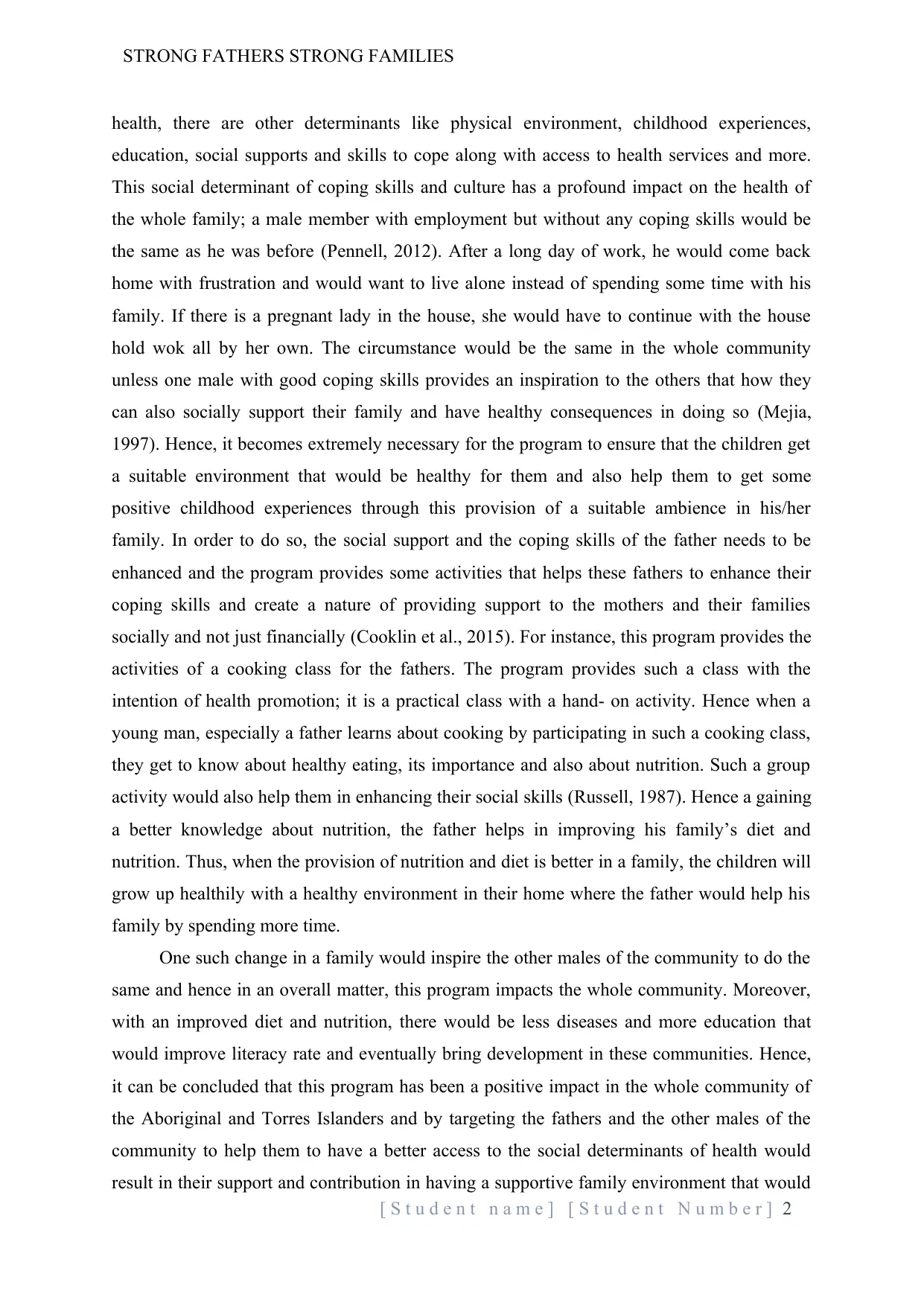
health, there are other determinants like physical environment, childhood experiences,
education, social supports and skills to cope along with access to health services and more.
This social determinant of coping skills and culture has a profound impact on the health of
the whole family; a male member with employment but without any coping skills would be
the same as he was before (Pennell, 2012). After a long day of work, he would come back
home with frustration and would want to live alone instead of spending some time with his
family. If there is a pregnant lady in the house, she would have to continue with the house
hold wok all by her own. The circumstance would be the same in the whole community
unless one male with good coping skills provides an inspiration to the others that how they
can also socially support their family and have healthy consequences in doing so (Mejia,
1997). Hence, it becomes extremely necessary for the program to ensure that the children get
a suitable environment that would be healthy for them and also help them to get some
positive childhood experiences through this provision of a suitable ambience in his/her
family. In order to do so, the social support and the coping skills of the father needs to be
enhanced and the program provides some activities that helps these fathers to enhance their
coping skills and create a nature of providing support to the mothers and their families
socially and not just financially (Cooklin et al., 2015). For instance, this program provides the
activities of a cooking class for the fathers. The program provides such a class with the
intention of health promotion; it is a practical class with a hand- on activity. Hence when a
young man, especially a father learns about cooking by participating in such a cooking class,
they get to know about healthy eating, its importance and also about nutrition. Such a group
activity would also help them in enhancing their social skills (Russell, 1987). Hence a gaining
a better knowledge about nutrition, the father helps in improving his family’s diet and
nutrition. Thus, when the provision of nutrition and diet is better in a family, the children will
grow up healthily with a healthy environment in their home where the father would help his
family by spending more time.
One such change in a family would inspire the other males of the community to do the
same and hence in an overall matter, this program impacts the whole community. Moreover,
with an improved diet and nutrition, there would be less diseases and more education that
would improve literacy rate and eventually bring development in these communities. Hence,
it can be concluded that this program has been a positive impact in the whole community of
the Aboriginal and Torres Islanders and by targeting the fathers and the other males of the
community to help them to have a better access to the social determinants of health would
result in their support and contribution in having a supportive family environment that would
[ S t u d e n t n a m e ] [ S t u d e n t N u m b e r ] 2
Document Page
STRONG FATHERS STRONG FAMILIES
be healthy for not only the children and the mothers but also for the other members of the
family.
[ S t u d e n t n a m e ] [ S t u d e n t N u m b e r ] 3
tabler-icon-diamond-filled.svg

Paraphrase This Document

Need a fresh take? Get an instant paraphrase of this document with our AI Paraphraser
Document Page
STRONG FATHERS STRONG FAMILIES
References:
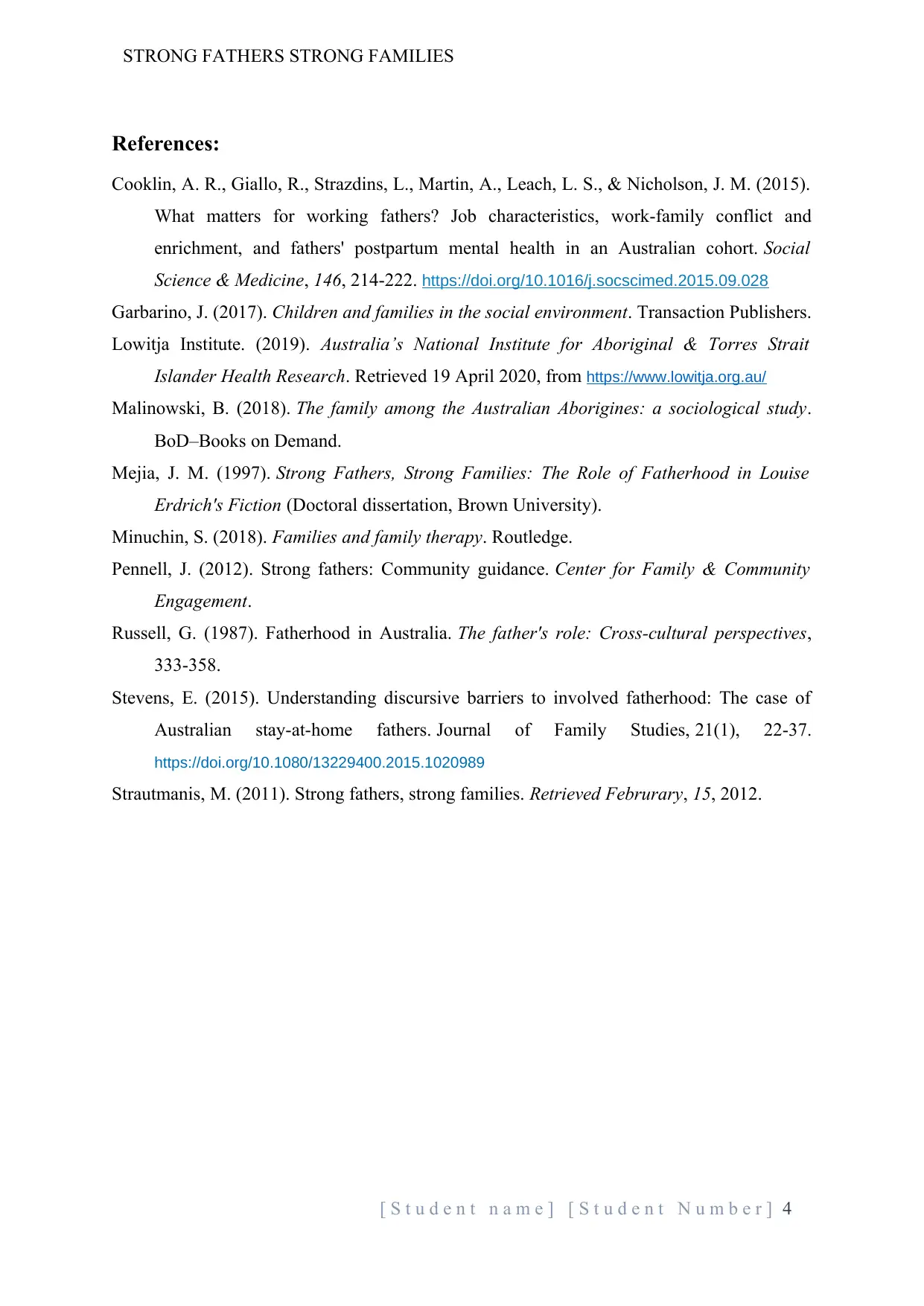
Cooklin, A. R., Giallo, R., Strazdins, L., Martin, A., Leach, L. S., & Nicholson, J. M. (2015).
What matters for working fathers? Job characteristics, work-family conflict and
enrichment, and fathers' postpartum mental health in an Australian cohort. Social
Science & Medicine, 146, 214-222. https://doi.org/10.1016/j.socscimed.2015.09.028
Garbarino, J. (2017). Children and families in the social environment. Transaction Publishers.
Lowitja Institute. (2019). Australia’s National Institute for Aboriginal & Torres Strait
Islander Health Research. Retrieved 19 April 2020, from https://www.lowitja.org.au/
Malinowski, B. (2018). The family among the Australian Aborigines: a sociological study.
BoD–Books on Demand.
Mejia, J. M. (1997). Strong Fathers, Strong Families: The Role of Fatherhood in Louise
Erdrich's Fiction (Doctoral dissertation, Brown University).
Minuchin, S. (2018). Families and family therapy. Routledge.
Pennell, J. (2012). Strong fathers: Community guidance. Center for Family & Community
Engagement.
Russell, G. (1987). Fatherhood in Australia. The father's role: Cross-cultural perspectives,
333-358.
Stevens, E. (2015). Understanding discursive barriers to involved fatherhood: The case of
Australian stay-at-home fathers. Journal of Family Studies, 21(1), 22-37.
https://doi.org/10.1080/13229400.2015.1020989
Strautmanis, M. (2011). Strong fathers, strong families. Retrieved Februrary, 15, 2012.
[ S t u d e n t n a m e ] [ S t u d e n t N u m b e r ] 4
chevron_up_icon
1 out of 5
circle_padding
hide_on_mobile
zoom_out_icon
[object Object]