Analysis of Earthquake Resistant Building Designs in India
VerifiedAdded on 2023/04/03
|19
|3253
|213
Report
AI Summary
This report provides a comprehensive analysis of earthquake-resistant building designs in India, focusing on the specific designs of Assam-type and Thathara houses. It delves into the features, building materials, and earthquake performance of these traditional structures, highlighting their resilience in seismic zones. The report also examines the earthquake-prone areas of India, the relationship between building structure and resilience, and reviews the relevant regulations and guidelines for designing earthquake-resistant buildings. The study incorporates references from the World Housing Encyclopedia and aims to provide a detailed understanding of the structural engineering principles applied to mitigate earthquake damage in India, with Harvard referencing throughout. The analysis covers the design considerations, materials, and performance characteristics of these buildings, offering insights into their ability to withstand seismic activity and protect inhabitants.
Running head: STRUCTURAL ENGINEERING 1
Civil Engineering
First Name Last Name
Institution
Civil Engineering
First Name Last Name
Institution

Paraphrase This Document
Need a fresh take? Get an instant paraphrase of this document with our AI Paraphraser
STRUCTURAL ENGINEERING 2
Table of Contents
Abstract………………………………………………………………………………………..3
1. Introduction…………………………………………………………………………...4
2. Assam type house
………………………………………………………………………………………….4
3. Thathara house
……………………………………………………………………………………….…9
4. Earthquake-prone areas in India……..
……………………………………………………………………………12
5. Relationship between building structure and resilience to India…………………14
6. Regulations and guidelines for design criteria for earthquake resilience buildings in
India………………………………………………………………………………..…15
References…………………………………………………………………………………….18
Table of Contents
Abstract………………………………………………………………………………………..3
1. Introduction…………………………………………………………………………...4
2. Assam type house
………………………………………………………………………………………….4
3. Thathara house
……………………………………………………………………………………….…9
4. Earthquake-prone areas in India……..
……………………………………………………………………………12
5. Relationship between building structure and resilience to India…………………14
6. Regulations and guidelines for design criteria for earthquake resilience buildings in
India………………………………………………………………………………..…15
References…………………………………………………………………………………….18
STRUCTURAL ENGINEERING 3
Abstract
The Indian subcontinent has endured the absolute most striking earthquakes on the planet. The
earthquakes of the late nineteenth and mid-twentieth century of years set off various early
advances in science and designing identified with earthquakes. These incorporate the
improvement of early codes and earthquake safe constructions after the 1935 Quetta quake in
Baluchistan, and reinforcing methods actualized after the 1941 Andaman Islands earthquake,
discovered in remote islands of India. The extent of losses that result from earthquake incidences
in India records significant variations especially based on the variety of building types that exist
here. For instance, Thathara house types have been found to be reasonably resistant to
earthquakes as well as the Assam-type of houses but the degree of their respective performances
is dependent on their respective building and design configurations to counter loading and
movements that accompany earthquake occurrence. Different regions are exposed to different
intensity and frequency of earthquakes hence the five earthquake zones in India. To mitigate
damages that result from earthquake occurrences, the building structure in India continue to
advance towards a resilient status as explored in the text. Furthermore, regulations and guidelines
for design criteria for earthquake resilience buildings in India are also explored in this paper.
Abstract
The Indian subcontinent has endured the absolute most striking earthquakes on the planet. The
earthquakes of the late nineteenth and mid-twentieth century of years set off various early
advances in science and designing identified with earthquakes. These incorporate the
improvement of early codes and earthquake safe constructions after the 1935 Quetta quake in
Baluchistan, and reinforcing methods actualized after the 1941 Andaman Islands earthquake,
discovered in remote islands of India. The extent of losses that result from earthquake incidences
in India records significant variations especially based on the variety of building types that exist
here. For instance, Thathara house types have been found to be reasonably resistant to
earthquakes as well as the Assam-type of houses but the degree of their respective performances
is dependent on their respective building and design configurations to counter loading and
movements that accompany earthquake occurrence. Different regions are exposed to different
intensity and frequency of earthquakes hence the five earthquake zones in India. To mitigate
damages that result from earthquake occurrences, the building structure in India continue to
advance towards a resilient status as explored in the text. Furthermore, regulations and guidelines
for design criteria for earthquake resilience buildings in India are also explored in this paper.
⊘ This is a preview!⊘
Do you want full access?
Subscribe today to unlock all pages.

Trusted by 1+ million students worldwide
STRUCTURAL ENGINEERING 4
1. Introduction
The World Housing Encyclopedia forms a key reference to earthquake design in buildings as it
provides a vast resource collection in regard to building practices in the seismic prone regions
globally. It provides an avenue for study and understanding of different types of construction in
these earth prone areas and their performance characteristics so as to informatively encourage the
adoption of earthquake resistant technologies globally (Jain, 2016). For instance, in India the
cataloged building types include but not limited to the following; -
Assam-type House
Thathara houses in Himachal Pradesh
Timber Frame Brick House with Attic
Mudwall construction in Spiti Valley (Himachal Pradesh)
Traditional Naga Type House
Koti Banal Architecture of Himachal Pradesh and Uttarakhand, Northern India
(Indraganti, 2018).
To understand the performance of such buildings against earthquake and tremors, it is crucial
that their respective design is well understood (Bansal & Verma, 2018). Detailed design of some
of the building types is explored in the following section.
2. Assam-type House (Ikra)
i. Regions found
Structures of this development type are common in the northeastern parts of India,
and in the Gangetic planes of Bengal, Orrisa, and Bihar, and in Asia in parts of
Bangladesh, Myanmar, Thailand, Cambodia and so forth (see figure-1). The area
encounters serious trembling because of subduction of the Indian plate under the
Eurasian plate along the north-northeastern bearing at a rate of approximately 4
cm annually (Bhattacharjee & Ng, 2017). Because of verifiable strong
earthquakes of the area the nearby individuals built up a one of a kind
development system utilizing locally accessible resources to build their houses
which are exceedingly earthquake safe.
1. Introduction
The World Housing Encyclopedia forms a key reference to earthquake design in buildings as it
provides a vast resource collection in regard to building practices in the seismic prone regions
globally. It provides an avenue for study and understanding of different types of construction in
these earth prone areas and their performance characteristics so as to informatively encourage the
adoption of earthquake resistant technologies globally (Jain, 2016). For instance, in India the
cataloged building types include but not limited to the following; -
Assam-type House
Thathara houses in Himachal Pradesh
Timber Frame Brick House with Attic
Mudwall construction in Spiti Valley (Himachal Pradesh)
Traditional Naga Type House
Koti Banal Architecture of Himachal Pradesh and Uttarakhand, Northern India
(Indraganti, 2018).
To understand the performance of such buildings against earthquake and tremors, it is crucial
that their respective design is well understood (Bansal & Verma, 2018). Detailed design of some
of the building types is explored in the following section.
2. Assam-type House (Ikra)
i. Regions found
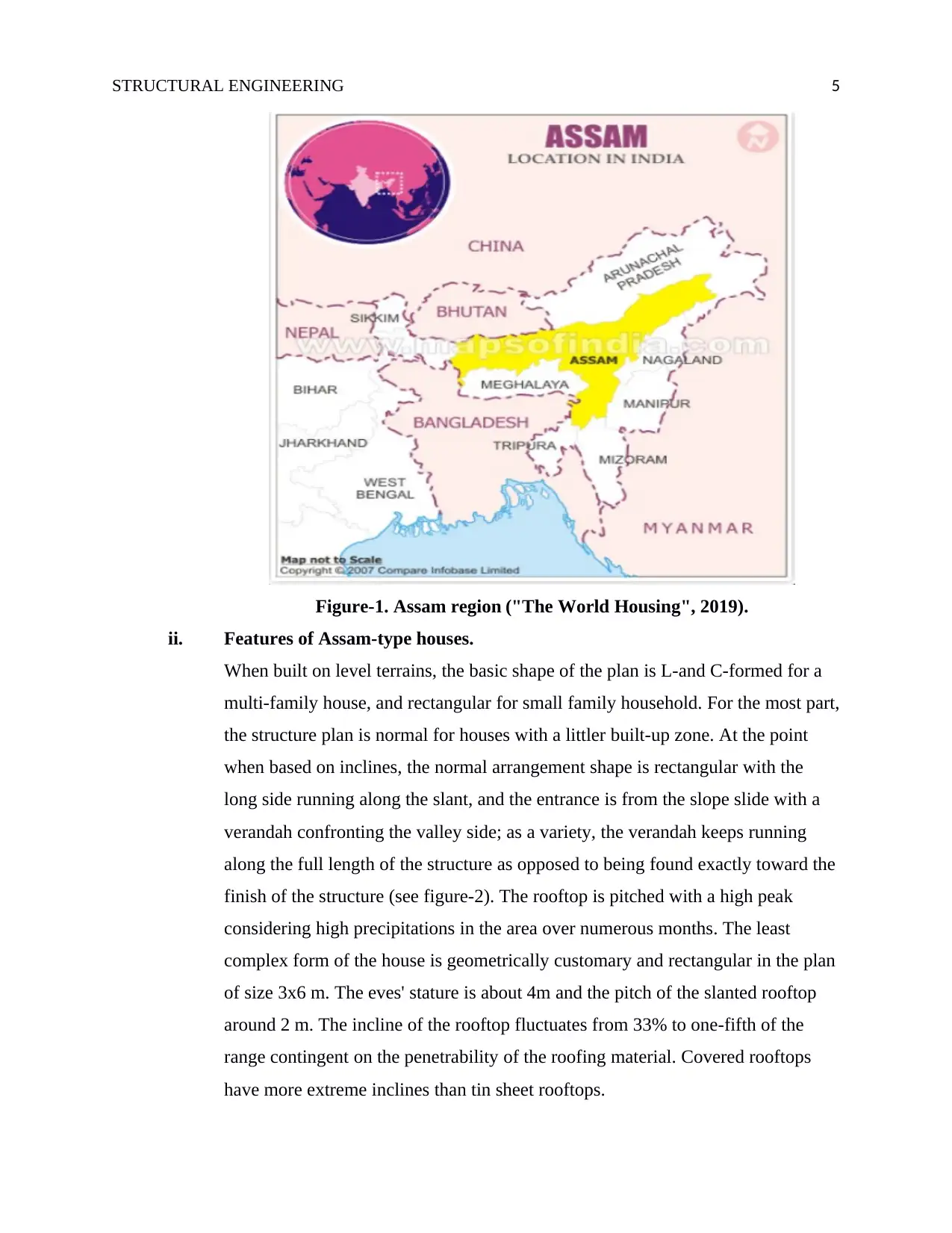
Structures of this development type are common in the northeastern parts of India,
and in the Gangetic planes of Bengal, Orrisa, and Bihar, and in Asia in parts of
Bangladesh, Myanmar, Thailand, Cambodia and so forth (see figure-1). The area
encounters serious trembling because of subduction of the Indian plate under the
Eurasian plate along the north-northeastern bearing at a rate of approximately 4
cm annually (Bhattacharjee & Ng, 2017). Because of verifiable strong
earthquakes of the area the nearby individuals built up a one of a kind
development system utilizing locally accessible resources to build their houses
which are exceedingly earthquake safe.
Paraphrase This Document
Need a fresh take? Get an instant paraphrase of this document with our AI Paraphraser
STRUCTURAL ENGINEERING 5
Figure-1. Assam region ("The World Housing", 2019).
ii. Features of Assam-type houses.
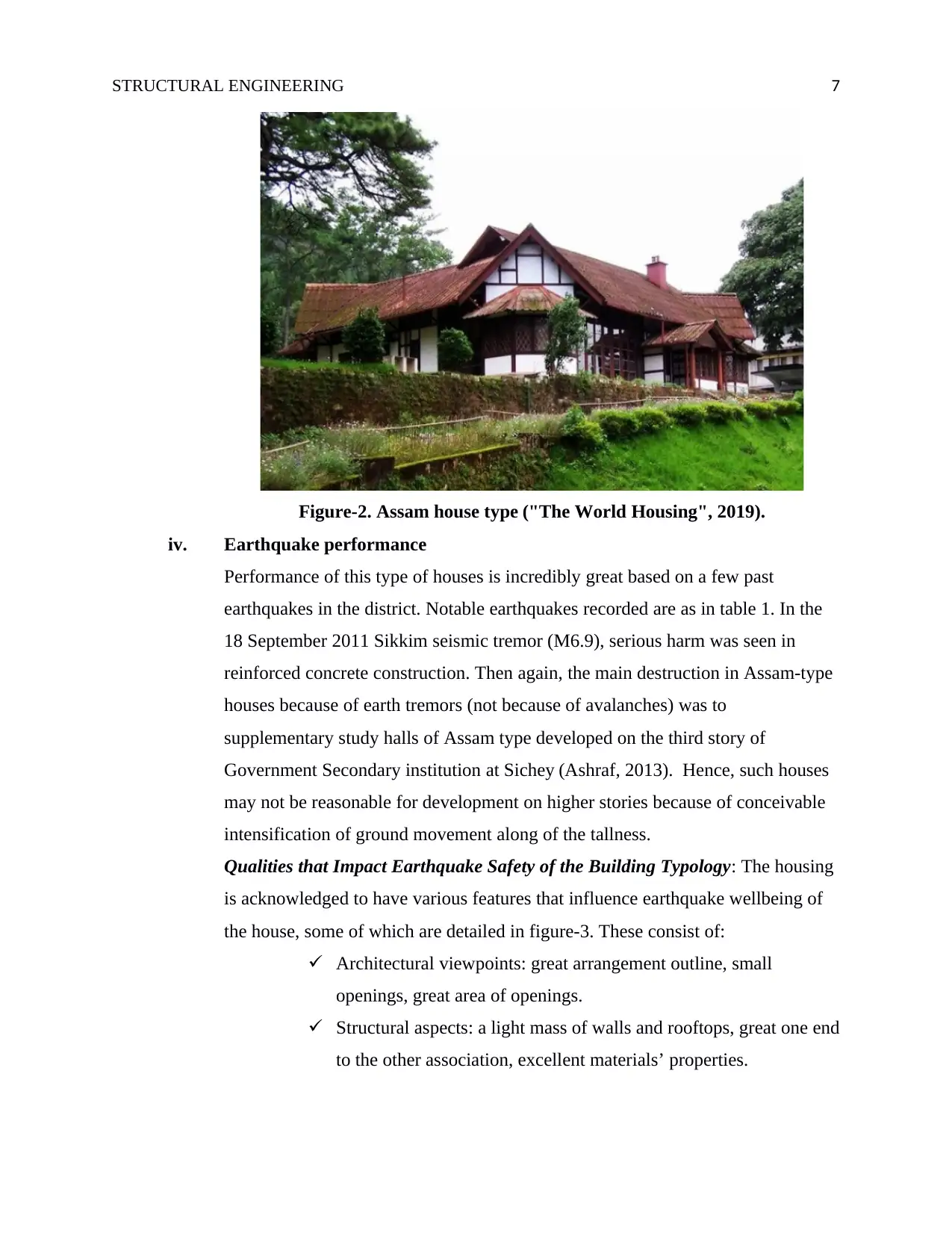
When built on level terrains, the basic shape of the plan is L-and C-formed for a
multi-family house, and rectangular for small family household. For the most part,
the structure plan is normal for houses with a littler built-up zone. At the point
when based on inclines, the normal arrangement shape is rectangular with the
long side running along the slant, and the entrance is from the slope slide with a
verandah confronting the valley side; as a variety, the verandah keeps running
along the full length of the structure as opposed to being found exactly toward the
finish of the structure (see figure-2). The rooftop is pitched with a high peak
considering high precipitations in the area over numerous months. The least
complex form of the house is geometrically customary and rectangular in the plan
of size 3x6 m. The eves' stature is about 4m and the pitch of the slanted rooftop
around 2 m. The incline of the rooftop fluctuates from 33% to one-fifth of the
range contingent on the penetrability of the roofing material. Covered rooftops
have more extreme inclines than tin sheet rooftops.
Figure-1. Assam region ("The World Housing", 2019).
ii. Features of Assam-type houses.
When built on level terrains, the basic shape of the plan is L-and C-formed for a
multi-family house, and rectangular for small family household. For the most part,
the structure plan is normal for houses with a littler built-up zone. At the point
when based on inclines, the normal arrangement shape is rectangular with the
long side running along the slant, and the entrance is from the slope slide with a
verandah confronting the valley side; as a variety, the verandah keeps running
along the full length of the structure as opposed to being found exactly toward the
finish of the structure (see figure-2). The rooftop is pitched with a high peak
considering high precipitations in the area over numerous months. The least
complex form of the house is geometrically customary and rectangular in the plan
of size 3x6 m. The eves' stature is about 4m and the pitch of the slanted rooftop
around 2 m. The incline of the rooftop fluctuates from 33% to one-fifth of the
range contingent on the penetrability of the roofing material. Covered rooftops
have more extreme inclines than tin sheet rooftops.
STRUCTURAL ENGINEERING 6
iii. Building materials
Wall: These boards can be either mud-put or dairy animals dung river sand
surfaced or concrete/lime-fine rivers and put on one/the two faces, they are
additionally painted on one or the two countenances, totally relying upon the
monetary limit of the house proprietor. In ongoing developments, the Ikra walls
don't proceed till ground level, rather un-strengthened brickwork walls/ dividers
of 120 mm thickness are built over the ground level till ledge level and after that
Ikra wall are upheld on the brickwork walls. These brickwork dividers are
supported with more than 250 mm thick walls of hidden dimension to a depth of
around 600 mm.
Edges: -Vertical Posts: The fundamental timber posts are made of 150-250 mm
measurement, and transitional wooden posts are made of an assortment of sizes,
for instance, 125#125 mm, 100#100 mm, 100#75 mm, 125#75 mm, utilizing
nearby accessible Sal wood. The transitional wooden verticals are commonly set
at a middle to-focus wall of approximately 1.2 m.
Foundations: The principle wooden columns are punctured into the foundation
600-900 mm deep. U-clamps and steel jolts are used to connect wooden columns
and posts at joints. The plinths are made of stone in mud/lime mortar; the plinth
walls are 400 mm in width and 500 mm into the foundation. The mortar utilized
in the block brickwork was made of lime, rice flour of a specific assortment of
rice, fine dirt particles, and so forth. Afterward, the establishments are made of
plain cement concrete (CC) slabs in concrete mix ratios of 1:3:6. Wooden posts
are secured on these solid platforms using iron fasteners. Accessibility to cement
and steel over time have led to the use of reinforced concrete footings and
proportionally small and effective foundations.
Rooftop Truss: Ikra houses consists of slanted duo-pitched rooftop with a
network of properly laid rafters, purlins, and wood posts over which roof cover
(ikra reed) is furnished. The rafters are 150 mm distance across wood logs from
locally accessible Sal wood, at about 600mm spacing. Bamboo of sizes 100 mm
at 300 mm spacing forms the roof purlins.
iii. Building materials
Wall: These boards can be either mud-put or dairy animals dung river sand
surfaced or concrete/lime-fine rivers and put on one/the two faces, they are
additionally painted on one or the two countenances, totally relying upon the
monetary limit of the house proprietor. In ongoing developments, the Ikra walls
don't proceed till ground level, rather un-strengthened brickwork walls/ dividers
of 120 mm thickness are built over the ground level till ledge level and after that
Ikra wall are upheld on the brickwork walls. These brickwork dividers are
supported with more than 250 mm thick walls of hidden dimension to a depth of
around 600 mm.
Edges: -Vertical Posts: The fundamental timber posts are made of 150-250 mm
measurement, and transitional wooden posts are made of an assortment of sizes,
for instance, 125#125 mm, 100#100 mm, 100#75 mm, 125#75 mm, utilizing
nearby accessible Sal wood. The transitional wooden verticals are commonly set
at a middle to-focus wall of approximately 1.2 m.
Foundations: The principle wooden columns are punctured into the foundation
600-900 mm deep. U-clamps and steel jolts are used to connect wooden columns
and posts at joints. The plinths are made of stone in mud/lime mortar; the plinth
walls are 400 mm in width and 500 mm into the foundation. The mortar utilized
in the block brickwork was made of lime, rice flour of a specific assortment of
rice, fine dirt particles, and so forth. Afterward, the establishments are made of
plain cement concrete (CC) slabs in concrete mix ratios of 1:3:6. Wooden posts
are secured on these solid platforms using iron fasteners. Accessibility to cement
and steel over time have led to the use of reinforced concrete footings and
proportionally small and effective foundations.
Rooftop Truss: Ikra houses consists of slanted duo-pitched rooftop with a
network of properly laid rafters, purlins, and wood posts over which roof cover
(ikra reed) is furnished. The rafters are 150 mm distance across wood logs from
locally accessible Sal wood, at about 600mm spacing. Bamboo of sizes 100 mm
at 300 mm spacing forms the roof purlins.
⊘ This is a preview!⊘
Do you want full access?
Subscribe today to unlock all pages.
Trusted by 1+ million students worldwide
STRUCTURAL ENGINEERING 7
Figure-2. Assam house type ("The World Housing", 2019).
iv. Earthquake performance
Performance of this type of houses is incredibly great based on a few past
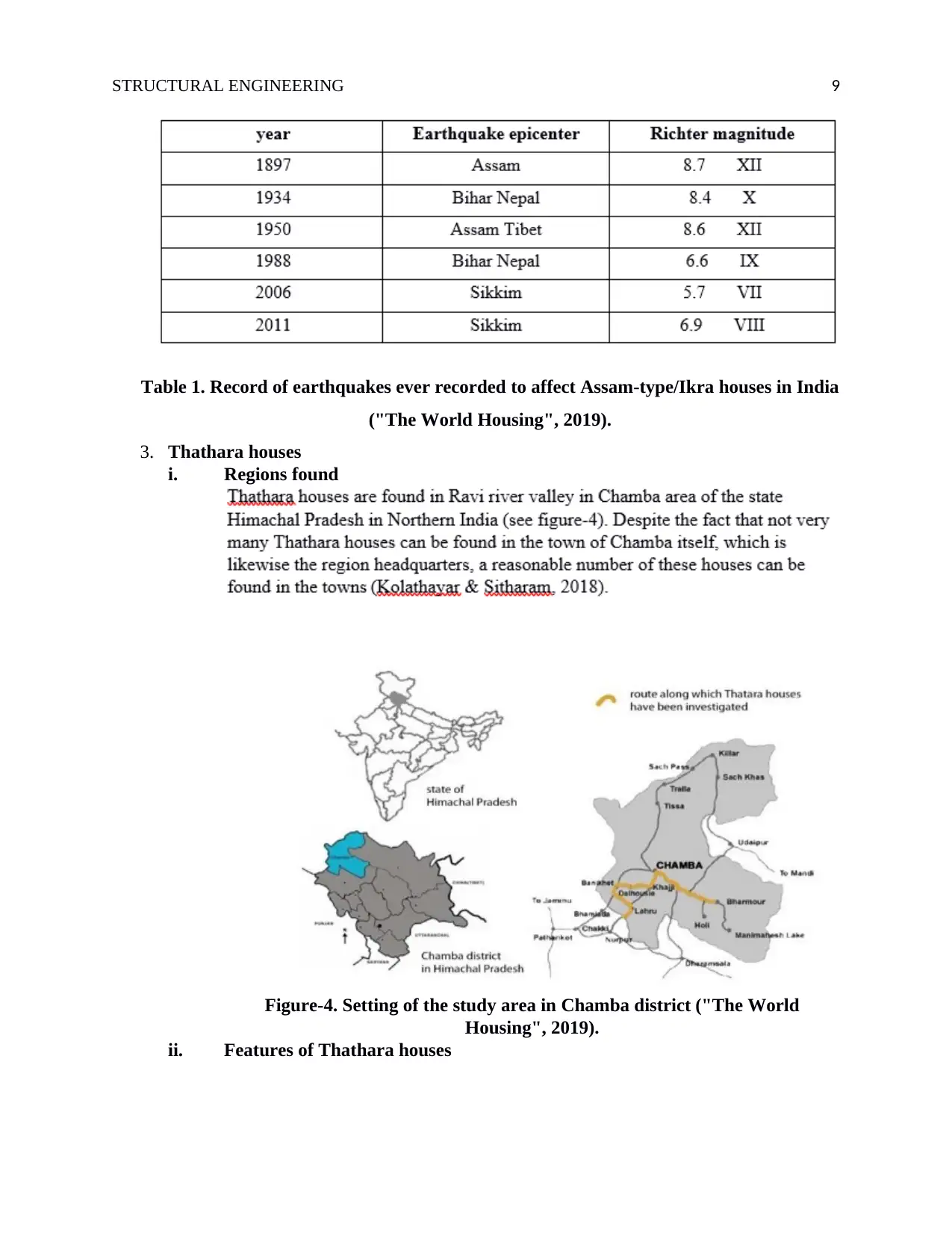
earthquakes in the district. Notable earthquakes recorded are as in table 1. In the
18 September 2011 Sikkim seismic tremor (M6.9), serious harm was seen in
reinforced concrete construction. Then again, the main destruction in Assam-type
houses because of earth tremors (not because of avalanches) was to
supplementary study halls of Assam type developed on the third story of
Government Secondary institution at Sichey (Ashraf, 2013). Hence, such houses
may not be reasonable for development on higher stories because of conceivable
intensification of ground movement along of the tallness.
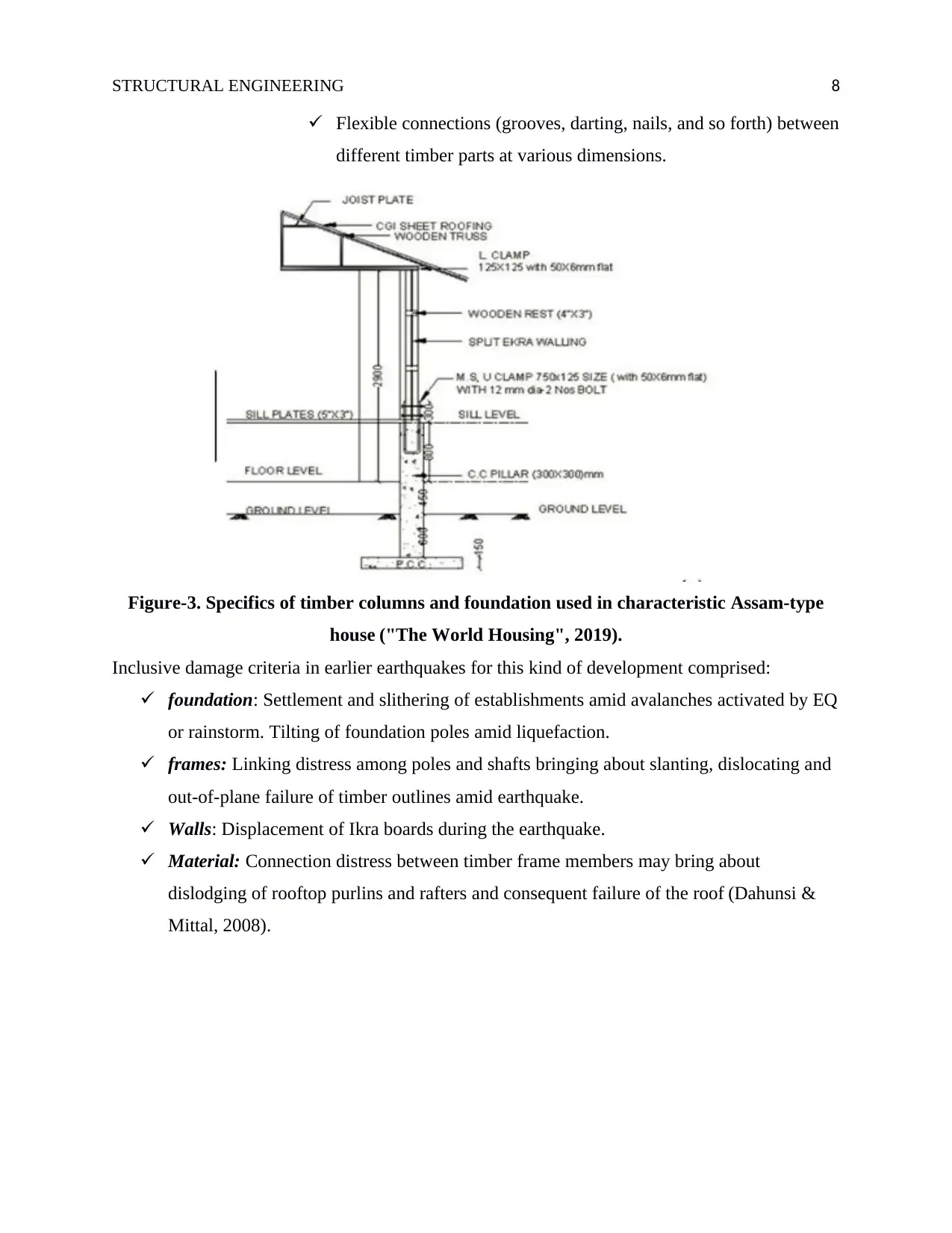
Qualities that Impact Earthquake Safety of the Building Typology: The housing
is acknowledged to have various features that influence earthquake wellbeing of
the house, some of which are detailed in figure-3. These consist of:
Architectural viewpoints: great arrangement outline, small
openings, great area of openings.
Structural aspects: a light mass of walls and rooftops, great one end
to the other association, excellent materials’ properties.
Figure-2. Assam house type ("The World Housing", 2019).
iv. Earthquake performance
Performance of this type of houses is incredibly great based on a few past
earthquakes in the district. Notable earthquakes recorded are as in table 1. In the
18 September 2011 Sikkim seismic tremor (M6.9), serious harm was seen in
reinforced concrete construction. Then again, the main destruction in Assam-type
houses because of earth tremors (not because of avalanches) was to
supplementary study halls of Assam type developed on the third story of
Government Secondary institution at Sichey (Ashraf, 2013). Hence, such houses
may not be reasonable for development on higher stories because of conceivable
intensification of ground movement along of the tallness.
Qualities that Impact Earthquake Safety of the Building Typology: The housing
is acknowledged to have various features that influence earthquake wellbeing of
the house, some of which are detailed in figure-3. These consist of:
Architectural viewpoints: great arrangement outline, small
openings, great area of openings.
Structural aspects: a light mass of walls and rooftops, great one end
to the other association, excellent materials’ properties.
Paraphrase This Document
Need a fresh take? Get an instant paraphrase of this document with our AI Paraphraser
STRUCTURAL ENGINEERING 8
Flexible connections (grooves, darting, nails, and so forth) between
different timber parts at various dimensions.
Figure-3. Specifics of timber columns and foundation used in characteristic Assam-type
house ("The World Housing", 2019).
Inclusive damage criteria in earlier earthquakes for this kind of development comprised:
foundation: Settlement and slithering of establishments amid avalanches activated by EQ
or rainstorm. Tilting of foundation poles amid liquefaction.
frames: Linking distress among poles and shafts bringing about slanting, dislocating and
out-of-plane failure of timber outlines amid earthquake.
Walls: Displacement of Ikra boards during the earthquake.
Material: Connection distress between timber frame members may bring about
dislodging of rooftop purlins and rafters and consequent failure of the roof (Dahunsi &
Mittal, 2008).
Flexible connections (grooves, darting, nails, and so forth) between
different timber parts at various dimensions.
Figure-3. Specifics of timber columns and foundation used in characteristic Assam-type
house ("The World Housing", 2019).
Inclusive damage criteria in earlier earthquakes for this kind of development comprised:
foundation: Settlement and slithering of establishments amid avalanches activated by EQ
or rainstorm. Tilting of foundation poles amid liquefaction.
frames: Linking distress among poles and shafts bringing about slanting, dislocating and
out-of-plane failure of timber outlines amid earthquake.
Walls: Displacement of Ikra boards during the earthquake.
Material: Connection distress between timber frame members may bring about
dislodging of rooftop purlins and rafters and consequent failure of the roof (Dahunsi &
Mittal, 2008).
STRUCTURAL ENGINEERING 9
Table 1. Record of earthquakes ever recorded to affect Assam-type/Ikra houses in India
("The World Housing", 2019).
3. Thathara houses
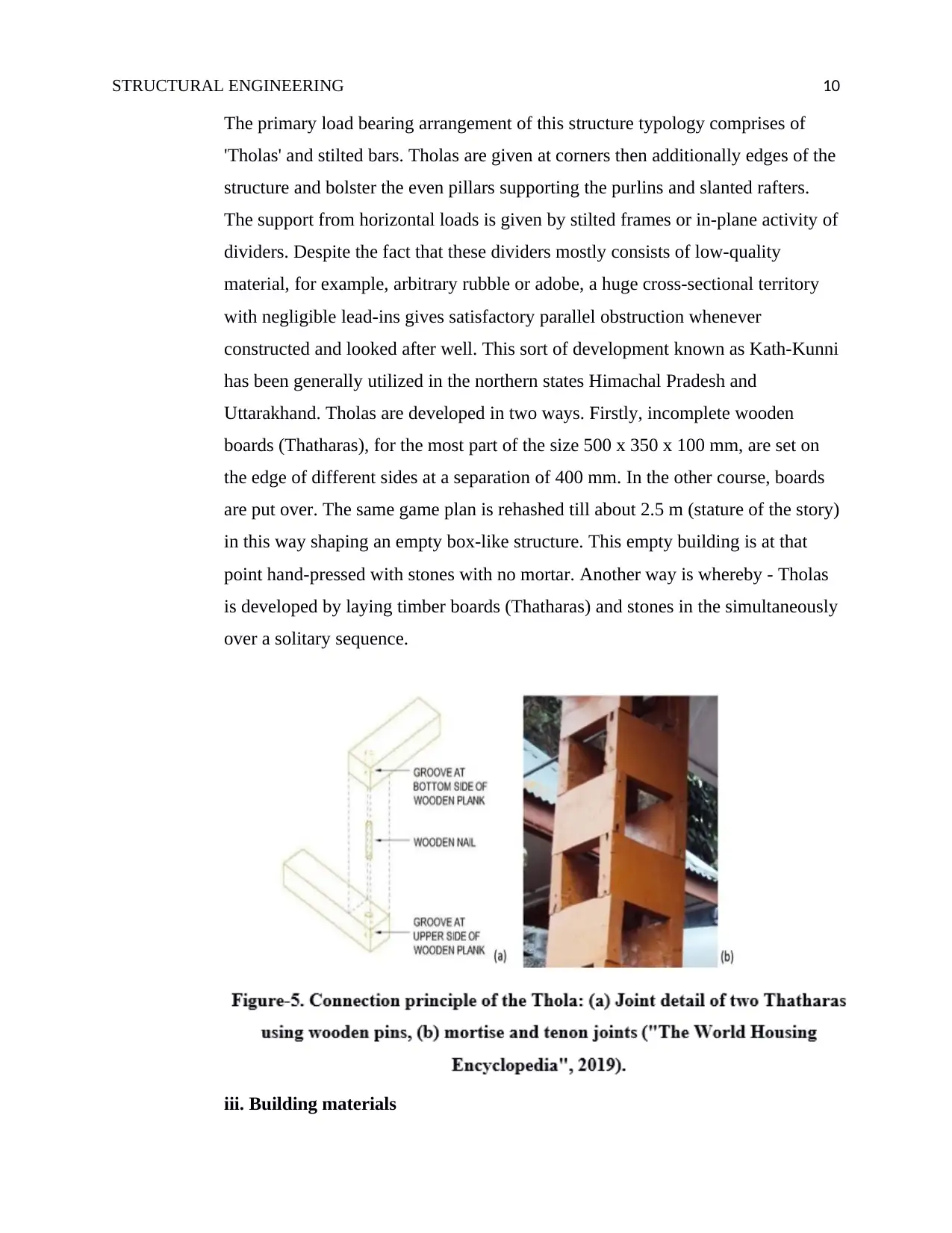
i. Regions found
Figure-4. Setting of the study area in Chamba district ("The World
Housing", 2019).
ii. Features of Thathara houses
Table 1. Record of earthquakes ever recorded to affect Assam-type/Ikra houses in India
("The World Housing", 2019).
3. Thathara houses
i. Regions found
Figure-4. Setting of the study area in Chamba district ("The World
Housing", 2019).
ii. Features of Thathara houses
⊘ This is a preview!⊘
Do you want full access?
Subscribe today to unlock all pages.
Trusted by 1+ million students worldwide
STRUCTURAL ENGINEERING 10
The primary load bearing arrangement of this structure typology comprises of
'Tholas' and stilted bars. Tholas are given at corners then additionally edges of the
structure and bolster the even pillars supporting the purlins and slanted rafters.
The support from horizontal loads is given by stilted frames or in-plane activity of
dividers. Despite the fact that these dividers mostly consists of low-quality
material, for example, arbitrary rubble or adobe, a huge cross-sectional territory
with negligible lead-ins gives satisfactory parallel obstruction whenever
constructed and looked after well. This sort of development known as Kath-Kunni
has been generally utilized in the northern states Himachal Pradesh and
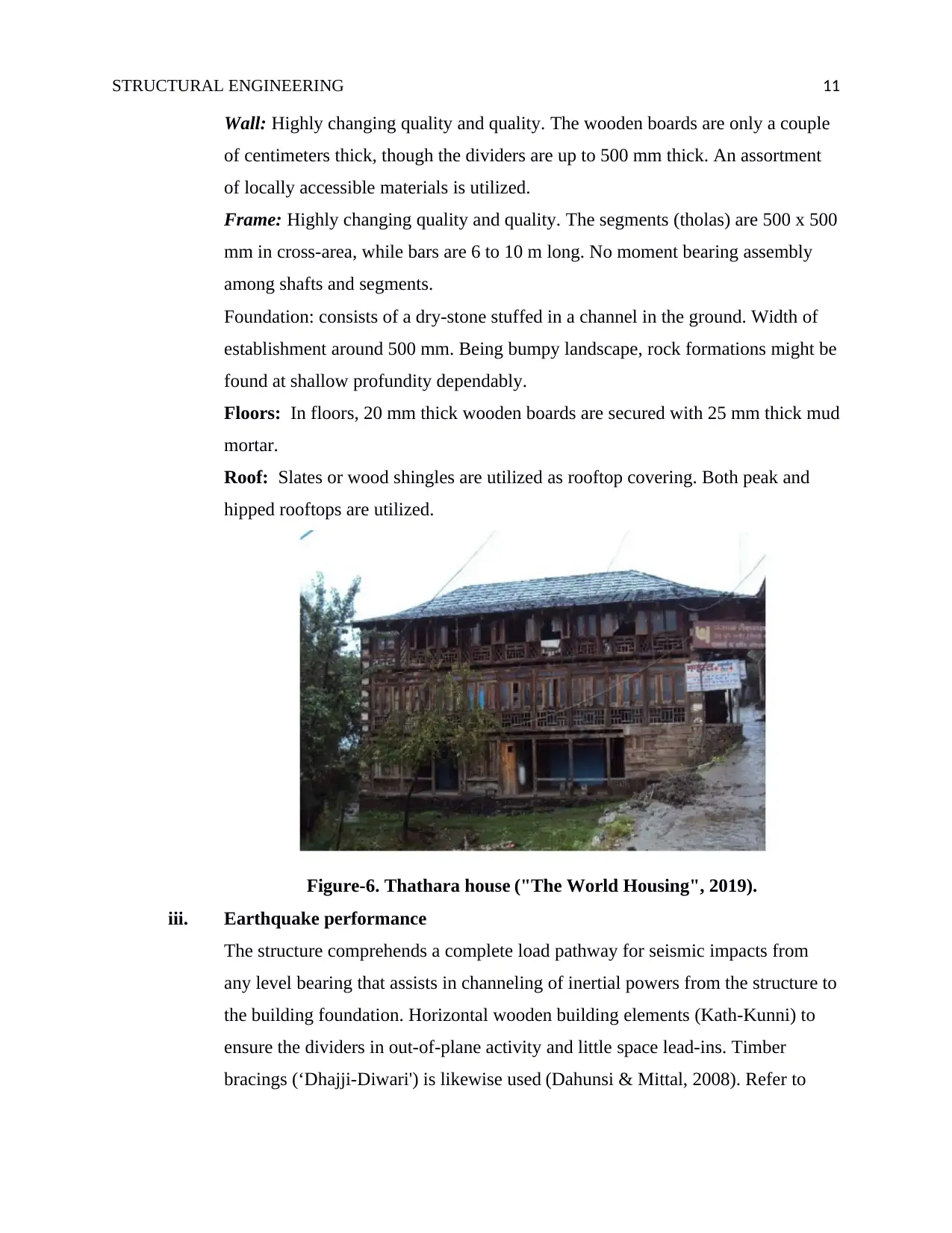
Uttarakhand. Tholas are developed in two ways. Firstly, incomplete wooden
boards (Thatharas), for the most part of the size 500 x 350 x 100 mm, are set on
the edge of different sides at a separation of 400 mm. In the other course, boards
are put over. The same game plan is rehashed till about 2.5 m (stature of the story)
in this way shaping an empty box-like structure. This empty building is at that
point hand-pressed with stones with no mortar. Another way is whereby - Tholas
is developed by laying timber boards (Thatharas) and stones in the simultaneously
over a solitary sequence.
iii. Building materials
The primary load bearing arrangement of this structure typology comprises of
'Tholas' and stilted bars. Tholas are given at corners then additionally edges of the
structure and bolster the even pillars supporting the purlins and slanted rafters.
The support from horizontal loads is given by stilted frames or in-plane activity of
dividers. Despite the fact that these dividers mostly consists of low-quality
material, for example, arbitrary rubble or adobe, a huge cross-sectional territory
with negligible lead-ins gives satisfactory parallel obstruction whenever
constructed and looked after well. This sort of development known as Kath-Kunni
has been generally utilized in the northern states Himachal Pradesh and
Uttarakhand. Tholas are developed in two ways. Firstly, incomplete wooden
boards (Thatharas), for the most part of the size 500 x 350 x 100 mm, are set on
the edge of different sides at a separation of 400 mm. In the other course, boards
are put over. The same game plan is rehashed till about 2.5 m (stature of the story)
in this way shaping an empty box-like structure. This empty building is at that
point hand-pressed with stones with no mortar. Another way is whereby - Tholas
is developed by laying timber boards (Thatharas) and stones in the simultaneously
over a solitary sequence.
iii. Building materials
Paraphrase This Document
Need a fresh take? Get an instant paraphrase of this document with our AI Paraphraser
STRUCTURAL ENGINEERING 11
Wall: Highly changing quality and quality. The wooden boards are only a couple
of centimeters thick, though the dividers are up to 500 mm thick. An assortment
of locally accessible materials is utilized.
Frame: Highly changing quality and quality. The segments (tholas) are 500 x 500
mm in cross-area, while bars are 6 to 10 m long. No moment bearing assembly
among shafts and segments.
Foundation: consists of a dry-stone stuffed in a channel in the ground. Width of
establishment around 500 mm. Being bumpy landscape, rock formations might be
found at shallow profundity dependably.
Floors: In floors, 20 mm thick wooden boards are secured with 25 mm thick mud
mortar.
Roof: Slates or wood shingles are utilized as rooftop covering. Both peak and
hipped rooftops are utilized.
Figure-6. Thathara house ("The World Housing", 2019).
iii. Earthquake performance
The structure comprehends a complete load pathway for seismic impacts from
any level bearing that assists in channeling of inertial powers from the structure to
the building foundation. Horizontal wooden building elements (Kath-Kunni) to
ensure the dividers in out-of-plane activity and little space lead-ins. Timber
bracings (‘Dhajji-Diwari') is likewise used (Dahunsi & Mittal, 2008). Refer to
Wall: Highly changing quality and quality. The wooden boards are only a couple
of centimeters thick, though the dividers are up to 500 mm thick. An assortment
of locally accessible materials is utilized.
Frame: Highly changing quality and quality. The segments (tholas) are 500 x 500
mm in cross-area, while bars are 6 to 10 m long. No moment bearing assembly
among shafts and segments.
Foundation: consists of a dry-stone stuffed in a channel in the ground. Width of
establishment around 500 mm. Being bumpy landscape, rock formations might be
found at shallow profundity dependably.
Floors: In floors, 20 mm thick wooden boards are secured with 25 mm thick mud
mortar.
Roof: Slates or wood shingles are utilized as rooftop covering. Both peak and
hipped rooftops are utilized.
Figure-6. Thathara house ("The World Housing", 2019).
iii. Earthquake performance
The structure comprehends a complete load pathway for seismic impacts from
any level bearing that assists in channeling of inertial powers from the structure to
the building foundation. Horizontal wooden building elements (Kath-Kunni) to
ensure the dividers in out-of-plane activity and little space lead-ins. Timber
bracings (‘Dhajji-Diwari') is likewise used (Dahunsi & Mittal, 2008). Refer to
STRUCTURAL ENGINEERING 12
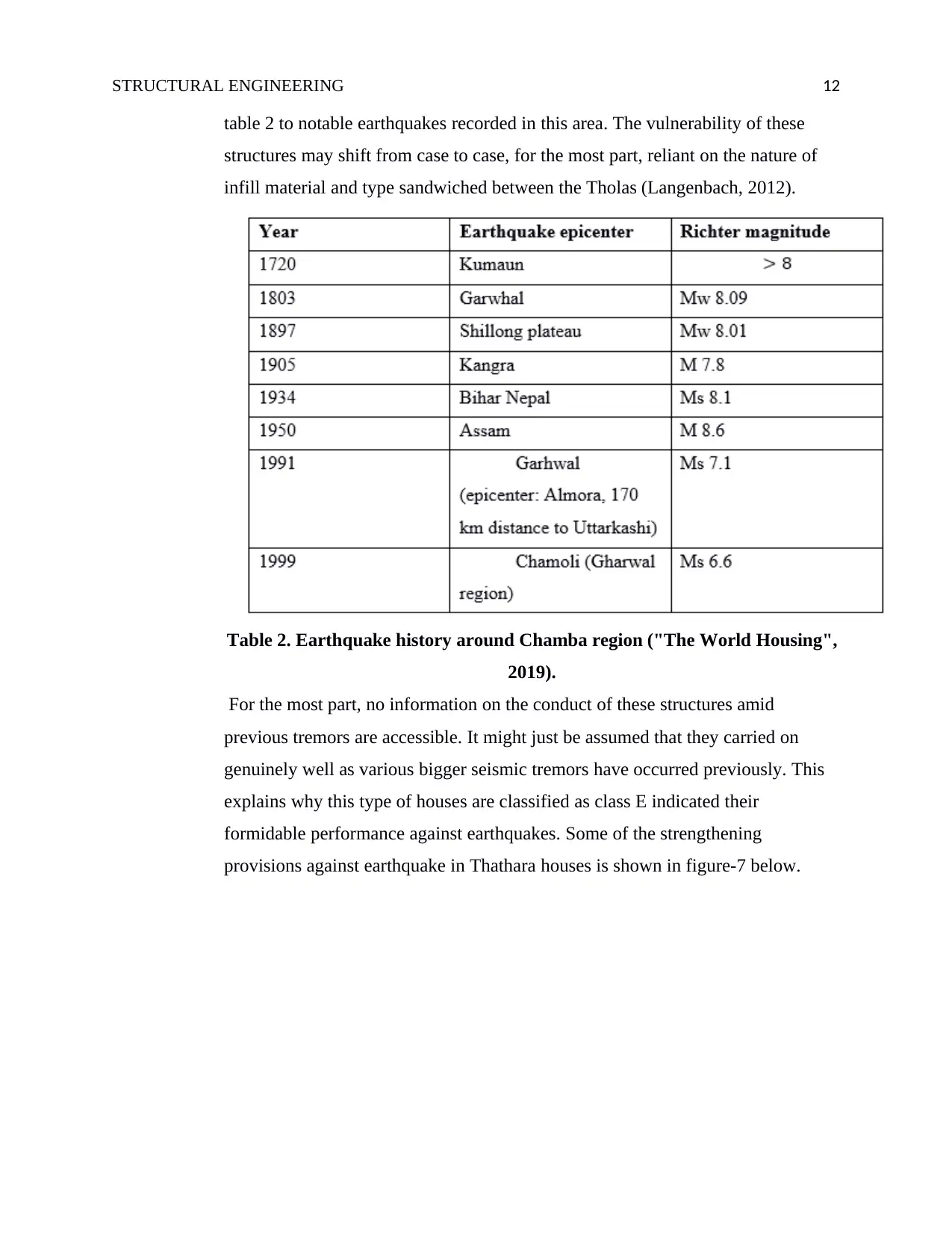
table 2 to notable earthquakes recorded in this area. The vulnerability of these
structures may shift from case to case, for the most part, reliant on the nature of
infill material and type sandwiched between the Tholas (Langenbach, 2012).
Table 2. Earthquake history around Chamba region ("The World Housing",
2019).
For the most part, no information on the conduct of these structures amid
previous tremors are accessible. It might just be assumed that they carried on
genuinely well as various bigger seismic tremors have occurred previously. This
explains why this type of houses are classified as class E indicated their
formidable performance against earthquakes. Some of the strengthening
provisions against earthquake in Thathara houses is shown in figure-7 below.
table 2 to notable earthquakes recorded in this area. The vulnerability of these
structures may shift from case to case, for the most part, reliant on the nature of
infill material and type sandwiched between the Tholas (Langenbach, 2012).
Table 2. Earthquake history around Chamba region ("The World Housing",
2019).
For the most part, no information on the conduct of these structures amid
previous tremors are accessible. It might just be assumed that they carried on
genuinely well as various bigger seismic tremors have occurred previously. This
explains why this type of houses are classified as class E indicated their
formidable performance against earthquakes. Some of the strengthening
provisions against earthquake in Thathara houses is shown in figure-7 below.
⊘ This is a preview!⊘
Do you want full access?
Subscribe today to unlock all pages.
Trusted by 1+ million students worldwide

1 out of 19


Your All-in-One AI-Powered Toolkit for Academic Success.
+13062052269
info@desklib.com
Available 24*7 on WhatsApp / Email
![[object Object]](/_next/static/media/star-bottom.7253800d.svg)
Unlock your academic potential
Copyright © 2020–2025 A2Z Services. All Rights Reserved. Developed and managed by ZUCOL.