Structural Health Monitoring for Marine Infrastructure Review

Verified

Added on  2021/10/19

|3
|831
|210
Report
AI Summary
This report provides a review of structural health monitoring (SHM) applications for marine infrastructure. It explores the use of various sensor technologies, including optical fiber Bragg grating sensors, piezoelectric transducers, and GPS receivers, in monitoring the health of structures. The report discusses the research context, literature review, and typical infrastructure applications, such as long-span bridges. The SHM system architecture for bridges is described, highlighting the integration of sensor subsystems, data management, data acquisition, and condition assessment. Data collection methods and avenues for further research, particularly in non-destructive evaluation techniques, are also presented. The review emphasizes the importance of SHM in enhancing safety, reliability, and minimizing operational costs in marine infrastructure.
Document Page
REVIEW OF
STRUCTURAL HEALTH MONITORING APPLICATIONS FOR MARINE
INFRASTRUCTURE
YOUR NAME
Griffith School of Engineering, Griffith University, Gold Coast, QLD4222, Australia
This paper presents a review of structural health monitoring applications for marine infrastructure. Structural Health
Monitoring is geared towards providing at any given moment during the life period of a structure, a diagnosis of the state
each of the materials, of the various parts as well as of the entire assembly of such parts that make up the structure as a
whole. It is a requirement that the state of the structure has to remain within the specified domain in the design even
though this may be changed by normal aging owing to usage, by environmental action or even by accidental occurrences.
Keywords: structural health monitoring, sensing
technology, system identification, infrastructure,
signal processing
1. The Research Context
Utilization of main infrastructures among them
large-scale space structures, high-rise building
as well as long-span bridges has gained
momentum leading to the need of a more
accurate as well as robust structural health
monitoring methods to enhance safety as well
as reliability while minimizing the cost of
operation and maintenance of the very
infrastructures [1].
2. The Literature Review
2.1. SMART SENSORS
2.1.1. Optical fiber Bragg grating sensors
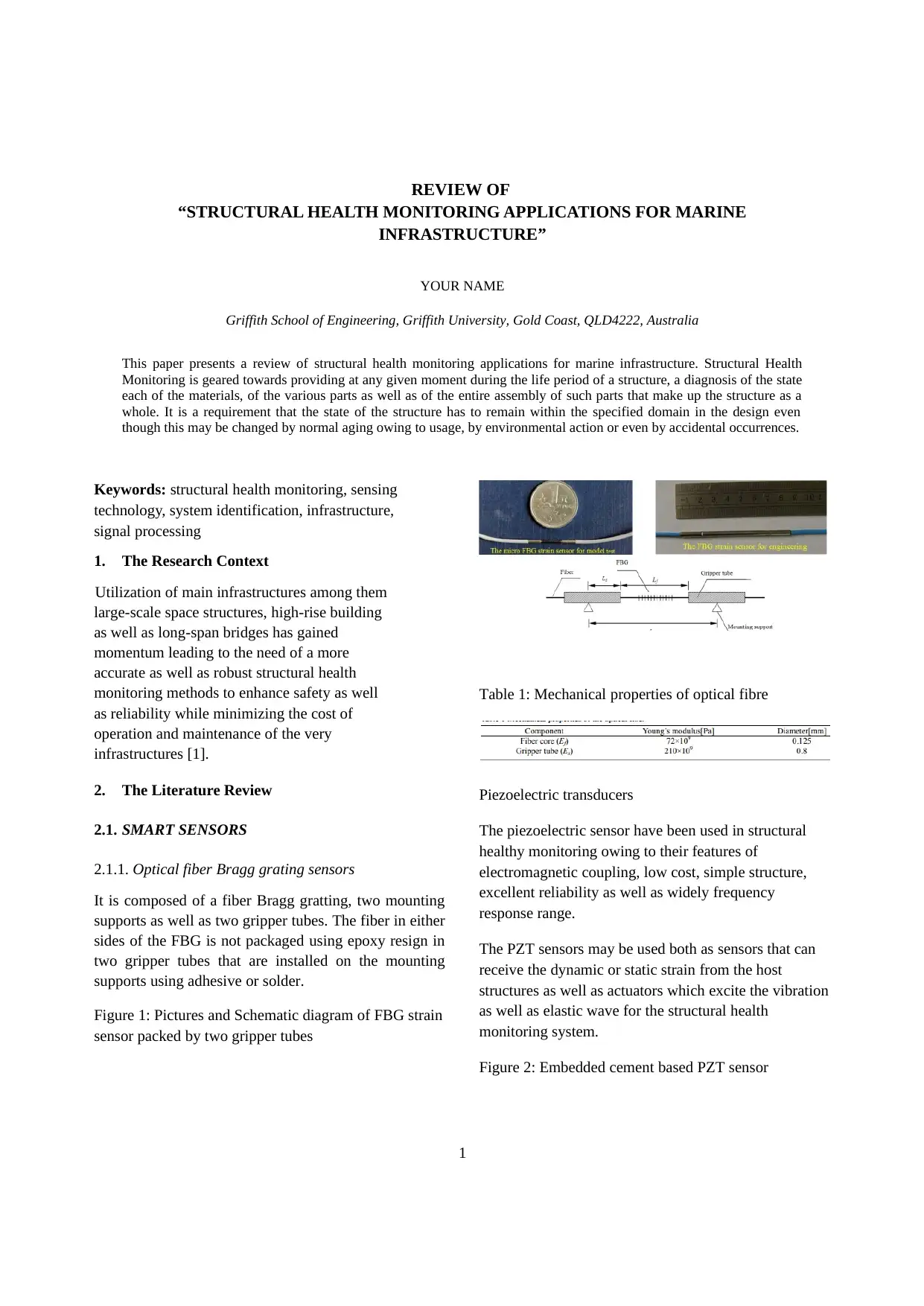
It is composed of a fiber Bragg gratting, two mounting
supports as well as two gripper tubes. The fiber in either
sides of the FBG is not packaged using epoxy resign in
two gripper tubes that are installed on the mounting
supports using adhesive or solder.
Figure 1: Pictures and Schematic diagram of FBG strain
sensor packed by two gripper tubes
Table 1: Mechanical properties of optical fibre
Piezoelectric transducers
The piezoelectric sensor have been used in structural
healthy monitoring owing to their features of
electromagnetic coupling, low cost, simple structure,
excellent reliability as well as widely frequency
response range.
The PZT sensors may be used both as sensors that can
receive the dynamic or static strain from the host
structures as well as actuators which excite the vibration
as well as elastic wave for the structural health
monitoring system.
Figure 2: Embedded cement based PZT sensor
1
tabler-icon-diamond-filled.svg

Paraphrase This Document

Need a fresh take? Get an instant paraphrase of this document with our AI Paraphraser
Document Page
Figure 3: The illustrate of the embedded PZT sensors
GPS receiver
The GPS has become a fundamental tool in the
monitoring of static, dynamic as well as quasi-static
response of infrastructures that are subjected to the
variation of temperature, earthquakes or gusty winds. A
GPS systems is compose d of a single reference station
that comprises dual-frequency GPS receiver installed at
a neighboring fixed point, one or multiple rover stations
as well as control center PC which runs the real time
monitoring software [2].
Figure 4: Results of calibration test
.
2.2. Typical infrastructure applications
A complex software system for structure health
monitoring should meet the following conditions:
Sample data continuously in real-time
Analyze data automatically
Be compatible with the various types of sensors
Be able to auto-warn functions [3].
Have steady methods of data storage for the static and
dynamic data
2.4.1 Long span bridges
The SHM system architecture of the bridge has been
configured into four integrating modules that are
composed of the sensor subsystem, data management
subsystem, data acquisition and transmission subsystem
as well as condition assessment subsystem.
It has five sensor types:
i. FBG strain sensors
ii. GPS revivers
iii. Anemometers
iv. FBG temperature sensors
v. Accelerometers.
3. Data Collection and Presentation
Data collection was done through secondary sources in
which analysis of the existing literature on the topic was
conducted. The gaps in the knowledge was identified
and recommended as future work on the topic.
4. Avenues for Further Work
Non-destructive techniques of evaluation remain a
single most important aspect of the health monitoring in
civil infrastructure. Further research can be done on the
ability of such techniques to identify more than a single
type of damage as a tool in damage detection.
References
1. Zhu, X. and Hao, H., 2012. Development of an
integrated structural health monitoring system
2
Document Page
for bridge structures in operational
conditions. Frontiers of Structural and Civil
Engineering, 6(3), pp.321-333.
2. Li, H.N., Yi, T.H., Ren, L., Li, D.S. and Huo,
L.S., 2014. Reviews on innovations and
applications in structural health monitoring for
infrastructures. Struct. Monit. Maint, 1(1), pp.1-
45.
3. Shaladi, R., Alatshan, F. and Yang, C., 2015.
An overview on the applications of structural
health monitoring using wireless sensor
networks in bridge engineering. In Proc. Int.
Conf. Adv. Sci. Eng. Technol. Nat.
Resources (pp. 4-11).
3
chevron_up_icon
1 out of 3
circle_padding
hide_on_mobile
zoom_out_icon
[object Object]