A Critical Review of Structuralist Economic Theory and its Application
VerifiedAdded on 2023/06/20
|12
|4451
|362
Essay
AI Summary
This essay provides a comprehensive appraisal of structuralist economic theory, focusing on its relevance to the economic development of developing nations. It examines the historical roots of structuralism, particularly within the Economic Commission for Latin America and the Caribbean (ECLAC), and its emphasis on the unique structural impediments faced by these countries. The essay delves into the core concepts of the center-periphery model, highlighting the unequal dynamics of technological diffusion and trade relations. It also discusses the methodological underpinnings of structuralist thought, contrasting it with other schools of economic analysis and emphasizing its focus on non-economic factors. The analysis covers the evolution of structuralist macroeconomics, its critique of traditional economic models, and its policy implications for addressing structural deficiencies and promoting sustainable development. Desklib offers this essay and many more resources for students.
INTRODUCTION....................................................................................................................2
General Methodological Concepts from the Structuralist Economic Tradition.........3
HISTORIA STRUCTURALISTICA......................................................................................3
STRUCTURALIST FOUNDATIONS IN ANCIENT LATIN AMERICA........................6
Structurealism in Macroeconomics.................................................................................7
STRUCTURALISM.................................................................................................................8
CONCLUSIONS.......................................................................................................................8
REFERENCES.......................................................................................................................10
INTRODUCTION
General Methodological Concepts from the Structuralist Economic Tradition.........3
HISTORIA STRUCTURALISTICA......................................................................................3
STRUCTURALIST FOUNDATIONS IN ANCIENT LATIN AMERICA........................6
Structurealism in Macroeconomics.................................................................................7
STRUCTURALISM.................................................................................................................8
CONCLUSIONS.......................................................................................................................8
REFERENCES.......................................................................................................................10
INTRODUCTION

Paraphrase This Document
Need a fresh take? Get an instant paraphrase of this document with our AI Paraphraser
This research offers a new appraisal of structuralist economic theory's core results, focusing on
the premise that a set of distinctive features primarily impede economic progress for
developing nations. An improvement in the economy's health occurs as output moves to more
"modern" (industrialised, technology-intensive) sectors.The phrase "economic structure" refers
to the many elements that influence a country's economic output. Other factors include the
nature and developmental basis of institutions, the degree of market development and
restrictions (or lack thereof), the level of specialisation in international trade, the level of
education among workers, the ownership structure of production factors, and the degree of
market development and restrictions (or lack thereof).
The unique contribution of this study is its synthesis of the aforementioned legacy from a
structuralist perspective. By doing so, we may perhaps gain a better understanding of the
history behind the development of "structuralist macroeconomics" and the role it plays in the
economic development of developing countries. This study documents the evolution of this
type of theory to explain the rising power of the centre relative to the periphery in developing
countries. There is a lot more depth to structuralist philosophy than is shown here, given the
breadth of themes and events covered. This research, then, will look at the theoretical and
methodological underpinnings of structuralist macroeconomics. Not the 'original' structuralism
itself (though the validity of this otherwise potential aim is duly acknowledged), but the
Economic Commission for Latin America and the Caribbean (ECLAC, also known by its Latin
American acronym CEPAL) school of thought is the focus of its analysis.
This publication is notable for its attempt to follow a historical timeline in portraying the
development of the structuralist approach to macroeconomics in Latin America throughout the
1970s and 1980s. It's likely that some authors will disagree with this view, despite the fact that
adequate data exists to support it1. Another important aspect of ECLAC theory is its focus on
the underlying structural problems faced by developing nations over the long run. This
suggests that it may initially be more difficult to examine the macroeconomic components
independently or to identify them, even if this becomes simpler in subsequent stages.This
paper is broken up into an introduction, main body, and conclusion to better serve its purpose.
The first of these talks about where structuralist thought came from and what it means. Section
3 introduces macroeconomic structurealism, while Section 4 addresses neo-structuralism. At
long last, we offer our closing remarks.
General Methodological Concepts from the Structuralist Economic Tradition
the premise that a set of distinctive features primarily impede economic progress for
developing nations. An improvement in the economy's health occurs as output moves to more
"modern" (industrialised, technology-intensive) sectors.The phrase "economic structure" refers
to the many elements that influence a country's economic output. Other factors include the
nature and developmental basis of institutions, the degree of market development and
restrictions (or lack thereof), the level of specialisation in international trade, the level of
education among workers, the ownership structure of production factors, and the degree of
market development and restrictions (or lack thereof).
The unique contribution of this study is its synthesis of the aforementioned legacy from a
structuralist perspective. By doing so, we may perhaps gain a better understanding of the
history behind the development of "structuralist macroeconomics" and the role it plays in the
economic development of developing countries. This study documents the evolution of this
type of theory to explain the rising power of the centre relative to the periphery in developing
countries. There is a lot more depth to structuralist philosophy than is shown here, given the
breadth of themes and events covered. This research, then, will look at the theoretical and
methodological underpinnings of structuralist macroeconomics. Not the 'original' structuralism
itself (though the validity of this otherwise potential aim is duly acknowledged), but the
Economic Commission for Latin America and the Caribbean (ECLAC, also known by its Latin
American acronym CEPAL) school of thought is the focus of its analysis.
This publication is notable for its attempt to follow a historical timeline in portraying the
development of the structuralist approach to macroeconomics in Latin America throughout the
1970s and 1980s. It's likely that some authors will disagree with this view, despite the fact that
adequate data exists to support it1. Another important aspect of ECLAC theory is its focus on
the underlying structural problems faced by developing nations over the long run. This
suggests that it may initially be more difficult to examine the macroeconomic components
independently or to identify them, even if this becomes simpler in subsequent stages.This
paper is broken up into an introduction, main body, and conclusion to better serve its purpose.
The first of these talks about where structuralist thought came from and what it means. Section
3 introduces macroeconomic structurealism, while Section 4 addresses neo-structuralism. At
long last, we offer our closing remarks.
General Methodological Concepts from the Structuralist Economic Tradition
The term "structuralism" can be understood in a wide range of contexts and cultures. As
Blankenburg, Palma, and Tregenna (2008) put it, structuralism is "fundamentally theoretical
approach" that "challenges the methods of both empiricism and positivism," with many of its
discoveries present in several domains throughout the social sciences and humanities. This
methodology is predicated on the idea that complex systems, like the economic system, are
best studied in their whole rather than in isolation. What this means is that the interactions
between elements of the structure are more important than the structure itself.
HISTORIA STRUCTURALISTICA
ECLAC, the group whose publications in the late 1950s gave rise to structuralist theory in
economics, is often mentioned in conjunction with structuralist economics. Arndt (1985)
claims the term was originally used to describe inflation in Latin America. However,
economist Ral Prebisch is often credited as the creator of the structuralist paradigm. Prebisch's
1949 manifesto envisioned an international framework of an industrial hegemonic core and a
reliant agrarian periphery, setting the stage for a distinctive and unequal growth pattern.
Bielschowsky (1998) claims that this approach incorporates four distinct types of research: (i)
a historical approach, based on the centre-periphery opposition; (ii) an international insertion
analysis of Latin America; (iii) a study of the domestic determinants of growth and
technological progress; and (iv) an evaluation of arguments in favour of or against State
intervention.
In their study, Prebisch and Furtado highlight the importance of "structures," whether they be
economic, political, or social. As Sunkel (1970) puts it, "given the structure of the system, the
way it works is determined, which in turn originates the results that the system produces" (p.
526, free translation from Portuguese). Researchers that use a structuralist approach are well-
known in the academic world because of their work pinpointing'structural deficiencies,'
'bottlenecks,' or 'inner dysfunctions' as the root of growth disparities in Latin America. These
'dysfunctions' can be attributed to (i) external factors like poor trade conditions and a lack of
import capacity, or (ii) internal factors like rapid population growth, early urbanisation, and the
growth of the service sector, or even the underdevelopment of agricultural production, the
shrunken size of domestic markets, or the presence of ineffective tributary systems (Street,
1967, p. 55).To formulate formal theories with exact connection to economic policy
suggestions, these components have to be recognised in conjunction with the centre-periphery
construct (and the other related theses) (Seers 1962, pp. 192-193).
Blankenburg, Palma, and Tregenna (2008) put it, structuralism is "fundamentally theoretical
approach" that "challenges the methods of both empiricism and positivism," with many of its
discoveries present in several domains throughout the social sciences and humanities. This
methodology is predicated on the idea that complex systems, like the economic system, are
best studied in their whole rather than in isolation. What this means is that the interactions
between elements of the structure are more important than the structure itself.
HISTORIA STRUCTURALISTICA
ECLAC, the group whose publications in the late 1950s gave rise to structuralist theory in
economics, is often mentioned in conjunction with structuralist economics. Arndt (1985)
claims the term was originally used to describe inflation in Latin America. However,
economist Ral Prebisch is often credited as the creator of the structuralist paradigm. Prebisch's
1949 manifesto envisioned an international framework of an industrial hegemonic core and a
reliant agrarian periphery, setting the stage for a distinctive and unequal growth pattern.
Bielschowsky (1998) claims that this approach incorporates four distinct types of research: (i)
a historical approach, based on the centre-periphery opposition; (ii) an international insertion
analysis of Latin America; (iii) a study of the domestic determinants of growth and
technological progress; and (iv) an evaluation of arguments in favour of or against State
intervention.
In their study, Prebisch and Furtado highlight the importance of "structures," whether they be
economic, political, or social. As Sunkel (1970) puts it, "given the structure of the system, the
way it works is determined, which in turn originates the results that the system produces" (p.
526, free translation from Portuguese). Researchers that use a structuralist approach are well-
known in the academic world because of their work pinpointing'structural deficiencies,'
'bottlenecks,' or 'inner dysfunctions' as the root of growth disparities in Latin America. These
'dysfunctions' can be attributed to (i) external factors like poor trade conditions and a lack of
import capacity, or (ii) internal factors like rapid population growth, early urbanisation, and the
growth of the service sector, or even the underdevelopment of agricultural production, the
shrunken size of domestic markets, or the presence of ineffective tributary systems (Street,
1967, p. 55).To formulate formal theories with exact connection to economic policy
suggestions, these components have to be recognised in conjunction with the centre-periphery
construct (and the other related theses) (Seers 1962, pp. 192-193).
⊘ This is a preview!⊘
Do you want full access?
Subscribe today to unlock all pages.

Trusted by 1+ million students worldwide
Latin American "structuralists" [...] have to be the first indigenous economics movement in a
developing country. The 1960s may see the school garner international attention equivalent to
that of Keynesian economics during the Great Depression era of the 1930s, as the theme of
economic growth becomes fashionable and as the weakness in commodities markets, the
population expansion, and growing economic ambitions look to be chronic.
At this time, two crucial topics require special emphasis. The most important aspect of Latin
American structuralism is its methodology. The first school of thought holds that economic
structuralism owes a great deal to the work of other, more established academics in fields like
anthropology, sociology, psychology, and philosophy, such as Levi-Strauss, Godelier, Piaget,
and Foucault. This school of thought is represented here by authors like Gibson (2003) and
Jamenson (1986). Love (2005) claims that structuralist thinking from Latin America is "one"
of a "family" of structuralist perspectives. In addition, the works of the French'structuralist'
school (Blankenburg, Palma, & Tregenna, 2008), the German historic economics school (Love,
2005), the Marxist school (Sunkel, 1989; Lustig, 1988), and the Keynesian, post-Keynesian,
and neoclassical traditions (Love, 1996; Lustig, 1988) form the basis for ECLAC thought.
When establishing a "new structuralist school," however, the most popular and widely-held
opinion (with which the authors of this study identify) adopts the opposite approach, relying
mainly on the work of Celso Furtado. First, as Furtado puts it, Latin American structuralism is
"very different from its French homonym."French structuralists emphasise the synchrony axis
in social analysis and develop a "syntax" of inconsistencies in social institutions, although
these concepts have nothing to do with what may be understood as "structuralist" in
economics. Economic structuralism is a school of thought that emerged in the first part of the
1950s from the work of Latin American economists. Its principal objective was to prove the
importance of so-called "non-economic elements" in macroeconomic models. Because of their
considerable influence on economic variables' behaviour, and because these variables might
undergo radical changes during social transitions or when the analytical time horizon is
expanded, these features merit in-depth study. This realisation is particularly useful in contexts
where there is social and technological variety, such as developing countries (Furtado, 2000, p.
95, free translation from Portuguese).
Since non-economic factors integrate the structural matrix of the model with which the
economist works3, those who place a premium on studying such parameters are known as
"structuralists," and according to Fonseca (2009), "not only does ECLAC structuralism take as
developing country. The 1960s may see the school garner international attention equivalent to
that of Keynesian economics during the Great Depression era of the 1930s, as the theme of
economic growth becomes fashionable and as the weakness in commodities markets, the
population expansion, and growing economic ambitions look to be chronic.
At this time, two crucial topics require special emphasis. The most important aspect of Latin
American structuralism is its methodology. The first school of thought holds that economic
structuralism owes a great deal to the work of other, more established academics in fields like
anthropology, sociology, psychology, and philosophy, such as Levi-Strauss, Godelier, Piaget,
and Foucault. This school of thought is represented here by authors like Gibson (2003) and
Jamenson (1986). Love (2005) claims that structuralist thinking from Latin America is "one"
of a "family" of structuralist perspectives. In addition, the works of the French'structuralist'
school (Blankenburg, Palma, & Tregenna, 2008), the German historic economics school (Love,
2005), the Marxist school (Sunkel, 1989; Lustig, 1988), and the Keynesian, post-Keynesian,
and neoclassical traditions (Love, 1996; Lustig, 1988) form the basis for ECLAC thought.
When establishing a "new structuralist school," however, the most popular and widely-held
opinion (with which the authors of this study identify) adopts the opposite approach, relying
mainly on the work of Celso Furtado. First, as Furtado puts it, Latin American structuralism is
"very different from its French homonym."French structuralists emphasise the synchrony axis
in social analysis and develop a "syntax" of inconsistencies in social institutions, although
these concepts have nothing to do with what may be understood as "structuralist" in
economics. Economic structuralism is a school of thought that emerged in the first part of the
1950s from the work of Latin American economists. Its principal objective was to prove the
importance of so-called "non-economic elements" in macroeconomic models. Because of their
considerable influence on economic variables' behaviour, and because these variables might
undergo radical changes during social transitions or when the analytical time horizon is
expanded, these features merit in-depth study. This realisation is particularly useful in contexts
where there is social and technological variety, such as developing countries (Furtado, 2000, p.
95, free translation from Portuguese).
Since non-economic factors integrate the structural matrix of the model with which the
economist works3, those who place a premium on studying such parameters are known as
"structuralists," and according to Fonseca (2009), "not only does ECLAC structuralism take as
Paraphrase This Document
Need a fresh take? Get an instant paraphrase of this document with our AI Paraphraser
its own the ambition to embrace non-economic variables in its models and theories, but also
makes it its exact reason for being, its brand or differential in comparison to other economic
schools,"
According to Bielschowsky (1998), the term "structuralism" initially referred to a synchronic
or non-historical analytical tool in linguistics and anthropology, two major branches of the
social sciences. In contrast, structuralism's economic analysis focuses closely on the
behaviours of social actors and the evolution of institutions across time, giving particular
attention to the passage of time.Second, there is little doubt that the structuralist movement in
Latin America had a significant impact on the regional economy. As such, Max Weber and
François Perroux are the primary recipients of the book's dedication (Fonseca, 2009, p. 871).
According to Furtado (2000, p. 94), the term "structure" is similar to the classic definition of
the term provided by the French author Perroux: "Proportions et relations qui caractérisent um
ensemble économique localisé dans le temps et dans l'espace4" (Pour um approfondissement
de la notion de strucure, 1939). As a matter of fact, while it does not completely abandon this
theoretical notion, it acquires a new meaning upon incorporation into the structuralist discourse
due to its conceptual recomposition and the introduction of historical matters and regional
specificities into the analysis (Mallorqun, 1999), not to mention the introduction of social
matters5.
Furthermore, Furtado (2000) outlines what could be considered the structuralist school's
ancestry: on the one hand, there is Marxism, from which he claims to have derived the concept
of "structures." To rephrase, the 'behaviour of economic variables' is described by'social
structures,' which are the focus of structuralist study. Therefore, it is crucial for economic
research to account for the time-varying structural matrices (which accompany the social
division of work) in economic models.
Instead, he argues that economic models are constructed in a way that is eerily similar to how
Weber builds his "ideal types":The economic models used by the economist share many
similarities with Max Weber's "ideal types" in terms of their conceptualization. These are
models (which the economist attempts to formalise) of parts of social reality, simple or
complex, in which all parts are precisely stated, i.e., have precise logical significance. Thus, in
pricing theory, the economist uses a conceptualization of the market that has the benefit of
being easily explicable but is nevertheless an abstraction from reality. At this degree of
generalisation, the market model may not be reflective of any given situation; yet, its value as
makes it its exact reason for being, its brand or differential in comparison to other economic
schools,"
According to Bielschowsky (1998), the term "structuralism" initially referred to a synchronic
or non-historical analytical tool in linguistics and anthropology, two major branches of the
social sciences. In contrast, structuralism's economic analysis focuses closely on the
behaviours of social actors and the evolution of institutions across time, giving particular
attention to the passage of time.Second, there is little doubt that the structuralist movement in
Latin America had a significant impact on the regional economy. As such, Max Weber and
François Perroux are the primary recipients of the book's dedication (Fonseca, 2009, p. 871).
According to Furtado (2000, p. 94), the term "structure" is similar to the classic definition of
the term provided by the French author Perroux: "Proportions et relations qui caractérisent um
ensemble économique localisé dans le temps et dans l'espace4" (Pour um approfondissement
de la notion de strucure, 1939). As a matter of fact, while it does not completely abandon this
theoretical notion, it acquires a new meaning upon incorporation into the structuralist discourse
due to its conceptual recomposition and the introduction of historical matters and regional
specificities into the analysis (Mallorqun, 1999), not to mention the introduction of social
matters5.
Furthermore, Furtado (2000) outlines what could be considered the structuralist school's
ancestry: on the one hand, there is Marxism, from which he claims to have derived the concept
of "structures." To rephrase, the 'behaviour of economic variables' is described by'social
structures,' which are the focus of structuralist study. Therefore, it is crucial for economic
research to account for the time-varying structural matrices (which accompany the social
division of work) in economic models.
Instead, he argues that economic models are constructed in a way that is eerily similar to how
Weber builds his "ideal types":The economic models used by the economist share many
similarities with Max Weber's "ideal types" in terms of their conceptualization. These are
models (which the economist attempts to formalise) of parts of social reality, simple or
complex, in which all parts are precisely stated, i.e., have precise logical significance. Thus, in
pricing theory, the economist uses a conceptualization of the market that has the benefit of
being easily explicable but is nevertheless an abstraction from reality. At this degree of
generalisation, the market model may not be reflective of any given situation; yet, its value as
an analytical tool cannot be denied (Furtado, 2000, p. 94; free translation from Portuguese).
STRUCTURALIST FOUNDATIONS IN ANCIENT LATIN AMERICA
Central to the growth of Latin American structuralism is the 'centre-periphery' basic
relationship, which is historically established by the expansion of technology across the global
economy. The dominant industrial core and the dependent agricultural periphery are the two
main components of the international relations system. This perspective recognises, either
implicitly or explicitly, the existence of a different and unequal pattern of development, in
contrast to the comparative advantage (Heckscher-Ohlin-Samuelson) theory of international
trade.
The essential idea is the acknowledgement of uneven technological diffusion. Generally
speaking, it is understood that such progress, or the indirect production processes it generates,
rapidly pervades the whole industrial apparatus of the core nations. This is because an increase
in real wages caused by economic growth and a lack of employees protected by strong labour
unions drives the research and development of new technologies that may substitute capital for
human labour. So, wage increases cause a larger concentration of economic activity in capital,
initially in certain industries and then generally. So, as the share of capital in the economy
grows, so do wages and productivity, allowing for accumulation-consistent wage levels to be
sustained. Furthermore, as productive resources may be moved from one industry to another
with relative ease, wages in the economy as a whole tend to level off (Rodriguez, 2009).
In contrast, export sectors for primary goods and a small number of export-related economic
activities typically start from a more primitive state of affairs and only after a period of
'outward development' do new techniques begin to be implemented, allowing them to coexist
with the more primitive export sectors. At this point, the generating structure on the perimeter
gains two crucial features. While its demand for goods and services is rising and diversifying,
much of the country's economic capacity goes towards shipping out raw materials. Therefore,
imports play a significant role in helping the country function. Specialisation in primary-
exports products has direct ramifications for the new development pattern that emerges when
industry emerges as the principal source of economic vitality (Rodriguez, 2009). The presence
of low-productivity activities and high-productivity sectors, such as export-oriented businesses,
makes this structure heterogeneous or even regressive. Compared to the core, which is both
varied (consisting of many different types of economic activity) and homogeneous (where
STRUCTURALIST FOUNDATIONS IN ANCIENT LATIN AMERICA
Central to the growth of Latin American structuralism is the 'centre-periphery' basic
relationship, which is historically established by the expansion of technology across the global
economy. The dominant industrial core and the dependent agricultural periphery are the two
main components of the international relations system. This perspective recognises, either
implicitly or explicitly, the existence of a different and unequal pattern of development, in
contrast to the comparative advantage (Heckscher-Ohlin-Samuelson) theory of international
trade.
The essential idea is the acknowledgement of uneven technological diffusion. Generally
speaking, it is understood that such progress, or the indirect production processes it generates,
rapidly pervades the whole industrial apparatus of the core nations. This is because an increase
in real wages caused by economic growth and a lack of employees protected by strong labour
unions drives the research and development of new technologies that may substitute capital for
human labour. So, wage increases cause a larger concentration of economic activity in capital,
initially in certain industries and then generally. So, as the share of capital in the economy
grows, so do wages and productivity, allowing for accumulation-consistent wage levels to be
sustained. Furthermore, as productive resources may be moved from one industry to another
with relative ease, wages in the economy as a whole tend to level off (Rodriguez, 2009).
In contrast, export sectors for primary goods and a small number of export-related economic
activities typically start from a more primitive state of affairs and only after a period of
'outward development' do new techniques begin to be implemented, allowing them to coexist
with the more primitive export sectors. At this point, the generating structure on the perimeter
gains two crucial features. While its demand for goods and services is rising and diversifying,
much of the country's economic capacity goes towards shipping out raw materials. Therefore,
imports play a significant role in helping the country function. Specialisation in primary-
exports products has direct ramifications for the new development pattern that emerges when
industry emerges as the principal source of economic vitality (Rodriguez, 2009). The presence
of low-productivity activities and high-productivity sectors, such as export-oriented businesses,
makes this structure heterogeneous or even regressive. Compared to the core, which is both
varied (consisting of many different types of economic activity) and homogeneous (where
⊘ This is a preview!⊘
Do you want full access?
Subscribe today to unlock all pages.
Trusted by 1+ million students worldwide
worker productivity is generally the same everywhere), the periphery's productive structure is
both specialised and diverse.
Structurealism in Macroeconomics
Academic economics literature has provided structuralist theories that have inspired studies
using macroeconomic models. The phrase "structuralist macroeconomics" is used to cover a
broad variety of economic theory, from basic variants on the "two sectors" model to more
complex multi-sectorial ones. Lance Taylor, it is generally agreed, is the scholar who, drawing
on the work of several other scholars, created structuralist macroeconomics. This approach
promotes the worth of institutions and the equality of wealth across sectors and populations9.
Jamenson (1986) cites Taylor (1979, p. 2) as the primary methodological tenet of the approach,
which states, "Economists have known for a long time that mathematical formulations of their
problems help clear away logical and metaphysical cobwebs." In the aforementioned research,
formal models are developed based on characteristics (or "stylized facts") that point to key
aspects of underdevelopment. Thus, the method's defining element is spelt out: using
mathematics to define the "stylized facts" typical of poor nations.
Structuralism relies on the growth of this language in order to engage with other economic
approaches and magnify the degree of specificity of its concepts. Because of this, it may be
presented in a formal manner, fitting in with the mode of reasoning typical of economic
thought, notably that of the Anglo-American tradition. It also diversifies or consolidates
understanding of the framework and mechanisms of international systems. Regarding the
latter, Dutt (1994) argues that the employment of mathematical instruments allows for the
delineation of precise circumstances under which certain discoveries are reached. For instance,
contrary to the verbal analysis according to which the relations between 'central' and
'peripheral' countries, the outcome is unequal development, the growth of mathematical models
that include 'North-South' trade demonstrates that, while such an outcome is possible, it is by
no means inevitable.
In addition to advancements in the mathematical instruments utilised in this formal analysis,
advances in our capacity to articulate the peculiarities of underdevelopment10 have also been
made. One of Taylor's (1979) key publications describes these "stylized facts" as characteristic
of this scenario:
STRUCTURALISM
both specialised and diverse.
Structurealism in Macroeconomics
Academic economics literature has provided structuralist theories that have inspired studies
using macroeconomic models. The phrase "structuralist macroeconomics" is used to cover a
broad variety of economic theory, from basic variants on the "two sectors" model to more
complex multi-sectorial ones. Lance Taylor, it is generally agreed, is the scholar who, drawing
on the work of several other scholars, created structuralist macroeconomics. This approach
promotes the worth of institutions and the equality of wealth across sectors and populations9.
Jamenson (1986) cites Taylor (1979, p. 2) as the primary methodological tenet of the approach,
which states, "Economists have known for a long time that mathematical formulations of their
problems help clear away logical and metaphysical cobwebs." In the aforementioned research,
formal models are developed based on characteristics (or "stylized facts") that point to key
aspects of underdevelopment. Thus, the method's defining element is spelt out: using
mathematics to define the "stylized facts" typical of poor nations.
Structuralism relies on the growth of this language in order to engage with other economic
approaches and magnify the degree of specificity of its concepts. Because of this, it may be
presented in a formal manner, fitting in with the mode of reasoning typical of economic
thought, notably that of the Anglo-American tradition. It also diversifies or consolidates
understanding of the framework and mechanisms of international systems. Regarding the
latter, Dutt (1994) argues that the employment of mathematical instruments allows for the
delineation of precise circumstances under which certain discoveries are reached. For instance,
contrary to the verbal analysis according to which the relations between 'central' and
'peripheral' countries, the outcome is unequal development, the growth of mathematical models
that include 'North-South' trade demonstrates that, while such an outcome is possible, it is by
no means inevitable.
In addition to advancements in the mathematical instruments utilised in this formal analysis,
advances in our capacity to articulate the peculiarities of underdevelopment10 have also been
made. One of Taylor's (1979) key publications describes these "stylized facts" as characteristic
of this scenario:
STRUCTURALISM
Paraphrase This Document
Need a fresh take? Get an instant paraphrase of this document with our AI Paraphraser
As the 1970s progressed, the influence of structuralist concepts waned. The necessity to
advance liberalisation and stabilisation procedures in line with the ideas of the 'Washington
Consensus' also gained traction, as did the 'Asian miracle'-inspired policy of export promotion
and import substitution. But in stark contrast to this autumn, neoliberalism rapidly became the
dominant worldview in both the academic and political spheres. The rapid ascension of the
discipline may be attributed to a number of causes, including the United States' hegemonic
position in academic circles and the logical coherence and methodological unity of the
neoliberal approach.
CONCLUSIONS
The structuralist approach has found application in a wide range of academic fields. ECLAC is
inseparable from the development of neoclassical economics as a school of thought. This
approach acknowledges that institutional and production frameworks that constitute stumbling
blocks for emerging countries are different from those in industrialised nations. When this
happens, they play a crucial role in embracing, promoting, and implementing technological
progress as a foundational method for overcoming laggardness.
Given its stance in opposition to the free functioning of market forces, this approach may
represent an actual Latin American addition to economic theory. Progress has been made
because the historical-structural approach has been honed and applied, and because analyses
have been confirmed by taking into account specific characteristics that both determine and are
determined by historical, economic, and social transformations (on a national and international
scale). When including historically contingent analyses with non-reductionist, non-
mechanistic, and non-deterministic qualities, such an application determines the concept of a
world that takes into account more than simply merely economic factors. We owe a debt of
gratitude to its pioneering contribution to our understanding of growth and underdevelopment
as interdependent processes in a globally integrated economy and of the crucial role of the
State in these dynamics.It is crucial to stress the importance of this approach from the
standpoint of advancing economic theory and policy. One indicator of its relevance is the
broad adoption of the underdevelopment theory developed by ECLAC in Latin America. In
Brazil, not just politicians but even businesspeople and scientists shared this trait (Colistete,
2001). However, as neoliberalism gained power in the 1970s, its influence began to decline.
advance liberalisation and stabilisation procedures in line with the ideas of the 'Washington
Consensus' also gained traction, as did the 'Asian miracle'-inspired policy of export promotion
and import substitution. But in stark contrast to this autumn, neoliberalism rapidly became the
dominant worldview in both the academic and political spheres. The rapid ascension of the
discipline may be attributed to a number of causes, including the United States' hegemonic
position in academic circles and the logical coherence and methodological unity of the
neoliberal approach.
CONCLUSIONS
The structuralist approach has found application in a wide range of academic fields. ECLAC is
inseparable from the development of neoclassical economics as a school of thought. This
approach acknowledges that institutional and production frameworks that constitute stumbling
blocks for emerging countries are different from those in industrialised nations. When this
happens, they play a crucial role in embracing, promoting, and implementing technological
progress as a foundational method for overcoming laggardness.
Given its stance in opposition to the free functioning of market forces, this approach may
represent an actual Latin American addition to economic theory. Progress has been made
because the historical-structural approach has been honed and applied, and because analyses
have been confirmed by taking into account specific characteristics that both determine and are
determined by historical, economic, and social transformations (on a national and international
scale). When including historically contingent analyses with non-reductionist, non-
mechanistic, and non-deterministic qualities, such an application determines the concept of a
world that takes into account more than simply merely economic factors. We owe a debt of
gratitude to its pioneering contribution to our understanding of growth and underdevelopment
as interdependent processes in a globally integrated economy and of the crucial role of the
State in these dynamics.It is crucial to stress the importance of this approach from the
standpoint of advancing economic theory and policy. One indicator of its relevance is the
broad adoption of the underdevelopment theory developed by ECLAC in Latin America. In
Brazil, not just politicians but even businesspeople and scientists shared this trait (Colistete,
2001). However, as neoliberalism gained power in the 1970s, its influence began to decline.

REFERENCES
• ARNDT, H. W. (1975). "The origins of structuralism". World Development, v. 13, n. 2, 151-
159.
• BIELSCHOWSKY, R. (1998). Cincuenta años del pensamiento de la CEPAL: una reseña.
• ARNDT, H. W. (1975). "The origins of structuralism". World Development, v. 13, n. 2, 151-
159.
• BIELSCHOWSKY, R. (1998). Cincuenta años del pensamiento de la CEPAL: una reseña.
⊘ This is a preview!⊘
Do you want full access?
Subscribe today to unlock all pages.
Trusted by 1+ million students worldwide
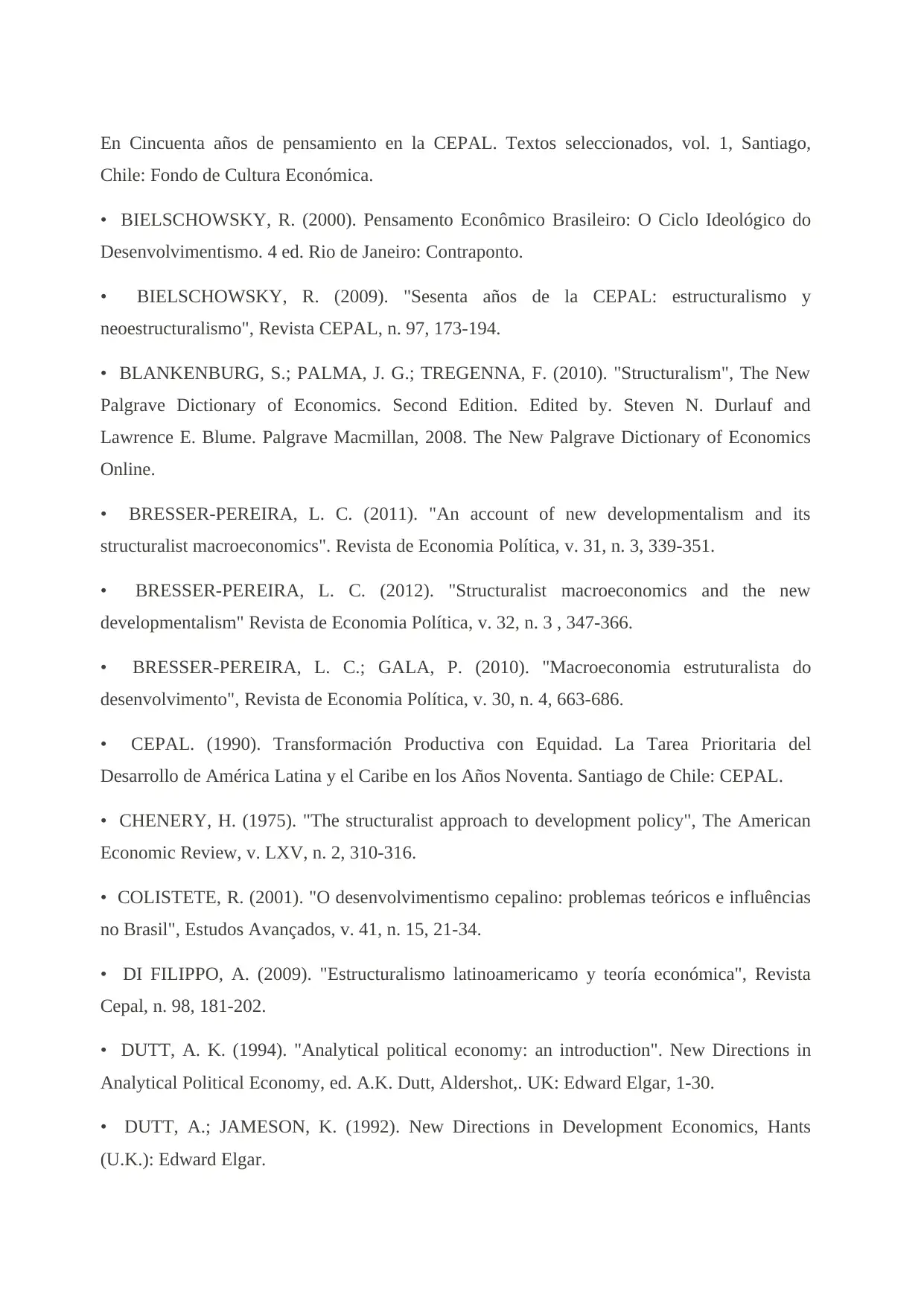
En Cincuenta años de pensamiento en la CEPAL. Textos seleccionados, vol. 1, Santiago,
Chile: Fondo de Cultura Económica.
• BIELSCHOWSKY, R. (2000). Pensamento Econômico Brasileiro: O Ciclo Ideológico do
Desenvolvimentismo. 4 ed. Rio de Janeiro: Contraponto.
• BIELSCHOWSKY, R. (2009). "Sesenta años de la CEPAL: estructuralismo y
neoestructuralismo", Revista CEPAL, n. 97, 173-194.
• BLANKENBURG, S.; PALMA, J. G.; TREGENNA, F. (2010). "Structuralism", The New
Palgrave Dictionary of Economics. Second Edition. Edited by. Steven N. Durlauf and
Lawrence E. Blume. Palgrave Macmillan, 2008. The New Palgrave Dictionary of Economics
Online.
• BRESSER-PEREIRA, L. C. (2011). "An account of new developmentalism and its
structuralist macroeconomics". Revista de Economia Política, v. 31, n. 3, 339-351.
• BRESSER-PEREIRA, L. C. (2012). "Structuralist macroeconomics and the new
developmentalism" Revista de Economia Política, v. 32, n. 3 , 347-366.
• BRESSER-PEREIRA, L. C.; GALA, P. (2010). "Macroeconomia estruturalista do
desenvolvimento", Revista de Economia Política, v. 30, n. 4, 663-686.
• CEPAL. (1990). Transformación Productiva con Equidad. La Tarea Prioritaria del
Desarrollo de América Latina y el Caribe en los Años Noventa. Santiago de Chile: CEPAL.
• CHENERY, H. (1975). "The structuralist approach to development policy", The American
Economic Review, v. LXV, n. 2, 310-316.
• COLISTETE, R. (2001). "O desenvolvimentismo cepalino: problemas teóricos e influências
no Brasil", Estudos Avançados, v. 41, n. 15, 21-34.
• DI FILIPPO, A. (2009). "Estructuralismo latinoamericamo y teoría económica", Revista
Cepal, n. 98, 181-202.
• DUTT, A. K. (1994). "Analytical political economy: an introduction". New Directions in
Analytical Political Economy, ed. A.K. Dutt, Aldershot,. UK: Edward Elgar, 1-30.
• DUTT, A.; JAMESON, K. (1992). New Directions in Development Economics, Hants
(U.K.): Edward Elgar.
Chile: Fondo de Cultura Económica.
• BIELSCHOWSKY, R. (2000). Pensamento Econômico Brasileiro: O Ciclo Ideológico do
Desenvolvimentismo. 4 ed. Rio de Janeiro: Contraponto.
• BIELSCHOWSKY, R. (2009). "Sesenta años de la CEPAL: estructuralismo y
neoestructuralismo", Revista CEPAL, n. 97, 173-194.
• BLANKENBURG, S.; PALMA, J. G.; TREGENNA, F. (2010). "Structuralism", The New
Palgrave Dictionary of Economics. Second Edition. Edited by. Steven N. Durlauf and
Lawrence E. Blume. Palgrave Macmillan, 2008. The New Palgrave Dictionary of Economics
Online.
• BRESSER-PEREIRA, L. C. (2011). "An account of new developmentalism and its
structuralist macroeconomics". Revista de Economia Política, v. 31, n. 3, 339-351.
• BRESSER-PEREIRA, L. C. (2012). "Structuralist macroeconomics and the new
developmentalism" Revista de Economia Política, v. 32, n. 3 , 347-366.
• BRESSER-PEREIRA, L. C.; GALA, P. (2010). "Macroeconomia estruturalista do
desenvolvimento", Revista de Economia Política, v. 30, n. 4, 663-686.
• CEPAL. (1990). Transformación Productiva con Equidad. La Tarea Prioritaria del
Desarrollo de América Latina y el Caribe en los Años Noventa. Santiago de Chile: CEPAL.
• CHENERY, H. (1975). "The structuralist approach to development policy", The American
Economic Review, v. LXV, n. 2, 310-316.
• COLISTETE, R. (2001). "O desenvolvimentismo cepalino: problemas teóricos e influências
no Brasil", Estudos Avançados, v. 41, n. 15, 21-34.
• DI FILIPPO, A. (2009). "Estructuralismo latinoamericamo y teoría económica", Revista
Cepal, n. 98, 181-202.
• DUTT, A. K. (1994). "Analytical political economy: an introduction". New Directions in
Analytical Political Economy, ed. A.K. Dutt, Aldershot,. UK: Edward Elgar, 1-30.
• DUTT, A.; JAMESON, K. (1992). New Directions in Development Economics, Hants
(U.K.): Edward Elgar.
Paraphrase This Document
Need a fresh take? Get an instant paraphrase of this document with our AI Paraphraser
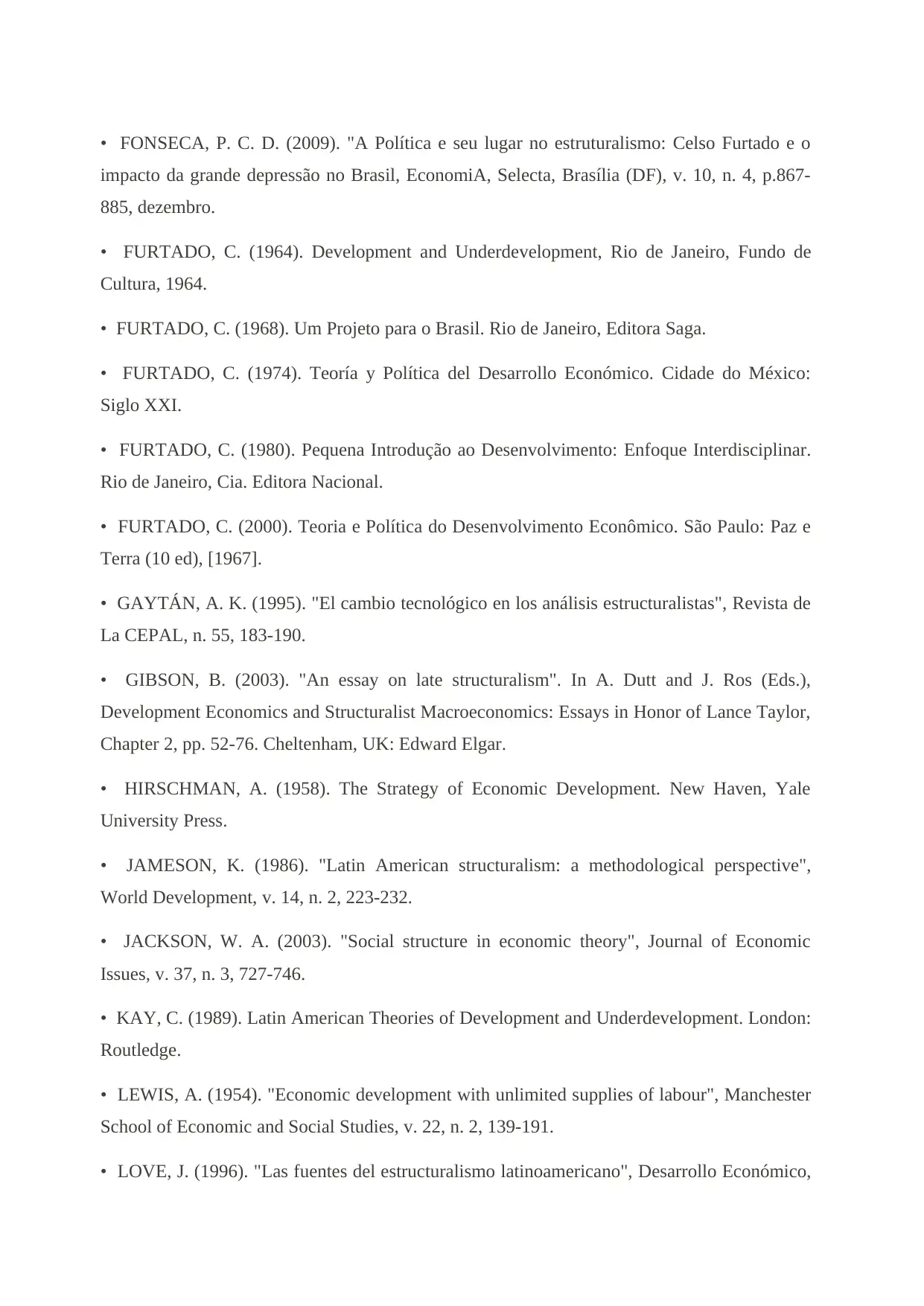
• FONSECA, P. C. D. (2009). "A Política e seu lugar no estruturalismo: Celso Furtado e o
impacto da grande depressão no Brasil, EconomiA, Selecta, Brasília (DF), v. 10, n. 4, p.867-
885, dezembro.
• FURTADO, C. (1964). Development and Underdevelopment, Rio de Janeiro, Fundo de
Cultura, 1964.
• FURTADO, C. (1968). Um Projeto para o Brasil. Rio de Janeiro, Editora Saga.
• FURTADO, C. (1974). Teoría y Política del Desarrollo Económico. Cidade do México:
Siglo XXI.
• FURTADO, C. (1980). Pequena Introdução ao Desenvolvimento: Enfoque Interdisciplinar.
Rio de Janeiro, Cia. Editora Nacional.
• FURTADO, C. (2000). Teoria e Política do Desenvolvimento Econômico. São Paulo: Paz e
Terra (10 ed), [1967].
• GAYTÁN, A. K. (1995). "El cambio tecnológico en los análisis estructuralistas", Revista de
La CEPAL, n. 55, 183-190.
• GIBSON, B. (2003). "An essay on late structuralism". In A. Dutt and J. Ros (Eds.),
Development Economics and Structuralist Macroeconomics: Essays in Honor of Lance Taylor,
Chapter 2, pp. 52-76. Cheltenham, UK: Edward Elgar.
• HIRSCHMAN, A. (1958). The Strategy of Economic Development. New Haven, Yale
University Press.
• JAMESON, K. (1986). "Latin American structuralism: a methodological perspective",
World Development, v. 14, n. 2, 223-232.
• JACKSON, W. A. (2003). "Social structure in economic theory", Journal of Economic
Issues, v. 37, n. 3, 727-746.
• KAY, C. (1989). Latin American Theories of Development and Underdevelopment. London:
Routledge.
• LEWIS, A. (1954). "Economic development with unlimited supplies of labour", Manchester
School of Economic and Social Studies, v. 22, n. 2, 139-191.
• LOVE, J. (1996). "Las fuentes del estructuralismo latinoamericano", Desarrollo Económico,
impacto da grande depressão no Brasil, EconomiA, Selecta, Brasília (DF), v. 10, n. 4, p.867-
885, dezembro.
• FURTADO, C. (1964). Development and Underdevelopment, Rio de Janeiro, Fundo de
Cultura, 1964.
• FURTADO, C. (1968). Um Projeto para o Brasil. Rio de Janeiro, Editora Saga.
• FURTADO, C. (1974). Teoría y Política del Desarrollo Económico. Cidade do México:
Siglo XXI.
• FURTADO, C. (1980). Pequena Introdução ao Desenvolvimento: Enfoque Interdisciplinar.
Rio de Janeiro, Cia. Editora Nacional.
• FURTADO, C. (2000). Teoria e Política do Desenvolvimento Econômico. São Paulo: Paz e
Terra (10 ed), [1967].
• GAYTÁN, A. K. (1995). "El cambio tecnológico en los análisis estructuralistas", Revista de
La CEPAL, n. 55, 183-190.
• GIBSON, B. (2003). "An essay on late structuralism". In A. Dutt and J. Ros (Eds.),
Development Economics and Structuralist Macroeconomics: Essays in Honor of Lance Taylor,
Chapter 2, pp. 52-76. Cheltenham, UK: Edward Elgar.
• HIRSCHMAN, A. (1958). The Strategy of Economic Development. New Haven, Yale
University Press.
• JAMESON, K. (1986). "Latin American structuralism: a methodological perspective",
World Development, v. 14, n. 2, 223-232.
• JACKSON, W. A. (2003). "Social structure in economic theory", Journal of Economic
Issues, v. 37, n. 3, 727-746.
• KAY, C. (1989). Latin American Theories of Development and Underdevelopment. London:
Routledge.
• LEWIS, A. (1954). "Economic development with unlimited supplies of labour", Manchester
School of Economic and Social Studies, v. 22, n. 2, 139-191.
• LOVE, J. (1996). "Las fuentes del estructuralismo latinoamericano", Desarrollo Económico,
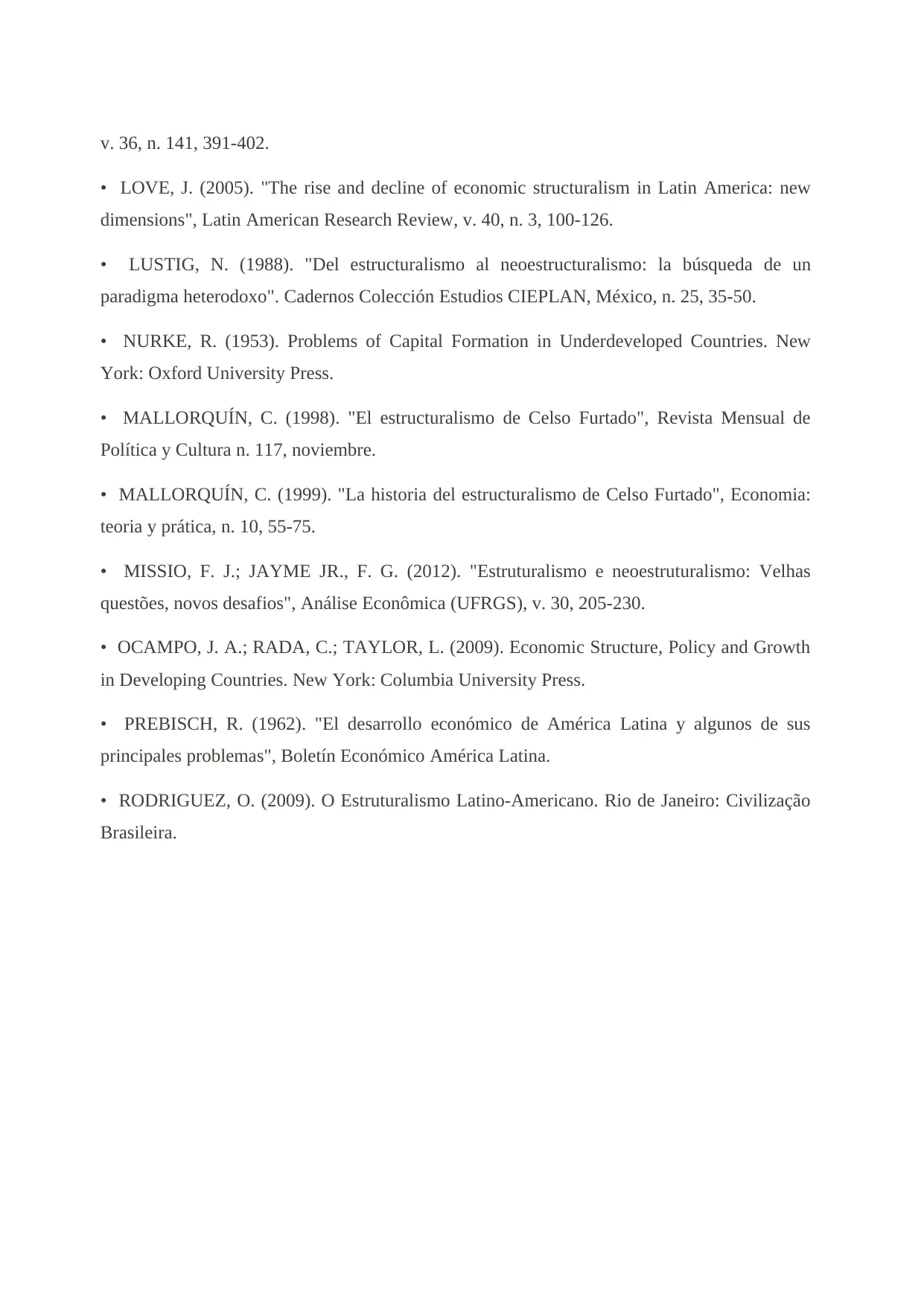
v. 36, n. 141, 391-402.
• LOVE, J. (2005). "The rise and decline of economic structuralism in Latin America: new
dimensions", Latin American Research Review, v. 40, n. 3, 100-126.
• LUSTIG, N. (1988). "Del estructuralismo al neoestructuralismo: la búsqueda de un
paradigma heterodoxo". Cadernos Colección Estudios CIEPLAN, México, n. 25, 35-50.
• NURKE, R. (1953). Problems of Capital Formation in Underdeveloped Countries. New
York: Oxford University Press.
• MALLORQUÍN, C. (1998). "El estructuralismo de Celso Furtado", Revista Mensual de
Política y Cultura n. 117, noviembre.
• MALLORQUÍN, C. (1999). "La historia del estructuralismo de Celso Furtado", Economia:
teoria y prática, n. 10, 55-75.
• MISSIO, F. J.; JAYME JR., F. G. (2012). "Estruturalismo e neoestruturalismo: Velhas
questões, novos desafios", Análise Econômica (UFRGS), v. 30, 205-230.
• OCAMPO, J. A.; RADA, C.; TAYLOR, L. (2009). Economic Structure, Policy and Growth
in Developing Countries. New York: Columbia University Press.
• PREBISCH, R. (1962). "El desarrollo económico de América Latina y algunos de sus
principales problemas", Boletín Económico América Latina.
• RODRIGUEZ, O. (2009). O Estruturalismo Latino-Americano. Rio de Janeiro: Civilização
Brasileira.
• LOVE, J. (2005). "The rise and decline of economic structuralism in Latin America: new
dimensions", Latin American Research Review, v. 40, n. 3, 100-126.
• LUSTIG, N. (1988). "Del estructuralismo al neoestructuralismo: la búsqueda de un
paradigma heterodoxo". Cadernos Colección Estudios CIEPLAN, México, n. 25, 35-50.
• NURKE, R. (1953). Problems of Capital Formation in Underdeveloped Countries. New
York: Oxford University Press.
• MALLORQUÍN, C. (1998). "El estructuralismo de Celso Furtado", Revista Mensual de
Política y Cultura n. 117, noviembre.
• MALLORQUÍN, C. (1999). "La historia del estructuralismo de Celso Furtado", Economia:
teoria y prática, n. 10, 55-75.
• MISSIO, F. J.; JAYME JR., F. G. (2012). "Estruturalismo e neoestruturalismo: Velhas
questões, novos desafios", Análise Econômica (UFRGS), v. 30, 205-230.
• OCAMPO, J. A.; RADA, C.; TAYLOR, L. (2009). Economic Structure, Policy and Growth
in Developing Countries. New York: Columbia University Press.
• PREBISCH, R. (1962). "El desarrollo económico de América Latina y algunos de sus
principales problemas", Boletín Económico América Latina.
• RODRIGUEZ, O. (2009). O Estruturalismo Latino-Americano. Rio de Janeiro: Civilização
Brasileira.
⊘ This is a preview!⊘
Do you want full access?
Subscribe today to unlock all pages.
Trusted by 1+ million students worldwide

1 out of 12


Related Documents


Your All-in-One AI-Powered Toolkit for Academic Success.
+13062052269
info@desklib.com
Available 24*7 on WhatsApp / Email
![[object Object]](/_next/static/media/star-bottom.7253800d.svg)
Unlock your academic potential
Copyright © 2020–2025 A2Z Services. All Rights Reserved. Developed and managed by ZUCOL.