General Structure of a Data Analysis and Visualisation Project Report

Verified

Added on  2019/10/16

|2
|971
|604
Report
AI Summary
This document provides a detailed guide on structuring project reports related to data analysis and visualisation. It outlines a general structure, emphasizing the importance of adapting it to the specific project requirements. The guide breaks down the report into three main sections: Introduction and Background (25%-50%), Methods and Implementation (25%-50%), and Results and Conclusions (25%-50%). Each section includes suggested headings, such as Abstract, Executive Summary, Literature Review, Design, Implementation, Results, and Conclusions, with explanations on what content should be included. The document stresses the importance of clear presentation, verifiable objectives, and demonstrating a thorough understanding of the subject matter, including the use of diagrams and data presentation techniques. The document also emphasizes the importance of explaining results rather than simply presenting them. This resource is designed to help students create comprehensive and well-structured reports for their data analysis projects.
Document Page
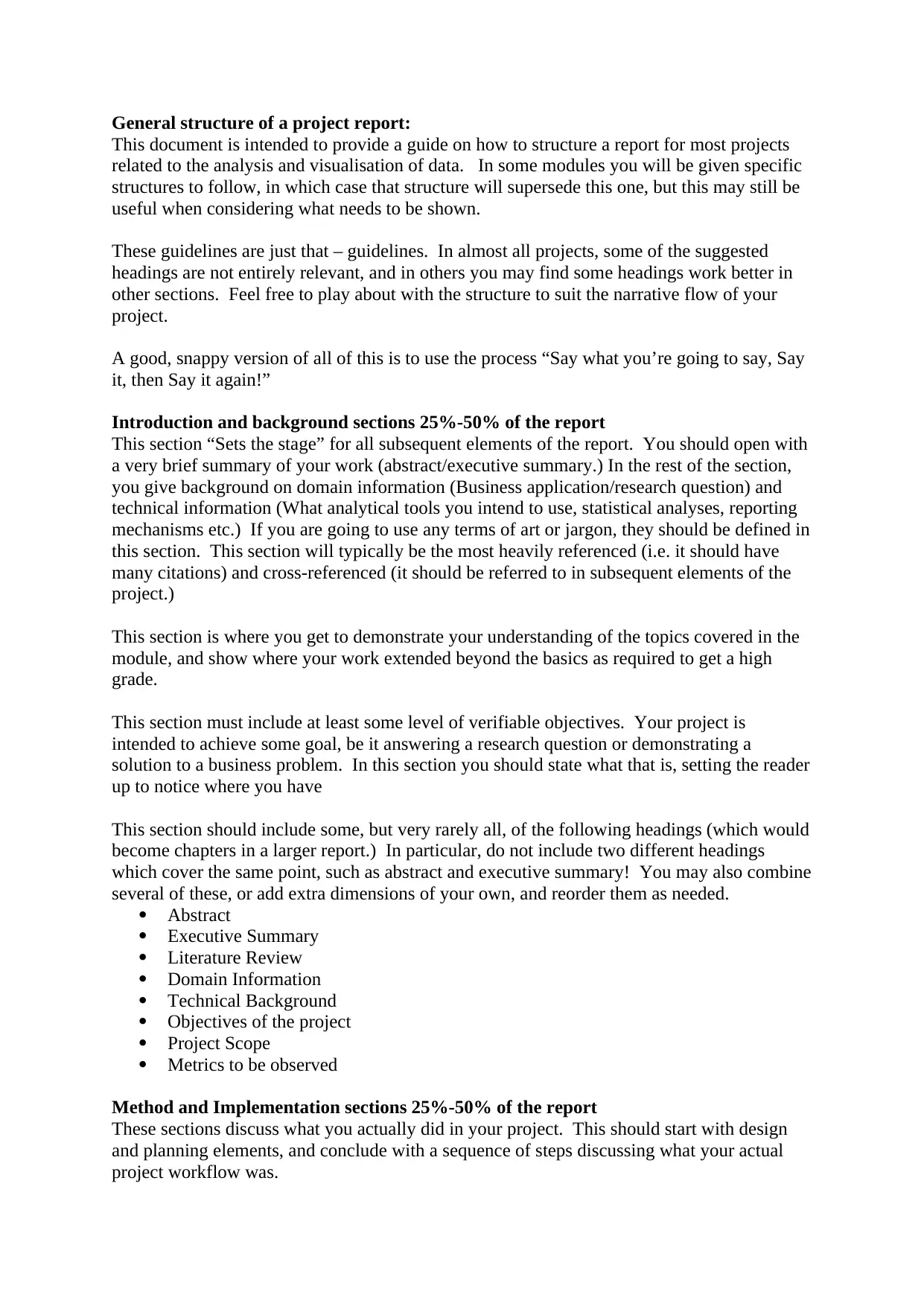
General structure of a project report:
This document is intended to provide a guide on how to structure a report for most projects
related to the analysis and visualisation of data. In some modules you will be given specific
structures to follow, in which case that structure will supersede this one, but this may still be
useful when considering what needs to be shown.
These guidelines are just that – guidelines. In almost all projects, some of the suggested
headings are not entirely relevant, and in others you may find some headings work better in
other sections. Feel free to play about with the structure to suit the narrative flow of your
project.
A good, snappy version of all of this is to use the process “Say what you’re going to say, Say
it, then Say it again!”
Introduction and background sections 25%-50% of the report
This section “Sets the stage” for all subsequent elements of the report. You should open with
a very brief summary of your work (abstract/executive summary.) In the rest of the section,
you give background on domain information (Business application/research question) and
technical information (What analytical tools you intend to use, statistical analyses, reporting
mechanisms etc.) If you are going to use any terms of art or jargon, they should be defined in
this section. This section will typically be the most heavily referenced (i.e. it should have
many citations) and cross-referenced (it should be referred to in subsequent elements of the
project.)
This section is where you get to demonstrate your understanding of the topics covered in the
module, and show where your work extended beyond the basics as required to get a high
grade.
This section must include at least some level of verifiable objectives. Your project is
intended to achieve some goal, be it answering a research question or demonstrating a
solution to a business problem. In this section you should state what that is, setting the reader
up to notice where you have
This section should include some, but very rarely all, of the following headings (which would
become chapters in a larger report.) In particular, do not include two different headings
which cover the same point, such as abstract and executive summary! You may also combine
several of these, or add extra dimensions of your own, and reorder them as needed.
Abstract
Executive Summary
Literature Review
Domain Information
Technical Background
Objectives of the project
Project Scope
Metrics to be observed
Method and Implementation sections 25%-50% of the report
These sections discuss what you actually did in your project. This should start with design
and planning elements, and conclude with a sequence of steps discussing what your actual
project workflow was.
tabler-icon-diamond-filled.svg

Paraphrase This Document

Need a fresh take? Get an instant paraphrase of this document with our AI Paraphraser
Document Page
In general, this section is where you get to show off the work you put in: the data acquisition,
the structuring of that data, how you analysed it and what you did to prepare the output. You
should emphasise the techniques you used, explain why they were suitable, and how come
you chose one option over another.
This section should include design diagrams and other documentation elements, from both a
design and a user documentation angle. Flowcharts, Entity Relationship Diagrams, Data
Flow Diagrams and so on: each of these has its place in this section, though not all are
entirely suitable to all projects: Projects using flat files, for example, don’t need an ERD.
As before, there should be at least some, though probably not all, of the following headings in
a “Methods” section. Remember to reorder them to suit if needed!
Design of Project
Equipment
Technology used
Techniques Employed
Implementation
Operation
Processing
Project Management
Results and Conclusions sections 25%-50% of the report
This section “ties together” the various strands of your project and provides a sense of
completion. In this section, you should present the results of your project, explain what they
mean and provide guidance on the future direction you would recommend for the field. It is
useful to explain how your results meet the objectives you have defined, and demonstrate
how your conclusions are answers to the research questions asked.
This section is where you get to show off the fruits of your labour. You have an opportunity
to illustrate the end product, and explain how it is useful to the domain to which you have
applied yourself. This again is an important point where you can demonstrate that you
understand what you’re doing.
One big recommendation I would make is that you should never present “naked” results – the
results very rarely speak for themselves – instead, you should always present results in
conjunction with an explanation. Charts and tables should be explained in the supporting
text. In particular, try to avoid screen-capping text results from packages such as R or Excel.
Instead, transcribe the results into a more suitable format to again highlight that you
understand what you’re doing!
As before, the following headings are useful guides, though some may be more use than
others
Results (may be split into several subheadings)
Conclusions
Future Work
Analysis of results
Metrics observed
Accomplishments
chevron_up_icon
1 out of 2
circle_padding
hide_on_mobile
zoom_out_icon
[object Object]