Student Alienation: Race, Ethnicity, and Policy Recommendations
VerifiedAdded on 2023/01/13
|11
|3248
|96
Essay
AI Summary
This essay investigates student alienation in educational settings, emphasizing the roles of race and ethnicity. It explores the concept of alienation, its causes, and relevant sociological theories, such as those of Karl Marx, Melvin Seaman, and Emile Durkheim. The essay analyzes how factors like social identity, cultural diversity, and power imbalances contribute to students' feelings of isolation and disengagement. It examines the impact of racial composition, cultural unawareness, and social hierarchies on student experiences. Furthermore, the essay offers recommendations for teachers and educational systems, advocating for inclusive environments that promote equality, equity, and cultural competency. It also proposes policy interventions to address and mitigate the effects of student alienation, ultimately aiming to foster a more supportive and equitable educational experience for all students.
Running head: STUDENT ALIENATION
STUDENT ALIENATION
Name of the student:
Name of the university:
Author note:
STUDENT ALIENATION
Name of the student:
Name of the university:
Author note:

Paraphrase This Document
Need a fresh take? Get an instant paraphrase of this document with our AI Paraphraser
1STUDENT ALIENATION
Introduction:
In the educational circle, the concepts of equity, diversity, and differences play a vital
role. The rapid growth in migrations for better opportunities has led families to move across
countries to get the best education (Banks, 2014). Also, some countries inherently possess more
than one kind of people and hence develop a multicultural society. Therefore, today a socially
inclusive environment is very crucial as they play a vital role and have a substantial impact on
the students. While discussing student alienation, it is the schools that are given the largest focus
and a great deal of attention. Student alienation may occur based on any social identity such as
race, gender, sexuality or culture. The paper aims to discuss the ways student’s alienation occurs
in schools emphasizing race and ethnicity as the prime aspect of discussion. The paper will
discuss the concept of alienation and the reasons for student’s feeling of alienation along with
sociological theories that will help in having a better understanding of student alienation.
Students’ feelings of alienation concept and causes:
The transformation in the social, cultural and technological aspects of everyday life have
creates problems, such as alienation, which ultimately impact our lives as individuals. Alienation
in a general form can be defined as isolation and withdrawal from an environment, a social group
or society with which one interacts. The concept of alienation of the phenomenon of alienation
has been known to exist since the inception of humanity (Ghent, 2018). However, the concept
and the definition have gone through different forms of alteration during the years. Many
scholars have defined alienation in various ways (Barnhardt & Ginns, 2014). The theoretical
concept of Alienation was developed by Karl Marx when he described the concept as isolating,
the dehumanizing and disenchanting effect of working within a capitalist system of production
Introduction:
In the educational circle, the concepts of equity, diversity, and differences play a vital
role. The rapid growth in migrations for better opportunities has led families to move across
countries to get the best education (Banks, 2014). Also, some countries inherently possess more
than one kind of people and hence develop a multicultural society. Therefore, today a socially
inclusive environment is very crucial as they play a vital role and have a substantial impact on
the students. While discussing student alienation, it is the schools that are given the largest focus
and a great deal of attention. Student alienation may occur based on any social identity such as
race, gender, sexuality or culture. The paper aims to discuss the ways student’s alienation occurs
in schools emphasizing race and ethnicity as the prime aspect of discussion. The paper will
discuss the concept of alienation and the reasons for student’s feeling of alienation along with
sociological theories that will help in having a better understanding of student alienation.
Students’ feelings of alienation concept and causes:
The transformation in the social, cultural and technological aspects of everyday life have
creates problems, such as alienation, which ultimately impact our lives as individuals. Alienation
in a general form can be defined as isolation and withdrawal from an environment, a social group
or society with which one interacts. The concept of alienation of the phenomenon of alienation
has been known to exist since the inception of humanity (Ghent, 2018). However, the concept
and the definition have gone through different forms of alteration during the years. Many
scholars have defined alienation in various ways (Barnhardt & Ginns, 2014). The theoretical
concept of Alienation was developed by Karl Marx when he described the concept as isolating,
the dehumanizing and disenchanting effect of working within a capitalist system of production
2STUDENT ALIENATION
(Kumar & Selvan, 2018). Although the concept was initiated within the capitalist framework, the
features seem to have similarity with other neo-capitalist scholar. Alienation is considered as the
negative process involving an abandonment of emotions, desires, thoughts and energy (Lomas &
Ivtzan, 2016). Also, it is considered as a sociologically-based process that leads to one’s
withdrawal from the society, group, values or organizations. Alienation is the concept that is
defined as a state or experience of being isolated from a group activity to which an individual
should belong or be involved (Shantz, Alfes, Bailey & Soane, 2015). One of the major problems
is alienation taking different shapes and forms such as isolation, burnout and loneliness
(Entzinger, 2014).
Alienation in education involves withdrawal from the learning and teaching process
which leads to disinterest in these processes and education. Alienation also reduces the entire
process into monotonous, boring and unappealing activity (Hascher & Hadjar, 2018). Alienation
has been affecting the lives of many groups of people and it created by any groups of people.
Alienation occurs in school as well leading a large number of students to drop out or change
school. Many factors play a key role in the student’s alienation. Although alienation is in many
forms with its density and has been present since the inception of humanity, it is a peculiar
behavior in modern society, specifically in the education field such as school. In the academic
field, education is relatively a new concept. In the education field, the major contributing factors
of student alienation are the education system, the agent of education such as school teachers and
the administration. The factors that have to lead to the emergence of this situation are depended
on the source of alienation. The factors causing the feeling of alienation can be addressed into
two groups of categories as in in-school and out-of-school factors or also known as
organizational and environmental factors. In the modern era, the factors are also categorized into
(Kumar & Selvan, 2018). Although the concept was initiated within the capitalist framework, the
features seem to have similarity with other neo-capitalist scholar. Alienation is considered as the
negative process involving an abandonment of emotions, desires, thoughts and energy (Lomas &
Ivtzan, 2016). Also, it is considered as a sociologically-based process that leads to one’s
withdrawal from the society, group, values or organizations. Alienation is the concept that is
defined as a state or experience of being isolated from a group activity to which an individual
should belong or be involved (Shantz, Alfes, Bailey & Soane, 2015). One of the major problems
is alienation taking different shapes and forms such as isolation, burnout and loneliness
(Entzinger, 2014).
Alienation in education involves withdrawal from the learning and teaching process
which leads to disinterest in these processes and education. Alienation also reduces the entire
process into monotonous, boring and unappealing activity (Hascher & Hadjar, 2018). Alienation
has been affecting the lives of many groups of people and it created by any groups of people.
Alienation occurs in school as well leading a large number of students to drop out or change
school. Many factors play a key role in the student’s alienation. Although alienation is in many
forms with its density and has been present since the inception of humanity, it is a peculiar
behavior in modern society, specifically in the education field such as school. In the academic
field, education is relatively a new concept. In the education field, the major contributing factors
of student alienation are the education system, the agent of education such as school teachers and
the administration. The factors that have to lead to the emergence of this situation are depended
on the source of alienation. The factors causing the feeling of alienation can be addressed into
two groups of categories as in in-school and out-of-school factors or also known as
organizational and environmental factors. In the modern era, the factors are also categorized into
⊘ This is a preview!⊘
Do you want full access?
Subscribe today to unlock all pages.

Trusted by 1+ million students worldwide
3STUDENT ALIENATION
“factors that affect the educator and learner” (Bashir & Khan, 2016). Factors such as the
teacher’s personality traits, expectations, beliefs and desires are seen as the factors of alienation.
Often socio-economic status such as age, sex, place of birth and other factors are the reasons.
Race and ethnicity have been found to be one of the main elements of alienation. Students come
from a diverse background in school which develops a missed culture (Morinaj et al., 2017).
Students begin to form groups on the basis of social identity that shape whether one belongs to
in-group or out-group.
The construction of racial identities aims to organize people across the world in various
groups. People construct hierarchy from the race that makes one race inferior to another. The
inferior race is often seen as the out-group who is the victim of discrimination. The racial
inferiority and racial superiority is the leading cause that leads to the student alienation in the
educational environment. The grouping process is associated with the way student feel in an
educational environment along with the teachers, administration and other associated factors. A
student may feel alienated when the racial composition of the school contains an improper
balance (De Board, 2014). The students belonging to a different ethnic group other than the
majority group often encounter cultural and social alienation in the educational system. The
unawareness regarding cultural diversity is a vital part of student alienation, and it involves not
only the students but the educational agents. When people are unaware of the cultural diversity,
and they do not possess culture competency, alienation becomes a natural process that is
performed by people without being aware. People tend to be with people they are compatible and
have similarities in any way.
Theoretical explanation:
“factors that affect the educator and learner” (Bashir & Khan, 2016). Factors such as the
teacher’s personality traits, expectations, beliefs and desires are seen as the factors of alienation.
Often socio-economic status such as age, sex, place of birth and other factors are the reasons.
Race and ethnicity have been found to be one of the main elements of alienation. Students come
from a diverse background in school which develops a missed culture (Morinaj et al., 2017).
Students begin to form groups on the basis of social identity that shape whether one belongs to
in-group or out-group.
The construction of racial identities aims to organize people across the world in various
groups. People construct hierarchy from the race that makes one race inferior to another. The
inferior race is often seen as the out-group who is the victim of discrimination. The racial
inferiority and racial superiority is the leading cause that leads to the student alienation in the
educational environment. The grouping process is associated with the way student feel in an
educational environment along with the teachers, administration and other associated factors. A
student may feel alienated when the racial composition of the school contains an improper
balance (De Board, 2014). The students belonging to a different ethnic group other than the
majority group often encounter cultural and social alienation in the educational system. The
unawareness regarding cultural diversity is a vital part of student alienation, and it involves not
only the students but the educational agents. When people are unaware of the cultural diversity,
and they do not possess culture competency, alienation becomes a natural process that is
performed by people without being aware. People tend to be with people they are compatible and
have similarities in any way.
Theoretical explanation:
Paraphrase This Document
Need a fresh take? Get an instant paraphrase of this document with our AI Paraphraser
4STUDENT ALIENATION
Karl Marx, the German sociologist, was the originator of the theory of alienation that
revolved around industrial capitalism and class-stratified social system (Burawoy, 2016). The
concept of alienation describes the isolating, dehumanizing and disenchanting effects of working
within the area of the capitalist system. For Marx, it was only with the economic system itself.
However, the term social alienation is a broad concept that sociologist describes the experience
of individuals or groups who feel disconnected from norms, values, practices and social relations
of the society or the community for a variety of social structure reason (Small, 2017). People
who feel alienated or experiencing alienation do not share the same values of the society,
common norms or they are not well integrated into society, institution, groups that are socially
isolated from the mainstream.
According to sociologist Melvin Seaman, social alienation consists of five features, the five
features of alienation are:
Powerlessness: an individual who is socially alienated, they tend to believe that anything
happens in their lives is outside their control and despite the things they do to improve it, it will
not be helpful. The alienated groups feel powerless regarding their lives and the challenges they
face (Özer et al., 2019).
Meaningless: when an individual fails to derive meaning from the things or situation they are
engaged, they feel meaningless. The alienated group does not get the meaning of the things that
happen to them or happen in their lives (Ghafouri Kale & Mohseni Tabrizi, 2018).
Social isolation: social alienation is also associated with social isolation. A person who feels that
they are not meaningfully connected t their lives they will feel the isolation. The values, rules
and norms are the aspects on the basis of which a person feel connected. Self-estrangement:
Karl Marx, the German sociologist, was the originator of the theory of alienation that
revolved around industrial capitalism and class-stratified social system (Burawoy, 2016). The
concept of alienation describes the isolating, dehumanizing and disenchanting effects of working
within the area of the capitalist system. For Marx, it was only with the economic system itself.
However, the term social alienation is a broad concept that sociologist describes the experience
of individuals or groups who feel disconnected from norms, values, practices and social relations
of the society or the community for a variety of social structure reason (Small, 2017). People
who feel alienated or experiencing alienation do not share the same values of the society,
common norms or they are not well integrated into society, institution, groups that are socially
isolated from the mainstream.
According to sociologist Melvin Seaman, social alienation consists of five features, the five
features of alienation are:
Powerlessness: an individual who is socially alienated, they tend to believe that anything
happens in their lives is outside their control and despite the things they do to improve it, it will
not be helpful. The alienated groups feel powerless regarding their lives and the challenges they
face (Özer et al., 2019).
Meaningless: when an individual fails to derive meaning from the things or situation they are
engaged, they feel meaningless. The alienated group does not get the meaning of the things that
happen to them or happen in their lives (Ghafouri Kale & Mohseni Tabrizi, 2018).
Social isolation: social alienation is also associated with social isolation. A person who feels that
they are not meaningfully connected t their lives they will feel the isolation. The values, rules
and norms are the aspects on the basis of which a person feel connected. Self-estrangement:
5STUDENT ALIENATION
when a person feels social alienation they may deny their interests as well as desires as it will
help them to fit in the place of others. To be placed in the place or the social norm, they begin to
adapt to the behavior of others or change their interest to satisfy demands placed by other social
norms and other people (Schwartz, 2017).
Theory of power: according to the theory of power, power is held by a minority group who are
the elite or the people who hold a dominant position in society. They have greater access to
resources, money and power to generate wealth. In this case, the student alienation by race the
elite people is the people with the “superior race” or who feel their race is superior to others or
the “minority”. To have access to the power, resources and opportunities they alienate the other
race. Students from other race are important to gain the resources from them; however, they
cannot be in power or the position of power. To maximize the profit the students need to be
present in the educational environment however to remain in the power they are alienated. The
student with “inferior race” are imposed with rules with no or minimum option. They remain
exploited and used, fulfilling the desires of the “superior race” (Grosfoguel, Oso&Christou,
2015).
Emile Durkheim has presented the concept of anomie, a sense of normlessness that fosters social
alienation. The concept of anomie is a social condition where there is a disappearance or
disintegration of the values and norms that was previously common to society. Anomie occurs
when there is rapid change to the social, political and economic structure of the society
(Teymoori, Bastian & Jetten, 2017). When there is a sudden change, people go through the
concept of anomie. The concept is regarded as the ‘normlessness’ since the person going through
this specific social condition, the person feels their norms and social values as meaningless. In
student alienation, the students may face anomie that is due to rapid change in their social culture
when a person feels social alienation they may deny their interests as well as desires as it will
help them to fit in the place of others. To be placed in the place or the social norm, they begin to
adapt to the behavior of others or change their interest to satisfy demands placed by other social
norms and other people (Schwartz, 2017).
Theory of power: according to the theory of power, power is held by a minority group who are
the elite or the people who hold a dominant position in society. They have greater access to
resources, money and power to generate wealth. In this case, the student alienation by race the
elite people is the people with the “superior race” or who feel their race is superior to others or
the “minority”. To have access to the power, resources and opportunities they alienate the other
race. Students from other race are important to gain the resources from them; however, they
cannot be in power or the position of power. To maximize the profit the students need to be
present in the educational environment however to remain in the power they are alienated. The
student with “inferior race” are imposed with rules with no or minimum option. They remain
exploited and used, fulfilling the desires of the “superior race” (Grosfoguel, Oso&Christou,
2015).
Emile Durkheim has presented the concept of anomie, a sense of normlessness that fosters social
alienation. The concept of anomie is a social condition where there is a disappearance or
disintegration of the values and norms that was previously common to society. Anomie occurs
when there is rapid change to the social, political and economic structure of the society
(Teymoori, Bastian & Jetten, 2017). When there is a sudden change, people go through the
concept of anomie. The concept is regarded as the ‘normlessness’ since the person going through
this specific social condition, the person feels their norms and social values as meaningless. In
student alienation, the students may face anomie that is due to rapid change in their social culture
⊘ This is a preview!⊘
Do you want full access?
Subscribe today to unlock all pages.
Trusted by 1+ million students worldwide
6STUDENT ALIENATION
where different race possess different social values and norms. While a student is feeling
alienated, the student goes through the transition phase wherein the norms and values of their
ethnicity is no more valid. Moving from one region to another region often destabilize a person’s
norms, practices and social relations in a way that causes social alienation. According to
sociologists, demographic changes also play an important role in understating the social
alienation (TenHouten, 2016).
Recommendation:
According to researches undertaken the issue of student alienation can be eliminated only
through an integrated approach, by implying new approaches to school as well as the system
schools operate. To create an educational environment free from student alienation, the prime
aims should be to create a socially inclusive environment. People from every cultural and ethnic
background should be treated equally (Tomé et al., 2015). Along with equality, the concept of
equity should be encouraged to help people who are lacking behind in the field of education. It is
essential that students who belong from socially backward groups are encouraged to pursue the
education they deserve and desire. Student alienation will only be eliminated when there are
contribution and incorporation from teachers and the educational system. It majorly depends on
the teachers who are responsible for the imparting education in cultural diversity, cultural
competency, equality, fundamental rights, social inequity and the consequences of
discrimination. By providing insights on these terms, students will learn the values and the
concept of equality. Only after a complete understanding of these terms, they will be able to
bring change in behavior and treatment of students who are often the victim of alienation. By
giving students the opportunity of sharing stories and sharing experiences with the other students
who belong from a different race or ethnic backgrounds. Teachers can switch up the seats of the
where different race possess different social values and norms. While a student is feeling
alienated, the student goes through the transition phase wherein the norms and values of their
ethnicity is no more valid. Moving from one region to another region often destabilize a person’s
norms, practices and social relations in a way that causes social alienation. According to
sociologists, demographic changes also play an important role in understating the social
alienation (TenHouten, 2016).
Recommendation:
According to researches undertaken the issue of student alienation can be eliminated only
through an integrated approach, by implying new approaches to school as well as the system
schools operate. To create an educational environment free from student alienation, the prime
aims should be to create a socially inclusive environment. People from every cultural and ethnic
background should be treated equally (Tomé et al., 2015). Along with equality, the concept of
equity should be encouraged to help people who are lacking behind in the field of education. It is
essential that students who belong from socially backward groups are encouraged to pursue the
education they deserve and desire. Student alienation will only be eliminated when there are
contribution and incorporation from teachers and the educational system. It majorly depends on
the teachers who are responsible for the imparting education in cultural diversity, cultural
competency, equality, fundamental rights, social inequity and the consequences of
discrimination. By providing insights on these terms, students will learn the values and the
concept of equality. Only after a complete understanding of these terms, they will be able to
bring change in behavior and treatment of students who are often the victim of alienation. By
giving students the opportunity of sharing stories and sharing experiences with the other students
who belong from a different race or ethnic backgrounds. Teachers can switch up the seats of the
Paraphrase This Document
Need a fresh take? Get an instant paraphrase of this document with our AI Paraphraser
7STUDENT ALIENATION
students in the class to provide the chance of getting to know other students (Morinaj et al.,
2017). When common ground is found, it becomes easier to create the 'we feeling'. Therefore, it
is important to create common ground among the students such as humanity or age groups which
may help them feel like one. Partner or small workgroups are another way of making
communication among the students which will assist in eliminating student alienation. The idea
is to create communication and interaction among the students to make them understand that the
gaps between different races are only hypothetical and absurd. In the contemporary era, the
growth of personality comes when an individual possesses a better idea of culture difference,
diversity and culture competency.
Conclusion:
One of the problems of achieving full literacy population is alienation. The concept of
student alienation is certainly not new as it has been present in the educational institutes for years
making the student feel powerless, meaningless, normless or estranged. Student Alienation is a
problem that has been addressed in the contemporary era and researchers have certainly studied
to find the best ways to reduce as well as eliminate the issue from the educational field. The idea
is to create communication and interaction among the students to make them understand that the
gaps between different races are only hypothetical and absurd. In the contemporary era, the
growth of personality comes when an individual possesses a better idea of culture difference,
diversity and culture competency.
students in the class to provide the chance of getting to know other students (Morinaj et al.,
2017). When common ground is found, it becomes easier to create the 'we feeling'. Therefore, it
is important to create common ground among the students such as humanity or age groups which
may help them feel like one. Partner or small workgroups are another way of making
communication among the students which will assist in eliminating student alienation. The idea
is to create communication and interaction among the students to make them understand that the
gaps between different races are only hypothetical and absurd. In the contemporary era, the
growth of personality comes when an individual possesses a better idea of culture difference,
diversity and culture competency.
Conclusion:
One of the problems of achieving full literacy population is alienation. The concept of
student alienation is certainly not new as it has been present in the educational institutes for years
making the student feel powerless, meaningless, normless or estranged. Student Alienation is a
problem that has been addressed in the contemporary era and researchers have certainly studied
to find the best ways to reduce as well as eliminate the issue from the educational field. The idea
is to create communication and interaction among the students to make them understand that the
gaps between different races are only hypothetical and absurd. In the contemporary era, the
growth of personality comes when an individual possesses a better idea of culture difference,
diversity and culture competency.
8STUDENT ALIENATION
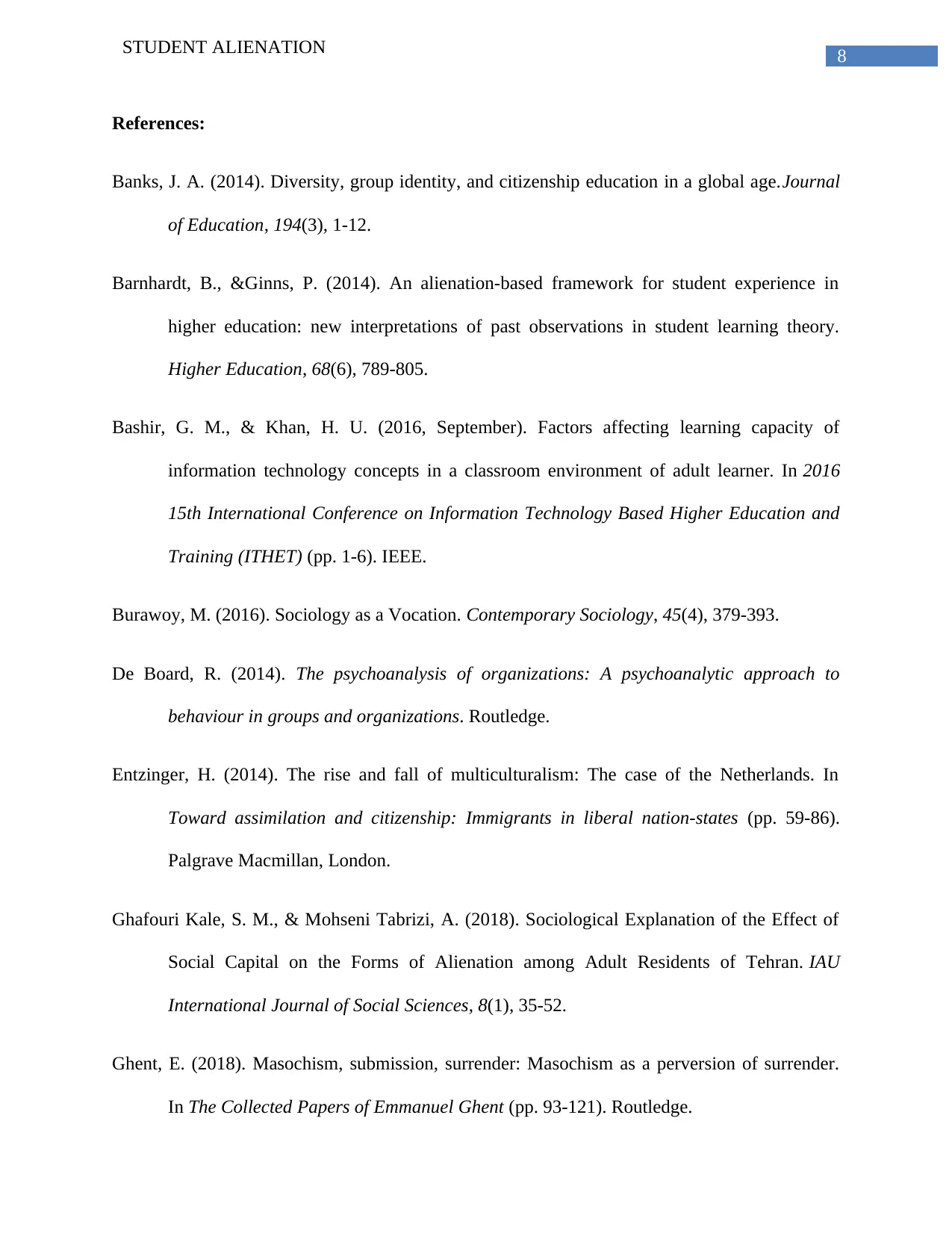
References:
Banks, J. A. (2014). Diversity, group identity, and citizenship education in a global age.Journal
of Education, 194(3), 1-12.
Barnhardt, B., &Ginns, P. (2014). An alienation-based framework for student experience in
higher education: new interpretations of past observations in student learning theory.
Higher Education, 68(6), 789-805.
Bashir, G. M., & Khan, H. U. (2016, September). Factors affecting learning capacity of
information technology concepts in a classroom environment of adult learner. In 2016
15th International Conference on Information Technology Based Higher Education and
Training (ITHET) (pp. 1-6). IEEE.
Burawoy, M. (2016). Sociology as a Vocation. Contemporary Sociology, 45(4), 379-393.
De Board, R. (2014). The psychoanalysis of organizations: A psychoanalytic approach to
behaviour in groups and organizations. Routledge.
Entzinger, H. (2014). The rise and fall of multiculturalism: The case of the Netherlands. In
Toward assimilation and citizenship: Immigrants in liberal nation-states (pp. 59-86).
Palgrave Macmillan, London.
Ghafouri Kale, S. M., & Mohseni Tabrizi, A. (2018). Sociological Explanation of the Effect of
Social Capital on the Forms of Alienation among Adult Residents of Tehran. IAU
International Journal of Social Sciences, 8(1), 35-52.
Ghent, E. (2018). Masochism, submission, surrender: Masochism as a perversion of surrender.
In The Collected Papers of Emmanuel Ghent (pp. 93-121). Routledge.
References:
Banks, J. A. (2014). Diversity, group identity, and citizenship education in a global age.Journal
of Education, 194(3), 1-12.
Barnhardt, B., &Ginns, P. (2014). An alienation-based framework for student experience in
higher education: new interpretations of past observations in student learning theory.
Higher Education, 68(6), 789-805.
Bashir, G. M., & Khan, H. U. (2016, September). Factors affecting learning capacity of
information technology concepts in a classroom environment of adult learner. In 2016
15th International Conference on Information Technology Based Higher Education and
Training (ITHET) (pp. 1-6). IEEE.
Burawoy, M. (2016). Sociology as a Vocation. Contemporary Sociology, 45(4), 379-393.
De Board, R. (2014). The psychoanalysis of organizations: A psychoanalytic approach to
behaviour in groups and organizations. Routledge.
Entzinger, H. (2014). The rise and fall of multiculturalism: The case of the Netherlands. In
Toward assimilation and citizenship: Immigrants in liberal nation-states (pp. 59-86).
Palgrave Macmillan, London.
Ghafouri Kale, S. M., & Mohseni Tabrizi, A. (2018). Sociological Explanation of the Effect of
Social Capital on the Forms of Alienation among Adult Residents of Tehran. IAU
International Journal of Social Sciences, 8(1), 35-52.
Ghent, E. (2018). Masochism, submission, surrender: Masochism as a perversion of surrender.
In The Collected Papers of Emmanuel Ghent (pp. 93-121). Routledge.
⊘ This is a preview!⊘
Do you want full access?
Subscribe today to unlock all pages.
Trusted by 1+ million students worldwide
9STUDENT ALIENATION
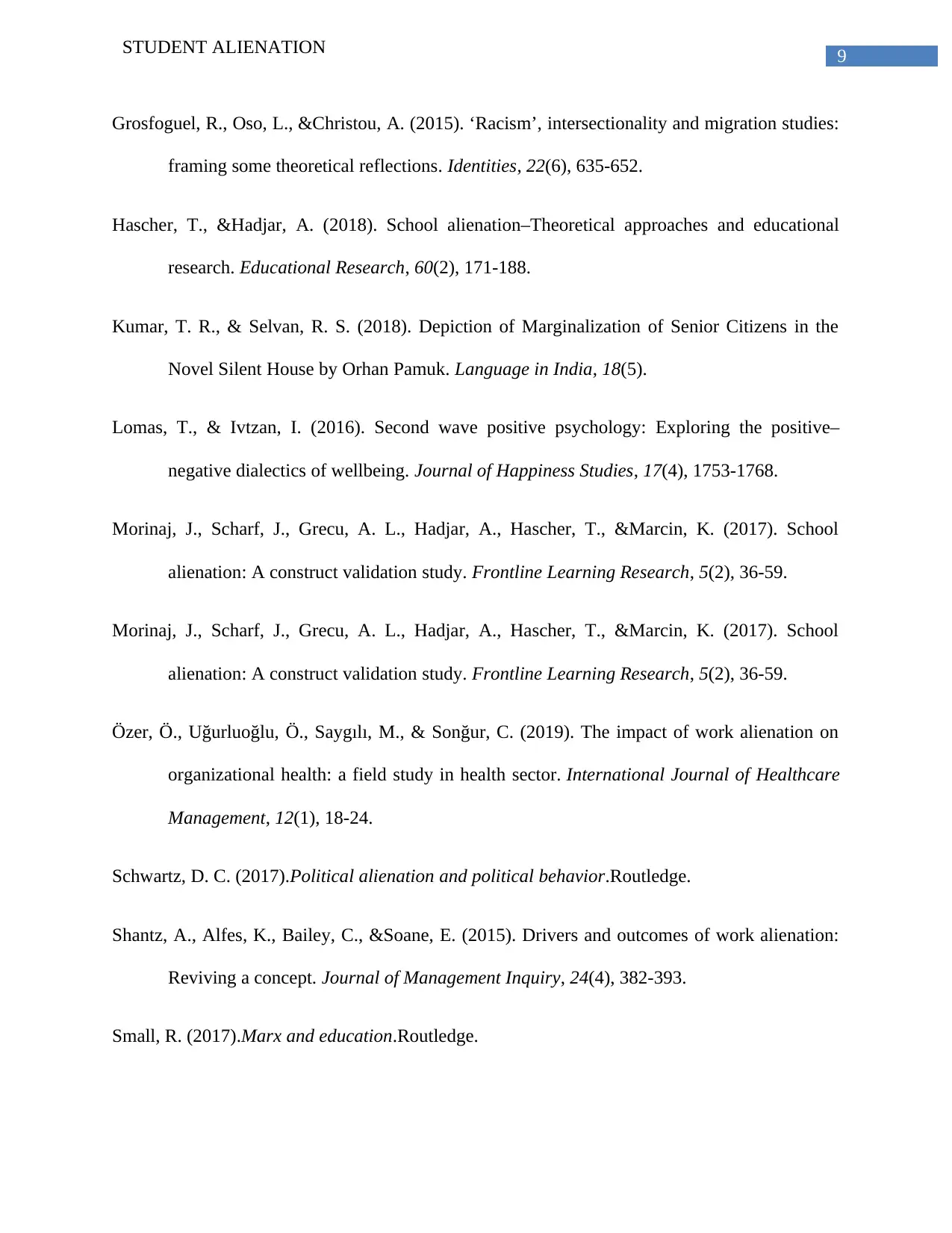
Grosfoguel, R., Oso, L., &Christou, A. (2015). ‘Racism’, intersectionality and migration studies:
framing some theoretical reflections. Identities, 22(6), 635-652.
Hascher, T., &Hadjar, A. (2018). School alienation–Theoretical approaches and educational
research. Educational Research, 60(2), 171-188.
Kumar, T. R., & Selvan, R. S. (2018). Depiction of Marginalization of Senior Citizens in the
Novel Silent House by Orhan Pamuk. Language in India, 18(5).
Lomas, T., & Ivtzan, I. (2016). Second wave positive psychology: Exploring the positive–
negative dialectics of wellbeing. Journal of Happiness Studies, 17(4), 1753-1768.
Morinaj, J., Scharf, J., Grecu, A. L., Hadjar, A., Hascher, T., &Marcin, K. (2017). School
alienation: A construct validation study. Frontline Learning Research, 5(2), 36-59.
Morinaj, J., Scharf, J., Grecu, A. L., Hadjar, A., Hascher, T., &Marcin, K. (2017). School
alienation: A construct validation study. Frontline Learning Research, 5(2), 36-59.
Özer, Ö., Uğurluoğlu, Ö., Saygılı, M., & Sonğur, C. (2019). The impact of work alienation on
organizational health: a field study in health sector. International Journal of Healthcare
Management, 12(1), 18-24.
Schwartz, D. C. (2017).Political alienation and political behavior.Routledge.
Shantz, A., Alfes, K., Bailey, C., &Soane, E. (2015). Drivers and outcomes of work alienation:
Reviving a concept. Journal of Management Inquiry, 24(4), 382-393.
Small, R. (2017).Marx and education.Routledge.
Grosfoguel, R., Oso, L., &Christou, A. (2015). ‘Racism’, intersectionality and migration studies:
framing some theoretical reflections. Identities, 22(6), 635-652.
Hascher, T., &Hadjar, A. (2018). School alienation–Theoretical approaches and educational
research. Educational Research, 60(2), 171-188.
Kumar, T. R., & Selvan, R. S. (2018). Depiction of Marginalization of Senior Citizens in the
Novel Silent House by Orhan Pamuk. Language in India, 18(5).
Lomas, T., & Ivtzan, I. (2016). Second wave positive psychology: Exploring the positive–
negative dialectics of wellbeing. Journal of Happiness Studies, 17(4), 1753-1768.
Morinaj, J., Scharf, J., Grecu, A. L., Hadjar, A., Hascher, T., &Marcin, K. (2017). School
alienation: A construct validation study. Frontline Learning Research, 5(2), 36-59.
Morinaj, J., Scharf, J., Grecu, A. L., Hadjar, A., Hascher, T., &Marcin, K. (2017). School
alienation: A construct validation study. Frontline Learning Research, 5(2), 36-59.
Özer, Ö., Uğurluoğlu, Ö., Saygılı, M., & Sonğur, C. (2019). The impact of work alienation on
organizational health: a field study in health sector. International Journal of Healthcare
Management, 12(1), 18-24.
Schwartz, D. C. (2017).Political alienation and political behavior.Routledge.
Shantz, A., Alfes, K., Bailey, C., &Soane, E. (2015). Drivers and outcomes of work alienation:
Reviving a concept. Journal of Management Inquiry, 24(4), 382-393.
Small, R. (2017).Marx and education.Routledge.
Paraphrase This Document
Need a fresh take? Get an instant paraphrase of this document with our AI Paraphraser
10STUDENT ALIENATION
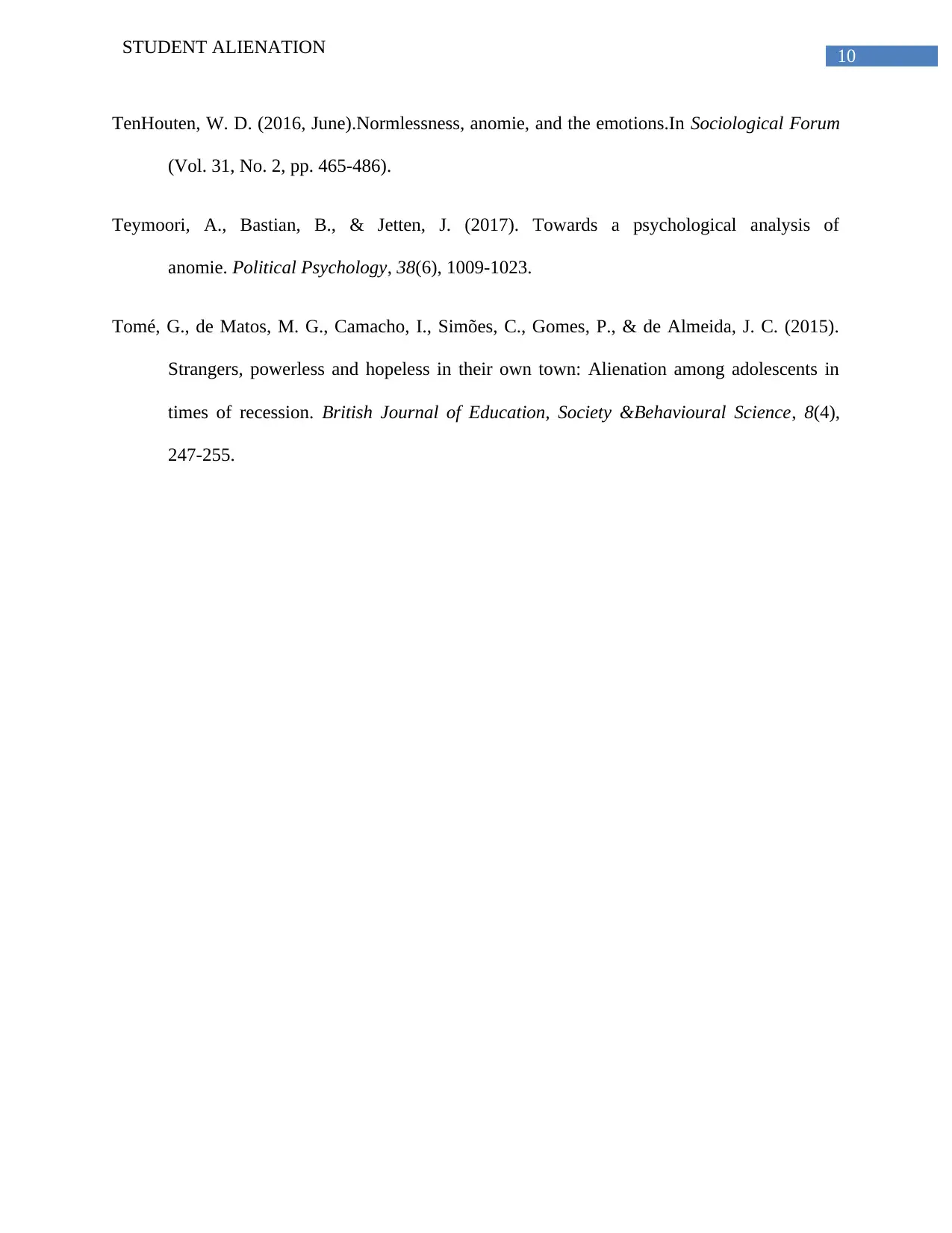
TenHouten, W. D. (2016, June).Normlessness, anomie, and the emotions.In Sociological Forum
(Vol. 31, No. 2, pp. 465-486).
Teymoori, A., Bastian, B., & Jetten, J. (2017). Towards a psychological analysis of
anomie. Political Psychology, 38(6), 1009-1023.
Tomé, G., de Matos, M. G., Camacho, I., Simões, C., Gomes, P., & de Almeida, J. C. (2015).
Strangers, powerless and hopeless in their own town: Alienation among adolescents in
times of recession. British Journal of Education, Society &Behavioural Science, 8(4),
247-255.
TenHouten, W. D. (2016, June).Normlessness, anomie, and the emotions.In Sociological Forum
(Vol. 31, No. 2, pp. 465-486).
Teymoori, A., Bastian, B., & Jetten, J. (2017). Towards a psychological analysis of
anomie. Political Psychology, 38(6), 1009-1023.
Tomé, G., de Matos, M. G., Camacho, I., Simões, C., Gomes, P., & de Almeida, J. C. (2015).
Strangers, powerless and hopeless in their own town: Alienation among adolescents in
times of recession. British Journal of Education, Society &Behavioural Science, 8(4),
247-255.

1 out of 11


Related Documents


Your All-in-One AI-Powered Toolkit for Academic Success.
+13062052269
info@desklib.com
Available 24*7 on WhatsApp / Email
![[object Object]](/_next/static/media/star-bottom.7253800d.svg)
Unlock your academic potential
Copyright © 2020–2026 A2Z Services. All Rights Reserved. Developed and managed by ZUCOL.