Student Food Choices, Nutrition, and Health: Research Report
VerifiedAdded on 2022/12/29
|9
|2710
|90
Report
AI Summary
This report explores the topic of student nutrition, focusing on the reasoning behind food choices and eating frequency among first-year students. The research begins with an introduction defining nutrition and highlighting its importance for student health, academic performance, and overall well-being. The methodology outlines the use of interviews as the primary data collection method, employing a random probabilistic sampling approach to gather insights from first-year students. The results section presents and analyzes the responses from interviewees, addressing questions about healthy diets, meal frequency, factors influencing food choices, the impact of food choices on intake frequency, and the relationship between nutrition and food selection. The discussion and conclusion section synthesizes the findings, emphasizing the strong connection between students' food choices and their nutritional status, while also identifying key factors like environment, taste, culture, and lifestyle that shape these choices. The report concludes by acknowledging research limitations and suggesting avenues for future investigation, particularly focusing on the impact of nutritional changes on student health and academic performance. The report also includes references to support the findings and conclusions.

ASSIGNMENT

Paraphrase This Document
Need a fresh take? Get an instant paraphrase of this document with our AI Paraphraser
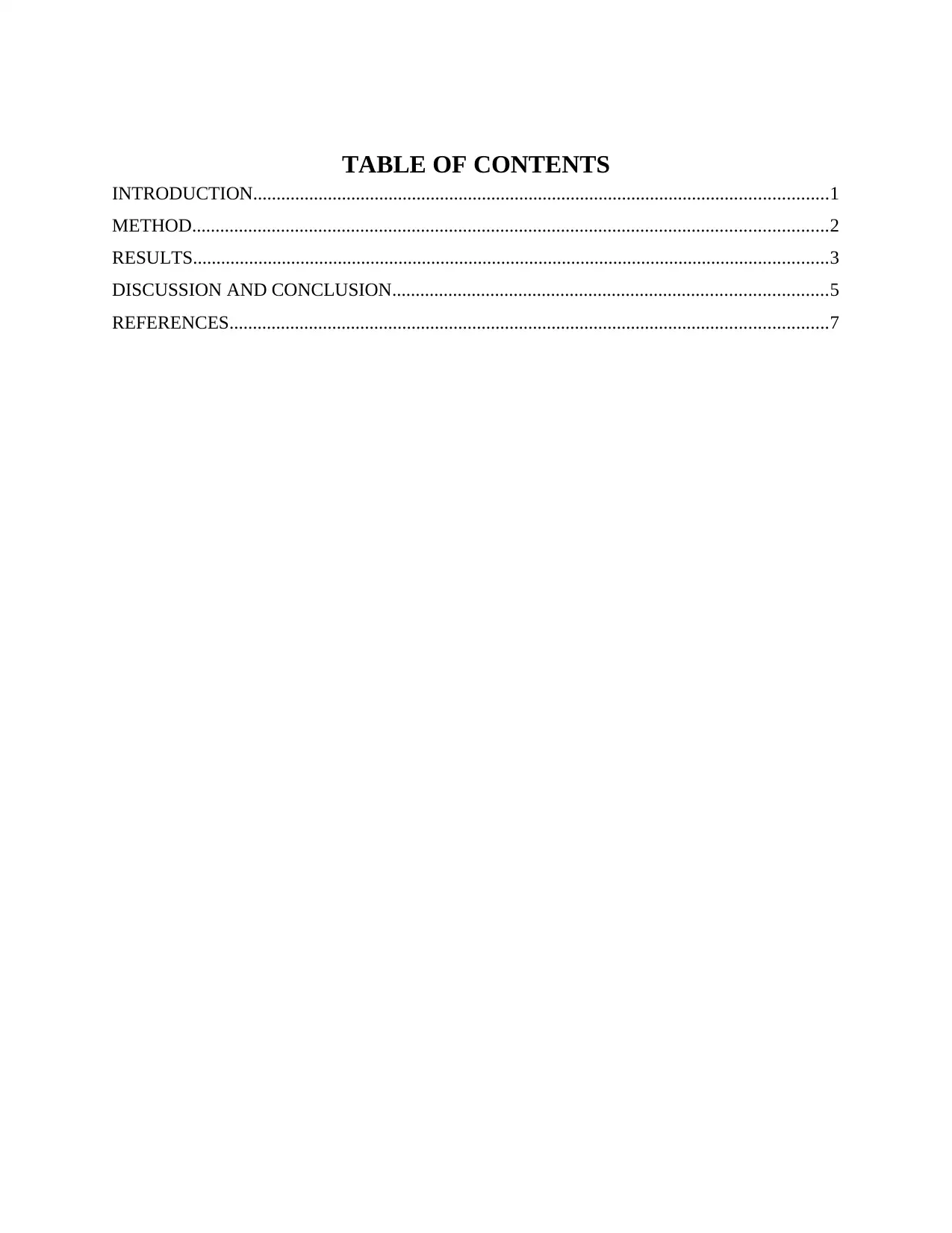
TABLE OF CONTENTS
INTRODUCTION...........................................................................................................................1
METHOD........................................................................................................................................2
RESULTS........................................................................................................................................3
DISCUSSION AND CONCLUSION.............................................................................................5
REFERENCES................................................................................................................................7
INTRODUCTION...........................................................................................................................1
METHOD........................................................................................................................................2
RESULTS........................................................................................................................................3
DISCUSSION AND CONCLUSION.............................................................................................5
REFERENCES................................................................................................................................7
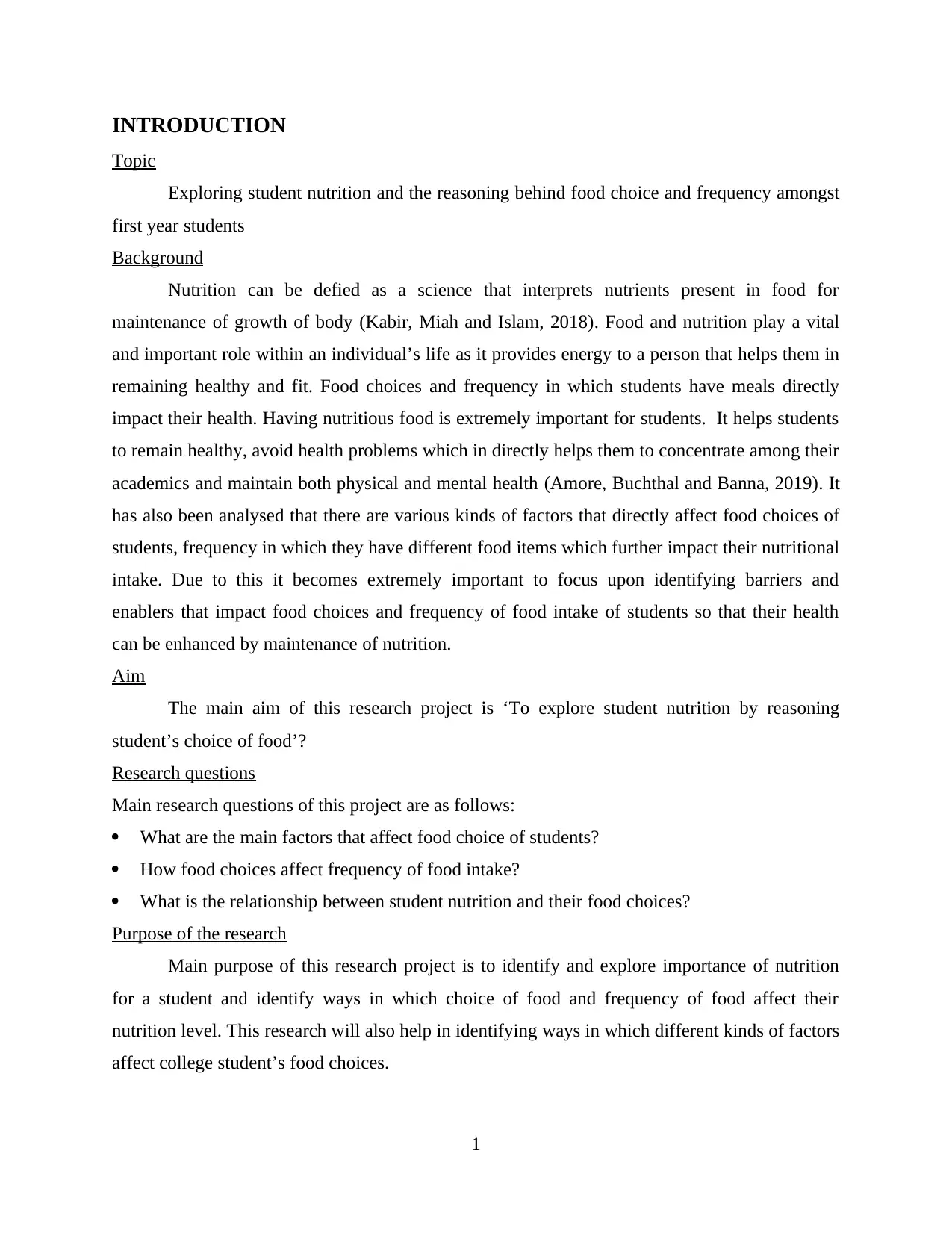
INTRODUCTION
Topic
Exploring student nutrition and the reasoning behind food choice and frequency amongst
first year students
Background
Nutrition can be defied as a science that interprets nutrients present in food for
maintenance of growth of body (Kabir, Miah and Islam, 2018). Food and nutrition play a vital
and important role within an individual’s life as it provides energy to a person that helps them in
remaining healthy and fit. Food choices and frequency in which students have meals directly
impact their health. Having nutritious food is extremely important for students. It helps students
to remain healthy, avoid health problems which in directly helps them to concentrate among their
academics and maintain both physical and mental health (Amore, Buchthal and Banna, 2019). It
has also been analysed that there are various kinds of factors that directly affect food choices of
students, frequency in which they have different food items which further impact their nutritional
intake. Due to this it becomes extremely important to focus upon identifying barriers and
enablers that impact food choices and frequency of food intake of students so that their health
can be enhanced by maintenance of nutrition.
Aim
The main aim of this research project is ‘To explore student nutrition by reasoning
student’s choice of food’?
Research questions
Main research questions of this project are as follows:
What are the main factors that affect food choice of students?
How food choices affect frequency of food intake?
What is the relationship between student nutrition and their food choices?
Purpose of the research
Main purpose of this research project is to identify and explore importance of nutrition
for a student and identify ways in which choice of food and frequency of food affect their
nutrition level. This research will also help in identifying ways in which different kinds of factors
affect college student’s food choices.
1
Topic
Exploring student nutrition and the reasoning behind food choice and frequency amongst
first year students
Background
Nutrition can be defied as a science that interprets nutrients present in food for
maintenance of growth of body (Kabir, Miah and Islam, 2018). Food and nutrition play a vital
and important role within an individual’s life as it provides energy to a person that helps them in
remaining healthy and fit. Food choices and frequency in which students have meals directly
impact their health. Having nutritious food is extremely important for students. It helps students
to remain healthy, avoid health problems which in directly helps them to concentrate among their
academics and maintain both physical and mental health (Amore, Buchthal and Banna, 2019). It
has also been analysed that there are various kinds of factors that directly affect food choices of
students, frequency in which they have different food items which further impact their nutritional
intake. Due to this it becomes extremely important to focus upon identifying barriers and
enablers that impact food choices and frequency of food intake of students so that their health
can be enhanced by maintenance of nutrition.
Aim
The main aim of this research project is ‘To explore student nutrition by reasoning
student’s choice of food’?
Research questions
Main research questions of this project are as follows:
What are the main factors that affect food choice of students?
How food choices affect frequency of food intake?
What is the relationship between student nutrition and their food choices?
Purpose of the research
Main purpose of this research project is to identify and explore importance of nutrition
for a student and identify ways in which choice of food and frequency of food affect their
nutrition level. This research will also help in identifying ways in which different kinds of factors
affect college student’s food choices.
1
⊘ This is a preview!⊘
Do you want full access?
Subscribe today to unlock all pages.

Trusted by 1+ million students worldwide
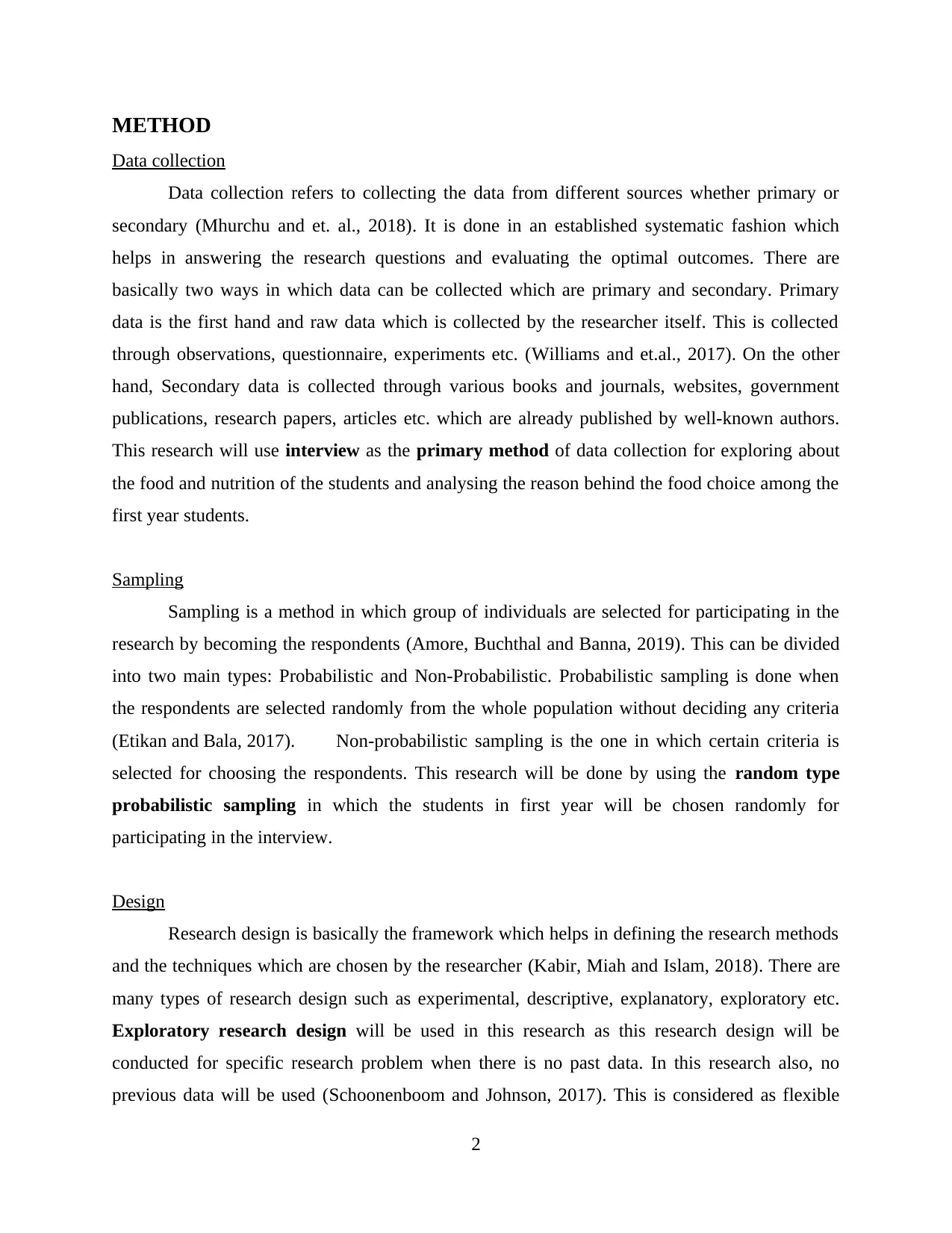
METHOD
Data collection
Data collection refers to collecting the data from different sources whether primary or
secondary (Mhurchu and et. al., 2018). It is done in an established systematic fashion which
helps in answering the research questions and evaluating the optimal outcomes. There are
basically two ways in which data can be collected which are primary and secondary. Primary
data is the first hand and raw data which is collected by the researcher itself. This is collected
through observations, questionnaire, experiments etc. (Williams and et.al., 2017). On the other
hand, Secondary data is collected through various books and journals, websites, government
publications, research papers, articles etc. which are already published by well-known authors.
This research will use interview as the primary method of data collection for exploring about
the food and nutrition of the students and analysing the reason behind the food choice among the
first year students.
Sampling
Sampling is a method in which group of individuals are selected for participating in the
research by becoming the respondents (Amore, Buchthal and Banna, 2019). This can be divided
into two main types: Probabilistic and Non-Probabilistic. Probabilistic sampling is done when
the respondents are selected randomly from the whole population without deciding any criteria
(Etikan and Bala, 2017). Non-probabilistic sampling is the one in which certain criteria is
selected for choosing the respondents. This research will be done by using the random type
probabilistic sampling in which the students in first year will be chosen randomly for
participating in the interview.
Design
Research design is basically the framework which helps in defining the research methods
and the techniques which are chosen by the researcher (Kabir, Miah and Islam, 2018). There are
many types of research design such as experimental, descriptive, explanatory, exploratory etc.
Exploratory research design will be used in this research as this research design will be
conducted for specific research problem when there is no past data. In this research also, no
previous data will be used (Schoonenboom and Johnson, 2017). This is considered as flexible
2
Data collection
Data collection refers to collecting the data from different sources whether primary or
secondary (Mhurchu and et. al., 2018). It is done in an established systematic fashion which
helps in answering the research questions and evaluating the optimal outcomes. There are
basically two ways in which data can be collected which are primary and secondary. Primary
data is the first hand and raw data which is collected by the researcher itself. This is collected
through observations, questionnaire, experiments etc. (Williams and et.al., 2017). On the other
hand, Secondary data is collected through various books and journals, websites, government
publications, research papers, articles etc. which are already published by well-known authors.
This research will use interview as the primary method of data collection for exploring about
the food and nutrition of the students and analysing the reason behind the food choice among the
first year students.
Sampling
Sampling is a method in which group of individuals are selected for participating in the
research by becoming the respondents (Amore, Buchthal and Banna, 2019). This can be divided
into two main types: Probabilistic and Non-Probabilistic. Probabilistic sampling is done when
the respondents are selected randomly from the whole population without deciding any criteria
(Etikan and Bala, 2017). Non-probabilistic sampling is the one in which certain criteria is
selected for choosing the respondents. This research will be done by using the random type
probabilistic sampling in which the students in first year will be chosen randomly for
participating in the interview.
Design
Research design is basically the framework which helps in defining the research methods
and the techniques which are chosen by the researcher (Kabir, Miah and Islam, 2018). There are
many types of research design such as experimental, descriptive, explanatory, exploratory etc.
Exploratory research design will be used in this research as this research design will be
conducted for specific research problem when there is no past data. In this research also, no
previous data will be used (Schoonenboom and Johnson, 2017). This is considered as flexible
2
Paraphrase This Document
Need a fresh take? Get an instant paraphrase of this document with our AI Paraphraser
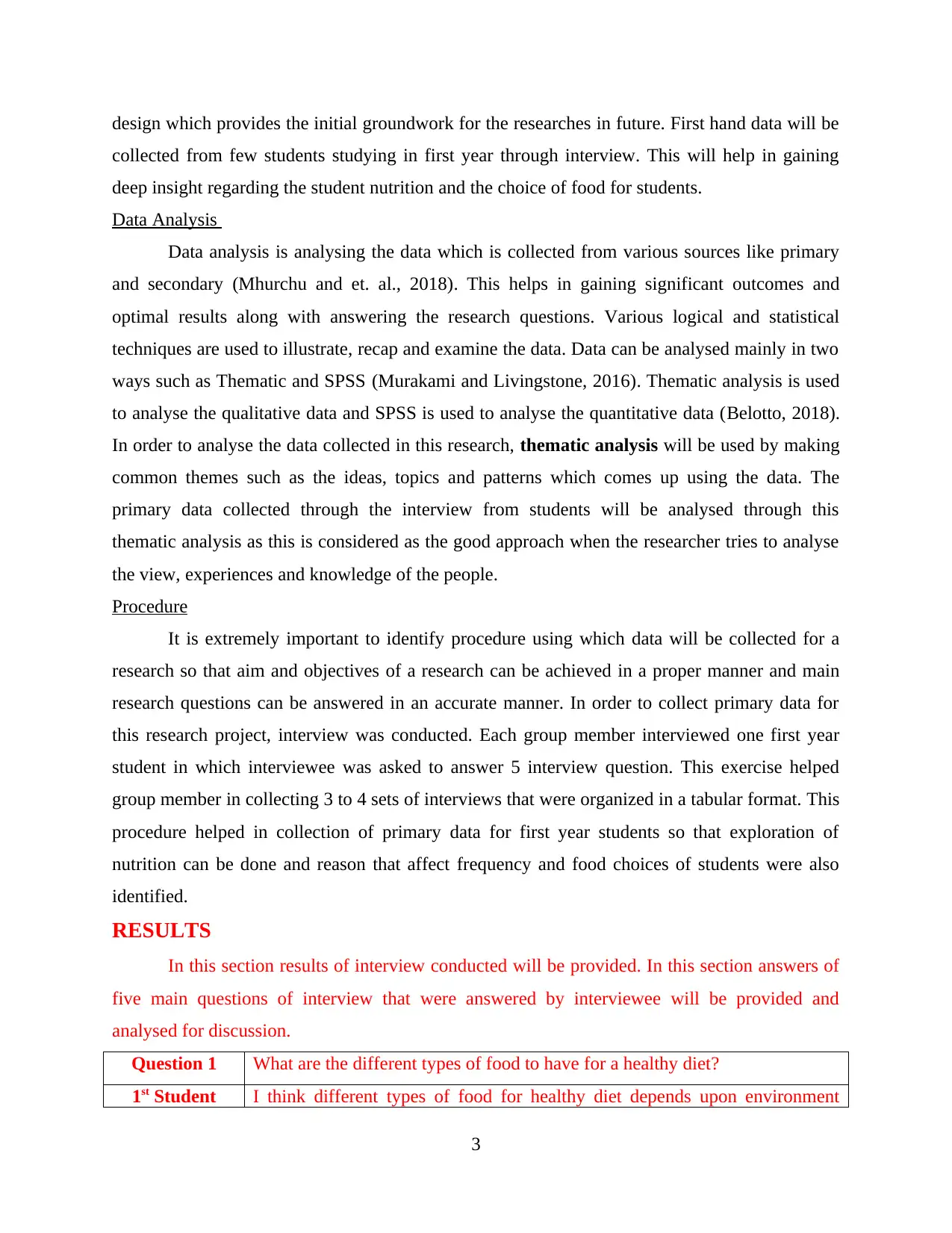
design which provides the initial groundwork for the researches in future. First hand data will be
collected from few students studying in first year through interview. This will help in gaining
deep insight regarding the student nutrition and the choice of food for students.
Data Analysis
Data analysis is analysing the data which is collected from various sources like primary
and secondary (Mhurchu and et. al., 2018). This helps in gaining significant outcomes and
optimal results along with answering the research questions. Various logical and statistical
techniques are used to illustrate, recap and examine the data. Data can be analysed mainly in two
ways such as Thematic and SPSS (Murakami and Livingstone, 2016). Thematic analysis is used
to analyse the qualitative data and SPSS is used to analyse the quantitative data (Belotto, 2018).
In order to analyse the data collected in this research, thematic analysis will be used by making
common themes such as the ideas, topics and patterns which comes up using the data. The
primary data collected through the interview from students will be analysed through this
thematic analysis as this is considered as the good approach when the researcher tries to analyse
the view, experiences and knowledge of the people.
Procedure
It is extremely important to identify procedure using which data will be collected for a
research so that aim and objectives of a research can be achieved in a proper manner and main
research questions can be answered in an accurate manner. In order to collect primary data for
this research project, interview was conducted. Each group member interviewed one first year
student in which interviewee was asked to answer 5 interview question. This exercise helped
group member in collecting 3 to 4 sets of interviews that were organized in a tabular format. This
procedure helped in collection of primary data for first year students so that exploration of
nutrition can be done and reason that affect frequency and food choices of students were also
identified.
RESULTS
In this section results of interview conducted will be provided. In this section answers of
five main questions of interview that were answered by interviewee will be provided and
analysed for discussion.
Question 1 What are the different types of food to have for a healthy diet?
1st Student I think different types of food for healthy diet depends upon environment
3
collected from few students studying in first year through interview. This will help in gaining
deep insight regarding the student nutrition and the choice of food for students.
Data Analysis
Data analysis is analysing the data which is collected from various sources like primary
and secondary (Mhurchu and et. al., 2018). This helps in gaining significant outcomes and
optimal results along with answering the research questions. Various logical and statistical
techniques are used to illustrate, recap and examine the data. Data can be analysed mainly in two
ways such as Thematic and SPSS (Murakami and Livingstone, 2016). Thematic analysis is used
to analyse the qualitative data and SPSS is used to analyse the quantitative data (Belotto, 2018).
In order to analyse the data collected in this research, thematic analysis will be used by making
common themes such as the ideas, topics and patterns which comes up using the data. The
primary data collected through the interview from students will be analysed through this
thematic analysis as this is considered as the good approach when the researcher tries to analyse
the view, experiences and knowledge of the people.
Procedure
It is extremely important to identify procedure using which data will be collected for a
research so that aim and objectives of a research can be achieved in a proper manner and main
research questions can be answered in an accurate manner. In order to collect primary data for
this research project, interview was conducted. Each group member interviewed one first year
student in which interviewee was asked to answer 5 interview question. This exercise helped
group member in collecting 3 to 4 sets of interviews that were organized in a tabular format. This
procedure helped in collection of primary data for first year students so that exploration of
nutrition can be done and reason that affect frequency and food choices of students were also
identified.
RESULTS
In this section results of interview conducted will be provided. In this section answers of
five main questions of interview that were answered by interviewee will be provided and
analysed for discussion.
Question 1 What are the different types of food to have for a healthy diet?
1st Student I think different types of food for healthy diet depends upon environment
3
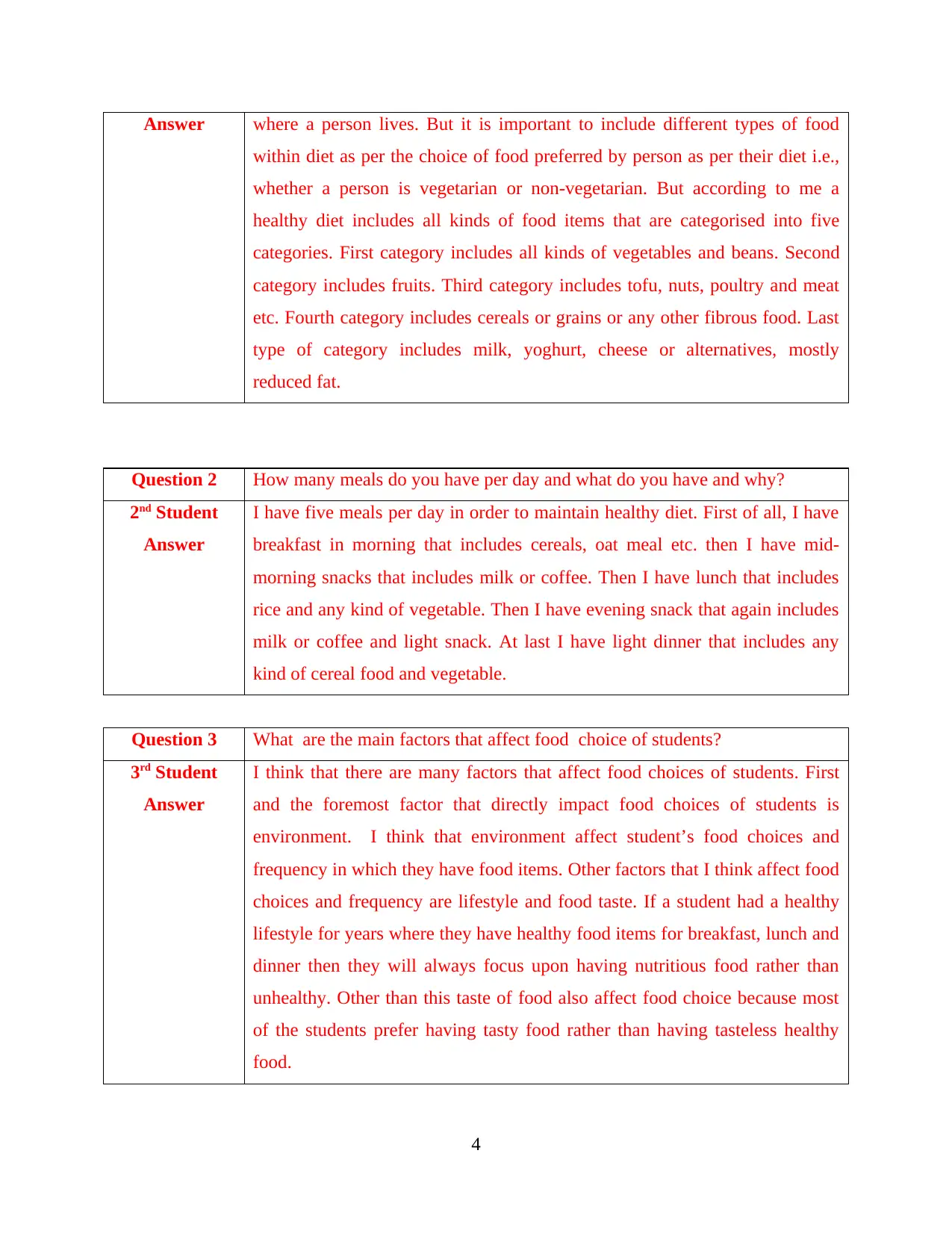
Answer where a person lives. But it is important to include different types of food
within diet as per the choice of food preferred by person as per their diet i.e.,
whether a person is vegetarian or non-vegetarian. But according to me a
healthy diet includes all kinds of food items that are categorised into five
categories. First category includes all kinds of vegetables and beans. Second
category includes fruits. Third category includes tofu, nuts, poultry and meat
etc. Fourth category includes cereals or grains or any other fibrous food. Last
type of category includes milk, yoghurt, cheese or alternatives, mostly
reduced fat.
Question 2 How many meals do you have per day and what do you have and why?
2nd Student
Answer
I have five meals per day in order to maintain healthy diet. First of all, I have
breakfast in morning that includes cereals, oat meal etc. then I have mid-
morning snacks that includes milk or coffee. Then I have lunch that includes
rice and any kind of vegetable. Then I have evening snack that again includes
milk or coffee and light snack. At last I have light dinner that includes any
kind of cereal food and vegetable.
Question 3 What are the main factors that affect food choice of students?
3rd Student
Answer
I think that there are many factors that affect food choices of students. First
and the foremost factor that directly impact food choices of students is
environment. I think that environment affect student’s food choices and
frequency in which they have food items. Other factors that I think affect food
choices and frequency are lifestyle and food taste. If a student had a healthy
lifestyle for years where they have healthy food items for breakfast, lunch and
dinner then they will always focus upon having nutritious food rather than
unhealthy. Other than this taste of food also affect food choice because most
of the students prefer having tasty food rather than having tasteless healthy
food.
4
within diet as per the choice of food preferred by person as per their diet i.e.,
whether a person is vegetarian or non-vegetarian. But according to me a
healthy diet includes all kinds of food items that are categorised into five
categories. First category includes all kinds of vegetables and beans. Second
category includes fruits. Third category includes tofu, nuts, poultry and meat
etc. Fourth category includes cereals or grains or any other fibrous food. Last
type of category includes milk, yoghurt, cheese or alternatives, mostly
reduced fat.
Question 2 How many meals do you have per day and what do you have and why?
2nd Student
Answer
I have five meals per day in order to maintain healthy diet. First of all, I have
breakfast in morning that includes cereals, oat meal etc. then I have mid-
morning snacks that includes milk or coffee. Then I have lunch that includes
rice and any kind of vegetable. Then I have evening snack that again includes
milk or coffee and light snack. At last I have light dinner that includes any
kind of cereal food and vegetable.
Question 3 What are the main factors that affect food choice of students?
3rd Student
Answer
I think that there are many factors that affect food choices of students. First
and the foremost factor that directly impact food choices of students is
environment. I think that environment affect student’s food choices and
frequency in which they have food items. Other factors that I think affect food
choices and frequency are lifestyle and food taste. If a student had a healthy
lifestyle for years where they have healthy food items for breakfast, lunch and
dinner then they will always focus upon having nutritious food rather than
unhealthy. Other than this taste of food also affect food choice because most
of the students prefer having tasty food rather than having tasteless healthy
food.
4
⊘ This is a preview!⊘
Do you want full access?
Subscribe today to unlock all pages.
Trusted by 1+ million students worldwide
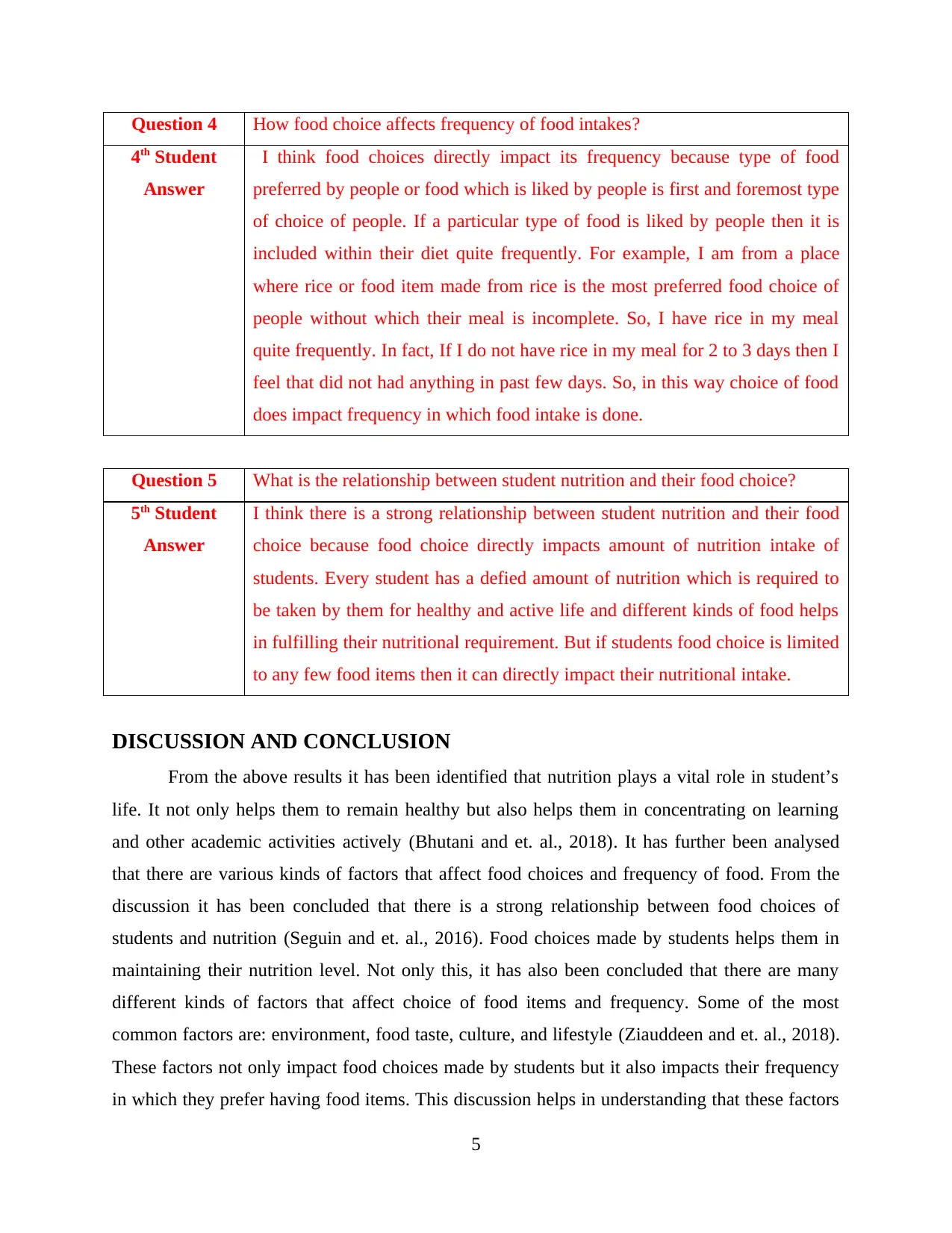
Question 4 How food choice affects frequency of food intakes?
4th Student
Answer
I think food choices directly impact its frequency because type of food
preferred by people or food which is liked by people is first and foremost type
of choice of people. If a particular type of food is liked by people then it is
included within their diet quite frequently. For example, I am from a place
where rice or food item made from rice is the most preferred food choice of
people without which their meal is incomplete. So, I have rice in my meal
quite frequently. In fact, If I do not have rice in my meal for 2 to 3 days then I
feel that did not had anything in past few days. So, in this way choice of food
does impact frequency in which food intake is done.
Question 5 What is the relationship between student nutrition and their food choice?
5th Student
Answer
I think there is a strong relationship between student nutrition and their food
choice because food choice directly impacts amount of nutrition intake of
students. Every student has a defied amount of nutrition which is required to
be taken by them for healthy and active life and different kinds of food helps
in fulfilling their nutritional requirement. But if students food choice is limited
to any few food items then it can directly impact their nutritional intake.
DISCUSSION AND CONCLUSION
From the above results it has been identified that nutrition plays a vital role in student’s
life. It not only helps them to remain healthy but also helps them in concentrating on learning
and other academic activities actively (Bhutani and et. al., 2018). It has further been analysed
that there are various kinds of factors that affect food choices and frequency of food. From the
discussion it has been concluded that there is a strong relationship between food choices of
students and nutrition (Seguin and et. al., 2016). Food choices made by students helps them in
maintaining their nutrition level. Not only this, it has also been concluded that there are many
different kinds of factors that affect choice of food items and frequency. Some of the most
common factors are: environment, food taste, culture, and lifestyle (Ziauddeen and et. al., 2018).
These factors not only impact food choices made by students but it also impacts their frequency
in which they prefer having food items. This discussion helps in understanding that these factors
5
4th Student
Answer
I think food choices directly impact its frequency because type of food
preferred by people or food which is liked by people is first and foremost type
of choice of people. If a particular type of food is liked by people then it is
included within their diet quite frequently. For example, I am from a place
where rice or food item made from rice is the most preferred food choice of
people without which their meal is incomplete. So, I have rice in my meal
quite frequently. In fact, If I do not have rice in my meal for 2 to 3 days then I
feel that did not had anything in past few days. So, in this way choice of food
does impact frequency in which food intake is done.
Question 5 What is the relationship between student nutrition and their food choice?
5th Student
Answer
I think there is a strong relationship between student nutrition and their food
choice because food choice directly impacts amount of nutrition intake of
students. Every student has a defied amount of nutrition which is required to
be taken by them for healthy and active life and different kinds of food helps
in fulfilling their nutritional requirement. But if students food choice is limited
to any few food items then it can directly impact their nutritional intake.
DISCUSSION AND CONCLUSION
From the above results it has been identified that nutrition plays a vital role in student’s
life. It not only helps them to remain healthy but also helps them in concentrating on learning
and other academic activities actively (Bhutani and et. al., 2018). It has further been analysed
that there are various kinds of factors that affect food choices and frequency of food. From the
discussion it has been concluded that there is a strong relationship between food choices of
students and nutrition (Seguin and et. al., 2016). Food choices made by students helps them in
maintaining their nutrition level. Not only this, it has also been concluded that there are many
different kinds of factors that affect choice of food items and frequency. Some of the most
common factors are: environment, food taste, culture, and lifestyle (Ziauddeen and et. al., 2018).
These factors not only impact food choices made by students but it also impacts their frequency
in which they prefer having food items. This discussion helps in understanding that these factors
5
Paraphrase This Document
Need a fresh take? Get an instant paraphrase of this document with our AI Paraphraser
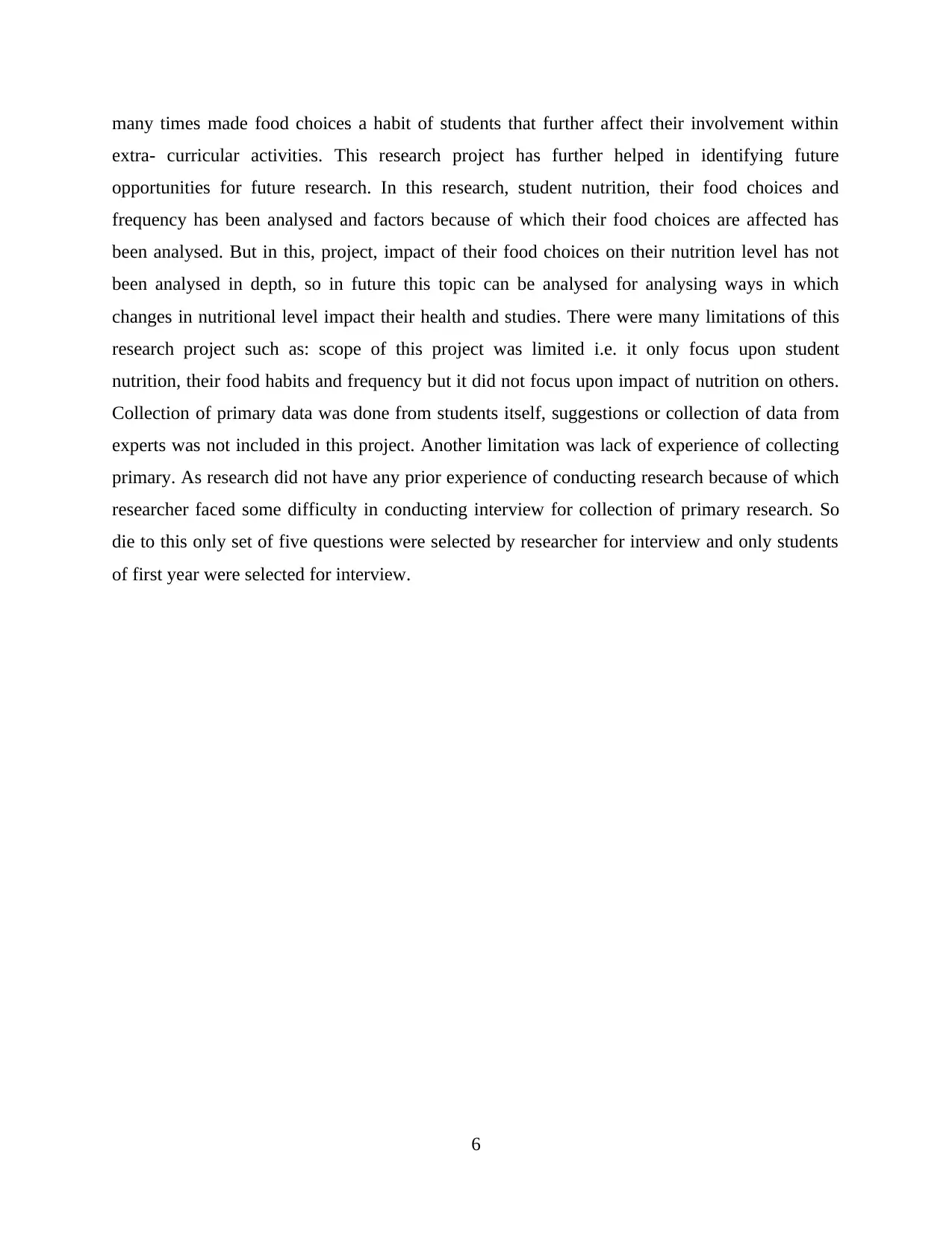
many times made food choices a habit of students that further affect their involvement within
extra- curricular activities. This research project has further helped in identifying future
opportunities for future research. In this research, student nutrition, their food choices and
frequency has been analysed and factors because of which their food choices are affected has
been analysed. But in this, project, impact of their food choices on their nutrition level has not
been analysed in depth, so in future this topic can be analysed for analysing ways in which
changes in nutritional level impact their health and studies. There were many limitations of this
research project such as: scope of this project was limited i.e. it only focus upon student
nutrition, their food habits and frequency but it did not focus upon impact of nutrition on others.
Collection of primary data was done from students itself, suggestions or collection of data from
experts was not included in this project. Another limitation was lack of experience of collecting
primary. As research did not have any prior experience of conducting research because of which
researcher faced some difficulty in conducting interview for collection of primary research. So
die to this only set of five questions were selected by researcher for interview and only students
of first year were selected for interview.
6
extra- curricular activities. This research project has further helped in identifying future
opportunities for future research. In this research, student nutrition, their food choices and
frequency has been analysed and factors because of which their food choices are affected has
been analysed. But in this, project, impact of their food choices on their nutrition level has not
been analysed in depth, so in future this topic can be analysed for analysing ways in which
changes in nutritional level impact their health and studies. There were many limitations of this
research project such as: scope of this project was limited i.e. it only focus upon student
nutrition, their food habits and frequency but it did not focus upon impact of nutrition on others.
Collection of primary data was done from students itself, suggestions or collection of data from
experts was not included in this project. Another limitation was lack of experience of collecting
primary. As research did not have any prior experience of conducting research because of which
researcher faced some difficulty in conducting interview for collection of primary research. So
die to this only set of five questions were selected by researcher for interview and only students
of first year were selected for interview.
6
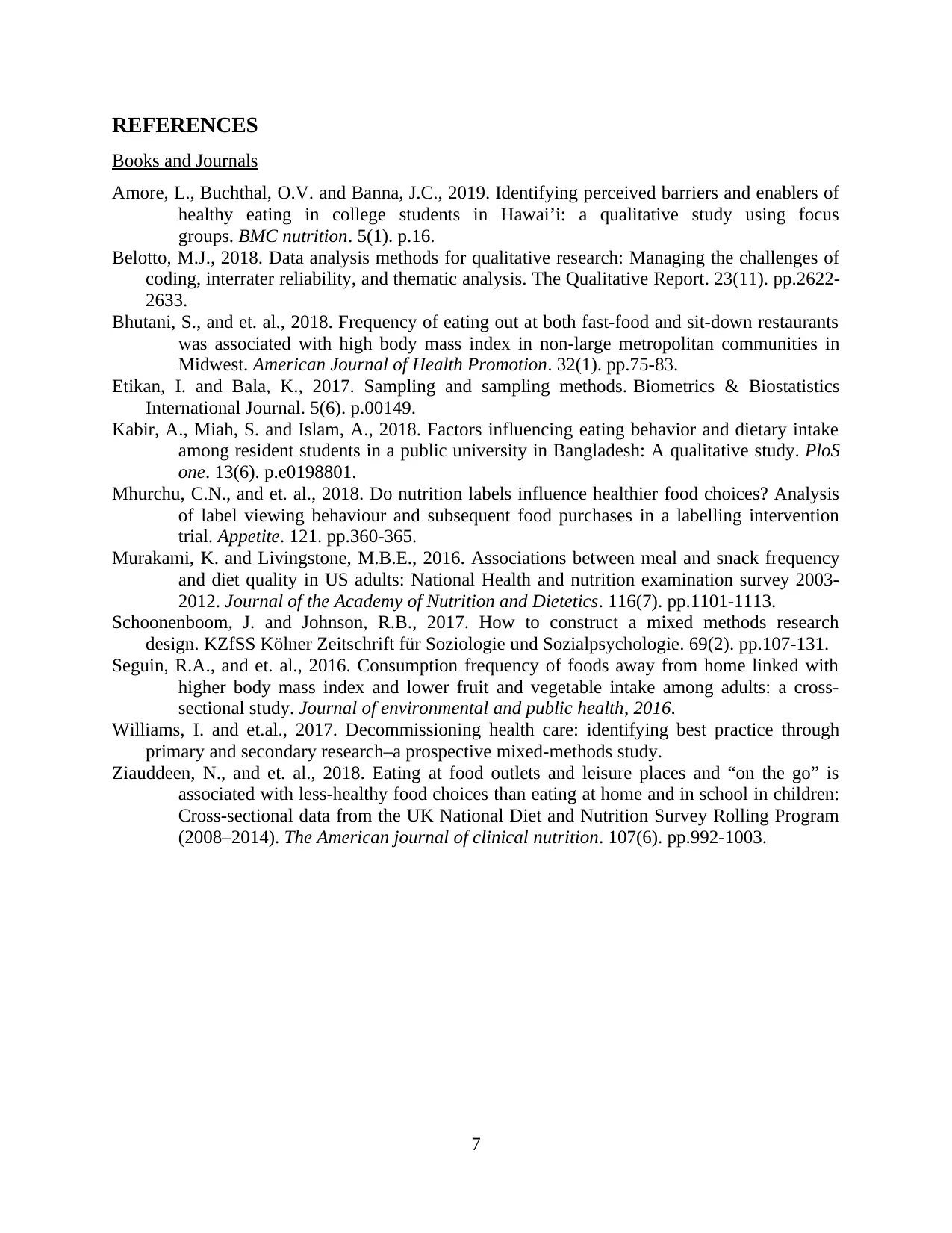
REFERENCES
Books and Journals
Amore, L., Buchthal, O.V. and Banna, J.C., 2019. Identifying perceived barriers and enablers of
healthy eating in college students in Hawai’i: a qualitative study using focus
groups. BMC nutrition. 5(1). p.16.
Belotto, M.J., 2018. Data analysis methods for qualitative research: Managing the challenges of
coding, interrater reliability, and thematic analysis. The Qualitative Report. 23(11). pp.2622-
2633.
Bhutani, S., and et. al., 2018. Frequency of eating out at both fast-food and sit-down restaurants
was associated with high body mass index in non-large metropolitan communities in
Midwest. American Journal of Health Promotion. 32(1). pp.75-83.
Etikan, I. and Bala, K., 2017. Sampling and sampling methods. Biometrics & Biostatistics
International Journal. 5(6). p.00149.
Kabir, A., Miah, S. and Islam, A., 2018. Factors influencing eating behavior and dietary intake
among resident students in a public university in Bangladesh: A qualitative study. PloS
one. 13(6). p.e0198801.
Mhurchu, C.N., and et. al., 2018. Do nutrition labels influence healthier food choices? Analysis
of label viewing behaviour and subsequent food purchases in a labelling intervention
trial. Appetite. 121. pp.360-365.
Murakami, K. and Livingstone, M.B.E., 2016. Associations between meal and snack frequency
and diet quality in US adults: National Health and nutrition examination survey 2003-
2012. Journal of the Academy of Nutrition and Dietetics. 116(7). pp.1101-1113.
Schoonenboom, J. and Johnson, R.B., 2017. How to construct a mixed methods research
design. KZfSS Kölner Zeitschrift für Soziologie und Sozialpsychologie. 69(2). pp.107-131.
Seguin, R.A., and et. al., 2016. Consumption frequency of foods away from home linked with
higher body mass index and lower fruit and vegetable intake among adults: a cross-
sectional study. Journal of environmental and public health, 2016.
Williams, I. and et.al., 2017. Decommissioning health care: identifying best practice through
primary and secondary research–a prospective mixed-methods study.
Ziauddeen, N., and et. al., 2018. Eating at food outlets and leisure places and “on the go” is
associated with less-healthy food choices than eating at home and in school in children:
Cross-sectional data from the UK National Diet and Nutrition Survey Rolling Program
(2008–2014). The American journal of clinical nutrition. 107(6). pp.992-1003.
7
Books and Journals
Amore, L., Buchthal, O.V. and Banna, J.C., 2019. Identifying perceived barriers and enablers of
healthy eating in college students in Hawai’i: a qualitative study using focus
groups. BMC nutrition. 5(1). p.16.
Belotto, M.J., 2018. Data analysis methods for qualitative research: Managing the challenges of
coding, interrater reliability, and thematic analysis. The Qualitative Report. 23(11). pp.2622-
2633.
Bhutani, S., and et. al., 2018. Frequency of eating out at both fast-food and sit-down restaurants
was associated with high body mass index in non-large metropolitan communities in
Midwest. American Journal of Health Promotion. 32(1). pp.75-83.
Etikan, I. and Bala, K., 2017. Sampling and sampling methods. Biometrics & Biostatistics
International Journal. 5(6). p.00149.
Kabir, A., Miah, S. and Islam, A., 2018. Factors influencing eating behavior and dietary intake
among resident students in a public university in Bangladesh: A qualitative study. PloS
one. 13(6). p.e0198801.
Mhurchu, C.N., and et. al., 2018. Do nutrition labels influence healthier food choices? Analysis
of label viewing behaviour and subsequent food purchases in a labelling intervention
trial. Appetite. 121. pp.360-365.
Murakami, K. and Livingstone, M.B.E., 2016. Associations between meal and snack frequency
and diet quality in US adults: National Health and nutrition examination survey 2003-
2012. Journal of the Academy of Nutrition and Dietetics. 116(7). pp.1101-1113.
Schoonenboom, J. and Johnson, R.B., 2017. How to construct a mixed methods research
design. KZfSS Kölner Zeitschrift für Soziologie und Sozialpsychologie. 69(2). pp.107-131.
Seguin, R.A., and et. al., 2016. Consumption frequency of foods away from home linked with
higher body mass index and lower fruit and vegetable intake among adults: a cross-
sectional study. Journal of environmental and public health, 2016.
Williams, I. and et.al., 2017. Decommissioning health care: identifying best practice through
primary and secondary research–a prospective mixed-methods study.
Ziauddeen, N., and et. al., 2018. Eating at food outlets and leisure places and “on the go” is
associated with less-healthy food choices than eating at home and in school in children:
Cross-sectional data from the UK National Diet and Nutrition Survey Rolling Program
(2008–2014). The American journal of clinical nutrition. 107(6). pp.992-1003.
7
⊘ This is a preview!⊘
Do you want full access?
Subscribe today to unlock all pages.
Trusted by 1+ million students worldwide

1 out of 9


Related Documents


Your All-in-One AI-Powered Toolkit for Academic Success.
+13062052269
info@desklib.com
Available 24*7 on WhatsApp / Email
![[object Object]](/_next/static/media/star-bottom.7253800d.svg)
Unlock your academic potential
Copyright © 2020–2026 A2Z Services. All Rights Reserved. Developed and managed by ZUCOL.