VitalSource Application: Designing a Student-Focused App

Verified

Added on  2022/10/11

|1
|263
|99
Homework Assignment
AI Summary
The assignment focuses on the development of the VitalSource application, a mobile learning tool designed to enhance the student's learning experience. The application should be intuitive, easy-to-use, and allow students to read, annotate, and highlight text, mirroring the functionality of physical books. It should incorporate a search tool and be compatible with multiple operating systems such as Android, Mac, and Windows, enabling use across various devices. The application should also include a download option for offline reading and support assistive technologies for learners with disabilities. The provided solution emphasizes the importance of accessibility and user-friendliness in the design of the VitalSource application. References from the assignment brief are also provided.
Document Page
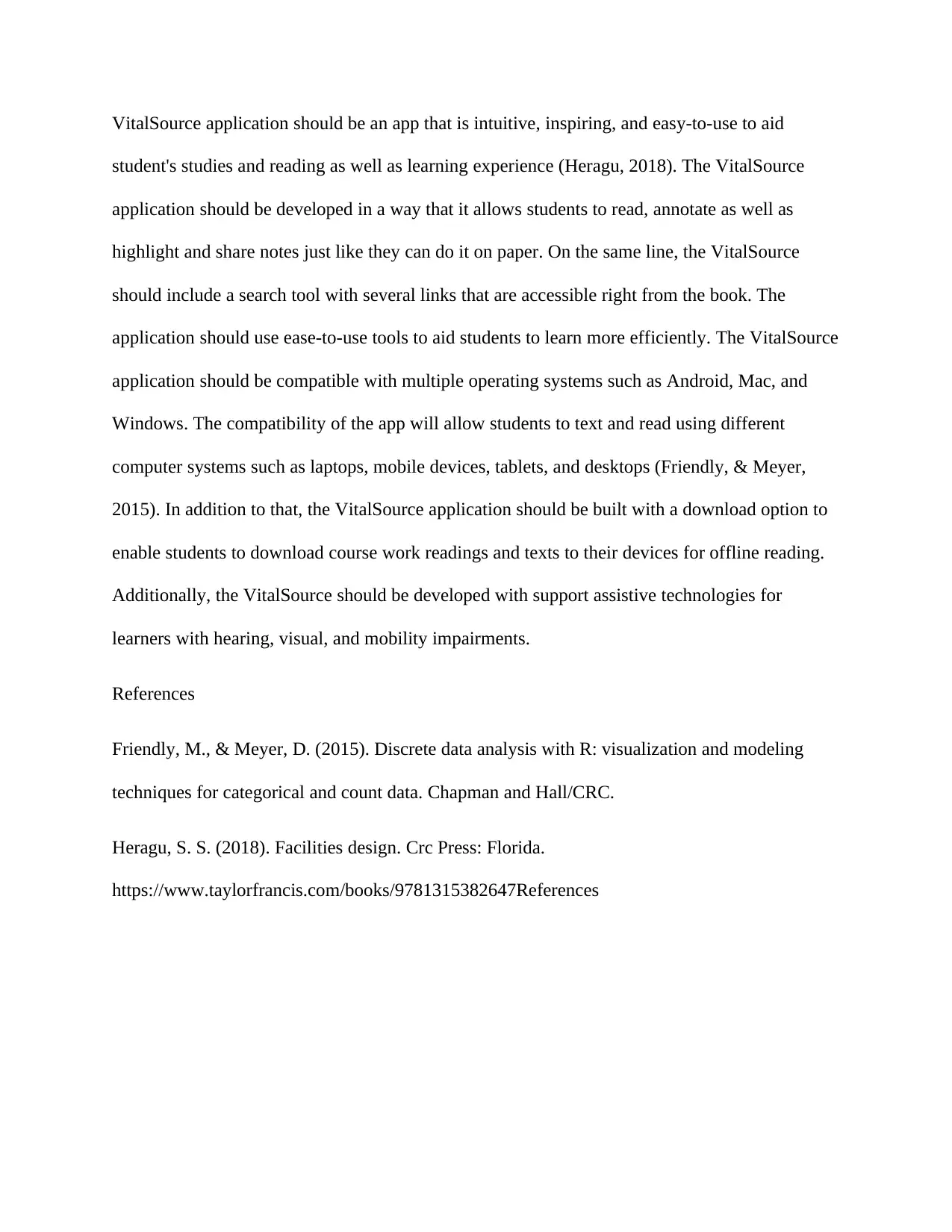
VitalSource application should be an app that is intuitive, inspiring, and easy-to-use to aid
student's studies and reading as well as learning experience (Heragu, 2018). The VitalSource
application should be developed in a way that it allows students to read, annotate as well as
highlight and share notes just like they can do it on paper. On the same line, the VitalSource
should include a search tool with several links that are accessible right from the book. The
application should use ease-to-use tools to aid students to learn more efficiently. The VitalSource
application should be compatible with multiple operating systems such as Android, Mac, and
Windows. The compatibility of the app will allow students to text and read using different
computer systems such as laptops, mobile devices, tablets, and desktops (Friendly, & Meyer,
2015). In addition to that, the VitalSource application should be built with a download option to
enable students to download course work readings and texts to their devices for offline reading.
Additionally, the VitalSource should be developed with support assistive technologies for
learners with hearing, visual, and mobility impairments.
References
Friendly, M., & Meyer, D. (2015). Discrete data analysis with R: visualization and modeling
techniques for categorical and count data. Chapman and Hall/CRC.
Heragu, S. S. (2018). Facilities design. Crc Press: Florida.
https://www.taylorfrancis.com/books/9781315382647References
tabler-icon-diamond-filled.svg

Paraphrase This Document

Need a fresh take? Get an instant paraphrase of this document with our AI Paraphraser
[object Object]