Investigating Assessment Methods & Motivation in Higher Education
VerifiedAdded on 2023/06/12
|40
|7707
|396
Report
AI Summary
This report investigates the perception of teachers regarding the decrease in student motivation due to current assessment methods in higher education. The research employs a questionnaire-based approach to gather data from teachers across five institutions. It examines the effectiveness of current assessment methods, identifies deficiencies, and proposes remedies such as the use of multiple assessment methods, embedded assessments, and a balance of direct and indirect methods, including both qualitative and quantitative approaches. The study covers the scope of assessment methods, research questions, literature review, methodology, results, discussions, and recommendations. The findings aim to inform learning institutions on improving their assessment methods to enhance the quality of education and produce well-rounded graduates. The report also acknowledges the contributions of research assistants and participating teachers.
DECREASE IN STUDENT MOTIVATION DUE TO ASSESSMENT METHODS 1
Unit Title
Student Name
University Name
Unit Title
Student Name
University Name

Paraphrase This Document
Need a fresh take? Get an instant paraphrase of this document with our AI Paraphraser
DECREASE IN STUDENT MOTIVATION DUE TO ASSESSMENT METHODS 2
1. Executive Summary
Some scholars have claimed that motivation is absolutely linked to assessment and evaluation
conducted in schools. A research was conducted to identify the perception of teachers about the
reason for the decrease in student’s motivation due to the current assessment methods (Shea, B,
2007). There is a deficiency in the current assessment methods which should be resolved by
remedies such as the use of multiple assessment methods, use of embedded assessment,
application of both direct and indirect methods and ensuring assessment methods include both
qualitative and quantitative methods (Baer, R, 2010).
2. Acknowledgements
I would like to acknowledge my research assistant who helped me in administering the
questionnaires in five institutions and the teachers who answered the questionnaires making our
research a success.
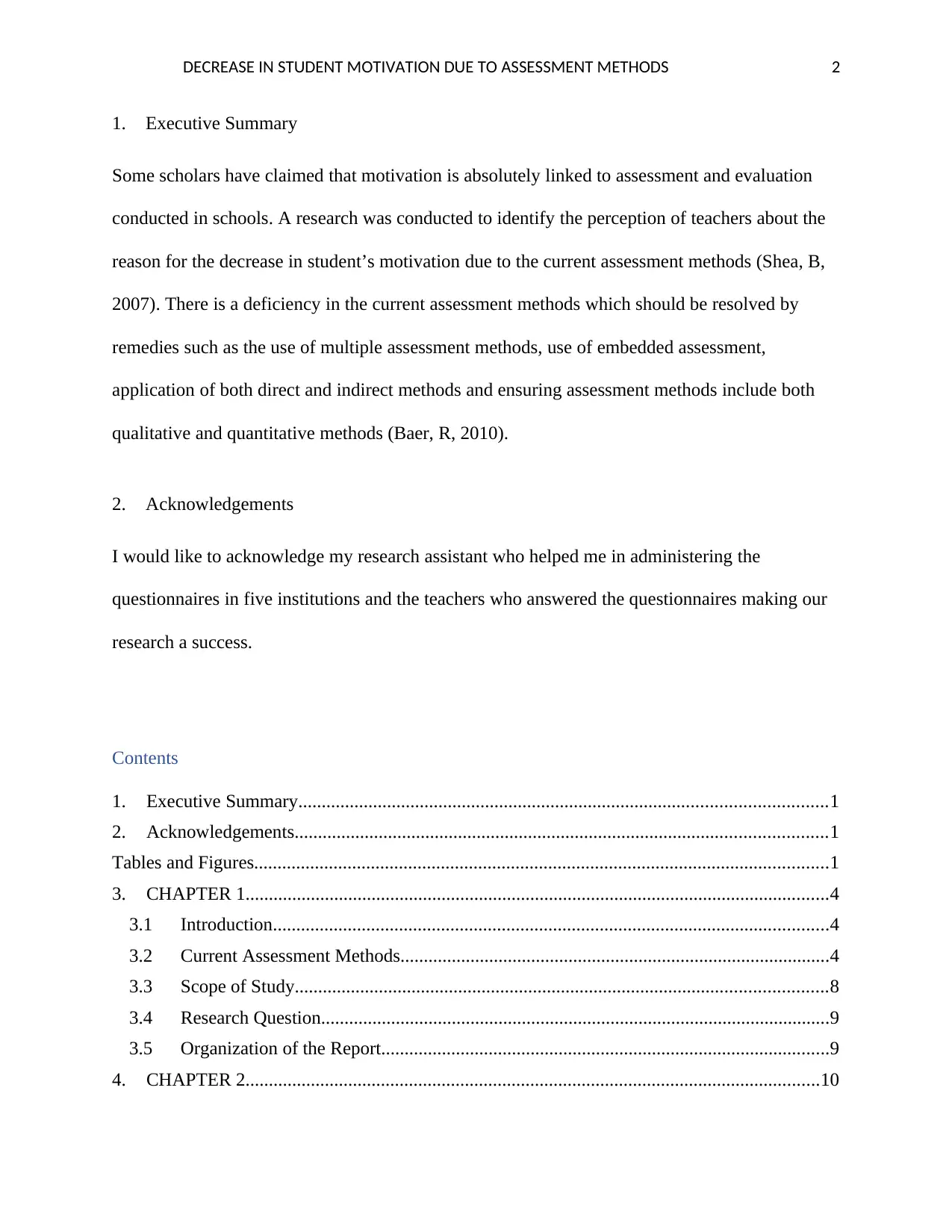
Contents
1. Executive Summary.................................................................................................................1
2. Acknowledgements..................................................................................................................1
Tables and Figures...........................................................................................................................1
3. CHAPTER 1.............................................................................................................................4
3.1 Introduction.......................................................................................................................4
3.2 Current Assessment Methods............................................................................................4
3.3 Scope of Study..................................................................................................................8
3.4 Research Question.............................................................................................................9
3.5 Organization of the Report................................................................................................9
4. CHAPTER 2...........................................................................................................................10
1. Executive Summary
Some scholars have claimed that motivation is absolutely linked to assessment and evaluation
conducted in schools. A research was conducted to identify the perception of teachers about the
reason for the decrease in student’s motivation due to the current assessment methods (Shea, B,
2007). There is a deficiency in the current assessment methods which should be resolved by
remedies such as the use of multiple assessment methods, use of embedded assessment,
application of both direct and indirect methods and ensuring assessment methods include both
qualitative and quantitative methods (Baer, R, 2010).
2. Acknowledgements
I would like to acknowledge my research assistant who helped me in administering the
questionnaires in five institutions and the teachers who answered the questionnaires making our
research a success.
Contents
1. Executive Summary.................................................................................................................1
2. Acknowledgements..................................................................................................................1
Tables and Figures...........................................................................................................................1
3. CHAPTER 1.............................................................................................................................4
3.1 Introduction.......................................................................................................................4
3.2 Current Assessment Methods............................................................................................4
3.3 Scope of Study..................................................................................................................8
3.4 Research Question.............................................................................................................9
3.5 Organization of the Report................................................................................................9
4. CHAPTER 2...........................................................................................................................10
DECREASE IN STUDENT MOTIVATION DUE TO ASSESSMENT METHODS 3
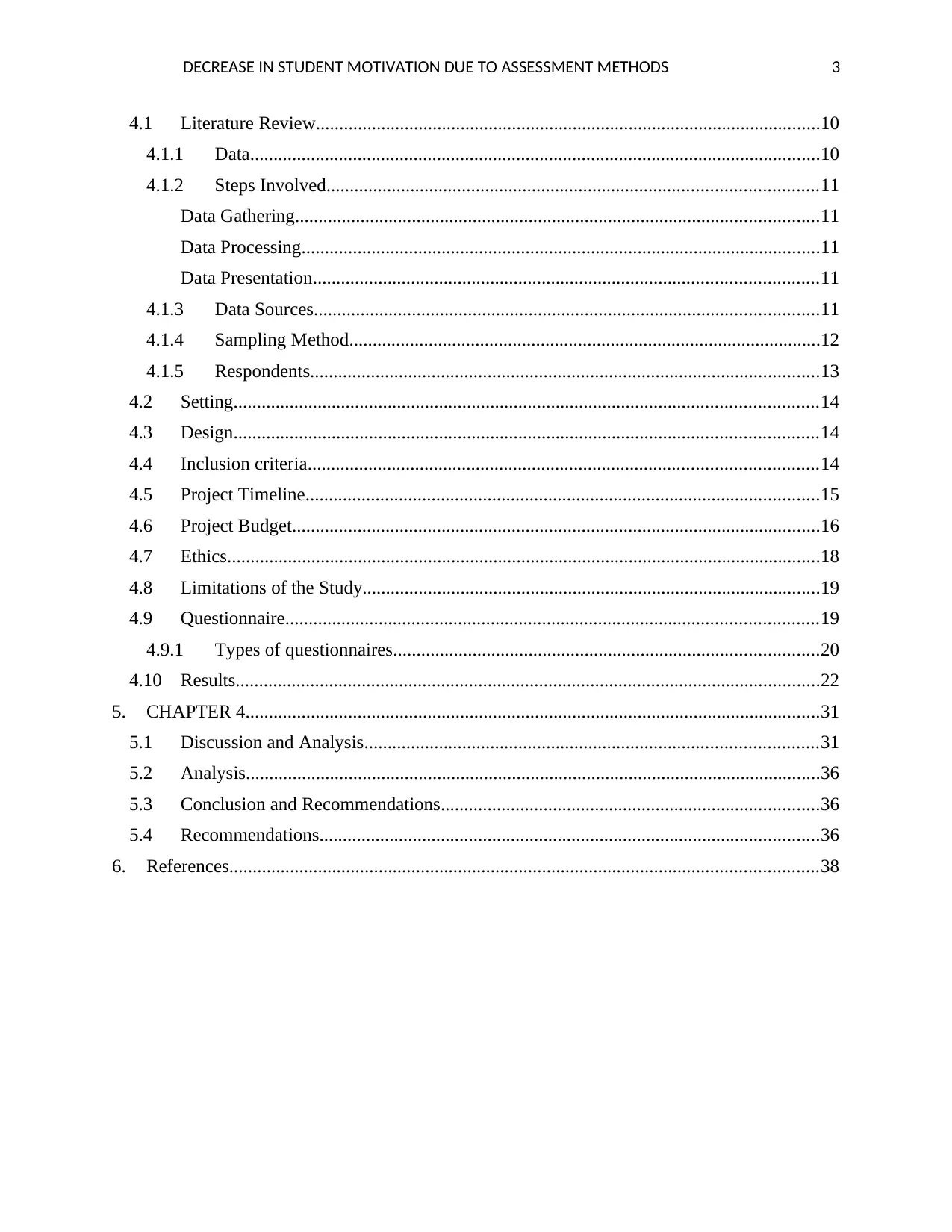
4.1 Literature Review............................................................................................................10
4.1.1 Data..........................................................................................................................10
4.1.2 Steps Involved.........................................................................................................11
Data Gathering................................................................................................................11
Data Processing...............................................................................................................11
Data Presentation............................................................................................................11
4.1.3 Data Sources............................................................................................................11
4.1.4 Sampling Method.....................................................................................................12
4.1.5 Respondents.............................................................................................................13
4.2 Setting.............................................................................................................................14
4.3 Design.............................................................................................................................14
4.4 Inclusion criteria.............................................................................................................14
4.5 Project Timeline..............................................................................................................15
4.6 Project Budget.................................................................................................................16
4.7 Ethics...............................................................................................................................18
4.8 Limitations of the Study..................................................................................................19
4.9 Questionnaire..................................................................................................................19
4.9.1 Types of questionnaires...........................................................................................20
4.10 Results.............................................................................................................................22
5. CHAPTER 4...........................................................................................................................31
5.1 Discussion and Analysis.................................................................................................31
5.2 Analysis...........................................................................................................................36
5.3 Conclusion and Recommendations.................................................................................36
5.4 Recommendations...........................................................................................................36
6. References..............................................................................................................................38
4.1 Literature Review............................................................................................................10
4.1.1 Data..........................................................................................................................10
4.1.2 Steps Involved.........................................................................................................11
Data Gathering................................................................................................................11
Data Processing...............................................................................................................11
Data Presentation............................................................................................................11
4.1.3 Data Sources............................................................................................................11
4.1.4 Sampling Method.....................................................................................................12
4.1.5 Respondents.............................................................................................................13
4.2 Setting.............................................................................................................................14
4.3 Design.............................................................................................................................14
4.4 Inclusion criteria.............................................................................................................14
4.5 Project Timeline..............................................................................................................15
4.6 Project Budget.................................................................................................................16
4.7 Ethics...............................................................................................................................18
4.8 Limitations of the Study..................................................................................................19
4.9 Questionnaire..................................................................................................................19
4.9.1 Types of questionnaires...........................................................................................20
4.10 Results.............................................................................................................................22
5. CHAPTER 4...........................................................................................................................31
5.1 Discussion and Analysis.................................................................................................31
5.2 Analysis...........................................................................................................................36
5.3 Conclusion and Recommendations.................................................................................36
5.4 Recommendations...........................................................................................................36
6. References..............................................................................................................................38
⊘ This is a preview!⊘
Do you want full access?
Subscribe today to unlock all pages.

Trusted by 1+ million students worldwide
DECREASE IN STUDENT MOTIVATION DUE TO ASSESSMENT METHODS 4
3. CHAPTER 1
3.1 Introduction
Institutional Assessment Methods are the tools, strategies, instruments and techniques for
collecting information to determine the extent to which students show the required outcomes of
learning (Nendaz, M, 2009). Several methods are used to assess students, there are both direct
and indirect learning methods. Indirect learning methods ask the students to reflect on their
learning while direct methods require students to demonstrate their learning e.g. in presentations,
tests and essays (Jantz, D, 2007). The assessment methods used by institutions in the Republic of
Maldives have various anomalies which have led to demotivation of students, this research
project seeks to get the perception of teachers on these methods and their opinion on what should
be implemented to motivate learners and create a more effective assessment system (Resiss, M,
2013).
3.2 Current Assessment Methods
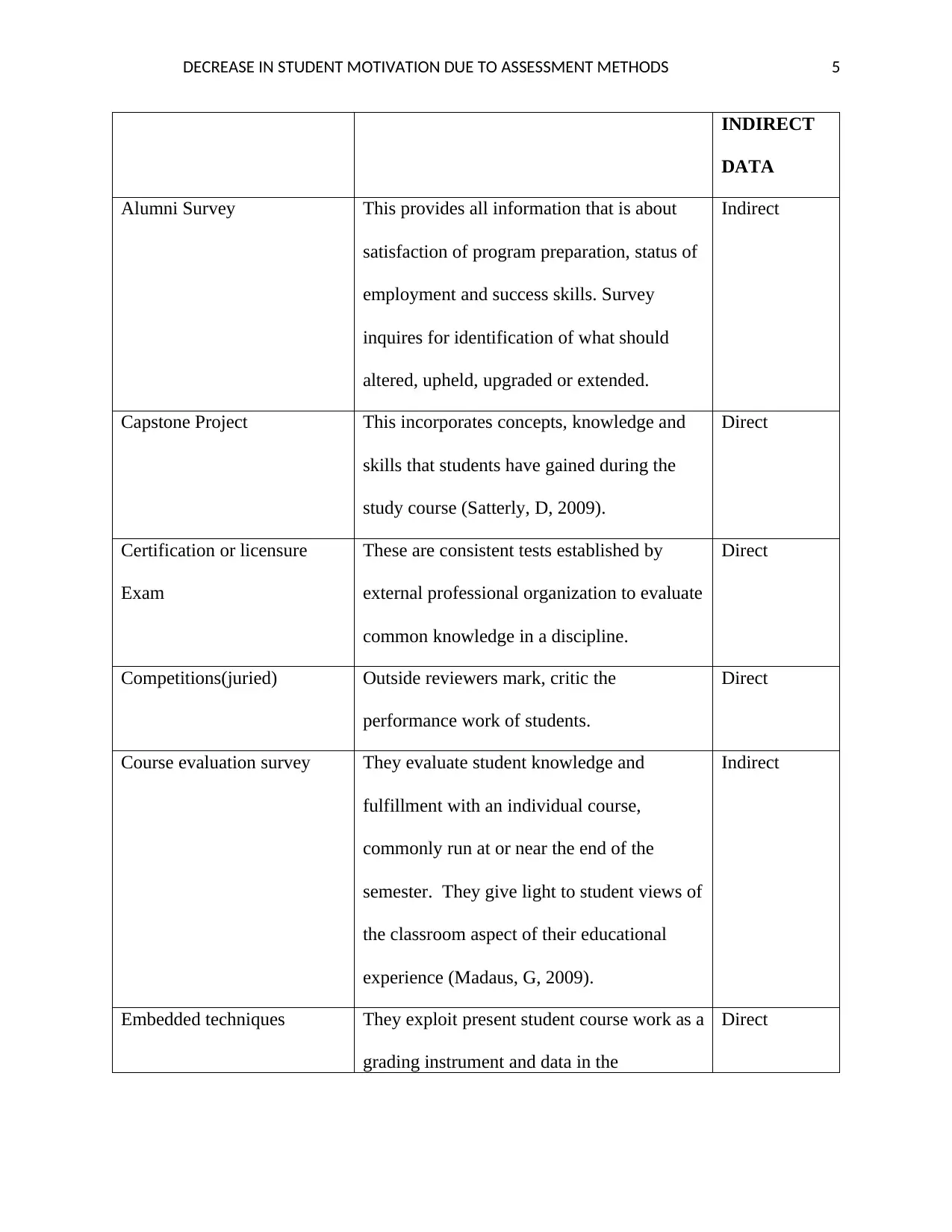
The table below summaries some of the current assessment methods, institutions have embraced
only a few of these methods leading to a less effective system (Schhon, I, 2009):
METHOD DESCRIPTION DIRECT OR
3. CHAPTER 1
3.1 Introduction
Institutional Assessment Methods are the tools, strategies, instruments and techniques for
collecting information to determine the extent to which students show the required outcomes of
learning (Nendaz, M, 2009). Several methods are used to assess students, there are both direct
and indirect learning methods. Indirect learning methods ask the students to reflect on their
learning while direct methods require students to demonstrate their learning e.g. in presentations,
tests and essays (Jantz, D, 2007). The assessment methods used by institutions in the Republic of
Maldives have various anomalies which have led to demotivation of students, this research
project seeks to get the perception of teachers on these methods and their opinion on what should
be implemented to motivate learners and create a more effective assessment system (Resiss, M,
2013).
3.2 Current Assessment Methods
The table below summaries some of the current assessment methods, institutions have embraced
only a few of these methods leading to a less effective system (Schhon, I, 2009):
METHOD DESCRIPTION DIRECT OR
Paraphrase This Document
Need a fresh take? Get an instant paraphrase of this document with our AI Paraphraser
DECREASE IN STUDENT MOTIVATION DUE TO ASSESSMENT METHODS 5
INDIRECT
DATA
Alumni Survey This provides all information that is about
satisfaction of program preparation, status of
employment and success skills. Survey
inquires for identification of what should
altered, upheld, upgraded or extended.
Indirect
Capstone Project This incorporates concepts, knowledge and
skills that students have gained during the
study course (Satterly, D, 2009).
Direct
Certification or licensure
Exam
These are consistent tests established by
external professional organization to evaluate
common knowledge in a discipline.
Direct
Competitions(juried) Outside reviewers mark, critic the
performance work of students.
Direct
Course evaluation survey They evaluate student knowledge and
fulfillment with an individual course,
commonly run at or near the end of the
semester. They give light to student views of
the classroom aspect of their educational
experience (Madaus, G, 2009).
Indirect
Embedded techniques They exploit present student course work as a
grading instrument and data in the
Direct
INDIRECT
DATA
Alumni Survey This provides all information that is about
satisfaction of program preparation, status of
employment and success skills. Survey
inquires for identification of what should
altered, upheld, upgraded or extended.
Indirect
Capstone Project This incorporates concepts, knowledge and
skills that students have gained during the
study course (Satterly, D, 2009).
Direct
Certification or licensure
Exam
These are consistent tests established by
external professional organization to evaluate
common knowledge in a discipline.
Direct
Competitions(juried) Outside reviewers mark, critic the
performance work of students.
Direct
Course evaluation survey They evaluate student knowledge and
fulfillment with an individual course,
commonly run at or near the end of the
semester. They give light to student views of
the classroom aspect of their educational
experience (Madaus, G, 2009).
Indirect
Embedded techniques They exploit present student course work as a
grading instrument and data in the
Direct
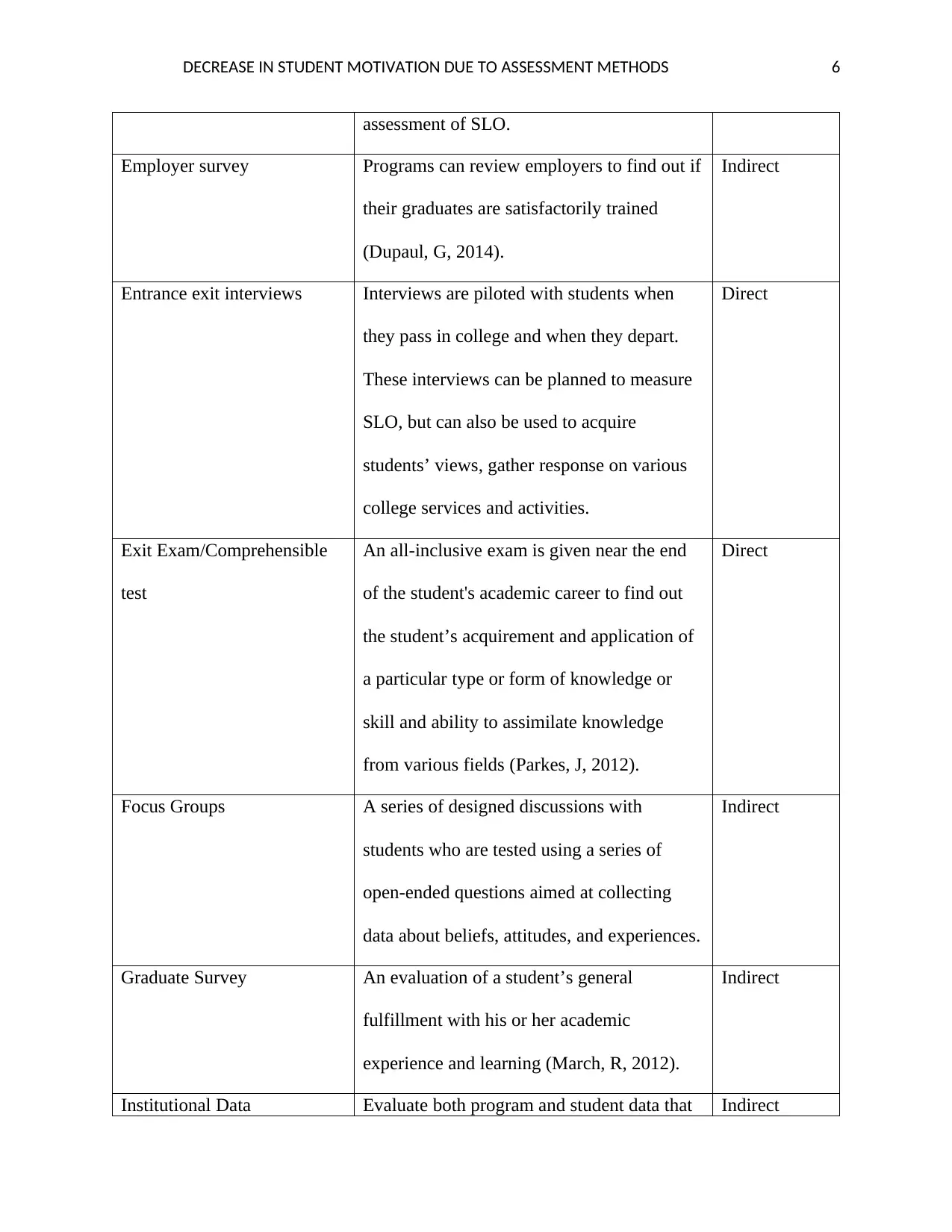
DECREASE IN STUDENT MOTIVATION DUE TO ASSESSMENT METHODS 6
assessment of SLO.
Employer survey Programs can review employers to find out if
their graduates are satisfactorily trained
(Dupaul, G, 2014).
Indirect
Entrance exit interviews Interviews are piloted with students when
they pass in college and when they depart.
These interviews can be planned to measure
SLO, but can also be used to acquire
students’ views, gather response on various
college services and activities.
Direct
Exit Exam/Comprehensible
test
An all-inclusive exam is given near the end
of the student's academic career to find out
the student’s acquirement and application of
a particular type or form of knowledge or
skill and ability to assimilate knowledge
from various fields (Parkes, J, 2012).
Direct
Focus Groups A series of designed discussions with
students who are tested using a series of
open-ended questions aimed at collecting
data about beliefs, attitudes, and experiences.
Indirect
Graduate Survey An evaluation of a student’s general
fulfillment with his or her academic
experience and learning (March, R, 2012).
Indirect
Institutional Data Evaluate both program and student data that Indirect
assessment of SLO.
Employer survey Programs can review employers to find out if
their graduates are satisfactorily trained
(Dupaul, G, 2014).
Indirect
Entrance exit interviews Interviews are piloted with students when
they pass in college and when they depart.
These interviews can be planned to measure
SLO, but can also be used to acquire
students’ views, gather response on various
college services and activities.
Direct
Exit Exam/Comprehensible
test
An all-inclusive exam is given near the end
of the student's academic career to find out
the student’s acquirement and application of
a particular type or form of knowledge or
skill and ability to assimilate knowledge
from various fields (Parkes, J, 2012).
Direct
Focus Groups A series of designed discussions with
students who are tested using a series of
open-ended questions aimed at collecting
data about beliefs, attitudes, and experiences.
Indirect
Graduate Survey An evaluation of a student’s general
fulfillment with his or her academic
experience and learning (March, R, 2012).
Indirect
Institutional Data Evaluate both program and student data that Indirect
⊘ This is a preview!⊘
Do you want full access?
Subscribe today to unlock all pages.
Trusted by 1+ million students worldwide
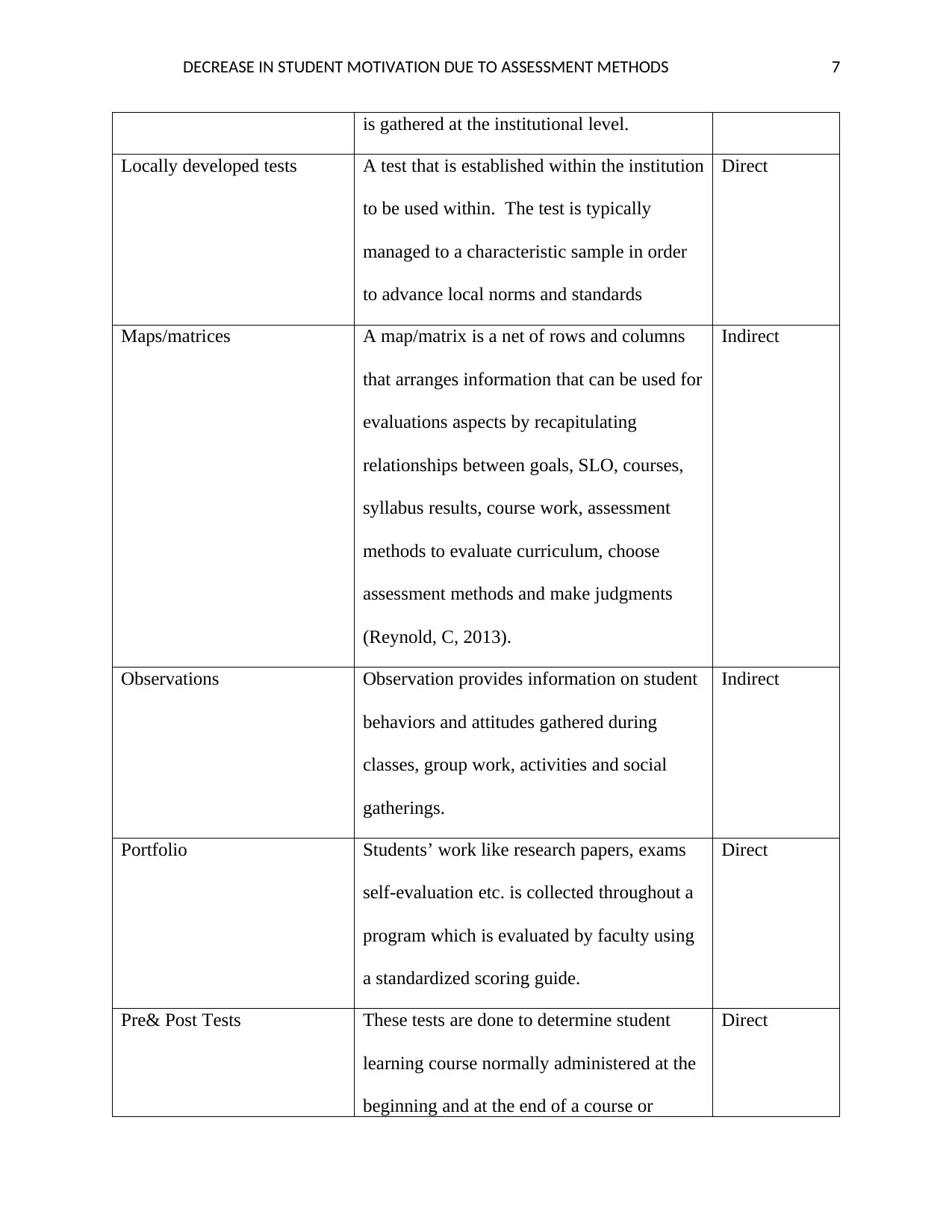
DECREASE IN STUDENT MOTIVATION DUE TO ASSESSMENT METHODS 7
is gathered at the institutional level.
Locally developed tests A test that is established within the institution
to be used within. The test is typically
managed to a characteristic sample in order
to advance local norms and standards
Direct
Maps/matrices A map/matrix is a net of rows and columns
that arranges information that can be used for
evaluations aspects by recapitulating
relationships between goals, SLO, courses,
syllabus results, course work, assessment
methods to evaluate curriculum, choose
assessment methods and make judgments
(Reynold, C, 2013).
Indirect
Observations Observation provides information on student
behaviors and attitudes gathered during
classes, group work, activities and social
gatherings.
Indirect
Portfolio Students’ work like research papers, exams
self-evaluation etc. is collected throughout a
program which is evaluated by faculty using
a standardized scoring guide.
Direct
Pre& Post Tests These tests are done to determine student
learning course normally administered at the
beginning and at the end of a course or
Direct
is gathered at the institutional level.
Locally developed tests A test that is established within the institution
to be used within. The test is typically
managed to a characteristic sample in order
to advance local norms and standards
Direct
Maps/matrices A map/matrix is a net of rows and columns
that arranges information that can be used for
evaluations aspects by recapitulating
relationships between goals, SLO, courses,
syllabus results, course work, assessment
methods to evaluate curriculum, choose
assessment methods and make judgments
(Reynold, C, 2013).
Indirect
Observations Observation provides information on student
behaviors and attitudes gathered during
classes, group work, activities and social
gatherings.
Indirect
Portfolio Students’ work like research papers, exams
self-evaluation etc. is collected throughout a
program which is evaluated by faculty using
a standardized scoring guide.
Direct
Pre& Post Tests These tests are done to determine student
learning course normally administered at the
beginning and at the end of a course or
Direct
Paraphrase This Document
Need a fresh take? Get an instant paraphrase of this document with our AI Paraphraser
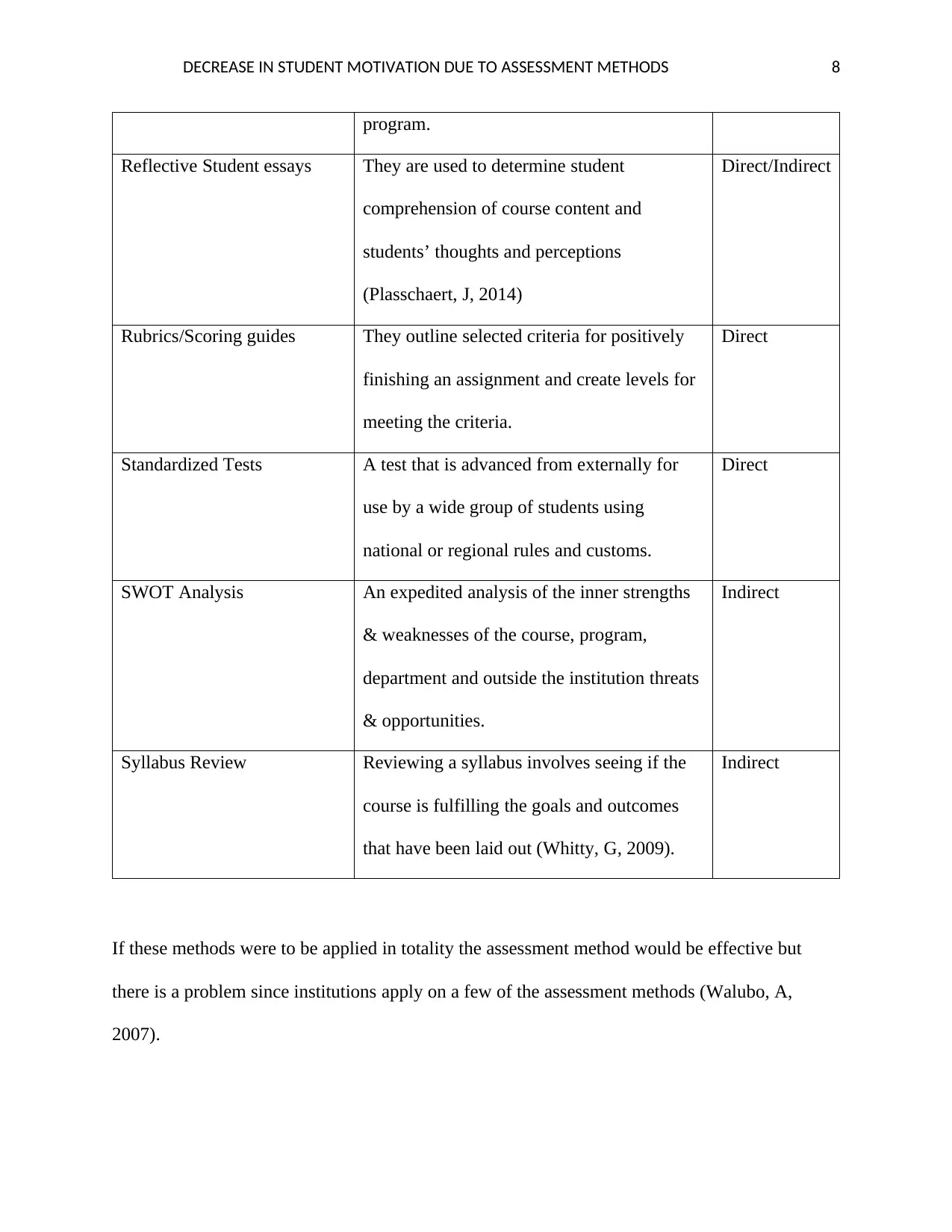
DECREASE IN STUDENT MOTIVATION DUE TO ASSESSMENT METHODS 8
program.
Reflective Student essays They are used to determine student
comprehension of course content and
students’ thoughts and perceptions
(Plasschaert, J, 2014)
Direct/Indirect
Rubrics/Scoring guides They outline selected criteria for positively
finishing an assignment and create levels for
meeting the criteria.
Direct
Standardized Tests A test that is advanced from externally for
use by a wide group of students using
national or regional rules and customs.
Direct
SWOT Analysis An expedited analysis of the inner strengths
& weaknesses of the course, program,
department and outside the institution threats
& opportunities.
Indirect
Syllabus Review Reviewing a syllabus involves seeing if the
course is fulfilling the goals and outcomes
that have been laid out (Whitty, G, 2009).
Indirect
If these methods were to be applied in totality the assessment method would be effective but
there is a problem since institutions apply on a few of the assessment methods (Walubo, A,
2007).
program.
Reflective Student essays They are used to determine student
comprehension of course content and
students’ thoughts and perceptions
(Plasschaert, J, 2014)
Direct/Indirect
Rubrics/Scoring guides They outline selected criteria for positively
finishing an assignment and create levels for
meeting the criteria.
Direct
Standardized Tests A test that is advanced from externally for
use by a wide group of students using
national or regional rules and customs.
Direct
SWOT Analysis An expedited analysis of the inner strengths
& weaknesses of the course, program,
department and outside the institution threats
& opportunities.
Indirect
Syllabus Review Reviewing a syllabus involves seeing if the
course is fulfilling the goals and outcomes
that have been laid out (Whitty, G, 2009).
Indirect
If these methods were to be applied in totality the assessment method would be effective but
there is a problem since institutions apply on a few of the assessment methods (Walubo, A,
2007).
DECREASE IN STUDENT MOTIVATION DUE TO ASSESSMENT METHODS 9
3.3 Scope of Study
This study is essential to learning institutions since it will help them to improve their assessment
methods. Improvement in assessment methods will lead to a quality education system thus
production of all rounded graduates (Izzo, C, 2009).
3.4 Research Question
The study question is:
Why are the current assessment methods causing a decrease in student motivation?
Project Aims
To analyze the current assessment methods
To study the effectiveness of current assessment methods
To get the view of teachers on the current assessment methods (Chermack, T, 2007)
To give a recommendation on how to improve the current assessment methods to make
the education system effective in the Republic of Medieval
3.5 Organization of the Report
The report has six chapters which are arranged as follows:
Chapter 1: Introduction
Chapter 2: Literature Review
Chapter 3: Methodology
3.3 Scope of Study
This study is essential to learning institutions since it will help them to improve their assessment
methods. Improvement in assessment methods will lead to a quality education system thus
production of all rounded graduates (Izzo, C, 2009).
3.4 Research Question
The study question is:
Why are the current assessment methods causing a decrease in student motivation?
Project Aims
To analyze the current assessment methods
To study the effectiveness of current assessment methods
To get the view of teachers on the current assessment methods (Chermack, T, 2007)
To give a recommendation on how to improve the current assessment methods to make
the education system effective in the Republic of Medieval
3.5 Organization of the Report
The report has six chapters which are arranged as follows:
Chapter 1: Introduction
Chapter 2: Literature Review
Chapter 3: Methodology
⊘ This is a preview!⊘
Do you want full access?
Subscribe today to unlock all pages.
Trusted by 1+ million students worldwide
DECREASE IN STUDENT MOTIVATION DUE TO ASSESSMENT METHODS 10
Chapter 4: Results
Chapter 5: Discussions
Chapter 6: Concluding remarks
Chapter 7: References
Besides there is the executive summary, the appendix and the table of contents.
4. CHAPTER 2
4.1 Literature Review
Hill in his journal states that several methods should be used to assess the learning outcome of
students. He further states that relying on one assessment method will be counterproductive since
it will only reflect a part of the achievement of a student (Hill, N, 2007). A blend of indirect and
direct methods should be applied in student assessment. For example, tests should be combine
with responses from students to ensure that the student learning outcome is effectively
determined. The indirect methods are meant to help student reflect on what they have learnt
while direct methods are meant to help students in demonstrating their knowledge.
Reiss concentrates his study on the embedded assessment methods and the use of grades for
assessment. He states that course grades are not sufficient in measuring student learning
outcomes of a program. Grades are not sufficient in showing if student learning outcomes have
been attained since faculty members may vary in their grading strategies besides the grades do
not show class participation (Reiss, M, 2013). Reiss indicates that embedded assessments should
be utilized to provide data in assessing the student learning outcomes.
Cross in her assessment on student motivation argues that teachers sometimes spend a lot of time
marking papers and grading and forget to motivate their students. Teachers must come up with
ways to develop opportunities for their students to think about their work and apply the teacher’s
feedback to develop ways to meet the set learning targets. Students should be involved in
analysing on tests and other learning outcomes, this gives them a clear picture on where they are
in the learning journey (Cross, K, 2013).
Chapter 4: Results
Chapter 5: Discussions
Chapter 6: Concluding remarks
Chapter 7: References
Besides there is the executive summary, the appendix and the table of contents.
4. CHAPTER 2
4.1 Literature Review
Hill in his journal states that several methods should be used to assess the learning outcome of
students. He further states that relying on one assessment method will be counterproductive since
it will only reflect a part of the achievement of a student (Hill, N, 2007). A blend of indirect and
direct methods should be applied in student assessment. For example, tests should be combine
with responses from students to ensure that the student learning outcome is effectively
determined. The indirect methods are meant to help student reflect on what they have learnt
while direct methods are meant to help students in demonstrating their knowledge.
Reiss concentrates his study on the embedded assessment methods and the use of grades for
assessment. He states that course grades are not sufficient in measuring student learning
outcomes of a program. Grades are not sufficient in showing if student learning outcomes have
been attained since faculty members may vary in their grading strategies besides the grades do
not show class participation (Reiss, M, 2013). Reiss indicates that embedded assessments should
be utilized to provide data in assessing the student learning outcomes.
Cross in her assessment on student motivation argues that teachers sometimes spend a lot of time
marking papers and grading and forget to motivate their students. Teachers must come up with
ways to develop opportunities for their students to think about their work and apply the teacher’s
feedback to develop ways to meet the set learning targets. Students should be involved in
analysing on tests and other learning outcomes, this gives them a clear picture on where they are
in the learning journey (Cross, K, 2013).
Paraphrase This Document
Need a fresh take? Get an instant paraphrase of this document with our AI Paraphraser
DECREASE IN STUDENT MOTIVATION DUE TO ASSESSMENT METHODS 11
4.1.1 Data
These are statistics and facts collected together for analysis or reference. Data can be categorized
in to two main classes, qualitative and quantitate data.
Qualitative Data
This is data that cannot be expressed numerically but represented using other variables for
example car preferences e.g. Toyota and gender (Jantzi, D, 2007).
Quantitative Data
This is data that can be expressed in numerical form. It is assumed to be more accurate compared
to qualitative data. There are many formulae that are used in the analysis of numerical data in
order to come up with conclusions from given data. In this research project both qualitative and
quantitative data is used (Eberly, M, 2011).
4.1.2 Steps Involved
There are a couple of steps which were involved from the project commencement to its
completion as follows:
Data Gathering
This is the first step in any data analysis project, it involved collecting data using questionnaire
from the five institutions.
Data Processing
This is the process of processing data using functions and formulas, the results of the
questionnaires were processed using graphs and charts to represent what is on the ground clearly
(Plasschart, A,2007).
4.1.1 Data
These are statistics and facts collected together for analysis or reference. Data can be categorized
in to two main classes, qualitative and quantitate data.
Qualitative Data
This is data that cannot be expressed numerically but represented using other variables for
example car preferences e.g. Toyota and gender (Jantzi, D, 2007).
Quantitative Data
This is data that can be expressed in numerical form. It is assumed to be more accurate compared
to qualitative data. There are many formulae that are used in the analysis of numerical data in
order to come up with conclusions from given data. In this research project both qualitative and
quantitative data is used (Eberly, M, 2011).
4.1.2 Steps Involved
There are a couple of steps which were involved from the project commencement to its
completion as follows:
Data Gathering
This is the first step in any data analysis project, it involved collecting data using questionnaire
from the five institutions.
Data Processing
This is the process of processing data using functions and formulas, the results of the
questionnaires were processed using graphs and charts to represent what is on the ground clearly
(Plasschart, A,2007).
DECREASE IN STUDENT MOTIVATION DUE TO ASSESSMENT METHODS 12
Data Presentation
The final computed data must be presented in order to finalize any data analysis project.
4.1.3 Data Sources
The data used in this project was gathered using the following methods:
a. Historical Records
b. Online Sources
c. Questionnaires administered to the thirty teachers from five institutions (Whitly, G, 2009).
4.1.4 Sampling Method
A random sampling technique was used to select the study sample. It followed 2 stages.
Stage 1: cluster sampling was used to yield 5 local government areas in the Republic of
Medieval out of 10 local government areas. Each name of the 10 local government areas
were written on a piece of paper and 4 names were chosen randomly in which four
leading institutions in the region were visited.
Stage 2: 10 leading schools were randomly selected from the regions selected from step
1 (two schools per region), names of the schools were written in a piece of paper and
randomly picked from each area that was selected in stage 1.
prior arrangement were made with the facilities to be studied whereby participants were
teachers in those institutions. Those teachers who met the inclusion criteria of research
were randomly selected through a random method of picking rolled pieces of paper
Data Presentation
The final computed data must be presented in order to finalize any data analysis project.
4.1.3 Data Sources
The data used in this project was gathered using the following methods:
a. Historical Records
b. Online Sources
c. Questionnaires administered to the thirty teachers from five institutions (Whitly, G, 2009).
4.1.4 Sampling Method
A random sampling technique was used to select the study sample. It followed 2 stages.
Stage 1: cluster sampling was used to yield 5 local government areas in the Republic of
Medieval out of 10 local government areas. Each name of the 10 local government areas
were written on a piece of paper and 4 names were chosen randomly in which four
leading institutions in the region were visited.
Stage 2: 10 leading schools were randomly selected from the regions selected from step
1 (two schools per region), names of the schools were written in a piece of paper and
randomly picked from each area that was selected in stage 1.
prior arrangement were made with the facilities to be studied whereby participants were
teachers in those institutions. Those teachers who met the inclusion criteria of research
were randomly selected through a random method of picking rolled pieces of paper
⊘ This is a preview!⊘
Do you want full access?
Subscribe today to unlock all pages.
Trusted by 1+ million students worldwide

1 out of 40


Related Documents


Your All-in-One AI-Powered Toolkit for Academic Success.
+13062052269
info@desklib.com
Available 24*7 on WhatsApp / Email
![[object Object]](/_next/static/media/star-bottom.7253800d.svg)
Unlock your academic potential
Copyright © 2020–2026 A2Z Services. All Rights Reserved. Developed and managed by ZUCOL.