A Report on Student Nutrition: Food Choices and Frequency Analysis
VerifiedAdded on 2023/06/12
|12
|2584
|168
Report
AI Summary
This report investigates the nutrition and food choices of first-year students, exploring the factors influencing their dietary habits and eating frequency. The research employs a descriptive research design and secondary data analysis to understand the biological, economic, physical, and social determinants affecting students' food intake. Findings indicate that students' dietary choices are often influenced by factors like cost, availability, education, culture, and peer influence. The report highlights the importance of promoting healthy eating habits and providing nutritional guidance to first-year students to improve their overall well-being and lifestyle. The study concludes that addressing these factors is crucial for fostering better nutrition and health outcomes among students.
Exploring student nutrition
and the reasoning behind food
choice and frequency amongst
first year students
and the reasoning behind food
choice and frequency amongst
first year students

Paraphrase This Document
Need a fresh take? Get an instant paraphrase of this document with our AI Paraphraser
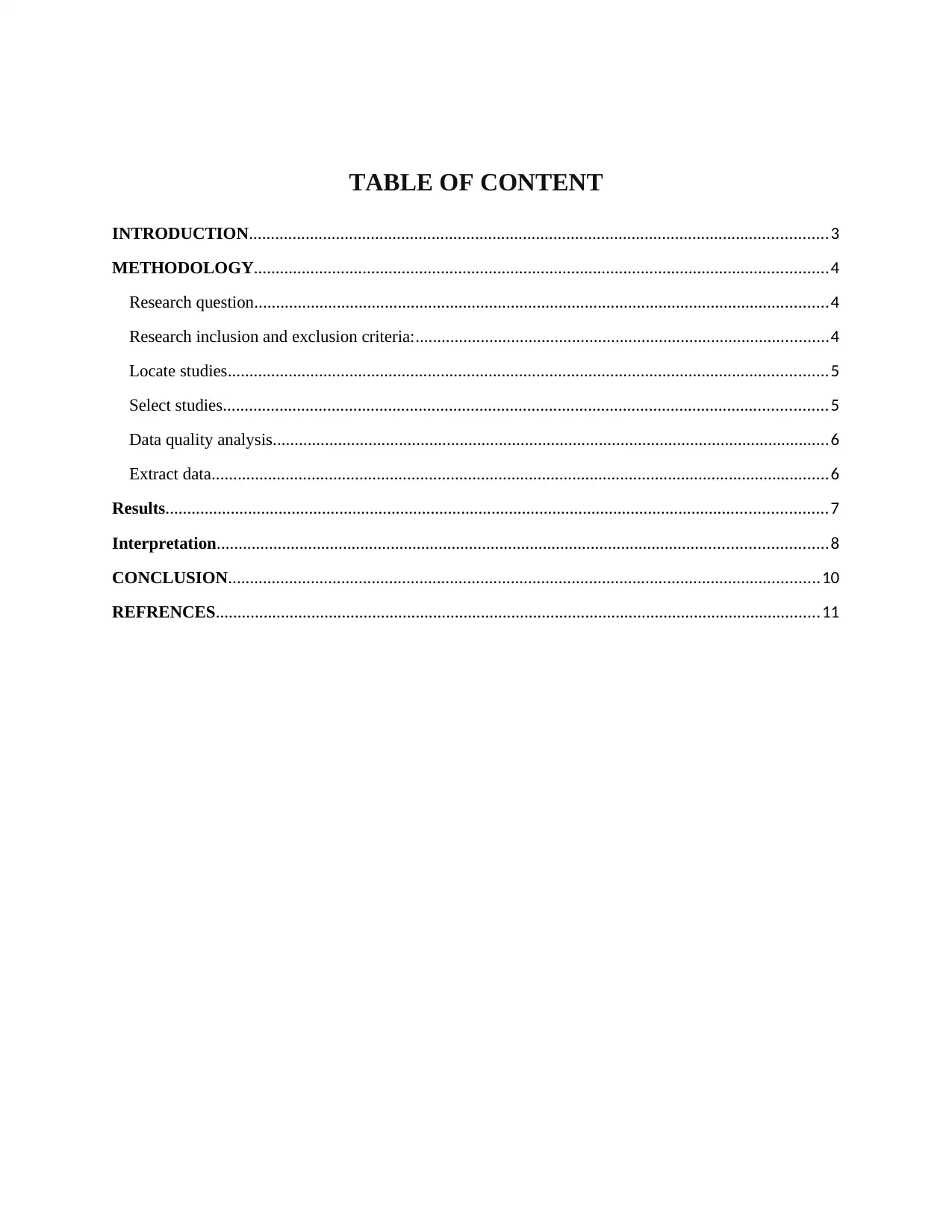
TABLE OF CONTENT
INTRODUCTION.....................................................................................................................................3
METHODOLOGY....................................................................................................................................4
Research question....................................................................................................................................4
Research inclusion and exclusion criteria:...............................................................................................4
Locate studies..........................................................................................................................................5
Select studies...........................................................................................................................................5
Data quality analysis................................................................................................................................6
Extract data..............................................................................................................................................6
Results........................................................................................................................................................7
Interpretation............................................................................................................................................8
CONCLUSION........................................................................................................................................10
REFRENCES...........................................................................................................................................11
INTRODUCTION.....................................................................................................................................3
METHODOLOGY....................................................................................................................................4
Research question....................................................................................................................................4
Research inclusion and exclusion criteria:...............................................................................................4
Locate studies..........................................................................................................................................5
Select studies...........................................................................................................................................5
Data quality analysis................................................................................................................................6
Extract data..............................................................................................................................................6
Results........................................................................................................................................................7
Interpretation............................................................................................................................................8
CONCLUSION........................................................................................................................................10
REFRENCES...........................................................................................................................................11

INTRODUCTION
Exploring student’s nutrition and reasoning behind food choice, frequency amongst first
year students plays keen role in determining best nutrition analysis diversely. Research will
explore importance of student’s nutrition, reasons behind food choice and frequency among first
Exploring student’s nutrition and reasoning behind food choice, frequency amongst first
year students plays keen role in determining best nutrition analysis diversely. Research will
explore importance of student’s nutrition, reasons behind food choice and frequency among first
⊘ This is a preview!⊘
Do you want full access?
Subscribe today to unlock all pages.

Trusted by 1+ million students worldwide
year people. Nutrition plays keen role in improved health management, food choices
development and optimizing best food priorities. Study will also further determine reasons
behind taking up food choices, and choosing the best frequency among first year young students.
The purpose behind research is exploring student’s nutrition choice, and identifying first year
student’s food priorities which make them acknowledged about food choices. Secondary data
collection will be done in research, for developing authentic working aspects within report and
determining usage of accurate findings. Research will also authentically identify methodology,
design methods which will be undertaken for competent research.
Aim: To explore student nutrition and reasoning behind food choice, frequency amongst first
year students.
METHODOLOGY
The descriptive research design has been taken in present research project, where topic I
exploring student’s nutrition and reasoning behind food choice. Implementation of descriptive
research design, will enable research to be specifically authentic for more extended goals.
Methodology specifically plays keen role to improvise new design oriented goals, for accurate
results within research (Mohajeri and et.a 2021). Descriptive research design holds huge
priorities, major working criteria within standards and generate authenticity of information
validity. There is high significance attached to research topic, where students nutrition and
reasoning behind food choices, frequency among first year students hold huge role.
Research question
Exploring student nutrition and the reasoning behind food choice and frequency among
first-year students. The research question holds significance, for strengthening vitality behind
nutrition importance for young students and reasoning behind their food choices. It also
competently holds huge importance to develop healthy nutrition habits among first year students,
and frequency behind specific food choice (Mertens, Deriemaeker and Beneden, 2021).
Students’ nutrition behind food choices and frequency among first year students, specifies that
healthy nutrition further is one of the keen factors for developing good lifestyle. Research
question is essentially crucial, where nutrition and reason behind food choice frequency among
first year students is essentially potent to determine accurate healthy living. This can be analyzed
development and optimizing best food priorities. Study will also further determine reasons
behind taking up food choices, and choosing the best frequency among first year young students.
The purpose behind research is exploring student’s nutrition choice, and identifying first year
student’s food priorities which make them acknowledged about food choices. Secondary data
collection will be done in research, for developing authentic working aspects within report and
determining usage of accurate findings. Research will also authentically identify methodology,
design methods which will be undertaken for competent research.
Aim: To explore student nutrition and reasoning behind food choice, frequency amongst first
year students.
METHODOLOGY
The descriptive research design has been taken in present research project, where topic I
exploring student’s nutrition and reasoning behind food choice. Implementation of descriptive
research design, will enable research to be specifically authentic for more extended goals.
Methodology specifically plays keen role to improvise new design oriented goals, for accurate
results within research (Mohajeri and et.a 2021). Descriptive research design holds huge
priorities, major working criteria within standards and generate authenticity of information
validity. There is high significance attached to research topic, where students nutrition and
reasoning behind food choices, frequency among first year students hold huge role.
Research question
Exploring student nutrition and the reasoning behind food choice and frequency among
first-year students. The research question holds significance, for strengthening vitality behind
nutrition importance for young students and reasoning behind their food choices. It also
competently holds huge importance to develop healthy nutrition habits among first year students,
and frequency behind specific food choice (Mertens, Deriemaeker and Beneden, 2021).
Students’ nutrition behind food choices and frequency among first year students, specifies that
healthy nutrition further is one of the keen factors for developing good lifestyle. Research
question is essentially crucial, where nutrition and reason behind food choice frequency among
first year students is essentially potent to determine accurate healthy living. This can be analyzed
Paraphrase This Document
Need a fresh take? Get an instant paraphrase of this document with our AI Paraphraser
that research question specifically holds huge role for determining wider engagement on latest
research goals and engage the best priorities.
Research inclusion and exclusion criteria:
Research inclusion criteria signifies that article published after 2018, will be used for
attaining information relevant with extended authentic data findings. The inclusion criteria will
determine optimum improvement in usage of descriptive research design, which further
improvises accuracy. Latest research articles of recent years, are authentic and develop best
results as per new inclusion and exclusion criteria to be worked on further within research
analysis. It will be more effective to use specific inclusive criteria for developing accurate
findings and using potentially accurate findings (Macknowski and Macknowski, 2021).
Exclusion criteria, will be articles published before 2018 will be excluded from research
to make it significantly rationale for further authentic research findings. Both inclusion and
exclusion criteria, will determine primitive engagement of best research articles and accurate
websites with latest information. Only informative, latest published data will be undertaken for
research to develop more accurate findings and generate specific working goals for more
informative long term productivity. It will further improvise more accurate results to be shaped
on, and develop primitive engagement for more accurate results. Inclusion and exclusion criteria
develops specific vision towards research benchmarks, based on studies management and
development of major parameters. It can be also analyzed that integration of best research
articles will develop more authenticity within findings ( Rose and et.a 2021).
Locate studies
Locating studies within research, will be done by utilizing the best websites and articles
published on topic research. Also locating of studies will be done on basis of aspects where
accurate working goals connected to improved functional vision behind research, as this will
determine inclusion of best studies for competent expansion of findings. By locating studies,
research benchmarks will be improved further more for accurate results as per research results
targets. Also locating studies with accurate authentic information, will competently improvise
findings for research to be accurate as per long term findings. Various websites and articles will
be researched to develop timely authentic information, towards specific keen priorities based on
specific topic for research to be more authentic. Location of studies, and specific research goals
research goals and engage the best priorities.
Research inclusion and exclusion criteria:
Research inclusion criteria signifies that article published after 2018, will be used for
attaining information relevant with extended authentic data findings. The inclusion criteria will
determine optimum improvement in usage of descriptive research design, which further
improvises accuracy. Latest research articles of recent years, are authentic and develop best
results as per new inclusion and exclusion criteria to be worked on further within research
analysis. It will be more effective to use specific inclusive criteria for developing accurate
findings and using potentially accurate findings (Macknowski and Macknowski, 2021).
Exclusion criteria, will be articles published before 2018 will be excluded from research
to make it significantly rationale for further authentic research findings. Both inclusion and
exclusion criteria, will determine primitive engagement of best research articles and accurate
websites with latest information. Only informative, latest published data will be undertaken for
research to develop more accurate findings and generate specific working goals for more
informative long term productivity. It will further improvise more accurate results to be shaped
on, and develop primitive engagement for more accurate results. Inclusion and exclusion criteria
develops specific vision towards research benchmarks, based on studies management and
development of major parameters. It can be also analyzed that integration of best research
articles will develop more authenticity within findings ( Rose and et.a 2021).
Locate studies
Locating studies within research, will be done by utilizing the best websites and articles
published on topic research. Also locating of studies will be done on basis of aspects where
accurate working goals connected to improved functional vision behind research, as this will
determine inclusion of best studies for competent expansion of findings. By locating studies,
research benchmarks will be improved further more for accurate results as per research results
targets. Also locating studies with accurate authentic information, will competently improvise
findings for research to be accurate as per long term findings. Various websites and articles will
be researched to develop timely authentic information, towards specific keen priorities based on
specific topic for research to be more authentic. Location of studies, and specific research goals
within artciles have been found to be essentially important for research to be done in timely
manner as per long term standards (Madlala and et.a, 2021).
Select studies
Selection of study will be done specifically based on specific aspects connected to
improvise new extended development in research topic, and improvise authenticity towards
wider benchmarks. Study selection also will be done as per key benchmarks, practical
importance within research topic for more in-depth analysis. This signifies that selection of study
will be based on inclusion, exclusion criteria parameters for more competent performance
oriented behind research to be authentic. By selection of best studies in research, useful accurate
information will be only utilized to develop productive working standards. Only useful and valid
information prescribed in studies will be potentially utilized within research, to make specific
working goals (.Rothblatt-Puglia and et.a 2022)., Studies have to be integrated in timely
manner, deliver more accurate information to be used for more in depth studies expansion
competently. Selection of appropriate studies and case studies for research to be dynamically
engaged on for more competent findings
Data quality analysis
The data quality analysis will be done through CASP method, where it enables to develop
appraise on strengths and limitations of qualitative research methodology. As it is descriptive
research methodology, quality analysis will be implemented by CASP method for effective
working analysis. It will enable quality appraisal based on qualitative format management to
develop more productive vision. By using CASP, data quality will be ideally analyzed and
utilized within research to be more informative and engaging towards the latest research
priorities. CASP criteria will be as per secondary research standards, and also potentially
improvise accurate benchmarks. The data quality analysis, will enable authenticity to be
maintained and determine further deliver dynamic competencies based on more accurate
benchmarks. The CASP criteria will be authentic to primitively engage the best data findings
and generate extended awareness about accurate working results as per specific key priorities.
Usage of data quality analysis, holds huge role to determine extended awareness as per
competitive work performance based on research aspects, for improvised extended awareness
within recent time period.
manner as per long term standards (Madlala and et.a, 2021).
Select studies
Selection of study will be done specifically based on specific aspects connected to
improvise new extended development in research topic, and improvise authenticity towards
wider benchmarks. Study selection also will be done as per key benchmarks, practical
importance within research topic for more in-depth analysis. This signifies that selection of study
will be based on inclusion, exclusion criteria parameters for more competent performance
oriented behind research to be authentic. By selection of best studies in research, useful accurate
information will be only utilized to develop productive working standards. Only useful and valid
information prescribed in studies will be potentially utilized within research, to make specific
working goals (.Rothblatt-Puglia and et.a 2022)., Studies have to be integrated in timely
manner, deliver more accurate information to be used for more in depth studies expansion
competently. Selection of appropriate studies and case studies for research to be dynamically
engaged on for more competent findings
Data quality analysis
The data quality analysis will be done through CASP method, where it enables to develop
appraise on strengths and limitations of qualitative research methodology. As it is descriptive
research methodology, quality analysis will be implemented by CASP method for effective
working analysis. It will enable quality appraisal based on qualitative format management to
develop more productive vision. By using CASP, data quality will be ideally analyzed and
utilized within research to be more informative and engaging towards the latest research
priorities. CASP criteria will be as per secondary research standards, and also potentially
improvise accurate benchmarks. The data quality analysis, will enable authenticity to be
maintained and determine further deliver dynamic competencies based on more accurate
benchmarks. The CASP criteria will be authentic to primitively engage the best data findings
and generate extended awareness about accurate working results as per specific key priorities.
Usage of data quality analysis, holds huge role to determine extended awareness as per
competitive work performance based on research aspects, for improvised extended awareness
within recent time period.
⊘ This is a preview!⊘
Do you want full access?
Subscribe today to unlock all pages.
Trusted by 1+ million students worldwide
Extract data
Secondary data findings will be based on accurate working criteria, benchmarks to
leverage accurate research results based on topic. Inclusion and exclusion criteria, will enable to
extract data with the best informative details about research. Healthy eating habits promote
metabolic functioning, where specific focus will be given to significant secondary data findings.
Extracting data accurately will make research more authentic, to be delivered in best format
within extended working. By utilizing secondary data findings in specific format, more accurate
benchmarks can be determined as per diverse domains. Furthermore, secondary data in
descriptive research design develops more authentic utilization of working paradigms. The
inclusion and exclusion of secondary data findings, will deliver best working research to be
presented in accurate format for more competent working. Extracting data further delivers
optimum efficiency within research arena, to improvise awareness and improved long term
vision within extended long term parameters.
Results
Food intake vary among young people, where health promoting diets and nutrients need
for dietary intervention holds huge importance. It has been identified that students consume poor
diets, incur greater food costs and unfavorable lifestyle behaviors which has long term health
effects significantly. Exploring student’s nutrition, within reasoning behind food choice holds
major priorities and frequency among first year students has been increasing rapidly among
recent time. Results within recent research, has summarized that food intake among young
people is expanding widely among recent time due to factors such as biological, economic,
physical and social determinants. The research has also potentially shed light on parameters
such as food intake importance among young people, where promoting healthy diet and nutrients
essentially plays keen role to generate healthy lifestyle (Hargreaves and et.al, 2021).
Biological determinants such as hunger, appetite and taste impacts student’s nutrition
specifically further improvise best determinants
Economic determinants such as cost, income and availability are some other parameters
which impact food choices.
Secondary data findings will be based on accurate working criteria, benchmarks to
leverage accurate research results based on topic. Inclusion and exclusion criteria, will enable to
extract data with the best informative details about research. Healthy eating habits promote
metabolic functioning, where specific focus will be given to significant secondary data findings.
Extracting data accurately will make research more authentic, to be delivered in best format
within extended working. By utilizing secondary data findings in specific format, more accurate
benchmarks can be determined as per diverse domains. Furthermore, secondary data in
descriptive research design develops more authentic utilization of working paradigms. The
inclusion and exclusion of secondary data findings, will deliver best working research to be
presented in accurate format for more competent working. Extracting data further delivers
optimum efficiency within research arena, to improvise awareness and improved long term
vision within extended long term parameters.
Results
Food intake vary among young people, where health promoting diets and nutrients need
for dietary intervention holds huge importance. It has been identified that students consume poor
diets, incur greater food costs and unfavorable lifestyle behaviors which has long term health
effects significantly. Exploring student’s nutrition, within reasoning behind food choice holds
major priorities and frequency among first year students has been increasing rapidly among
recent time. Results within recent research, has summarized that food intake among young
people is expanding widely among recent time due to factors such as biological, economic,
physical and social determinants. The research has also potentially shed light on parameters
such as food intake importance among young people, where promoting healthy diet and nutrients
essentially plays keen role to generate healthy lifestyle (Hargreaves and et.al, 2021).
Biological determinants such as hunger, appetite and taste impacts student’s nutrition
specifically further improvise best determinants
Economic determinants such as cost, income and availability are some other parameters
which impact food choices.
Paraphrase This Document
Need a fresh take? Get an instant paraphrase of this document with our AI Paraphraser
Physical determinant such as access, education and skills also influence food choices for
young adults based on specific aspects impacting their vital improvement.
Social determinants such as culture, peer and meal patterns are specifically crucial and
varied diversifying within recent time to develop preferences in food .
The above discussed factors are connected to student nutrition assessment, reasoning
behind food choices and frequency analyzed students first year assessment. It can be also
analyzed that students' nutrition, has to be done in specific format towards more
exploratory format. The students' nutrition is one of the key factor, where food choices
and frequency analysis holds huge importance for strengthening rapid competitive
abilities. Exploring students nutrition and reasoning behind food choices, and frequency
among first year students enables to develop fundamental light on specific aspect where
food choices further forms new preferences. It can be also analyzed that by food choice
formation, frequency among first year students plays essential role to improvise extended
abilities within their lifestyle (Conde-Caballero, Rivero-Jimenez and Mariano-Juarez,
2021).
Interpretation
The interpretation behind results analysis from research signifies that student nutrition is
one of the keen factor, behind food choices and frequency optimization which proactively plays
keen role. Students’ food nutrition choices have been varied diversifying within recent time, as
major people food choices have been expiring wide shift due to social, physical and economic
determinants. It can be essentially analyzed that research proactively summarized importance of
student’s nutrition, reasoning behind food choices and frequency in adopting healthy lifestyle.
This can be also analyzed that student’s nutrition preferences variedly differs as per various
preferences, within their lifestyle aspects. Adopting healthy lifestyle and food choices, is one of
the most essential factors among food choices and frequency in first year students further plays
keen role to improvise new lifestyle priorities (De Jan’s and et.al, 2021). Students’ nutrition and
reasoning behind food choices are some of the most specific aspects were developing rapid
priorities as per their lifestyle factors, holds importance functionally. Secondary data findings
have concluded that the students' nutrition exploration is crucial, to leverage more accurate food
choices and frequency among food development. This also primitively plays keen role for
young adults based on specific aspects impacting their vital improvement.
Social determinants such as culture, peer and meal patterns are specifically crucial and
varied diversifying within recent time to develop preferences in food .
The above discussed factors are connected to student nutrition assessment, reasoning
behind food choices and frequency analyzed students first year assessment. It can be also
analyzed that students' nutrition, has to be done in specific format towards more
exploratory format. The students' nutrition is one of the key factor, where food choices
and frequency analysis holds huge importance for strengthening rapid competitive
abilities. Exploring students nutrition and reasoning behind food choices, and frequency
among first year students enables to develop fundamental light on specific aspect where
food choices further forms new preferences. It can be also analyzed that by food choice
formation, frequency among first year students plays essential role to improvise extended
abilities within their lifestyle (Conde-Caballero, Rivero-Jimenez and Mariano-Juarez,
2021).
Interpretation
The interpretation behind results analysis from research signifies that student nutrition is
one of the keen factor, behind food choices and frequency optimization which proactively plays
keen role. Students’ food nutrition choices have been varied diversifying within recent time, as
major people food choices have been expiring wide shift due to social, physical and economic
determinants. It can be essentially analyzed that research proactively summarized importance of
student’s nutrition, reasoning behind food choices and frequency in adopting healthy lifestyle.
This can be also analyzed that student’s nutrition preferences variedly differs as per various
preferences, within their lifestyle aspects. Adopting healthy lifestyle and food choices, is one of
the most essential factors among food choices and frequency in first year students further plays
keen role to improvise new lifestyle priorities (De Jan’s and et.al, 2021). Students’ nutrition and
reasoning behind food choices are some of the most specific aspects were developing rapid
priorities as per their lifestyle factors, holds importance functionally. Secondary data findings
have concluded that the students' nutrition exploration is crucial, to leverage more accurate food
choices and frequency among food development. This also primitively plays keen role for
improved vision among young people, and deliver specific working vision towards proactive
working goals for diverse determinants.
Also, it can be analyzed that lifestyle among first year students varies as per their varied
preferences and specifically as per their choices to determine engaged wellness dynamically. It
can be also analyzed that Students nutrition is one of the most specific essential factors where
research in depth has been worked on for more accurate results. It can be also analyzed that
student’s nutrition management in healthy choices format holds huge importance, to improvise
lifestyle factors.
working goals for diverse determinants.
Also, it can be analyzed that lifestyle among first year students varies as per their varied
preferences and specifically as per their choices to determine engaged wellness dynamically. It
can be also analyzed that Students nutrition is one of the most specific essential factors where
research in depth has been worked on for more accurate results. It can be also analyzed that
student’s nutrition management in healthy choices format holds huge importance, to improvise
lifestyle factors.
⊘ This is a preview!⊘
Do you want full access?
Subscribe today to unlock all pages.
Trusted by 1+ million students worldwide
CONCLUSION
The research in present study has concluded that exploring students’ nutrition and
reasoning behind food choices among set first year students, is essentially crucial for developing
timely engagement as per specific nutrition standards. Research done in study has summarized
methodology, descriptive design method to be utilized on within report to be more authentic. The
report has concluded students’ nutrition and reason behind food choice is affected by physical,
psychological factors which plays keen role in delivering extended awareness. Study also
summarized students’ nutrition reasons behind best food choice management, frequency
optimization behind new first year students.
The research in present study has concluded that exploring students’ nutrition and
reasoning behind food choices among set first year students, is essentially crucial for developing
timely engagement as per specific nutrition standards. Research done in study has summarized
methodology, descriptive design method to be utilized on within report to be more authentic. The
report has concluded students’ nutrition and reason behind food choice is affected by physical,
psychological factors which plays keen role in delivering extended awareness. Study also
summarized students’ nutrition reasons behind best food choice management, frequency
optimization behind new first year students.
Paraphrase This Document
Need a fresh take? Get an instant paraphrase of this document with our AI Paraphraser
REFRENCES
Books and Journals
Conde-Caballero, D., Rivero-Jimenez, B. and Mariano-Juarez, L., 2021. Memories of hunger,
continuities, and food choices: An ethnography of the elderly in Extremadura
(Spain). Appetite, 164, p.105267.
De Jans, S and et.al, 2021. Digital food marketing to children: How an influencer's lifestyle can
stimulate healthy food choices among children. Appetite, 162, p.105182.
Hargreaves, D and et.al, 2021. Strategies and interventions for healthy adolescent growth,
nutrition, and development. The Lancet.
Madlala, S. S and et.a, 2021. Protocol: Adult food choices in association with the local retail
food environment and food access in resource-poor communities: a scoping review
protocol. BMJ Open, 11(8).
Małachowska, A. and Jeżewska-Zychowicz, M., 2021. Does Examining the Childhood Food
Experiences Help to Better Understand Food Choices in
Adulthood?. Nutrients, 13(3), p.983.
Mertens, E., Deriemaeker, P. and Beneden, K. V., 2021. Adjustments in Food Choices and
Physical Activity during Lockdown by Flemish Adults. Nutrients, 13(11), p.3794.
Mohajeri, M and et.a 2021. The food choice determinants and adherence to Mediterranean diet
in Iranian adults before and during COVID-19 lockdown: population-based
study. Nutrition & Food Science.
Rose, K. and et.a 2021. The impact of, and views on, school food intervention and policy in
young people aged 11–18 years in Europe: a mixed methods systematic
review. Obesity Reviews, 22(5), p.e13186.
Books and Journals
Conde-Caballero, D., Rivero-Jimenez, B. and Mariano-Juarez, L., 2021. Memories of hunger,
continuities, and food choices: An ethnography of the elderly in Extremadura
(Spain). Appetite, 164, p.105267.
De Jans, S and et.al, 2021. Digital food marketing to children: How an influencer's lifestyle can
stimulate healthy food choices among children. Appetite, 162, p.105182.
Hargreaves, D and et.al, 2021. Strategies and interventions for healthy adolescent growth,
nutrition, and development. The Lancet.
Madlala, S. S and et.a, 2021. Protocol: Adult food choices in association with the local retail
food environment and food access in resource-poor communities: a scoping review
protocol. BMJ Open, 11(8).
Małachowska, A. and Jeżewska-Zychowicz, M., 2021. Does Examining the Childhood Food
Experiences Help to Better Understand Food Choices in
Adulthood?. Nutrients, 13(3), p.983.
Mertens, E., Deriemaeker, P. and Beneden, K. V., 2021. Adjustments in Food Choices and
Physical Activity during Lockdown by Flemish Adults. Nutrients, 13(11), p.3794.
Mohajeri, M and et.a 2021. The food choice determinants and adherence to Mediterranean diet
in Iranian adults before and during COVID-19 lockdown: population-based
study. Nutrition & Food Science.
Rose, K. and et.a 2021. The impact of, and views on, school food intervention and policy in
young people aged 11–18 years in Europe: a mixed methods systematic
review. Obesity Reviews, 22(5), p.e13186.

Rothpletz-Puglia, P and et.a 2022. Position of the Society for Nutrition Education and Behavior:
Healthful Food for Children is the Same as Adults. Journal of Nutrition Education
and Behavior, 54(1), pp.4-11.
Healthful Food for Children is the Same as Adults. Journal of Nutrition Education
and Behavior, 54(1), pp.4-11.
⊘ This is a preview!⊘
Do you want full access?
Subscribe today to unlock all pages.
Trusted by 1+ million students worldwide

1 out of 12


Related Documents


Your All-in-One AI-Powered Toolkit for Academic Success.
+13062052269
info@desklib.com
Available 24*7 on WhatsApp / Email
![[object Object]](/_next/static/media/star-bottom.7253800d.svg)
Unlock your academic potential
Copyright © 2020–2026 A2Z Services. All Rights Reserved. Developed and managed by ZUCOL.