Advocacy Student Workbook: NZCHW 2017, Community Health Work Module

Verified

Added on  2023/06/05

|28
|3372
|478
Homework Assignment
AI Summary
This Advocacy Student Workbook from the Royal New Zealand Plunket Society (Inc) for the NZCHW Community Health Work 2017 module focuses on advocacy within the role of a community health worker. It covers various aspects of advocacy, including definitions, types (self-advocacy, service user, systemic, and individual), and the roles and strategies involved. The workbook includes tasks that require students to identify types of advocacy in different scenarios, develop advocacy strategies, understand the importance of working in partnership, reflect on self-advocacy situations, and describe personal characteristics and interpersonal skills essential for effective advocacy. The tasks emphasize cultural responsiveness, referral processes, and navigating health and social services to improve health outcomes for individuals and communities. The workbook also touches on developing an effective advocacy plan and reflection on advocacy practices.
Document Page
Advocacy
Student workbook
Advocacy Module
NZCHW
Community Health Work
2017
The Royal New Zealand Plunket Society (Inc)
2017 1
tabler-icon-diamond-filled.svg

Paraphrase This Document

Need a fresh take? Get an instant paraphrase of this document with our AI Paraphraser
Document Page
Advocacy
Student workbook
Name ___________
Copyright © 2015, Royal New Zealand Plunket Society (Inc.)
This Assessment Book is not to be duplicated without prior permission
The Royal New Zealand Plunket Society (Inc)
2017 2
Document Page
Advocacy
Student workbook
This Assignment is part of the leadership and cultural responsiveness paper.
This assignment focuses on advocacy within the role of a community health worker, and
considers the health work in a social/ health service work setting.
Learning Outcome
Working alongside people Whanau or family to access and engage with the local community
services. The assignment tasks will illustrate your understanding of cultural responsiveness,
advocacy, referral processes and your ability to navigate health and social services.
Assessment outline
Task 1: The focus of an advocate
Task 2: Advocacy strategies
Task 3: Working in partnership
Task 4: Self advocacy
Task 5: Personal characteristics of an advocate
Task 6: Interpersonal skills
Task 7: Practical skills
Task 8 An effective advocacy plan
Task 9 Reflection
The Royal New Zealand Plunket Society (Inc)
2017
3
Document Page
Advocacy
Student workbook
Overall, Students are asked to describe the concept of effective advocacy, the components of
effective advocacy and the components of an effective advocacy plan.
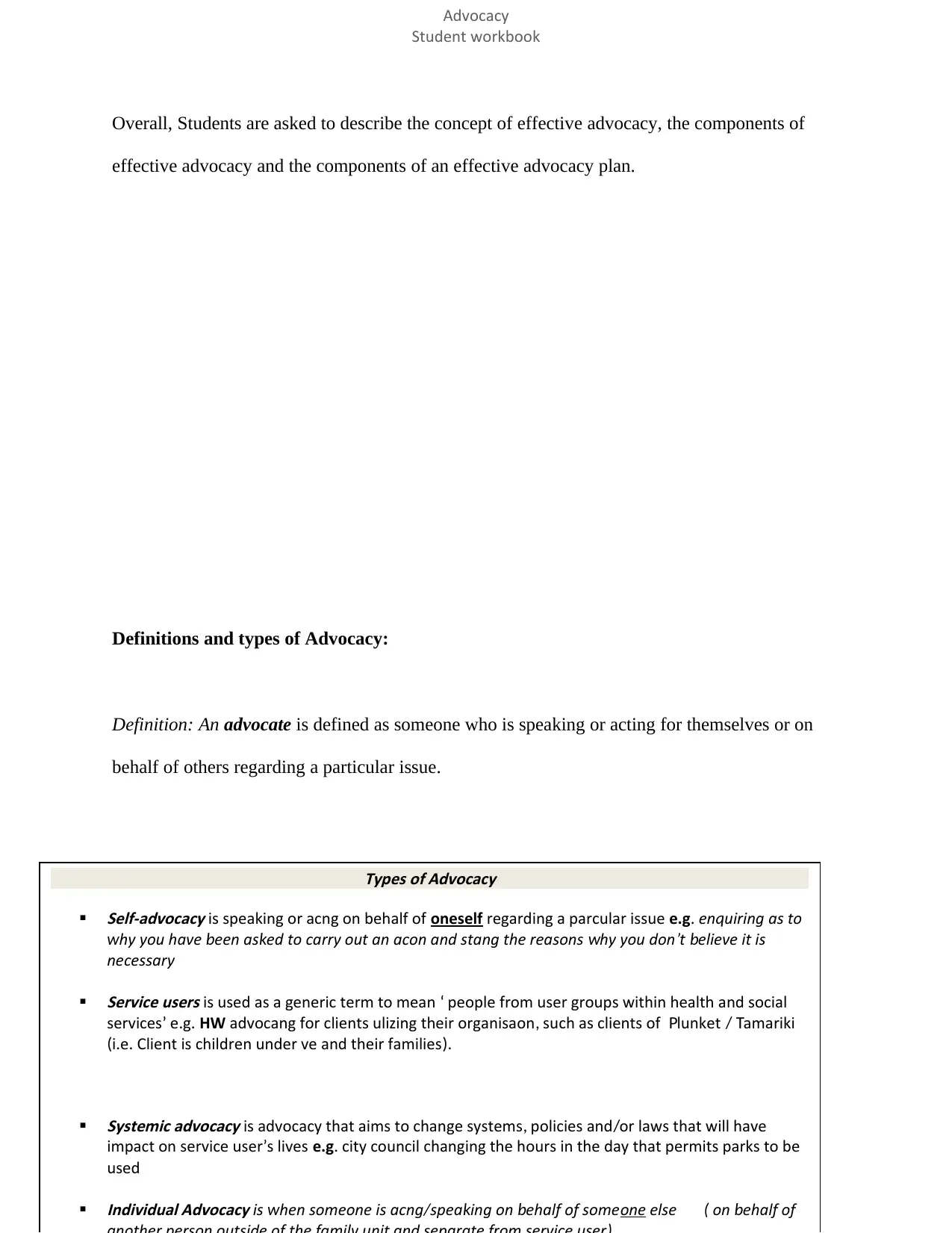
Definitions and types of Advocacy:
Definition: An advocate is defined as someone who is speaking or acting for themselves or on
behalf of others regarding a particular issue.
The Royal New Zealand Plunket Society (Inc)
2017
4
Types of Advocacy

Self-advocacy is speaking or acting on behalf of oneself regarding a particular issue e.g. en uiring as toq
hy you have een as ed to carry out an action and stating the reasons hy you don t elieve it isw b k w ’ b
necessary

Service users is used as a generic term to mean people from user groups within health and social
services e g . . HW advocating for clients utilizing their organisation such as clients of lunket amariki, P / T
i e Client is children under fi ve and their families( . . ).

Systemic advocacy is advocacy that aims to change systems policies and or laws that will have, /
impact on service user s lives e.g city council changing the hours in the day that permits parks to be.
used

Individual Advocacy is hen someone is acting spea ing on ehalf of somew / k b one else on ehalf of( b
tabler-icon-diamond-filled.svg

Paraphrase This Document

Need a fresh take? Get an instant paraphrase of this document with our AI Paraphraser
Document Page
Advocacy
Student workbook
Assignment: Please complete the eight (8) tasks set out in the work book
The Royal New Zealand Plunket Society (Inc)
2017
5
Document Page
Advocacy
Student workbook
Please refer to the extra reading in association to this assignment, and the definitions on page 3
of this workbook as these will assist you with this task. (Look in this study section on Moodle
‘Advocacy Information’)
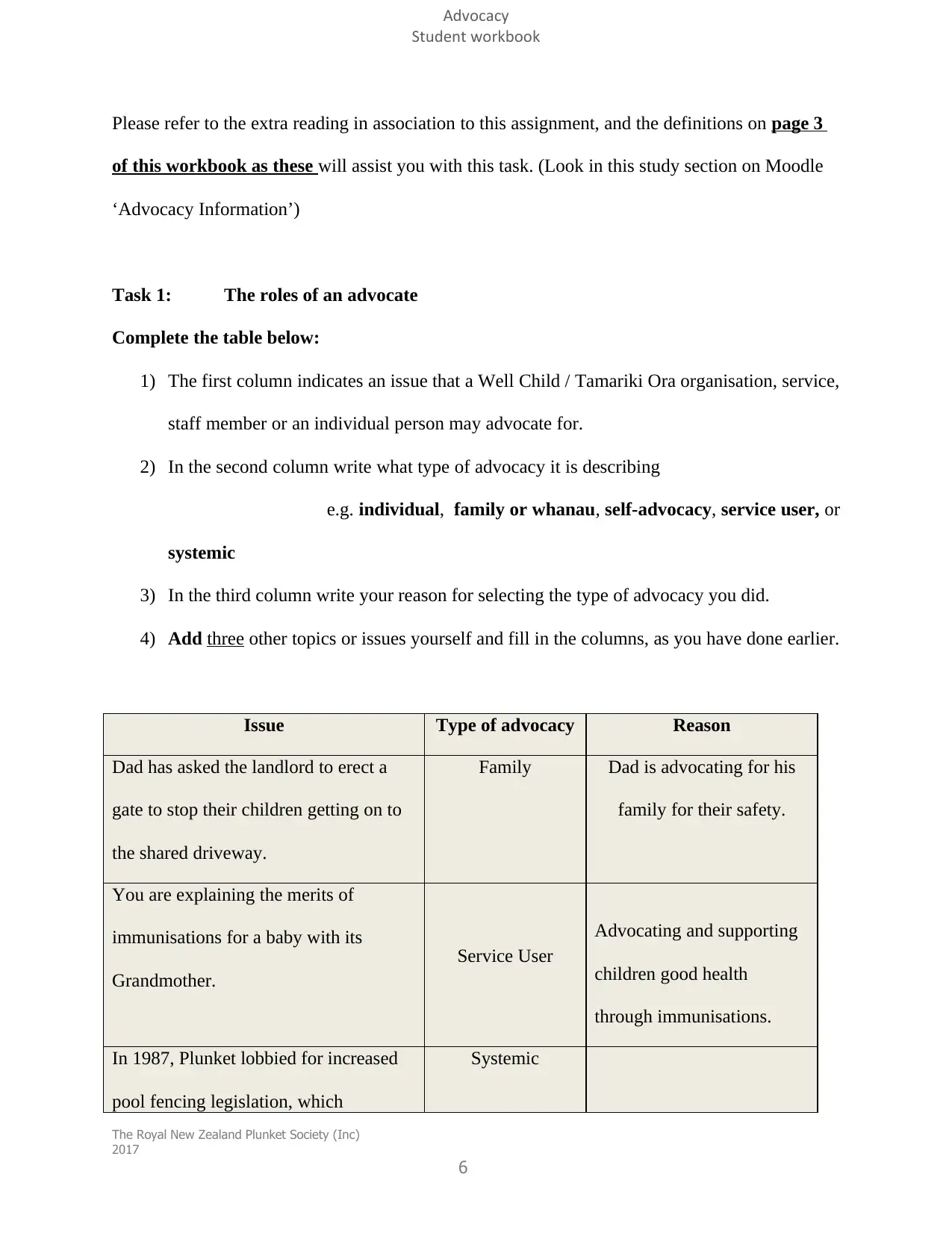
Task 1: The roles of an advocate
Complete the table below:
1) The first column indicates an issue that a Well Child / Tamariki Ora organisation, service,
staff member or an individual person may advocate for.
2) In the second column write what type of advocacy it is describing
e.g. individual, family or whanau, self-advocacy, service user, or
systemic
3) In the third column write your reason for selecting the type of advocacy you did.
4) Add three other topics or issues yourself and fill in the columns, as you have done earlier.
Issue Type of advocacy Reason
Dad has asked the landlord to erect a
gate to stop their children getting on to
the shared driveway.
Family Dad is advocating for his
family for their safety.
You are explaining the merits of
immunisations for a baby with its
Grandmother.
Service User
Advocating and supporting
children good health
through immunisations.
In 1987, Plunket lobbied for increased
pool fencing legislation, which
Systemic
The Royal New Zealand Plunket Society (Inc)
2017
6
Document Page
Advocacy
Student workbook
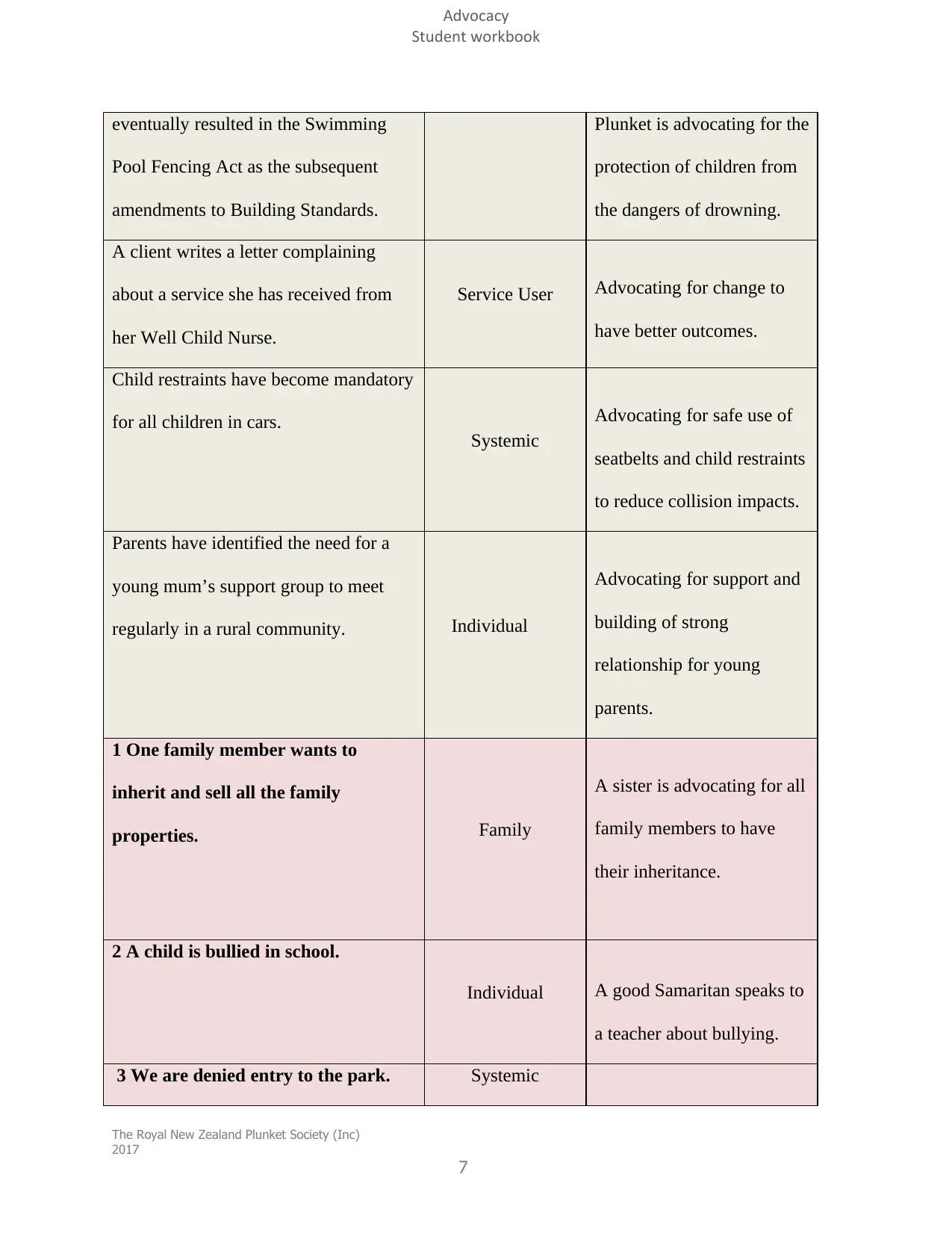
eventually resulted in the Swimming
Pool Fencing Act as the subsequent
amendments to Building Standards.
Plunket is advocating for the
protection of children from
the dangers of drowning.
A client writes a letter complaining
about a service she has received from
her Well Child Nurse.
Service User Advocating for change to
have better outcomes.
Child restraints have become mandatory
for all children in cars. Systemic
Advocating for safe use of
seatbelts and child restraints
to reduce collision impacts.
Parents have identified the need for a
young mum’s support group to meet
regularly in a rural community. Individual
Advocating for support and
building of strong
relationship for young
parents.
1 One family member wants to
inherit and sell all the family
properties. Family
A sister is advocating for all
family members to have
their inheritance.
2 A child is bullied in school.
Individual A good Samaritan speaks to
a teacher about bullying.
3 We are denied entry to the park. Systemic
The Royal New Zealand Plunket Society (Inc)
2017
7
tabler-icon-diamond-filled.svg

Paraphrase This Document

Need a fresh take? Get an instant paraphrase of this document with our AI Paraphraser
Document Page
Advocacy
Student workbook
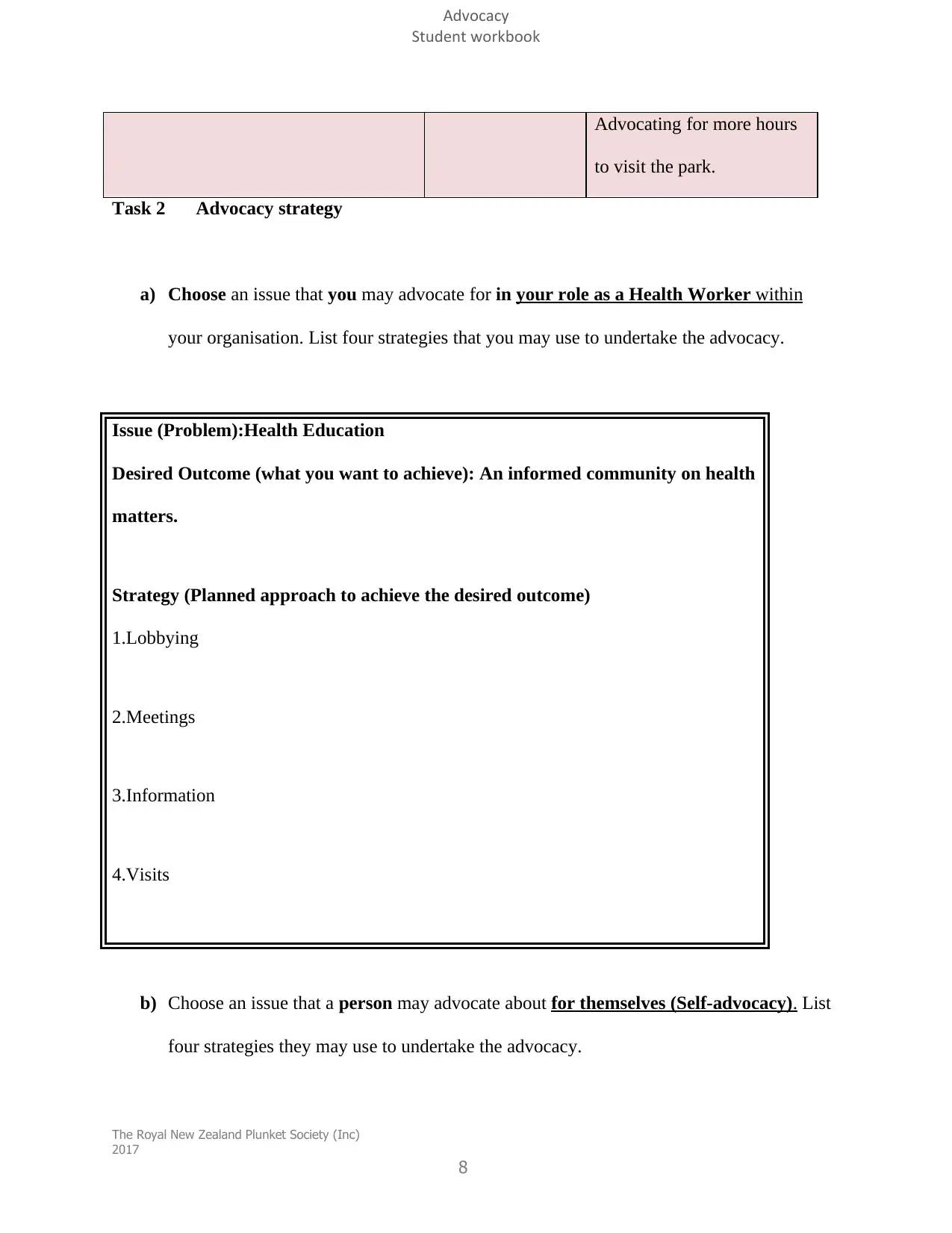
Advocating for more hours
to visit the park.
Task 2 Advocacy strategy
a) Choose an issue that you may advocate for in your role as a Health Worker within
your organisation. List four strategies that you may use to undertake the advocacy.
Issue (Problem):Health Education
Desired Outcome (what you want to achieve): An informed community on health
matters.
Strategy (Planned approach to achieve the desired outcome)
1.Lobbying
2.Meetings
3.Information
4.Visits
b) Choose an issue that a person may advocate about for themselves (Self-advocacy). List
four strategies they may use to undertake the advocacy.
The Royal New Zealand Plunket Society (Inc)
2017
8
Document Page
Advocacy
Student workbook
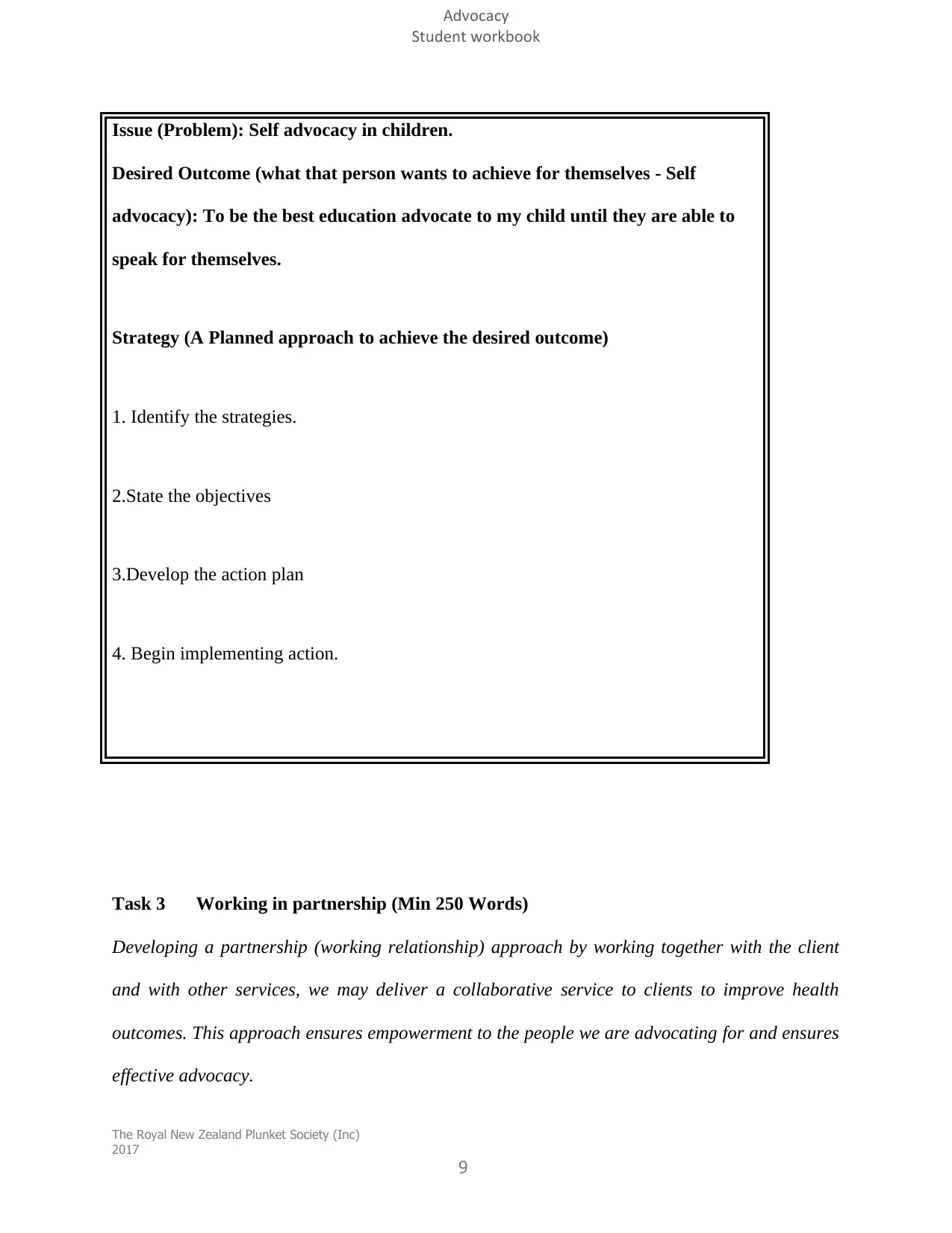
Issue (Problem): Self advocacy in children.
Desired Outcome (what that person wants to achieve for themselves - Self
advocacy): To be the best education advocate to my child until they are able to
speak for themselves.
Strategy (A Planned approach to achieve the desired outcome)
1. Identify the strategies.
2.State the objectives
3.Develop the action plan
4. Begin implementing action.
Task 3 Working in partnership (Min 250 Words)
Developing a partnership (working relationship) approach by working together with the client
and with other services, we may deliver a collaborative service to clients to improve health
outcomes. This approach ensures empowerment to the people we are advocating for and ensures
effective advocacy.
The Royal New Zealand Plunket Society (Inc)
2017
9
Document Page
Advocacy
Student workbook
The White Paper or the Vulnerable Children’s Act focuses on vulnerable children and
describes a number of ways in which different partnerships are needed to address issues related
to child safety.
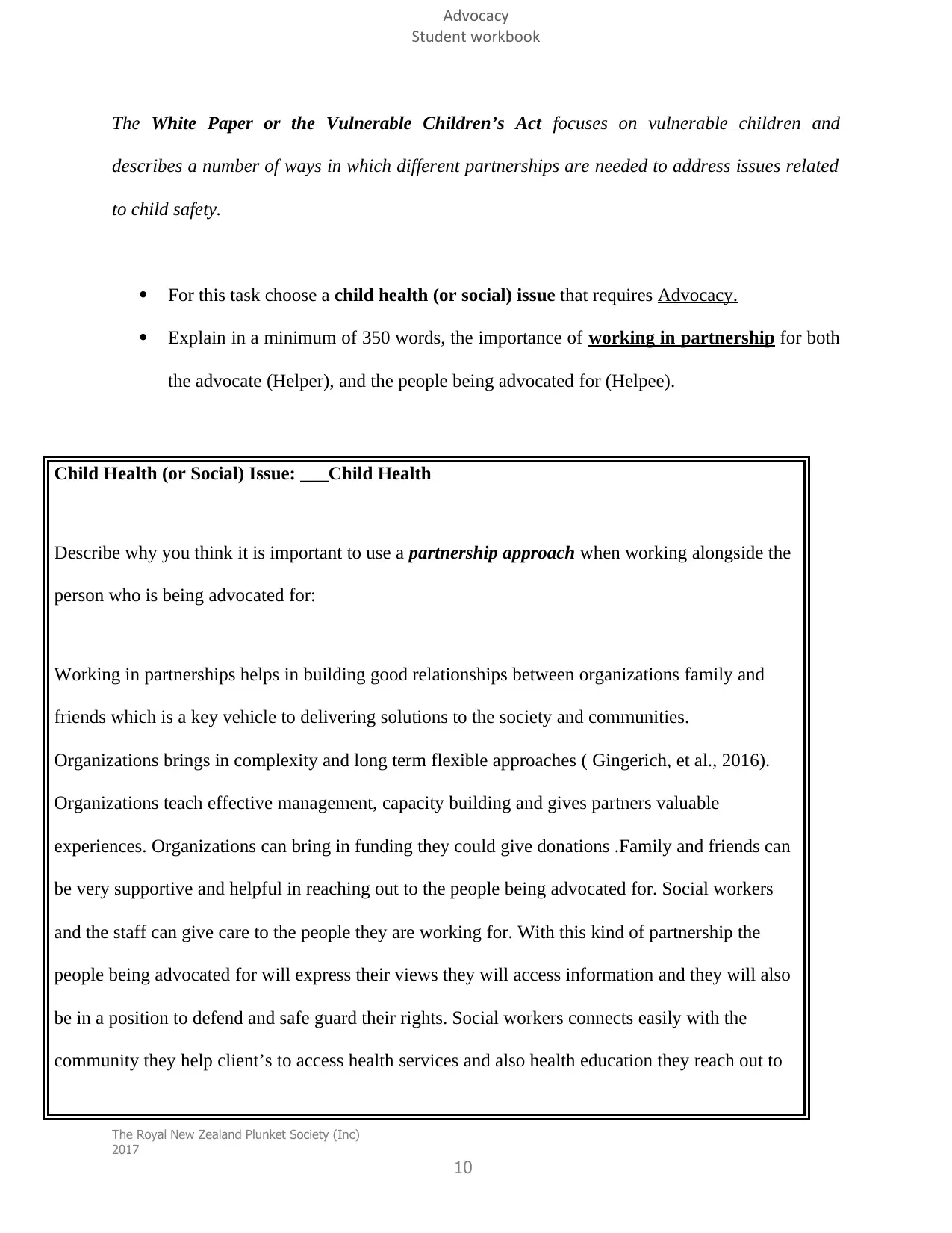
For this task choose a child health (or social) issue that requires Advocacy.
Explain in a minimum of 350 words, the importance of working in partnership for both
the advocate (Helper), and the people being advocated for (Helpee).
Child Health (or Social) Issue: ___Child Health
Describe why you think it is important to use a partnership approach when working alongside the
person who is being advocated for:
Working in partnerships helps in building good relationships between organizations family and
friends which is a key vehicle to delivering solutions to the society and communities.
Organizations brings in complexity and long term flexible approaches ( Gingerich, et al., 2016).
Organizations teach effective management, capacity building and gives partners valuable
experiences. Organizations can bring in funding they could give donations .Family and friends can
be very supportive and helpful in reaching out to the people being advocated for. Social workers
and the staff can give care to the people they are working for. With this kind of partnership the
people being advocated for will express their views they will access information and they will also
be in a position to defend and safe guard their rights. Social workers connects easily with the
community they help client’s to access health services and also health education they reach out to
The Royal New Zealand Plunket Society (Inc)
2017
10
tabler-icon-diamond-filled.svg

Paraphrase This Document

Need a fresh take? Get an instant paraphrase of this document with our AI Paraphraser
Document Page
Advocacy
Student workbook
those who are less privileged and cannot make a trip to the health facilities.
Task 4: Self-advocacy – Reflecting on an advocacy situation (Min 300 Words)
The Royal New Zealand Plunket Society (Inc)
2017
11
Document Page
Advocacy
Student workbook
In your reflection consider the following bullet points:
Reflect on, and describe a situation where ‘self-advocacy’ took place
What impact did self-advocacy have on the situation?
What effect did self-advocacy have on the self-confidence of the person concerned?
How do families / Whanau learn to advocate for themselves?
The Royal New Zealand Plunket Society (Inc)
2017
12
chevron_up_icon
1 out of 28
circle_padding
hide_on_mobile
zoom_out_icon
[object Object]