Study Skills for Higher Education: Skills for University and Workplace
VerifiedAdded on 2022/11/25
|9
|2500
|183
Report
AI Summary
This report examines the crucial study skills necessary for success in higher education and the professional world. It identifies six key skills: adaptive thinking, communication, critical thinking, personal management, inquiry skills, and soft skills, explaining their importance in both academic and workplace environments. The report also provides six recommendations to help students improve their CVs, focusing on trimming unnecessary information, tidying the presentation, incorporating keywords, including a personal statement, quantifying achievements, and highlighting personal growth. The analysis underscores the significance of these skills and CV enhancements for students aiming to excel in their studies and secure desirable job opportunities, emphasizing the need for continuous skill development and strategic self-presentation. The document is contributed by a student to be published on the website Desklib, a platform which provides all the necessary AI based study tools for students.
Study Skills for Higher
Education
Education

Paraphrase This Document
Need a fresh take? Get an instant paraphrase of this document with our AI Paraphraser
Contents
INTRODUCTION...........................................................................................................................3
Main body........................................................................................................................................3
1) Six skills that students require to be successful at university and discuss why they are also
important in the workplace..............................................................................................................3
2) Six recommendations that could help students improve the content of their CVs......................5
Conclusion.......................................................................................................................................8
INTRODUCTION...........................................................................................................................3
Main body........................................................................................................................................3
1) Six skills that students require to be successful at university and discuss why they are also
important in the workplace..............................................................................................................3
2) Six recommendations that could help students improve the content of their CVs......................5
Conclusion.......................................................................................................................................8
INTRODUCTION
There are some skill sets that are essentially required for the purpose of of having success at
University. The changing external environment the job market is becoming extensively
competitive but there are certain specific skill sets that can help individuals and students to
achieve higher paid jobs when they are completing their graduation. The skill development
process at university is regarded as transferable skills they are valued by employers at all the
work places (Carbonell Carrera and et.al., 2017). So skill development at higher education plays
a very important role in the overall development of a student in the course of self learning and
self development. In present report there is analysis of the specific skill sets that are required to
be successful for individual at University. Based on the skill sets further recommendations are
drawn that can help students in improving the content of their resume that also plays a very
considerable role while searching for job opportunities.
Main body
1) Six skills that students require to be successful at university and discuss
why they are also important in the workplace.
In present report there are specific skills and that are identified which is very important to be
successful at the University and also going to help in future professional career of students.
Adaptive thinking: In the changing digital age there are changes taking place at
exponential rates. While in student is at University and working towards their learning
process. Adaptive skills help them in adjusting to the environment around them (Clark,
McEwan. and Christie, 2019). The skill set helps them in continuously adapting to the
changes in terms of their lecturers assignments colleagues peer groups or other social
activities so that they are able to deal with the situations with less amount of stress.
Professional development: future employers always expect employees are able to adjust
their organisational environment. Adaptive thinking will help individuals in learning new
things efficiently and quickly at the workplace.
Communication skills: There is requirement of some skills sets that can help students in
dealing with the culture of independence and competition in the learning process of
academic course. Most of the classrooms require collaboration and teamwork on part of
There are some skill sets that are essentially required for the purpose of of having success at
University. The changing external environment the job market is becoming extensively
competitive but there are certain specific skill sets that can help individuals and students to
achieve higher paid jobs when they are completing their graduation. The skill development
process at university is regarded as transferable skills they are valued by employers at all the
work places (Carbonell Carrera and et.al., 2017). So skill development at higher education plays
a very important role in the overall development of a student in the course of self learning and
self development. In present report there is analysis of the specific skill sets that are required to
be successful for individual at University. Based on the skill sets further recommendations are
drawn that can help students in improving the content of their resume that also plays a very
considerable role while searching for job opportunities.
Main body
1) Six skills that students require to be successful at university and discuss
why they are also important in the workplace.
In present report there are specific skills and that are identified which is very important to be
successful at the University and also going to help in future professional career of students.
Adaptive thinking: In the changing digital age there are changes taking place at
exponential rates. While in student is at University and working towards their learning
process. Adaptive skills help them in adjusting to the environment around them (Clark,
McEwan. and Christie, 2019). The skill set helps them in continuously adapting to the
changes in terms of their lecturers assignments colleagues peer groups or other social
activities so that they are able to deal with the situations with less amount of stress.
Professional development: future employers always expect employees are able to adjust
their organisational environment. Adaptive thinking will help individuals in learning new
things efficiently and quickly at the workplace.
Communication skills: There is requirement of some skills sets that can help students in
dealing with the culture of independence and competition in the learning process of
academic course. Most of the classrooms require collaboration and teamwork on part of
⊘ This is a preview!⊘
Do you want full access?
Subscribe today to unlock all pages.

Trusted by 1+ million students worldwide
the students. Collaborative learning skills help in development of teamwork spirit and
collective learning process. Professional development: In future while a individual is
working in a organisation there is requirement of collaborative learning skills that will
help them in having better cooperation and coordination with their team members.
Critical thinking: students have to lay emphasis on critical thinking skills that can help
them in dealing with various problems or issues arising in the course of their academic
career. Professional development: while working in an organisation employers require
self independent employees who are able to deal with their problems on their own.
Critical thinking skills helps employee in adjusting to the rapidly changing environment
in a particular organisation and also provide ideas for further improvements in areas
where organisation is lacking behind.
Personal management: the skill of personal management is related to the ability for
students to independently plan, lay, organise, create and further execute such operations.
While academic learning process takes place students have to manage their activities and
learning process through personal management skills. Professional development: In the
future professional career personal management skills are going to assist employees in
meeting their deadlines. It is also going to help in having proper time management and
managing their work as per the directions provided to them by their superiors.
Inquiry skills: Inquiry skills are related to the ability to ask great and meaningful
questions on part of students. Asking questions is related to the process of self learning
and self evaluation in the academic development process (Bean and Forneris, 2017).
When a student is able to ask meaningful questions it is directly related to the level of
understanding and grasping power with a particular subject. Professional development:
In case of professional career development process Inquiry skills are required so that
employees are able to have adequate amount of clarity, while they are assigned the course
of roles and responsibilities. It also helps in development of a culture that requires
constant creativity and innovation on part of employees.
Soft skills: There are certain soft skills that are compulsory required in individual both in
their academic learning process and professional development career. These skills are
compulsory required to shape the behaviour of a individual that can help in dealing with
the uncertainty in their academic process and also in their professional career. For
collective learning process. Professional development: In future while a individual is
working in a organisation there is requirement of collaborative learning skills that will
help them in having better cooperation and coordination with their team members.
Critical thinking: students have to lay emphasis on critical thinking skills that can help
them in dealing with various problems or issues arising in the course of their academic
career. Professional development: while working in an organisation employers require
self independent employees who are able to deal with their problems on their own.
Critical thinking skills helps employee in adjusting to the rapidly changing environment
in a particular organisation and also provide ideas for further improvements in areas
where organisation is lacking behind.
Personal management: the skill of personal management is related to the ability for
students to independently plan, lay, organise, create and further execute such operations.
While academic learning process takes place students have to manage their activities and
learning process through personal management skills. Professional development: In the
future professional career personal management skills are going to assist employees in
meeting their deadlines. It is also going to help in having proper time management and
managing their work as per the directions provided to them by their superiors.
Inquiry skills: Inquiry skills are related to the ability to ask great and meaningful
questions on part of students. Asking questions is related to the process of self learning
and self evaluation in the academic development process (Bean and Forneris, 2017).
When a student is able to ask meaningful questions it is directly related to the level of
understanding and grasping power with a particular subject. Professional development:
In case of professional career development process Inquiry skills are required so that
employees are able to have adequate amount of clarity, while they are assigned the course
of roles and responsibilities. It also helps in development of a culture that requires
constant creativity and innovation on part of employees.
Soft skills: There are certain soft skills that are compulsory required in individual both in
their academic learning process and professional development career. These skills are
compulsory required to shape the behaviour of a individual that can help in dealing with
the uncertainty in their academic process and also in their professional career. For
Paraphrase This Document
Need a fresh take? Get an instant paraphrase of this document with our AI Paraphraser
instance some of the necessarily required soft skills include time management skills,
having high amount of self confidence to deal with uncertain future situations, risk
management, conflict resolution and other necessary organisational skills. These are
some of the crucial it required skills in individual in order to manage their work with
higher effectiveness level (Perry Bridges and Burrow, 2021). Professional development:
In case of professional career employees required individuals who are able to become
future business leaders. Having time management skills is most of the important aspects
because in organisations time is equivalent to money. So, when our employee is able to
effectively manage there available time period with maximum output it leads to optimum
utilisation of resources.
Apart from the above-mentioned 6 types of major skills other different types of skill sets are also
required on part of employees to perform their job roles and responsibilities as per employee
expectations. Some of the skill sets include having in empathy and prospective skills that can
help in understanding the feelings of their subordinates superiors colleagues and help them in
dealing with the problems. Technology skills are very important in the digital age where schools
are also adapting to such rapidly changing environment. It can assist students in learning the
latest technology that can help them in their future professional careers.
2) Six recommendations that could help students improve the content of their
CVs
In the present competitive job market it is difficult to score the dream job with the lower grades
or having no satisfactory level of academic performance. All students may not be good at
academic performance or skill learning process. So, sometimes there is requirement to focus on
boosting of the CV that can help them in getting their ambition at right place. For the purpose of
catering into an organisation the first impression is put by individual based on their curriculum
viate. Therefore for every student it becomes very important to understand some of the skill sets
that can help them in building up their curriculum vitae in a way that can help in having an
effective impression on their prospective employers (Ren and Chadee, 2017). For this purpose
there are some of the recommendations that have been developed in the course of present report.
Some of the recommendations for having an effective content in CV are discussed below:
having high amount of self confidence to deal with uncertain future situations, risk
management, conflict resolution and other necessary organisational skills. These are
some of the crucial it required skills in individual in order to manage their work with
higher effectiveness level (Perry Bridges and Burrow, 2021). Professional development:
In case of professional career employees required individuals who are able to become
future business leaders. Having time management skills is most of the important aspects
because in organisations time is equivalent to money. So, when our employee is able to
effectively manage there available time period with maximum output it leads to optimum
utilisation of resources.
Apart from the above-mentioned 6 types of major skills other different types of skill sets are also
required on part of employees to perform their job roles and responsibilities as per employee
expectations. Some of the skill sets include having in empathy and prospective skills that can
help in understanding the feelings of their subordinates superiors colleagues and help them in
dealing with the problems. Technology skills are very important in the digital age where schools
are also adapting to such rapidly changing environment. It can assist students in learning the
latest technology that can help them in their future professional careers.
2) Six recommendations that could help students improve the content of their
CVs
In the present competitive job market it is difficult to score the dream job with the lower grades
or having no satisfactory level of academic performance. All students may not be good at
academic performance or skill learning process. So, sometimes there is requirement to focus on
boosting of the CV that can help them in getting their ambition at right place. For the purpose of
catering into an organisation the first impression is put by individual based on their curriculum
viate. Therefore for every student it becomes very important to understand some of the skill sets
that can help them in building up their curriculum vitae in a way that can help in having an
effective impression on their prospective employers (Ren and Chadee, 2017). For this purpose
there are some of the recommendations that have been developed in the course of present report.
Some of the recommendations for having an effective content in CV are discussed below:
1. Trim the execs information: Employers are only willing to see the relevant information
that can make a person interesting candidate for a interview. It is the responsibility of
individual to trim and remove all the access information that can lead to unnecessary
loading of information on the CV. For this purpose candidate has to use simple plain
understandable English with avoidance of any type of jargon or clinches that can lead to
the waffling of the situation.
2. Tidy it up: Representation of curriculum vitae is very important irrespective of the
content. So, it is necessary for the candidate to fill all the space between the different
items that can help in having clarity (Bauer. and Liou, 2020). Apart from this is there
must not be fragmentation of long paragraphs. Proper line breaks have to be given to
draw the reader’s eye to keep statistics only. There must not be use of any type of fussy
fonts but there should be simple and clear fonts like Arial and verodana. Font-size must
never go below 10 points there must be use of proper bold italic and underline in case of
important headings.
3. Focus on key words: It is very important for the candidate to focus on key set of
information only. The prospective employee is looking for specific phrases or words that
are related to job specialisation and industry. It is important to look for specific keywords
that include communication skills, higher level of self confidence, polite, organised and
effective time management skills (Elkins and Schurer, 2020). These are some of the basic
skills at that are compulsory required in an individual to perform the job roles and
responsibilities of a similar work or similar industry. While forming the curriculum viate
it becomes very important for the individual to focus on the keywords and help the
prospective employer in understanding the basic skills at that are possessed by the
individual.
4. Include a personal statement: There is need of a good personal statement that can play a
very effective role in giving a first positive impression on the employer. It must start with
highlighting the first level of experiences with professional qualities, strong skill sets that
can make an individual right for a particular job (Gordon and Gordon, 2017). Example:
as an innovative executive confidence chef with 10 years of working experience in the
restaurant industry. I have depicted a high level of commitment towards my roles and
responsibilities. I have work towards providing exceptional customer experiences with
that can make a person interesting candidate for a interview. It is the responsibility of
individual to trim and remove all the access information that can lead to unnecessary
loading of information on the CV. For this purpose candidate has to use simple plain
understandable English with avoidance of any type of jargon or clinches that can lead to
the waffling of the situation.
2. Tidy it up: Representation of curriculum vitae is very important irrespective of the
content. So, it is necessary for the candidate to fill all the space between the different
items that can help in having clarity (Bauer. and Liou, 2020). Apart from this is there
must not be fragmentation of long paragraphs. Proper line breaks have to be given to
draw the reader’s eye to keep statistics only. There must not be use of any type of fussy
fonts but there should be simple and clear fonts like Arial and verodana. Font-size must
never go below 10 points there must be use of proper bold italic and underline in case of
important headings.
3. Focus on key words: It is very important for the candidate to focus on key set of
information only. The prospective employee is looking for specific phrases or words that
are related to job specialisation and industry. It is important to look for specific keywords
that include communication skills, higher level of self confidence, polite, organised and
effective time management skills (Elkins and Schurer, 2020). These are some of the basic
skills at that are compulsory required in an individual to perform the job roles and
responsibilities of a similar work or similar industry. While forming the curriculum viate
it becomes very important for the individual to focus on the keywords and help the
prospective employer in understanding the basic skills at that are possessed by the
individual.
4. Include a personal statement: There is need of a good personal statement that can play a
very effective role in giving a first positive impression on the employer. It must start with
highlighting the first level of experiences with professional qualities, strong skill sets that
can make an individual right for a particular job (Gordon and Gordon, 2017). Example:
as an innovative executive confidence chef with 10 years of working experience in the
restaurant industry. I have depicted a high level of commitment towards my roles and
responsibilities. I have work towards providing exceptional customer experiences with
⊘ This is a preview!⊘
Do you want full access?
Subscribe today to unlock all pages.
Trusted by 1+ million students worldwide
my present skill sets and future development opportunities that are provided to me in the
course of my working. My key strength has been my ability to deal with different
conflicting situations and maintaining a professional attitude.
5. Quantity the achievement: In some instances excess of qualitative information can lead
towards a difficulty of having a proper scenario for the competence and abilities of a
candidate. This helps in detecting the achieved level of performance in major numerical
terms (Chapman, Miles. and Maurer, 2017). It leads to more trustworthy information
because these instances can be easily verified in form of certifications that are attached
along with the curriculum viate. Further, for the purpose of having proper evidence
approach to all the information mentioned in the CV there must be proper references that
are to be attached at the end of the CV. It is going to help the prospective employer in
having a more reliability of information as there can be authentication done as and
whenever required.
6. Highlight changes and growth: It is important for a proper curriculum that they must be
proper explanation of the personal development process. Individual have to properly
mention their roles and accomplishments that have been achieved in their previous job
roles.
From the above demonstration it can be said that while surving in a organisation it becomes very
important for the individual to have required skill sets that can help them in getting effectiveness
in the process of getting the dream job. Apart from this a candidate must possess all the required
information of the organisational and the industry to which they are applying, it is going to
ensure that they possess a detailed preview of the prospective job roles using of power words in
the development of CV can also lead to a effective impact on the future perspective employer.
course of my working. My key strength has been my ability to deal with different
conflicting situations and maintaining a professional attitude.
5. Quantity the achievement: In some instances excess of qualitative information can lead
towards a difficulty of having a proper scenario for the competence and abilities of a
candidate. This helps in detecting the achieved level of performance in major numerical
terms (Chapman, Miles. and Maurer, 2017). It leads to more trustworthy information
because these instances can be easily verified in form of certifications that are attached
along with the curriculum viate. Further, for the purpose of having proper evidence
approach to all the information mentioned in the CV there must be proper references that
are to be attached at the end of the CV. It is going to help the prospective employer in
having a more reliability of information as there can be authentication done as and
whenever required.
6. Highlight changes and growth: It is important for a proper curriculum that they must be
proper explanation of the personal development process. Individual have to properly
mention their roles and accomplishments that have been achieved in their previous job
roles.
From the above demonstration it can be said that while surving in a organisation it becomes very
important for the individual to have required skill sets that can help them in getting effectiveness
in the process of getting the dream job. Apart from this a candidate must possess all the required
information of the organisational and the industry to which they are applying, it is going to
ensure that they possess a detailed preview of the prospective job roles using of power words in
the development of CV can also lead to a effective impact on the future perspective employer.
Paraphrase This Document
Need a fresh take? Get an instant paraphrase of this document with our AI Paraphraser
Conclusion
From the above mentioned aspects it can be said that there are some of the skill stes are
compulsory required for an individual to have the required level of competence level that can
assist them in the process of learning and having the required level of professional careers. While
a student is in they are able to demonstrate their level of present skills and competence based on
the expansion capacity in the future course of individual development. A curriculum viate has to
depict the strength and weakness in such a way that it can assist in the process of skill
development.
From the above mentioned aspects it can be said that there are some of the skill stes are
compulsory required for an individual to have the required level of competence level that can
assist them in the process of learning and having the required level of professional careers. While
a student is in they are able to demonstrate their level of present skills and competence based on
the expansion capacity in the future course of individual development. A curriculum viate has to
depict the strength and weakness in such a way that it can assist in the process of skill
development.
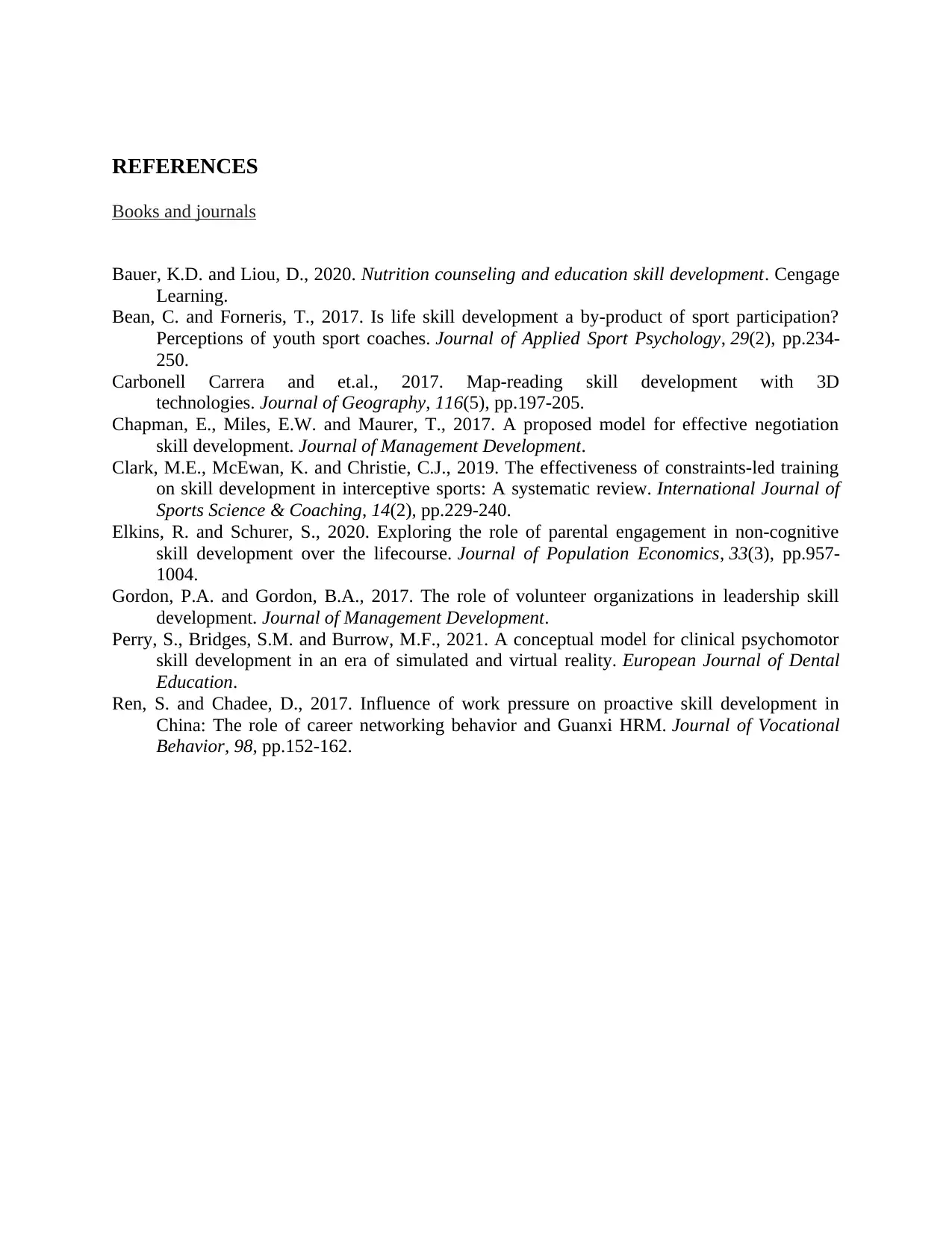
REFERENCES
Books and journals
Bauer, K.D. and Liou, D., 2020. Nutrition counseling and education skill development. Cengage
Learning.
Bean, C. and Forneris, T., 2017. Is life skill development a by-product of sport participation?
Perceptions of youth sport coaches. Journal of Applied Sport Psychology, 29(2), pp.234-
250.
Carbonell Carrera and et.al., 2017. Map-reading skill development with 3D
technologies. Journal of Geography, 116(5), pp.197-205.
Chapman, E., Miles, E.W. and Maurer, T., 2017. A proposed model for effective negotiation
skill development. Journal of Management Development.
Clark, M.E., McEwan, K. and Christie, C.J., 2019. The effectiveness of constraints-led training
on skill development in interceptive sports: A systematic review. International Journal of
Sports Science & Coaching, 14(2), pp.229-240.
Elkins, R. and Schurer, S., 2020. Exploring the role of parental engagement in non-cognitive
skill development over the lifecourse. Journal of Population Economics, 33(3), pp.957-
1004.
Gordon, P.A. and Gordon, B.A., 2017. The role of volunteer organizations in leadership skill
development. Journal of Management Development.
Perry, S., Bridges, S.M. and Burrow, M.F., 2021. A conceptual model for clinical psychomotor
skill development in an era of simulated and virtual reality. European Journal of Dental
Education.
Ren, S. and Chadee, D., 2017. Influence of work pressure on proactive skill development in
China: The role of career networking behavior and Guanxi HRM. Journal of Vocational
Behavior, 98, pp.152-162.
Books and journals
Bauer, K.D. and Liou, D., 2020. Nutrition counseling and education skill development. Cengage
Learning.
Bean, C. and Forneris, T., 2017. Is life skill development a by-product of sport participation?
Perceptions of youth sport coaches. Journal of Applied Sport Psychology, 29(2), pp.234-
250.
Carbonell Carrera and et.al., 2017. Map-reading skill development with 3D
technologies. Journal of Geography, 116(5), pp.197-205.
Chapman, E., Miles, E.W. and Maurer, T., 2017. A proposed model for effective negotiation
skill development. Journal of Management Development.
Clark, M.E., McEwan, K. and Christie, C.J., 2019. The effectiveness of constraints-led training
on skill development in interceptive sports: A systematic review. International Journal of
Sports Science & Coaching, 14(2), pp.229-240.
Elkins, R. and Schurer, S., 2020. Exploring the role of parental engagement in non-cognitive
skill development over the lifecourse. Journal of Population Economics, 33(3), pp.957-
1004.
Gordon, P.A. and Gordon, B.A., 2017. The role of volunteer organizations in leadership skill
development. Journal of Management Development.
Perry, S., Bridges, S.M. and Burrow, M.F., 2021. A conceptual model for clinical psychomotor
skill development in an era of simulated and virtual reality. European Journal of Dental
Education.
Ren, S. and Chadee, D., 2017. Influence of work pressure on proactive skill development in
China: The role of career networking behavior and Guanxi HRM. Journal of Vocational
Behavior, 98, pp.152-162.
⊘ This is a preview!⊘
Do you want full access?
Subscribe today to unlock all pages.
Trusted by 1+ million students worldwide

1 out of 9


Related Documents


Your All-in-One AI-Powered Toolkit for Academic Success.
+13062052269
info@desklib.com
Available 24*7 on WhatsApp / Email
![[object Object]](/_next/static/media/star-bottom.7253800d.svg)
Unlock your academic potential
Copyright © 2020–2026 A2Z Services. All Rights Reserved. Developed and managed by ZUCOL.