Subway Case Study: Analysis, Recommendations, and Implementation Plan

Verified

Added on  2023/06/05

|10
|1953
|274
Case Study
AI Summary
This case study analyzes Subway's operational challenges through an undercover investigation, focusing on customer satisfaction, cultural adaptation, product delivery, and corporate social responsibility. The report identifies issues such as long customer queues, inconsistent cultural integration, slow delivery times, and a lack of CSR initiatives. Recommendations include implementing a comprehensive CSR policy, developing an online ordering system, and providing enhanced customer management training for employees. The proposed implementation plan involves developing and marketing a user-friendly Subway application for online orders, conducting employee training on customer handling, and rolling out a community-focused corporate social responsibility program, ultimately aiming to improve Subway's brand image and customer loyalty. Desklib provides access to similar case studies and solved assignments for students.
Document Page
Running head: SUBWAY CASE STUDY
1
Subway Case Study
Student’s Name
University
tabler-icon-diamond-filled.svg

Paraphrase This Document

Need a fresh take? Get an instant paraphrase of this document with our AI Paraphraser
Document Page
SUBWAY CASE STUDY
2
Executive Summary
Customer satisfaction is the driver of all businesses in the world. However, to understand the
way employees handle customers, managers have to develop monitoring strategies that are not
easy. This is the reason why Chief Development Officer of subway goes on an undercover
mission to try and establish ways that the organization can improve. This report analyses the
subway case study to identify issues that the company is facing, offer recommendations and
develop an implementation plan for the organization.
Document Page
SUBWAY CASE STUDY
3
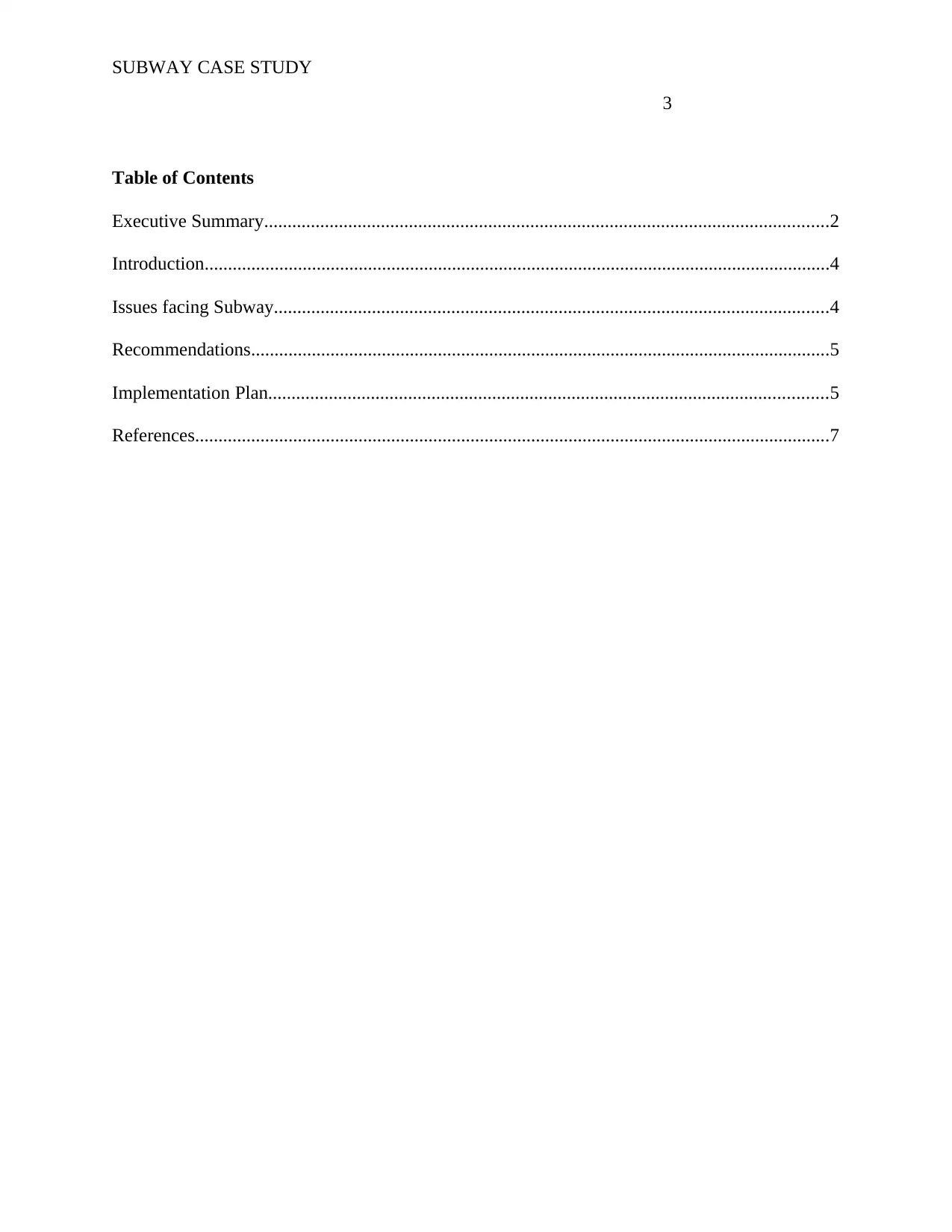
Table of Contents
Executive Summary.........................................................................................................................2
Introduction......................................................................................................................................4
Issues facing Subway.......................................................................................................................4
Recommendations............................................................................................................................5
Implementation Plan........................................................................................................................5
References........................................................................................................................................7
Document Page
SUBWAY CASE STUDY
4
Subway Case Study
Introduction
Customer satisfaction is the driver of every organization and the reason for being in
business. Many organizations struggle with customer satisfaction because customer needs keep
on changing making it difficult to meet these needs (John, 2003). This is the reason why the
Chief Development Officer of subway goes on an undercover mission to try and establish ways
that the organization can improve. Successful organizations have developed innovation ideas
from their own employees rather than management. This is because lower-level employees
interact directly with the business and its customers on a day to day basis. As Don Fertman went
behind the counter, he discovered that the store's team was implementing their own strategies to
ensure that the organization makes more profits. This report highlights the issues facing Subway
from the undercover video, offers recommendations and develops an action plan for a dressing
these challenges.
Issues facing Subway
One major challenge that the company is facing is long customer queues due to the
number of people who come in the stress to buy. Swartz & Iacobucci (2010) states that customer
service is the process that ensures customer satisfaction that takes place from the time of
initiating contact with the customer to the time that the transaction ends. Whatever happens in
between this process is what makes customers return to the business for another product. Since
the sandwich that the company sales are popular with the people, it attracts many customers who
pour in stores during different times. This means that the longer the queue, the less satisfied
customers re. Customer satisfaction is one of the greatest assets that an organization can use to
tabler-icon-diamond-filled.svg

Paraphrase This Document

Need a fresh take? Get an instant paraphrase of this document with our AI Paraphraser
Document Page
SUBWAY CASE STUDY
5
ensure that it meets the needs of the customer. Despite the fact that the employees are training
everything possible to manage customer waiting time, there is still a longer waiting time which
needs to be reduced.
Another challenge that the organization is facing is blending the business services offered
to reflect the cultural needs of the local community. Every business works in a community that
has its own culture and way of doing things. Subway has several stores across the country which
means that the stores need to reflect the people’s culture in the area that they are working in. For
example, the Buffalo New York store is established in a church which means that the business
profile and operations must reflect the needs of the community (Soares, 2014). As people
integrated with the business they feel free since it meets their cultural needs.
Another challenge that Subway is facing is product delivery time. This ranges from door
to door deliveries to waiting time within the store. Although the sandwich preparation time is
supposed to be two minutes, this can be reduced to increased customer satisfaction. On the other
hand, the delivery system in the Buffalo store is not working well since it has just been started
(Soares, 2014). This is seen from the fact that customers had to call in for the second time to
determine whether their delivery is on the way or not. This means that there is a need to improve
and develop better strategies.
Subway also faces a lack of corporate social responsibility initiatives that can increase the
public image of the company. For example in the case of the Buffalo store, the fact that it exists
in a church and is designed to offer rescue to the community means that corporate social
responsibility is an area that Subway needs to look in. Adhikari (2016) views social
responsibility as a way of giving back to the community and allowing the community to
appreciate the role of the organization in assisting them to meet their needs. it exists in four area
Document Page
SUBWAY CASE STUDY
6
of the environment, philanthropy, ethical business practice, and economic responsibility. It goes
beyond the concept of profit to developing ways of improving the livelihood of the community
through giving back what the business has gained from the community. These are thus business
efforts geared towards improving the life of the community that they work in.
Recommendations
One way of implementing the concept of social responsibility is to start by making it part
of the business policy and initiative. The first step in implementing this plan is knowing the type
of customers that the organization deals with and how their needs can be met (Lee & Kotler,
2013). The best way that the company can achieve this by developing partnerships with the
communities that it runs the business. This will ensure that it cuts costs of having to run the
program alone but rather uses its own community customers to run the initiative thus cutting
costs.
The next recommendation is developing an online ordering system that is computerized
and not in the form of paper. This allows customers to login to the system, make an order and get
a bill for what they wish to buy and pay before the order is delivered (Schwarzl & Grabowska,
2015). According to Mooradian, Matzler, & Ring (2012), this approach reduces the hustle of
billing the customer at delivery and struggling with papers when taking the orders of the client.
Business like Amazon have thrived in the online system because they have streamlined their
system and made it user-friendly to the fact that customers can easily login into the system and
make their own orders (Peresadko, Pidlisna, Olefirenko, & Karpishchenko, 2014). This can be
achieved by developing the Subway application for online orders. With this, customers can
Document Page
SUBWAY CASE STUDY
7
create their own profiles where they login make a request and pay directly and wait for delivery.
This system can reduce the burden of customers calling in to make orders since it is real time.
The last recommendation is the training of employees on customer management
initiative. What is seen in the case study is that most of the store managers are not adequately
trained but have the passion for the job. This means that training the employees can empower
them with adequate skills for improving customer satisfaction by developing new ways of
dealing with customers and queue management (Fornell, Rust, & Dekimpe, 2010). It is the role
of the organization to empower employees with the right resources for dealing with business
situations that they work in.
Implementation Plan
The first step in the implementation plan is to develop a Subway application with a
customer interface for orders. This application will be developed by hiring an applications
developer who will meet all the requirements of an online system. The application needs to be
user-friendly to allow customers to use it. This will be followed by an aggressive marketing of
the application both within the store and outside the stores using different media sources. The
application will be first rolled out as a pilot project in Buffalo store, then reviews on how it can
be improved collected before it is rolled out to other stores. This should take a maximum of two
weeks.
The next step will be the training and development of employees as a way of empowering
them to understand how to manage employee-related issues. The training will be done on a
rolling basis to ensure that operations in the stores do not stall. The training will cover areas of
customer handling and satisfaction to empower employees with better skills in dealing with
tabler-icon-diamond-filled.svg

Paraphrase This Document

Need a fresh take? Get an instant paraphrase of this document with our AI Paraphraser
Document Page
SUBWAY CASE STUDY
8
employee related issues. The empowerment process will run for three months in each store since
employees have to be trained separately.
The last part of the implementation process is rolling out the corporate social
responsibility program. Sheehy (2015) suggests that the best way to implement a corporate social
responsibility program is to start by identifying the main areas that the organization needs to
invest in and determining the costs. For example, the empowerment pioneered by the Buffalo
store is one of the issues that will be developed. Once the areas have been identified, the
organization will start allocating resources to these areas and develop a partnership plan with the
community on how the program can be initiated. This will lead to Subway face and developing a
brand image that increases customer loyalty. This should happen within a year to allow the
organization develop proper strategies for meeting the needs of the organization.
Document Page
SUBWAY CASE STUDY
9
References
Adhikari, B. (2016). Causal effect of analyst following on corporate social responsibility.
Journal of Corporate Finance, 41, 201–216.
Fornell, C., Rust, R., & Dekimpe, M. (2010). The Effect of Customer Satisfaction on Consumer
Spending Growth. Journal of Marketing, 47(1), 28-35.
John, J. (2003). Fundamentals of Customer-Focused Management: Competing Through Service.
Conn: Praeger.
Lee, N., & Kotler, P. (2013). Corporate social responsibility doing the most good for your
company and your cause. Hoboken: Wiley.
Mooradian, T. A., Matzler, K., & Ring, L. J. (2012). Strategic Marketing. New York: Pearson
Education.
Peresadko, G., Pidlisna, O., Olefirenko, O., & Karpishchenko, O. (2014). Marketing Researches
of Social Communication Forms in the Dinamics of Human Development. Economics
and Sociology, 7(1), 217-227.
Schwarzl, S., & Grabowska, M. (2015). Online marketing strategies: the future is here. Journal
of International Studies, 8(2), 187-196.
Sheehy, B. (2015). Defining CSR: Problems and Solutions. Journal of Business Ethics, 131(3),
625-648.
Soares, L. (Director). (2014). Undercover Boss USA Subway [Motion Picture]. Retrieved from
https://www.youtube.com/watch?v=OQrr0DcwalU&feature=youtu.be
Swartz, T., & Iacobucci., D. (2010). Handbook of Services Marketing and Management.
Thousand Oaks: Sage.
Document Page
SUBWAY CASE STUDY
10
chevron_up_icon
1 out of 10
circle_padding
hide_on_mobile
zoom_out_icon
[object Object]