Impact of Single Element Deficiencies on Sunflower Seedling Growth
VerifiedAdded on 2023/01/19
|11
|2783
|64
Report
AI Summary
This scientific report investigates the impact of single element deficiencies (iron, potassium, magnesium, and nitrogen) on the growth and development of sunflower seedlings. The experiment involved growing sunflower seedlings in hydroponic solutions with specific nutrient deficiencies and observing the resulting symptoms over six weeks. Results indicated that deficiencies in these elements led to reduced height, stunted growth, chlorosis, necrosis, and altered root development. Iron deficiency, in particular, resulted in leaf chlorosis and reduced stem height. The report concludes that understanding these deficiency symptoms is crucial for optimizing plant nutrition and improving crop yields. Desklib provides access to this report and other solved assignments for students' reference.
A scientific report on -
The effect of single element deficiencies
on the growth of Sunflower (Helianthus
annuus) seedlings.
Student’s Name:
University:
The effect of single element deficiencies
on the growth of Sunflower (Helianthus
annuus) seedlings.
Student’s Name:
University:

Paraphrase This Document
Need a fresh take? Get an instant paraphrase of this document with our AI Paraphraser
Abstract
Plant nutrition is the key area for understanding the nutrition requirements of the plants. To
understand the standard plant nutrition as well as their related deficiencies is the key factor in the
field of agriculture. The knowledge obtained the plant nutrition studies help to develop better-
adapted plants in areas which are nutrient deficient. Therefore, the identification of the single
element deficiency and its symptoms are required in plants like Sunflower. Hence, the present
report stated the experiments that were carried out for identification of the effect of single
element deficiency in seedlings of the sunflower plant. The iron, potassium, magnesium as well
as nitrogen deficiency in sunflower seedlings as identified in the present study results in reduced
height, and length. The deficiency further results in stunted growth, browning, necrosis, and
chlorosis. The symptoms that are observed in the present study are found to be in agreement with
characteristic symptoms of single element deficiency in several studies. The results of the report
are essential as they provide a better understanding of the effect of single element deficiency on
sunflower seedlings. Plant nutrition is an important research area for understanding the
requirements of the plants as well as for increasing yields. The aim of the scientific report is the
investigation of the impact of single element deficiency such as Fe, K, Mg, and N on the growth
as well as the development of sunflower.
Introduction
Plants are known as photosynthetic autotrophs, as they are capable of producing their own food
with the help of photosynthesis. It has been recognized that the growth and development of plant
highly depend upon the total mineral concentration as well as their combinations present in the
soil. However, several challenges are faced by plants to obtain an appropriate amount of
elements. Single element deficiency results in reduced productivity of the plant. Such type of
deficiency effect agriculture which results in decreased yield as well as the quality of a plant
(Alves et al., 2019).
The practice of hydroponics started in the mid-19th century which enables the growth of plants
using defined media supplied with elements. Macronutrients are elements which are needed in
considerable quantities which accumulates up to 0.1 percent, while micronutrients accumulate up
to less than 0.0.1 percent of the total amount of dry mass. Other than iron, the importance of
single element was initially stated in the 1900s (Chowdhury et al., 2018).
Plants need elements (macronutrients (C,H,O,N,P,S,K,Mg,Ca), micronutrients
(Fe,Mn,Zn,Cu,B,Mo,Cl,Ni) in a particular quantity for growth and development. Deficiency in
any single element results in particular physical symptoms such as stunted growth of leaves as
well as stem, chlorotic effect in leaves and other parts, necrosis, decreased the height of the plant
Plant nutrition is the key area for understanding the nutrition requirements of the plants. To
understand the standard plant nutrition as well as their related deficiencies is the key factor in the
field of agriculture. The knowledge obtained the plant nutrition studies help to develop better-
adapted plants in areas which are nutrient deficient. Therefore, the identification of the single
element deficiency and its symptoms are required in plants like Sunflower. Hence, the present
report stated the experiments that were carried out for identification of the effect of single
element deficiency in seedlings of the sunflower plant. The iron, potassium, magnesium as well
as nitrogen deficiency in sunflower seedlings as identified in the present study results in reduced
height, and length. The deficiency further results in stunted growth, browning, necrosis, and
chlorosis. The symptoms that are observed in the present study are found to be in agreement with
characteristic symptoms of single element deficiency in several studies. The results of the report
are essential as they provide a better understanding of the effect of single element deficiency on
sunflower seedlings. Plant nutrition is an important research area for understanding the
requirements of the plants as well as for increasing yields. The aim of the scientific report is the
investigation of the impact of single element deficiency such as Fe, K, Mg, and N on the growth
as well as the development of sunflower.
Introduction
Plants are known as photosynthetic autotrophs, as they are capable of producing their own food
with the help of photosynthesis. It has been recognized that the growth and development of plant
highly depend upon the total mineral concentration as well as their combinations present in the
soil. However, several challenges are faced by plants to obtain an appropriate amount of
elements. Single element deficiency results in reduced productivity of the plant. Such type of
deficiency effect agriculture which results in decreased yield as well as the quality of a plant
(Alves et al., 2019).
The practice of hydroponics started in the mid-19th century which enables the growth of plants
using defined media supplied with elements. Macronutrients are elements which are needed in
considerable quantities which accumulates up to 0.1 percent, while micronutrients accumulate up
to less than 0.0.1 percent of the total amount of dry mass. Other than iron, the importance of
single element was initially stated in the 1900s (Chowdhury et al., 2018).
Plants need elements (macronutrients (C,H,O,N,P,S,K,Mg,Ca), micronutrients
(Fe,Mn,Zn,Cu,B,Mo,Cl,Ni) in a particular quantity for growth and development. Deficiency in
any single element results in particular physical symptoms such as stunted growth of leaves as
well as stem, chlorotic effect in leaves and other parts, necrosis, decreased the height of the plant
as well as leaf size (Lazar, 2019). In Sunflower, deficiency in nitrogen exhibit chlorotic and
necrotic effect, while a deficiency in potassium results in mottled/ leaves chlorosis, narrowing of
the stem, necrosis in leaf tips and margins. Furthermore, the deficiency in magnesium causes
spots of necrosis, weak and thin stems, while the deficiency of iron causes symptoms of
chlorosis in interveins of leaves, with short stems. The aim of the scientific report is to
investigate the effect of single element deficiency on the growth and development of dicotyledon
sunflower (Helianthus annuus L.) seedlings (Oren and Celik, 2018).
Materials and Methods
Sunflower (Helianthus annuus L.) seeds, complete/deficient mineral solution. De-ionized water,
bottles.
Sunflower (Helianthus annuus L.) seedlings in a vermiculite supplement free condition were
developed and grown out of which seeds were gotten for the analysis. A rack of 10 bottles was
arranged which contains total/lacking supplement arrangements. The bottles were then named
in the sequential number. The bottles were then half-loaded up with water (de-ionized) and
thus, every stock arrangement (Table 1) containing supplements were then added to the half-
filled bottle while they were tenderly twirled so as to blend the arrangements. Besides, every
one of the containers were filled just beneath the water neckline with the assistance of de-
ionized water. The containers were then kept in a vacant rack.
The seedlings were deliberately evacuated out of the vermiculite and their roots were washed.
The harmed seedlings were disposed of. One seed is put in each bottle which contains a
supplement arrangement. The containers were then kept on a rack and put in a glasshouse.
Perceptions were made on a week after week basis for up to 6 weeks for the development and
improvement of plants. Following 6 weeks, every one of the plants were taken from the bottles
and to gauge the biggest leaf estimate, shoot range from the cotyledon, nodal root development,
and the initiation of chlorosis in old leaves. Any sort of development variation, just as the
manifestations of supplement inadequacy, for example, change in color, necrosis of new leaves,
were observed.
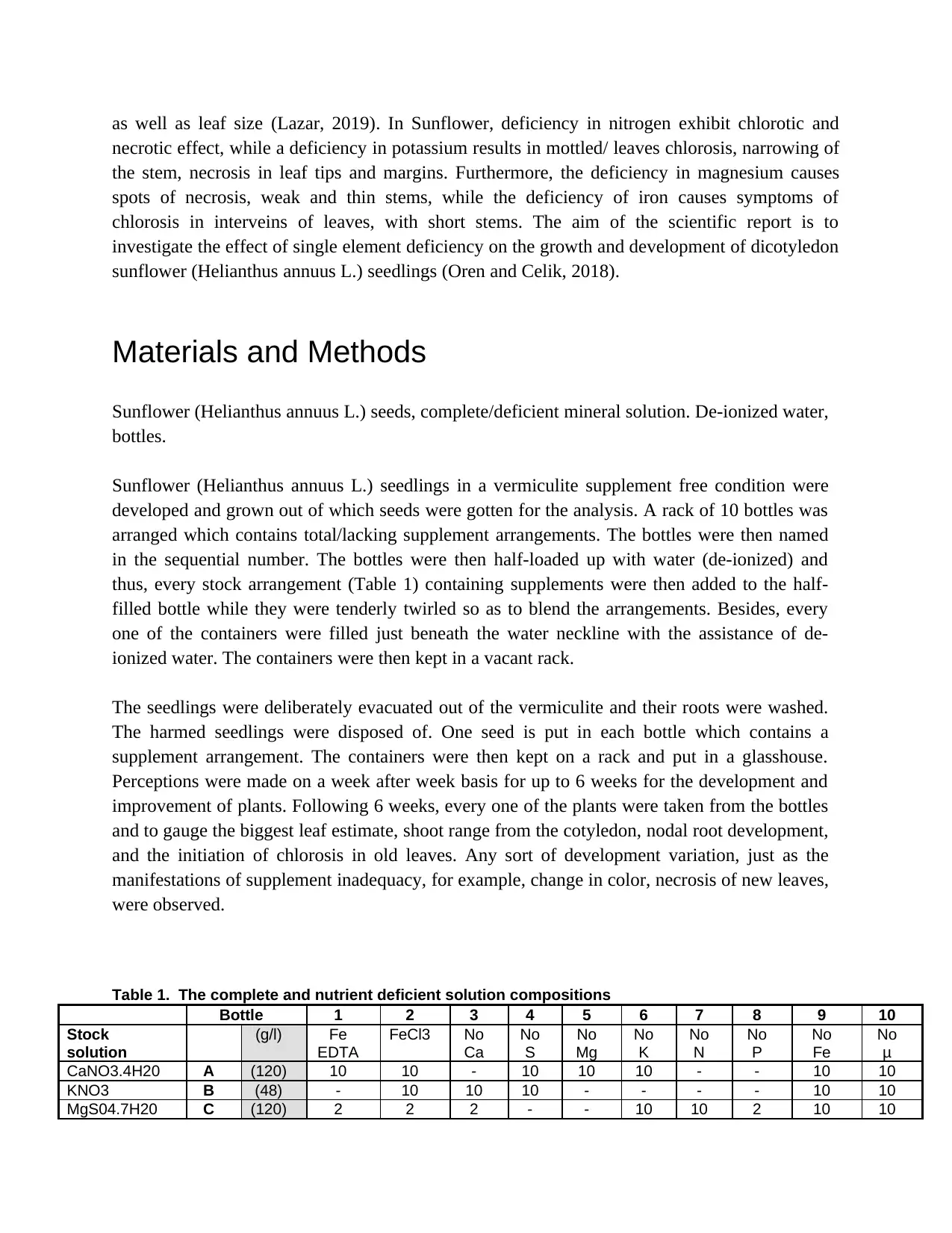
Table 1. The complete and nutrient deficient solution compositions
Bottle 1 2 3 4 5 6 7 8 9 10
Stock
solution
(g/l) Fe
EDTA
FeCl3 No
Ca
No
S
No
Mg
No
K
No
N
No
P
No
Fe
No
μ
CaNO3.4H20 A (120) 10 10 - 10 10 10 - - 10 10
KNO3 B (48) - 10 10 10 - - - - 10 10
MgS04.7H20 C (120) 2 2 2 - - 10 10 2 10 10
necrotic effect, while a deficiency in potassium results in mottled/ leaves chlorosis, narrowing of
the stem, necrosis in leaf tips and margins. Furthermore, the deficiency in magnesium causes
spots of necrosis, weak and thin stems, while the deficiency of iron causes symptoms of
chlorosis in interveins of leaves, with short stems. The aim of the scientific report is to
investigate the effect of single element deficiency on the growth and development of dicotyledon
sunflower (Helianthus annuus L.) seedlings (Oren and Celik, 2018).
Materials and Methods
Sunflower (Helianthus annuus L.) seeds, complete/deficient mineral solution. De-ionized water,
bottles.
Sunflower (Helianthus annuus L.) seedlings in a vermiculite supplement free condition were
developed and grown out of which seeds were gotten for the analysis. A rack of 10 bottles was
arranged which contains total/lacking supplement arrangements. The bottles were then named
in the sequential number. The bottles were then half-loaded up with water (de-ionized) and
thus, every stock arrangement (Table 1) containing supplements were then added to the half-
filled bottle while they were tenderly twirled so as to blend the arrangements. Besides, every
one of the containers were filled just beneath the water neckline with the assistance of de-
ionized water. The containers were then kept in a vacant rack.
The seedlings were deliberately evacuated out of the vermiculite and their roots were washed.
The harmed seedlings were disposed of. One seed is put in each bottle which contains a
supplement arrangement. The containers were then kept on a rack and put in a glasshouse.
Perceptions were made on a week after week basis for up to 6 weeks for the development and
improvement of plants. Following 6 weeks, every one of the plants were taken from the bottles
and to gauge the biggest leaf estimate, shoot range from the cotyledon, nodal root development,
and the initiation of chlorosis in old leaves. Any sort of development variation, just as the
manifestations of supplement inadequacy, for example, change in color, necrosis of new leaves,
were observed.
Table 1. The complete and nutrient deficient solution compositions
Bottle 1 2 3 4 5 6 7 8 9 10
Stock
solution
(g/l) Fe
EDTA
FeCl3 No
Ca
No
S
No
Mg
No
K
No
N
No
P
No
Fe
No
μ
CaNO3.4H20 A (120) 10 10 - 10 10 10 - - 10 10
KNO3 B (48) - 10 10 10 - - - - 10 10
MgS04.7H20 C (120) 2 2 2 - - 10 10 2 10 10
⊘ This is a preview!⊘
Do you want full access?
Subscribe today to unlock all pages.

Trusted by 1+ million students worldwide
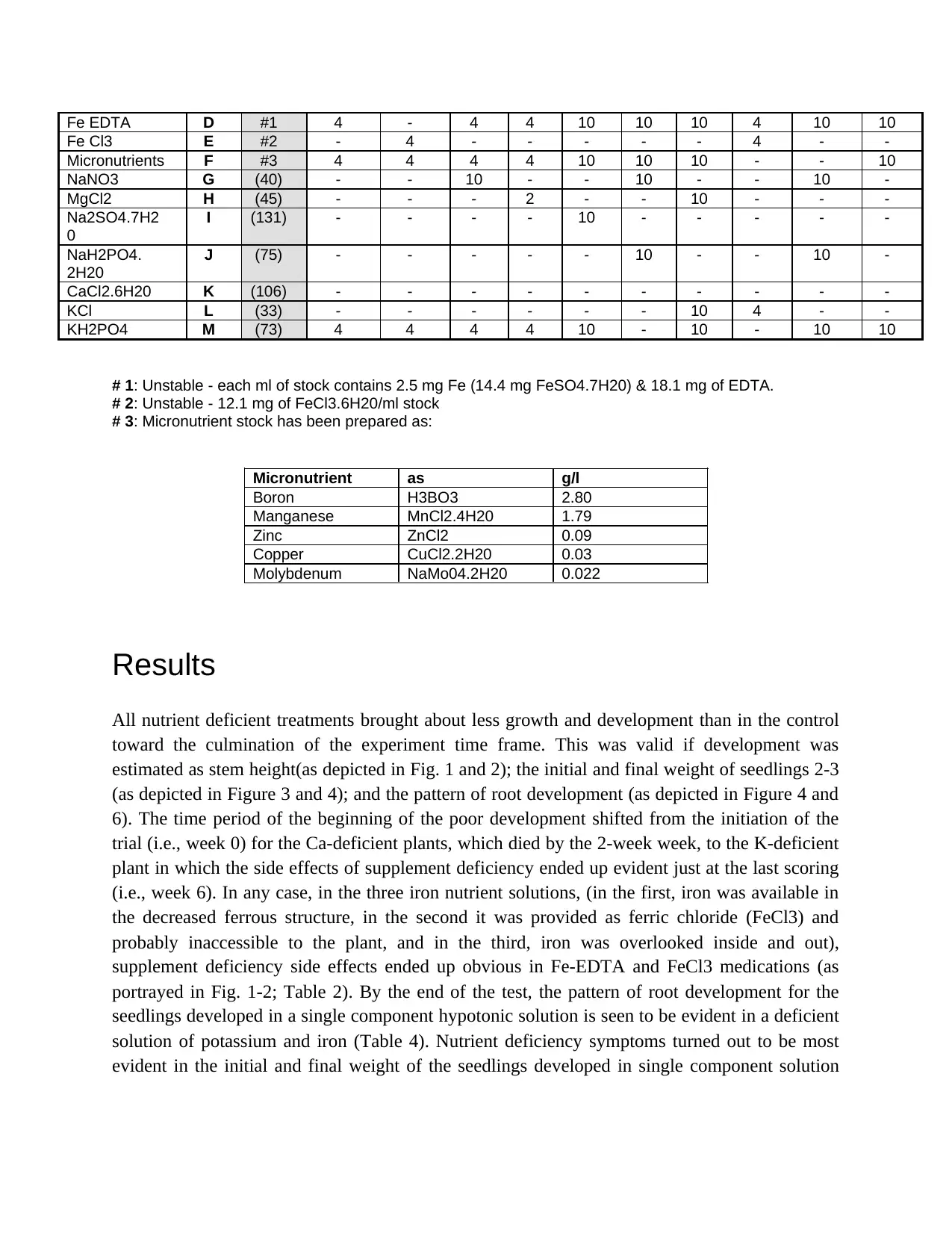
Fe EDTA D #1 4 - 4 4 10 10 10 4 10 10
Fe Cl3 E #2 - 4 - - - - - 4 - -
Micronutrients F #3 4 4 4 4 10 10 10 - - 10
NaNO3 G (40) - - 10 - - 10 - - 10 -
MgCl2 H (45) - - - 2 - - 10 - - -
Na2SO4.7H2
0
I (131) - - - - 10 - - - - -
NaH2PO4.
2H20
J (75) - - - - - 10 - - 10 -
CaCl2.6H20 K (106) - - - - - - - - - -
KCl L (33) - - - - - - 10 4 - -
KH2PO4 M (73) 4 4 4 4 10 - 10 - 10 10
# 1: Unstable - each ml of stock contains 2.5 mg Fe (14.4 mg FeSO4.7H20) & 18.1 mg of EDTA.
# 2: Unstable - 12.1 mg of FeCl3.6H20/ml stock
# 3: Micronutrient stock has been prepared as:
Micronutrient as g/l
Boron H3BO3 2.80
Manganese MnCl2.4H20 1.79
Zinc ZnCl2 0.09
Copper CuCl2.2H20 0.03
Molybdenum NaMo04.2H20 0.022
Results
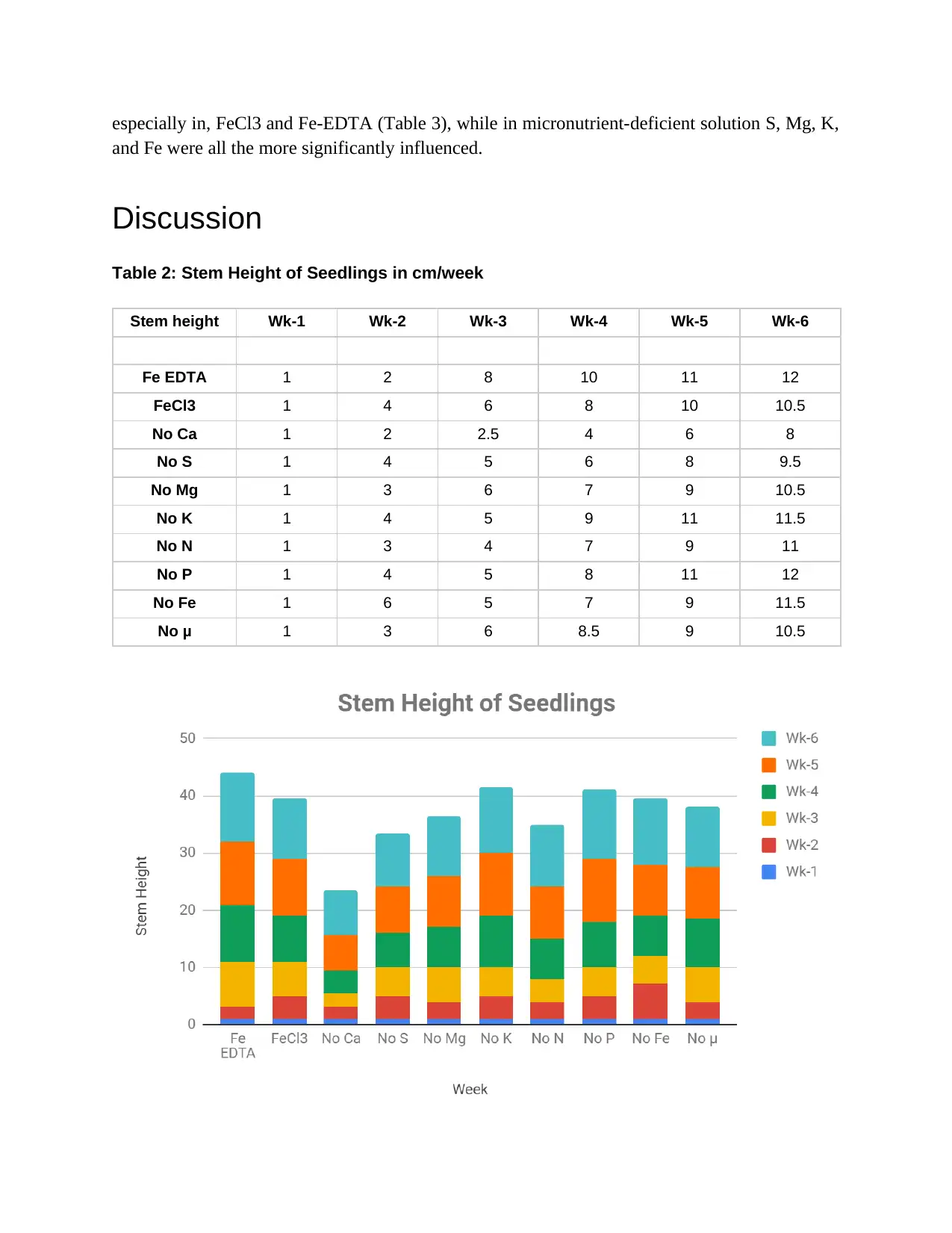
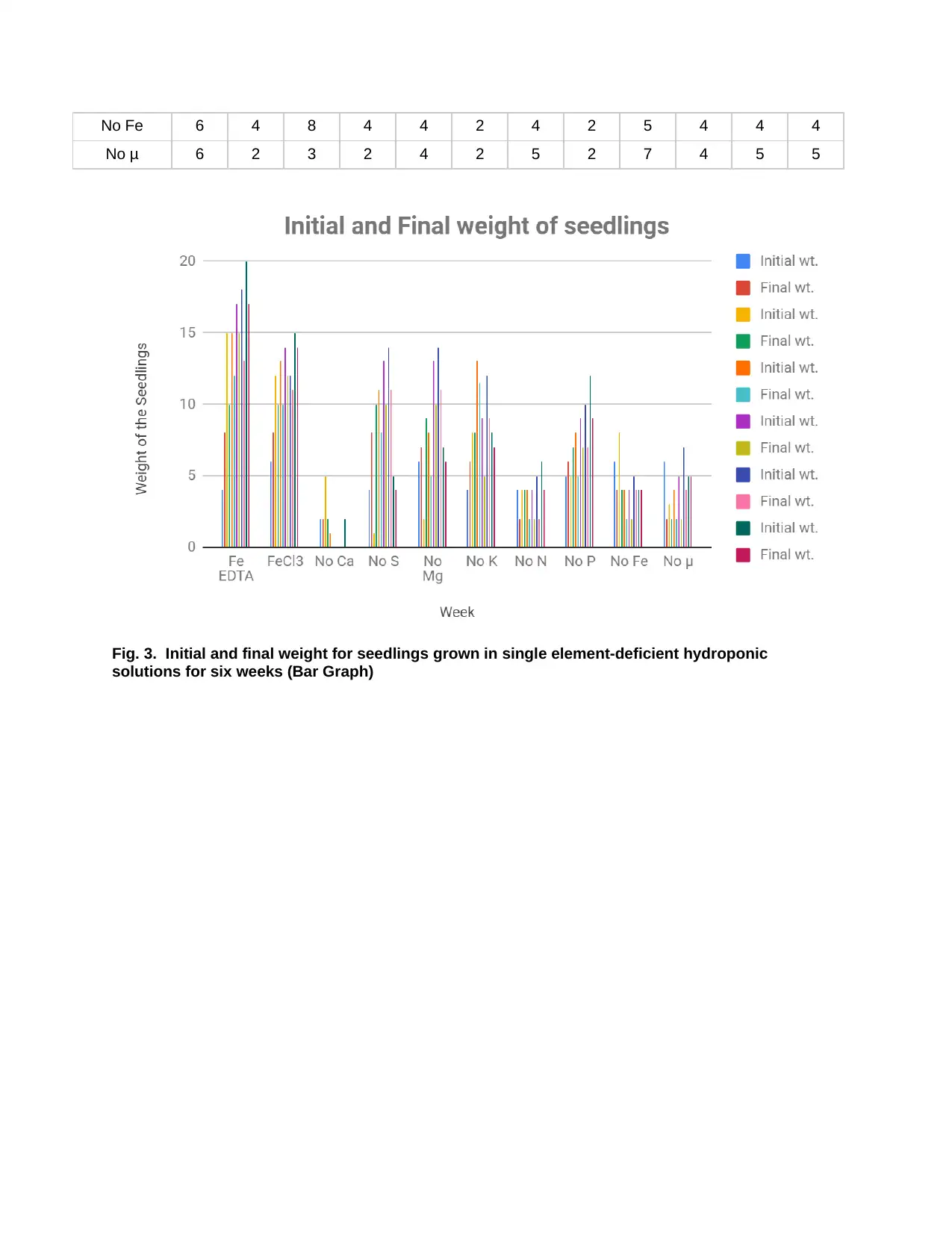
All nutrient deficient treatments brought about less growth and development than in the control
toward the culmination of the experiment time frame. This was valid if development was
estimated as stem height(as depicted in Fig. 1 and 2); the initial and final weight of seedlings 2-3
(as depicted in Figure 3 and 4); and the pattern of root development (as depicted in Figure 4 and
6). The time period of the beginning of the poor development shifted from the initiation of the
trial (i.e., week 0) for the Ca-deficient plants, which died by the 2-week week, to the K-deficient
plant in which the side effects of supplement deficiency ended up evident just at the last scoring
(i.e., week 6). In any case, in the three iron nutrient solutions, (in the first, iron was available in
the decreased ferrous structure, in the second it was provided as ferric chloride (FeCl3) and
probably inaccessible to the plant, and in the third, iron was overlooked inside and out),
supplement deficiency side effects ended up obvious in Fe-EDTA and FeCl3 medications (as
portrayed in Fig. 1-2; Table 2). By the end of the test, the pattern of root development for the
seedlings developed in a single component hypotonic solution is seen to be evident in a deficient
solution of potassium and iron (Table 4). Nutrient deficiency symptoms turned out to be most
evident in the initial and final weight of the seedlings developed in single component solution
Fe Cl3 E #2 - 4 - - - - - 4 - -
Micronutrients F #3 4 4 4 4 10 10 10 - - 10
NaNO3 G (40) - - 10 - - 10 - - 10 -
MgCl2 H (45) - - - 2 - - 10 - - -
Na2SO4.7H2
0
I (131) - - - - 10 - - - - -
NaH2PO4.
2H20
J (75) - - - - - 10 - - 10 -
CaCl2.6H20 K (106) - - - - - - - - - -
KCl L (33) - - - - - - 10 4 - -
KH2PO4 M (73) 4 4 4 4 10 - 10 - 10 10
# 1: Unstable - each ml of stock contains 2.5 mg Fe (14.4 mg FeSO4.7H20) & 18.1 mg of EDTA.
# 2: Unstable - 12.1 mg of FeCl3.6H20/ml stock
# 3: Micronutrient stock has been prepared as:
Micronutrient as g/l
Boron H3BO3 2.80
Manganese MnCl2.4H20 1.79
Zinc ZnCl2 0.09
Copper CuCl2.2H20 0.03
Molybdenum NaMo04.2H20 0.022
Results
All nutrient deficient treatments brought about less growth and development than in the control
toward the culmination of the experiment time frame. This was valid if development was
estimated as stem height(as depicted in Fig. 1 and 2); the initial and final weight of seedlings 2-3
(as depicted in Figure 3 and 4); and the pattern of root development (as depicted in Figure 4 and
6). The time period of the beginning of the poor development shifted from the initiation of the
trial (i.e., week 0) for the Ca-deficient plants, which died by the 2-week week, to the K-deficient
plant in which the side effects of supplement deficiency ended up evident just at the last scoring
(i.e., week 6). In any case, in the three iron nutrient solutions, (in the first, iron was available in
the decreased ferrous structure, in the second it was provided as ferric chloride (FeCl3) and
probably inaccessible to the plant, and in the third, iron was overlooked inside and out),
supplement deficiency side effects ended up obvious in Fe-EDTA and FeCl3 medications (as
portrayed in Fig. 1-2; Table 2). By the end of the test, the pattern of root development for the
seedlings developed in a single component hypotonic solution is seen to be evident in a deficient
solution of potassium and iron (Table 4). Nutrient deficiency symptoms turned out to be most
evident in the initial and final weight of the seedlings developed in single component solution
Paraphrase This Document
Need a fresh take? Get an instant paraphrase of this document with our AI Paraphraser
especially in, FeCl3 and Fe-EDTA (Table 3), while in micronutrient-deficient solution S, Mg, K,
and Fe were all the more significantly influenced.
Discussion
Table 2: Stem Height of Seedlings in cm/week
Stem height Wk-1 Wk-2 Wk-3 Wk-4 Wk-5 Wk-6
Fe EDTA 1 2 8 10 11 12
FeCl3 1 4 6 8 10 10.5
No Ca 1 2 2.5 4 6 8
No S 1 4 5 6 8 9.5
No Mg 1 3 6 7 9 10.5
No K 1 4 5 9 11 11.5
No N 1 3 4 7 9 11
No P 1 4 5 8 11 12
No Fe 1 6 5 7 9 11.5
No μ 1 3 6 8.5 9 10.5
and Fe were all the more significantly influenced.
Discussion
Table 2: Stem Height of Seedlings in cm/week
Stem height Wk-1 Wk-2 Wk-3 Wk-4 Wk-5 Wk-6
Fe EDTA 1 2 8 10 11 12
FeCl3 1 4 6 8 10 10.5
No Ca 1 2 2.5 4 6 8
No S 1 4 5 6 8 9.5
No Mg 1 3 6 7 9 10.5
No K 1 4 5 9 11 11.5
No N 1 3 4 7 9 11
No P 1 4 5 8 11 12
No Fe 1 6 5 7 9 11.5
No μ 1 3 6 8.5 9 10.5
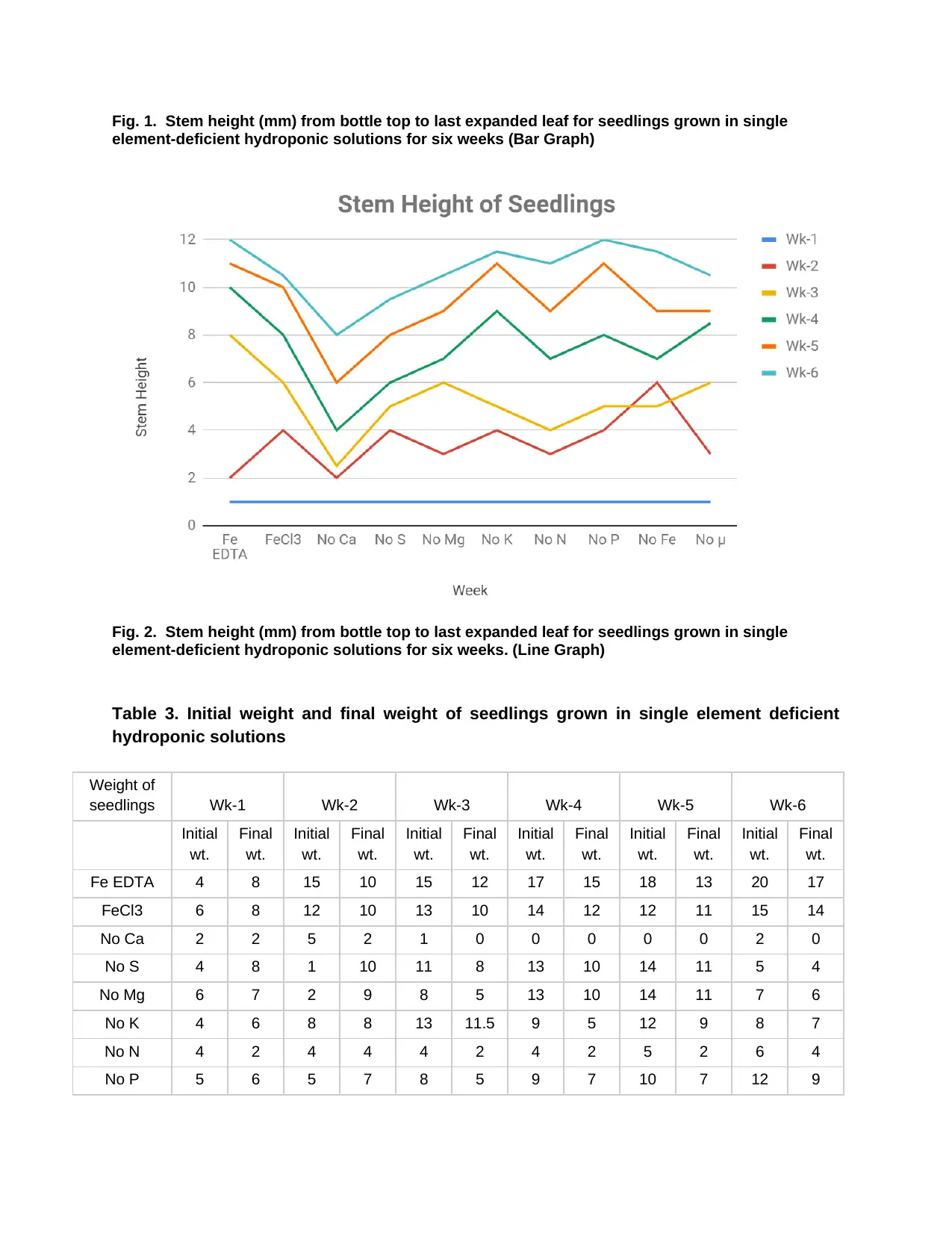
Fig. 1. Stem height (mm) from bottle top to last expanded leaf for seedlings grown in single
element-deficient hydroponic solutions for six weeks (Bar Graph)
Fig. 2. Stem height (mm) from bottle top to last expanded leaf for seedlings grown in single
element-deficient hydroponic solutions for six weeks. (Line Graph)
Table 3. Initial weight and final weight of seedlings grown in single element deficient
hydroponic solutions
Weight of
seedlings Wk-1 Wk-2 Wk-3 Wk-4 Wk-5 Wk-6
Initial
wt.
Final
wt.
Initial
wt.
Final
wt.
Initial
wt.
Final
wt.
Initial
wt.
Final
wt.
Initial
wt.
Final
wt.
Initial
wt.
Final
wt.
Fe EDTA 4 8 15 10 15 12 17 15 18 13 20 17
FeCl3 6 8 12 10 13 10 14 12 12 11 15 14
No Ca 2 2 5 2 1 0 0 0 0 0 2 0
No S 4 8 1 10 11 8 13 10 14 11 5 4
No Mg 6 7 2 9 8 5 13 10 14 11 7 6
No K 4 6 8 8 13 11.5 9 5 12 9 8 7
No N 4 2 4 4 4 2 4 2 5 2 6 4
No P 5 6 5 7 8 5 9 7 10 7 12 9
element-deficient hydroponic solutions for six weeks (Bar Graph)
Fig. 2. Stem height (mm) from bottle top to last expanded leaf for seedlings grown in single
element-deficient hydroponic solutions for six weeks. (Line Graph)
Table 3. Initial weight and final weight of seedlings grown in single element deficient
hydroponic solutions
Weight of
seedlings Wk-1 Wk-2 Wk-3 Wk-4 Wk-5 Wk-6
Initial
wt.
Final
wt.
Initial
wt.
Final
wt.
Initial
wt.
Final
wt.
Initial
wt.
Final
wt.
Initial
wt.
Final
wt.
Initial
wt.
Final
wt.
Fe EDTA 4 8 15 10 15 12 17 15 18 13 20 17
FeCl3 6 8 12 10 13 10 14 12 12 11 15 14
No Ca 2 2 5 2 1 0 0 0 0 0 2 0
No S 4 8 1 10 11 8 13 10 14 11 5 4
No Mg 6 7 2 9 8 5 13 10 14 11 7 6
No K 4 6 8 8 13 11.5 9 5 12 9 8 7
No N 4 2 4 4 4 2 4 2 5 2 6 4
No P 5 6 5 7 8 5 9 7 10 7 12 9
⊘ This is a preview!⊘
Do you want full access?
Subscribe today to unlock all pages.
Trusted by 1+ million students worldwide
No Fe 6 4 8 4 4 2 4 2 5 4 4 4
No μ 6 2 3 2 4 2 5 2 7 4 5 5
Fig. 3. Initial and final weight for seedlings grown in single element-deficient hydroponic
solutions for six weeks (Bar Graph)
No μ 6 2 3 2 4 2 5 2 7 4 5 5
Fig. 3. Initial and final weight for seedlings grown in single element-deficient hydroponic
solutions for six weeks (Bar Graph)
Paraphrase This Document
Need a fresh take? Get an instant paraphrase of this document with our AI Paraphraser
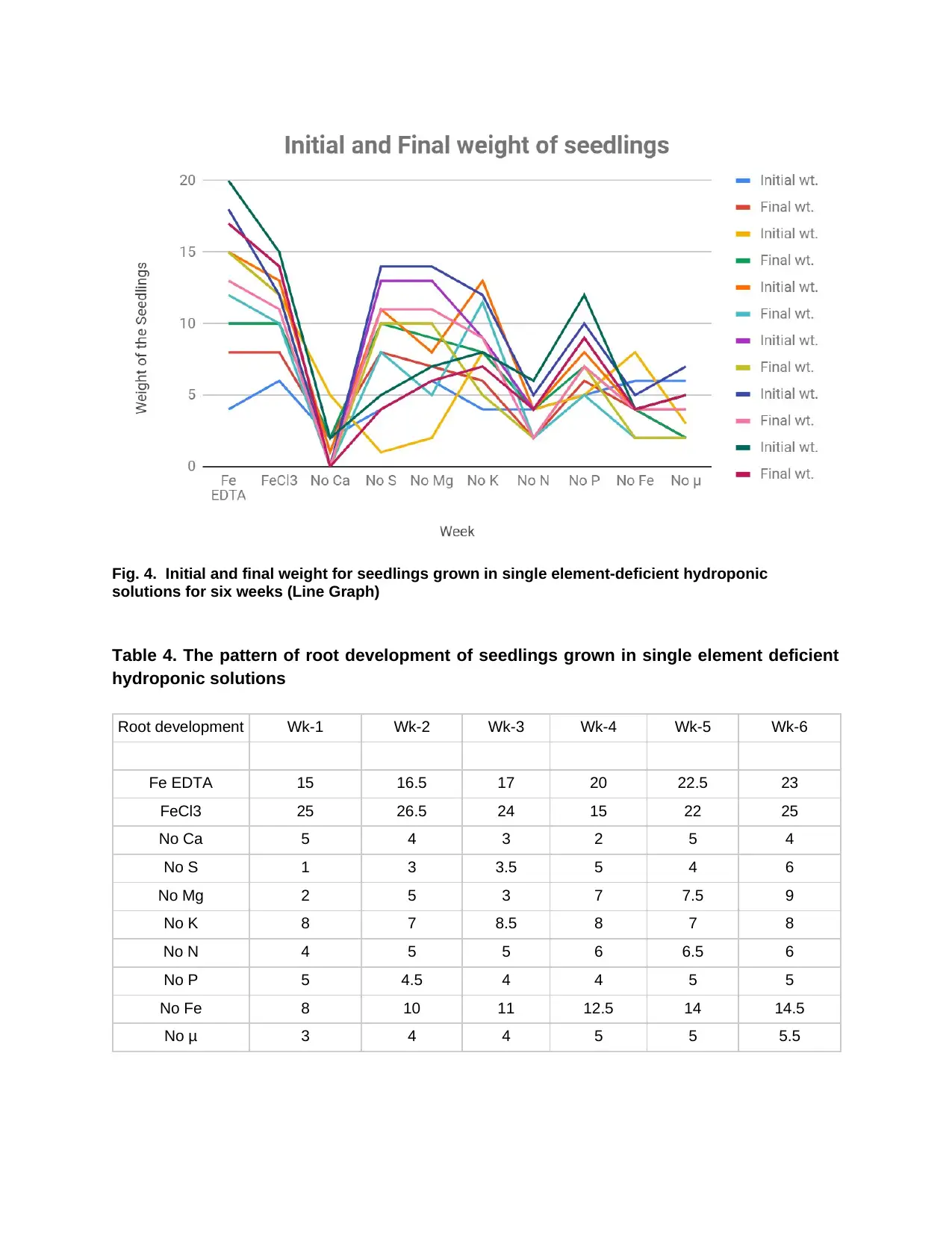
Fig. 4. Initial and final weight for seedlings grown in single element-deficient hydroponic
solutions for six weeks (Line Graph)
Table 4. The pattern of root development of seedlings grown in single element deficient
hydroponic solutions
Root development Wk-1 Wk-2 Wk-3 Wk-4 Wk-5 Wk-6
Fe EDTA 15 16.5 17 20 22.5 23
FeCl3 25 26.5 24 15 22 25
No Ca 5 4 3 2 5 4
No S 1 3 3.5 5 4 6
No Mg 2 5 3 7 7.5 9
No K 8 7 8.5 8 7 8
No N 4 5 5 6 6.5 6
No P 5 4.5 4 4 5 5
No Fe 8 10 11 12.5 14 14.5
No μ 3 4 4 5 5 5.5
solutions for six weeks (Line Graph)
Table 4. The pattern of root development of seedlings grown in single element deficient
hydroponic solutions
Root development Wk-1 Wk-2 Wk-3 Wk-4 Wk-5 Wk-6
Fe EDTA 15 16.5 17 20 22.5 23
FeCl3 25 26.5 24 15 22 25
No Ca 5 4 3 2 5 4
No S 1 3 3.5 5 4 6
No Mg 2 5 3 7 7.5 9
No K 8 7 8.5 8 7 8
No N 4 5 5 6 6.5 6
No P 5 4.5 4 4 5 5
No Fe 8 10 11 12.5 14 14.5
No μ 3 4 4 5 5 5.5
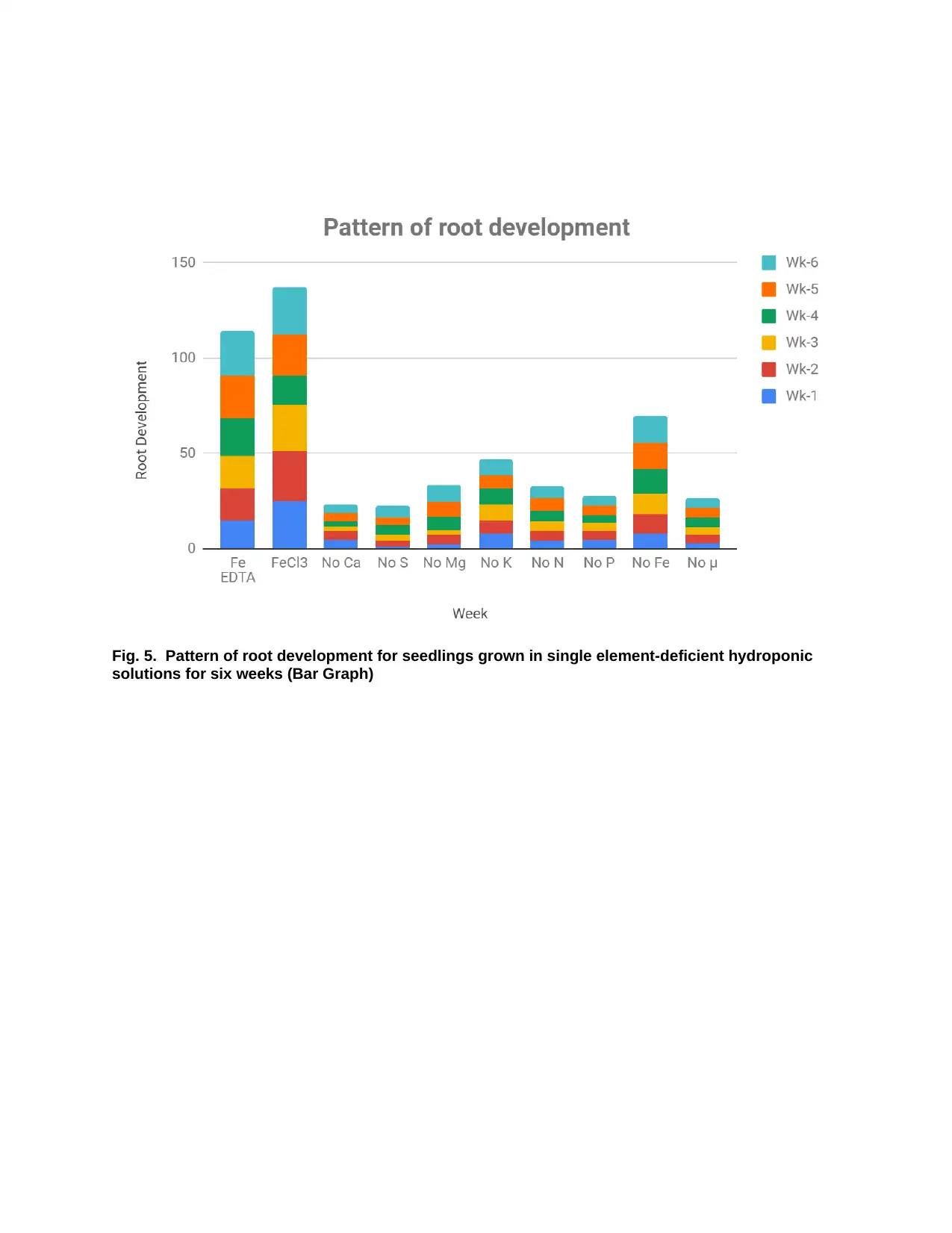
Fig. 5. Pattern of root development for seedlings grown in single element-deficient hydroponic
solutions for six weeks (Bar Graph)
solutions for six weeks (Bar Graph)
⊘ This is a preview!⊘
Do you want full access?
Subscribe today to unlock all pages.
Trusted by 1+ million students worldwide
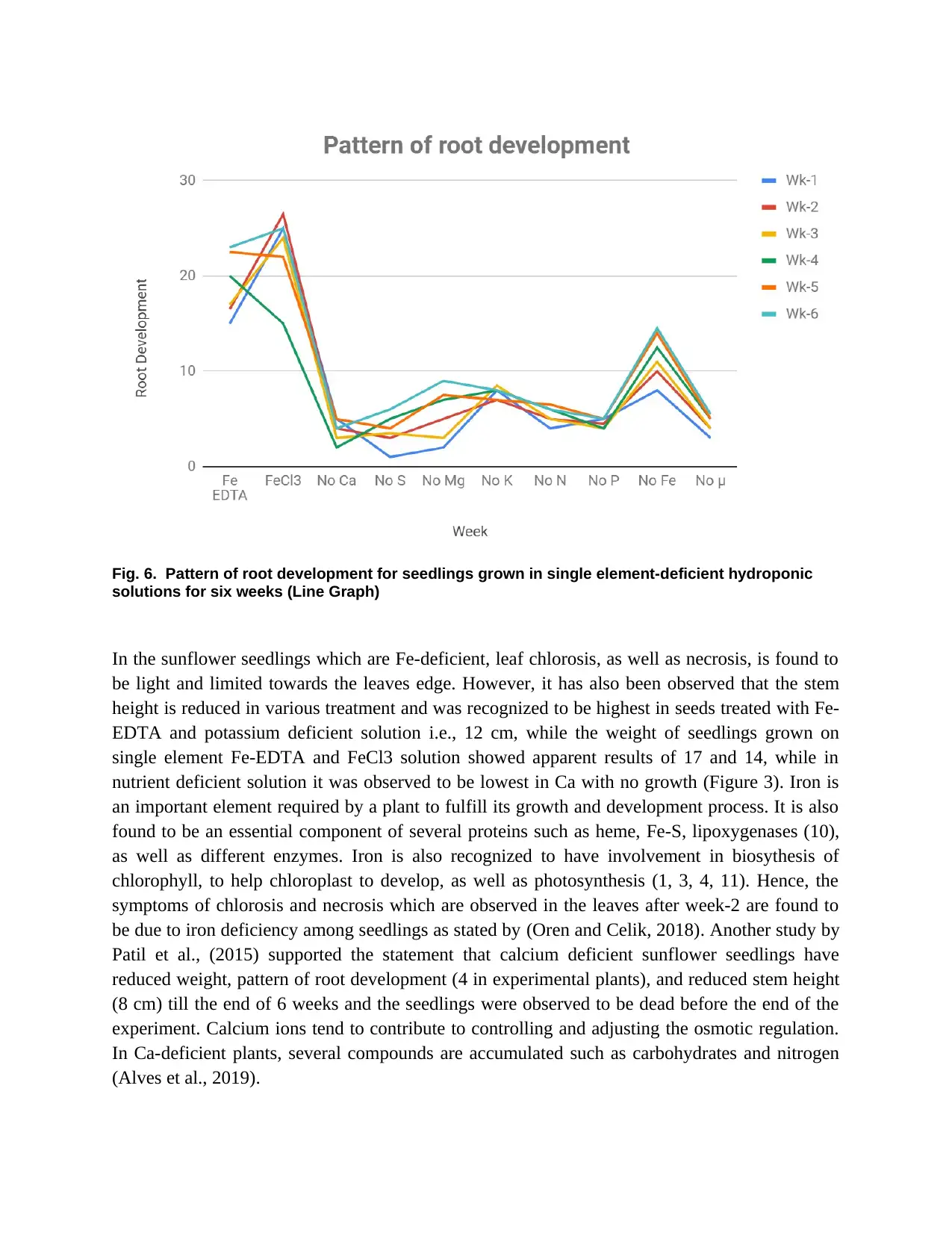
Fig. 6. Pattern of root development for seedlings grown in single element-deficient hydroponic
solutions for six weeks (Line Graph)
In the sunflower seedlings which are Fe-deficient, leaf chlorosis, as well as necrosis, is found to
be light and limited towards the leaves edge. However, it has also been observed that the stem
height is reduced in various treatment and was recognized to be highest in seeds treated with Fe-
EDTA and potassium deficient solution i.e., 12 cm, while the weight of seedlings grown on
single element Fe-EDTA and FeCl3 solution showed apparent results of 17 and 14, while in
nutrient deficient solution it was observed to be lowest in Ca with no growth (Figure 3). Iron is
an important element required by a plant to fulfill its growth and development process. It is also
found to be an essential component of several proteins such as heme, Fe-S, lipoxygenases (10),
as well as different enzymes. Iron is also recognized to have involvement in biosythesis of
chlorophyll, to help chloroplast to develop, as well as photosynthesis (1, 3, 4, 11). Hence, the
symptoms of chlorosis and necrosis which are observed in the leaves after week-2 are found to
be due to iron deficiency among seedlings as stated by (Oren and Celik, 2018). Another study by
Patil et al., (2015) supported the statement that calcium deficient sunflower seedlings have
reduced weight, pattern of root development (4 in experimental plants), and reduced stem height
(8 cm) till the end of 6 weeks and the seedlings were observed to be dead before the end of the
experiment. Calcium ions tend to contribute to controlling and adjusting the osmotic regulation.
In Ca-deficient plants, several compounds are accumulated such as carbohydrates and nitrogen
(Alves et al., 2019).
solutions for six weeks (Line Graph)
In the sunflower seedlings which are Fe-deficient, leaf chlorosis, as well as necrosis, is found to
be light and limited towards the leaves edge. However, it has also been observed that the stem
height is reduced in various treatment and was recognized to be highest in seeds treated with Fe-
EDTA and potassium deficient solution i.e., 12 cm, while the weight of seedlings grown on
single element Fe-EDTA and FeCl3 solution showed apparent results of 17 and 14, while in
nutrient deficient solution it was observed to be lowest in Ca with no growth (Figure 3). Iron is
an important element required by a plant to fulfill its growth and development process. It is also
found to be an essential component of several proteins such as heme, Fe-S, lipoxygenases (10),
as well as different enzymes. Iron is also recognized to have involvement in biosythesis of
chlorophyll, to help chloroplast to develop, as well as photosynthesis (1, 3, 4, 11). Hence, the
symptoms of chlorosis and necrosis which are observed in the leaves after week-2 are found to
be due to iron deficiency among seedlings as stated by (Oren and Celik, 2018). Another study by
Patil et al., (2015) supported the statement that calcium deficient sunflower seedlings have
reduced weight, pattern of root development (4 in experimental plants), and reduced stem height
(8 cm) till the end of 6 weeks and the seedlings were observed to be dead before the end of the
experiment. Calcium ions tend to contribute to controlling and adjusting the osmotic regulation.
In Ca-deficient plants, several compounds are accumulated such as carbohydrates and nitrogen
(Alves et al., 2019).
Paraphrase This Document
Need a fresh take? Get an instant paraphrase of this document with our AI Paraphraser
Mobile nutrients have the ability to move from older leaves towards the new or yound leaves and
other young parts of the plant when they are in inadequate supply. The mobile nutrients consists
of N, P, K, Cl, Mg, Mo. Hence, the mobile nature of such elements their deficiency is visualised
at the first place as compared to non-mobile elements. The symptoms initially occurs in older or
leaves at lower level and their impact could be both localized or generalized. However, the Ca-
deficiency was not observed in the present experiment at initial levels as it is a type non-mobile
nutrient hence, it cannot move from 1 part of the plant to other, also the deficiency symptoms
occur within the young leaves or leaves which are present in the upper part of the plant. The
findings of the present report will help to attain significant knowledge in order to understand the
impact of nutrient deficiency on sunflower seedlings in a better way (Lazar, 2019).
References
Alves, A., Souza, F., Chaves, L., Sousa, J. and Vasconcelos, A. (2019). Effect of nutrient
omission in the development of sunflower BRS-122 in greenhouse conditions. Revista
Facultad Nacional de Agronomía Medellín, 72(1), pp.8663-8671.
Chowdhury, F., Halim, M., Hossain, F. and Akhtar, N. (2018). Effects of sodium chloride on
germination and seedling growth of Sunflower (Helianthus annuus L.). Jahangirnagar
University Journal of Biological Sciences, 7(1), pp.35-44.
LAZAR, T. (2019). Taiz, L. and Zeiger, E. Plant physiology. 3rd edn..
Oren, G. and Celik, H. (2018). Effects of nitrogen doses on growth and some nutrient
element uptake of sunflower (Helianthus Annuus L.) hybrids. Agricultural Science and
Technology, 10(4), pp.338-343.
Patil, S., Mishra, P., Ramesha, M. and Math, S. (2015). Response of Sunflower to
Rainwater Conservation and Nutrient Management in Semi-arid Conditions. Helia,
0(0).
other young parts of the plant when they are in inadequate supply. The mobile nutrients consists
of N, P, K, Cl, Mg, Mo. Hence, the mobile nature of such elements their deficiency is visualised
at the first place as compared to non-mobile elements. The symptoms initially occurs in older or
leaves at lower level and their impact could be both localized or generalized. However, the Ca-
deficiency was not observed in the present experiment at initial levels as it is a type non-mobile
nutrient hence, it cannot move from 1 part of the plant to other, also the deficiency symptoms
occur within the young leaves or leaves which are present in the upper part of the plant. The
findings of the present report will help to attain significant knowledge in order to understand the
impact of nutrient deficiency on sunflower seedlings in a better way (Lazar, 2019).
References
Alves, A., Souza, F., Chaves, L., Sousa, J. and Vasconcelos, A. (2019). Effect of nutrient
omission in the development of sunflower BRS-122 in greenhouse conditions. Revista
Facultad Nacional de Agronomía Medellín, 72(1), pp.8663-8671.
Chowdhury, F., Halim, M., Hossain, F. and Akhtar, N. (2018). Effects of sodium chloride on
germination and seedling growth of Sunflower (Helianthus annuus L.). Jahangirnagar
University Journal of Biological Sciences, 7(1), pp.35-44.
LAZAR, T. (2019). Taiz, L. and Zeiger, E. Plant physiology. 3rd edn..
Oren, G. and Celik, H. (2018). Effects of nitrogen doses on growth and some nutrient
element uptake of sunflower (Helianthus Annuus L.) hybrids. Agricultural Science and
Technology, 10(4), pp.338-343.
Patil, S., Mishra, P., Ramesha, M. and Math, S. (2015). Response of Sunflower to
Rainwater Conservation and Nutrient Management in Semi-arid Conditions. Helia,
0(0).

1 out of 11


Your All-in-One AI-Powered Toolkit for Academic Success.
+13062052269
info@desklib.com
Available 24*7 on WhatsApp / Email
![[object Object]](/_next/static/media/star-bottom.7253800d.svg)
Unlock your academic potential
Copyright © 2020–2025 A2Z Services. All Rights Reserved. Developed and managed by ZUCOL.