Report on the Statistical Analysis of Superstition and Self-Efficacy
VerifiedAdded on 2023/06/12
|19
|3440
|349
Report
AI Summary
This report delves into the statistical analysis of superstitious beliefs and self-efficacy, utilizing data related to activities like refraining from jinxing, crossing fingers, and repeating phrases, alongside a self-efficacy scale. The analysis employs regression and correlation tests to explore the relationships between these variables. The report tests hypotheses related to the association between superstitious beliefs (such as jinxing and crossing fingers) and self-efficacy, interpreting the statistical significance of these relationships using SPSS. The findings suggest varying degrees of association between specific superstitions and self-efficacy, with some hypotheses being accepted or rejected based on p-values. The report also investigates the relationship between checking horoscopes and wearing lucky objects, providing a comprehensive overview of the statistical connections between superstition and self-perceived efficacy. Desklib provides similar solved assignments for students.

Rubric.

Paraphrase This Document
Need a fresh take? Get an instant paraphrase of this document with our AI Paraphraser

Contents
INTRODUCTION...........................................................................................................................2
MAIN BODY...................................................................................................................................2
CONCLUSION..............................................................................................................................17
REFERENCES..............................................................................................................................18
1
INTRODUCTION...........................................................................................................................2
MAIN BODY...................................................................................................................................2
CONCLUSION..............................................................................................................................17
REFERENCES..............................................................................................................................18
1

INTRODUCTION
SPSS stands for statistical package for social science. It is a software which is used to perform the complex calculations of
statistics. The statistics is divided into two parts: descriptive statistics and inferential statistics. The descriptive statistics includes
mean, mode and median. On the other hand, inferential statistics includes various parametric and non-parametric tests such as t-test,
ANOVA, correlation and regression (Abu-Bader,. and Jones, 2021). This report includes the data about superstitious beliefs which
includes various activities such as refrain from jinxing, cross fingers and repeating a particular phase. It also includes the self-
efficiency scale. According to the data, hypothesis is framed and inferential test are performed.
MAIN BODY
Regression:
Model Summary
Model R R Square Adjusted R Square Std. Error of the
Estimate
2
SPSS stands for statistical package for social science. It is a software which is used to perform the complex calculations of
statistics. The statistics is divided into two parts: descriptive statistics and inferential statistics. The descriptive statistics includes
mean, mode and median. On the other hand, inferential statistics includes various parametric and non-parametric tests such as t-test,
ANOVA, correlation and regression (Abu-Bader,. and Jones, 2021). This report includes the data about superstitious beliefs which
includes various activities such as refrain from jinxing, cross fingers and repeating a particular phase. It also includes the self-
efficiency scale. According to the data, hypothesis is framed and inferential test are performed.
MAIN BODY
Regression:
Model Summary
Model R R Square Adjusted R Square Std. Error of the
Estimate
2
⊘ This is a preview!⊘
Do you want full access?
Subscribe today to unlock all pages.

Trusted by 1+ million students worldwide

1 .168a .028 .024 1.252
a. Predictors: (Constant), The last section entails the Self-efficacy scale, developed by
Chen et al. (2001). Please indicate on a scale of 1-5 how much you agree with the
following statements (with 1 being strongly disagree and 5 being strongly agree). - I
will be able to achieve most of the goals that I have set for myself
ANOVAa
Model Sum of Squares df Mean Square F Sig.
1
Regression 9.279 1 9.279 5.924 .016b
Residual 317.970 203 1.566
Total 327.249 204
a. Dependent Variable: 'Superstitions are beliefs that have no religious or scientific foundations
and which lead people to think that certain facts or objects can bring good or bad luck, or are
signs that bring about positive or negative consequences'.
Below is a list of common superstitions, please indicate on a scale of 1-5 how effective you think
each of the following are (1 being not effective, and 5 being very effective) - Refrain from jinxing
b. Predictors: (Constant), The last section entails the Self-efficacy scale, developed by Chen et
al. (2001). Please indicate on a scale of 1-5 how much you agree with the following statements
(with 1 being strongly disagree and 5 being strongly agree). - I will be able to achieve most of the
goals that I have set for myself
H0 (Null Hypothesis): There is no significant relationship between superstitious beliefs of jinxing and self-efficacy of an individual.
H1 (alternate Hypothesis): There is significant relationship between superstitious beliefs of jinxing and self-efficacy of an individual.
3
a. Predictors: (Constant), The last section entails the Self-efficacy scale, developed by
Chen et al. (2001). Please indicate on a scale of 1-5 how much you agree with the
following statements (with 1 being strongly disagree and 5 being strongly agree). - I
will be able to achieve most of the goals that I have set for myself
ANOVAa
Model Sum of Squares df Mean Square F Sig.
1
Regression 9.279 1 9.279 5.924 .016b
Residual 317.970 203 1.566
Total 327.249 204
a. Dependent Variable: 'Superstitions are beliefs that have no religious or scientific foundations
and which lead people to think that certain facts or objects can bring good or bad luck, or are
signs that bring about positive or negative consequences'.
Below is a list of common superstitions, please indicate on a scale of 1-5 how effective you think
each of the following are (1 being not effective, and 5 being very effective) - Refrain from jinxing
b. Predictors: (Constant), The last section entails the Self-efficacy scale, developed by Chen et
al. (2001). Please indicate on a scale of 1-5 how much you agree with the following statements
(with 1 being strongly disagree and 5 being strongly agree). - I will be able to achieve most of the
goals that I have set for myself
H0 (Null Hypothesis): There is no significant relationship between superstitious beliefs of jinxing and self-efficacy of an individual.
H1 (alternate Hypothesis): There is significant relationship between superstitious beliefs of jinxing and self-efficacy of an individual.
3
Paraphrase This Document
Need a fresh take? Get an instant paraphrase of this document with our AI Paraphraser

Interpretation: From the above prepared statistical table it can be interpreted that regression model applied on the factors that possess
dependent and independent nature in SPSS it can be observed that correlation between the influence of the factors is very less and the
significance value recorded is .016 which is more than 0.05 thus alternate hypothesis would be selected. It helps to understand related
effect observed of superstitious beliefs in relation with certain related facts, objects that would bring good luck or bad luck. It helps to
predict on the scale of 1 to 5 as what would be the related impact and whether there is any significant association present between
superstition beliefs in relation to refrain from jinxing and if a respected person would be able to achieve goals by him/her for
himself/herself. It is thus observed that there is significant association present between the dependent & independent variables present.
Therefore, the scale provided ranging from 1 to 5 where 1 indicates being not effective and 5 represents being very effective in case of
refrain whereas in case of self-efficacy scale 1 reflects strong disagreement and 5 depicts strong agreement in table.
Coefficientsa
Model Unstandardized Coefficients Standardized
Coefficients
t Sig.
B Std. Error Beta
1 (Constant) 3.379 .373 9.069 .000
4
dependent and independent nature in SPSS it can be observed that correlation between the influence of the factors is very less and the
significance value recorded is .016 which is more than 0.05 thus alternate hypothesis would be selected. It helps to understand related
effect observed of superstitious beliefs in relation with certain related facts, objects that would bring good luck or bad luck. It helps to
predict on the scale of 1 to 5 as what would be the related impact and whether there is any significant association present between
superstition beliefs in relation to refrain from jinxing and if a respected person would be able to achieve goals by him/her for
himself/herself. It is thus observed that there is significant association present between the dependent & independent variables present.
Therefore, the scale provided ranging from 1 to 5 where 1 indicates being not effective and 5 represents being very effective in case of
refrain whereas in case of self-efficacy scale 1 reflects strong disagreement and 5 depicts strong agreement in table.
Coefficientsa
Model Unstandardized Coefficients Standardized
Coefficients
t Sig.
B Std. Error Beta
1 (Constant) 3.379 .373 9.069 .000
4

The last section entails the
Self-efficacy scale,
developed by Chen et al.
(2001). Please indicate on a
scale of 1-5 how much you
agree with the following
statements (with 1 being
strongly disagree and 5
being strongly agree). - I will
be able to achieve most of
the goals that I have set for
myself
-.240 .099 -.168 -2.434 .016
a. Dependent Variable: 'Superstitions are beliefs that have no religious or scientific foundations and which lead
people to think that certain facts or objects can bring good or bad luck, or are signs that bring about positive or
negative consequences'.
Below is a list of common superstitions, please indicate on a scale of 1-5 how effective you think each of the
following are (1 being not effective, and 5 being very effective) - Refrain from jinxing
Variables Entered/Removeda
Model Variables
Entered
Variables
Removed
Method
5
Self-efficacy scale,
developed by Chen et al.
(2001). Please indicate on a
scale of 1-5 how much you
agree with the following
statements (with 1 being
strongly disagree and 5
being strongly agree). - I will
be able to achieve most of
the goals that I have set for
myself
-.240 .099 -.168 -2.434 .016
a. Dependent Variable: 'Superstitions are beliefs that have no religious or scientific foundations and which lead
people to think that certain facts or objects can bring good or bad luck, or are signs that bring about positive or
negative consequences'.
Below is a list of common superstitions, please indicate on a scale of 1-5 how effective you think each of the
following are (1 being not effective, and 5 being very effective) - Refrain from jinxing
Variables Entered/Removeda
Model Variables
Entered
Variables
Removed
Method
5
⊘ This is a preview!⊘
Do you want full access?
Subscribe today to unlock all pages.
Trusted by 1+ million students worldwide

1
The last section
entails the Self-
efficacy scale,
developed by
Chen et al.
(2001). Please
indicate on a
scale of 1-5 how
much you agree
with the
following
statements (with
1 being strongly
disagree and 5
being strongly
agree). - When
facing difficult
tasks, I am
certain that I will
accomplish
themb
. Enter
6
The last section
entails the Self-
efficacy scale,
developed by
Chen et al.
(2001). Please
indicate on a
scale of 1-5 how
much you agree
with the
following
statements (with
1 being strongly
disagree and 5
being strongly
agree). - When
facing difficult
tasks, I am
certain that I will
accomplish
themb
. Enter
6
Paraphrase This Document
Need a fresh take? Get an instant paraphrase of this document with our AI Paraphraser
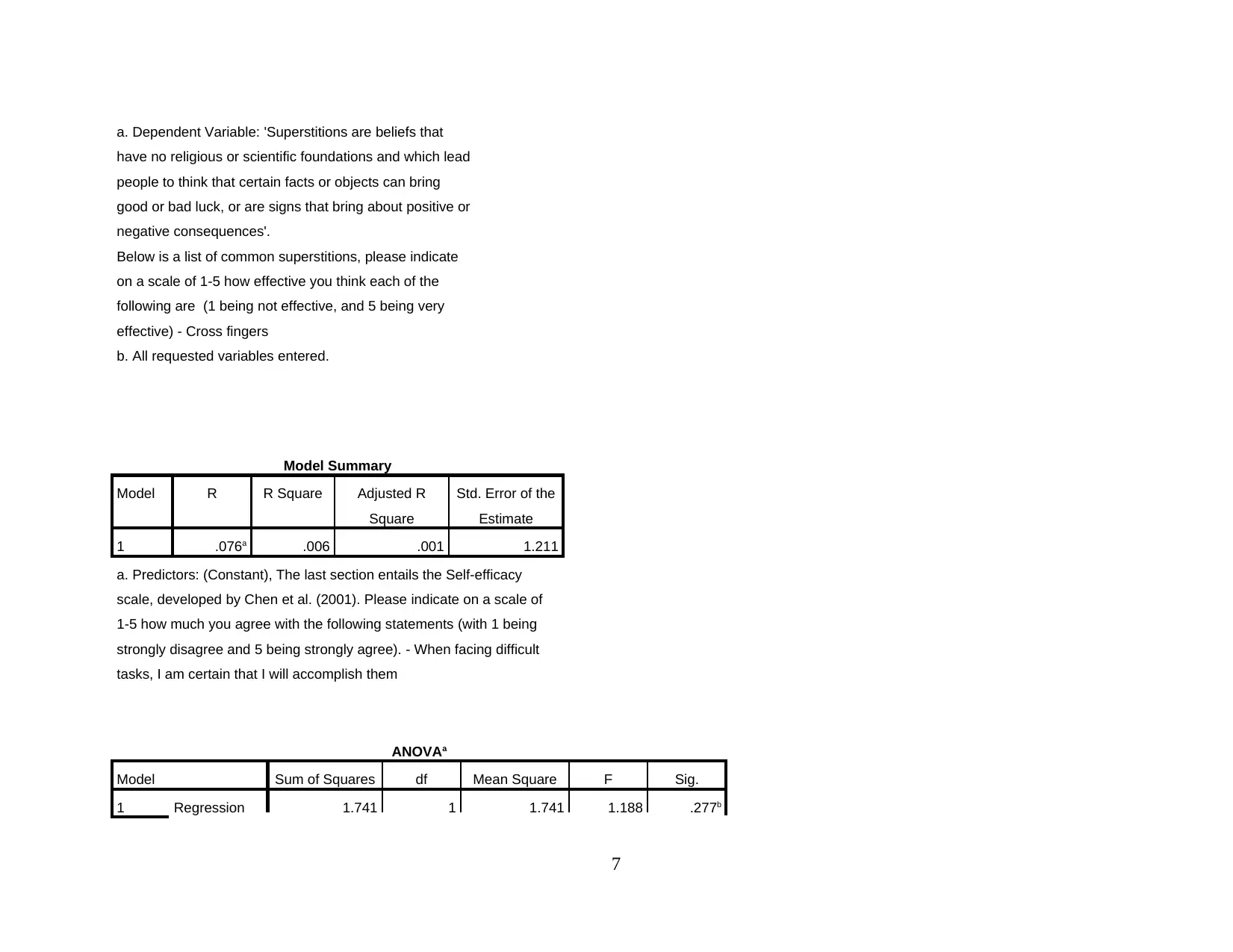
a. Dependent Variable: 'Superstitions are beliefs that
have no religious or scientific foundations and which lead
people to think that certain facts or objects can bring
good or bad luck, or are signs that bring about positive or
negative consequences'.
Below is a list of common superstitions, please indicate
on a scale of 1-5 how effective you think each of the
following are (1 being not effective, and 5 being very
effective) - Cross fingers
b. All requested variables entered.
Model Summary
Model R R Square Adjusted R
Square
Std. Error of the
Estimate
1 .076a .006 .001 1.211
a. Predictors: (Constant), The last section entails the Self-efficacy
scale, developed by Chen et al. (2001). Please indicate on a scale of
1-5 how much you agree with the following statements (with 1 being
strongly disagree and 5 being strongly agree). - When facing difficult
tasks, I am certain that I will accomplish them
ANOVAa
Model Sum of Squares df Mean Square F Sig.
1 Regression 1.741 1 1.741 1.188 .277b
7
have no religious or scientific foundations and which lead
people to think that certain facts or objects can bring
good or bad luck, or are signs that bring about positive or
negative consequences'.
Below is a list of common superstitions, please indicate
on a scale of 1-5 how effective you think each of the
following are (1 being not effective, and 5 being very
effective) - Cross fingers
b. All requested variables entered.
Model Summary
Model R R Square Adjusted R
Square
Std. Error of the
Estimate
1 .076a .006 .001 1.211
a. Predictors: (Constant), The last section entails the Self-efficacy
scale, developed by Chen et al. (2001). Please indicate on a scale of
1-5 how much you agree with the following statements (with 1 being
strongly disagree and 5 being strongly agree). - When facing difficult
tasks, I am certain that I will accomplish them
ANOVAa
Model Sum of Squares df Mean Square F Sig.
1 Regression 1.741 1 1.741 1.188 .277b
7

Residual 297.508 203 1.466
Total 299.249 204
a. Dependent Variable: 'Superstitions are beliefs that have no religious or scientific foundations
and which lead people to think that certain facts or objects can bring good or bad luck, or are
signs that bring about positive or negative consequences'.
Below is a list of common superstitions, please indicate on a scale of 1-5 how effective you think
each of the following are (1 being not effective, and 5 being very effective) - Cross fingers
b. Predictors: (Constant), The last section entails the Self-efficacy scale, developed by Chen et
al. (2001). Please indicate on a scale of 1-5 how much you agree with the following statements
(with 1 being strongly disagree and 5 being strongly agree). - When facing difficult tasks, I am
certain that I will accomplish them
2. H0 (null hypothesis)- There is no significant relationship between the superstitious belief of cross fingers and self-efficacy to
accomplish certain difficult task.
H1 (alternate hypothesis)- There is significant relationship between the superstitious belief of cross fingers and self-efficacy to
accomplish certain difficult task.
Interpretation: The above table shows the relationship between superstitious belief and self-efficacy to achieve a specific task. The r
value denotes the relationship between null and alternate hypothesis. There is high correlation between the variables. The value of r2
denotes the coefficient of determination, it is computed at 0.006. In the above scenario, the test of regression is being performed. The
significant difference is 0.016. It shows the level of acceptance of null hypothesis. The value is less than the 0.05 which shows that
null hypothesis will be selected. The null hypothesis is the value which takes no difference between the independent and dependent
variable. It shows that there is no relationship between cross fingers and self-efficacy to accomplish certain tasks. The cross finger is a
gesture to believe that good luck will occur and it does not create any impact on the self-efficacy. Hence, it can be concluded that one
should believe in its hard work and must not depend on any specific gesture. The level of hard work will impact the results and further
no more activities are responsible for the success of any task.
8
Total 299.249 204
a. Dependent Variable: 'Superstitions are beliefs that have no religious or scientific foundations
and which lead people to think that certain facts or objects can bring good or bad luck, or are
signs that bring about positive or negative consequences'.
Below is a list of common superstitions, please indicate on a scale of 1-5 how effective you think
each of the following are (1 being not effective, and 5 being very effective) - Cross fingers
b. Predictors: (Constant), The last section entails the Self-efficacy scale, developed by Chen et
al. (2001). Please indicate on a scale of 1-5 how much you agree with the following statements
(with 1 being strongly disagree and 5 being strongly agree). - When facing difficult tasks, I am
certain that I will accomplish them
2. H0 (null hypothesis)- There is no significant relationship between the superstitious belief of cross fingers and self-efficacy to
accomplish certain difficult task.
H1 (alternate hypothesis)- There is significant relationship between the superstitious belief of cross fingers and self-efficacy to
accomplish certain difficult task.
Interpretation: The above table shows the relationship between superstitious belief and self-efficacy to achieve a specific task. The r
value denotes the relationship between null and alternate hypothesis. There is high correlation between the variables. The value of r2
denotes the coefficient of determination, it is computed at 0.006. In the above scenario, the test of regression is being performed. The
significant difference is 0.016. It shows the level of acceptance of null hypothesis. The value is less than the 0.05 which shows that
null hypothesis will be selected. The null hypothesis is the value which takes no difference between the independent and dependent
variable. It shows that there is no relationship between cross fingers and self-efficacy to accomplish certain tasks. The cross finger is a
gesture to believe that good luck will occur and it does not create any impact on the self-efficacy. Hence, it can be concluded that one
should believe in its hard work and must not depend on any specific gesture. The level of hard work will impact the results and further
no more activities are responsible for the success of any task.
8
⊘ This is a preview!⊘
Do you want full access?
Subscribe today to unlock all pages.
Trusted by 1+ million students worldwide

Coefficientsa
Model Unstandardized Coefficients Standardized
Coefficients
t Sig.
B Std. Error Beta
1
(Constant) 3.008 .297 10.121 .000
The last section entails the
Self-efficacy scale,
developed by Chen et al.
(2001). Please indicate on a
scale of 1-5 how much you
agree with the following
statements (with 1 being
strongly disagree and 5
being strongly agree). -
When facing difficult tasks, I
am certain that I will
accomplish them
-.097 .089 -.076 -1.090 .277
a. Dependent Variable: 'Superstitions are beliefs that have no religious or scientific foundations and which lead
people to think that certain facts or objects can bring good or bad luck, or are signs that bring about positive or
negative consequences'.
Below is a list of common superstitions, please indicate on a scale of 1-5 how effective you think each of the
following are (1 being not effective, and 5 being very effective) - Cross fingers
3.H0: There is no significant relationship between superstitious belief of cross fingers and bad luck& good luck.
H1: There is significant relationship between superstitious belief of cross fingers and bad luck& good luck.
Interpretation: The above table shows the significant relationship between superstitious belief of cross finger& good luck and bad
luck. The test performed in the above table is ANOVA. It is used to monitor the means of two or more groups and how significantly
are both the variables related to each other. The significance value for the above table is 0.277 which is more than the p value.
9
Model Unstandardized Coefficients Standardized
Coefficients
t Sig.
B Std. Error Beta
1
(Constant) 3.008 .297 10.121 .000
The last section entails the
Self-efficacy scale,
developed by Chen et al.
(2001). Please indicate on a
scale of 1-5 how much you
agree with the following
statements (with 1 being
strongly disagree and 5
being strongly agree). -
When facing difficult tasks, I
am certain that I will
accomplish them
-.097 .089 -.076 -1.090 .277
a. Dependent Variable: 'Superstitions are beliefs that have no religious or scientific foundations and which lead
people to think that certain facts or objects can bring good or bad luck, or are signs that bring about positive or
negative consequences'.
Below is a list of common superstitions, please indicate on a scale of 1-5 how effective you think each of the
following are (1 being not effective, and 5 being very effective) - Cross fingers
3.H0: There is no significant relationship between superstitious belief of cross fingers and bad luck& good luck.
H1: There is significant relationship between superstitious belief of cross fingers and bad luck& good luck.
Interpretation: The above table shows the significant relationship between superstitious belief of cross finger& good luck and bad
luck. The test performed in the above table is ANOVA. It is used to monitor the means of two or more groups and how significantly
are both the variables related to each other. The significance value for the above table is 0.277 which is more than the p value.
9
Paraphrase This Document
Need a fresh take? Get an instant paraphrase of this document with our AI Paraphraser

Therefore, the alternate hypothesis are to be selected. It simply depicts that there is significant relationship between cross fingers and
good luck & bad luck. Most of the respondents believe that there is relationship between both the variables.
Correlation
Descriptive Statistics
Mean Std. Deviation N
'Superstitions are beliefs that
have no religious or scientific
foundations and which lead
people to think that certain
facts or objects can bring
good or bad luck, or are
signs that bring about
positive or negative
consequences'.
Below is a list of common
superstitions, please indicate
on a scale of 1-5 how
effective you think each of
the following are (1 being
not effective, and 5 being
very effective) - Cross
fingers
2.70 1.211 205
10
good luck & bad luck. Most of the respondents believe that there is relationship between both the variables.
Correlation
Descriptive Statistics
Mean Std. Deviation N
'Superstitions are beliefs that
have no religious or scientific
foundations and which lead
people to think that certain
facts or objects can bring
good or bad luck, or are
signs that bring about
positive or negative
consequences'.
Below is a list of common
superstitions, please indicate
on a scale of 1-5 how
effective you think each of
the following are (1 being
not effective, and 5 being
very effective) - Cross
fingers
2.70 1.211 205
10

'Superstitions are beliefs that
have no religious or scientific
foundations and which lead
people to think that certain
facts or objects can bring
good or bad luck, or are
signs that bring about
positive or negative
consequences'.
Below is a list of common
superstitions, please indicate
on a scale of 1-5 how
effective you think each of
the following are (1 being
not effective, and 5 being
very effective) - Check
horoscope
2.12 1.192 205
4.Correlation
H0: There is no relationship between superstitious belief of checking horoscope and wearing a luck object for improving the future.
H1: There is a relationship between superstitious belief of checking horoscope and wearing a luck object for improving the future.
Interpretation: From the above prepared table it can be interpreted that the value observed by developed statistical table for calculating
the efficient association between variables such as checking horoscope and wearing an object that would improve their future related
aspects situations and conditions is .392. It helps to calculate and predict significant relationship thus the value is more than .05 which
is less than .392 hence it can be seen that the alternative hypothesis would be selected. It is thus believed that wearing something such
as any lucky object or a thing that would make you believe that it would help to predict horoscope.
11
have no religious or scientific
foundations and which lead
people to think that certain
facts or objects can bring
good or bad luck, or are
signs that bring about
positive or negative
consequences'.
Below is a list of common
superstitions, please indicate
on a scale of 1-5 how
effective you think each of
the following are (1 being
not effective, and 5 being
very effective) - Check
horoscope
2.12 1.192 205
4.Correlation
H0: There is no relationship between superstitious belief of checking horoscope and wearing a luck object for improving the future.
H1: There is a relationship between superstitious belief of checking horoscope and wearing a luck object for improving the future.
Interpretation: From the above prepared table it can be interpreted that the value observed by developed statistical table for calculating
the efficient association between variables such as checking horoscope and wearing an object that would improve their future related
aspects situations and conditions is .392. It helps to calculate and predict significant relationship thus the value is more than .05 which
is less than .392 hence it can be seen that the alternative hypothesis would be selected. It is thus believed that wearing something such
as any lucky object or a thing that would make you believe that it would help to predict horoscope.
11
⊘ This is a preview!⊘
Do you want full access?
Subscribe today to unlock all pages.
Trusted by 1+ million students worldwide

1 out of 19


Your All-in-One AI-Powered Toolkit for Academic Success.
+13062052269
info@desklib.com
Available 24*7 on WhatsApp / Email
![[object Object]](/_next/static/media/star-bottom.7253800d.svg)
Unlock your academic potential
Copyright © 2020–2026 A2Z Services. All Rights Reserved. Developed and managed by ZUCOL.