Supervisory Management Report: Bus Eireann Recruitment and Selection
VerifiedAdded on 2022/08/13
|14
|3402
|34
Report
AI Summary
This report provides a detailed analysis of supervisory management within Bus Eireann, focusing on its strengths, weaknesses, opportunities, and threats (SWOT), as well as its political, economic, social, and technological (PEST) environment. The report evaluates current standards, guidelines, and recommended practices affecting supervision, including staff recruitment, selection, training, and evaluation. It examines the recruitment process, proposes a Standard Operating Procedure (SOP), and assesses staff training methods. The report also summarizes staff evaluation techniques, including feedback and identification of development opportunities. Recommendations are provided to address identified weaknesses and improve organizational functions within the context of the competitive bus market. The report emphasizes the importance of communication, contract staff management, and professional association memberships for enhanced operational effectiveness.
Supervisory Management - Collection of Work
Name of the Student
Name of the University
Author Note
Name of the Student
Name of the University
Author Note

Paraphrase This Document
Need a fresh take? Get an instant paraphrase of this document with our AI Paraphraser
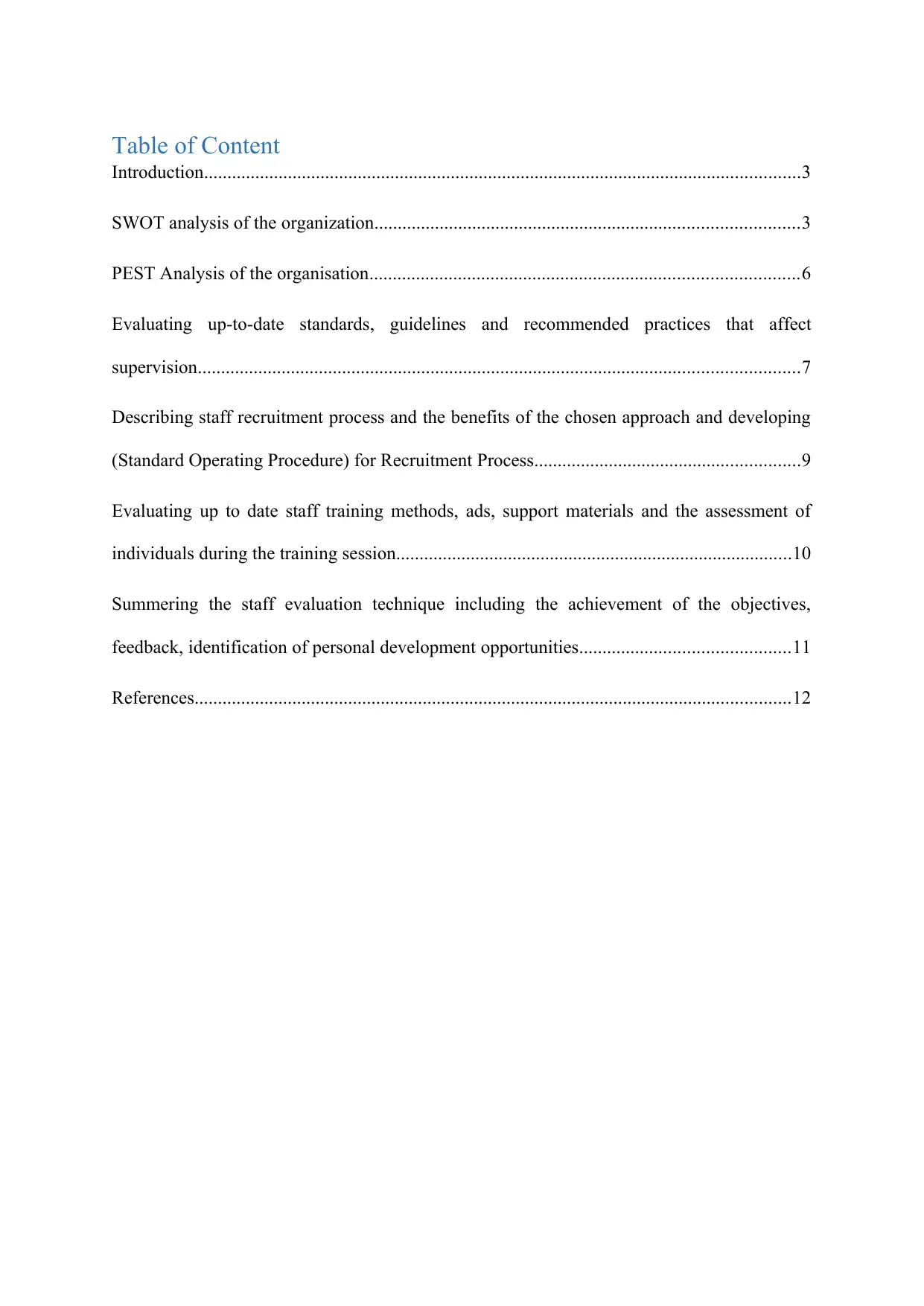
Table of Content
Introduction................................................................................................................................3
SWOT analysis of the organization...........................................................................................3
PEST Analysis of the organisation............................................................................................6
Evaluating up-to-date standards, guidelines and recommended practices that affect
supervision.................................................................................................................................7
Describing staff recruitment process and the benefits of the chosen approach and developing
(Standard Operating Procedure) for Recruitment Process.........................................................9
Evaluating up to date staff training methods, ads, support materials and the assessment of
individuals during the training session.....................................................................................10
Summering the staff evaluation technique including the achievement of the objectives,
feedback, identification of personal development opportunities.............................................11
References................................................................................................................................12
Introduction................................................................................................................................3
SWOT analysis of the organization...........................................................................................3
PEST Analysis of the organisation............................................................................................6
Evaluating up-to-date standards, guidelines and recommended practices that affect
supervision.................................................................................................................................7
Describing staff recruitment process and the benefits of the chosen approach and developing
(Standard Operating Procedure) for Recruitment Process.........................................................9
Evaluating up to date staff training methods, ads, support materials and the assessment of
individuals during the training session.....................................................................................10
Summering the staff evaluation technique including the achievement of the objectives,
feedback, identification of personal development opportunities.............................................11
References................................................................................................................................12
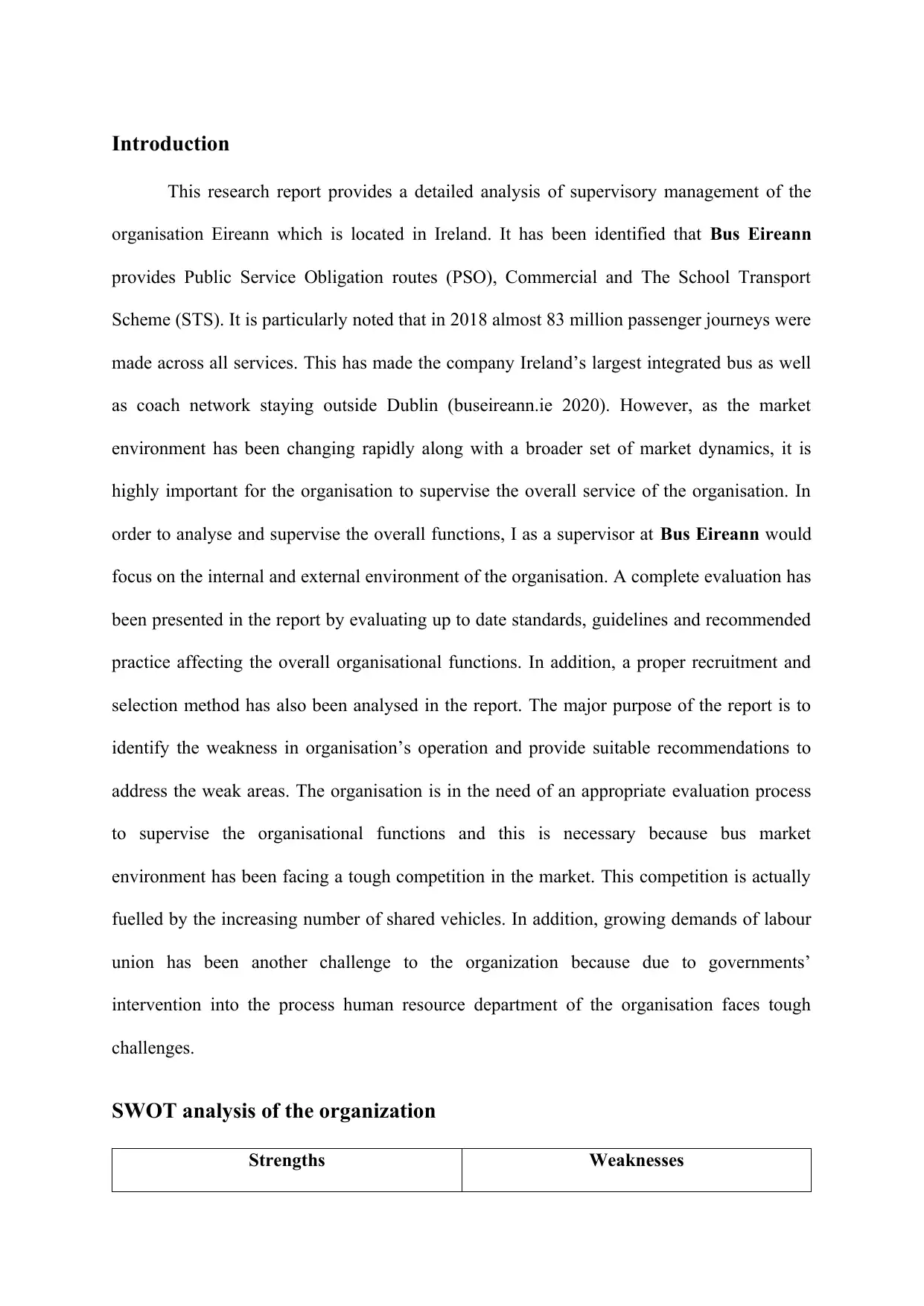
Introduction
This research report provides a detailed analysis of supervisory management of the
organisation Eireann which is located in Ireland. It has been identified that Bus Eireann
provides Public Service Obligation routes (PSO), Commercial and The School Transport
Scheme (STS). It is particularly noted that in 2018 almost 83 million passenger journeys were
made across all services. This has made the company Ireland’s largest integrated bus as well
as coach network staying outside Dublin (buseireann.ie 2020). However, as the market
environment has been changing rapidly along with a broader set of market dynamics, it is
highly important for the organisation to supervise the overall service of the organisation. In
order to analyse and supervise the overall functions, I as a supervisor at Bus Eireann would
focus on the internal and external environment of the organisation. A complete evaluation has
been presented in the report by evaluating up to date standards, guidelines and recommended
practice affecting the overall organisational functions. In addition, a proper recruitment and
selection method has also been analysed in the report. The major purpose of the report is to
identify the weakness in organisation’s operation and provide suitable recommendations to
address the weak areas. The organisation is in the need of an appropriate evaluation process
to supervise the organisational functions and this is necessary because bus market
environment has been facing a tough competition in the market. This competition is actually
fuelled by the increasing number of shared vehicles. In addition, growing demands of labour
union has been another challenge to the organization because due to governments’
intervention into the process human resource department of the organisation faces tough
challenges.
SWOT analysis of the organization
Strengths Weaknesses
This research report provides a detailed analysis of supervisory management of the
organisation Eireann which is located in Ireland. It has been identified that Bus Eireann
provides Public Service Obligation routes (PSO), Commercial and The School Transport
Scheme (STS). It is particularly noted that in 2018 almost 83 million passenger journeys were
made across all services. This has made the company Ireland’s largest integrated bus as well
as coach network staying outside Dublin (buseireann.ie 2020). However, as the market
environment has been changing rapidly along with a broader set of market dynamics, it is
highly important for the organisation to supervise the overall service of the organisation. In
order to analyse and supervise the overall functions, I as a supervisor at Bus Eireann would
focus on the internal and external environment of the organisation. A complete evaluation has
been presented in the report by evaluating up to date standards, guidelines and recommended
practice affecting the overall organisational functions. In addition, a proper recruitment and
selection method has also been analysed in the report. The major purpose of the report is to
identify the weakness in organisation’s operation and provide suitable recommendations to
address the weak areas. The organisation is in the need of an appropriate evaluation process
to supervise the organisational functions and this is necessary because bus market
environment has been facing a tough competition in the market. This competition is actually
fuelled by the increasing number of shared vehicles. In addition, growing demands of labour
union has been another challenge to the organization because due to governments’
intervention into the process human resource department of the organisation faces tough
challenges.
SWOT analysis of the organization
Strengths Weaknesses
⊘ This is a preview!⊘
Do you want full access?
Subscribe today to unlock all pages.

Trusted by 1+ million students worldwide
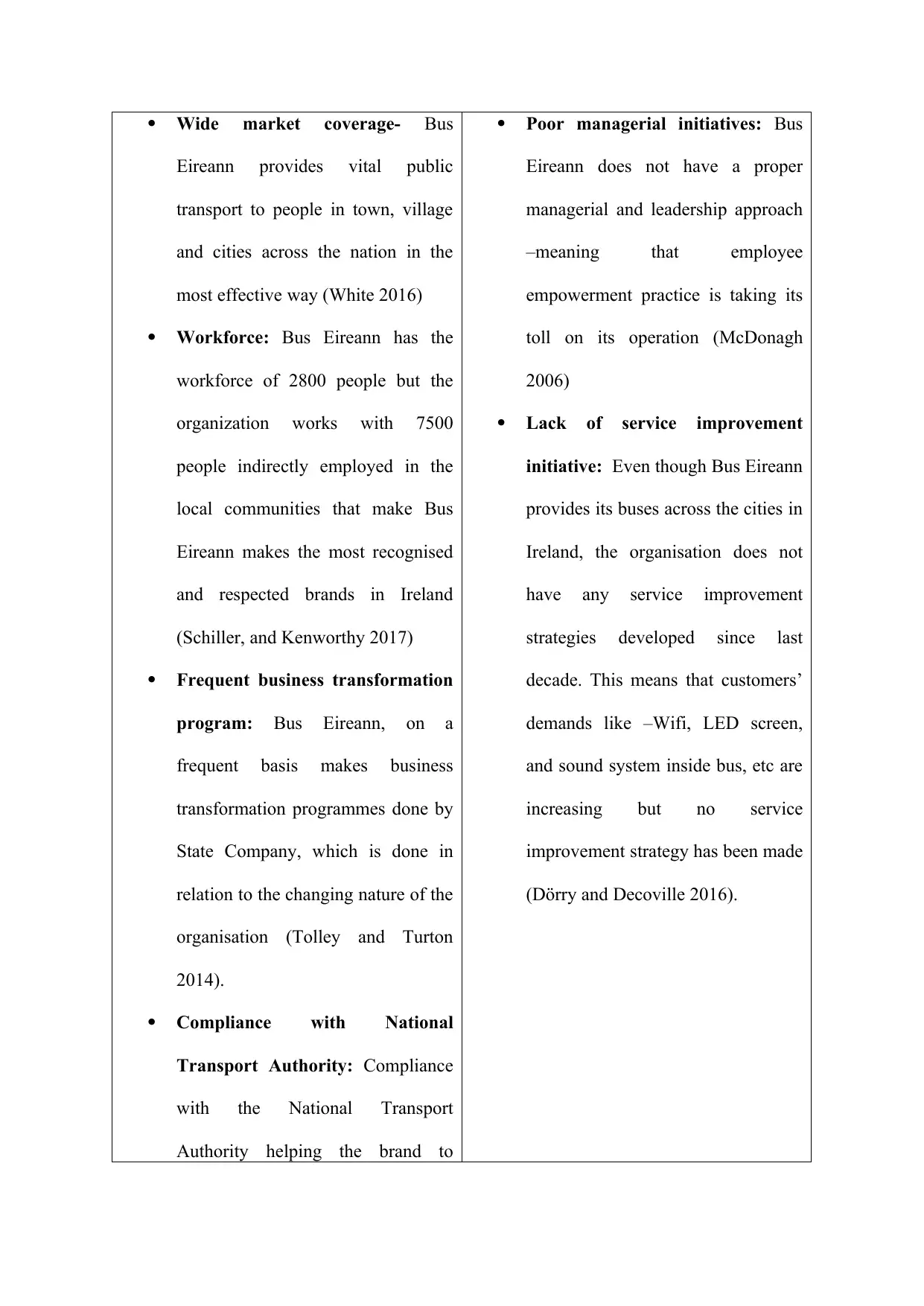
Wide market coverage- Bus
Eireann provides vital public
transport to people in town, village
and cities across the nation in the
most effective way (White 2016)
Workforce: Bus Eireann has the
workforce of 2800 people but the
organization works with 7500
people indirectly employed in the
local communities that make Bus
Eireann makes the most recognised
and respected brands in Ireland
(Schiller, and Kenworthy 2017)
Frequent business transformation
program: Bus Eireann, on a
frequent basis makes business
transformation programmes done by
State Company, which is done in
relation to the changing nature of the
organisation (Tolley and Turton
2014).
Compliance with National
Transport Authority: Compliance
with the National Transport
Authority helping the brand to
Poor managerial initiatives: Bus
Eireann does not have a proper
managerial and leadership approach
–meaning that employee
empowerment practice is taking its
toll on its operation (McDonagh
2006)
Lack of service improvement
initiative: Even though Bus Eireann
provides its buses across the cities in
Ireland, the organisation does not
have any service improvement
strategies developed since last
decade. This means that customers’
demands like –Wifi, LED screen,
and sound system inside bus, etc are
increasing but no service
improvement strategy has been made
(Dörry and Decoville 2016).
Eireann provides vital public
transport to people in town, village
and cities across the nation in the
most effective way (White 2016)
Workforce: Bus Eireann has the
workforce of 2800 people but the
organization works with 7500
people indirectly employed in the
local communities that make Bus
Eireann makes the most recognised
and respected brands in Ireland
(Schiller, and Kenworthy 2017)
Frequent business transformation
program: Bus Eireann, on a
frequent basis makes business
transformation programmes done by
State Company, which is done in
relation to the changing nature of the
organisation (Tolley and Turton
2014).
Compliance with National
Transport Authority: Compliance
with the National Transport
Authority helping the brand to
Poor managerial initiatives: Bus
Eireann does not have a proper
managerial and leadership approach
–meaning that employee
empowerment practice is taking its
toll on its operation (McDonagh
2006)
Lack of service improvement
initiative: Even though Bus Eireann
provides its buses across the cities in
Ireland, the organisation does not
have any service improvement
strategies developed since last
decade. This means that customers’
demands like –Wifi, LED screen,
and sound system inside bus, etc are
increasing but no service
improvement strategy has been made
(Dörry and Decoville 2016).
Paraphrase This Document
Need a fresh take? Get an instant paraphrase of this document with our AI Paraphraser
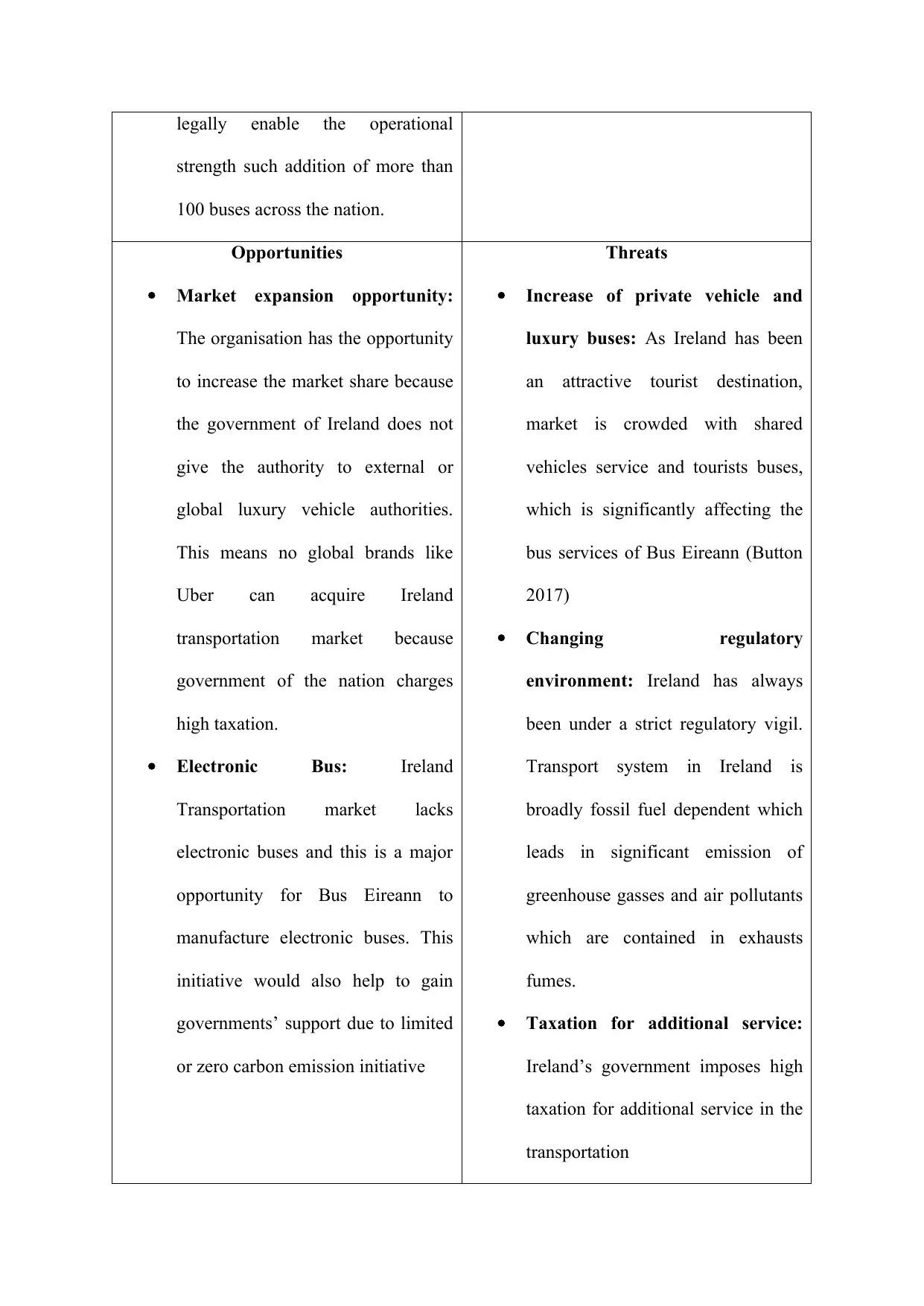
legally enable the operational
strength such addition of more than
100 buses across the nation.
Opportunities
Market expansion opportunity:
The organisation has the opportunity
to increase the market share because
the government of Ireland does not
give the authority to external or
global luxury vehicle authorities.
This means no global brands like
Uber can acquire Ireland
transportation market because
government of the nation charges
high taxation.
Electronic Bus: Ireland
Transportation market lacks
electronic buses and this is a major
opportunity for Bus Eireann to
manufacture electronic buses. This
initiative would also help to gain
governments’ support due to limited
or zero carbon emission initiative
Threats
Increase of private vehicle and
luxury buses: As Ireland has been
an attractive tourist destination,
market is crowded with shared
vehicles service and tourists buses,
which is significantly affecting the
bus services of Bus Eireann (Button
2017)
Changing regulatory
environment: Ireland has always
been under a strict regulatory vigil.
Transport system in Ireland is
broadly fossil fuel dependent which
leads in significant emission of
greenhouse gasses and air pollutants
which are contained in exhausts
fumes.
Taxation for additional service:
Ireland’s government imposes high
taxation for additional service in the
transportation
strength such addition of more than
100 buses across the nation.
Opportunities
Market expansion opportunity:
The organisation has the opportunity
to increase the market share because
the government of Ireland does not
give the authority to external or
global luxury vehicle authorities.
This means no global brands like
Uber can acquire Ireland
transportation market because
government of the nation charges
high taxation.
Electronic Bus: Ireland
Transportation market lacks
electronic buses and this is a major
opportunity for Bus Eireann to
manufacture electronic buses. This
initiative would also help to gain
governments’ support due to limited
or zero carbon emission initiative
Threats
Increase of private vehicle and
luxury buses: As Ireland has been
an attractive tourist destination,
market is crowded with shared
vehicles service and tourists buses,
which is significantly affecting the
bus services of Bus Eireann (Button
2017)
Changing regulatory
environment: Ireland has always
been under a strict regulatory vigil.
Transport system in Ireland is
broadly fossil fuel dependent which
leads in significant emission of
greenhouse gasses and air pollutants
which are contained in exhausts
fumes.
Taxation for additional service:
Ireland’s government imposes high
taxation for additional service in the
transportation
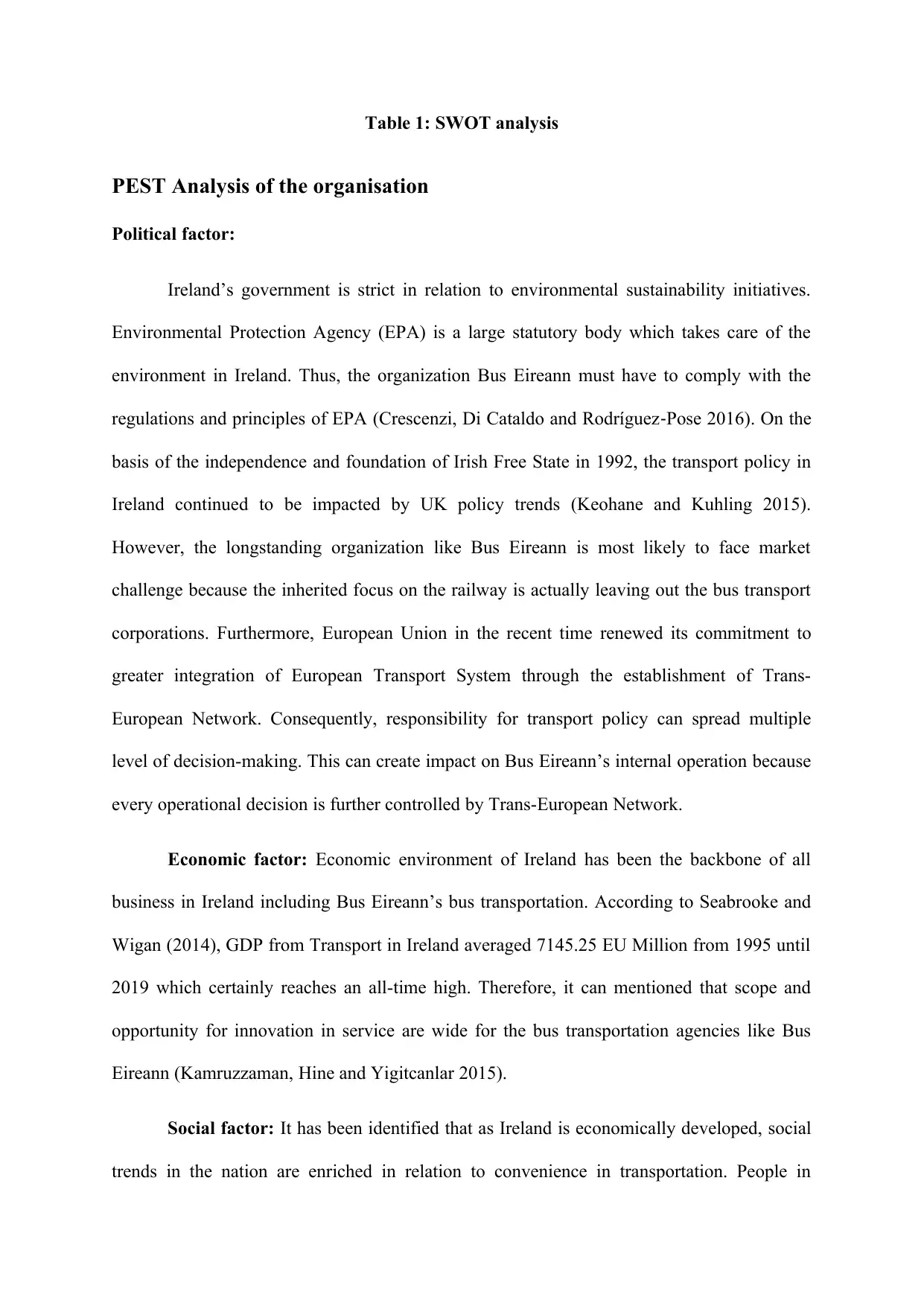
Table 1: SWOT analysis
PEST Analysis of the organisation
Political factor:
Ireland’s government is strict in relation to environmental sustainability initiatives.
Environmental Protection Agency (EPA) is a large statutory body which takes care of the
environment in Ireland. Thus, the organization Bus Eireann must have to comply with the
regulations and principles of EPA (Crescenzi, Di Cataldo and Rodríguez‐Pose 2016). On the
basis of the independence and foundation of Irish Free State in 1992, the transport policy in
Ireland continued to be impacted by UK policy trends (Keohane and Kuhling 2015).
However, the longstanding organization like Bus Eireann is most likely to face market
challenge because the inherited focus on the railway is actually leaving out the bus transport
corporations. Furthermore, European Union in the recent time renewed its commitment to
greater integration of European Transport System through the establishment of Trans-
European Network. Consequently, responsibility for transport policy can spread multiple
level of decision-making. This can create impact on Bus Eireann’s internal operation because
every operational decision is further controlled by Trans-European Network.
Economic factor: Economic environment of Ireland has been the backbone of all
business in Ireland including Bus Eireann’s bus transportation. According to Seabrooke and
Wigan (2014), GDP from Transport in Ireland averaged 7145.25 EU Million from 1995 until
2019 which certainly reaches an all-time high. Therefore, it can mentioned that scope and
opportunity for innovation in service are wide for the bus transportation agencies like Bus
Eireann (Kamruzzaman, Hine and Yigitcanlar 2015).
Social factor: It has been identified that as Ireland is economically developed, social
trends in the nation are enriched in relation to convenience in transportation. People in
PEST Analysis of the organisation
Political factor:
Ireland’s government is strict in relation to environmental sustainability initiatives.
Environmental Protection Agency (EPA) is a large statutory body which takes care of the
environment in Ireland. Thus, the organization Bus Eireann must have to comply with the
regulations and principles of EPA (Crescenzi, Di Cataldo and Rodríguez‐Pose 2016). On the
basis of the independence and foundation of Irish Free State in 1992, the transport policy in
Ireland continued to be impacted by UK policy trends (Keohane and Kuhling 2015).
However, the longstanding organization like Bus Eireann is most likely to face market
challenge because the inherited focus on the railway is actually leaving out the bus transport
corporations. Furthermore, European Union in the recent time renewed its commitment to
greater integration of European Transport System through the establishment of Trans-
European Network. Consequently, responsibility for transport policy can spread multiple
level of decision-making. This can create impact on Bus Eireann’s internal operation because
every operational decision is further controlled by Trans-European Network.
Economic factor: Economic environment of Ireland has been the backbone of all
business in Ireland including Bus Eireann’s bus transportation. According to Seabrooke and
Wigan (2014), GDP from Transport in Ireland averaged 7145.25 EU Million from 1995 until
2019 which certainly reaches an all-time high. Therefore, it can mentioned that scope and
opportunity for innovation in service are wide for the bus transportation agencies like Bus
Eireann (Kamruzzaman, Hine and Yigitcanlar 2015).
Social factor: It has been identified that as Ireland is economically developed, social
trends in the nation are enriched in relation to convenience in transportation. People in
⊘ This is a preview!⊘
Do you want full access?
Subscribe today to unlock all pages.
Trusted by 1+ million students worldwide
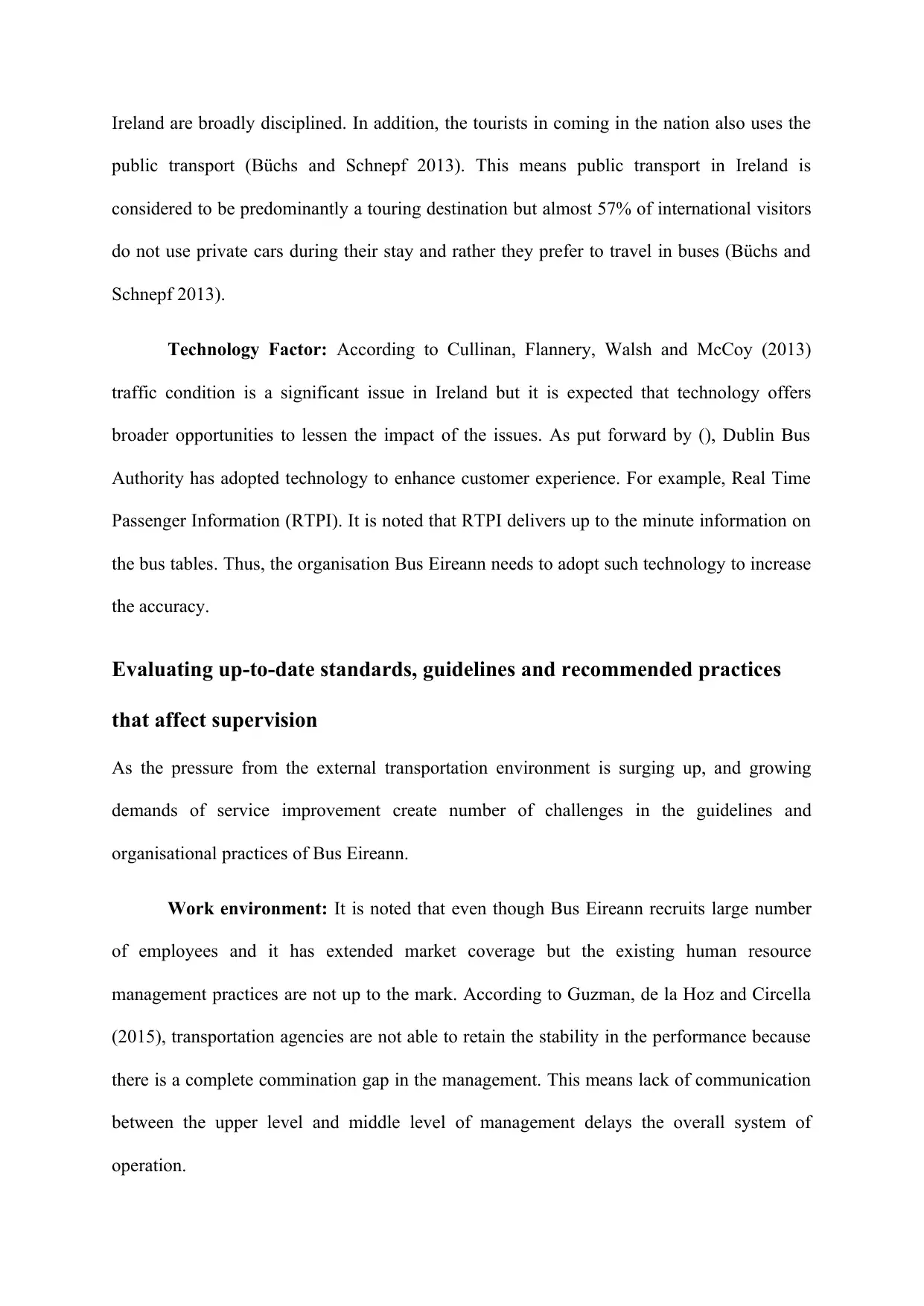
Ireland are broadly disciplined. In addition, the tourists in coming in the nation also uses the
public transport (Büchs and Schnepf 2013). This means public transport in Ireland is
considered to be predominantly a touring destination but almost 57% of international visitors
do not use private cars during their stay and rather they prefer to travel in buses (Büchs and
Schnepf 2013).
Technology Factor: According to Cullinan, Flannery, Walsh and McCoy (2013)
traffic condition is a significant issue in Ireland but it is expected that technology offers
broader opportunities to lessen the impact of the issues. As put forward by (), Dublin Bus
Authority has adopted technology to enhance customer experience. For example, Real Time
Passenger Information (RTPI). It is noted that RTPI delivers up to the minute information on
the bus tables. Thus, the organisation Bus Eireann needs to adopt such technology to increase
the accuracy.
Evaluating up-to-date standards, guidelines and recommended practices
that affect supervision
As the pressure from the external transportation environment is surging up, and growing
demands of service improvement create number of challenges in the guidelines and
organisational practices of Bus Eireann.
Work environment: It is noted that even though Bus Eireann recruits large number
of employees and it has extended market coverage but the existing human resource
management practices are not up to the mark. According to Guzman, de la Hoz and Circella
(2015), transportation agencies are not able to retain the stability in the performance because
there is a complete commination gap in the management. This means lack of communication
between the upper level and middle level of management delays the overall system of
operation.
public transport (Büchs and Schnepf 2013). This means public transport in Ireland is
considered to be predominantly a touring destination but almost 57% of international visitors
do not use private cars during their stay and rather they prefer to travel in buses (Büchs and
Schnepf 2013).
Technology Factor: According to Cullinan, Flannery, Walsh and McCoy (2013)
traffic condition is a significant issue in Ireland but it is expected that technology offers
broader opportunities to lessen the impact of the issues. As put forward by (), Dublin Bus
Authority has adopted technology to enhance customer experience. For example, Real Time
Passenger Information (RTPI). It is noted that RTPI delivers up to the minute information on
the bus tables. Thus, the organisation Bus Eireann needs to adopt such technology to increase
the accuracy.
Evaluating up-to-date standards, guidelines and recommended practices
that affect supervision
As the pressure from the external transportation environment is surging up, and growing
demands of service improvement create number of challenges in the guidelines and
organisational practices of Bus Eireann.
Work environment: It is noted that even though Bus Eireann recruits large number
of employees and it has extended market coverage but the existing human resource
management practices are not up to the mark. According to Guzman, de la Hoz and Circella
(2015), transportation agencies are not able to retain the stability in the performance because
there is a complete commination gap in the management. This means lack of communication
between the upper level and middle level of management delays the overall system of
operation.
Paraphrase This Document
Need a fresh take? Get an instant paraphrase of this document with our AI Paraphraser
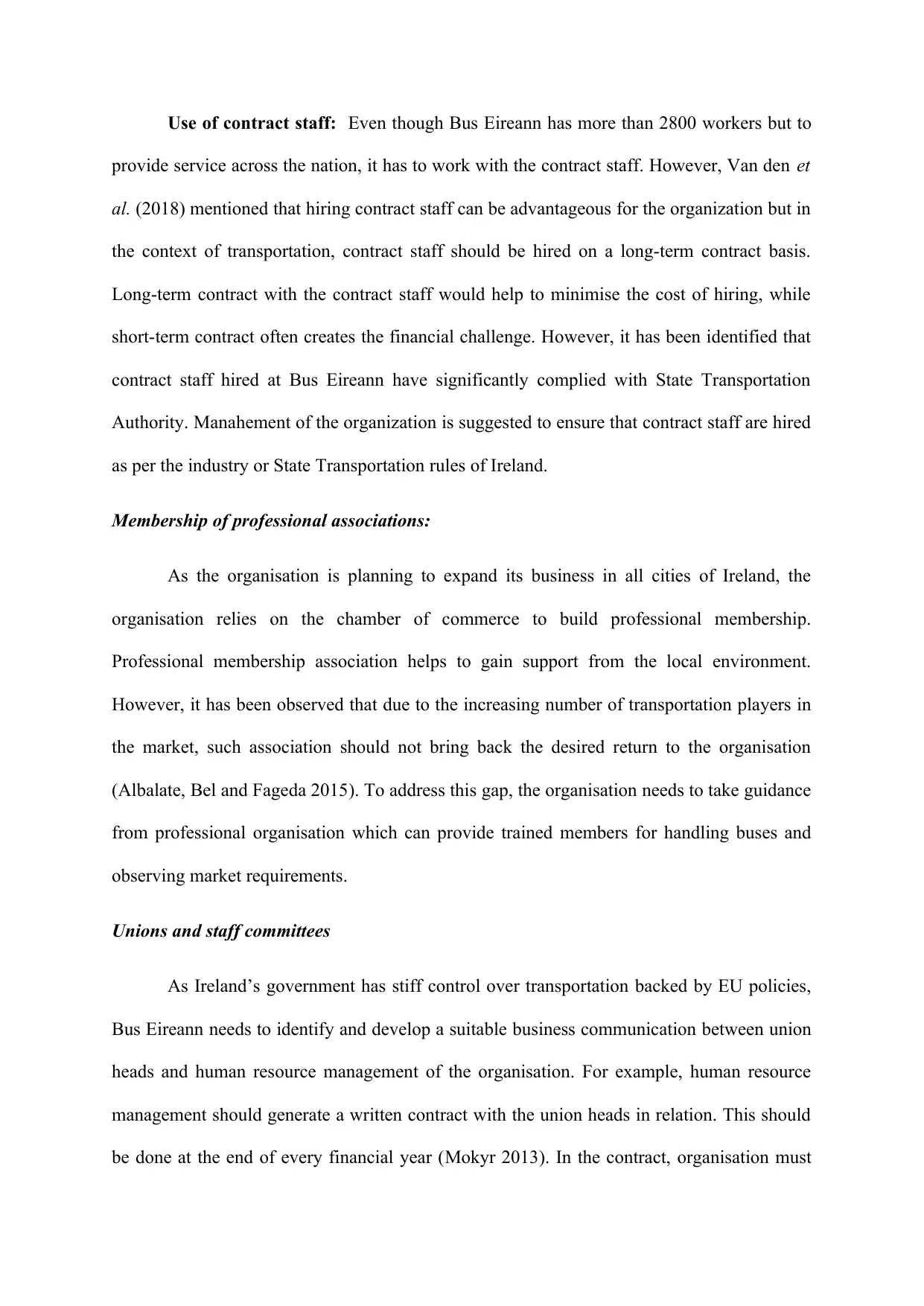
Use of contract staff: Even though Bus Eireann has more than 2800 workers but to
provide service across the nation, it has to work with the contract staff. However, Van den et
al. (2018) mentioned that hiring contract staff can be advantageous for the organization but in
the context of transportation, contract staff should be hired on a long-term contract basis.
Long-term contract with the contract staff would help to minimise the cost of hiring, while
short-term contract often creates the financial challenge. However, it has been identified that
contract staff hired at Bus Eireann have significantly complied with State Transportation
Authority. Manahement of the organization is suggested to ensure that contract staff are hired
as per the industry or State Transportation rules of Ireland.
Membership of professional associations:
As the organisation is planning to expand its business in all cities of Ireland, the
organisation relies on the chamber of commerce to build professional membership.
Professional membership association helps to gain support from the local environment.
However, it has been observed that due to the increasing number of transportation players in
the market, such association should not bring back the desired return to the organisation
(Albalate, Bel and Fageda 2015). To address this gap, the organisation needs to take guidance
from professional organisation which can provide trained members for handling buses and
observing market requirements.
Unions and staff committees
As Ireland’s government has stiff control over transportation backed by EU policies,
Bus Eireann needs to identify and develop a suitable business communication between union
heads and human resource management of the organisation. For example, human resource
management should generate a written contract with the union heads in relation. This should
be done at the end of every financial year (Mokyr 2013). In the contract, organisation must
provide service across the nation, it has to work with the contract staff. However, Van den et
al. (2018) mentioned that hiring contract staff can be advantageous for the organization but in
the context of transportation, contract staff should be hired on a long-term contract basis.
Long-term contract with the contract staff would help to minimise the cost of hiring, while
short-term contract often creates the financial challenge. However, it has been identified that
contract staff hired at Bus Eireann have significantly complied with State Transportation
Authority. Manahement of the organization is suggested to ensure that contract staff are hired
as per the industry or State Transportation rules of Ireland.
Membership of professional associations:
As the organisation is planning to expand its business in all cities of Ireland, the
organisation relies on the chamber of commerce to build professional membership.
Professional membership association helps to gain support from the local environment.
However, it has been observed that due to the increasing number of transportation players in
the market, such association should not bring back the desired return to the organisation
(Albalate, Bel and Fageda 2015). To address this gap, the organisation needs to take guidance
from professional organisation which can provide trained members for handling buses and
observing market requirements.
Unions and staff committees
As Ireland’s government has stiff control over transportation backed by EU policies,
Bus Eireann needs to identify and develop a suitable business communication between union
heads and human resource management of the organisation. For example, human resource
management should generate a written contract with the union heads in relation. This should
be done at the end of every financial year (Mokyr 2013). In the contract, organisation must
clearly state the number of employees it requires in the coming months at specified wages
structure; thereby, unions cannot create additional pressure on the organisation during the
period.
Describing staff recruitment process and the benefits of the chosen
approach and developing (Standard Operating Procedure) for Recruitment
Process
It can be mentioned that staff recruitment process should following a systematic
method which should takes place in steps.
Job Vacancy: This usually the first stage in which the organization needs to identify
the number of vacant positions for the ongoing jobs. For example, the organization may
require new accountants for payment related jobs (Louw 2013)
Job analysis: It is necessary for the organisation to have a defined job description in
place for every vacant and thereby, it becomes easy for the organization to know what it
wants from its employees (Stanujkic, Djordjevic and Karabasevi 2015).
Attracting candidates:
On the basis of job requirements, the organisation needs to attract the suitable
candidates. In order to do this, the organisation needs to take help of internal recruitment
procedure. There can be some good number of candidates fits the vacant position, while to
hire candidates from external environment the organisation needs to take help from external
sources like websites, national or local newspaper and recruitment agencies (Yaro 2014.)
Screening of candidates:
structure; thereby, unions cannot create additional pressure on the organisation during the
period.
Describing staff recruitment process and the benefits of the chosen
approach and developing (Standard Operating Procedure) for Recruitment
Process
It can be mentioned that staff recruitment process should following a systematic
method which should takes place in steps.
Job Vacancy: This usually the first stage in which the organization needs to identify
the number of vacant positions for the ongoing jobs. For example, the organization may
require new accountants for payment related jobs (Louw 2013)
Job analysis: It is necessary for the organisation to have a defined job description in
place for every vacant and thereby, it becomes easy for the organization to know what it
wants from its employees (Stanujkic, Djordjevic and Karabasevi 2015).
Attracting candidates:
On the basis of job requirements, the organisation needs to attract the suitable
candidates. In order to do this, the organisation needs to take help of internal recruitment
procedure. There can be some good number of candidates fits the vacant position, while to
hire candidates from external environment the organisation needs to take help from external
sources like websites, national or local newspaper and recruitment agencies (Yaro 2014.)
Screening of candidates:
⊘ This is a preview!⊘
Do you want full access?
Subscribe today to unlock all pages.
Trusted by 1+ million students worldwide
To choose the best candidates through screening method, organisation may conduct a
telephonic interview process. This would help to narrow down the field and minimise the
time required for recruitment method (Cullinan et al. 2013).
Interviewing the candidates: Once the selection is filtered through the screening
method, the organisation should take the interview. For example, the interviewer needs to
ensure that adequate notice is given about the date and time for the interview and ensure that
the chosen candidate knows about the venue, time and process.
Selecting and appointing the candidates: After taking the interview of the chosen
candidates after the screening method, selection method should be done on the basis of a
measurement criteria like good, poor, outstanding, etc. According to Louw (2013), besides
the measurement method, a short brief of each candidate needs to noted which would further
help to make the selection –such as on the basis of behavioural approach an intelligence.
Induction and training:
This is one of the most significant step in the recruitment method because once the
candidates are selected, on the basis of job requirements each candidate should be provided
with the induction programs which would clearly describe the organizational culture,
activities, rules, etc and training should only related to required job duties and responsibilities
(Seabrooke, and Wigan 2014).
Evaluating up to date staff training methods, ads, support materials and
the assessment of individuals during the training session
Training is the most effective and vital method that human resource management
needs to supervise. Employee performance is determined on the basis of given training
method. So, in order to provide the training to each individuals, there should be an integrated
telephonic interview process. This would help to narrow down the field and minimise the
time required for recruitment method (Cullinan et al. 2013).
Interviewing the candidates: Once the selection is filtered through the screening
method, the organisation should take the interview. For example, the interviewer needs to
ensure that adequate notice is given about the date and time for the interview and ensure that
the chosen candidate knows about the venue, time and process.
Selecting and appointing the candidates: After taking the interview of the chosen
candidates after the screening method, selection method should be done on the basis of a
measurement criteria like good, poor, outstanding, etc. According to Louw (2013), besides
the measurement method, a short brief of each candidate needs to noted which would further
help to make the selection –such as on the basis of behavioural approach an intelligence.
Induction and training:
This is one of the most significant step in the recruitment method because once the
candidates are selected, on the basis of job requirements each candidate should be provided
with the induction programs which would clearly describe the organizational culture,
activities, rules, etc and training should only related to required job duties and responsibilities
(Seabrooke, and Wigan 2014).
Evaluating up to date staff training methods, ads, support materials and
the assessment of individuals during the training session
Training is the most effective and vital method that human resource management
needs to supervise. Employee performance is determined on the basis of given training
method. So, in order to provide the training to each individuals, there should be an integrated
Paraphrase This Document
Need a fresh take? Get an instant paraphrase of this document with our AI Paraphraser
schedule for hired employees. This means at least two months of training schedule needs to
be made and so that there can be a session of repetition and tests during the period. First three
weeks of training period would be about time management, job performance criteria, job
duties on regular basis, timing, etc, In the following week, each candidate should be taught
about the communication required for the job. Communication training should take place for
two weeks. In the last two weeks of training, trainer needs to take a number of test and
sessions in which candidates have to demonstrate what they have learnt (Stanujkic,
Djordjevic and Karabasevic 2015). Eventually, there should be a feedback method in which
selected individuals would provide feedback against the training they received.
Summering the staff evaluation technique including the achievement of the
objectives, feedback, identification of personal development opportunities
Every comprehensive employee performance evaluation technique consists of
different evaluation technique to measure the performance.
Peer review method: The method would allow the organisation to take anonymous
feedback from colleagues, teammates, and peers based on specific elements of employee
performance (Ahmed et al. 2013)
Self-Evaluation: This method makes the process more efficient and this method
provides and offers a great chance for employees to play the most active role in the
evaluation process. This method would provide more effective link between the jobs and
evaluation technique and eventually develops a better communication between employees
and management (Wu et al. 2015).
be made and so that there can be a session of repetition and tests during the period. First three
weeks of training period would be about time management, job performance criteria, job
duties on regular basis, timing, etc, In the following week, each candidate should be taught
about the communication required for the job. Communication training should take place for
two weeks. In the last two weeks of training, trainer needs to take a number of test and
sessions in which candidates have to demonstrate what they have learnt (Stanujkic,
Djordjevic and Karabasevic 2015). Eventually, there should be a feedback method in which
selected individuals would provide feedback against the training they received.
Summering the staff evaluation technique including the achievement of the
objectives, feedback, identification of personal development opportunities
Every comprehensive employee performance evaluation technique consists of
different evaluation technique to measure the performance.
Peer review method: The method would allow the organisation to take anonymous
feedback from colleagues, teammates, and peers based on specific elements of employee
performance (Ahmed et al. 2013)
Self-Evaluation: This method makes the process more efficient and this method
provides and offers a great chance for employees to play the most active role in the
evaluation process. This method would provide more effective link between the jobs and
evaluation technique and eventually develops a better communication between employees
and management (Wu et al. 2015).
References
Ahmed, I., Sultana, I., Paul, S.K. and Azeem, A., 2013. Employee performance evaluation: a
fuzzy approach. International Journal of Productivity and Performance Management.
Albalate, D., Bel, G. and Fageda, X., 2015. Competition and cooperation between high-speed
rail and air transportation services in Europe. Journal of Transport Geography, 42, pp.166-
174.
Büchs, M. and Schnepf, S.V., 2013. Who emits most? Associations between socio-economic
factors and UK households' home energy, transport, indirect and total CO2
emissions. Ecological Economics, 90, pp.114-123.
buseireann.ie (2020). Bus Éireann - View Ireland Bus and Coach Timetables & Buy Tickets.
[online] Buseireann.ie. Available at: https://www.buseireann.ie/ [Accessed 17 Feb. 2020].
Button, K., 2017. Wings across Europe: towards an efficient European air transport system.
Routledge.
Crescenzi, R., Di Cataldo, M. and Rodríguez‐Pose, A., 2016. Government quality and the
economic returns of transport infrastructure investment in European regions. Journal of
Regional Science, 56(4), pp.555-582.
Cullinan, J., Flannery, D., Walsh, S. and McCoy, S., 2013. Distance effects, social class and
the decision to participate in higher education in Ireland. The Economic and Social
Review, 44(1, Spring), pp.19-51.
Dörry, S. and Decoville, A., 2016. Governance and transportation policy networks in the
cross-border metropolitan region of Luxembourg: A social network analysis. European
Urban and Regional Studies, 23(1), pp.69-85.
Ahmed, I., Sultana, I., Paul, S.K. and Azeem, A., 2013. Employee performance evaluation: a
fuzzy approach. International Journal of Productivity and Performance Management.
Albalate, D., Bel, G. and Fageda, X., 2015. Competition and cooperation between high-speed
rail and air transportation services in Europe. Journal of Transport Geography, 42, pp.166-
174.
Büchs, M. and Schnepf, S.V., 2013. Who emits most? Associations between socio-economic
factors and UK households' home energy, transport, indirect and total CO2
emissions. Ecological Economics, 90, pp.114-123.
buseireann.ie (2020). Bus Éireann - View Ireland Bus and Coach Timetables & Buy Tickets.
[online] Buseireann.ie. Available at: https://www.buseireann.ie/ [Accessed 17 Feb. 2020].
Button, K., 2017. Wings across Europe: towards an efficient European air transport system.
Routledge.
Crescenzi, R., Di Cataldo, M. and Rodríguez‐Pose, A., 2016. Government quality and the
economic returns of transport infrastructure investment in European regions. Journal of
Regional Science, 56(4), pp.555-582.
Cullinan, J., Flannery, D., Walsh, S. and McCoy, S., 2013. Distance effects, social class and
the decision to participate in higher education in Ireland. The Economic and Social
Review, 44(1, Spring), pp.19-51.
Dörry, S. and Decoville, A., 2016. Governance and transportation policy networks in the
cross-border metropolitan region of Luxembourg: A social network analysis. European
Urban and Regional Studies, 23(1), pp.69-85.
⊘ This is a preview!⊘
Do you want full access?
Subscribe today to unlock all pages.
Trusted by 1+ million students worldwide

1 out of 14


Related Documents


Your All-in-One AI-Powered Toolkit for Academic Success.
+13062052269
info@desklib.com
Available 24*7 on WhatsApp / Email
![[object Object]](/_next/static/media/star-bottom.7253800d.svg)
Unlock your academic potential
Copyright © 2020–2026 A2Z Services. All Rights Reserved. Developed and managed by ZUCOL.