MKT202: Brand Image and Supplementary Services: Grace Hotel Study
VerifiedAdded on  2023/06/04
|8
|1663
|148
Report
AI Summary
This marketing research report examines the influence of supplementary services on the brand image of Grace Hotel in Sydney. The research employs a deductive approach, utilizing existing theories to analyze the relationship between supplementary services and brand perception. The methodology includes a descriptive research design, incorporating both primary data collected through surveys from 150 guests using a simple random sampling technique and secondary data from various sources. The study focuses on identifying the importance of supplementary services, highlighting strategies to improve brand image, and offering recommendations to enhance services and brand perception. Data analysis involves the use of SPSS 2.0 software for correlation and regression analysis, with reliability assessed using Cronbach's alpha. The research anticipates that improved supplementary services will enhance guest satisfaction and elevate the hotel's brand image, particularly among foreign guests who value these services. The report concludes by emphasizing the significance of personalized services and the expectations of guests for both core and supplementary services from hotel staff.
Running head: MARKETING RESEARCH ESSENTIALS
MKT202: Marketing Research Essentials
Topic: Impact of supplementary services on the brand image in the hospitality industry: Study
based on Grace Hotel
Student’s name:
Name of the university:
Author’s note:
MKT202: Marketing Research Essentials
Topic: Impact of supplementary services on the brand image in the hospitality industry: Study
based on Grace Hotel
Student’s name:
Name of the university:
Author’s note:
Paraphrase This Document
Need a fresh take? Get an instant paraphrase of this document with our AI Paraphraser

1MARKETING RESEARCH ESSENTIALS
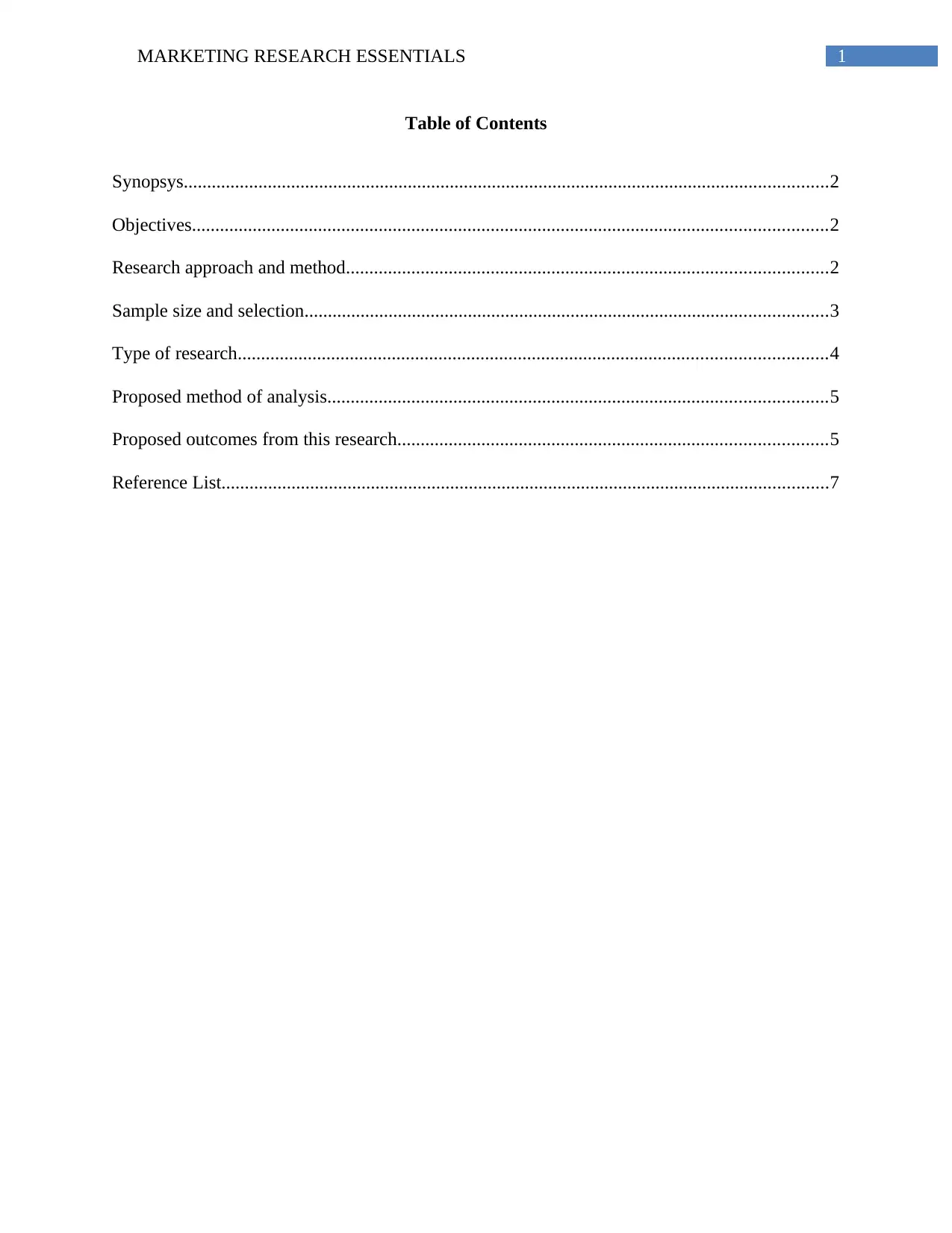
Table of Contents
Synopsys..........................................................................................................................................2
Objectives........................................................................................................................................2
Research approach and method.......................................................................................................2
Sample size and selection................................................................................................................3
Type of research..............................................................................................................................4
Proposed method of analysis...........................................................................................................5
Proposed outcomes from this research............................................................................................5
Reference List..................................................................................................................................7
Table of Contents
Synopsys..........................................................................................................................................2
Objectives........................................................................................................................................2
Research approach and method.......................................................................................................2
Sample size and selection................................................................................................................3
Type of research..............................................................................................................................4
Proposed method of analysis...........................................................................................................5
Proposed outcomes from this research............................................................................................5
Reference List..................................................................................................................................7

2MARKETING RESEARCH ESSENTIALS
Synopsys
In hospitality industry, supplementary services facilitate the use of core services and
these are the support services to be used as bundled with core services in order to increase the
brand image. In supplementary services, the hospitality industry provides the information, order
taking, billing and payment as the facilitating services and enhancing services of the hospitality
industry are the consultation, hospitality and safekeeping (Byrd et al., 2016). Grace Hotel in
Sydney fails to provide the supplementary services due to unskilled employees and the brand
image of the organisation is degrading.
Objectives
The objectives of the research are:
ï‚· To find out the importance of supplementary services in hospitality industry
ï‚· To highlight the strategies taken by the hospitality organisations to improve brand image
ï‚· To explore the impact of supplementary services on brand image of Grace Hotel
ï‚· To provide some possible recommendations to improve the supplementary services and
brand image of Grace Hotel
Research approach and method
The research approach is a procedure which consists of the steps of assumptions to the
process of data collection, interpretation and analysis. The research approach is of mainly two
types; deductive approach and inductive approach. In this research, the researcher will select the
deductive approach as it develops the hypothesis based on the existing theories. The topic of the
research is to analyse the impact of supplementary services on the brand image; therefore, there
Synopsys
In hospitality industry, supplementary services facilitate the use of core services and
these are the support services to be used as bundled with core services in order to increase the
brand image. In supplementary services, the hospitality industry provides the information, order
taking, billing and payment as the facilitating services and enhancing services of the hospitality
industry are the consultation, hospitality and safekeeping (Byrd et al., 2016). Grace Hotel in
Sydney fails to provide the supplementary services due to unskilled employees and the brand
image of the organisation is degrading.
Objectives
The objectives of the research are:
ï‚· To find out the importance of supplementary services in hospitality industry
ï‚· To highlight the strategies taken by the hospitality organisations to improve brand image
ï‚· To explore the impact of supplementary services on brand image of Grace Hotel
ï‚· To provide some possible recommendations to improve the supplementary services and
brand image of Grace Hotel
Research approach and method
The research approach is a procedure which consists of the steps of assumptions to the
process of data collection, interpretation and analysis. The research approach is of mainly two
types; deductive approach and inductive approach. In this research, the researcher will select the
deductive approach as it develops the hypothesis based on the existing theories. The topic of the
research is to analyse the impact of supplementary services on the brand image; therefore, there
⊘ This is a preview!⊘
Do you want full access?
Subscribe today to unlock all pages.

Trusted by 1+ million students worldwide

3MARKETING RESEARCH ESSENTIALS
is a huge amount of data already present to use for the theories purposes. In addition, the
deductive approach discusses the subject matter from particular to the general. The deductive
approach will further help the researcher to explain the causal relationship between the variables
and concept. The deductive approach helps to measure the concept in quantitative data analysis
process (Mackey and Gass 2015).
In this research, the researcher will use the research design for the systematic data
collection purpose. The research method is a systematic strategy which is used to implement the
plan of the research. The research will use the descriptive research method to closely review the
sample of the research. As opined by Scheurich (2014), descriptive research design is a scientific
method that involves in describing and observing the behaviour of the population without
impacting. Descriptive research method will be useful to understand the influence of
supplementary services in the brand image of the organisation. In this research, the observational
method will be selected to record the data of the participants. The researcher will collect both
primary and secondary data to conduct the research. The researcher will collect the primary data
by conducting the survey. The researcher will prepare 12 close-ended questions to conduct the
survey using the survey form (hard copy). The researcher will use some of the questions using a
Likert scale giving options to the respondents. The questionnaire will be segregated into two
parts; demographic and subjective. Additionally, secondary data will be collected from books,
journals, magazines, online articles, websites and government reports.
Sample size and selection
The researcher will collect the survey data from the guests of Grace Hotel in Sydney. The
sample population of the study will be guests at the Grace Hotel. On average, during the peak
is a huge amount of data already present to use for the theories purposes. In addition, the
deductive approach discusses the subject matter from particular to the general. The deductive
approach will further help the researcher to explain the causal relationship between the variables
and concept. The deductive approach helps to measure the concept in quantitative data analysis
process (Mackey and Gass 2015).
In this research, the researcher will use the research design for the systematic data
collection purpose. The research method is a systematic strategy which is used to implement the
plan of the research. The research will use the descriptive research method to closely review the
sample of the research. As opined by Scheurich (2014), descriptive research design is a scientific
method that involves in describing and observing the behaviour of the population without
impacting. Descriptive research method will be useful to understand the influence of
supplementary services in the brand image of the organisation. In this research, the observational
method will be selected to record the data of the participants. The researcher will collect both
primary and secondary data to conduct the research. The researcher will collect the primary data
by conducting the survey. The researcher will prepare 12 close-ended questions to conduct the
survey using the survey form (hard copy). The researcher will use some of the questions using a
Likert scale giving options to the respondents. The questionnaire will be segregated into two
parts; demographic and subjective. Additionally, secondary data will be collected from books,
journals, magazines, online articles, websites and government reports.
Sample size and selection
The researcher will collect the survey data from the guests of Grace Hotel in Sydney. The
sample population of the study will be guests at the Grace Hotel. On average, during the peak
Paraphrase This Document
Need a fresh take? Get an instant paraphrase of this document with our AI Paraphraser

4MARKETING RESEARCH ESSENTIALS
season, more than 400 guests accommodate in Grace Hotel. The researcher is aiming to collect
the data from the guests using Simple Random sampling technique. In simple random sampling,
every individual in the population has an equal chance of being selected in the sample. Selection
of the individual in the sample is depended on probability (Clemence et al. 2014). The sample
size of the research will be kept as 150 as the researcher is expecting to collect data from at least
150 guests of Grace Hotel in Sydney. The researcher will use the hard copy of the survey form as
a sample frame. The researcher will ask the respondents to provide an answer to each of the
questions.
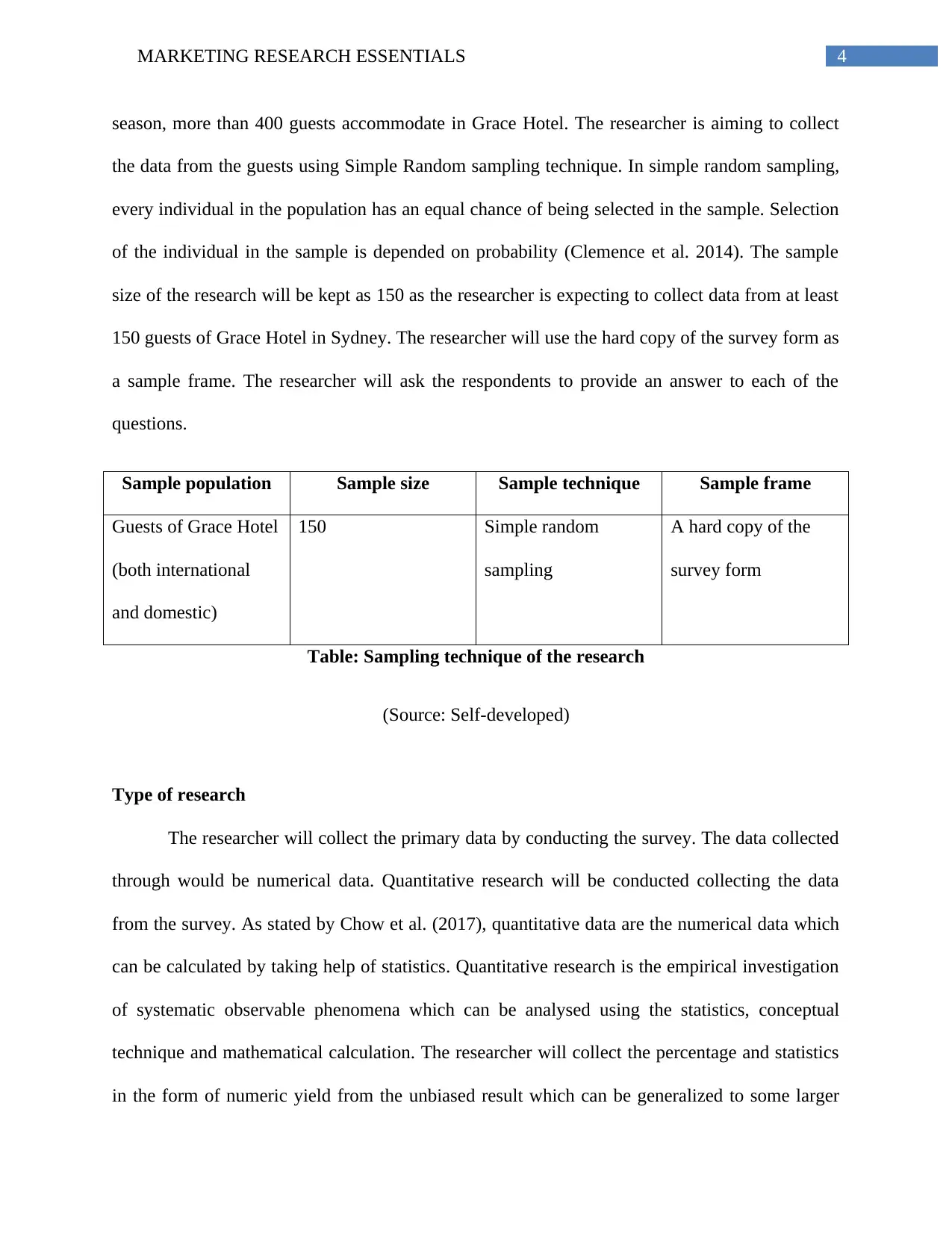
Sample population Sample size Sample technique Sample frame
Guests of Grace Hotel
(both international
and domestic)
150 Simple random
sampling
A hard copy of the
survey form
Table: Sampling technique of the research
(Source: Self-developed)
Type of research
The researcher will collect the primary data by conducting the survey. The data collected
through would be numerical data. Quantitative research will be conducted collecting the data
from the survey. As stated by Chow et al. (2017), quantitative data are the numerical data which
can be calculated by taking help of statistics. Quantitative research is the empirical investigation
of systematic observable phenomena which can be analysed using the statistics, conceptual
technique and mathematical calculation. The researcher will collect the percentage and statistics
in the form of numeric yield from the unbiased result which can be generalized to some larger
season, more than 400 guests accommodate in Grace Hotel. The researcher is aiming to collect
the data from the guests using Simple Random sampling technique. In simple random sampling,
every individual in the population has an equal chance of being selected in the sample. Selection
of the individual in the sample is depended on probability (Clemence et al. 2014). The sample
size of the research will be kept as 150 as the researcher is expecting to collect data from at least
150 guests of Grace Hotel in Sydney. The researcher will use the hard copy of the survey form as
a sample frame. The researcher will ask the respondents to provide an answer to each of the
questions.
Sample population Sample size Sample technique Sample frame
Guests of Grace Hotel
(both international
and domestic)
150 Simple random
sampling
A hard copy of the
survey form
Table: Sampling technique of the research
(Source: Self-developed)
Type of research
The researcher will collect the primary data by conducting the survey. The data collected
through would be numerical data. Quantitative research will be conducted collecting the data
from the survey. As stated by Chow et al. (2017), quantitative data are the numerical data which
can be calculated by taking help of statistics. Quantitative research is the empirical investigation
of systematic observable phenomena which can be analysed using the statistics, conceptual
technique and mathematical calculation. The researcher will collect the percentage and statistics
in the form of numeric yield from the unbiased result which can be generalized to some larger

5MARKETING RESEARCH ESSENTIALS
population. The researcher will put the survey result data into the database and this data would
explore through text, visual-based data and narrative. In this research, the data will be gathered
using the structured research instruments. The result of the research will be based on the sample
size and research study will also usually be repeated and replicated in high reliability.
Proposed method of analysis
The researcher will collect the data from the survey and the data will be put into excel
sheet. The researcher will be using data from the excel sheet to segregate the data based on
variables. The researcher will use SPSS 2.0 software to do the correlation and regression
analysis. Data correlation and regression helps the researcher to segregate the data into several
factors of variables. SPSS software is a platform which offers advanced statistical analysis with
vast machine learning algorithm, open-source extensibility and text analysis. As opined by
Taylor et al. (2015), correlation and regression are two analysis which is based on the
multivariate distribution. The reliability of the data will be based on the Cronbach's alpha which
measures the internal consistency and it is how the closely related set of items can be grouped.
Cronbach's alpha is considered as the measurement of scale in reliability.
Proposed outcomes from this research
Grace Hotel in Sydney is a five-hotel and major guests in Grace Hotel are foreigners. The
foreigners would respond to the survey conducted by the researcher. The foreigners like to have
the supplementary services and supplementary services either facilitate the use of core services
or these services can enhance the core services as well. Facilitating services in the hotel are the
order taking, billing, payment and information, whereas, enhancing services in hotels are
associated with the consultation, hospitality, safekeeping and exceptions. Along with these
population. The researcher will put the survey result data into the database and this data would
explore through text, visual-based data and narrative. In this research, the data will be gathered
using the structured research instruments. The result of the research will be based on the sample
size and research study will also usually be repeated and replicated in high reliability.
Proposed method of analysis
The researcher will collect the data from the survey and the data will be put into excel
sheet. The researcher will be using data from the excel sheet to segregate the data based on
variables. The researcher will use SPSS 2.0 software to do the correlation and regression
analysis. Data correlation and regression helps the researcher to segregate the data into several
factors of variables. SPSS software is a platform which offers advanced statistical analysis with
vast machine learning algorithm, open-source extensibility and text analysis. As opined by
Taylor et al. (2015), correlation and regression are two analysis which is based on the
multivariate distribution. The reliability of the data will be based on the Cronbach's alpha which
measures the internal consistency and it is how the closely related set of items can be grouped.
Cronbach's alpha is considered as the measurement of scale in reliability.
Proposed outcomes from this research
Grace Hotel in Sydney is a five-hotel and major guests in Grace Hotel are foreigners. The
foreigners would respond to the survey conducted by the researcher. The foreigners like to have
the supplementary services and supplementary services either facilitate the use of core services
or these services can enhance the core services as well. Facilitating services in the hotel are the
order taking, billing, payment and information, whereas, enhancing services in hotels are
associated with the consultation, hospitality, safekeeping and exceptions. Along with these
⊘ This is a preview!⊘
Do you want full access?
Subscribe today to unlock all pages.

Trusted by 1+ million students worldwide

6MARKETING RESEARCH ESSENTIALS
services, the guests in the hotel like to have the personalised services. If the services in the hotel
can satisfy the guests, it would definitely improve the brand image of the hotel. The guests
expect that supplementary services for the guests who stay in the hotel would be free and these
would be included the price of the room. Supplementary services please the guests and the guests
give a higher rating to the hotel as a result of better supplementary services. The guests of Grace
Hotel might be having both core and supplementary services from the staffs and the guests
expect better services from both front stage and backstage staffs.
services, the guests in the hotel like to have the personalised services. If the services in the hotel
can satisfy the guests, it would definitely improve the brand image of the hotel. The guests
expect that supplementary services for the guests who stay in the hotel would be free and these
would be included the price of the room. Supplementary services please the guests and the guests
give a higher rating to the hotel as a result of better supplementary services. The guests of Grace
Hotel might be having both core and supplementary services from the staffs and the guests
expect better services from both front stage and backstage staffs.
Paraphrase This Document
Need a fresh take? Get an instant paraphrase of this document with our AI Paraphraser

7MARKETING RESEARCH ESSENTIALS
Reference List
Byrd, E. T., Canziani, B., Hsieh, Y. C. J., Debbage, K., & Sonmez, S. (2016). Wine tourism:
Motivating visitors through core and supplementary services. Tourism Management, 52, 19-29.
Chow, S.C., Shao, J., Wang, H. and Lokhnygina, Y., 2017. Sample size calculations in clinical
research. Chapman and Hall/CRC.
Clemence, A., Doise, W. and Lorenzi-Cioldi, F., 2014. The quantitative analysis of social
representations. Abingdon: Routledge.
Mackey, A. and Gass, S.M., 2015. Second language research: Methodology and design.
Abingdon: Routledge.
Palinkas, L.A., Horwitz, S.M., Green, C.A., Wisdom, J.P., Duan, N. and Hoagwood, K., 2015.
Purposeful sampling for qualitative data collection and analysis in mixed method implementation
research. Administration and Policy in Mental Health and Mental Health Services
Research, 42(5), pp.533-544.
Scheurich, J., 2014. A research method in the postmodern. Abingdon: Routledge.
Taylor, S.J., Bogdan, R. and DeVault, M., 2015. Introduction to qualitative research methods: A
guidebook and resource. New Jersey: John Wiley & Sons.
Reference List
Byrd, E. T., Canziani, B., Hsieh, Y. C. J., Debbage, K., & Sonmez, S. (2016). Wine tourism:
Motivating visitors through core and supplementary services. Tourism Management, 52, 19-29.
Chow, S.C., Shao, J., Wang, H. and Lokhnygina, Y., 2017. Sample size calculations in clinical
research. Chapman and Hall/CRC.
Clemence, A., Doise, W. and Lorenzi-Cioldi, F., 2014. The quantitative analysis of social
representations. Abingdon: Routledge.
Mackey, A. and Gass, S.M., 2015. Second language research: Methodology and design.
Abingdon: Routledge.
Palinkas, L.A., Horwitz, S.M., Green, C.A., Wisdom, J.P., Duan, N. and Hoagwood, K., 2015.
Purposeful sampling for qualitative data collection and analysis in mixed method implementation
research. Administration and Policy in Mental Health and Mental Health Services
Research, 42(5), pp.533-544.
Scheurich, J., 2014. A research method in the postmodern. Abingdon: Routledge.
Taylor, S.J., Bogdan, R. and DeVault, M., 2015. Introduction to qualitative research methods: A
guidebook and resource. New Jersey: John Wiley & Sons.
1 out of 8
Related Documents
Your All-in-One AI-Powered Toolkit for Academic Success.
 +13062052269
info@desklib.com
Available 24*7 on WhatsApp / Email
Unlock your academic potential
Copyright © 2020–2025 A2Z Services. All Rights Reserved. Developed and managed by ZUCOL.