Aligning Supply Chain with Organizational Goals: A Strategic Plan
VerifiedAdded on 2023/06/11
|31
|8114
|360
Report
AI Summary
This report provides an in-depth analysis of supply chain management, focusing on aligning supply chain strategies with an organization's long-term objectives. It explores the roles of supply chain management, offering a ten-point plan to ensure its relevance. The importance of negotiation strategies in the procurement cycle is discussed, emphasizing value attainment over price. The report also highlights the concept of Best Alternative to a Negotiated Agreement (BATNA), providing an example of its application within an organizational context, specifically in insurance policy renewal, to illustrate how understanding and comparing alternatives can lead to better decision-making.
SUPPLY CHAIN MANAGEMENT
[Author Name(s), First M. Last, Omit Titles and Degrees]
[Institutional Affiliation(s)]
[Author Name(s), First M. Last, Omit Titles and Degrees]
[Institutional Affiliation(s)]

Paraphrase This Document
Need a fresh take? Get an instant paraphrase of this document with our AI Paraphraser
Introduction
Dell is a for-profit organization, which is mainly an American multinational computer
technology commonly based in the Round Rock, Texas, in the United States of America. The
organization deals in the development, sale, repairs as well as supports to computers and
computer related products and services Ashby et al. (2012). The organizations deal in the sale of
personal computers, network switches, servers, software, devices for use in data storage, printers,
cameras, computer peripherals, MP3 players and electronics among other related products that
are built by other manufacturers. The company is vastly known for its innovation and creativity
when it comes to supply chain management and electronic commerce; specifically its model of
direct sales as well as it’s built to order or configure to order technique or approach in
manufacturing.
Through this approach, the company is able to deliver individual personal computers to the
specifications of the customers. For most of its existence, the organization has remained a pure
hardware vendor, a situation that changed in 2009 upon the acquisition Perot Systems that saw
the organization become part of the market subscribers for IT services. Since then, the
organization has managed to make more acquisitions in terms of storage and networking system
with an aim of increasing its portfolio from offering just computers to delivering solutions for
computers to each of the enterprise customers Othman et al. (2015).
Aim
The aim of this task is to establish a plan that an organization may adopt in ensuring that its
objectives, both short term and long term remain within the confines of a supply chain function.
Dell is a for-profit organization, which is mainly an American multinational computer
technology commonly based in the Round Rock, Texas, in the United States of America. The
organization deals in the development, sale, repairs as well as supports to computers and
computer related products and services Ashby et al. (2012). The organizations deal in the sale of
personal computers, network switches, servers, software, devices for use in data storage, printers,
cameras, computer peripherals, MP3 players and electronics among other related products that
are built by other manufacturers. The company is vastly known for its innovation and creativity
when it comes to supply chain management and electronic commerce; specifically its model of
direct sales as well as it’s built to order or configure to order technique or approach in
manufacturing.
Through this approach, the company is able to deliver individual personal computers to the
specifications of the customers. For most of its existence, the organization has remained a pure
hardware vendor, a situation that changed in 2009 upon the acquisition Perot Systems that saw
the organization become part of the market subscribers for IT services. Since then, the
organization has managed to make more acquisitions in terms of storage and networking system
with an aim of increasing its portfolio from offering just computers to delivering solutions for
computers to each of the enterprise customers Othman et al. (2015).
Aim
The aim of this task is to establish a plan that an organization may adopt in ensuring that its
objectives, both short term and long term remain within the confines of a supply chain function.
Objectives
The objectives include:
To explore the roles of supply chain management
Create a plan that ensures the supply chain functions are in line with the objectives of an
organization
Explore on the need of negotiation strategies in the procurement cycle
Discuss BATNA in negotiation Green Jr et al. (2012)
Establish where BATNA is applicable in the negotiation activities of an organization
Literature Review
Supply Chain Management
Supply Chain Management refers to the active control of the activities of supply chain in order to
maximize the value of the customers as well as attains sustainable competitive advantage. It is an
illustration of conscious efforts of the firms of supply chain to come up with and run supply
chains in ways that are perceived to be as most effective and efficient as possible. Supply chain
activities encompass everything ranging from development of the product, production, sourcing,
and logistics besides the information systems that are required in the coordination of such
activities Rönnbäck (2012).
There are two main ideas on which the concept of supply chain management is based on:
The first concept is that every product that gests to an end user is representative of the
cumulative efforts of numerous organisations. These numerous organisations are known as the
supply chain.
The objectives include:
To explore the roles of supply chain management
Create a plan that ensures the supply chain functions are in line with the objectives of an
organization
Explore on the need of negotiation strategies in the procurement cycle
Discuss BATNA in negotiation Green Jr et al. (2012)
Establish where BATNA is applicable in the negotiation activities of an organization
Literature Review
Supply Chain Management
Supply Chain Management refers to the active control of the activities of supply chain in order to
maximize the value of the customers as well as attains sustainable competitive advantage. It is an
illustration of conscious efforts of the firms of supply chain to come up with and run supply
chains in ways that are perceived to be as most effective and efficient as possible. Supply chain
activities encompass everything ranging from development of the product, production, sourcing,
and logistics besides the information systems that are required in the coordination of such
activities Rönnbäck (2012).
There are two main ideas on which the concept of supply chain management is based on:
The first concept is that every product that gests to an end user is representative of the
cumulative efforts of numerous organisations. These numerous organisations are known as the
supply chain.
⊘ This is a preview!⊘
Do you want full access?
Subscribe today to unlock all pages.

Trusted by 1+ million students worldwide
The second idea is that is as much as supply chains have for a long time been in existence, a
significant number of the organisations have only been focusing on what was going on within
their four walls. Very few businesses comprehends, much less managed the whole chain of
activities that finally delivered the products to the final customer Stadtler. (2015). The result was
a disjointed outcome that in most cases ineffective of the supply chains.
The organizations involved in the supply chain are joined together through informational and
physical flows. Physical flows encompass change, movements and storage of materials and
goods and tend to be the most visible supply chain pieces. Informational flows include such
services that permit the different supply Chain partners to cooperate and coordinate their long
term plans as well as engage in every day flow of goods and materials up and down the supply
chain Ross (2013).
Elements of Supply Chain Management
There is a sequence of processes that need to be completed in order to generate and distributes a
commodity when it comes to supply chain. The commodity may be either goods or services but
whichever way, there is need for a precise and clear manufacturing path for the commodity that
is generated Brandenburg et al. (2014). The achievement of this goal significantly relies on a
strong supply chain and hence it’s effective management calls for the production of the best
results by the supply chain since that is of utmost importance to the health of a business. There
are four main elements of supply chain management: integration, operation, purchasing and
distribution.
Integration is perceived as the brainwork and heart of supply chain and an oversight of the
integration os supply chain refers to coordinating communications between the other parts of the
significant number of the organisations have only been focusing on what was going on within
their four walls. Very few businesses comprehends, much less managed the whole chain of
activities that finally delivered the products to the final customer Stadtler. (2015). The result was
a disjointed outcome that in most cases ineffective of the supply chains.
The organizations involved in the supply chain are joined together through informational and
physical flows. Physical flows encompass change, movements and storage of materials and
goods and tend to be the most visible supply chain pieces. Informational flows include such
services that permit the different supply Chain partners to cooperate and coordinate their long
term plans as well as engage in every day flow of goods and materials up and down the supply
chain Ross (2013).
Elements of Supply Chain Management
There is a sequence of processes that need to be completed in order to generate and distributes a
commodity when it comes to supply chain. The commodity may be either goods or services but
whichever way, there is need for a precise and clear manufacturing path for the commodity that
is generated Brandenburg et al. (2014). The achievement of this goal significantly relies on a
strong supply chain and hence it’s effective management calls for the production of the best
results by the supply chain since that is of utmost importance to the health of a business. There
are four main elements of supply chain management: integration, operation, purchasing and
distribution.
Integration is perceived as the brainwork and heart of supply chain and an oversight of the
integration os supply chain refers to coordinating communications between the other parts of the
Paraphrase This Document
Need a fresh take? Get an instant paraphrase of this document with our AI Paraphraser
supply chain to come up with timely and effective outcomes. In most cases, this means an
exploration of the new software and the means of technology that promote communication
among the various departments. Those tasked with the responsibility of ensuring integration are
supposed to ensure that things happen timely and within the constraints of the budgeting without
having the quality compromised.
Operation offers a link in the supply chain that ensures coordination of the details of the
everyday operations of the organization. It aids in the planning of the output of the organization
to ensure that all is running well and there is maximization of the advantages. Operations mainly
keep an eye on the inventory of the organization and utilize business forecasting in the prediction
of the supplies that will be required when and by whom as well as establishing ways that foretell
the effectiveness of the products, the approaches to marketing and the results of the end user. In
overall, the production of the organisation is overseen by operations.
Purchasing is the department that is tasked with the sourcing of materials, products and other
goods that are required for the production of the products of the organization. Purchasing
establishes a relationship with the supplier as well as aiding in the identification of the quantities
and qualities of the required items. Keeping an eye on the budget of the things that are to be
purchased is an integral aspect of purchasing that enhances costs effectiveness of the company
and also fostering adherence to high quality standards.
Distribution involves the processes through which the commodities get to the end user. The
distribution department is responsible for the logistics of communication among the various
clients, wholesalers and retailers in the supply chain command. These groups must ensure they
keep an eye on the shipment to establish not only that which os required in house to produce the
exploration of the new software and the means of technology that promote communication
among the various departments. Those tasked with the responsibility of ensuring integration are
supposed to ensure that things happen timely and within the constraints of the budgeting without
having the quality compromised.
Operation offers a link in the supply chain that ensures coordination of the details of the
everyday operations of the organization. It aids in the planning of the output of the organization
to ensure that all is running well and there is maximization of the advantages. Operations mainly
keep an eye on the inventory of the organization and utilize business forecasting in the prediction
of the supplies that will be required when and by whom as well as establishing ways that foretell
the effectiveness of the products, the approaches to marketing and the results of the end user. In
overall, the production of the organisation is overseen by operations.
Purchasing is the department that is tasked with the sourcing of materials, products and other
goods that are required for the production of the products of the organization. Purchasing
establishes a relationship with the supplier as well as aiding in the identification of the quantities
and qualities of the required items. Keeping an eye on the budget of the things that are to be
purchased is an integral aspect of purchasing that enhances costs effectiveness of the company
and also fostering adherence to high quality standards.
Distribution involves the processes through which the commodities get to the end user. The
distribution department is responsible for the logistics of communication among the various
clients, wholesalers and retailers in the supply chain command. These groups must ensure they
keep an eye on the shipment to establish not only that which os required in house to produce the
desired products but also that final products get to the end user in the desired shape and on time.
The discussed elements of supply chain management must work in cohesion for the benefit of
everyone. The rewards are reaped by both the end users and the employees and a properly oiled
supply chain is integral aspect of a harmoniously working environment since by having everyone
do what is expected of them to do, stress is minimized for every individual.
The importance of negotiation strategies in the procurement cycle
Commercial negotiations refers to the process of coming together of parties to comes to a
consumed over a situation in which there exist conflict of in interest between them. The aim of
commercial negotiation is to establish a jointly acceptable agreement. There are negotiation
skills that are expected of procurements professionals in order to meet the set objectives of the
negotiation process. Below are some of the areas in which negotiation skills I supply chain
management and procurement are of utmost importance:
Negotiation is required in situation in which the terms of sales are inclusive of different
clauses or in cases where the buyer feels or suspects that the prices that have been quoted
for a commodity are unreasonably high
Negotiations may be needed as a product of procurement role in creating a challenge to
the user identified requirement. This is significance since through negotiation; it is
possible to attain the requirements of commercially sound and added value requirements
by the procurement professionals.
Negotiations are also applicable in open specifications or specification that are less
prescriptive to reach to an agreement with regard to better benefits, value for money as
well as total package.
The discussed elements of supply chain management must work in cohesion for the benefit of
everyone. The rewards are reaped by both the end users and the employees and a properly oiled
supply chain is integral aspect of a harmoniously working environment since by having everyone
do what is expected of them to do, stress is minimized for every individual.
The importance of negotiation strategies in the procurement cycle
Commercial negotiations refers to the process of coming together of parties to comes to a
consumed over a situation in which there exist conflict of in interest between them. The aim of
commercial negotiation is to establish a jointly acceptable agreement. There are negotiation
skills that are expected of procurements professionals in order to meet the set objectives of the
negotiation process. Below are some of the areas in which negotiation skills I supply chain
management and procurement are of utmost importance:
Negotiation is required in situation in which the terms of sales are inclusive of different
clauses or in cases where the buyer feels or suspects that the prices that have been quoted
for a commodity are unreasonably high
Negotiations may be needed as a product of procurement role in creating a challenge to
the user identified requirement. This is significance since through negotiation; it is
possible to attain the requirements of commercially sound and added value requirements
by the procurement professionals.
Negotiations are also applicable in open specifications or specification that are less
prescriptive to reach to an agreement with regard to better benefits, value for money as
well as total package.
⊘ This is a preview!⊘
Do you want full access?
Subscribe today to unlock all pages.
Trusted by 1+ million students worldwide
In cases where there are opportunities of improving the offer of the supplier, post
tendering negotiations are deemed of importance.
Negotiations serve as channels of resolution of conflicts between the supplier and the
buyer and are used in reaching at set agreements which would otherwise spill into serious
disagreements.
There are a few tips that can be used by procurement and supply chain professionals to attain the
value for negotiations. Among such tips that may see negotiation fruitful include:
Separation of the individuals involved in the negotiations from the contentious issue
Concentrate on the interest as opposed to the position. Knowledge on the interest of an
individual tend to offer a clue on the reason behind them being in given scenario
Knutsson & Thomasson (2014)
Focus on using objective criteria in the sense that adopting fair standards for substantive
question to the use of fair procedure in resolving the conflict of interest.
Coming up with an option geared towards mutual gain: It is of importance and good if the
aim of negotiators is to come up with a win-win result as it has the capability of building
on the trust as well as offering an opportunity for improved and better innovation and
relationship or association Witjes & Lozano (2016)
Having and understanding alternative approaches to a negotiation agreement: This aid
understands any cases of walking away from the point of negotiation and having
alternative ways of securing the interests of the parties involved Moe (2014).
tendering negotiations are deemed of importance.
Negotiations serve as channels of resolution of conflicts between the supplier and the
buyer and are used in reaching at set agreements which would otherwise spill into serious
disagreements.
There are a few tips that can be used by procurement and supply chain professionals to attain the
value for negotiations. Among such tips that may see negotiation fruitful include:
Separation of the individuals involved in the negotiations from the contentious issue
Concentrate on the interest as opposed to the position. Knowledge on the interest of an
individual tend to offer a clue on the reason behind them being in given scenario
Knutsson & Thomasson (2014)
Focus on using objective criteria in the sense that adopting fair standards for substantive
question to the use of fair procedure in resolving the conflict of interest.
Coming up with an option geared towards mutual gain: It is of importance and good if the
aim of negotiators is to come up with a win-win result as it has the capability of building
on the trust as well as offering an opportunity for improved and better innovation and
relationship or association Witjes & Lozano (2016)
Having and understanding alternative approaches to a negotiation agreement: This aid
understands any cases of walking away from the point of negotiation and having
alternative ways of securing the interests of the parties involved Moe (2014).
Paraphrase This Document
Need a fresh take? Get an instant paraphrase of this document with our AI Paraphraser
Best alternative to a negotiated agreement, BATNA
Best alternative to a negotiated agreement or BATNA offers an alternative course of action that
can be adopted by a party in cases where negotiations have not been successful and hence
reaching an agreement has turned out to be challenging. Among the situations that may result
into failure of reaching an agree include diverse situations, an appeal to the ruling by a court of
law, change to another negotiating partner, establishment of other forms of alliances as well as
the execution of strikes. BATNA forms a fundamental aspect in the establishment of a successful
negotiator. BATNA advocates for taking time out for a translation process that is explicit so as to
ensure that an individual is not surrendering a good deal for an unknown BATNA. An example
of application of BATNA in an organization could be the case where there is needs to renew the
deadline of the insurance policy of the organization.
The organization opts to perform a market check to establish the variations in the prices. The
current insurer of the organization, call it Amex, has been found to be increasing the rates by 8%
and 12% every year for the last three years and the urination was not quite certain that it was
getting the best deal. After a market price search, the organization n finds a carrier that offers a
policy for 25% less than Amex’s renewal rate Kim et al. (2012). Very impressed, the
organization moved very close to changing to the new insurer. But upon doing a little bit of
digging and having access to some self-interest guidance from the insurer, the organization
realized crucial coverage and term definitions that were hidden in the legalese of the two
different policies.
Upon going through a process of translation to arrive at comparison of the two prices, the
organization noticed that Amex which is its current insurer has been offering a better deal Hsu et
Best alternative to a negotiated agreement or BATNA offers an alternative course of action that
can be adopted by a party in cases where negotiations have not been successful and hence
reaching an agreement has turned out to be challenging. Among the situations that may result
into failure of reaching an agree include diverse situations, an appeal to the ruling by a court of
law, change to another negotiating partner, establishment of other forms of alliances as well as
the execution of strikes. BATNA forms a fundamental aspect in the establishment of a successful
negotiator. BATNA advocates for taking time out for a translation process that is explicit so as to
ensure that an individual is not surrendering a good deal for an unknown BATNA. An example
of application of BATNA in an organization could be the case where there is needs to renew the
deadline of the insurance policy of the organization.
The organization opts to perform a market check to establish the variations in the prices. The
current insurer of the organization, call it Amex, has been found to be increasing the rates by 8%
and 12% every year for the last three years and the urination was not quite certain that it was
getting the best deal. After a market price search, the organization n finds a carrier that offers a
policy for 25% less than Amex’s renewal rate Kim et al. (2012). Very impressed, the
organization moved very close to changing to the new insurer. But upon doing a little bit of
digging and having access to some self-interest guidance from the insurer, the organization
realized crucial coverage and term definitions that were hidden in the legalese of the two
different policies.
Upon going through a process of translation to arrive at comparison of the two prices, the
organization noticed that Amex which is its current insurer has been offering a better deal Hsu et
al. (2013). From the given illustration, as opposed to assuming that the deal that was being offer
matched the BATNA of the organization point by point, the organization took the initiative of
fully comprehending the package of the negotiation that was yet to be offered by the alternative
insurer.
Assignment Task 2
The procurement and logistics process may be a sophisticated process and strategic procurement
tends to be a process that covers the whole organization. It calls for the input from the various
departments and the functional segments of the organization. It is for this reason that
organization should come up with a strategic procurement team that would adopt the data from
the strategic procurement process and use it in the development and implementation of a
strategic procurement plan Tayur, Ganeshan & Magazine (2012). The procurement and supply
cycle is an ideal tool in the development of the tenders as it offers the main steps that are to be
followed during the process of procuring goods or services. The cycle is composed of 13 steps
with the first step being understanding the needs and coming up with high level specification
while the last step asset management or the end of life step of the asset.
matched the BATNA of the organization point by point, the organization took the initiative of
fully comprehending the package of the negotiation that was yet to be offered by the alternative
insurer.
Assignment Task 2
The procurement and logistics process may be a sophisticated process and strategic procurement
tends to be a process that covers the whole organization. It calls for the input from the various
departments and the functional segments of the organization. It is for this reason that
organization should come up with a strategic procurement team that would adopt the data from
the strategic procurement process and use it in the development and implementation of a
strategic procurement plan Tayur, Ganeshan & Magazine (2012). The procurement and supply
cycle is an ideal tool in the development of the tenders as it offers the main steps that are to be
followed during the process of procuring goods or services. The cycle is composed of 13 steps
with the first step being understanding the needs and coming up with high level specification
while the last step asset management or the end of life step of the asset.
⊘ This is a preview!⊘
Do you want full access?
Subscribe today to unlock all pages.
Trusted by 1+ million students worldwide
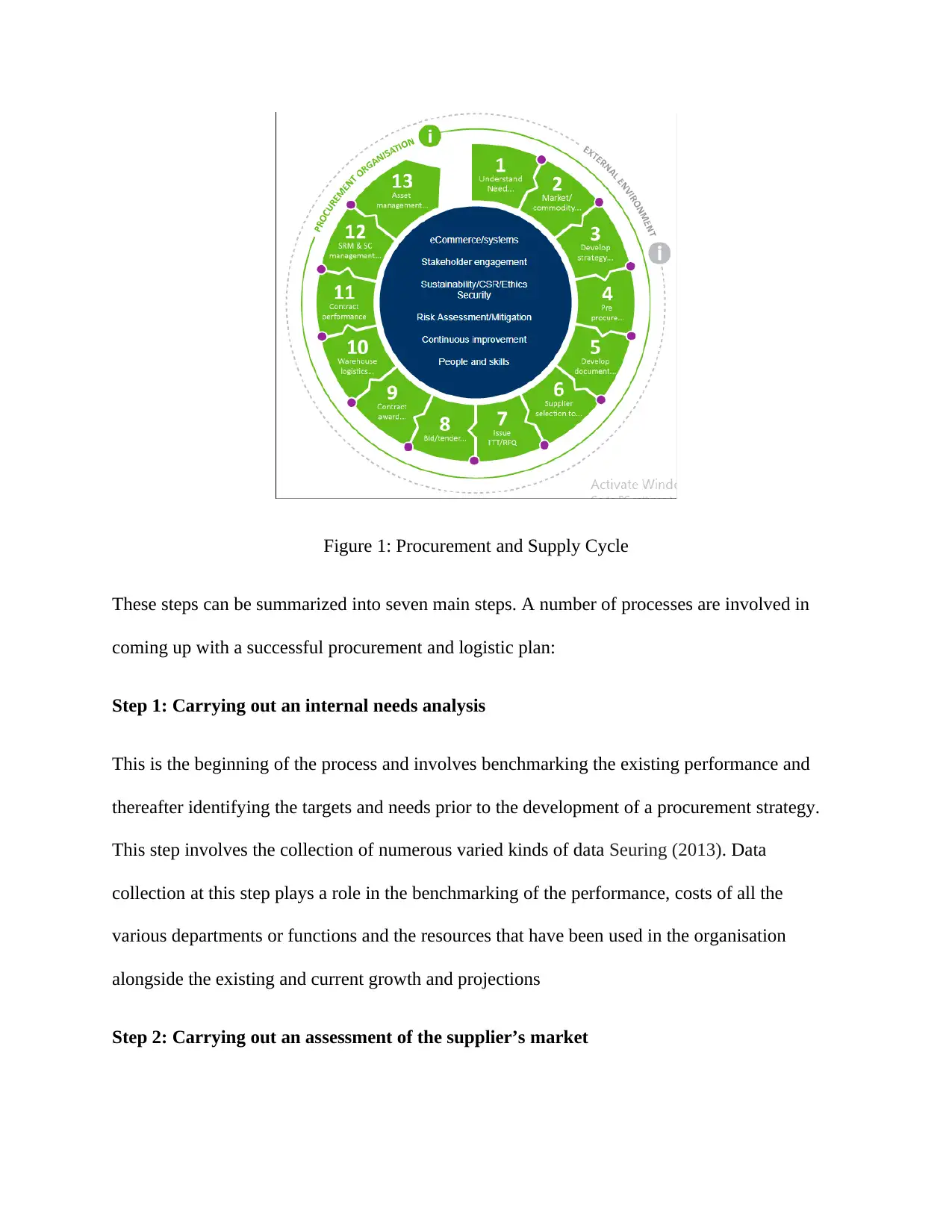
Figure 1: Procurement and Supply Cycle
These steps can be summarized into seven main steps. A number of processes are involved in
coming up with a successful procurement and logistic plan:
Step 1: Carrying out an internal needs analysis
This is the beginning of the process and involves benchmarking the existing performance and
thereafter identifying the targets and needs prior to the development of a procurement strategy.
This step involves the collection of numerous varied kinds of data Seuring (2013). Data
collection at this step plays a role in the benchmarking of the performance, costs of all the
various departments or functions and the resources that have been used in the organisation
alongside the existing and current growth and projections
Step 2: Carrying out an assessment of the supplier’s market
These steps can be summarized into seven main steps. A number of processes are involved in
coming up with a successful procurement and logistic plan:
Step 1: Carrying out an internal needs analysis
This is the beginning of the process and involves benchmarking the existing performance and
thereafter identifying the targets and needs prior to the development of a procurement strategy.
This step involves the collection of numerous varied kinds of data Seuring (2013). Data
collection at this step plays a role in the benchmarking of the performance, costs of all the
various departments or functions and the resources that have been used in the organisation
alongside the existing and current growth and projections
Step 2: Carrying out an assessment of the supplier’s market
Paraphrase This Document
Need a fresh take? Get an instant paraphrase of this document with our AI Paraphraser
In this step, the potential countries are identified by the procurement team based on the
feasibility of the sources of the components, raw materials and finished commodities. In cases
where there are specific requires, the number of potential countries may be limited. An example
can the case where the raw materials that is used by the organization can only be found in one
country, then the remaining options remain narrower. For the case of manufactured goods, there
tends to be a wider range of potential countries from which selection can be made. On the other
hand, the supply of services may be tied to the technological requirements as dictated by the
organization.
Step 3: Collection of supplier information
Careful selection of a supplier by an organization is very important as the failure or inability of a
supplier to attain the selection criterion can culminate into significant losses for the organization
in terms of finances Barney (2012). This thus calls for the evaluation of the performance and
business reputation of the supplier as well as its financial statements, references and credit
reports which must as well be given a close look. Where possible, the organization may make
arrangements and evaluate the site of the supplier and shared with other customers on their
experiences with the supplier. This process may also be fostered through the use of agents who
have a vast understanding and familiarity with the stakeholder of the market.
In a bid to avoid possible disruption in the supply, the organization may opt to use more than a
supplier that will also serve to create a competitive environment. Such a strategy may also be
ideal for large multinational organizations as it permits centralized control at the same time
enhancing more regional delivery.
Step 4: Establishment of a sourcing or outsourcing strategy
feasibility of the sources of the components, raw materials and finished commodities. In cases
where there are specific requires, the number of potential countries may be limited. An example
can the case where the raw materials that is used by the organization can only be found in one
country, then the remaining options remain narrower. For the case of manufactured goods, there
tends to be a wider range of potential countries from which selection can be made. On the other
hand, the supply of services may be tied to the technological requirements as dictated by the
organization.
Step 3: Collection of supplier information
Careful selection of a supplier by an organization is very important as the failure or inability of a
supplier to attain the selection criterion can culminate into significant losses for the organization
in terms of finances Barney (2012). This thus calls for the evaluation of the performance and
business reputation of the supplier as well as its financial statements, references and credit
reports which must as well be given a close look. Where possible, the organization may make
arrangements and evaluate the site of the supplier and shared with other customers on their
experiences with the supplier. This process may also be fostered through the use of agents who
have a vast understanding and familiarity with the stakeholder of the market.
In a bid to avoid possible disruption in the supply, the organization may opt to use more than a
supplier that will also serve to create a competitive environment. Such a strategy may also be
ideal for large multinational organizations as it permits centralized control at the same time
enhancing more regional delivery.
Step 4: Establishment of a sourcing or outsourcing strategy
Based on the data that has been collected in the latter steps, an organization should be able to
come up with outsourcing or sourcing strategy Christopher (2016). Among the examples of
sourcing strategies that may be adopted include:
Direct purchase which involves sends in a request for proposal or a request for quote to
the selected suppliers
Acquisition which involves making purchases from a desirable supplier
Strategic partnership which involving engaging in an agreement with a chosen supplier
The overall strategy of the business, the competitive nature of the supplier market place
and the risk tolerance of the sourcing or outsourcing organization and the motivation for
sourcing or outsourcing are among the determinant of the right strategy that the
organization may adopt.
Step 5: Implementation of the sourcing strategy adopted
Sourcing strategies that encompass strategic or acquisition partnerships tend to be a major part of
the undertakings. In such cases, the suppliers may have some characteristics among them:
Being part of the broader business stagey
Taking part in the activities that are of greatest importance to the buyer for example the
supply of limited raw materials of the main product, gaining access to propriety
knowledge treated to be high confidential
One of a few suppliers with the certain equipment or technology and a pool os skilled
labor
For the case of a direct purchase, the organisation may opt to start with an Expression of Interest,
then prepare an RFP or in other cases RFQ and finally solicit bids from the suppliers that have
come up with outsourcing or sourcing strategy Christopher (2016). Among the examples of
sourcing strategies that may be adopted include:
Direct purchase which involves sends in a request for proposal or a request for quote to
the selected suppliers
Acquisition which involves making purchases from a desirable supplier
Strategic partnership which involving engaging in an agreement with a chosen supplier
The overall strategy of the business, the competitive nature of the supplier market place
and the risk tolerance of the sourcing or outsourcing organization and the motivation for
sourcing or outsourcing are among the determinant of the right strategy that the
organization may adopt.
Step 5: Implementation of the sourcing strategy adopted
Sourcing strategies that encompass strategic or acquisition partnerships tend to be a major part of
the undertakings. In such cases, the suppliers may have some characteristics among them:
Being part of the broader business stagey
Taking part in the activities that are of greatest importance to the buyer for example the
supply of limited raw materials of the main product, gaining access to propriety
knowledge treated to be high confidential
One of a few suppliers with the certain equipment or technology and a pool os skilled
labor
For the case of a direct purchase, the organisation may opt to start with an Expression of Interest,
then prepare an RFP or in other cases RFQ and finally solicit bids from the suppliers that have
⊘ This is a preview!⊘
Do you want full access?
Subscribe today to unlock all pages.
Trusted by 1+ million students worldwide

1 out of 31


Related Documents


Your All-in-One AI-Powered Toolkit for Academic Success.
+13062052269
info@desklib.com
Available 24*7 on WhatsApp / Email
![[object Object]](/_next/static/media/star-bottom.7253800d.svg)
Unlock your academic potential
Copyright © 2020–2026 A2Z Services. All Rights Reserved. Developed and managed by ZUCOL.