Supply Chain Operations Management Assignment - University Name

Verified

Added on  2022/10/12

|6
|1075
|57
Homework Assignment
AI Summary
This assignment solution addresses key concepts in Supply Chain Operations Management through three problems. The first problem, involving M.M. Sprout, analyzes a customer service representative (CSR) using queuing theory to determine capacity utilization, average waiting time, the average number of customers in the system, and the total hourly cost. The second problem, concerning First Local Bank, evaluates the economic and quality-based justifications for leasing new equipment, considering server capacity, arrival rates, and waiting times. The third problem focuses on inventory management, calculating the Economic Order Quantity (EOQ) and optimal reorder point (ROP) for a catalog printing scenario, considering demand, costs, and service levels. The solution provides detailed calculations and justifications for each problem, demonstrating the application of operations management principles to real-world scenarios.
Document Page
Supply Chain
Operations Management
UNIVERSITY NAME
Student Name:
Student ID Number:
Submission Date:
tabler-icon-diamond-filled.svg

Paraphrase This Document

Need a fresh take? Get an instant paraphrase of this document with our AI Paraphraser
Document Page
Table of Contents
Problem 1 (M.M. Sprout)...........................................................................................................3
1.a The proportion of time that the CSR will be busy...........................................................3
1.b The average time that a customer will be on hold...........................................................3
1.c The average number of customers using the line (on hold and being served).................4
1.d The total hourly cost of service and waiting....................................................................4
Problem 2 (First Local Bank).....................................................................................................4
2.a Justification for leasing the new equipment on an economic basis..................................4
2.b Justification for leasing the new equipment on quality standard basis............................5
Problem 3...................................................................................................................................5
Document Page
Problem 1 (M.M. Sprout)
1.a The proportion of time that the CSR will be busy
Here, Number of servers, c = 1 (only one CSR)
Average arrival rate, Ri = 1/5 per minute or 12 per hour
Service time Tp = 4 minutes per call
Service rate 1/Tp = 1 call per 0.25 minutes or 15 calls per hour
Hence, Capacity utilization of servers u = Ri / (1/Tp*c) = 80%
So, the CSR will be busy for 80% of the time.
1.b The average time that a customer will be on hold
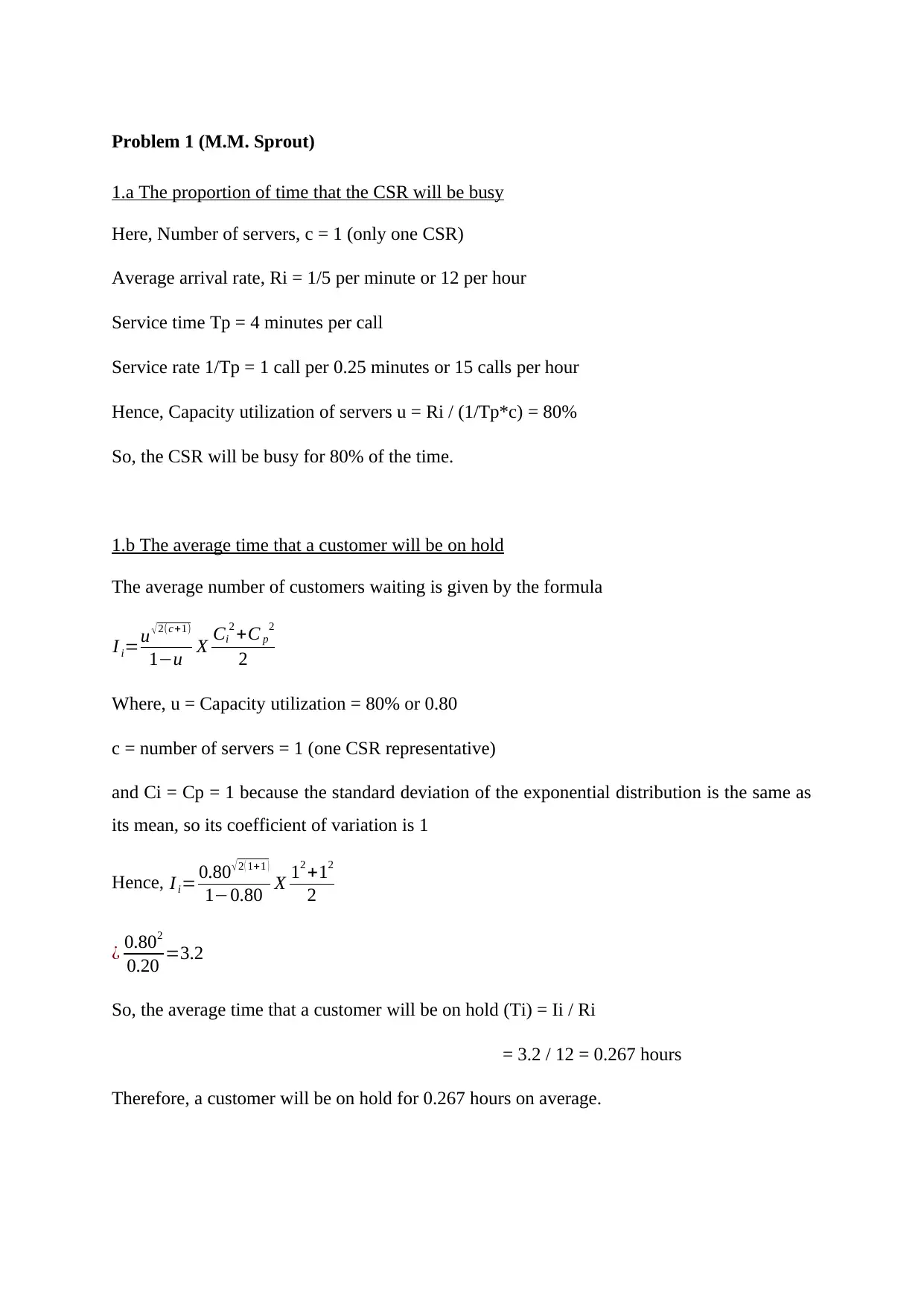
The average number of customers waiting is given by the formula
I i=u 2(c+1)
1u X Ci
2 +C p
2
2
Where, u = Capacity utilization = 80% or 0.80
c = number of servers = 1 (one CSR representative)
and Ci = Cp = 1 because the standard deviation of the exponential distribution is the same as
its mean, so its coefficient of variation is 1
Hence, I i= 0.80 2 ( 1+1 )
10.80 X 12 +12
2
¿ 0.802
0.20 =3.2
So, the average time that a customer will be on hold (Ti) = Ii / Ri
= 3.2 / 12 = 0.267 hours
Therefore, a customer will be on hold for 0.267 hours on average.
Document Page
1.c The average number of customers using the line (on hold and being served)
The average number (I) in the system is given by the formula
I =I i+cu
Where, Ii = average number of customers waiting = 3.2
u = Capacity utilization = 80% or 0.80
c = number of servers = 1 (one CSR representative)
and u = Capacity utilization = 80% or 0.80
Hence, I = 3.2 + (1*0.80) = 4 customers
1.d The total hourly cost of service and waiting
The CSR is paid $20 an hour and the telephone company charges $5 an hour, so the hourly
cost of providing service will be $25. Moreover, as average 3.2 customers are waiting the
waiting cost will be (3.2 X $2) $6.4.
So, the total hourly cost of service and waiting will be $25 + $6.4 = $31.4
Problem 2 (First Local Bank)
2.a Justification for leasing the new equipment on an economic basis
Here, Number of servers c = 4 (4 windows of customer service)
Arrival Rate Ri = 40 per hour
Service time of each server, Tp = 5 minutes per customer
Service rate = 1/Tp = 12 customers per hour
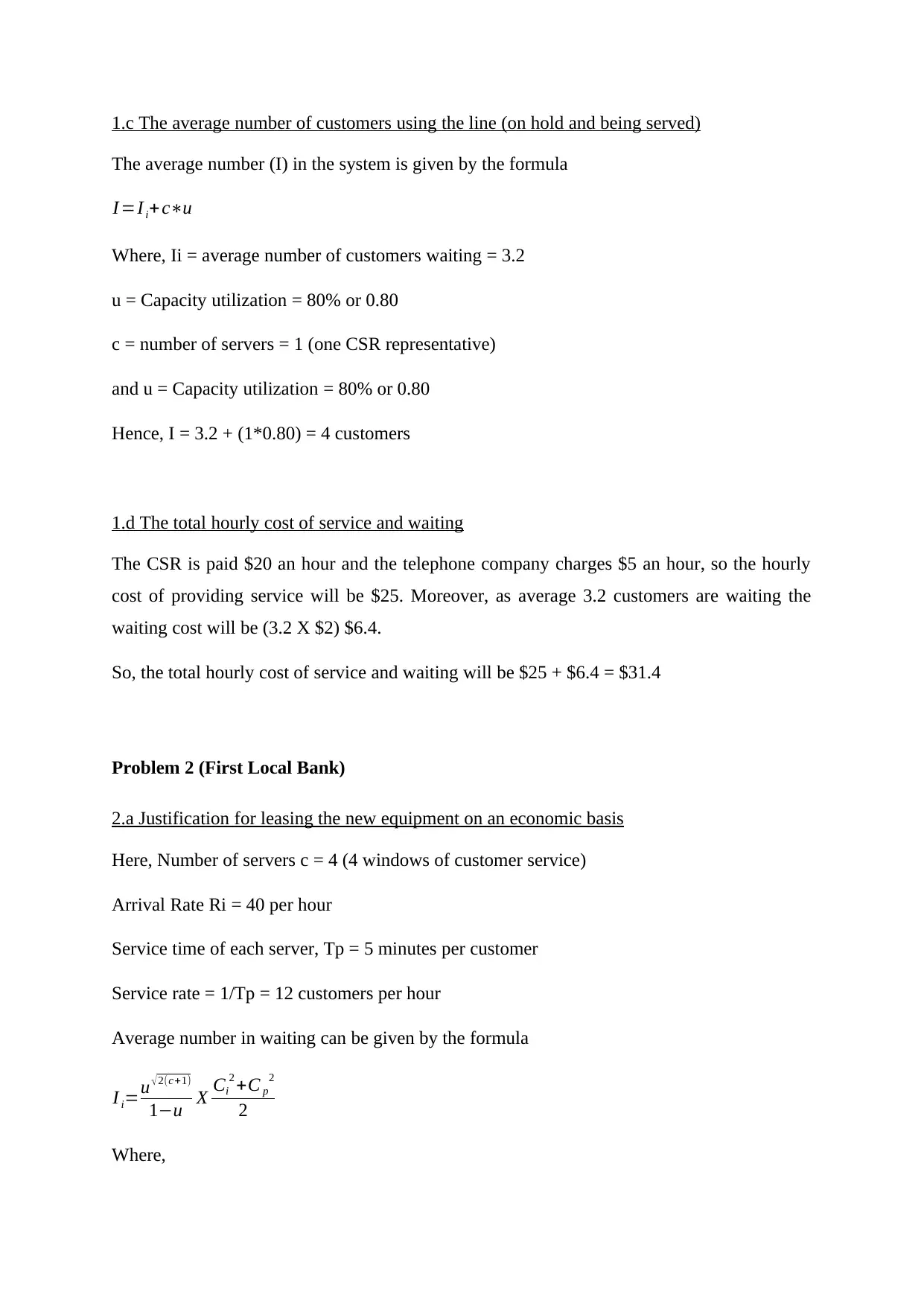
Average number in waiting can be given by the formula
I i=u 2(c+1)
1u X Ci
2 +C p
2
2
Where,
tabler-icon-diamond-filled.svg

Paraphrase This Document

Need a fresh take? Get an instant paraphrase of this document with our AI Paraphraser
Document Page
Where, u = Capacity utilization = Ri / c*1/Tp = 83.33% or 0.83
c = number of servers = 4
and Ci = Cp = 1 because the standard deviation of the exponential distribution is the same as
its mean, so its coefficient of variation is 1
Hence, I i= 0.83 2 ( 4 +1 )
10.83 X 12+12
2 =3.30
Since the cost of a customer’s waiting time is $20 per hour, the total waiting cost would be =
$20 X Ii = $20 X 3.30 = $66 per hour
Since the leasing of a new high-speed information-retrieval and communication equipment
would cost $30 per hour, it is justified to lease the new equipment on economic basis.
2.b Justification for leasing the new equipment on quality standard basis
The average waiting time Ti can be calculated as
Ti = Ii / Ri = 3.30 / 40 = 0.08222 hours = 4.9 minutes
Hence, Total time required for a customer to be in and out of the system = transaction time +
waiting time = 4 + 4.9 = 8.9 minutes. It should be noted that it is greater than the standard
competitive time of 8 minutes.
However, the use of the new equipment is expected to reduce the total transaction time by 4
minutes which will then be less than the standard time of 8 minutes. Therefore, First Local
Bank should lease the new high-speed equipment to meet the standard.
Problem 3
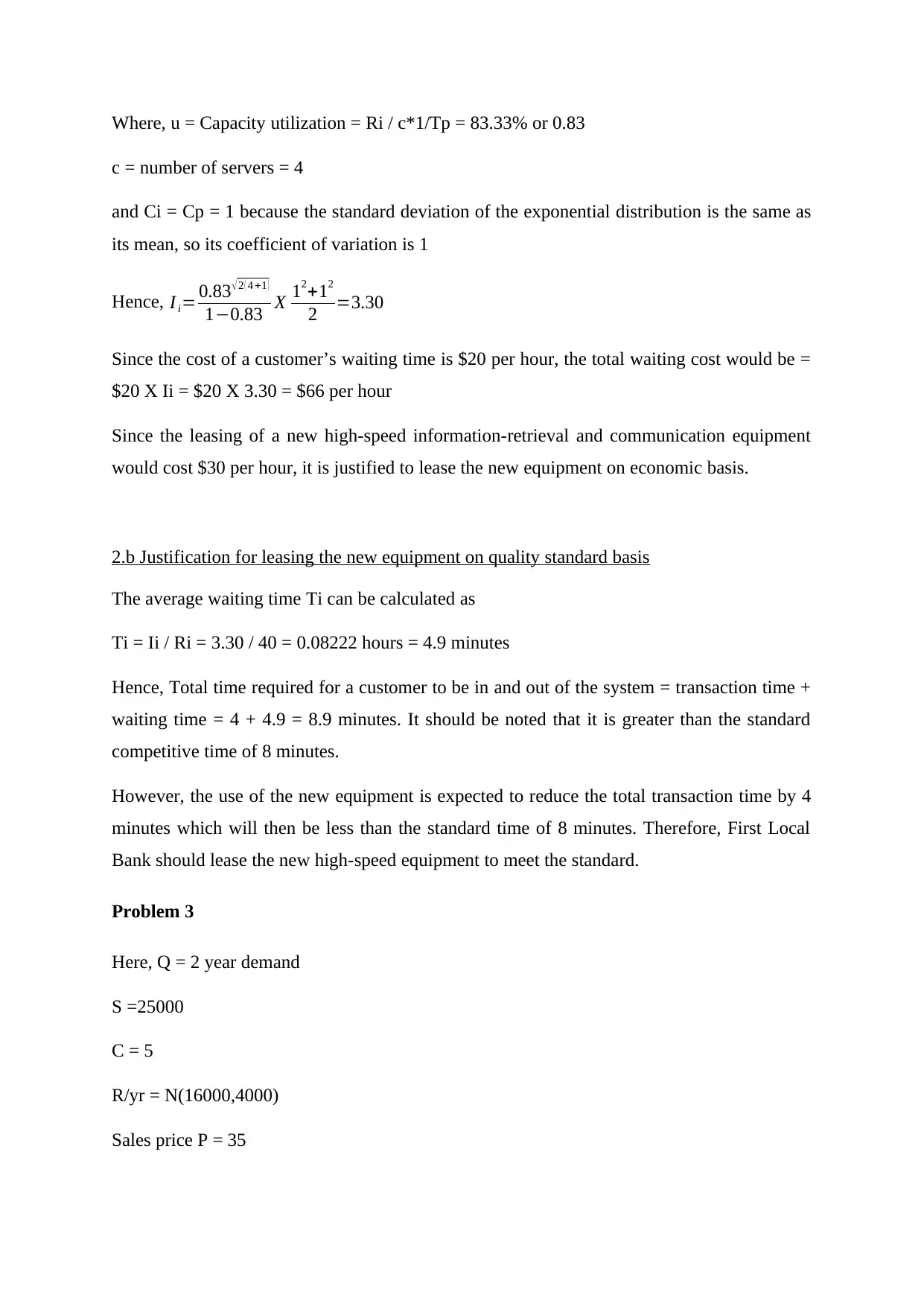
Here, Q = 2 year demand
S =25000
C = 5
R/yr = N(16000,4000)
Sales price P = 35
Document Page
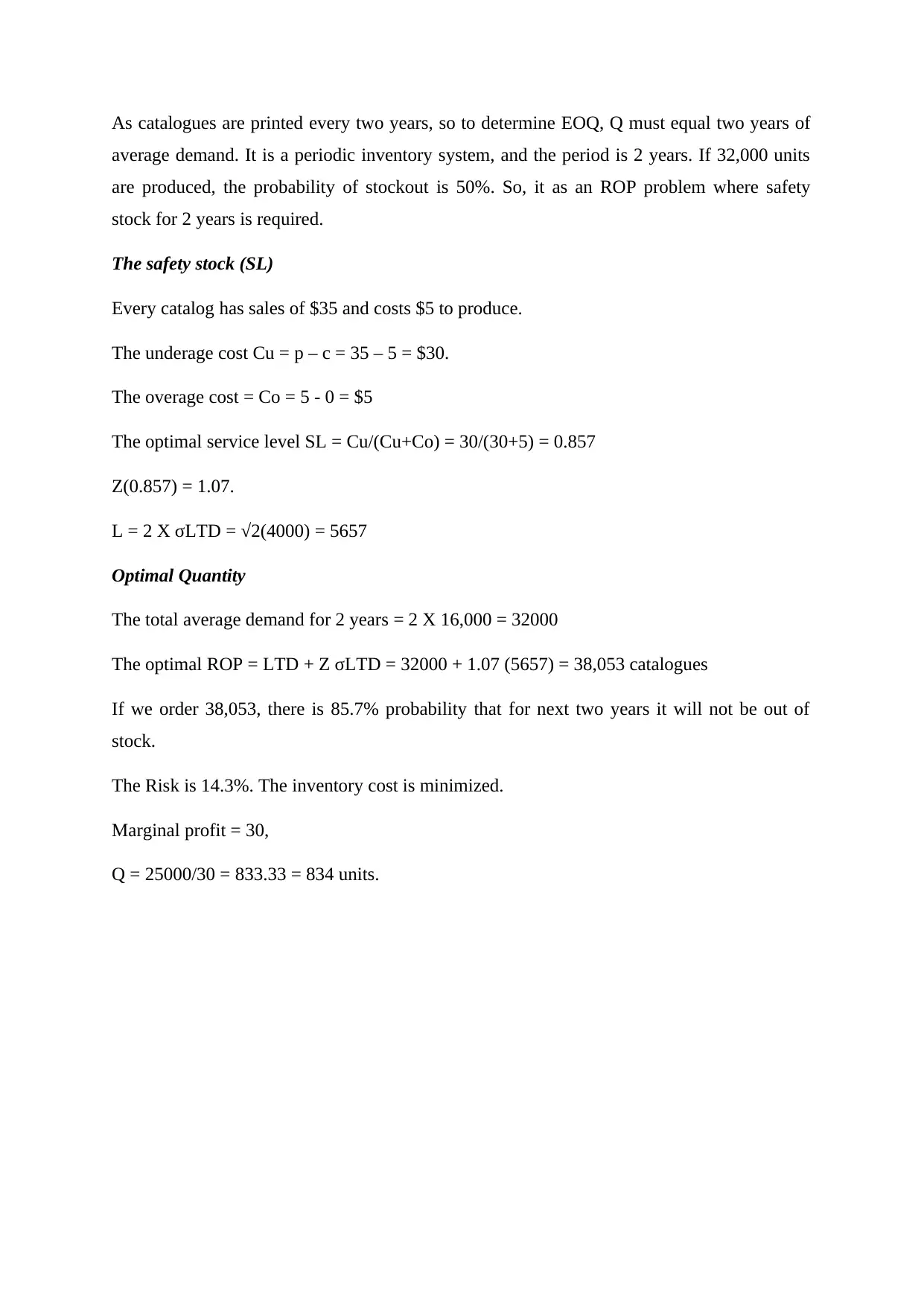
As catalogues are printed every two years, so to determine EOQ, Q must equal two years of
average demand. It is a periodic inventory system, and the period is 2 years. If 32,000 units
are produced, the probability of stockout is 50%. So, it as an ROP problem where safety
stock for 2 years is required.
The safety stock (SL)
Every catalog has sales of $35 and costs $5 to produce.
The underage cost Cu = p – c = 35 – 5 = $30.
The overage cost = Co = 5 - 0 = $5
The optimal service level SL = Cu/(Cu+Co) = 30/(30+5) = 0.857
Z(0.857) = 1.07.
L = 2 X σLTD = √2(4000) = 5657
Optimal Quantity
The total average demand for 2 years = 2 X 16,000 = 32000
The optimal ROP = LTD + Z σLTD = 32000 + 1.07 (5657) = 38,053 catalogues
If we order 38,053, there is 85.7% probability that for next two years it will not be out of
stock.
The Risk is 14.3%. The inventory cost is minimized.
Marginal profit = 30,
Q = 25000/30 = 833.33 = 834 units.
chevron_up_icon
1 out of 6
circle_padding
hide_on_mobile
zoom_out_icon
[object Object]