Evaluation of Production Planning Techniques: MG6.01 Supply Chain
VerifiedAdded on 2023/06/11
|8
|1539
|74
Report
AI Summary
This report provides an evaluation of production planning techniques and models within the context of supply chain management. It covers aggregate planning, including demand-based and capacity-based options, and discusses the creation of an aggregate plan for production planning. The report also delves into Material Requirements Planning (MRP), explaining time-phased product structures, gross requirement plans, and net requirement plans. Furthermore, it examines inventory planning, focusing on various inventory models like Economic Order Quantity (EOQ) and ABC analysis, highlighting their benefits in optimizing inventory levels and reducing costs. The report concludes with recommendations for effective production planning, emphasizing the use of EOQ for inventory management and demand-based options for long-term benefits.
RUNNING HEAD: Advanced Operations Management
Advanced Operations Management
Paraphrase This Document
Need a fresh take? Get an instant paraphrase of this document with our AI Paraphraser

Advanced Operations Management 1
Contents
Introduction......................................................................................................................................2
Evaluation of production planning techniques and models.............................................................2
Aggregate planning......................................................................................................................2
Aggregate planning options......................................................................................................2
Aggregate Plan for Production Planning..................................................................................2
Evaluation of Aggregate planning options...............................................................................3
Material Requirements Planning..................................................................................................3
Time-phased Product Structure................................................................................................3
Gross requirement plan............................................................................................................3
Net Requirement Plan..............................................................................................................4
Inventory Planning.......................................................................................................................4
Inventory Models.....................................................................................................................4
ABC Analysis...........................................................................................................................5
Conclusion.......................................................................................................................................5
Recommendations............................................................................................................................6
References........................................................................................................................................7
Contents
Introduction......................................................................................................................................2
Evaluation of production planning techniques and models.............................................................2
Aggregate planning......................................................................................................................2
Aggregate planning options......................................................................................................2
Aggregate Plan for Production Planning..................................................................................2
Evaluation of Aggregate planning options...............................................................................3
Material Requirements Planning..................................................................................................3
Time-phased Product Structure................................................................................................3
Gross requirement plan............................................................................................................3
Net Requirement Plan..............................................................................................................4
Inventory Planning.......................................................................................................................4
Inventory Models.....................................................................................................................4
ABC Analysis...........................................................................................................................5
Conclusion.......................................................................................................................................5
Recommendations............................................................................................................................6
References........................................................................................................................................7

Advanced Operations Management 2
Introduction
Production planning can be defined as the planning of manufacturing and production modules in
an organization or industry. It makes the use of resource allocation of production capacity,
activities of employees and materials for the purpose of serving diverse customers. Production
planning can also be referred to as the plan for future production in which the facilities required
are identified and arranged (Fitouhi & Nourelfath, 2014). This report focuses on the evaluation
of the production planning techniques and the models developed.
Evaluation of techniques and models of Production Planning
Aggregate planning
Aggregate planning can be defined as a marketing activity in which an aggregate plan is
prepared for the process of production in advance for providing an idea to the management
regarding the quantity of resources and materials required to be procured in order to keep the
cost of operations minimum for the given period (Demirel, Ozelkan, & Lim, 2018).
Aggregate planning options
There are two options available while formulating an aggregate plan namely demand- based
options and capacity- based options.
Demand-based Options- it can be defined as the group of options that are responsible for
responding towards demand fluctuations with the help of back orders or inventory or by shifting
the demand pattern.
Capacity-based options- this option makes a change in the output capacity for the purpose of
meeting the demand with the use of undertime, overtime, hires, fires, subcontracting, etc. The
requirement of this option arises when there is a difference between current capacity and current
demand.
Aggregate Plan for Production Planning
Firstly the aggregate plan is identified that matches with the objectives of the company: level,
chase or hybrid. On the basis of such aggregate plan, the aggregate production rate is determined.
Introduction
Production planning can be defined as the planning of manufacturing and production modules in
an organization or industry. It makes the use of resource allocation of production capacity,
activities of employees and materials for the purpose of serving diverse customers. Production
planning can also be referred to as the plan for future production in which the facilities required
are identified and arranged (Fitouhi & Nourelfath, 2014). This report focuses on the evaluation
of the production planning techniques and the models developed.
Evaluation of techniques and models of Production Planning
Aggregate planning
Aggregate planning can be defined as a marketing activity in which an aggregate plan is
prepared for the process of production in advance for providing an idea to the management
regarding the quantity of resources and materials required to be procured in order to keep the
cost of operations minimum for the given period (Demirel, Ozelkan, & Lim, 2018).
Aggregate planning options
There are two options available while formulating an aggregate plan namely demand- based
options and capacity- based options.
Demand-based Options- it can be defined as the group of options that are responsible for
responding towards demand fluctuations with the help of back orders or inventory or by shifting
the demand pattern.
Capacity-based options- this option makes a change in the output capacity for the purpose of
meeting the demand with the use of undertime, overtime, hires, fires, subcontracting, etc. The
requirement of this option arises when there is a difference between current capacity and current
demand.
Aggregate Plan for Production Planning
Firstly the aggregate plan is identified that matches with the objectives of the company: level,
chase or hybrid. On the basis of such aggregate plan, the aggregate production rate is determined.
⊘ This is a preview!⊘
Do you want full access?
Subscribe today to unlock all pages.

Trusted by 1+ million students worldwide

Advanced Operations Management 3
In case of level plan, the aggregate production rate is fixed equivalent to average demand and in
case of chase aggregate plan, output capacity required for the period is first calculated along with
the calculation of production of units on overtime and regular time and number of units to be
subcontracted (Viroli, Pianini, Ricci & Croatti, 2017).
Then the size of the workforce is determined. In case of level aggregate plan, the number of
workers required for achieving average production rate is calculated. If capacity period is
changed with hires and fires, workers needed are calculated and necessary changes are made in
the workforce. Then at last, the plan is required to be tested for robustness (Krajewski, 2017).
Evaluation of Aggregate planning options
The evaluation of the options provides that demand based options is good for establishments
such as a restaurant where prices can be reduced for a specific period for encouraging the
customers to dine earlier and spreading the demand for a longer time period. On the other hand,
capacity based option is suitable when the currently adopted capacity is not equivalent to current
demand. The fluctuating demand is relieved by the offers but each has operational and cost
implications for the company.
Material Requirements Planning
Material Requirements Planning (MRP) can be defined as an inventory control, scheduling and
production planning system with the help of which manufacturing processes are managed
(Krajewski, Ritzman & Malhotra, 2015).
Time-phased Product Structure
It can be built with the help of Bill of Materials (BOM) of the given product. The list of BOM
contains the quantities required and the lead times of subassemblies and parts for the assembly of
final product. It illustrates the time required for building or acquiring the components to
assemble the final product.
Gross requirement plan
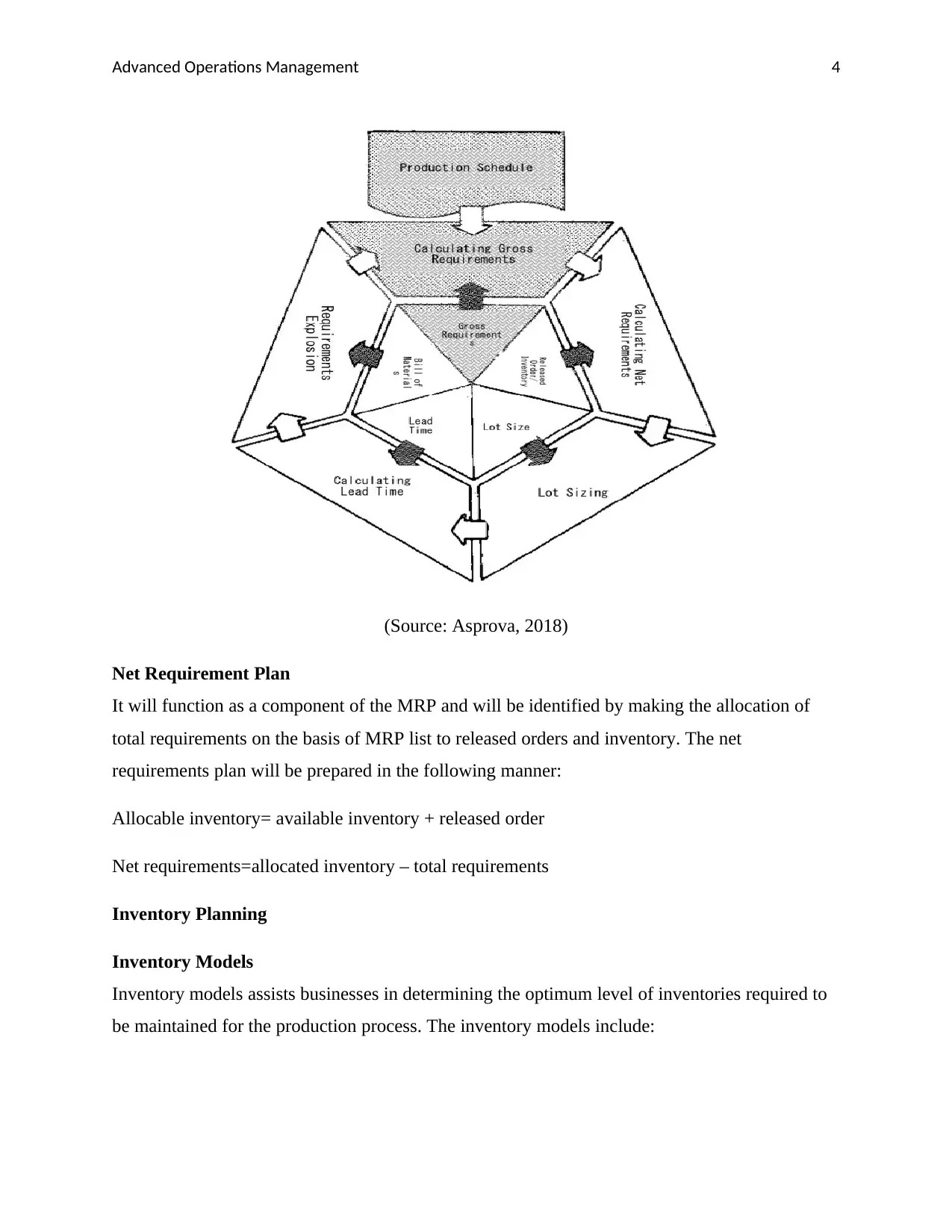
Firstly, the gross requirements are calculated in MRP. In gross requirements plan, the
requirements are obtained through the use of MRP list by determining the item’s demand
quantity and then combining them. Then the gross requirements of the period are taken to further
stage for the calculation of the net requirements.
In case of level plan, the aggregate production rate is fixed equivalent to average demand and in
case of chase aggregate plan, output capacity required for the period is first calculated along with
the calculation of production of units on overtime and regular time and number of units to be
subcontracted (Viroli, Pianini, Ricci & Croatti, 2017).
Then the size of the workforce is determined. In case of level aggregate plan, the number of
workers required for achieving average production rate is calculated. If capacity period is
changed with hires and fires, workers needed are calculated and necessary changes are made in
the workforce. Then at last, the plan is required to be tested for robustness (Krajewski, 2017).
Evaluation of Aggregate planning options
The evaluation of the options provides that demand based options is good for establishments
such as a restaurant where prices can be reduced for a specific period for encouraging the
customers to dine earlier and spreading the demand for a longer time period. On the other hand,
capacity based option is suitable when the currently adopted capacity is not equivalent to current
demand. The fluctuating demand is relieved by the offers but each has operational and cost
implications for the company.
Material Requirements Planning
Material Requirements Planning (MRP) can be defined as an inventory control, scheduling and
production planning system with the help of which manufacturing processes are managed
(Krajewski, Ritzman & Malhotra, 2015).
Time-phased Product Structure
It can be built with the help of Bill of Materials (BOM) of the given product. The list of BOM
contains the quantities required and the lead times of subassemblies and parts for the assembly of
final product. It illustrates the time required for building or acquiring the components to
assemble the final product.
Gross requirement plan
Firstly, the gross requirements are calculated in MRP. In gross requirements plan, the
requirements are obtained through the use of MRP list by determining the item’s demand
quantity and then combining them. Then the gross requirements of the period are taken to further
stage for the calculation of the net requirements.
Paraphrase This Document
Need a fresh take? Get an instant paraphrase of this document with our AI Paraphraser

Advanced Operations Management 4
(Source: Asprova, 2018)
Net Requirement Plan
It will function as a component of the MRP and will be identified by making the allocation of
total requirements on the basis of MRP list to released orders and inventory. The net
requirements plan will be prepared in the following manner:
Allocable inventory= available inventory + released order
Net requirements=allocated inventory – total requirements
Inventory Planning
Inventory Models
Inventory models assists businesses in determining the optimum level of inventories required to
be maintained for the production process. The inventory models include:
(Source: Asprova, 2018)
Net Requirement Plan
It will function as a component of the MRP and will be identified by making the allocation of
total requirements on the basis of MRP list to released orders and inventory. The net
requirements plan will be prepared in the following manner:
Allocable inventory= available inventory + released order
Net requirements=allocated inventory – total requirements
Inventory Planning
Inventory Models
Inventory models assists businesses in determining the optimum level of inventories required to
be maintained for the production process. The inventory models include:

Advanced Operations Management 5
Economic Order Quantity- This model provides quantity to be ordered that reduces the ordering
costs and total holding for the year. It also provides a good indication regarding whether the
current order quantities are reasonable or not (Battini, Persona & Sgarbossa, 2014).
Base Stock Model- in this model, the demand is random but the refill of inventory is one unit at a
time.
Economic production quantity- this model helps in finding out the quantity required to be
ordered for minimizing the total inventory costs by bringing a balance between the fixed
ordering cost and inventory holding cost. This model is an extension of EOQ model.
ABC Analysis
ABC analysis can be defined as a method which divides the items in three categories A, B and C,
where A is the most valuable item and C is the least valuable item (Ravinder & Misra, 2014).
A-items consist of the goods which have highest consumption value. The top 70-80% annual
consumption value accounts for only 10-20% of the complete stock of the company.
B-items are also known as interclass items that have medium consumption value. 30% of the
total stock items are accounted for by 15-25% of the annual consumption value.
C-items are the items having the lowest consumption value. 50% of the total stock items are
accounted for by 5% of the annual consumption value.
Conclusion
Therefore, it can be concluded that production planning is the planning of production modules by
making the use of different production planning techniques such as aggregate planning, material
resource planning and inventory planning. The evaluation of the models and techniques provides
that they are beneficial in the overall production planning in a number of ways.
Economic Order Quantity- This model provides quantity to be ordered that reduces the ordering
costs and total holding for the year. It also provides a good indication regarding whether the
current order quantities are reasonable or not (Battini, Persona & Sgarbossa, 2014).
Base Stock Model- in this model, the demand is random but the refill of inventory is one unit at a
time.
Economic production quantity- this model helps in finding out the quantity required to be
ordered for minimizing the total inventory costs by bringing a balance between the fixed
ordering cost and inventory holding cost. This model is an extension of EOQ model.
ABC Analysis
ABC analysis can be defined as a method which divides the items in three categories A, B and C,
where A is the most valuable item and C is the least valuable item (Ravinder & Misra, 2014).
A-items consist of the goods which have highest consumption value. The top 70-80% annual
consumption value accounts for only 10-20% of the complete stock of the company.
B-items are also known as interclass items that have medium consumption value. 30% of the
total stock items are accounted for by 15-25% of the annual consumption value.
C-items are the items having the lowest consumption value. 50% of the total stock items are
accounted for by 5% of the annual consumption value.
Conclusion
Therefore, it can be concluded that production planning is the planning of production modules by
making the use of different production planning techniques such as aggregate planning, material
resource planning and inventory planning. The evaluation of the models and techniques provides
that they are beneficial in the overall production planning in a number of ways.
⊘ This is a preview!⊘
Do you want full access?
Subscribe today to unlock all pages.

Trusted by 1+ million students worldwide

Advanced Operations Management 6
Recommendations
It is recommended to make the use of EOQ model for inventory planning which minimizes the
ordering and holding costs. Demand based option is recommended over capacity based option
due to the long time benefits offered by it.
Recommendations
It is recommended to make the use of EOQ model for inventory planning which minimizes the
ordering and holding costs. Demand based option is recommended over capacity based option
due to the long time benefits offered by it.
Paraphrase This Document
Need a fresh take? Get an instant paraphrase of this document with our AI Paraphraser

Advanced Operations Management 7
References
Asprova. 2018. Calculating Gross Requirements. Retrieved on June 17, 2018 from
https://www.asprova.jp/mrp/glossary/en/cat248/post-714.html
Battini, D., Persona, A., & Sgarbossa, F. (2014). A sustainable EOQ model: theoretical
formulation and applications. International Journal of Production Economics, 149, 145-
153.
Demirel, E., Özelkan, E. C., & Lim, C. (2018). Aggregate planning with Flexibility
Requirements Profile. International Journal of Production Economics, 202, 45-58.
Fitouhi, M. C., & Nourelfath, M. (2014). Integrating noncyclical preventive maintenance
scheduling and production planning for multi-state systems. Reliability Engineering &
System Safety, 121, 175-186.
Krajewski, L. (2017). Aggregate Production Planning. In The Routledge Companion to
Production and Operations Management (pp. 63-81). Routledge.
Krajewski, L. J., Ritzman, L. P., & Malhotra, M. K. (2015). Operations management: processes
and supply chains. New York, EEUU: Prentice hall.
Ravinder, H., & Misra, R. B. (2014). ABC analysis for inventory management: Bridging the gap
between research and classroom. American Journal of Business Education (Online), 7(3),
257.
Viroli, M., Pianini, D., Ricci, A., & Croatti, A. (2017). Aggregate plans for multiagent
systems. International Journal of Agent-Oriented Software Engineering, 5(4), 336-365.
References
Asprova. 2018. Calculating Gross Requirements. Retrieved on June 17, 2018 from
https://www.asprova.jp/mrp/glossary/en/cat248/post-714.html
Battini, D., Persona, A., & Sgarbossa, F. (2014). A sustainable EOQ model: theoretical
formulation and applications. International Journal of Production Economics, 149, 145-
153.
Demirel, E., Özelkan, E. C., & Lim, C. (2018). Aggregate planning with Flexibility
Requirements Profile. International Journal of Production Economics, 202, 45-58.
Fitouhi, M. C., & Nourelfath, M. (2014). Integrating noncyclical preventive maintenance
scheduling and production planning for multi-state systems. Reliability Engineering &
System Safety, 121, 175-186.
Krajewski, L. (2017). Aggregate Production Planning. In The Routledge Companion to
Production and Operations Management (pp. 63-81). Routledge.
Krajewski, L. J., Ritzman, L. P., & Malhotra, M. K. (2015). Operations management: processes
and supply chains. New York, EEUU: Prentice hall.
Ravinder, H., & Misra, R. B. (2014). ABC analysis for inventory management: Bridging the gap
between research and classroom. American Journal of Business Education (Online), 7(3),
257.
Viroli, M., Pianini, D., Ricci, A., & Croatti, A. (2017). Aggregate plans for multiagent
systems. International Journal of Agent-Oriented Software Engineering, 5(4), 336-365.
1 out of 8
Related Documents
Your All-in-One AI-Powered Toolkit for Academic Success.
+13062052269
info@desklib.com
Available 24*7 on WhatsApp / Email
Unlock your academic potential
Copyright © 2020–2025 A2Z Services. All Rights Reserved. Developed and managed by ZUCOL.