Analysis of Global Logistics and Supply Chain Performance
VerifiedAdded on 2023/06/15
|10
|2708
|300
Report
AI Summary
This report provides an overview of global logistics and supply chains, focusing on performance measurement systems and a critical evaluation of various supply chain models. It discusses process-based and perspective-based approaches to measuring supply chain performance, including the Balanced Scorecard model (BSC) and the Supply Chain Operations Reference model (SCOR). The report then evaluates different supply chain models such as Continuous Flow, Fast, Efficient, and Flexible models, highlighting their advantages and disadvantages. Finally, it addresses the implementation challenges faced by organizations, including fast-changing markets, the demand for high-quality products, unexpected delays, and the importance of customer service. The report concludes that organizations use different supply chain models to meet their goals and provide effective customer service through suitable performance measurement systems.
Global Logistics and Supply
Chains
Chains

Paraphrase This Document
Need a fresh take? Get an instant paraphrase of this document with our AI Paraphraser
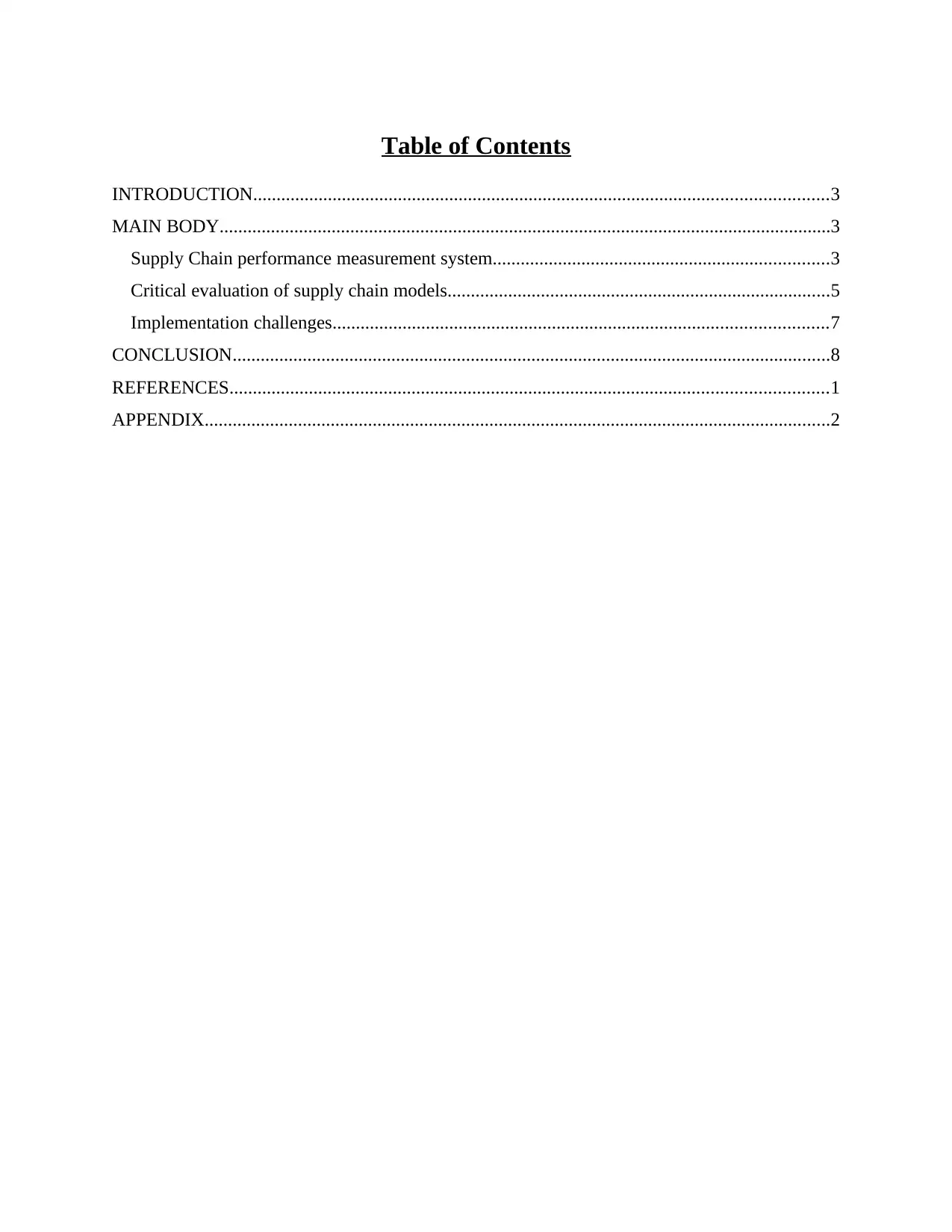
Table of Contents
INTRODUCTION...........................................................................................................................3
MAIN BODY...................................................................................................................................3
Supply Chain performance measurement system........................................................................3
Critical evaluation of supply chain models..................................................................................5
Implementation challenges..........................................................................................................7
CONCLUSION................................................................................................................................8
REFERENCES................................................................................................................................1
APPENDIX......................................................................................................................................2
INTRODUCTION...........................................................................................................................3
MAIN BODY...................................................................................................................................3
Supply Chain performance measurement system........................................................................3
Critical evaluation of supply chain models..................................................................................5
Implementation challenges..........................................................................................................7
CONCLUSION................................................................................................................................8
REFERENCES................................................................................................................................1
APPENDIX......................................................................................................................................2
INTRODUCTION
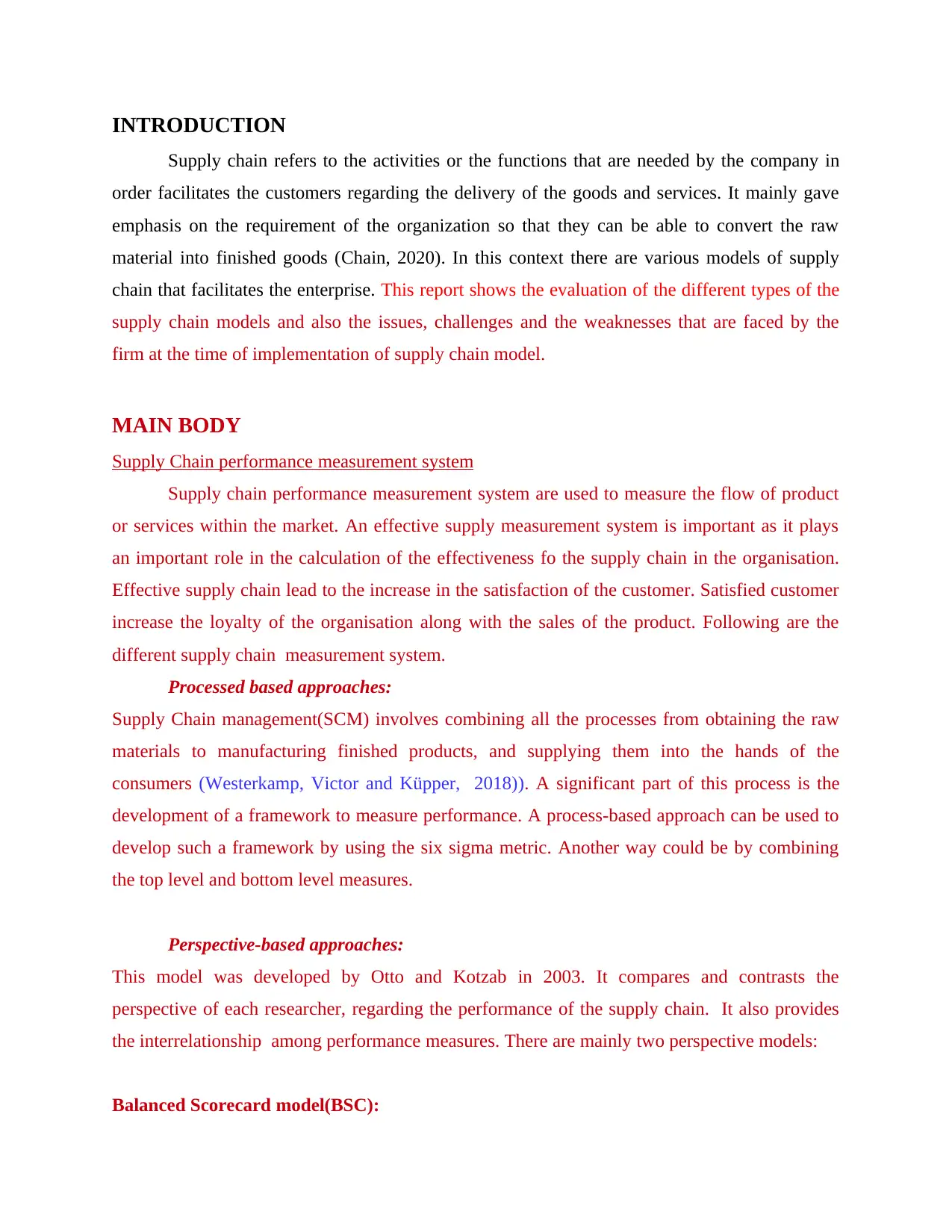
Supply chain refers to the activities or the functions that are needed by the company in
order facilitates the customers regarding the delivery of the goods and services. It mainly gave
emphasis on the requirement of the organization so that they can be able to convert the raw
material into finished goods (Chain, 2020). In this context there are various models of supply
chain that facilitates the enterprise. This report shows the evaluation of the different types of the
supply chain models and also the issues, challenges and the weaknesses that are faced by the
firm at the time of implementation of supply chain model.
MAIN BODY
Supply Chain performance measurement system
Supply chain performance measurement system are used to measure the flow of product
or services within the market. An effective supply measurement system is important as it plays
an important role in the calculation of the effectiveness fo the supply chain in the organisation.
Effective supply chain lead to the increase in the satisfaction of the customer. Satisfied customer
increase the loyalty of the organisation along with the sales of the product. Following are the
different supply chain measurement system.
Processed based approaches:
Supply Chain management(SCM) involves combining all the processes from obtaining the raw
materials to manufacturing finished products, and supplying them into the hands of the
consumers (Westerkamp, Victor and Küpper, 2018)). A significant part of this process is the
development of a framework to measure performance. A process-based approach can be used to
develop such a framework by using the six sigma metric. Another way could be by combining
the top level and bottom level measures.
Perspective-based approaches:
This model was developed by Otto and Kotzab in 2003. It compares and contrasts the
perspective of each researcher, regarding the performance of the supply chain. It also provides
the interrelationship among performance measures. There are mainly two perspective models:
Balanced Scorecard model(BSC):
Supply chain refers to the activities or the functions that are needed by the company in
order facilitates the customers regarding the delivery of the goods and services. It mainly gave
emphasis on the requirement of the organization so that they can be able to convert the raw
material into finished goods (Chain, 2020). In this context there are various models of supply
chain that facilitates the enterprise. This report shows the evaluation of the different types of the
supply chain models and also the issues, challenges and the weaknesses that are faced by the
firm at the time of implementation of supply chain model.
MAIN BODY
Supply Chain performance measurement system
Supply chain performance measurement system are used to measure the flow of product
or services within the market. An effective supply measurement system is important as it plays
an important role in the calculation of the effectiveness fo the supply chain in the organisation.
Effective supply chain lead to the increase in the satisfaction of the customer. Satisfied customer
increase the loyalty of the organisation along with the sales of the product. Following are the
different supply chain measurement system.
Processed based approaches:
Supply Chain management(SCM) involves combining all the processes from obtaining the raw
materials to manufacturing finished products, and supplying them into the hands of the
consumers (Westerkamp, Victor and Küpper, 2018)). A significant part of this process is the
development of a framework to measure performance. A process-based approach can be used to
develop such a framework by using the six sigma metric. Another way could be by combining
the top level and bottom level measures.
Perspective-based approaches:
This model was developed by Otto and Kotzab in 2003. It compares and contrasts the
perspective of each researcher, regarding the performance of the supply chain. It also provides
the interrelationship among performance measures. There are mainly two perspective models:
Balanced Scorecard model(BSC):
⊘ This is a preview!⊘
Do you want full access?
Subscribe today to unlock all pages.

Trusted by 1+ million students worldwide
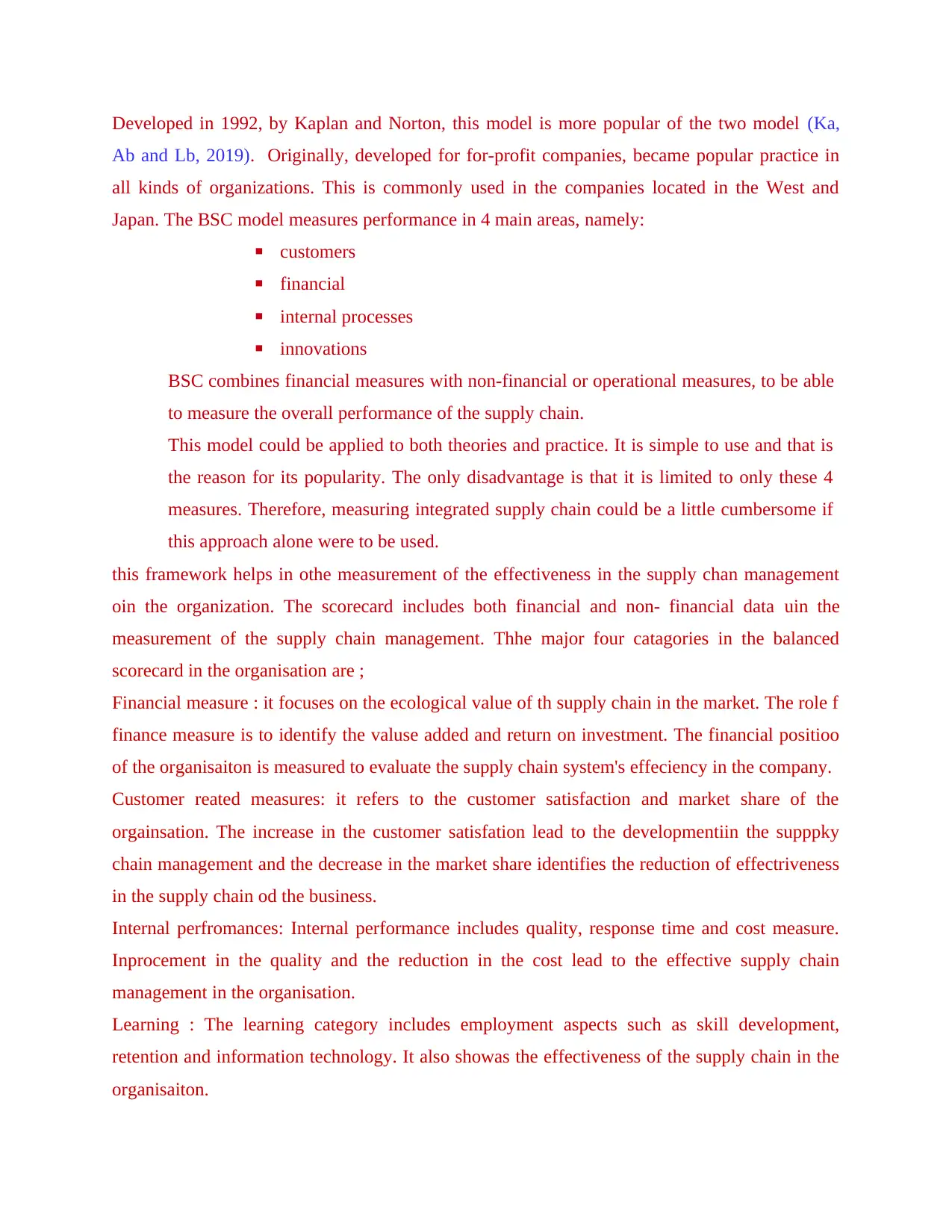
Developed in 1992, by Kaplan and Norton, this model is more popular of the two model (Ka,
Ab and Lb, 2019). Originally, developed for for-profit companies, became popular practice in
all kinds of organizations. This is commonly used in the companies located in the West and
Japan. The BSC model measures performance in 4 main areas, namely:
▪ customers
▪ financial
▪ internal processes
▪ innovations
BSC combines financial measures with non-financial or operational measures, to be able
to measure the overall performance of the supply chain.
This model could be applied to both theories and practice. It is simple to use and that is
the reason for its popularity. The only disadvantage is that it is limited to only these 4
measures. Therefore, measuring integrated supply chain could be a little cumbersome if
this approach alone were to be used.
this framework helps in othe measurement of the effectiveness in the supply chan management
oin the organization. The scorecard includes both financial and non- financial data uin the
measurement of the supply chain management. Thhe major four catagories in the balanced
scorecard in the organisation are ;
Financial measure : it focuses on the ecological value of th supply chain in the market. The role f
finance measure is to identify the valuse added and return on investment. The financial positioo
of the organisaiton is measured to evaluate the supply chain system's effeciency in the company.
Customer reated measures: it refers to the customer satisfaction and market share of the
orgainsation. The increase in the customer satisfation lead to the developmentiin the supppky
chain management and the decrease in the market share identifies the reduction of effectriveness
in the supply chain od the business.
Internal perfromances: Internal performance includes quality, response time and cost measure.
Inprocement in the quality and the reduction in the cost lead to the effective supply chain
management in the organisation.
Learning : The learning category includes employment aspects such as skill development,
retention and information technology. It also showas the effectiveness of the supply chain in the
organisaiton.
Ab and Lb, 2019). Originally, developed for for-profit companies, became popular practice in
all kinds of organizations. This is commonly used in the companies located in the West and
Japan. The BSC model measures performance in 4 main areas, namely:
▪ customers
▪ financial
▪ internal processes
▪ innovations
BSC combines financial measures with non-financial or operational measures, to be able
to measure the overall performance of the supply chain.
This model could be applied to both theories and practice. It is simple to use and that is
the reason for its popularity. The only disadvantage is that it is limited to only these 4
measures. Therefore, measuring integrated supply chain could be a little cumbersome if
this approach alone were to be used.
this framework helps in othe measurement of the effectiveness in the supply chan management
oin the organization. The scorecard includes both financial and non- financial data uin the
measurement of the supply chain management. Thhe major four catagories in the balanced
scorecard in the organisation are ;
Financial measure : it focuses on the ecological value of th supply chain in the market. The role f
finance measure is to identify the valuse added and return on investment. The financial positioo
of the organisaiton is measured to evaluate the supply chain system's effeciency in the company.
Customer reated measures: it refers to the customer satisfaction and market share of the
orgainsation. The increase in the customer satisfation lead to the developmentiin the supppky
chain management and the decrease in the market share identifies the reduction of effectriveness
in the supply chain od the business.
Internal perfromances: Internal performance includes quality, response time and cost measure.
Inprocement in the quality and the reduction in the cost lead to the effective supply chain
management in the organisation.
Learning : The learning category includes employment aspects such as skill development,
retention and information technology. It also showas the effectiveness of the supply chain in the
organisaiton.
Paraphrase This Document
Need a fresh take? Get an instant paraphrase of this document with our AI Paraphraser
Supply Chain Operations Reference model(SCOR):
This model was developed in 1996 by the SCC(Supply Chain Council), with the help of world's
70 leading manufacturing companies (Mor, Bhardwaj and Singh, 2018). The model describes
those business processes which are essential to satisfy the various demands of a customer.
SCOR model contains 13 metrics which can be grouped into 5 categories (Supply chain
reliability metrics, flexibility metrics, responsiveness metrics, cost metrics, asset metrics).
It focuses on 5 management process-
▪ plan
▪ source
▪ make
▪ deliver
▪ return
Benchmarking
A formal definition of benchmarking is that it consists of a systematic procedure for
identifying the best practice and modifying actual knowledge to achieve superior performance. It
refer to the processof supply chain measrement that compare the current practises against the
best practises. It has five basic purposes that include
Strategy
Forecasting
New Ideas
Process comperasion
Setting Objectives and targets
Critical evaluation of supply chain models
Supply chains have both positive and negative impact in the organisation. The flow of
goods and services create a major impact on the growth and sales of the organisation. Following
is the critical evaluation of the different supply chain models.
Continuous Flow supply chain Model:
This model was developed in 1996 by the SCC(Supply Chain Council), with the help of world's
70 leading manufacturing companies (Mor, Bhardwaj and Singh, 2018). The model describes
those business processes which are essential to satisfy the various demands of a customer.
SCOR model contains 13 metrics which can be grouped into 5 categories (Supply chain
reliability metrics, flexibility metrics, responsiveness metrics, cost metrics, asset metrics).
It focuses on 5 management process-
▪ plan
▪ source
▪ make
▪ deliver
▪ return
Benchmarking
A formal definition of benchmarking is that it consists of a systematic procedure for
identifying the best practice and modifying actual knowledge to achieve superior performance. It
refer to the processof supply chain measrement that compare the current practises against the
best practises. It has five basic purposes that include
Strategy
Forecasting
New Ideas
Process comperasion
Setting Objectives and targets
Critical evaluation of supply chain models
Supply chains have both positive and negative impact in the organisation. The flow of
goods and services create a major impact on the growth and sales of the organisation. Following
is the critical evaluation of the different supply chain models.
Continuous Flow supply chain Model:
The major advantage of this model is that it maintains high level or service and low amount of
inventory that allows the organization to determine the total cost utilization. It has another
advantage of getting always keep the production and keep the stability in the supply chain of the
organisation (Calatayud, Mangan and Christopher, 2018). However, in a critical evaluation, this
model of supply chain chin management doest not work effectively in the irregular patterns in
demand of customer. The cost in the supply is also high as the continuous supply lead to the
increase in the transportation cost of the organisation. It require considerable supply chain
cooperation to work effectively.
Fast supply chain model
Fast supply chain allows the organisation to bring the trend in he market quickly that lead to the
increase in the sales of the organisation. It also has advantage in time saving of the organisation.
Another benefit of fast supply chain model us that it offer the flexibility in the business as the
changes are adopted quickly to increase the growth of company effectively. However, it can be
critically evaluated that fast supply chain model lead to the increase in the supply chain cost.
Another major disadvantage of the fast supply chain is that it increase the risk of failure in the
market (Koberg and Longoni, 2019). In order to bring the trend in the market companies product
at large scale and the sudden change in the trend lead to the huge loss for the organisation.
Efficient supply chain model
The major advantage of the effective supply chain model is that it reduce the cost of the product.
This supply chain model have various benefits such as better collaboration, higher efficiency
rate, keeping up with demand, shipping optimization. It also allows the organisation to improve
the cash flow in the market and the company (Saberi, Kouhizadeh, Sarkis and Shen, 2019).
However, it can be critically evaluated that efficient supply chain model have several
disadvantages such as issues are faced by the organisation to create an effective ways to decrease
the cost of the organisation. It also leads to the decrease in the quality of the product that may
create a huge negative impact on the organisation. The flow of goods and services are slow in the
effective supply chain model that sometimes increase the risk of lack of availability in the
market.
The Flexible supply chain model
Flexible model of supply chain management provides maximum profits to the company.
Advantages of adopting the flexible supply chain model is that less risk is covered as the raw
inventory that allows the organization to determine the total cost utilization. It has another
advantage of getting always keep the production and keep the stability in the supply chain of the
organisation (Calatayud, Mangan and Christopher, 2018). However, in a critical evaluation, this
model of supply chain chin management doest not work effectively in the irregular patterns in
demand of customer. The cost in the supply is also high as the continuous supply lead to the
increase in the transportation cost of the organisation. It require considerable supply chain
cooperation to work effectively.
Fast supply chain model
Fast supply chain allows the organisation to bring the trend in he market quickly that lead to the
increase in the sales of the organisation. It also has advantage in time saving of the organisation.
Another benefit of fast supply chain model us that it offer the flexibility in the business as the
changes are adopted quickly to increase the growth of company effectively. However, it can be
critically evaluated that fast supply chain model lead to the increase in the supply chain cost.
Another major disadvantage of the fast supply chain is that it increase the risk of failure in the
market (Koberg and Longoni, 2019). In order to bring the trend in the market companies product
at large scale and the sudden change in the trend lead to the huge loss for the organisation.
Efficient supply chain model
The major advantage of the effective supply chain model is that it reduce the cost of the product.
This supply chain model have various benefits such as better collaboration, higher efficiency
rate, keeping up with demand, shipping optimization. It also allows the organisation to improve
the cash flow in the market and the company (Saberi, Kouhizadeh, Sarkis and Shen, 2019).
However, it can be critically evaluated that efficient supply chain model have several
disadvantages such as issues are faced by the organisation to create an effective ways to decrease
the cost of the organisation. It also leads to the decrease in the quality of the product that may
create a huge negative impact on the organisation. The flow of goods and services are slow in the
effective supply chain model that sometimes increase the risk of lack of availability in the
market.
The Flexible supply chain model
Flexible model of supply chain management provides maximum profits to the company.
Advantages of adopting the flexible supply chain model is that less risk is covered as the raw
⊘ This is a preview!⊘
Do you want full access?
Subscribe today to unlock all pages.
Trusted by 1+ million students worldwide
material are purchased on the increase of the demand. It also creates the simplicity and reduce
the complexes in the supply chain management (Francisco and Swanson, 2018). The changes are
quickly adopted in the organisation which lead to the reduction of barriers in the operational
activities in the business. It also provides flexibility to the organisation. However, in a critical
evaluation the adoption of such module does not create a good brand value and the recognizance
of the organisation is always low.
Implementation challenges
Various challenges are faced by the organisations in the implementation of appropriate
supply chain model. Following are the challenges in the implementation of supply chain
management.
Fast changing market
Supply chain is highly affected by the change in the market. Such changes increase pressure on
the organisation for the implementation of appropriate supply chain. The issue related to the
change in market is constant and the supply of organization is impacted by the changes at large
scale (Wiedmer and Griffis, 2021). Change in market refers to the change in taste and preference
of the customer and increasing awareness worth the help of digital tool is also creating changes
in the market and the demand of customer is changing. The challenges are arising for companies
to meet the desire of the customer with the help of a supply chain that creates a good advantage
to the organisation. Weakness of the supply chain also bring the challenges in the organization.
Quality of a product
Apart from the change in market, social media is also increasing the demand for high
quality products in the market. People are more likely to purchase a good quality of product and
it is creating the challenges for the organisation in the implementation of the supply chain that
keeps the good quality and have an effective cost (Büyüközkan and Göçer, 2018). Challenges in
the supply chain are arising related to the import if raw material and addressing the quality of the
product at each level of supply chain management. Issues are faced by the companies in selecting
the most appropriate supply change model that complete the desire of both customer and
business. Weakness in the supply chain also reduce the quality of the product such as delay in the
supply of food product decrease the quality of the item.
Unexpected delays
the complexes in the supply chain management (Francisco and Swanson, 2018). The changes are
quickly adopted in the organisation which lead to the reduction of barriers in the operational
activities in the business. It also provides flexibility to the organisation. However, in a critical
evaluation the adoption of such module does not create a good brand value and the recognizance
of the organisation is always low.
Implementation challenges
Various challenges are faced by the organisations in the implementation of appropriate
supply chain model. Following are the challenges in the implementation of supply chain
management.
Fast changing market
Supply chain is highly affected by the change in the market. Such changes increase pressure on
the organisation for the implementation of appropriate supply chain. The issue related to the
change in market is constant and the supply of organization is impacted by the changes at large
scale (Wiedmer and Griffis, 2021). Change in market refers to the change in taste and preference
of the customer and increasing awareness worth the help of digital tool is also creating changes
in the market and the demand of customer is changing. The challenges are arising for companies
to meet the desire of the customer with the help of a supply chain that creates a good advantage
to the organisation. Weakness of the supply chain also bring the challenges in the organization.
Quality of a product
Apart from the change in market, social media is also increasing the demand for high
quality products in the market. People are more likely to purchase a good quality of product and
it is creating the challenges for the organisation in the implementation of the supply chain that
keeps the good quality and have an effective cost (Büyüközkan and Göçer, 2018). Challenges in
the supply chain are arising related to the import if raw material and addressing the quality of the
product at each level of supply chain management. Issues are faced by the companies in selecting
the most appropriate supply change model that complete the desire of both customer and
business. Weakness in the supply chain also reduce the quality of the product such as delay in the
supply of food product decrease the quality of the item.
Unexpected delays
Paraphrase This Document
Need a fresh take? Get an instant paraphrase of this document with our AI Paraphraser
The major weakness of the supply chain is the unexpected delays in the organisation.
Delay in the import of raw material in the organisation lead to the late delivery of the final goods
to the market. It creates a hug negative impact on the sales of the business. In terms of fast
supply chain model unexpected delay lead to occur of hug loss to the organisation. Delay in
arrival of raw goods disturb the activities and plan of the company. It affects the whole
production process of the organisation. In order to decrease the delay of the final product to the
market lead to the decrease in the quality of the product.
Customer Service
the major aim of the organisation to select appropriate supply chain model in the
organisation is to provide effective service to the customer. The supply chin plays in important
role in the customer service and satisfaction of the customer. The challenges are arises to provide
service to the customer timely and effectively. The goal of the supply chain is to deliver the
right quantity at right time (Kusi-Sarpong, Gupta and Sarkis, 2019). Managing the both aspects
of the supply chain is very difficult as in order to deliver the product on right time the company
must decrease the quantity and to deliver the right quantity company will delay in meeting the
right time. In order to do meet the both company must sacrifice the quality of product.
CONCLUSION
From the discussion in the report, it can be concluded that different supply chain models
are used by the organization to meet their goals. The services are provided to the customer in the
most effective ways with the use of most suitable supply chain performasnce measutement
systems. Different types of supply performasnce measutement systems were discussed such as
Process based approaces, balance scoreboard model and suply chain operations reference model
and benchmarking. Their critical evaluation were also done by determining the advantages and
disadvantages of each supply chain model. Issue related to the implementation of supply chain
were also discussed that included customer service, quality product, fast changing market and
Unexpected delays.
Delay in the import of raw material in the organisation lead to the late delivery of the final goods
to the market. It creates a hug negative impact on the sales of the business. In terms of fast
supply chain model unexpected delay lead to occur of hug loss to the organisation. Delay in
arrival of raw goods disturb the activities and plan of the company. It affects the whole
production process of the organisation. In order to decrease the delay of the final product to the
market lead to the decrease in the quality of the product.
Customer Service
the major aim of the organisation to select appropriate supply chain model in the
organisation is to provide effective service to the customer. The supply chin plays in important
role in the customer service and satisfaction of the customer. The challenges are arises to provide
service to the customer timely and effectively. The goal of the supply chain is to deliver the
right quantity at right time (Kusi-Sarpong, Gupta and Sarkis, 2019). Managing the both aspects
of the supply chain is very difficult as in order to deliver the product on right time the company
must decrease the quantity and to deliver the right quantity company will delay in meeting the
right time. In order to do meet the both company must sacrifice the quality of product.
CONCLUSION
From the discussion in the report, it can be concluded that different supply chain models
are used by the organization to meet their goals. The services are provided to the customer in the
most effective ways with the use of most suitable supply chain performasnce measutement
systems. Different types of supply performasnce measutement systems were discussed such as
Process based approaces, balance scoreboard model and suply chain operations reference model
and benchmarking. Their critical evaluation were also done by determining the advantages and
disadvantages of each supply chain model. Issue related to the implementation of supply chain
were also discussed that included customer service, quality product, fast changing market and
Unexpected delays.
REFERENCES
Books and journals
Büyüközkan, G. and Göçer, F., 2018. Digital Supply Chain: Literature review and a proposed
framework for future research. Computers in Industry, 97, pp.157-177.
Calatayud, A., Mangan, J. and Christopher, M., 2018. The self-thinking supply chain. Supply
Chain Management: An International Journal.
Francisco, K. and Swanson, D., 2018. The supply chain has no clothes: Technology adoption of
blockchain for supply chain transparency. Logistics, 2(1), p.2.
Ka, J.M.R., Ab, N.R. and Lb, K., 2019. A review on supply chain performance measurement
systems. Procedia Manufacturing, 30, pp.40-47.
Koberg, E. and Longoni, A., 2019. A systematic review of sustainable supply chain management
in global supply chains. Journal of cleaner production, 207, pp.1084-1098.
Kusi-Sarpong, S., Gupta, H. and Sarkis, J., 2019. A supply chain sustainability innovation
framework and evaluation methodology. International Journal of Production
Research, 57(7), pp.1990-2008.
Mor, R.S., Bhardwaj, A. and Singh, S., 2018. Benchmarking the interactions among performance
indicators in dairy supply chain: an ISM approach. Benchmarking: An International
Journal.
Saberi, S., Kouhizadeh, M., Sarkis, J. and Shen, L., 2019. Blockchain technology and its
relationships to sustainable supply chain management. International Journal of
Production Research, 57(7), pp.2117-2135.
Westerkamp, M., Victor, F. and Küpper, A., 2018, July. Blockchain-based supply chain
traceability: Token recipes model manufacturing processes. In 2018 IEEE International
Conference on Internet of Things (iThings) and IEEE Green Computing and
Communications (GreenCom) and IEEE Cyber, Physical and Social Computing
(CPSCom) and IEEE Smart Data (SmartData) (pp. 1595-1602). IEEE.
Wiedmer, R. and Griffis, S.E., 2021. Structural characteristics of complex supply chain
networks. Journal of Business Logistics, 42(2), pp.264-290.
1
Books and journals
Büyüközkan, G. and Göçer, F., 2018. Digital Supply Chain: Literature review and a proposed
framework for future research. Computers in Industry, 97, pp.157-177.
Calatayud, A., Mangan, J. and Christopher, M., 2018. The self-thinking supply chain. Supply
Chain Management: An International Journal.
Francisco, K. and Swanson, D., 2018. The supply chain has no clothes: Technology adoption of
blockchain for supply chain transparency. Logistics, 2(1), p.2.
Ka, J.M.R., Ab, N.R. and Lb, K., 2019. A review on supply chain performance measurement
systems. Procedia Manufacturing, 30, pp.40-47.
Koberg, E. and Longoni, A., 2019. A systematic review of sustainable supply chain management
in global supply chains. Journal of cleaner production, 207, pp.1084-1098.
Kusi-Sarpong, S., Gupta, H. and Sarkis, J., 2019. A supply chain sustainability innovation
framework and evaluation methodology. International Journal of Production
Research, 57(7), pp.1990-2008.
Mor, R.S., Bhardwaj, A. and Singh, S., 2018. Benchmarking the interactions among performance
indicators in dairy supply chain: an ISM approach. Benchmarking: An International
Journal.
Saberi, S., Kouhizadeh, M., Sarkis, J. and Shen, L., 2019. Blockchain technology and its
relationships to sustainable supply chain management. International Journal of
Production Research, 57(7), pp.2117-2135.
Westerkamp, M., Victor, F. and Küpper, A., 2018, July. Blockchain-based supply chain
traceability: Token recipes model manufacturing processes. In 2018 IEEE International
Conference on Internet of Things (iThings) and IEEE Green Computing and
Communications (GreenCom) and IEEE Cyber, Physical and Social Computing
(CPSCom) and IEEE Smart Data (SmartData) (pp. 1595-1602). IEEE.
Wiedmer, R. and Griffis, S.E., 2021. Structural characteristics of complex supply chain
networks. Journal of Business Logistics, 42(2), pp.264-290.
1
⊘ This is a preview!⊘
Do you want full access?
Subscribe today to unlock all pages.
Trusted by 1+ million students worldwide
APPENDIX
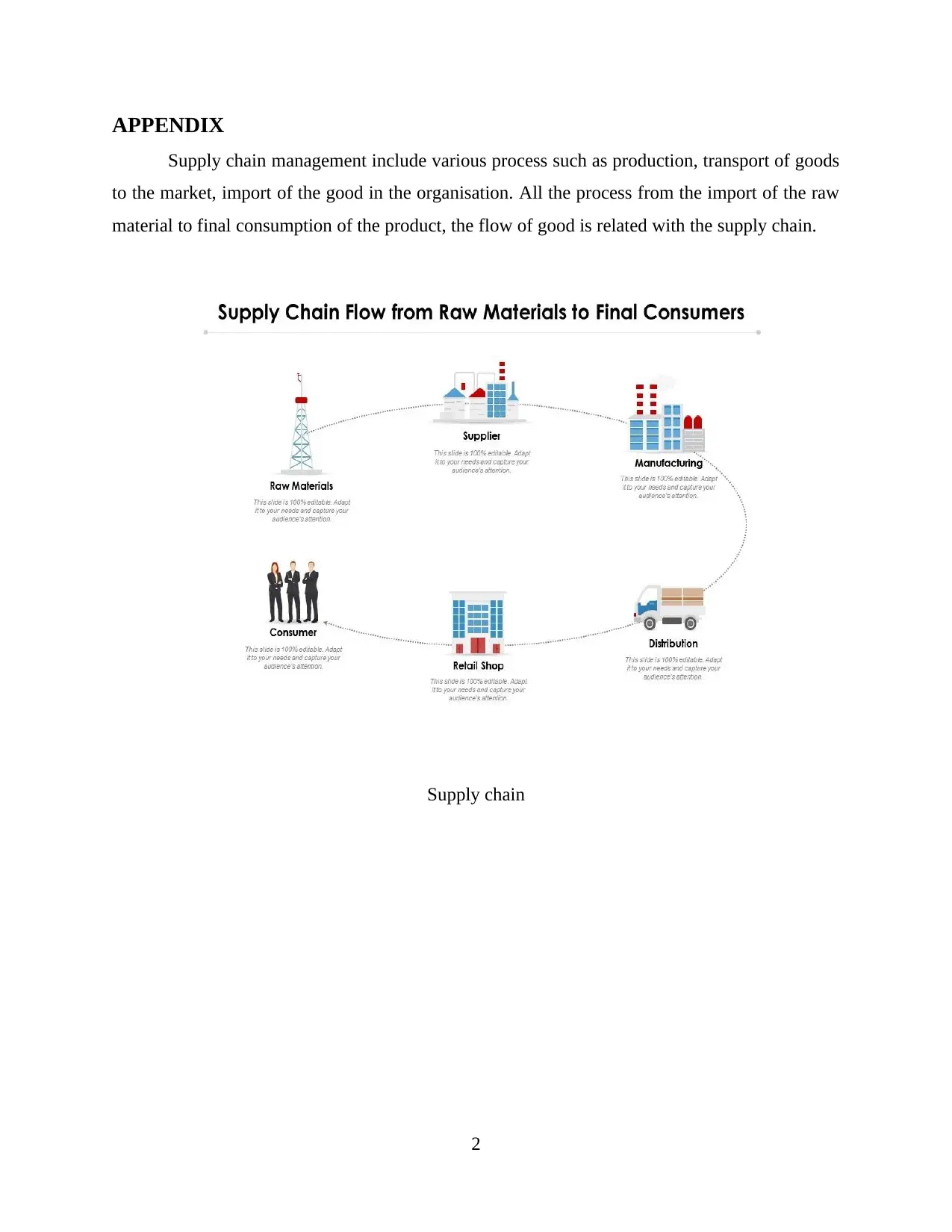
Supply chain management include various process such as production, transport of goods
to the market, import of the good in the organisation. All the process from the import of the raw
material to final consumption of the product, the flow of good is related with the supply chain.
Supply chain
2
Supply chain management include various process such as production, transport of goods
to the market, import of the good in the organisation. All the process from the import of the raw
material to final consumption of the product, the flow of good is related with the supply chain.
Supply chain
2

1 out of 10


Related Documents


Your All-in-One AI-Powered Toolkit for Academic Success.
+13062052269
info@desklib.com
Available 24*7 on WhatsApp / Email
![[object Object]](/_next/static/media/star-bottom.7253800d.svg)
Unlock your academic potential
Copyright © 2020–2026 A2Z Services. All Rights Reserved. Developed and managed by ZUCOL.