BPM Project Management Report: First Antenna Quality Analysis
VerifiedAdded on 2022/08/18
|31
|5985
|452
Report
AI Summary
This report provides a comprehensive analysis of the project management challenges faced by First Antenna Pty, a designer and supplier of communications hardware for the automotive industry. The company is experiencing quality issues with parts from a new factory, impacting the production of a GPS/Glonass aerial for a major automotive manufacturer. The report explores the relationship between project management (PM) and quality management (QM), emphasizing the importance of QM in delivering successful projects. It discusses the implementation of a quality management framework based on ISO 9001:2015, along with specific steps to improve product quality, including defining quality from the customer's perspective and developing an understanding of the cost of quality. The report also examines quality control tools and techniques, the benefits of a structured project management approach, and tactics to reduce quality problems. Furthermore, it addresses customer benefits from the new approach, actions to improve the situation, and the importance of continuous improvement throughout the project lifecycle. The report concludes by emphasizing the interrelation between quality management and project management and the need for a holistic approach to address quality issues within First Antenna Pty's supply chain.
Running head: BPM
Business Project Management
Name of Student
Name of University
Author Note
Business Project Management
Name of Student
Name of University
Author Note

Paraphrase This Document
Need a fresh take? Get an instant paraphrase of this document with our AI Paraphraser
1
Table of Contents
Part A-General Overview....................................................................................................3
Introduction......................................................................................................................3
1. Relation between PM and QM....................................................................................4
2. Steps for Improving Quality of Product at First Antenna Pty (FA)............................7
2.1. Quality Management Framework.............................................................................7
2.2. Quality Control Tools and Techniques...................................................................10
2.3. Continuous Improvement.......................................................................................10
2.4. Benefits of Project Quality Management...............................................................11
3. Strengths of a Structured Project Management Approach: PMM.............................12
4. Tactics and Measures for implementing new Approach and to Reduce Quality
Problems....................................................................................................................................13
5. Customer Benefit from new Approach......................................................................16
6. Actions to Improve the Situation...............................................................................16
Conclusion.....................................................................................................................18
Part B Project Planning......................................................................................................19
Part C-Budget Creation......................................................................................................21
First Task.......................................................................................................................21
Second Task...................................................................................................................21
References..........................................................................................................................23
Table of Contents
Part A-General Overview....................................................................................................3
Introduction......................................................................................................................3
1. Relation between PM and QM....................................................................................4
2. Steps for Improving Quality of Product at First Antenna Pty (FA)............................7
2.1. Quality Management Framework.............................................................................7
2.2. Quality Control Tools and Techniques...................................................................10
2.3. Continuous Improvement.......................................................................................10
2.4. Benefits of Project Quality Management...............................................................11
3. Strengths of a Structured Project Management Approach: PMM.............................12
4. Tactics and Measures for implementing new Approach and to Reduce Quality
Problems....................................................................................................................................13
5. Customer Benefit from new Approach......................................................................16
6. Actions to Improve the Situation...............................................................................16
Conclusion.....................................................................................................................18
Part B Project Planning......................................................................................................19
Part C-Budget Creation......................................................................................................21
First Task.......................................................................................................................21
Second Task...................................................................................................................21
References..........................................................................................................................23
2
Appendix............................................................................................................................27
B1: Gantt chart Duration 4 Months...............................................................................27
B2: Gantt Chart Duration 3 Months..............................................................................28
C1: Budget.....................................................................................................................29
C2: Revised Budget.......................................................................................................30
Appendix............................................................................................................................27
B1: Gantt chart Duration 4 Months...............................................................................27
B2: Gantt Chart Duration 3 Months..............................................................................28
C1: Budget.....................................................................................................................29
C2: Revised Budget.......................................................................................................30
⊘ This is a preview!⊘
Do you want full access?
Subscribe today to unlock all pages.

Trusted by 1+ million students worldwide
3
Part A-General Overview
Introduction
Project Management can be described as a practice of initiating, planning, execution and
controlling a project to meet a specific project goal. The success of any project depends on the
accurateness of project management (Todorović et al. 2015). The project success is mostly
measured in terms of cost, time and quality. Turner has indicated five functions of project
management which incorporates, defining the project scope, organization of the project and
management of the triple constraint such as the time, cost and duration.
The company First Antenna is a supplier and designer of communications hardware
needed for automotive and industrial application. The company is presently tied up in a project
that aims in integrating and producing a GPS/Glonass aerial for a certain manufacturer’s newest
vehicle programme. However, there are several issues that are being faced by the project team.
The key issue that is being faced by the management is that the parts for testing sent from the
new factory are majorly inferior to the original specification, which is causing multiple failure in
the entire testing process. The goal of this part of the report is to deliver a general overview of
the relationship between project management (PM) and quality management (QM). QM is
integral for delivering successful project. The necessary steps that are needed to be taken to
improve the product developed at First antenna is discussed along with the strengths of the
chosen PM approach. The quality problems that are persisting in First Antenna are needed to be
addressed and for that certain key measures are needed to be implemented to reduce quality
issues that are being by First Antenna Pty. The benefit a customer can realize with the new
approach is further evaluated in the following sections.
Part A-General Overview
Introduction
Project Management can be described as a practice of initiating, planning, execution and
controlling a project to meet a specific project goal. The success of any project depends on the
accurateness of project management (Todorović et al. 2015). The project success is mostly
measured in terms of cost, time and quality. Turner has indicated five functions of project
management which incorporates, defining the project scope, organization of the project and
management of the triple constraint such as the time, cost and duration.
The company First Antenna is a supplier and designer of communications hardware
needed for automotive and industrial application. The company is presently tied up in a project
that aims in integrating and producing a GPS/Glonass aerial for a certain manufacturer’s newest
vehicle programme. However, there are several issues that are being faced by the project team.
The key issue that is being faced by the management is that the parts for testing sent from the
new factory are majorly inferior to the original specification, which is causing multiple failure in
the entire testing process. The goal of this part of the report is to deliver a general overview of
the relationship between project management (PM) and quality management (QM). QM is
integral for delivering successful project. The necessary steps that are needed to be taken to
improve the product developed at First antenna is discussed along with the strengths of the
chosen PM approach. The quality problems that are persisting in First Antenna are needed to be
addressed and for that certain key measures are needed to be implemented to reduce quality
issues that are being by First Antenna Pty. The benefit a customer can realize with the new
approach is further evaluated in the following sections.
Paraphrase This Document
Need a fresh take? Get an instant paraphrase of this document with our AI Paraphraser
4
1. Relation between PM and QM
This section of the report aims in establishing a relationship between project management
and quality management. The quality of a project can be described as the expectations of the
customers and stakeholders from a particular project or a product. The quality management is
linked with operations management. Improving the internal operations and the techniques used
to implement a project can help in improving the overall quality of the project.
Quality Management (QM), is a process that ascertain that the project activities which are
essential for planning, designing and execution of a project, are efficient in relation to the set
objectives and the performance of an undertaken project (Goetsch and Davis 2014). Quality
management is continuous process that continues throughout the execution phase of a project.
QM and PM is complementary. QM process helps in emphasizing the satisfaction of the
customers and the underlying belief associated with the quality leads and the satisfaction of the
customers. The process of QM mainly encompasses the processes and activities needed to
achieve a product of desired quality and to ascertain that the project deliverables meet the
required project quality. The QM process is integral to manage the needs and expectations of the
customer. Thus, this process has an integral role to play in project management as well. The total
Quality Management or TQM ensure long term accomplishment in a project and customer
satisfaction and hence it has an integral role to play in PM. It is n holistic approach of
management of the quality issues persisting in an Organization (Oakland 2014).
A structured QM process sets a standard baseline for the project performance that helps
in evaluating whether the project is meeting the expected standard. Any negative variance in the
performance level indicate that the project has failed to meet the stakeholders’ expectations or
1. Relation between PM and QM
This section of the report aims in establishing a relationship between project management
and quality management. The quality of a project can be described as the expectations of the
customers and stakeholders from a particular project or a product. The quality management is
linked with operations management. Improving the internal operations and the techniques used
to implement a project can help in improving the overall quality of the project.
Quality Management (QM), is a process that ascertain that the project activities which are
essential for planning, designing and execution of a project, are efficient in relation to the set
objectives and the performance of an undertaken project (Goetsch and Davis 2014). Quality
management is continuous process that continues throughout the execution phase of a project.
QM and PM is complementary. QM process helps in emphasizing the satisfaction of the
customers and the underlying belief associated with the quality leads and the satisfaction of the
customers. The process of QM mainly encompasses the processes and activities needed to
achieve a product of desired quality and to ascertain that the project deliverables meet the
required project quality. The QM process is integral to manage the needs and expectations of the
customer. Thus, this process has an integral role to play in project management as well. The total
Quality Management or TQM ensure long term accomplishment in a project and customer
satisfaction and hence it has an integral role to play in PM. It is n holistic approach of
management of the quality issues persisting in an Organization (Oakland 2014).
A structured QM process sets a standard baseline for the project performance that helps
in evaluating whether the project is meeting the expected standard. Any negative variance in the
performance level indicate that the project has failed to meet the stakeholders’ expectations or
5
the customers (Colledani et al. 2014). QM and Quality Assurance (QA) is related to the
continuous improvement process in PM. The QM process verifies the accepted level of quality
of the product while the QA process ensure that the product of accepted quality level is being
deliver to the client.
Improper Quality management or absence of a planned quality management process has
resulted in facing several quality issues in Antenna Pty product development. Quality planning is
required to be done at an initial stage of the project execution so that it can be followed
throughout the execution phase (Garstenauer, Blackburn and Olson 2014). It is necessary to
confirm effective QM and quality improvement process while planning a project to ascertain that
the clients’ expectation and the expectations of the stakeholders are met.
The QM process runs parallel with the project execution process and therefore, it can be
said the QM and Project management is interlinked (Kafetzopoulos, Psomas and Gotzamani
2015). Absence of QM or presence of an ineffective QM process often result in project delay or
project failure.
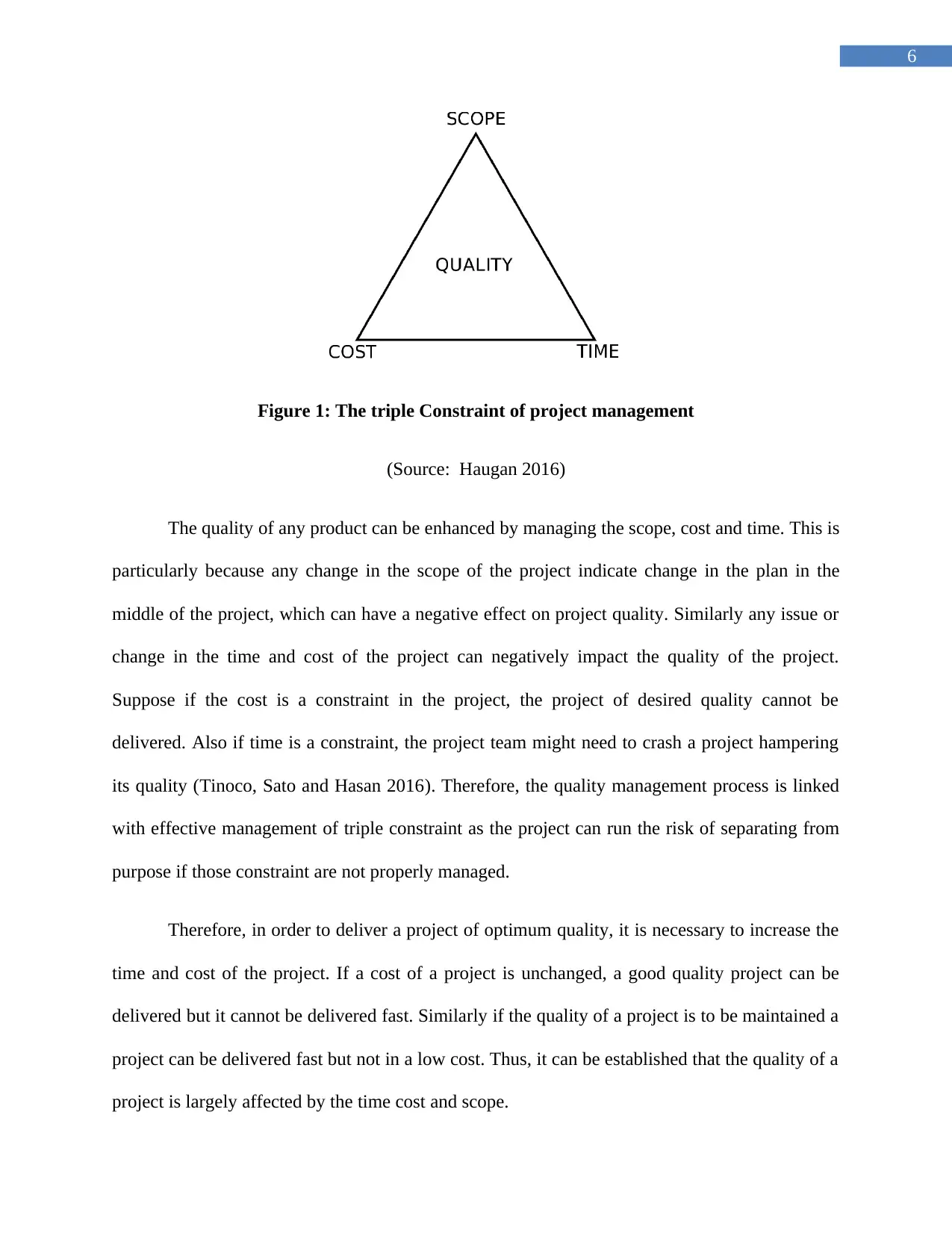
The quality management process is linked with project management as the desired quality
of a product that is being developed can be achieved by managing the triple constraint of project
management, which is time cost and scope. The triple constraint of project management is
indicated in the following figure-
the customers (Colledani et al. 2014). QM and Quality Assurance (QA) is related to the
continuous improvement process in PM. The QM process verifies the accepted level of quality
of the product while the QA process ensure that the product of accepted quality level is being
deliver to the client.
Improper Quality management or absence of a planned quality management process has
resulted in facing several quality issues in Antenna Pty product development. Quality planning is
required to be done at an initial stage of the project execution so that it can be followed
throughout the execution phase (Garstenauer, Blackburn and Olson 2014). It is necessary to
confirm effective QM and quality improvement process while planning a project to ascertain that
the clients’ expectation and the expectations of the stakeholders are met.
The QM process runs parallel with the project execution process and therefore, it can be
said the QM and Project management is interlinked (Kafetzopoulos, Psomas and Gotzamani
2015). Absence of QM or presence of an ineffective QM process often result in project delay or
project failure.
The quality management process is linked with project management as the desired quality
of a product that is being developed can be achieved by managing the triple constraint of project
management, which is time cost and scope. The triple constraint of project management is
indicated in the following figure-
⊘ This is a preview!⊘
Do you want full access?
Subscribe today to unlock all pages.
Trusted by 1+ million students worldwide
6
Figure 1: The triple Constraint of project management
(Source: Haugan 2016)
The quality of any product can be enhanced by managing the scope, cost and time. This is
particularly because any change in the scope of the project indicate change in the plan in the
middle of the project, which can have a negative effect on project quality. Similarly any issue or
change in the time and cost of the project can negatively impact the quality of the project.
Suppose if the cost is a constraint in the project, the project of desired quality cannot be
delivered. Also if time is a constraint, the project team might need to crash a project hampering
its quality (Tinoco, Sato and Hasan 2016). Therefore, the quality management process is linked
with effective management of triple constraint as the project can run the risk of separating from
purpose if those constraint are not properly managed.
Therefore, in order to deliver a project of optimum quality, it is necessary to increase the
time and cost of the project. If a cost of a project is unchanged, a good quality project can be
delivered but it cannot be delivered fast. Similarly if the quality of a project is to be maintained a
project can be delivered fast but not in a low cost. Thus, it can be established that the quality of a
project is largely affected by the time cost and scope.
Figure 1: The triple Constraint of project management
(Source: Haugan 2016)
The quality of any product can be enhanced by managing the scope, cost and time. This is
particularly because any change in the scope of the project indicate change in the plan in the
middle of the project, which can have a negative effect on project quality. Similarly any issue or
change in the time and cost of the project can negatively impact the quality of the project.
Suppose if the cost is a constraint in the project, the project of desired quality cannot be
delivered. Also if time is a constraint, the project team might need to crash a project hampering
its quality (Tinoco, Sato and Hasan 2016). Therefore, the quality management process is linked
with effective management of triple constraint as the project can run the risk of separating from
purpose if those constraint are not properly managed.
Therefore, in order to deliver a project of optimum quality, it is necessary to increase the
time and cost of the project. If a cost of a project is unchanged, a good quality project can be
delivered but it cannot be delivered fast. Similarly if the quality of a project is to be maintained a
project can be delivered fast but not in a low cost. Thus, it can be established that the quality of a
project is largely affected by the time cost and scope.
Paraphrase This Document
Need a fresh take? Get an instant paraphrase of this document with our AI Paraphraser
7
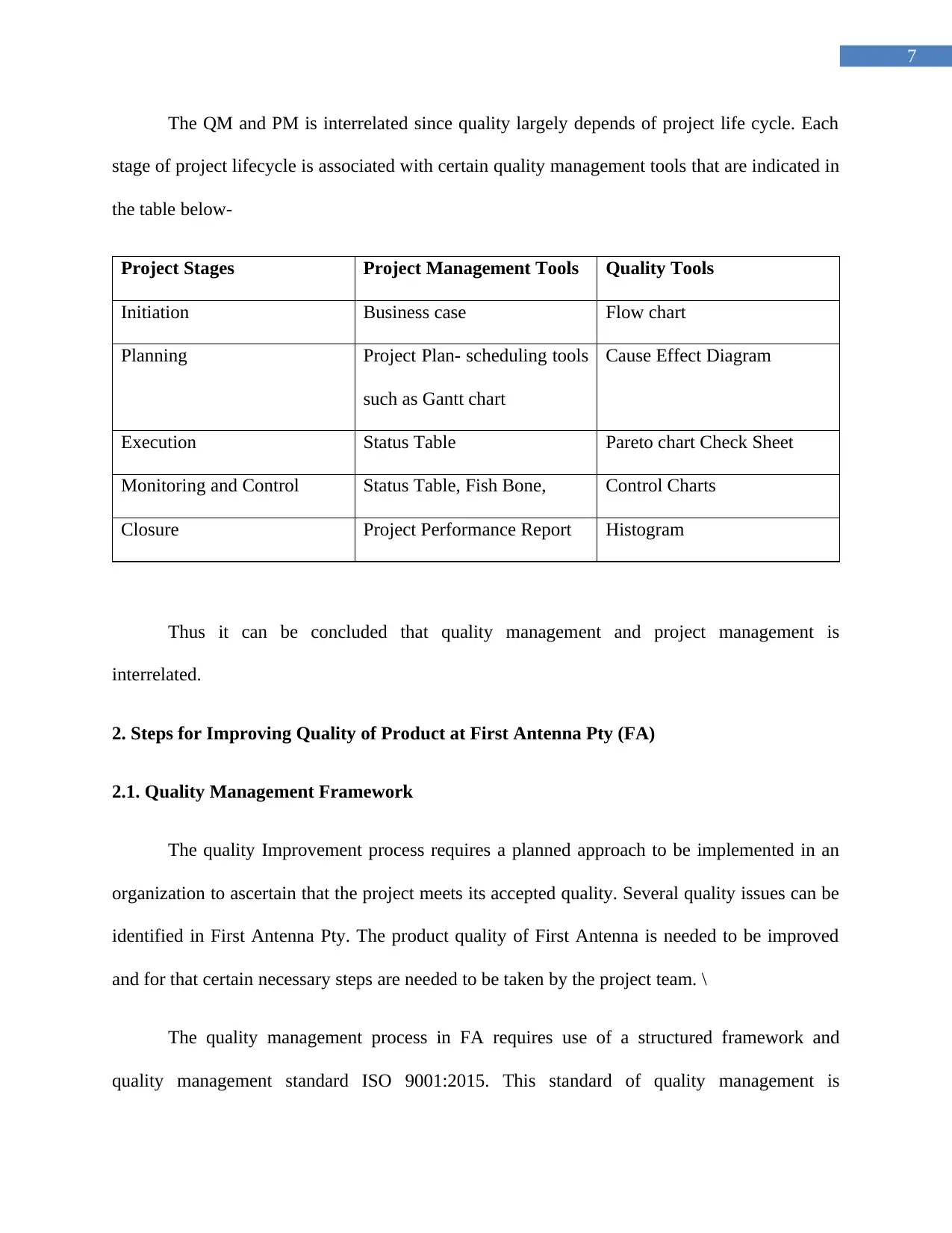
The QM and PM is interrelated since quality largely depends of project life cycle. Each
stage of project lifecycle is associated with certain quality management tools that are indicated in
the table below-
Project Stages Project Management Tools Quality Tools
Initiation Business case Flow chart
Planning Project Plan- scheduling tools
such as Gantt chart
Cause Effect Diagram
Execution Status Table Pareto chart Check Sheet
Monitoring and Control Status Table, Fish Bone, Control Charts
Closure Project Performance Report Histogram
Thus it can be concluded that quality management and project management is
interrelated.
2. Steps for Improving Quality of Product at First Antenna Pty (FA)
2.1. Quality Management Framework
The quality Improvement process requires a planned approach to be implemented in an
organization to ascertain that the project meets its accepted quality. Several quality issues can be
identified in First Antenna Pty. The product quality of First Antenna is needed to be improved
and for that certain necessary steps are needed to be taken by the project team. \
The quality management process in FA requires use of a structured framework and
quality management standard ISO 9001:2015. This standard of quality management is
The QM and PM is interrelated since quality largely depends of project life cycle. Each
stage of project lifecycle is associated with certain quality management tools that are indicated in
the table below-
Project Stages Project Management Tools Quality Tools
Initiation Business case Flow chart
Planning Project Plan- scheduling tools
such as Gantt chart
Cause Effect Diagram
Execution Status Table Pareto chart Check Sheet
Monitoring and Control Status Table, Fish Bone, Control Charts
Closure Project Performance Report Histogram
Thus it can be concluded that quality management and project management is
interrelated.
2. Steps for Improving Quality of Product at First Antenna Pty (FA)
2.1. Quality Management Framework
The quality Improvement process requires a planned approach to be implemented in an
organization to ascertain that the project meets its accepted quality. Several quality issues can be
identified in First Antenna Pty. The product quality of First Antenna is needed to be improved
and for that certain necessary steps are needed to be taken by the project team. \
The quality management process in FA requires use of a structured framework and
quality management standard ISO 9001:2015. This standard of quality management is
8
recommended for FA as it effectively specifies the requirements of managing quality of a system
or a product. The key quality issue that is observed in FA is that the product coming through
testing from new factory is well below the specifications. This can be managed by
implementation of ISO 9001:2015, which has the following to principle-
1. The framework demonstrates the need to deliver consistent product and services to
meet customer. Statutory and regulatory requirement (Wilson and Campbell 2016).
2. The framework aims in enhancement of customer satisfaction through effective
application of process improvement in a system.
The implementation of ISO 9001:2015 framework will therefore, help in addressing the
quality issues faced in FA. The framework specifies the requirements for a quality management
system within an organization. The recommendations for quality improvements on basis of ISO
9001:2015 framework in FA are indicated as follows-
- A Quality management System (QMS) is to be implemented in FA that will include
management of human resources as well as the work environment
- Implementation of internal audit practices to measure the efficiency of the
implemented QMS
Apart from implementation of ISO 9001:2015 framework, the key steps that are needed
to be taken to bring in improvement in the quality of product provision at First Antenna Pty are
indicated as follows-
1. Defining the Quality from Customer Perspective: The end product is to be delivered
to the customers and is to be accepted by the customers. Hence it is necessary to define the
recommended for FA as it effectively specifies the requirements of managing quality of a system
or a product. The key quality issue that is observed in FA is that the product coming through
testing from new factory is well below the specifications. This can be managed by
implementation of ISO 9001:2015, which has the following to principle-
1. The framework demonstrates the need to deliver consistent product and services to
meet customer. Statutory and regulatory requirement (Wilson and Campbell 2016).
2. The framework aims in enhancement of customer satisfaction through effective
application of process improvement in a system.
The implementation of ISO 9001:2015 framework will therefore, help in addressing the
quality issues faced in FA. The framework specifies the requirements for a quality management
system within an organization. The recommendations for quality improvements on basis of ISO
9001:2015 framework in FA are indicated as follows-
- A Quality management System (QMS) is to be implemented in FA that will include
management of human resources as well as the work environment
- Implementation of internal audit practices to measure the efficiency of the
implemented QMS
Apart from implementation of ISO 9001:2015 framework, the key steps that are needed
to be taken to bring in improvement in the quality of product provision at First Antenna Pty are
indicated as follows-
1. Defining the Quality from Customer Perspective: The end product is to be delivered
to the customers and is to be accepted by the customers. Hence it is necessary to define the
⊘ This is a preview!⊘
Do you want full access?
Subscribe today to unlock all pages.
Trusted by 1+ million students worldwide
9
quality of the product from customer perspective. Once the needed quality is defined, it would be
easier to manage the quality and deliver a product of expected quality.
2. Developing the organizational understanding of Cost of Quality: The quality issues
in First Antenna Pty. Are quite prominent from the parts that are being sent for testing in the new
factory are well below specification. Therefore, after defining the quality from the customer
perspective, it is integral to develop the organizational understanding of the cost of quality
(Shaari et al. 2015). Detailed cost estimation in relation to the quality repairs will help in
effective implementation of quality control in the project undertaken by First Antenna Pty.
3. Solving Problems Completely: The root cause of the problems at First Antenna Pty. Is
needed to be identified and fixed rather that fixing the symptoms of the problem. This is more
integral for the manufacturing process.
Employing Strong Process Discipline: After finding solution to the existing problem, it
is quite integral to employ a strong process discipline to monitor the entire manufacturing
process to ensure that the product that is being manufactured meets the expected quality
standard. Monitoring the entire quality management process is needed to maintain a good
consistency and understanding of the products that are being developed.
The above defined steps are needed to be taken by the entire manufacturing and the
project management team of First Antenna Pty to bring on improvement in the quality of product
provision. Apart from that, implementation of the TQM approach in Antenna becomes a
necessity. Quality management or TQM is a continuous improvement process and therefore, is
associated with project lifecycle. Each stage of a project lifecycle, should involve quality
quality of the product from customer perspective. Once the needed quality is defined, it would be
easier to manage the quality and deliver a product of expected quality.
2. Developing the organizational understanding of Cost of Quality: The quality issues
in First Antenna Pty. Are quite prominent from the parts that are being sent for testing in the new
factory are well below specification. Therefore, after defining the quality from the customer
perspective, it is integral to develop the organizational understanding of the cost of quality
(Shaari et al. 2015). Detailed cost estimation in relation to the quality repairs will help in
effective implementation of quality control in the project undertaken by First Antenna Pty.
3. Solving Problems Completely: The root cause of the problems at First Antenna Pty. Is
needed to be identified and fixed rather that fixing the symptoms of the problem. This is more
integral for the manufacturing process.
Employing Strong Process Discipline: After finding solution to the existing problem, it
is quite integral to employ a strong process discipline to monitor the entire manufacturing
process to ensure that the product that is being manufactured meets the expected quality
standard. Monitoring the entire quality management process is needed to maintain a good
consistency and understanding of the products that are being developed.
The above defined steps are needed to be taken by the entire manufacturing and the
project management team of First Antenna Pty to bring on improvement in the quality of product
provision. Apart from that, implementation of the TQM approach in Antenna becomes a
necessity. Quality management or TQM is a continuous improvement process and therefore, is
associated with project lifecycle. Each stage of a project lifecycle, should involve quality
Paraphrase This Document
Need a fresh take? Get an instant paraphrase of this document with our AI Paraphraser
10
checking and quality assurance to ensure that a product of accepted quality is delivered to the
client.
2.2. Quality Control Tools and Techniques
FA needs to enhance the quality of the parts coming through testing to a particular
specification. FA lacks the strategic use of 7 basis quality tools, which are check sheet, control
chart, pareto chart, flow chart, histogram, cause and effect diagram and scatter diagram (Goetsch
and Davis 2014). These quality control tools can help the project team to track the quality lag in
the products developed at the new factory.
Apart from that, the use of inspection is recommended. Quality inspection helps in
measuring and testing one or more products as per the requirements and compliance. Thus, the
use of same can improve the quality issues of the products tested at the new factory of FA.
Along with inspection, the use of DEO and FEMA is recommended as well. Design of
Experiments can be described as a branch of applied statistics that deals with planning,
conducting, analyzing and interpreting controlled investigation to evaluate the factors that
control the value of a parameter. FA needs to investigate the key reason of the quality issue and
therefore use of DEO is recommended.
Failure Mode and Effects Analysis is a methodology that is recommended for FA as a
steep of improving the quality (Shui et al. 2015). This will help FA to identify the failures during
the design stage to plan the possible improvements in the project. Along with that, FA requires to
undertake statistical process control to identify the processes at the new factory that are operating
efficiently.
checking and quality assurance to ensure that a product of accepted quality is delivered to the
client.
2.2. Quality Control Tools and Techniques
FA needs to enhance the quality of the parts coming through testing to a particular
specification. FA lacks the strategic use of 7 basis quality tools, which are check sheet, control
chart, pareto chart, flow chart, histogram, cause and effect diagram and scatter diagram (Goetsch
and Davis 2014). These quality control tools can help the project team to track the quality lag in
the products developed at the new factory.
Apart from that, the use of inspection is recommended. Quality inspection helps in
measuring and testing one or more products as per the requirements and compliance. Thus, the
use of same can improve the quality issues of the products tested at the new factory of FA.
Along with inspection, the use of DEO and FEMA is recommended as well. Design of
Experiments can be described as a branch of applied statistics that deals with planning,
conducting, analyzing and interpreting controlled investigation to evaluate the factors that
control the value of a parameter. FA needs to investigate the key reason of the quality issue and
therefore use of DEO is recommended.
Failure Mode and Effects Analysis is a methodology that is recommended for FA as a
steep of improving the quality (Shui et al. 2015). This will help FA to identify the failures during
the design stage to plan the possible improvements in the project. Along with that, FA requires to
undertake statistical process control to identify the processes at the new factory that are operating
efficiently.
11
2.3. Continuous Improvement
Continuous improvement is another step that is recommended to improve the quality of
the product and the parts from the new factory. For continuous improvement, the use of TQM is
proposed. The principle of TQM is indicated in the image below-
Figure 2: Representing the principles of TQM
(Source: Oakland 2014)
TQM is an effective tool of quality improvement that make use of strategy, data and
proper communication to integrate quality discipline into culture and activities. The figure above
indicates the eight principles of TQM. TQM ensures fact based decision making and therefore,
the use of this particular tool that help FA in finding creative ways of continual improvement and
take effective decisions related to quality improvement.
2.4. Benefits of Project Quality Management
2.3. Continuous Improvement
Continuous improvement is another step that is recommended to improve the quality of
the product and the parts from the new factory. For continuous improvement, the use of TQM is
proposed. The principle of TQM is indicated in the image below-
Figure 2: Representing the principles of TQM
(Source: Oakland 2014)
TQM is an effective tool of quality improvement that make use of strategy, data and
proper communication to integrate quality discipline into culture and activities. The figure above
indicates the eight principles of TQM. TQM ensures fact based decision making and therefore,
the use of this particular tool that help FA in finding creative ways of continual improvement and
take effective decisions related to quality improvement.
2.4. Benefits of Project Quality Management
⊘ This is a preview!⊘
Do you want full access?
Subscribe today to unlock all pages.
Trusted by 1+ million students worldwide

1 out of 31


Related Documents


Your All-in-One AI-Powered Toolkit for Academic Success.
+13062052269
info@desklib.com
Available 24*7 on WhatsApp / Email
![[object Object]](/_next/static/media/star-bottom.7253800d.svg)
Unlock your academic potential
Copyright © 2020–2026 A2Z Services. All Rights Reserved. Developed and managed by ZUCOL.