The Laws of Supply and Demand and Economic Theories: A Detailed Report
VerifiedAdded on 2023/01/05
|16
|3325
|37
Report
AI Summary
This report delves into the fundamental economic principles of supply and demand, exploring their application within micro and macroeconomics, with a specific focus on the oil industry. It demonstrates the law of demand through tables and graphical representations, illustrating how price changes affect the quantity demanded. The report also examines factors that influence market changes, such as wage, usage, environment and preferences. Furthermore, it presents the law of supply, explaining its relationship with price and market dynamics. The report also offers an overview of key economic theories of the mid-twentieth century and modern era, including the work of Karl Marx, the constant model, and neo-classical sociology, as well as behavioral economics and its impact on decision-making. It concludes by discussing the role of biases and inconsistencies in influencing economic behavior.
The Laws of Supply and
Demand
Demand

Paraphrase This Document
Need a fresh take? Get an instant paraphrase of this document with our AI Paraphraser
Table of Contents
Introduction......................................................................................................................................3
Task 1...............................................................................................................................................4
Demonstrate rule of demand:.......................................................................................................4
Factors that influence market change:.........................................................................................8
Demonstrate rule of supply..........................................................................................................8
TASK 2..........................................................................................................................................10
Conclusion.....................................................................................................................................15
Introduction......................................................................................................................................3
Task 1...............................................................................................................................................4
Demonstrate rule of demand:.......................................................................................................4
Factors that influence market change:.........................................................................................8
Demonstrate rule of supply..........................................................................................................8
TASK 2..........................................................................................................................................10
Conclusion.....................................................................................................................................15
Introduction
Economics is a philosophy that regulates the development, delivery and use of company's
product components. This theory can be split into two broad categories: portfolio and micro-
economics. It is analyzing the behavior of the aggregate economy (Clark and Schumacher,
2017). Modern market analysis is distinguished by the transformation of business strategy in the
industrial world. It includes the procurement of cutting-edge strategies to maximize the income
of the firm. This appraisal is related to the clarity of the legislation on involvement and its
versatility in the sense of the petroleum industry. Configuration 2, as a reflection learned in the
mid 20th century, is based on theoretical frameworks. In contrast to these terms of recent
financial implications, the theories of the 20th century have also been discussed. In this
assessment, the oil sector was provided as a guide in order to consider the various notions of
importance and the rule of grace.
Economics is a philosophy that regulates the development, delivery and use of company's
product components. This theory can be split into two broad categories: portfolio and micro-
economics. It is analyzing the behavior of the aggregate economy (Clark and Schumacher,
2017). Modern market analysis is distinguished by the transformation of business strategy in the
industrial world. It includes the procurement of cutting-edge strategies to maximize the income
of the firm. This appraisal is related to the clarity of the legislation on involvement and its
versatility in the sense of the petroleum industry. Configuration 2, as a reflection learned in the
mid 20th century, is based on theoretical frameworks. In contrast to these terms of recent
financial implications, the theories of the 20th century have also been discussed. In this
assessment, the oil sector was provided as a guide in order to consider the various notions of
importance and the rule of grace.
⊘ This is a preview!⊘
Do you want full access?
Subscribe today to unlock all pages.

Trusted by 1+ million students worldwide
Task 1
Demonstrate rule of demand:
The law of demand lies under micro and macro economics (peribus cartridges). It works kindly
with the law to clarify how market economies allocate resources and determine the costs of the
products and businesses we see in ordinary trade (AMADEO, 2019). The law of interest states
that the amount purchased is different than the cost. At the end of the day, the higher the value,
the lower the amount required. This is done by reducing the amount of available resources. That
is, the buyers use the main units of money they buy to satisfy their most important needs first,
and they use each additional unit of the larger ones to gradually satisfy their needs (S, 2018).
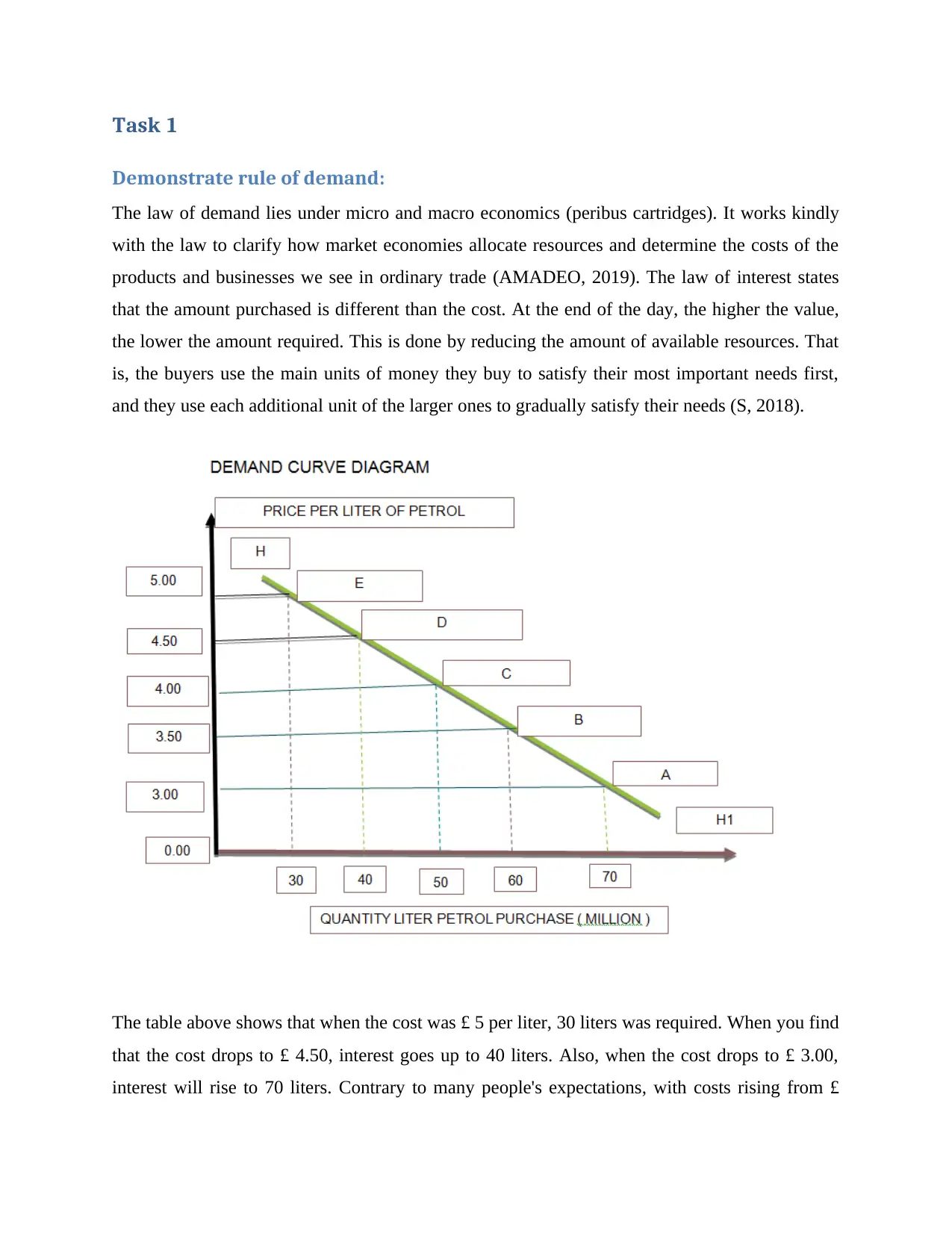
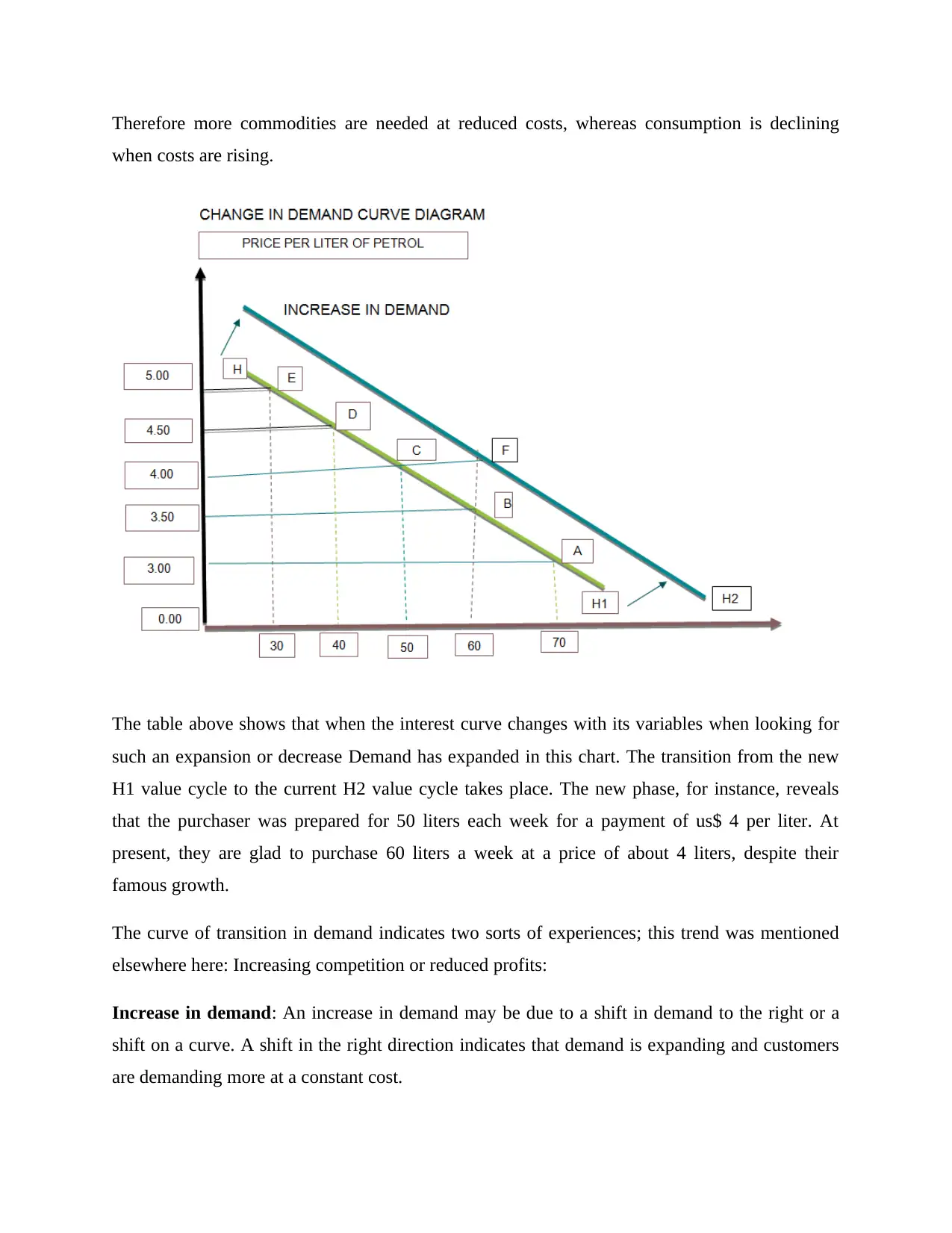
The table above shows that when the cost was £ 5 per liter, 30 liters was required. When you find
that the cost drops to £ 4.50, interest goes up to 40 liters. Also, when the cost drops to £ 3.00,
interest will rise to 70 liters. Contrary to many people's expectations, with costs rising from £
Demonstrate rule of demand:
The law of demand lies under micro and macro economics (peribus cartridges). It works kindly
with the law to clarify how market economies allocate resources and determine the costs of the
products and businesses we see in ordinary trade (AMADEO, 2019). The law of interest states
that the amount purchased is different than the cost. At the end of the day, the higher the value,
the lower the amount required. This is done by reducing the amount of available resources. That
is, the buyers use the main units of money they buy to satisfy their most important needs first,
and they use each additional unit of the larger ones to gradually satisfy their needs (S, 2018).
The table above shows that when the cost was £ 5 per liter, 30 liters was required. When you find
that the cost drops to £ 4.50, interest goes up to 40 liters. Also, when the cost drops to £ 3.00,
interest will rise to 70 liters. Contrary to many people's expectations, with costs rising from £
Paraphrase This Document
Need a fresh take? Get an instant paraphrase of this document with our AI Paraphraser
3.00, interest is down from 70 liters (Whelan and Msefer, 1996). The attraction for 30 liters at
£5.00 demonstrates in the measure E of the HH1 line. The exchange rate is as high as £ 4.50, £
4.00, £ 3.50 and £ 3.00 as normal, to 40, 50, 60 and 70 gallons. The emphasis of D, C, B and A
indicates this. Thus the drop in investment H1 means which petroleum is pursuing growth as its
demand falls. This indicates the delicate link between price and request.
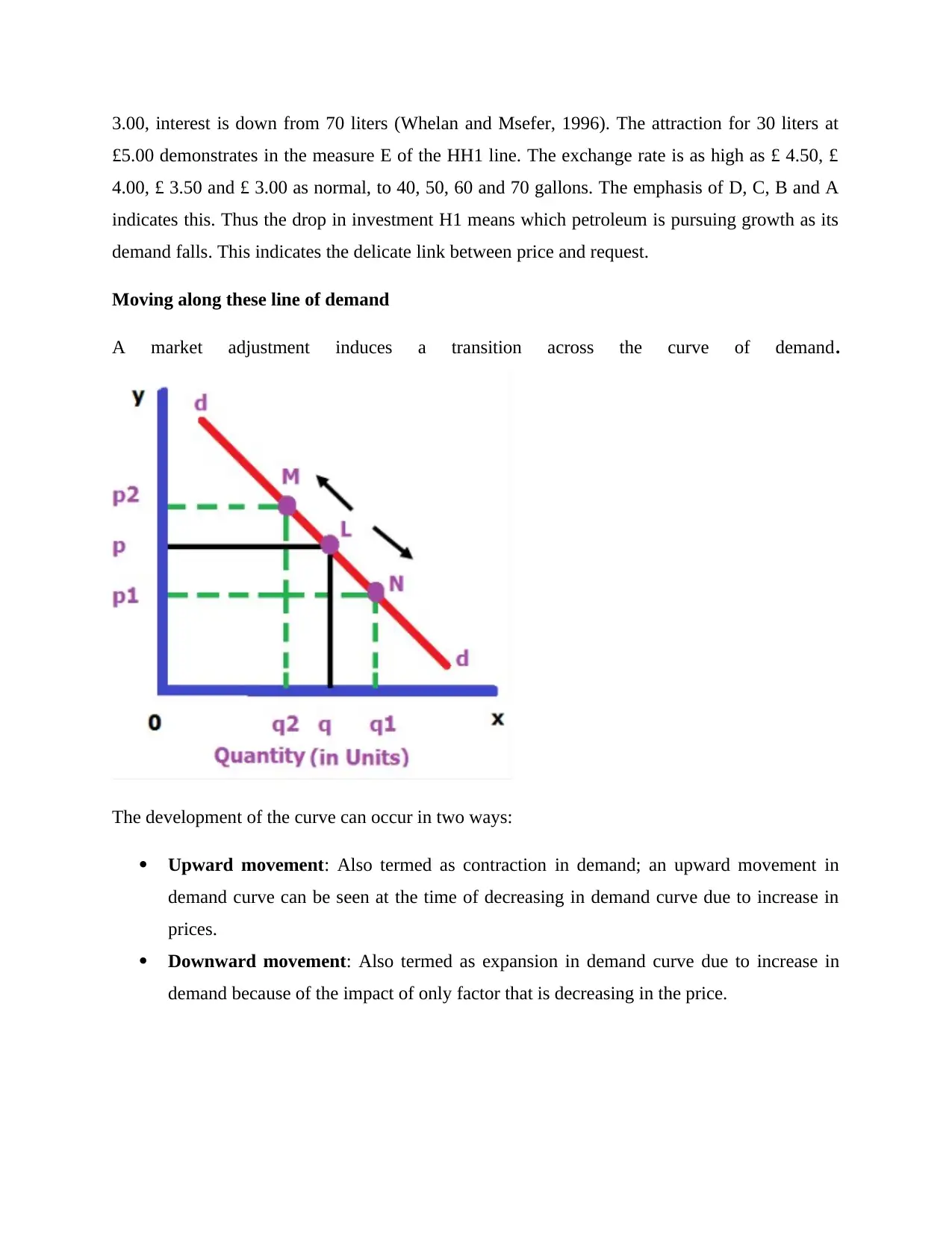
Moving along these line of demand
A market adjustment induces a transition across the curve of demand.
The development of the curve can occur in two ways:
Upward movement: Also termed as contraction in demand; an upward movement in
demand curve can be seen at the time of decreasing in demand curve due to increase in
prices.
Downward movement: Also termed as expansion in demand curve due to increase in
demand because of the impact of only factor that is decreasing in the price.
£5.00 demonstrates in the measure E of the HH1 line. The exchange rate is as high as £ 4.50, £
4.00, £ 3.50 and £ 3.00 as normal, to 40, 50, 60 and 70 gallons. The emphasis of D, C, B and A
indicates this. Thus the drop in investment H1 means which petroleum is pursuing growth as its
demand falls. This indicates the delicate link between price and request.
Moving along these line of demand
A market adjustment induces a transition across the curve of demand.
The development of the curve can occur in two ways:
Upward movement: Also termed as contraction in demand; an upward movement in
demand curve can be seen at the time of decreasing in demand curve due to increase in
prices.
Downward movement: Also termed as expansion in demand curve due to increase in
demand because of the impact of only factor that is decreasing in the price.
Therefore more commodities are needed at reduced costs, whereas consumption is declining
when costs are rising.
The table above shows that when the interest curve changes with its variables when looking for
such an expansion or decrease Demand has expanded in this chart. The transition from the new
H1 value cycle to the current H2 value cycle takes place. The new phase, for instance, reveals
that the purchaser was prepared for 50 liters each week for a payment of us$ 4 per liter. At
present, they are glad to purchase 60 liters a week at a price of about 4 liters, despite their
famous growth.
The curve of transition in demand indicates two sorts of experiences; this trend was mentioned
elsewhere here: Increasing competition or reduced profits:
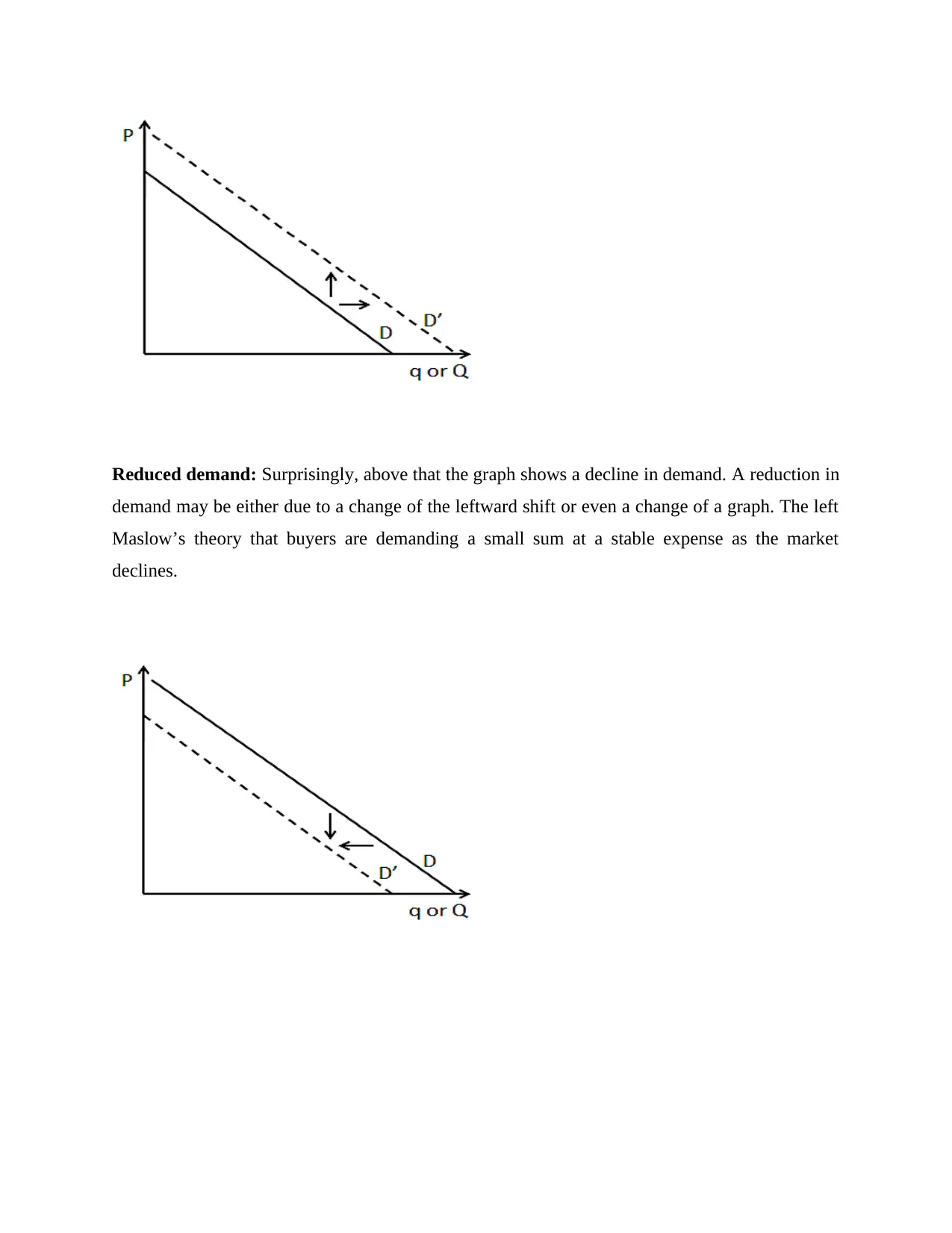
Increase in demand: An increase in demand may be due to a shift in demand to the right or a
shift on a curve. A shift in the right direction indicates that demand is expanding and customers
are demanding more at a constant cost.
when costs are rising.
The table above shows that when the interest curve changes with its variables when looking for
such an expansion or decrease Demand has expanded in this chart. The transition from the new
H1 value cycle to the current H2 value cycle takes place. The new phase, for instance, reveals
that the purchaser was prepared for 50 liters each week for a payment of us$ 4 per liter. At
present, they are glad to purchase 60 liters a week at a price of about 4 liters, despite their
famous growth.
The curve of transition in demand indicates two sorts of experiences; this trend was mentioned
elsewhere here: Increasing competition or reduced profits:
Increase in demand: An increase in demand may be due to a shift in demand to the right or a
shift on a curve. A shift in the right direction indicates that demand is expanding and customers
are demanding more at a constant cost.
⊘ This is a preview!⊘
Do you want full access?
Subscribe today to unlock all pages.
Trusted by 1+ million students worldwide
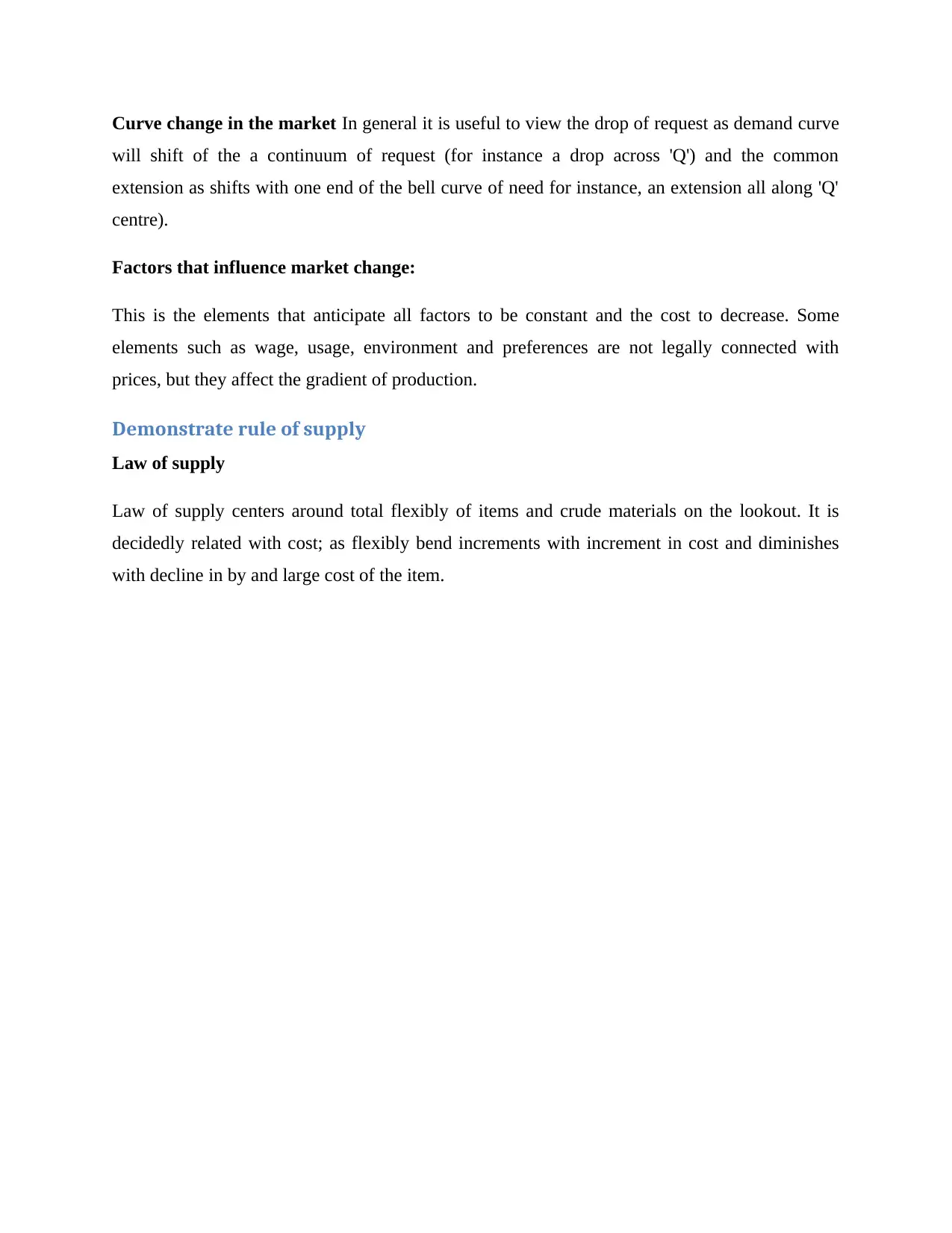
Reduced demand: Surprisingly, above that the graph shows a decline in demand. A reduction in
demand may be either due to a change of the leftward shift or even a change of a graph. The left
Maslow’s theory that buyers are demanding a small sum at a stable expense as the market
declines.
demand may be either due to a change of the leftward shift or even a change of a graph. The left
Maslow’s theory that buyers are demanding a small sum at a stable expense as the market
declines.
Paraphrase This Document
Need a fresh take? Get an instant paraphrase of this document with our AI Paraphraser
Curve change in the market In general it is useful to view the drop of request as demand curve
will shift of the a continuum of request (for instance a drop across 'Q') and the common
extension as shifts with one end of the bell curve of need for instance, an extension all along 'Q'
centre).
Factors that influence market change:
This is the elements that anticipate all factors to be constant and the cost to decrease. Some
elements such as wage, usage, environment and preferences are not legally connected with
prices, but they affect the gradient of production.
Demonstrate rule of supply
Law of supply
Law of supply centers around total flexibly of items and crude materials on the lookout. It is
decidedly related with cost; as flexibly bend increments with increment in cost and diminishes
with decline in by and large cost of the item.
will shift of the a continuum of request (for instance a drop across 'Q') and the common
extension as shifts with one end of the bell curve of need for instance, an extension all along 'Q'
centre).
Factors that influence market change:
This is the elements that anticipate all factors to be constant and the cost to decrease. Some
elements such as wage, usage, environment and preferences are not legally connected with
prices, but they affect the gradient of production.
Demonstrate rule of supply
Law of supply
Law of supply centers around total flexibly of items and crude materials on the lookout. It is
decidedly related with cost; as flexibly bend increments with increment in cost and diminishes
with decline in by and large cost of the item.
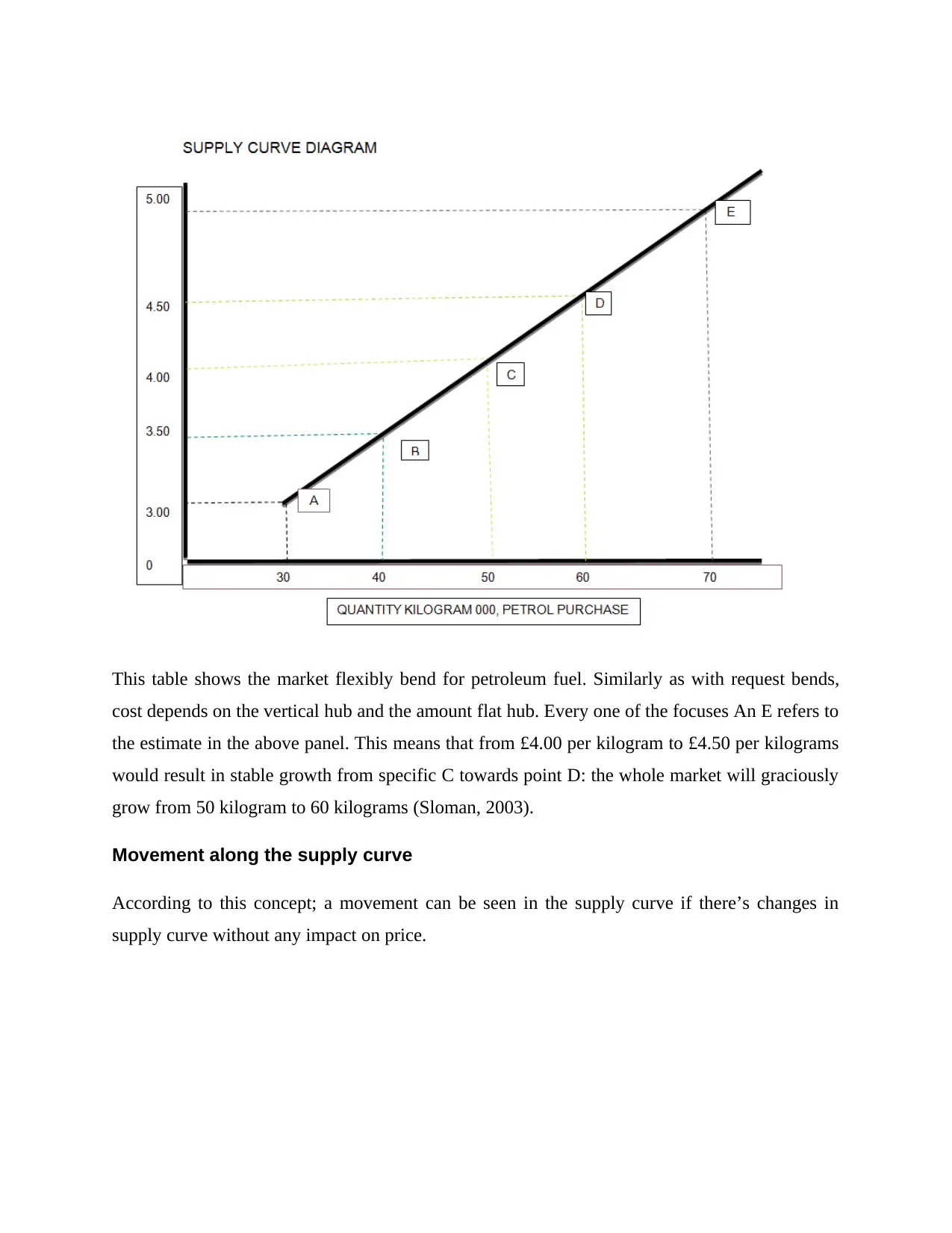
This table shows the market flexibly bend for petroleum fuel. Similarly as with request bends,
cost depends on the vertical hub and the amount flat hub. Every one of the focuses An E refers to
the estimate in the above panel. This means that from £4.00 per kilogram to £4.50 per kilograms
would result in stable growth from specific C towards point D: the whole market will graciously
grow from 50 kilogram to 60 kilograms (Sloman, 2003).
Movement along the supply curve
According to this concept; a movement can be seen in the supply curve if there’s changes in
supply curve without any impact on price.
cost depends on the vertical hub and the amount flat hub. Every one of the focuses An E refers to
the estimate in the above panel. This means that from £4.00 per kilogram to £4.50 per kilograms
would result in stable growth from specific C towards point D: the whole market will graciously
grow from 50 kilogram to 60 kilograms (Sloman, 2003).
Movement along the supply curve
According to this concept; a movement can be seen in the supply curve if there’s changes in
supply curve without any impact on price.
⊘ This is a preview!⊘
Do you want full access?
Subscribe today to unlock all pages.
Trusted by 1+ million students worldwide
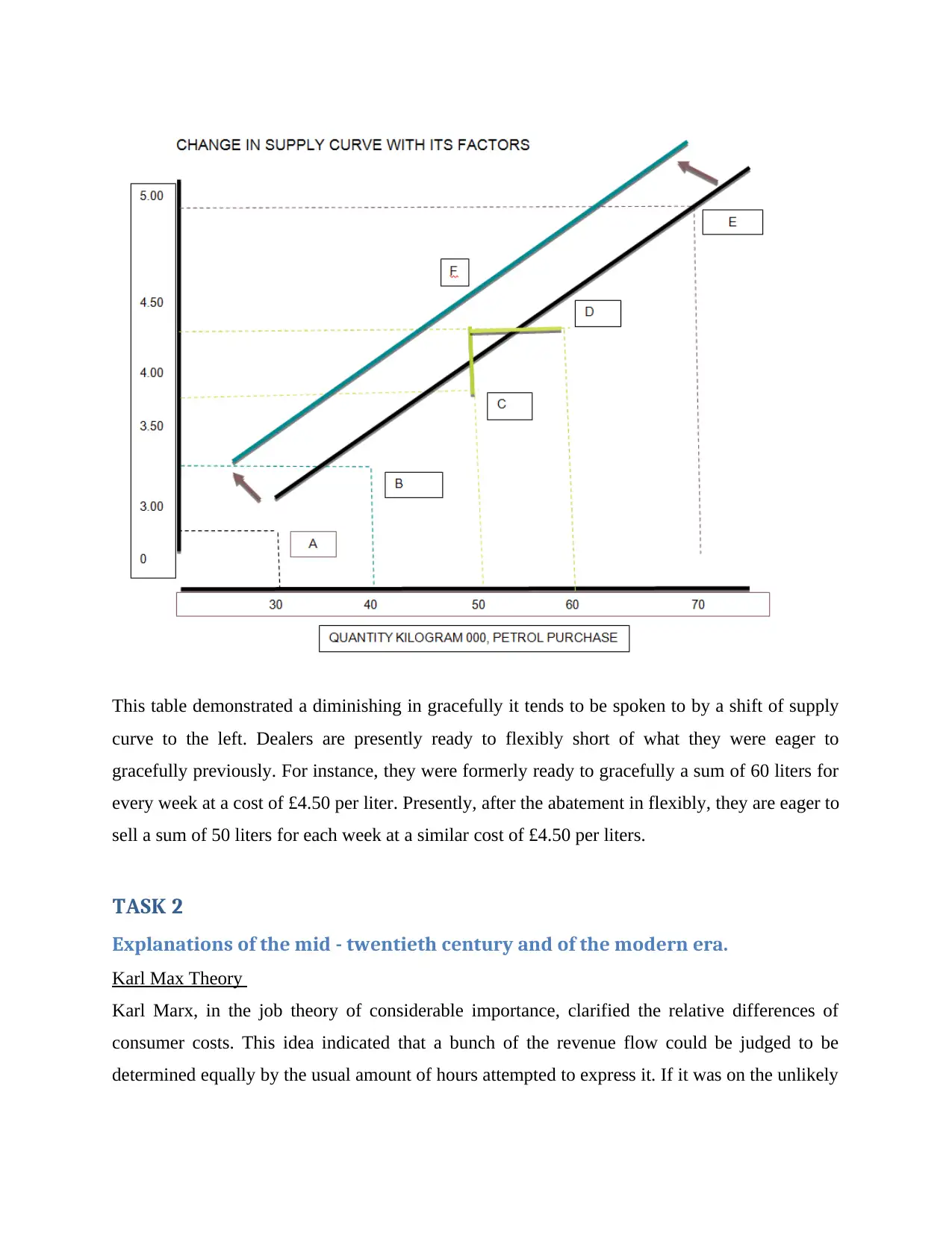
This table demonstrated a diminishing in gracefully it tends to be spoken to by a shift of supply
curve to the left. Dealers are presently ready to flexibly short of what they were eager to
gracefully previously. For instance, they were formerly ready to gracefully a sum of 60 liters for
every week at a cost of £4.50 per liter. Presently, after the abatement in flexibly, they are eager to
sell a sum of 50 liters for each week at a similar cost of £4.50 per liters.
TASK 2
Explanations of the mid - twentieth century and of the modern era.
Karl Max Theory
Karl Marx, in the job theory of considerable importance, clarified the relative differences of
consumer costs. This idea indicated that a bunch of the revenue flow could be judged to be
determined equally by the usual amount of hours attempted to express it. If it was on the unlikely
curve to the left. Dealers are presently ready to flexibly short of what they were eager to
gracefully previously. For instance, they were formerly ready to gracefully a sum of 60 liters for
every week at a cost of £4.50 per liter. Presently, after the abatement in flexibly, they are eager to
sell a sum of 50 liters for each week at a similar cost of £4.50 per liters.
TASK 2
Explanations of the mid - twentieth century and of the modern era.
Karl Max Theory
Karl Marx, in the job theory of considerable importance, clarified the relative differences of
consumer costs. This idea indicated that a bunch of the revenue flow could be judged to be
determined equally by the usual amount of hours attempted to express it. If it was on the unlikely
Paraphrase This Document
Need a fresh take? Get an instant paraphrase of this document with our AI Paraphraser
possibility that the table would consider twice the size of the bench, at that stage the table would
have to appear twice the size of the table.
Steady Model
The constant model framework illustrates that staff are individuals, have experience and seek to
help the community past their everyday activities. It's working on the premise of the project. In
this paradigm, the concept of intervention is based on an institutional context, where the
supervisor directly pushes his/her members by setting up real templates, becoming available and
being aligned with various job mandates. Overall, the leader endeavors to create a healthy
working atmosphere for the workers.
Neo-old-style sociology has had a widespread influence of economical and social thinking for
such a long time. It prepares thin monetary laws relating to production and utilization by
counting substantial value and gain at the bottom (Zhang and Chang, 2017). Customers and
companies evaluate each testable to behave wisely, customers raise their influence by leveling
the value per pound expended, while makers misuse income in every artifact and business core.
Neo-traditional economics focuses on the concept of peace, thus the effect of the money cycle
mostly on recognition of an affordable exchange of goods.
The neo-classical behavior model is based on the following assumptions:
Agents are opting for some
The agent has built up tastes and preferences
Agents collect full data on interest decisions
Agents constantly create exceptional selection based on their desires.
This is not only a miniature paradigm (related, for example, to the firm's consistency hypothesis),
it is also the inspiration of an abundant political theory, for instance, an empirical need
hypothesis. In outpatient terminology, neo-old-style philosophy has always become "Homo
Economics" (a greedy and utilitarian, unbounded-sound agent)
The rising appraisal in neo-traditional psychology came first through financial analysts UN
organization discussed whether the details had been finalized. Akerlof and Stiglitz showed that
professionals could feel the ill consequences of evidence loss, for example, square calculating a
few conflicts of opinion and this could lead to questionable decisions. Created by Stiglitz and
have to appear twice the size of the table.
Steady Model
The constant model framework illustrates that staff are individuals, have experience and seek to
help the community past their everyday activities. It's working on the premise of the project. In
this paradigm, the concept of intervention is based on an institutional context, where the
supervisor directly pushes his/her members by setting up real templates, becoming available and
being aligned with various job mandates. Overall, the leader endeavors to create a healthy
working atmosphere for the workers.
Neo-old-style sociology has had a widespread influence of economical and social thinking for
such a long time. It prepares thin monetary laws relating to production and utilization by
counting substantial value and gain at the bottom (Zhang and Chang, 2017). Customers and
companies evaluate each testable to behave wisely, customers raise their influence by leveling
the value per pound expended, while makers misuse income in every artifact and business core.
Neo-traditional economics focuses on the concept of peace, thus the effect of the money cycle
mostly on recognition of an affordable exchange of goods.
The neo-classical behavior model is based on the following assumptions:
Agents are opting for some
The agent has built up tastes and preferences
Agents collect full data on interest decisions
Agents constantly create exceptional selection based on their desires.
This is not only a miniature paradigm (related, for example, to the firm's consistency hypothesis),
it is also the inspiration of an abundant political theory, for instance, an empirical need
hypothesis. In outpatient terminology, neo-old-style philosophy has always become "Homo
Economics" (a greedy and utilitarian, unbounded-sound agent)
The rising appraisal in neo-traditional psychology came first through financial analysts UN
organization discussed whether the details had been finalized. Akerlof and Stiglitz showed that
professionals could feel the ill consequences of evidence loss, for example, square calculating a
few conflicts of opinion and this could lead to questionable decisions. Created by Stiglitz and

Akerl, the basic logic periodic theory has been delayed and has been largely maintained in
thinking sociology, in particular techniques aimed at changing the knowledge available to
customers until the Government has been developed. Efforts to change the use of benefit and de-
merit products.
In 1955, in an imperative article, Simon imprinted the curiosity of pseudo sociology together
with minimal reflective rationality (Rathnayaka, Malano and Arora, 2016). Most consumers and
organizations performance criteria unwilling to frame thoroughly informed choices after
decisions have been made and therefore the increasing multifaceted existence of the commodity
making life uncomfortable people have limited access to concentrate and manage limited
rationality meaning that buyers and organizations prefer behaving rather than amplifying them
would use accurate guidance. Conduct of sociology started to emerge with the remarkable work
of Kahneman and Tversky (again each granted the scientist for sociology however Tversky
kicked the bucket before it had been given). 'Experts do not reason well and behave naturally
with respect to Kahneman. This reading is largely focused on multiple inquiries, during and there
is a 'correct response, anyway people overhead wouldn't pick that up. Productive variations from
soundness have made some of the popular methodological norms problematic. For certain,
Thaler, a UN organisation that promoted the concept of prods, concluded that the true
justification for intervention in sociology is to illustrate activities that measure squarely in the
battle against the performance conscientious paradigm.
Inactivity models:
The rationalization of the ease of a strategy is restricted to people rather than having a
significant impact on social communities and on the utilization of agreed efficient
techniques.
In particular, be alert to human and relaxed gestures.
Exclusion of probability, which gives you an indication of the availability range
Poor luck vs. patient and humiliating misery is more critical than proportionate additions.
The behavior is connected to the automatic updates.
Somehow for the emotional component of the judgment bias. Perhaps orderly
inconsistency depending on what is perceived to be a crucial option.
thinking sociology, in particular techniques aimed at changing the knowledge available to
customers until the Government has been developed. Efforts to change the use of benefit and de-
merit products.
In 1955, in an imperative article, Simon imprinted the curiosity of pseudo sociology together
with minimal reflective rationality (Rathnayaka, Malano and Arora, 2016). Most consumers and
organizations performance criteria unwilling to frame thoroughly informed choices after
decisions have been made and therefore the increasing multifaceted existence of the commodity
making life uncomfortable people have limited access to concentrate and manage limited
rationality meaning that buyers and organizations prefer behaving rather than amplifying them
would use accurate guidance. Conduct of sociology started to emerge with the remarkable work
of Kahneman and Tversky (again each granted the scientist for sociology however Tversky
kicked the bucket before it had been given). 'Experts do not reason well and behave naturally
with respect to Kahneman. This reading is largely focused on multiple inquiries, during and there
is a 'correct response, anyway people overhead wouldn't pick that up. Productive variations from
soundness have made some of the popular methodological norms problematic. For certain,
Thaler, a UN organisation that promoted the concept of prods, concluded that the true
justification for intervention in sociology is to illustrate activities that measure squarely in the
battle against the performance conscientious paradigm.
Inactivity models:
The rationalization of the ease of a strategy is restricted to people rather than having a
significant impact on social communities and on the utilization of agreed efficient
techniques.
In particular, be alert to human and relaxed gestures.
Exclusion of probability, which gives you an indication of the availability range
Poor luck vs. patient and humiliating misery is more critical than proportionate additions.
The behavior is connected to the automatic updates.
Somehow for the emotional component of the judgment bias. Perhaps orderly
inconsistency depending on what is perceived to be a crucial option.
⊘ This is a preview!⊘
Do you want full access?
Subscribe today to unlock all pages.
Trusted by 1+ million students worldwide

1 out of 16


Related Documents


Your All-in-One AI-Powered Toolkit for Academic Success.
+13062052269
info@desklib.com
Available 24*7 on WhatsApp / Email
![[object Object]](/_next/static/media/star-bottom.7253800d.svg)
Unlock your academic potential
Copyright © 2020–2026 A2Z Services. All Rights Reserved. Developed and managed by ZUCOL.