Supporting Change within Organizations: Analysis and HR Strategies
VerifiedAdded on 2023/06/18
|10
|1854
|359
Report
AI Summary
This report examines supporting change within organizations, focusing on Almarai as a case study. It identifies internal and external factors necessitating change, such as political tensions, economic fluctuations, and evolving consumer preferences. Various change management approaches, including Lewin's model, McKinsey's 7S framework, and Kotter's theory, are compared. The report also analyzes the impact of change on employees at individual, team, and organizational levels, highlighting the critical role of HR in leading change, acting as change agents, and guiding employees through the transition. The analysis incorporates SWOT and PEST analyses to provide a comprehensive understanding of the change landscape within Almarai.
SUPPORTING CHANGE
WITHIN
ORGANIZATION'S SCO
1
WITHIN
ORGANIZATION'S SCO
1

Paraphrase This Document
Need a fresh take? Get an instant paraphrase of this document with our AI Paraphraser
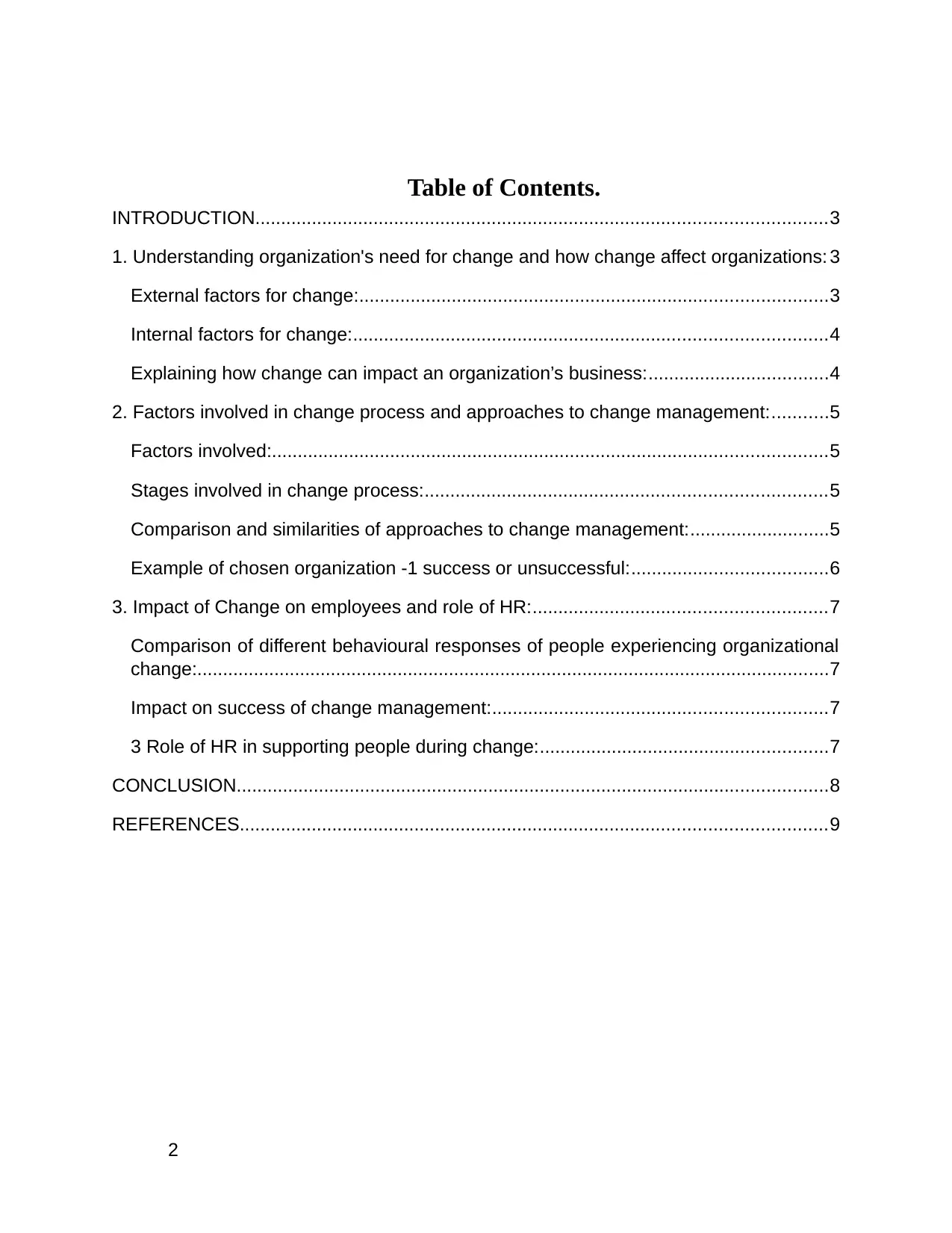
Table of Contents.
INTRODUCTION...............................................................................................................3
1. Understanding organization's need for change and how change affect organizations: 3
External factors for change:...........................................................................................3
Internal factors for change:............................................................................................4
Explaining how change can impact an organization’s business:...................................4
2. Factors involved in change process and approaches to change management:...........5
Factors involved:............................................................................................................5
Stages involved in change process:..............................................................................5
Comparison and similarities of approaches to change management:...........................5
Example of chosen organization -1 success or unsuccessful:......................................6
3. Impact of Change on employees and role of HR:.........................................................7
Comparison of different behavioural responses of people experiencing organizational
change:...........................................................................................................................7
Impact on success of change management:.................................................................7
3 Role of HR in supporting people during change:........................................................7
CONCLUSION...................................................................................................................8
REFERENCES..................................................................................................................9
2
INTRODUCTION...............................................................................................................3
1. Understanding organization's need for change and how change affect organizations: 3
External factors for change:...........................................................................................3
Internal factors for change:............................................................................................4
Explaining how change can impact an organization’s business:...................................4
2. Factors involved in change process and approaches to change management:...........5
Factors involved:............................................................................................................5
Stages involved in change process:..............................................................................5
Comparison and similarities of approaches to change management:...........................5
Example of chosen organization -1 success or unsuccessful:......................................6
3. Impact of Change on employees and role of HR:.........................................................7
Comparison of different behavioural responses of people experiencing organizational
change:...........................................................................................................................7
Impact on success of change management:.................................................................7
3 Role of HR in supporting people during change:........................................................7
CONCLUSION...................................................................................................................8
REFERENCES..................................................................................................................9
2
INTRODUCTION
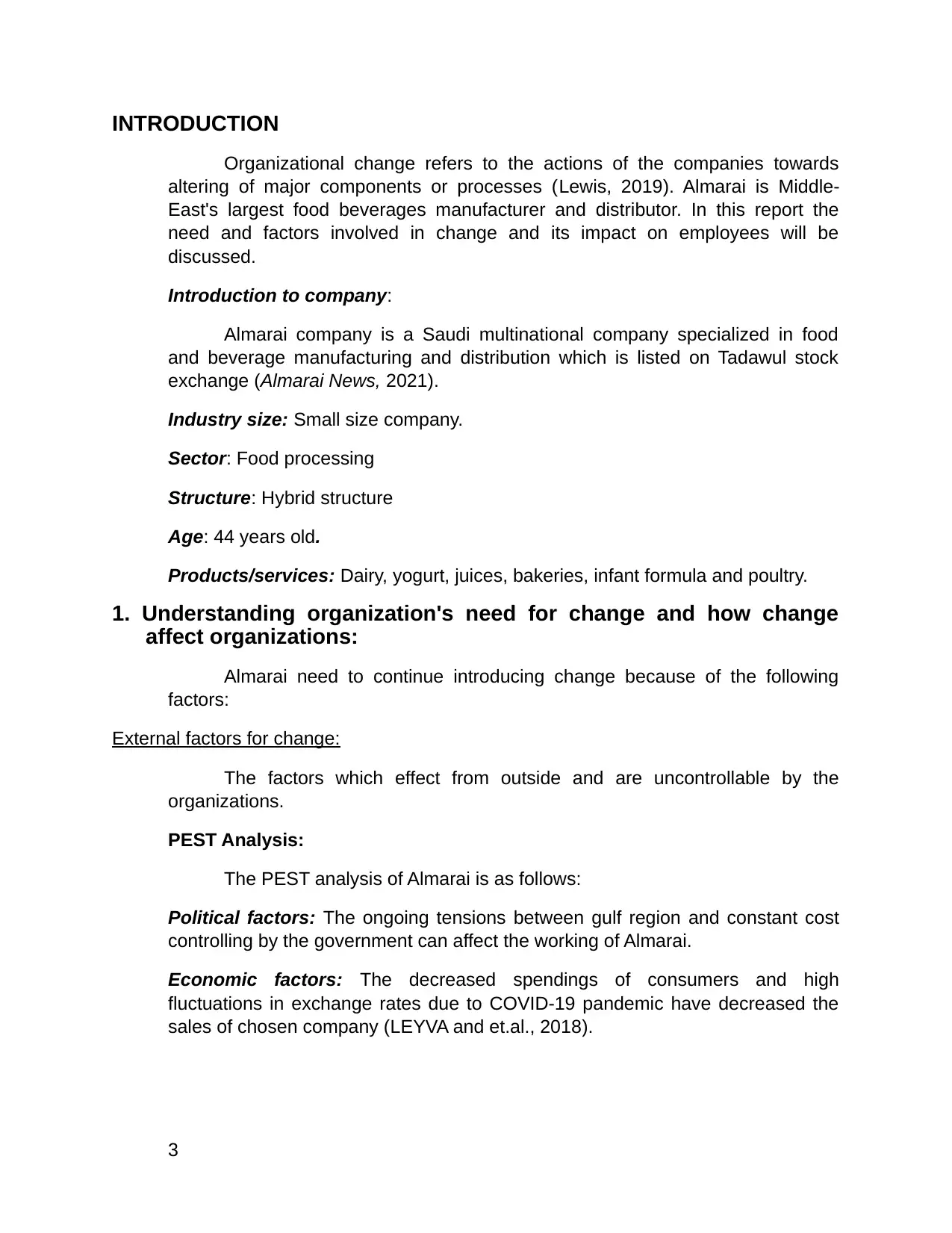
Organizational change refers to the actions of the companies towards
altering of major components or processes (Lewis, 2019). Almarai is Middle-
East's largest food beverages manufacturer and distributor. In this report the
need and factors involved in change and its impact on employees will be
discussed.
Introduction to company:
Almarai company is a Saudi multinational company specialized in food
and beverage manufacturing and distribution which is listed on Tadawul stock
exchange (Almarai News, 2021).
Industry size: Small size company.
Sector: Food processing
Structure: Hybrid structure
Age: 44 years old.
Products/services: Dairy, yogurt, juices, bakeries, infant formula and poultry.
1. Understanding organization's need for change and how change
affect organizations:
Almarai need to continue introducing change because of the following
factors:
External factors for change:
The factors which effect from outside and are uncontrollable by the
organizations.
PEST Analysis:
The PEST analysis of Almarai is as follows:
Political factors: The ongoing tensions between gulf region and constant cost
controlling by the government can affect the working of Almarai.
Economic factors: The decreased spendings of consumers and high
fluctuations in exchange rates due to COVID-19 pandemic have decreased the
sales of chosen company (LEYVA and et.al., 2018).
3
Organizational change refers to the actions of the companies towards
altering of major components or processes (Lewis, 2019). Almarai is Middle-
East's largest food beverages manufacturer and distributor. In this report the
need and factors involved in change and its impact on employees will be
discussed.
Introduction to company:
Almarai company is a Saudi multinational company specialized in food
and beverage manufacturing and distribution which is listed on Tadawul stock
exchange (Almarai News, 2021).
Industry size: Small size company.
Sector: Food processing
Structure: Hybrid structure
Age: 44 years old.
Products/services: Dairy, yogurt, juices, bakeries, infant formula and poultry.
1. Understanding organization's need for change and how change
affect organizations:
Almarai need to continue introducing change because of the following
factors:
External factors for change:
The factors which effect from outside and are uncontrollable by the
organizations.
PEST Analysis:
The PEST analysis of Almarai is as follows:
Political factors: The ongoing tensions between gulf region and constant cost
controlling by the government can affect the working of Almarai.
Economic factors: The decreased spendings of consumers and high
fluctuations in exchange rates due to COVID-19 pandemic have decreased the
sales of chosen company (LEYVA and et.al., 2018).
3
⊘ This is a preview!⊘
Do you want full access?
Subscribe today to unlock all pages.

Trusted by 1+ million students worldwide
Social factors: The consumer's preferences towards health and nutrition
provides the potential of increase in sales in daily and milk market of the chosen
company.
Legal factors: The changes in regulatory laws have made it difficult for the
chosen company to operate in some countries like US.
Internal factors for change:
The factors which arise from internally and are controllable by the
companies.
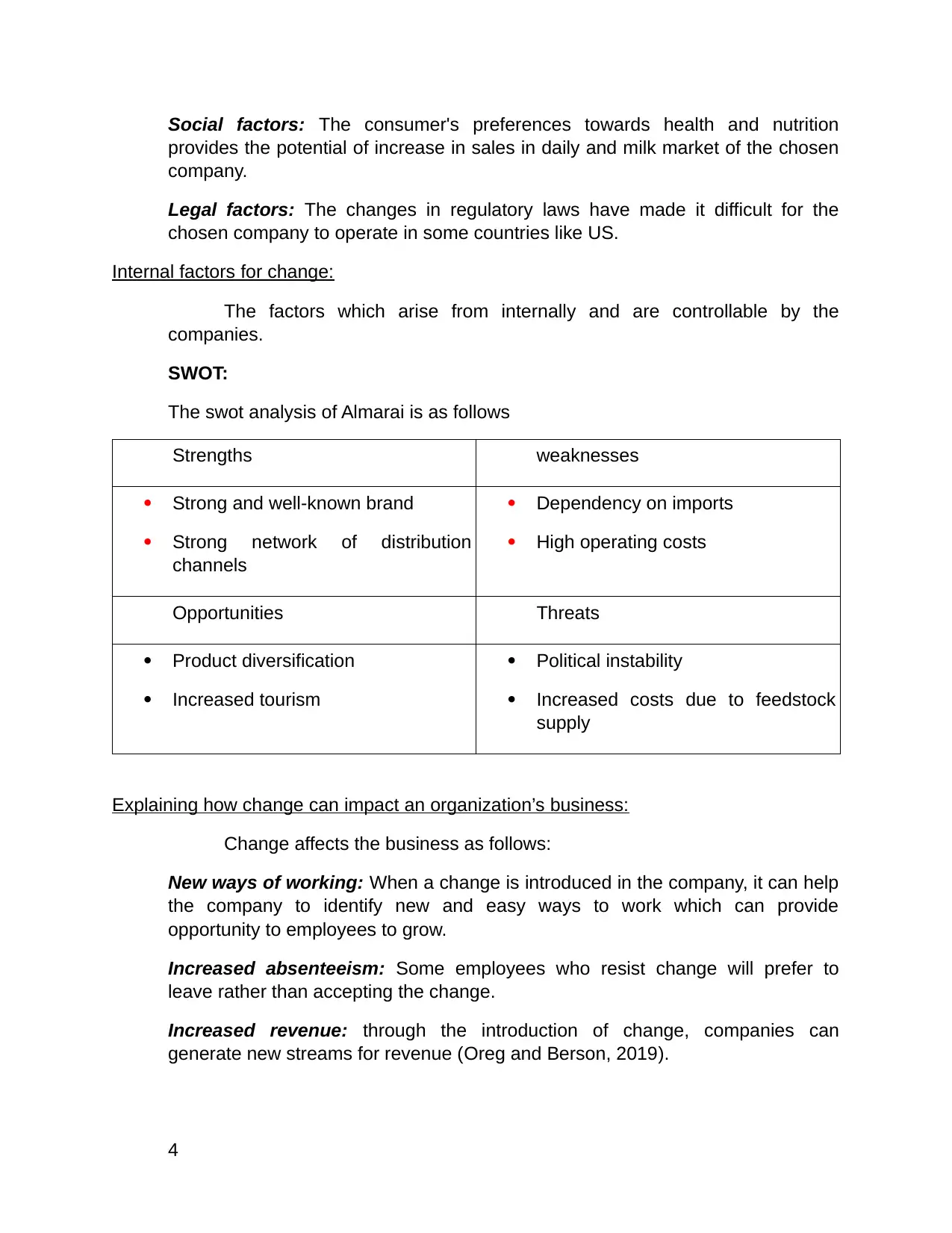
SWOT:
The swot analysis of Almarai is as follows
Strengths weaknesses
Strong and well-known brand
Strong network of distribution
channels
Dependency on imports
High operating costs
Opportunities Threats
Product diversification
Increased tourism
Political instability
Increased costs due to feedstock
supply
Explaining how change can impact an organization’s business:
Change affects the business as follows:
New ways of working: When a change is introduced in the company, it can help
the company to identify new and easy ways to work which can provide
opportunity to employees to grow.
Increased absenteeism: Some employees who resist change will prefer to
leave rather than accepting the change.
Increased revenue: through the introduction of change, companies can
generate new streams for revenue (Oreg and Berson, 2019).
4
provides the potential of increase in sales in daily and milk market of the chosen
company.
Legal factors: The changes in regulatory laws have made it difficult for the
chosen company to operate in some countries like US.
Internal factors for change:
The factors which arise from internally and are controllable by the
companies.
SWOT:
The swot analysis of Almarai is as follows
Strengths weaknesses
Strong and well-known brand
Strong network of distribution
channels
Dependency on imports
High operating costs
Opportunities Threats
Product diversification
Increased tourism
Political instability
Increased costs due to feedstock
supply
Explaining how change can impact an organization’s business:
Change affects the business as follows:
New ways of working: When a change is introduced in the company, it can help
the company to identify new and easy ways to work which can provide
opportunity to employees to grow.
Increased absenteeism: Some employees who resist change will prefer to
leave rather than accepting the change.
Increased revenue: through the introduction of change, companies can
generate new streams for revenue (Oreg and Berson, 2019).
4
Paraphrase This Document
Need a fresh take? Get an instant paraphrase of this document with our AI Paraphraser
2. Factors involved in change process and approaches to change
management:
Factors involved:
Following are some factors which are involved in change management of
Almarai:
Clear vision: The clear vision for future should be accessible to everyone as it
will allow the whole organization to work in the same direction.
Employee engagement: Every employee need to be a part of the ongoing
change. Their engagement is ensured through clear vision, directions and need
for change (Sun and Bunchapattanasakda, 2019).
Accountability: Change management required accountability of current
performance of the business.
Better communication: As change management is function of people
management it requires constant communication between all the employees.
Stages involved in change process:
Following are the steps involved in change management process:
Preparing the organization for the change to be introduced.
Formulating a vision and plan for change.
Implying changes within the organizational practices and culture (Smith, 2020).
In the last the process is reviewed and analysed.
Comparison and similarities of approaches to change management:
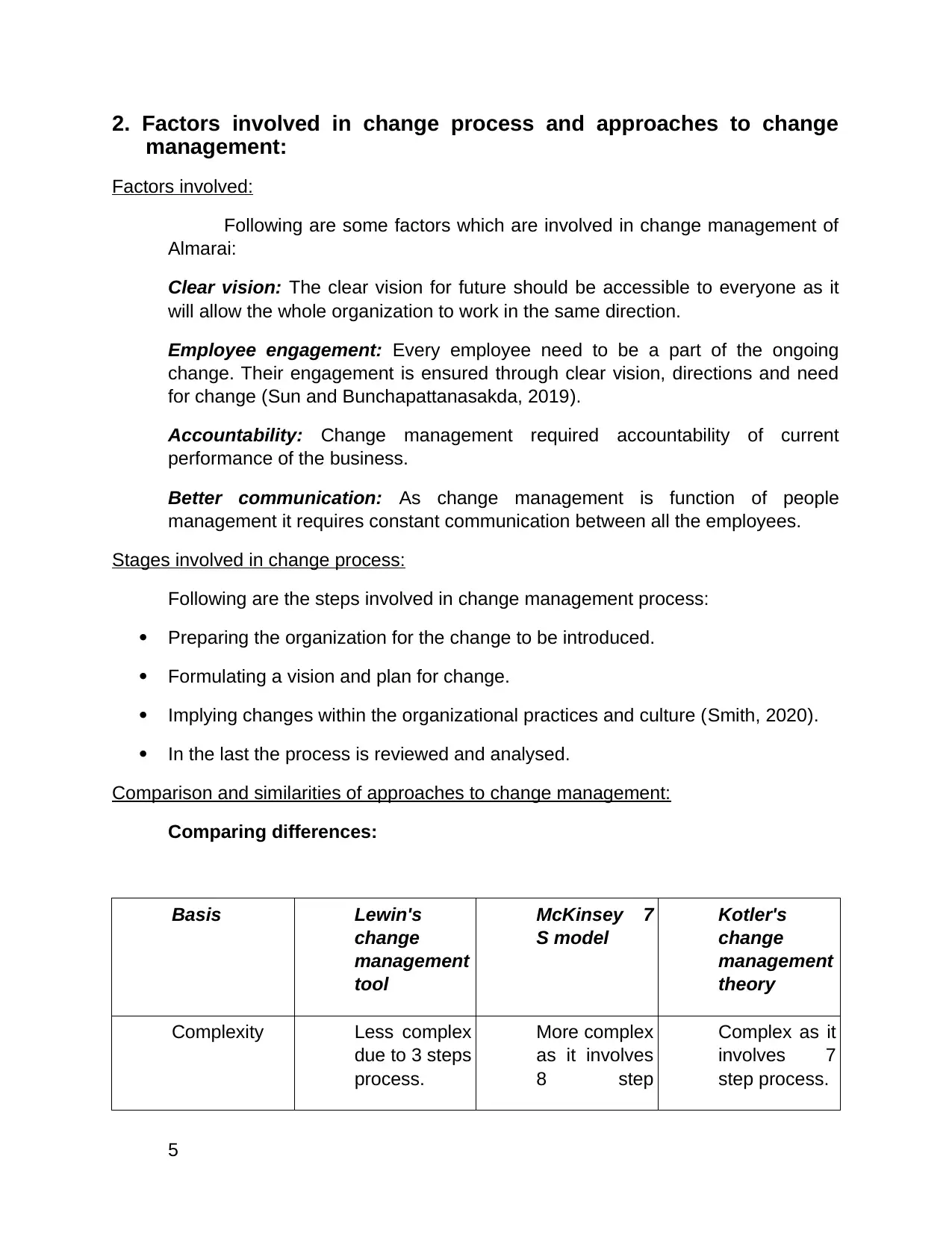
Comparing differences:
Basis Lewin's
change
management
tool
McKinsey 7
S model
Kotler's
change
management
theory
Complexity Less complex
due to 3 steps
process.
More complex
as it involves
8 step
Complex as it
involves 7
step process.
5
management:
Factors involved:
Following are some factors which are involved in change management of
Almarai:
Clear vision: The clear vision for future should be accessible to everyone as it
will allow the whole organization to work in the same direction.
Employee engagement: Every employee need to be a part of the ongoing
change. Their engagement is ensured through clear vision, directions and need
for change (Sun and Bunchapattanasakda, 2019).
Accountability: Change management required accountability of current
performance of the business.
Better communication: As change management is function of people
management it requires constant communication between all the employees.
Stages involved in change process:
Following are the steps involved in change management process:
Preparing the organization for the change to be introduced.
Formulating a vision and plan for change.
Implying changes within the organizational practices and culture (Smith, 2020).
In the last the process is reviewed and analysed.
Comparison and similarities of approaches to change management:
Comparing differences:
Basis Lewin's
change
management
tool
McKinsey 7
S model
Kotler's
change
management
theory
Complexity Less complex
due to 3 steps
process.
More complex
as it involves
8 step
Complex as it
involves 7
step process.
5
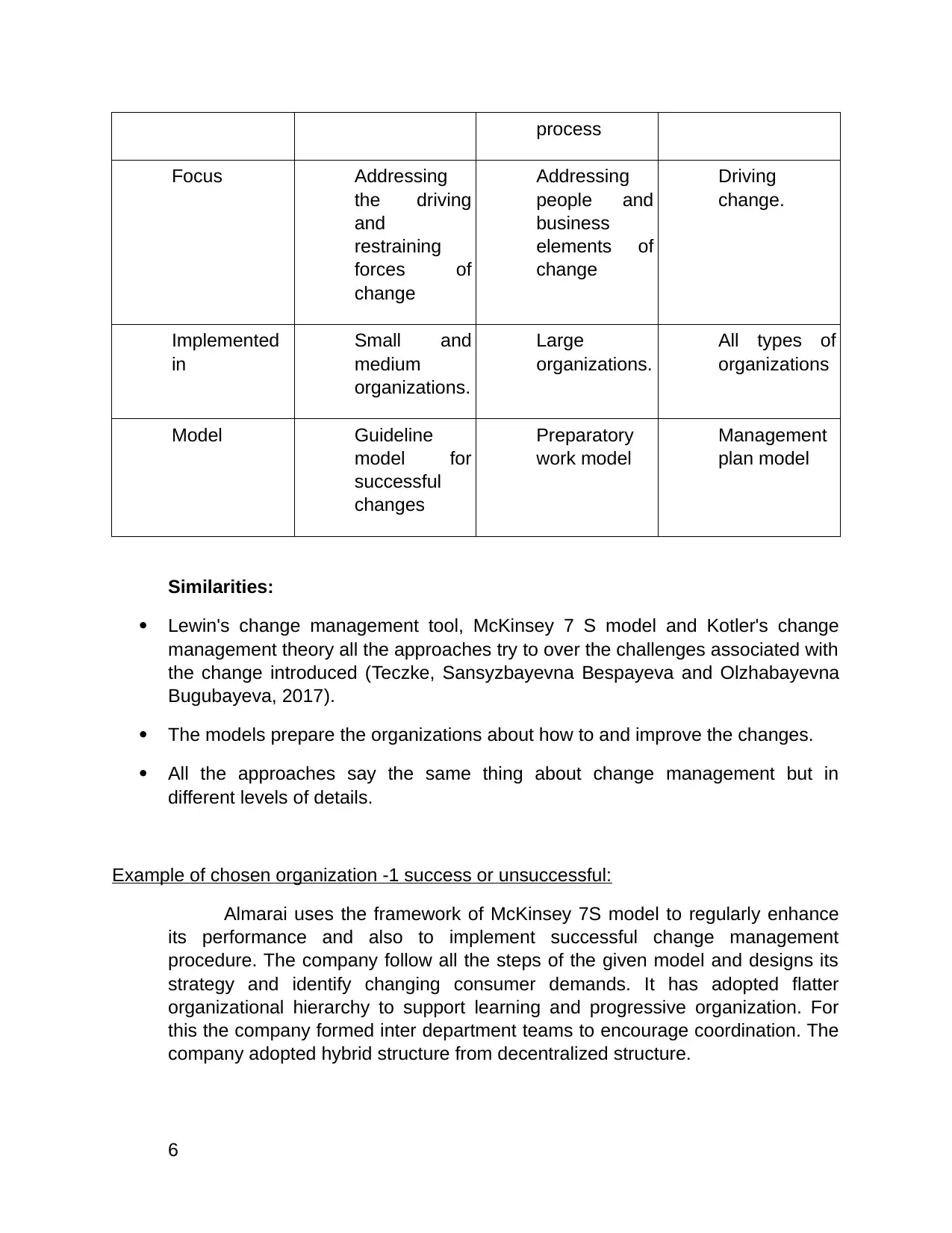
process
Focus Addressing
the driving
and
restraining
forces of
change
Addressing
people and
business
elements of
change
Driving
change.
Implemented
in
Small and
medium
organizations.
Large
organizations.
All types of
organizations
Model Guideline
model for
successful
changes
Preparatory
work model
Management
plan model
Similarities:
Lewin's change management tool, McKinsey 7 S model and Kotler's change
management theory all the approaches try to over the challenges associated with
the change introduced (Teczke, Sansyzbayevna Bespayeva and Olzhabayevna
Bugubayeva, 2017).
The models prepare the organizations about how to and improve the changes.
All the approaches say the same thing about change management but in
different levels of details.
Example of chosen organization -1 success or unsuccessful:
Almarai uses the framework of McKinsey 7S model to regularly enhance
its performance and also to implement successful change management
procedure. The company follow all the steps of the given model and designs its
strategy and identify changing consumer demands. It has adopted flatter
organizational hierarchy to support learning and progressive organization. For
this the company formed inter department teams to encourage coordination. The
company adopted hybrid structure from decentralized structure.
6
Focus Addressing
the driving
and
restraining
forces of
change
Addressing
people and
business
elements of
change
Driving
change.
Implemented
in
Small and
medium
organizations.
Large
organizations.
All types of
organizations
Model Guideline
model for
successful
changes
Preparatory
work model
Management
plan model
Similarities:
Lewin's change management tool, McKinsey 7 S model and Kotler's change
management theory all the approaches try to over the challenges associated with
the change introduced (Teczke, Sansyzbayevna Bespayeva and Olzhabayevna
Bugubayeva, 2017).
The models prepare the organizations about how to and improve the changes.
All the approaches say the same thing about change management but in
different levels of details.
Example of chosen organization -1 success or unsuccessful:
Almarai uses the framework of McKinsey 7S model to regularly enhance
its performance and also to implement successful change management
procedure. The company follow all the steps of the given model and designs its
strategy and identify changing consumer demands. It has adopted flatter
organizational hierarchy to support learning and progressive organization. For
this the company formed inter department teams to encourage coordination. The
company adopted hybrid structure from decentralized structure.
6
⊘ This is a preview!⊘
Do you want full access?
Subscribe today to unlock all pages.
Trusted by 1+ million students worldwide
3. Impact of Change on employees and role of HR:
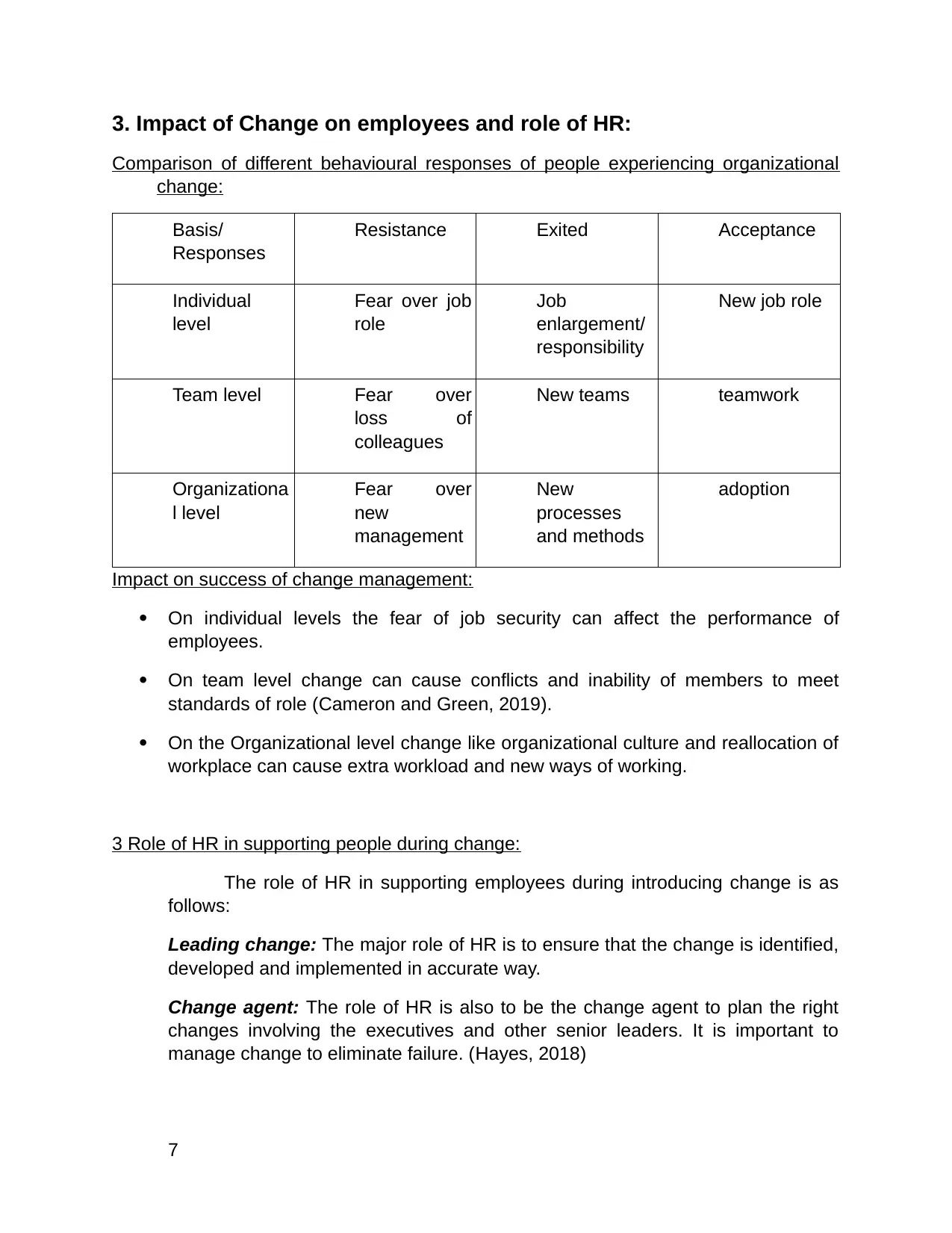
Comparison of different behavioural responses of people experiencing organizational
change:
Basis/
Responses
Resistance Exited Acceptance
Individual
level
Fear over job
role
Job
enlargement/
responsibility
New job role
Team level Fear over
loss of
colleagues
New teams teamwork
Organizationa
l level
Fear over
new
management
New
processes
and methods
adoption
Impact on success of change management:
On individual levels the fear of job security can affect the performance of
employees.
On team level change can cause conflicts and inability of members to meet
standards of role (Cameron and Green, 2019).
On the Organizational level change like organizational culture and reallocation of
workplace can cause extra workload and new ways of working.
3 Role of HR in supporting people during change:
The role of HR in supporting employees during introducing change is as
follows:
Leading change: The major role of HR is to ensure that the change is identified,
developed and implemented in accurate way.
Change agent: The role of HR is also to be the change agent to plan the right
changes involving the executives and other senior leaders. It is important to
manage change to eliminate failure. (Hayes, 2018)
7
Comparison of different behavioural responses of people experiencing organizational
change:
Basis/
Responses
Resistance Exited Acceptance
Individual
level
Fear over job
role
Job
enlargement/
responsibility
New job role
Team level Fear over
loss of
colleagues
New teams teamwork
Organizationa
l level
Fear over
new
management
New
processes
and methods
adoption
Impact on success of change management:
On individual levels the fear of job security can affect the performance of
employees.
On team level change can cause conflicts and inability of members to meet
standards of role (Cameron and Green, 2019).
On the Organizational level change like organizational culture and reallocation of
workplace can cause extra workload and new ways of working.
3 Role of HR in supporting people during change:
The role of HR in supporting employees during introducing change is as
follows:
Leading change: The major role of HR is to ensure that the change is identified,
developed and implemented in accurate way.
Change agent: The role of HR is also to be the change agent to plan the right
changes involving the executives and other senior leaders. It is important to
manage change to eliminate failure. (Hayes, 2018)
7
Paraphrase This Document
Need a fresh take? Get an instant paraphrase of this document with our AI Paraphraser
Guiding people: The people in an organization need to be properly guided
through the change on how to adopt the behaviours and habits necessary.
CONCLUSION
It can be concluded that organizational changes are the actions and
attitudes of organizations towards the innovation or improvements of new
process or structures. The need for change can be analysed through various
external and internal factors such as tension between gulf region and COVID-19
pandemic. The factors like vision and employee engagement can be managed
through different approaches to change management. Change impacts the
people in different levels in an organization and the HR leads towards change
and guides people about it.
Key learning summary and development plan:
Key learning summary:
Throughout my learning process I have learned how the change affects
externally and as well as internally. I have learned the different factors of change
which impact the working of the company in both the positive and negative
aspects. I learned how different approaches can be used to implement and adapt
those changes and what role HR plays in the implementation of these changes.
Learning points for future:
In the future, I will emphasis more on how to adapt change more positively and
implement it. I will focus on gaining continuous knowledge. I will also learn the
value of team work in adapting change and develop skills to reflect change in a
way that it enhances my performance.
8
through the change on how to adopt the behaviours and habits necessary.
CONCLUSION
It can be concluded that organizational changes are the actions and
attitudes of organizations towards the innovation or improvements of new
process or structures. The need for change can be analysed through various
external and internal factors such as tension between gulf region and COVID-19
pandemic. The factors like vision and employee engagement can be managed
through different approaches to change management. Change impacts the
people in different levels in an organization and the HR leads towards change
and guides people about it.
Key learning summary and development plan:
Key learning summary:
Throughout my learning process I have learned how the change affects
externally and as well as internally. I have learned the different factors of change
which impact the working of the company in both the positive and negative
aspects. I learned how different approaches can be used to implement and adapt
those changes and what role HR plays in the implementation of these changes.
Learning points for future:
In the future, I will emphasis more on how to adapt change more positively and
implement it. I will focus on gaining continuous knowledge. I will also learn the
value of team work in adapting change and develop skills to reflect change in a
way that it enhances my performance.
8
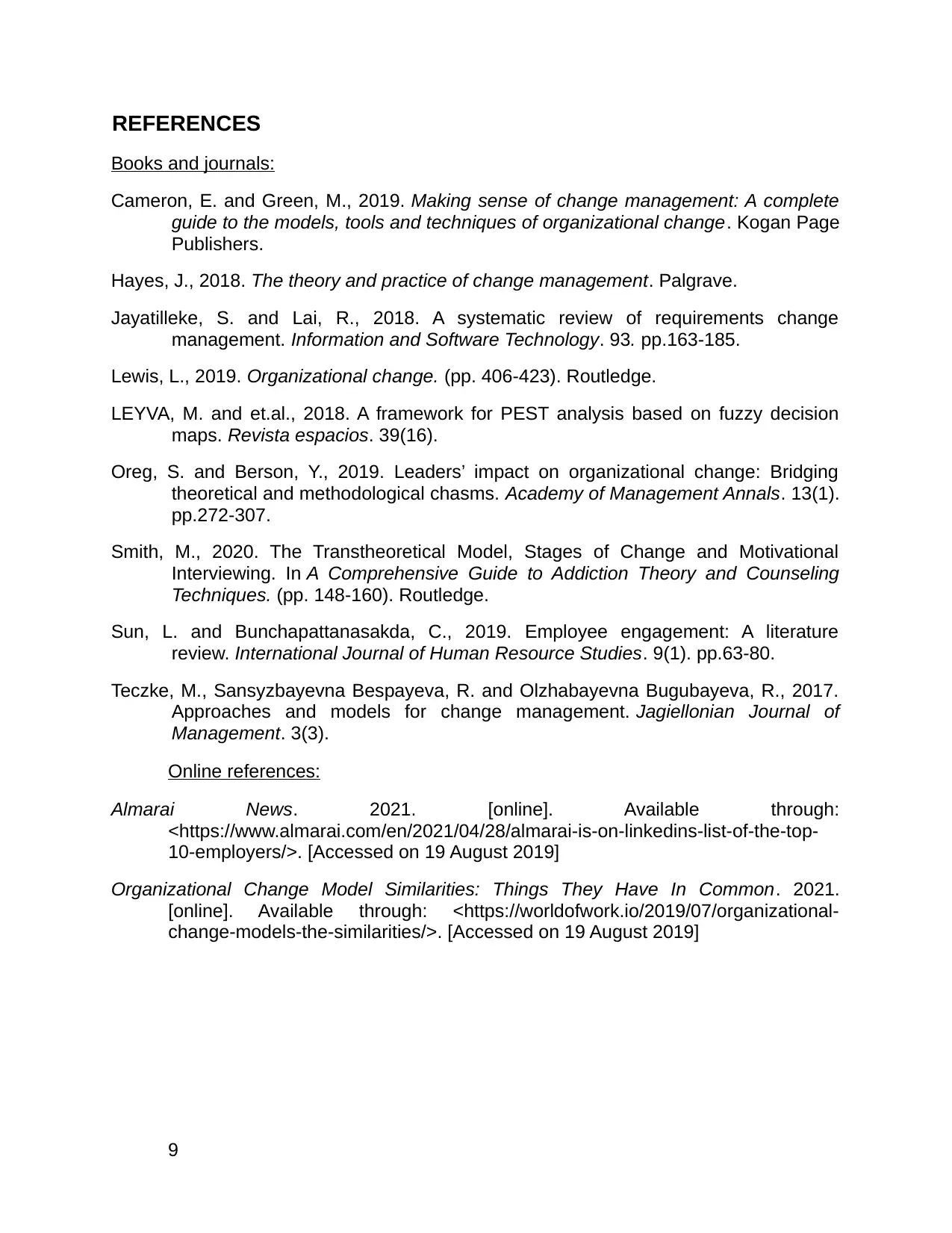
REFERENCES
Books and journals:
Cameron, E. and Green, M., 2019. Making sense of change management: A complete
guide to the models, tools and techniques of organizational change. Kogan Page
Publishers.
Hayes, J., 2018. The theory and practice of change management. Palgrave.
Jayatilleke, S. and Lai, R., 2018. A systematic review of requirements change
management. Information and Software Technology. 93. pp.163-185.
Lewis, L., 2019. Organizational change. (pp. 406-423). Routledge.
LEYVA, M. and et.al., 2018. A framework for PEST analysis based on fuzzy decision
maps. Revista espacios. 39(16).
Oreg, S. and Berson, Y., 2019. Leaders’ impact on organizational change: Bridging
theoretical and methodological chasms. Academy of Management Annals. 13(1).
pp.272-307.
Smith, M., 2020. The Transtheoretical Model, Stages of Change and Motivational
Interviewing. In A Comprehensive Guide to Addiction Theory and Counseling
Techniques. (pp. 148-160). Routledge.
Sun, L. and Bunchapattanasakda, C., 2019. Employee engagement: A literature
review. International Journal of Human Resource Studies. 9(1). pp.63-80.
Teczke, M., Sansyzbayevna Bespayeva, R. and Olzhabayevna Bugubayeva, R., 2017.
Approaches and models for change management. Jagiellonian Journal of
Management. 3(3).
Online references:
Almarai News. 2021. [online]. Available through:
<https://www.almarai.com/en/2021/04/28/almarai-is-on-linkedins-list-of-the-top-
10-employers/>. [Accessed on 19 August 2019]
Organizational Change Model Similarities: Things They Have In Common. 2021.
[online]. Available through: <https://worldofwork.io/2019/07/organizational-
change-models-the-similarities/>. [Accessed on 19 August 2019]
9
Books and journals:
Cameron, E. and Green, M., 2019. Making sense of change management: A complete
guide to the models, tools and techniques of organizational change. Kogan Page
Publishers.
Hayes, J., 2018. The theory and practice of change management. Palgrave.
Jayatilleke, S. and Lai, R., 2018. A systematic review of requirements change
management. Information and Software Technology. 93. pp.163-185.
Lewis, L., 2019. Organizational change. (pp. 406-423). Routledge.
LEYVA, M. and et.al., 2018. A framework for PEST analysis based on fuzzy decision
maps. Revista espacios. 39(16).
Oreg, S. and Berson, Y., 2019. Leaders’ impact on organizational change: Bridging
theoretical and methodological chasms. Academy of Management Annals. 13(1).
pp.272-307.
Smith, M., 2020. The Transtheoretical Model, Stages of Change and Motivational
Interviewing. In A Comprehensive Guide to Addiction Theory and Counseling
Techniques. (pp. 148-160). Routledge.
Sun, L. and Bunchapattanasakda, C., 2019. Employee engagement: A literature
review. International Journal of Human Resource Studies. 9(1). pp.63-80.
Teczke, M., Sansyzbayevna Bespayeva, R. and Olzhabayevna Bugubayeva, R., 2017.
Approaches and models for change management. Jagiellonian Journal of
Management. 3(3).
Online references:
Almarai News. 2021. [online]. Available through:
<https://www.almarai.com/en/2021/04/28/almarai-is-on-linkedins-list-of-the-top-
10-employers/>. [Accessed on 19 August 2019]
Organizational Change Model Similarities: Things They Have In Common. 2021.
[online]. Available through: <https://worldofwork.io/2019/07/organizational-
change-models-the-similarities/>. [Accessed on 19 August 2019]
9
⊘ This is a preview!⊘
Do you want full access?
Subscribe today to unlock all pages.
Trusted by 1+ million students worldwide

10

1 out of 10


Related Documents


Your All-in-One AI-Powered Toolkit for Academic Success.
+13062052269
info@desklib.com
Available 24*7 on WhatsApp / Email
![[object Object]](/_next/static/media/star-bottom.7253800d.svg)
Unlock your academic potential
Copyright © 2020–2026 A2Z Services. All Rights Reserved. Developed and managed by ZUCOL.