Report: Supporting Independent Living in Health and Social Care
VerifiedAdded on 2020/11/23
|13
|4907
|102
Report
AI Summary
This report delves into the crucial role of technology in supporting independent living within health and social care settings. It examines the application of assistive technologies, such as telecare systems and remote monitoring devices, to empower individuals with disabilities and older adults to maintain their independence and quality of life. The report analyzes the benefits of these technologies for both service users and healthcare organizations, including reduced hospital admissions, improved patient monitoring, and enhanced care coordination. It also addresses the barriers to technology adoption, such as staff training needs, funding constraints, and ethical considerations related to data privacy and patient safety. Furthermore, the report offers recommendations for overcoming these challenges, emphasizing the importance of comprehensive staff training, effective planning, and the integration of technology within a patient-centered care model. The case study of Mrs. Mary Johnson illustrates how assistive technology can significantly improve the lives of individuals requiring support, highlighting the positive impact of devices such as lifeline alarms, gas sensors, and medication dispensers. The report concludes by emphasizing the need for ongoing innovation and investment in assistive technologies to ensure that individuals can live safely and independently within their communities.
Supporting Independent
Living in Health and Social
Care
Living in Health and Social
Care

Paraphrase This Document
Need a fresh take? Get an instant paraphrase of this document with our AI Paraphraser
Table of Contents
INTRODUCTION...........................................................................................................................3
MAIN BODY...................................................................................................................................4
TASK 1............................................................................................................................................4
1.1 Use of technology which support users of social and health care services to live
independently..............................................................................................................................4
1.2 Barriers to use of technology that support users of health and social care services in living
independently..............................................................................................................................5
1.3 Benefits of technologies to social and healthcare organisation............................................6
TASK 2 ......................................................................................................................................7
2.1 Health and safety consideration of the assistive technologies..............................................7
2.2 Ethical consideration in use of assistive technologies .........................................................8
2.3 Impact of recent and emerging technologies developments on social and health care
organizations, care workers and services....................................................................................9
TASK 3..........................................................................................................................................10
3.1 Specific needs of person requiring support ........................................................................10
3.2 Recommendations for technologies how these can support independent living
arrangements.............................................................................................................................11
3.3 Usefulness of technology for the users of social and healthcare services...........................12
CONCLUSION..............................................................................................................................12
REFERENCES..............................................................................................................................14
INTRODUCTION...........................................................................................................................3
MAIN BODY...................................................................................................................................4
TASK 1............................................................................................................................................4
1.1 Use of technology which support users of social and health care services to live
independently..............................................................................................................................4
1.2 Barriers to use of technology that support users of health and social care services in living
independently..............................................................................................................................5
1.3 Benefits of technologies to social and healthcare organisation............................................6
TASK 2 ......................................................................................................................................7
2.1 Health and safety consideration of the assistive technologies..............................................7
2.2 Ethical consideration in use of assistive technologies .........................................................8
2.3 Impact of recent and emerging technologies developments on social and health care
organizations, care workers and services....................................................................................9
TASK 3..........................................................................................................................................10
3.1 Specific needs of person requiring support ........................................................................10
3.2 Recommendations for technologies how these can support independent living
arrangements.............................................................................................................................11
3.3 Usefulness of technology for the users of social and healthcare services...........................12
CONCLUSION..............................................................................................................................12
REFERENCES..............................................................................................................................14
INTRODUCTION
Supporting independent living in health and social care is refers to those who need
support of other to live quality of life. Technology is utilized by most individuals to help such
kind of people with their everyday needs and lives. Email aid and mobile communication,
internet is type of source of information and remote control devices which works with a single
button. This technology can help people to access social and health care services so that
individuals with their specific needs and live independently (Aveyard, 2014). Increasingly social
and health care is seeking to make sure that individuals with disability and other diseases or older
individuals are able to live without depending on other within their communities. To make it
effective and achieve, there are new types of care solutions have been identified which will allow
receipts to maintain privacy wish list and support of technologies which will easy their work.
Telecare is constructed by number of new features in that some are passive which monitor well
being and health of person without the active involvement. This assignment will include
knowledge about technologies and how it can be used to provide support and different
implications of the development in these technologies for social and health care.
MAIN BODY
TASK 1
1.1 Use of technology which support users of social and health care services to live
independently
Independent living is defined as ability to examine or check alternatives and making
informed decisions directly in one's own life. It is an ability which requires availability of
financial resources, peer group support and information systems, this process is dynamic and it
can not be static. This is a philosophy and movement of individuals with disabilities which work
for self-determination, self respect and equal opportunities. This means people who are not able
to support their own needs needs due to health issues are vulnerable part of group or community
also requires similar opportunities related to life so that they can have a quality of life like
normal people older and disable individual need technologies which make their life more easier,
there are some health care devices which helps such people to provide their needs and ensure that
they are living in such a way as they want (Berzin, Singer and Hokanson, 2014). People who are
Supporting independent living in health and social care is refers to those who need
support of other to live quality of life. Technology is utilized by most individuals to help such
kind of people with their everyday needs and lives. Email aid and mobile communication,
internet is type of source of information and remote control devices which works with a single
button. This technology can help people to access social and health care services so that
individuals with their specific needs and live independently (Aveyard, 2014). Increasingly social
and health care is seeking to make sure that individuals with disability and other diseases or older
individuals are able to live without depending on other within their communities. To make it
effective and achieve, there are new types of care solutions have been identified which will allow
receipts to maintain privacy wish list and support of technologies which will easy their work.
Telecare is constructed by number of new features in that some are passive which monitor well
being and health of person without the active involvement. This assignment will include
knowledge about technologies and how it can be used to provide support and different
implications of the development in these technologies for social and health care.
MAIN BODY
TASK 1
1.1 Use of technology which support users of social and health care services to live
independently
Independent living is defined as ability to examine or check alternatives and making
informed decisions directly in one's own life. It is an ability which requires availability of
financial resources, peer group support and information systems, this process is dynamic and it
can not be static. This is a philosophy and movement of individuals with disabilities which work
for self-determination, self respect and equal opportunities. This means people who are not able
to support their own needs needs due to health issues are vulnerable part of group or community
also requires similar opportunities related to life so that they can have a quality of life like
normal people older and disable individual need technologies which make their life more easier,
there are some health care devices which helps such people to provide their needs and ensure that
they are living in such a way as they want (Berzin, Singer and Hokanson, 2014). People who are
⊘ This is a preview!⊘
Do you want full access?
Subscribe today to unlock all pages.

Trusted by 1+ million students worldwide
dependent on other people or their family to get support for their basic needs are mainly require
social and health care in order to fulfil their basic health related requirements.
In such individual to get all the needs they want assistive technology is used by installing
certain types of devices which helps social care workers to track their patients. Assistive
technology is a wide term that is used to explain any object, system or device and item which
enables an individual to perform any task that they could not able perform in the absence of that
particular device or increase safety and ease by which specific tasks can be done. This
technology is aid which can assist most vulnerable and frail members of society to live with
safety and live well in particular environment. This is very important and essential technology
which helps both social workers and service users (Chen, Hicks and While, 2014).
In the case study Mrs Mary Johnson live alone in Northamptonshire, as she is becoming
disorientated and increasingly forgetful which makes difficult to fine way of home and this is
effecting mentally, causing distress. This is why Mary referred to safe at home scheme for
assistive technology. As her children are interested in this technology to know whether this help
their mother with daily needs. Care providers installed gas sensor and cut off valve, door alert for
back door, lifeline telecare alarm unit and radio smoke detector. Lifeline alarm which is
provided by telecare is emergency system which helps to get care with care team whenever the
button is pressed. Radio smoke detector is heat alarm which is interlinked through the radio
frequency signals. As patient forgets things often which can create risk in this case. And the
other device which is door alert for back door as sometimes Mary goes out and forget the way
of home this alarm will provide information about patient whenever she is going out.
1.2 Barriers to use of technology that support users of health and social care services in living
independently
Use of assistive technology have suggested infrequent utilization of prescribed device at
home, community settings and vocational & poor rate of by the care workers, as programmes
related AT should be implemented. There are certain barriers which challenges utilization of AT.
Staff training and attitude, as this technology regulation requires special training for staff and
care workers. Some worker will not be familiar with the use of given devices and equipments
which can be harmful for patient, such type of equipment handling requires training in that
particular area in order to provide care to patients (Corrigan, Druss and Perlick, 2014).
Occupational therapists have critical role in assessment of assistive technology needs and also
social and health care in order to fulfil their basic health related requirements.
In such individual to get all the needs they want assistive technology is used by installing
certain types of devices which helps social care workers to track their patients. Assistive
technology is a wide term that is used to explain any object, system or device and item which
enables an individual to perform any task that they could not able perform in the absence of that
particular device or increase safety and ease by which specific tasks can be done. This
technology is aid which can assist most vulnerable and frail members of society to live with
safety and live well in particular environment. This is very important and essential technology
which helps both social workers and service users (Chen, Hicks and While, 2014).
In the case study Mrs Mary Johnson live alone in Northamptonshire, as she is becoming
disorientated and increasingly forgetful which makes difficult to fine way of home and this is
effecting mentally, causing distress. This is why Mary referred to safe at home scheme for
assistive technology. As her children are interested in this technology to know whether this help
their mother with daily needs. Care providers installed gas sensor and cut off valve, door alert for
back door, lifeline telecare alarm unit and radio smoke detector. Lifeline alarm which is
provided by telecare is emergency system which helps to get care with care team whenever the
button is pressed. Radio smoke detector is heat alarm which is interlinked through the radio
frequency signals. As patient forgets things often which can create risk in this case. And the
other device which is door alert for back door as sometimes Mary goes out and forget the way
of home this alarm will provide information about patient whenever she is going out.
1.2 Barriers to use of technology that support users of health and social care services in living
independently
Use of assistive technology have suggested infrequent utilization of prescribed device at
home, community settings and vocational & poor rate of by the care workers, as programmes
related AT should be implemented. There are certain barriers which challenges utilization of AT.
Staff training and attitude, as this technology regulation requires special training for staff and
care workers. Some worker will not be familiar with the use of given devices and equipments
which can be harmful for patient, such type of equipment handling requires training in that
particular area in order to provide care to patients (Corrigan, Druss and Perlick, 2014).
Occupational therapists have critical role in assessment of assistive technology needs and also
Paraphrase This Document
Need a fresh take? Get an instant paraphrase of this document with our AI Paraphraser
implementation of the use of device. Sometimes lack of commitment of staff can be a major
barriers to use AT at that time it can affect to their involvement as well as decision making.
Assessment issues are major in order to deal with AT, this can be critical as assessment is very
important for AT. Planning issues are beyond assessing process of AT needs and necessary
equipments has to be carefully plan in case of older individuals. Lack of planning for
implementation can affect individuals who are with needs.
Funding issues can be great barrier to provide facility of assistive technology. High cost
of the assistive technology devices and less fund available to meet costs for devices and such
type of devices requires more funds as they are expensive. Equipments issues include any kind of
problem related to AT devices reflect difficulties to access equipments and issues in maintain
and use of equipments. Difficulty obtaining and locating devices is such as funding which is
considered as common barrier to achieve promised benefits related to AT for users. In case of
Mary installation of these telecare equipments involved several people and took approximate 3
hours to get complete. This make Mary much stressed as patient was already having anxiety
problem due to health related problems. Due to more number of people patients can feel quite
discomfort which can cause more stress and anxiety problems (Curtis and Burns, 2015).
Solutions for all the barriers which are explained above are important to make AT more
effective. Training programmes can be provided to staff who are lacking with skill management
and less information about assistive technology devices. Negative attitude of staff towards
patients can be changed by giving information and making them understand such people's
problems so that they can make their care more better. Planning issues can be deal by making
plans according to situation, as they have to plan properly according patient's requirement and
staff who will involve in AT. Planning for any task gives always positive results. Funding issue
which is major problem can be solved by making budget according to equipments which are
more important. Applying in National health service and government system to provide enough
funds to fulfil requirements of equipments and devices which are necessary for AT. Making
contact with NGOs to provide funds which will solve the fund problem which is associated with
equipments of AT.
1.3 Benefits of technologies to social and healthcare organisation
Assistive technology has several benefits for people who are old and disable by enabling
them to live autonomously. As some patient can not help oneself with their needs and daily
barriers to use AT at that time it can affect to their involvement as well as decision making.
Assessment issues are major in order to deal with AT, this can be critical as assessment is very
important for AT. Planning issues are beyond assessing process of AT needs and necessary
equipments has to be carefully plan in case of older individuals. Lack of planning for
implementation can affect individuals who are with needs.
Funding issues can be great barrier to provide facility of assistive technology. High cost
of the assistive technology devices and less fund available to meet costs for devices and such
type of devices requires more funds as they are expensive. Equipments issues include any kind of
problem related to AT devices reflect difficulties to access equipments and issues in maintain
and use of equipments. Difficulty obtaining and locating devices is such as funding which is
considered as common barrier to achieve promised benefits related to AT for users. In case of
Mary installation of these telecare equipments involved several people and took approximate 3
hours to get complete. This make Mary much stressed as patient was already having anxiety
problem due to health related problems. Due to more number of people patients can feel quite
discomfort which can cause more stress and anxiety problems (Curtis and Burns, 2015).
Solutions for all the barriers which are explained above are important to make AT more
effective. Training programmes can be provided to staff who are lacking with skill management
and less information about assistive technology devices. Negative attitude of staff towards
patients can be changed by giving information and making them understand such people's
problems so that they can make their care more better. Planning issues can be deal by making
plans according to situation, as they have to plan properly according patient's requirement and
staff who will involve in AT. Planning for any task gives always positive results. Funding issue
which is major problem can be solved by making budget according to equipments which are
more important. Applying in National health service and government system to provide enough
funds to fulfil requirements of equipments and devices which are necessary for AT. Making
contact with NGOs to provide funds which will solve the fund problem which is associated with
equipments of AT.
1.3 Benefits of technologies to social and healthcare organisation
Assistive technology has several benefits for people who are old and disable by enabling
them to live autonomously. As some patient can not help oneself with their needs and daily
activity so theses equipments and devices are designed to help and fill gaps that can create an
enabling environment. Assistive technology also helps in decreasing risk which can be faced by
such people in order to perform any kind of task. As patient will be dependent on other
individual to get their needs, and sometimes absences of that particular individual can form risk
for patient. This technology is beneficial for social and health care services as AT reduce number
of the hospital admission as well as waiting time. For older patients waiting for long time to get
services can be risky as they may not able to wait for long time (Dodds, 2014). Waiting can also
effect on their health and mind they may not able to come back for treatments as they know they
have to wait for long time. When healthcare system provide vulnerable individuals with assistive
technology devices in their own living place, then patients do not require to visit hospitals again
and again and this minimize burden in organization. Rather keeping patient in the hospital they
can deliver it at home through AT. Organization needs number of staff at one time to provide
care to every patient, increasing number of patients can make hospital more crowded.
As patient will be provided with assistive technology this also benefit who are around
that individual. As this technology provide support to patient live independently that decreases
concern of family and friends they do not need to worry about it all the time. Their family can
find some personal time for themselves they can not make time for themselves. It will be more
easy to track them as in case they are lost somewhere, this makes easy to find them with their
live location. In the given case Mary benefited from AT in order to get support from care team as
Mary is not good with memory which makes it more difficult to find way to home. If patient
needs any kind of help she can use lifeline telecare alarm that send signals to care worker
whenever patient needs help. Automatic pill dispenser helps to manage schedule of complex
medication on their own, this was helping patient to take medication without help of caregiver or
family. With the help of picture telephone Mary could save numbers and picture phone is great
aide to caregiver as well as patient (Glasby, 2017).
TASK 2
2.1 Health and safety consideration of the assistive technologies
Health and safety at work act 1974 have broad rage of duties on workers. Employers
should protect health, welfare and safety at the workplace of their every employees as well as
self employed, casual workers, clients and visitors. However, duties which are related to health
enabling environment. Assistive technology also helps in decreasing risk which can be faced by
such people in order to perform any kind of task. As patient will be dependent on other
individual to get their needs, and sometimes absences of that particular individual can form risk
for patient. This technology is beneficial for social and health care services as AT reduce number
of the hospital admission as well as waiting time. For older patients waiting for long time to get
services can be risky as they may not able to wait for long time (Dodds, 2014). Waiting can also
effect on their health and mind they may not able to come back for treatments as they know they
have to wait for long time. When healthcare system provide vulnerable individuals with assistive
technology devices in their own living place, then patients do not require to visit hospitals again
and again and this minimize burden in organization. Rather keeping patient in the hospital they
can deliver it at home through AT. Organization needs number of staff at one time to provide
care to every patient, increasing number of patients can make hospital more crowded.
As patient will be provided with assistive technology this also benefit who are around
that individual. As this technology provide support to patient live independently that decreases
concern of family and friends they do not need to worry about it all the time. Their family can
find some personal time for themselves they can not make time for themselves. It will be more
easy to track them as in case they are lost somewhere, this makes easy to find them with their
live location. In the given case Mary benefited from AT in order to get support from care team as
Mary is not good with memory which makes it more difficult to find way to home. If patient
needs any kind of help she can use lifeline telecare alarm that send signals to care worker
whenever patient needs help. Automatic pill dispenser helps to manage schedule of complex
medication on their own, this was helping patient to take medication without help of caregiver or
family. With the help of picture telephone Mary could save numbers and picture phone is great
aide to caregiver as well as patient (Glasby, 2017).
TASK 2
2.1 Health and safety consideration of the assistive technologies
Health and safety at work act 1974 have broad rage of duties on workers. Employers
should protect health, welfare and safety at the workplace of their every employees as well as
self employed, casual workers, clients and visitors. However, duties which are related to health
⊘ This is a preview!⊘
Do you want full access?
Subscribe today to unlock all pages.
Trusted by 1+ million students worldwide
and safety are qualified with the help of policies and procedures of that particular organization.
This act take care of staff member's health and safety so that they can perform work carefully.
This act plays major role to reduce risk and problems during work. In any organization if any
particular person work the organization has to ensure their safety and health then only workers
will able to function well (Harper, 2014).
Assistive technology can help to patients who want to meet their basic needs. This
technology requires trained care workers who can handle these devices with care to provide care
to patients. According to health and safety legislation workers have to provide with proper safety
when they are using such equipments, training and knowledge about certain devices can make it
easy to handle so handle with the care is more important. Understanding such type of problem
to to do not get annoy and irritate with their behaviour. Understanding their behaviour helps to
give them good quality of care as they require. Well knowledge about technologies makes ease
to use different devices to meet needs in case of patients. In the case study Mary was not ready to
take AT, explaining benefits which she can get can convince patient as well as their family. As
patient is with stress and anxiety, in such case patient should be handled with more sensitive
care. This will provide health and safety to workers as well as patient.
As Mary was with not so good with her memory, there were so many issues with patients
care and treatment to solve such problems AT was given to patient. As health and safety of
patient is very important, the different assistive technology was providing to Mary to solve
health related needs. Patient was provided with all basic devices which person needs in their
daily lives. All these devices were able to help patient to get required support for health
problems. As on the day of installation of equipment, it was quite stressed for patient as number
of people were present there so patient was convinced to take out for the day (Harris and White,
2018).
2.2 Ethical consideration in use of assistive technologies
Ethics are the set of moral principles that affects the way in which decisions are made by
people. It also leaves impact upon the way in which individuals communicate with each other. In
other words it can be defined as a moral, philosophy or code of practices which are conducted by
people while interacting with others. There are various types of ethical considerations which are
used in health and social care which helps to distinguish between wrong and right things. All of
them are as follows:
This act take care of staff member's health and safety so that they can perform work carefully.
This act plays major role to reduce risk and problems during work. In any organization if any
particular person work the organization has to ensure their safety and health then only workers
will able to function well (Harper, 2014).
Assistive technology can help to patients who want to meet their basic needs. This
technology requires trained care workers who can handle these devices with care to provide care
to patients. According to health and safety legislation workers have to provide with proper safety
when they are using such equipments, training and knowledge about certain devices can make it
easy to handle so handle with the care is more important. Understanding such type of problem
to to do not get annoy and irritate with their behaviour. Understanding their behaviour helps to
give them good quality of care as they require. Well knowledge about technologies makes ease
to use different devices to meet needs in case of patients. In the case study Mary was not ready to
take AT, explaining benefits which she can get can convince patient as well as their family. As
patient is with stress and anxiety, in such case patient should be handled with more sensitive
care. This will provide health and safety to workers as well as patient.
As Mary was with not so good with her memory, there were so many issues with patients
care and treatment to solve such problems AT was given to patient. As health and safety of
patient is very important, the different assistive technology was providing to Mary to solve
health related needs. Patient was provided with all basic devices which person needs in their
daily lives. All these devices were able to help patient to get required support for health
problems. As on the day of installation of equipment, it was quite stressed for patient as number
of people were present there so patient was convinced to take out for the day (Harris and White,
2018).
2.2 Ethical consideration in use of assistive technologies
Ethics are the set of moral principles that affects the way in which decisions are made by
people. It also leaves impact upon the way in which individuals communicate with each other. In
other words it can be defined as a moral, philosophy or code of practices which are conducted by
people while interacting with others. There are various types of ethical considerations which are
used in health and social care which helps to distinguish between wrong and right things. All of
them are as follows:
Paraphrase This Document
Need a fresh take? Get an instant paraphrase of this document with our AI Paraphraser
Non maleficence: It means not inflicting and harming the least harm possible to reach a
beneficial outcome. It states that a person should not harm others to reach objectives or
acquire benefits. It is used in assistive technologies in health and social care.
Autonomy: It is a process in which people make their own decisions by themselves. In
health and social care nurses and doctors are required to respect personal autonomy of
patient as they are free to take their own decisions regarding medical care.
Beneficence: It is an act of making charity, kindness and mercy with a strong
connotation of conducting such activities which are good for other people. In health care
its example is nurses hold hands of dying patients and show their kind behaviour towards
them (Jones, 2014).
Justice: It last ethical principle which shows that all the people have right to acquire all
those things which they are due. It is measured with the help of different elements such as
equality, fairness etc. It is vital for nurses and doctors to provide adequate treatment to
the patients according to their requirements.
Benefits to following ethical guidelines:
If health and social care homes follow ethical guidelines then it helps them to operate
business appropriately.
It is beneficial to follow ethical guidelines in supporting users of heath and social care
with assistive technology because it helps to provide best treatment to the patients by
guiding doctors and nurses.
Implications of not following ethical guidelines:
If health and social care homes are not able to follow ethical guidelines then it can leave
negative impacts upon it by reducing number of clients.
If these are not followed by health and social care home then it will affect health of
patients.
Recommendation: It has been recommended to the health and social care home to
comply with ethics in the use of assistive technologies as it is vital to treat patients appropriately
which using such way to provide them medical treatment (Ni, García Hernando and de la Cruz,
2015).
beneficial outcome. It states that a person should not harm others to reach objectives or
acquire benefits. It is used in assistive technologies in health and social care.
Autonomy: It is a process in which people make their own decisions by themselves. In
health and social care nurses and doctors are required to respect personal autonomy of
patient as they are free to take their own decisions regarding medical care.
Beneficence: It is an act of making charity, kindness and mercy with a strong
connotation of conducting such activities which are good for other people. In health care
its example is nurses hold hands of dying patients and show their kind behaviour towards
them (Jones, 2014).
Justice: It last ethical principle which shows that all the people have right to acquire all
those things which they are due. It is measured with the help of different elements such as
equality, fairness etc. It is vital for nurses and doctors to provide adequate treatment to
the patients according to their requirements.
Benefits to following ethical guidelines:
If health and social care homes follow ethical guidelines then it helps them to operate
business appropriately.
It is beneficial to follow ethical guidelines in supporting users of heath and social care
with assistive technology because it helps to provide best treatment to the patients by
guiding doctors and nurses.
Implications of not following ethical guidelines:
If health and social care homes are not able to follow ethical guidelines then it can leave
negative impacts upon it by reducing number of clients.
If these are not followed by health and social care home then it will affect health of
patients.
Recommendation: It has been recommended to the health and social care home to
comply with ethics in the use of assistive technologies as it is vital to treat patients appropriately
which using such way to provide them medical treatment (Ni, García Hernando and de la Cruz,
2015).
2.3 Impact of recent and emerging technologies developments on social and health care
organizations, care workers and services
There are various types of assistive technologies which are emerging in current era which
are used to support users of health and social care (Emerging assistive technologies, 2019). Some
of them are as follows:
Screen readers: It is an emerging assistive technology used in health and social care. It
is mainly used for such individuals who are not able to read properly or struggle to read.
It has hundred of commands which could be used by readers to carry out different tasks
such as reading a part or whole document or navigating a web page.
Switch devices: It is a device which is used on the place of keyboard or mouse. Most of
the people use it for the purpose of controlling computers, electric wheelchairs, smart
phones etc.
Graphic organisers: It is a type of visual tool of assistive technology used in health and
social care. It helps a patient to organise ideas and thoughts while writing or resolving
problems (Oliver, 2017).
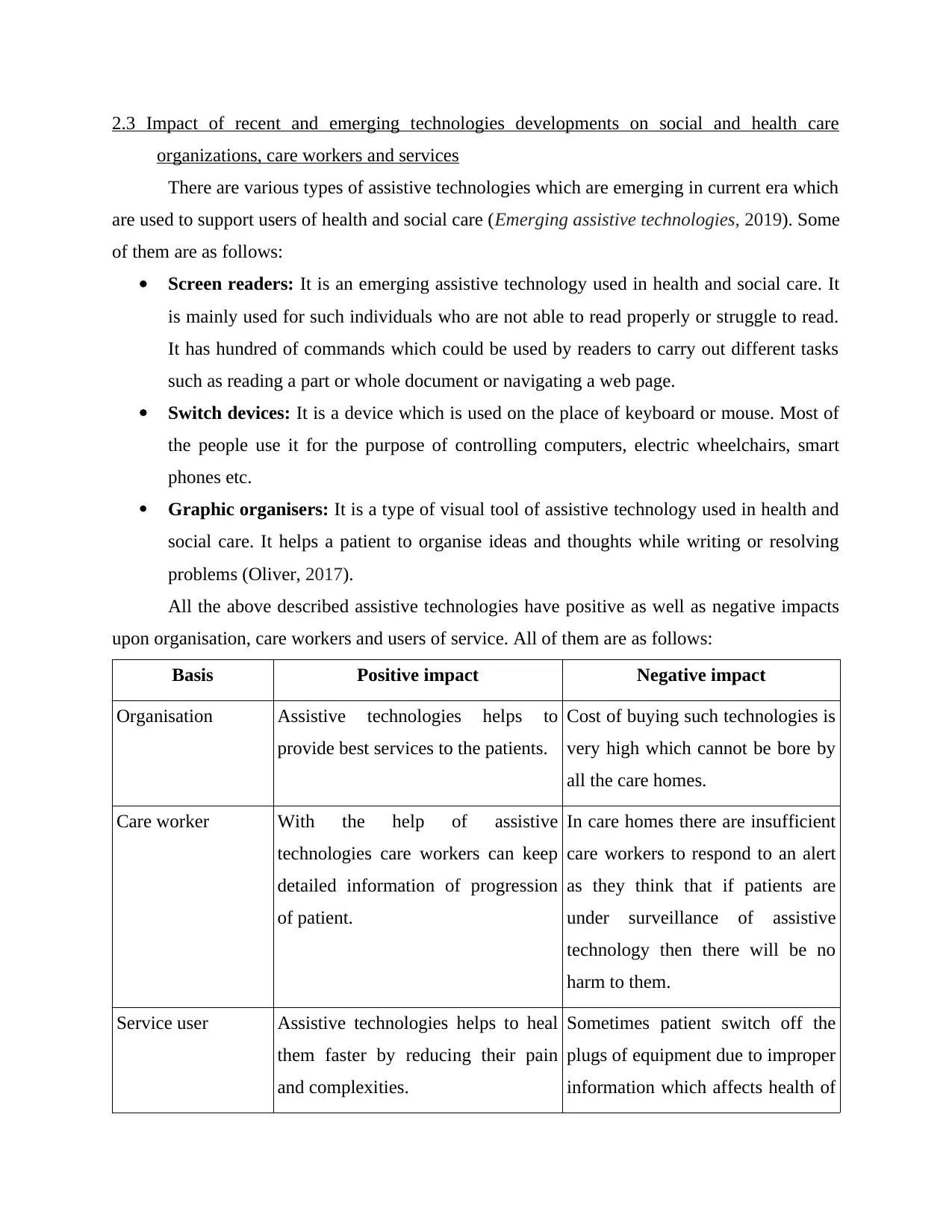
All the above described assistive technologies have positive as well as negative impacts
upon organisation, care workers and users of service. All of them are as follows:
Basis Positive impact Negative impact
Organisation Assistive technologies helps to
provide best services to the patients.
Cost of buying such technologies is
very high which cannot be bore by
all the care homes.
Care worker With the help of assistive
technologies care workers can keep
detailed information of progression
of patient.
In care homes there are insufficient
care workers to respond to an alert
as they think that if patients are
under surveillance of assistive
technology then there will be no
harm to them.
Service user Assistive technologies helps to heal
them faster by reducing their pain
and complexities.
Sometimes patient switch off the
plugs of equipment due to improper
information which affects health of
organizations, care workers and services
There are various types of assistive technologies which are emerging in current era which
are used to support users of health and social care (Emerging assistive technologies, 2019). Some
of them are as follows:
Screen readers: It is an emerging assistive technology used in health and social care. It
is mainly used for such individuals who are not able to read properly or struggle to read.
It has hundred of commands which could be used by readers to carry out different tasks
such as reading a part or whole document or navigating a web page.
Switch devices: It is a device which is used on the place of keyboard or mouse. Most of
the people use it for the purpose of controlling computers, electric wheelchairs, smart
phones etc.
Graphic organisers: It is a type of visual tool of assistive technology used in health and
social care. It helps a patient to organise ideas and thoughts while writing or resolving
problems (Oliver, 2017).
All the above described assistive technologies have positive as well as negative impacts
upon organisation, care workers and users of service. All of them are as follows:
Basis Positive impact Negative impact
Organisation Assistive technologies helps to
provide best services to the patients.
Cost of buying such technologies is
very high which cannot be bore by
all the care homes.
Care worker With the help of assistive
technologies care workers can keep
detailed information of progression
of patient.
In care homes there are insufficient
care workers to respond to an alert
as they think that if patients are
under surveillance of assistive
technology then there will be no
harm to them.
Service user Assistive technologies helps to heal
them faster by reducing their pain
and complexities.
Sometimes patient switch off the
plugs of equipment due to improper
information which affects health of
⊘ This is a preview!⊘
Do you want full access?
Subscribe today to unlock all pages.
Trusted by 1+ million students worldwide
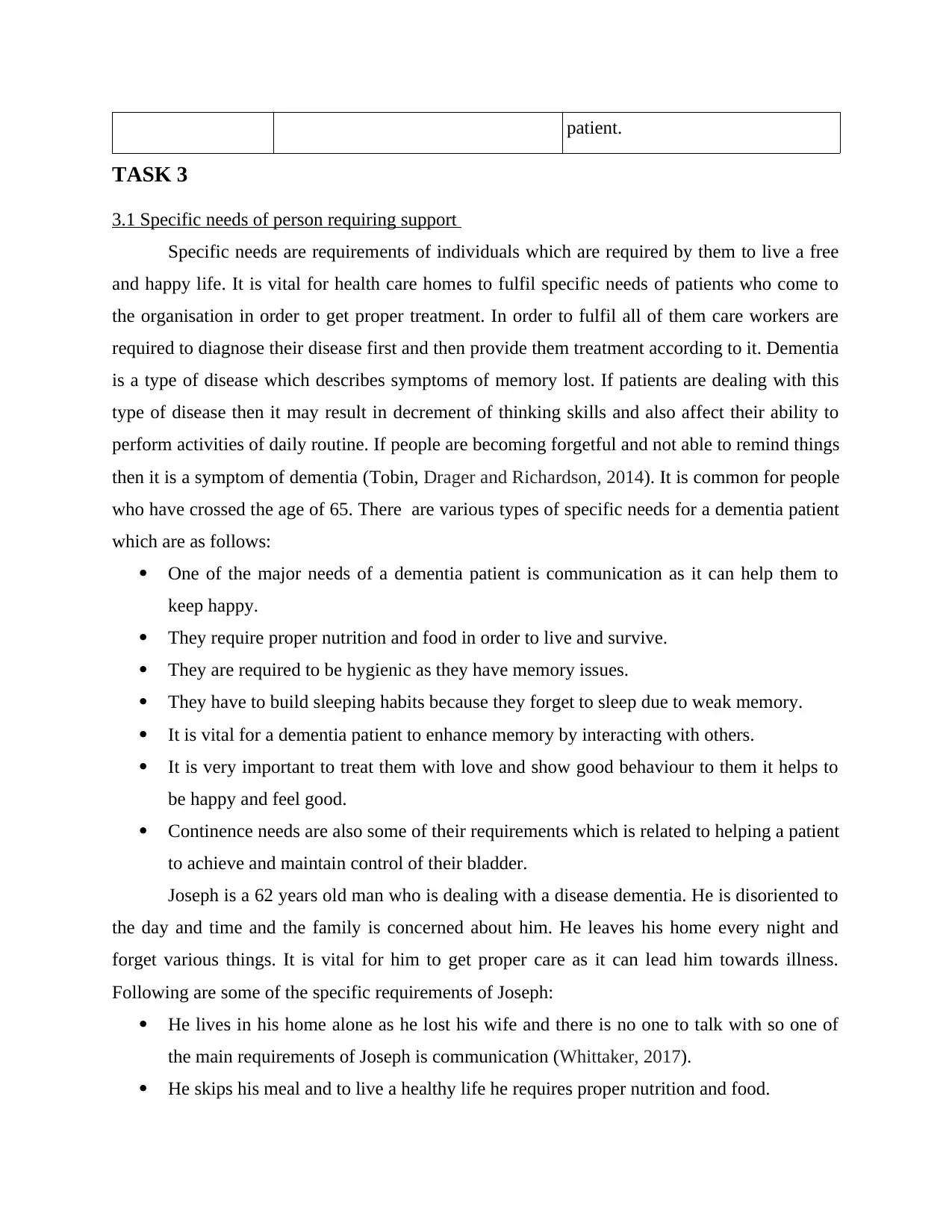
patient.
TASK 3
3.1 Specific needs of person requiring support
Specific needs are requirements of individuals which are required by them to live a free
and happy life. It is vital for health care homes to fulfil specific needs of patients who come to
the organisation in order to get proper treatment. In order to fulfil all of them care workers are
required to diagnose their disease first and then provide them treatment according to it. Dementia
is a type of disease which describes symptoms of memory lost. If patients are dealing with this
type of disease then it may result in decrement of thinking skills and also affect their ability to
perform activities of daily routine. If people are becoming forgetful and not able to remind things
then it is a symptom of dementia (Tobin, Drager and Richardson, 2014). It is common for people
who have crossed the age of 65. There are various types of specific needs for a dementia patient
which are as follows:
One of the major needs of a dementia patient is communication as it can help them to
keep happy.
They require proper nutrition and food in order to live and survive.
They are required to be hygienic as they have memory issues.
They have to build sleeping habits because they forget to sleep due to weak memory.
It is vital for a dementia patient to enhance memory by interacting with others.
It is very important to treat them with love and show good behaviour to them it helps to
be happy and feel good.
Continence needs are also some of their requirements which is related to helping a patient
to achieve and maintain control of their bladder.
Joseph is a 62 years old man who is dealing with a disease dementia. He is disoriented to
the day and time and the family is concerned about him. He leaves his home every night and
forget various things. It is vital for him to get proper care as it can lead him towards illness.
Following are some of the specific requirements of Joseph:
He lives in his home alone as he lost his wife and there is no one to talk with so one of
the main requirements of Joseph is communication (Whittaker, 2017).
He skips his meal and to live a healthy life he requires proper nutrition and food.
TASK 3
3.1 Specific needs of person requiring support
Specific needs are requirements of individuals which are required by them to live a free
and happy life. It is vital for health care homes to fulfil specific needs of patients who come to
the organisation in order to get proper treatment. In order to fulfil all of them care workers are
required to diagnose their disease first and then provide them treatment according to it. Dementia
is a type of disease which describes symptoms of memory lost. If patients are dealing with this
type of disease then it may result in decrement of thinking skills and also affect their ability to
perform activities of daily routine. If people are becoming forgetful and not able to remind things
then it is a symptom of dementia (Tobin, Drager and Richardson, 2014). It is common for people
who have crossed the age of 65. There are various types of specific needs for a dementia patient
which are as follows:
One of the major needs of a dementia patient is communication as it can help them to
keep happy.
They require proper nutrition and food in order to live and survive.
They are required to be hygienic as they have memory issues.
They have to build sleeping habits because they forget to sleep due to weak memory.
It is vital for a dementia patient to enhance memory by interacting with others.
It is very important to treat them with love and show good behaviour to them it helps to
be happy and feel good.
Continence needs are also some of their requirements which is related to helping a patient
to achieve and maintain control of their bladder.
Joseph is a 62 years old man who is dealing with a disease dementia. He is disoriented to
the day and time and the family is concerned about him. He leaves his home every night and
forget various things. It is vital for him to get proper care as it can lead him towards illness.
Following are some of the specific requirements of Joseph:
He lives in his home alone as he lost his wife and there is no one to talk with so one of
the main requirements of Joseph is communication (Whittaker, 2017).
He skips his meal and to live a healthy life he requires proper nutrition and food.
Paraphrase This Document
Need a fresh take? Get an instant paraphrase of this document with our AI Paraphraser
It is vital for him to build memory abilities as one night he forgot to off the tap and it ash
resulted in water in his house.
He goes out every night which means he was not taking proper nap one of the major need
of Joseph is building sleeping habits.
He requires good behaviour from others in order to feel good.
3.2 Recommendations for technologies how these can support independent living arrangements
Assistive devices are mainly made for such people who have weak memory and other
issues which are affecting their daily life. With the help of them Joseph will be able to remember
each and everything and it can also help him to fulfil all his needs regarding food, nutrition,
hygiene, sleep etc. All the assistive devices which are recommended to Joseph are as follows:
Home care robots: Nowadays most of the people keep home care robots who can look
after their home and keep it clean. Joseph can also use this option in which robot will take care of
his home and the situation of flowing water will not take place again (World Health
Organization, 2015).
Reminder messages: It is a modern way to remembers things. Joseph can set reminders
for everything such as taking a meal, sleep, bathing and going home. With the help of it he will
be able to get nutritions, food and nap on time (World Health Organization, 2016).
3.3 Usefulness of technology for the users of social and healthcare services
Two different types of assistive technologies are recommended to Joseph which are
robots for home care and reminder messages. Both of them are useful for Joseph as robots will
take care of him home and reminder messages will help him to remind everything. With the help
of these assistive devices he will be able to eat food on time and take proper nap. There are
various other devices which are not useful for Joseph such as screen readers because these are
mainly focused with such people who are not able to see properly.
If Joseph will not use the assistive technology properly then it can create issues for him.
For example, if he will ignore the reminder messages then his medical issue will be increased
and it will become difficult for him to deal with dementia. Other negative impact of not using AT
appropriately is that in this situation he will not be able to recover soon and his problem will
become more critical (Yusif, Soar and Hafeez-Baig, 2016).
It has been recommended that Joseph could be sent to a care home where he can get
proper treatment for dementia because at his own house he may ignore reminder messages.
resulted in water in his house.
He goes out every night which means he was not taking proper nap one of the major need
of Joseph is building sleeping habits.
He requires good behaviour from others in order to feel good.
3.2 Recommendations for technologies how these can support independent living arrangements
Assistive devices are mainly made for such people who have weak memory and other
issues which are affecting their daily life. With the help of them Joseph will be able to remember
each and everything and it can also help him to fulfil all his needs regarding food, nutrition,
hygiene, sleep etc. All the assistive devices which are recommended to Joseph are as follows:
Home care robots: Nowadays most of the people keep home care robots who can look
after their home and keep it clean. Joseph can also use this option in which robot will take care of
his home and the situation of flowing water will not take place again (World Health
Organization, 2015).
Reminder messages: It is a modern way to remembers things. Joseph can set reminders
for everything such as taking a meal, sleep, bathing and going home. With the help of it he will
be able to get nutritions, food and nap on time (World Health Organization, 2016).
3.3 Usefulness of technology for the users of social and healthcare services
Two different types of assistive technologies are recommended to Joseph which are
robots for home care and reminder messages. Both of them are useful for Joseph as robots will
take care of him home and reminder messages will help him to remind everything. With the help
of these assistive devices he will be able to eat food on time and take proper nap. There are
various other devices which are not useful for Joseph such as screen readers because these are
mainly focused with such people who are not able to see properly.
If Joseph will not use the assistive technology properly then it can create issues for him.
For example, if he will ignore the reminder messages then his medical issue will be increased
and it will become difficult for him to deal with dementia. Other negative impact of not using AT
appropriately is that in this situation he will not be able to recover soon and his problem will
become more critical (Yusif, Soar and Hafeez-Baig, 2016).
It has been recommended that Joseph could be sent to a care home where he can get
proper treatment for dementia because at his own house he may ignore reminder messages.
CONCLUSION
From the above project report it has been concluded that for all the human beings who are
dealing with any kind of issue or medial situation it is their right to live independently. There are
various types of assistive technologies which are used by health care homes in order to provide
best treatment to the patients who are staying there to resolve their medical issues. Such types of
technologies are used according to the diseases which are diagnosed by doctors in their patients.
Some examples of them are lifeline alarm, radio smoke detector, screen readers, switch devices,
graphic organisers etc. With the help of all of them patients who are facing diseases such as
dementia and other issues. There are various advantages and disadvantages of assistive devices
so it is essential for patients, organisation and care workers to get detailed information of the way
in which all of them could be used.
From the above project report it has been concluded that for all the human beings who are
dealing with any kind of issue or medial situation it is their right to live independently. There are
various types of assistive technologies which are used by health care homes in order to provide
best treatment to the patients who are staying there to resolve their medical issues. Such types of
technologies are used according to the diseases which are diagnosed by doctors in their patients.
Some examples of them are lifeline alarm, radio smoke detector, screen readers, switch devices,
graphic organisers etc. With the help of all of them patients who are facing diseases such as
dementia and other issues. There are various advantages and disadvantages of assistive devices
so it is essential for patients, organisation and care workers to get detailed information of the way
in which all of them could be used.
⊘ This is a preview!⊘
Do you want full access?
Subscribe today to unlock all pages.
Trusted by 1+ million students worldwide

1 out of 13


Related Documents


Your All-in-One AI-Powered Toolkit for Academic Success.
+13062052269
info@desklib.com
Available 24*7 on WhatsApp / Email
![[object Object]](/_next/static/media/star-bottom.7253800d.svg)
Unlock your academic potential
Copyright © 2020–2026 A2Z Services. All Rights Reserved. Developed and managed by ZUCOL.