Sussan Fashion: Designing an In-House Training & Development Program
VerifiedAdded on 2023/03/31
|19
|3734
|283
Project
AI Summary
This project outlines a comprehensive in-house training and development program designed for Susan Fashion, an Australian fashion retailer. The training program addresses needs identified from previous assessments, focusing on implementing AI-oriented marketing platforms, advanced CRM tools, and robotics in design. Key training areas include CRM tool usage for the marketing department, visual searching for in-store staff, VR-based shopping system training, and soft-bot design training. The program incorporates behaviorism, social learning, cognitive, and constructivist learning theories. The plan includes detailed schedules, activities, delivery methods (both on-the-job and off-the-job), trainer instructions, feedback mechanisms, and required resources. The project also considers potential barriers such as management support, perception, finance, and conflicting priorities, providing a cost-benefit analysis to demonstrate the return on investment. This training aims to enhance employee skills, improve organizational productivity, and create a competitive edge for Susan Fashion.

Running head: HUMAN RESOURCE DEVELOPMENT AND TRAINING 1
Human Resource Development and Training
Name
Institutional Affiliation
Human Resource Development and Training
Name
Institutional Affiliation

Paraphrase This Document
Need a fresh take? Get an instant paraphrase of this document with our AI Paraphraser
HUMAN RESOURCE DEVELOPMENT AND TRAINING 2
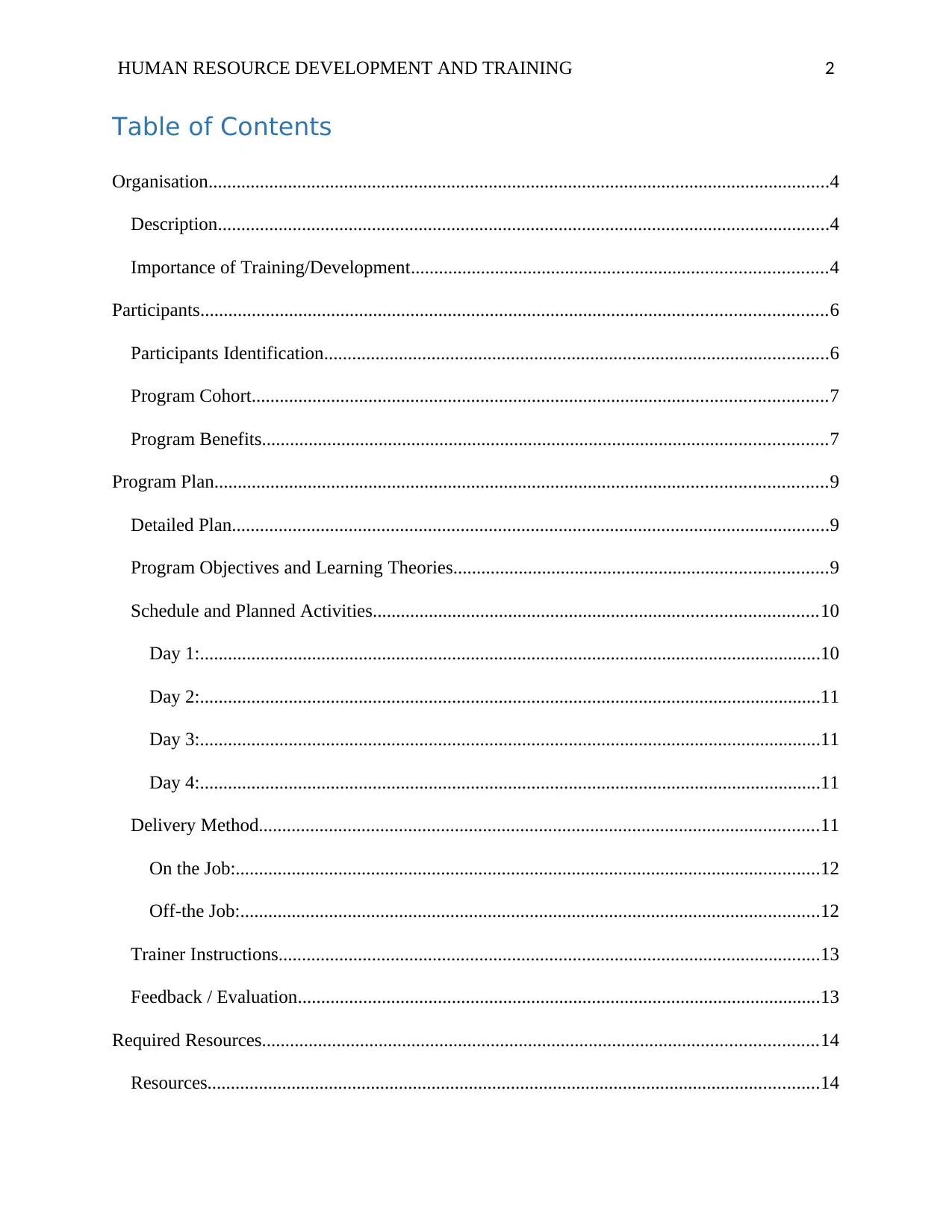
Table of Contents
Organisation.....................................................................................................................................4
Description...................................................................................................................................4
Importance of Training/Development.........................................................................................4
Participants......................................................................................................................................6
Participants Identification............................................................................................................6
Program Cohort...........................................................................................................................7
Program Benefits.........................................................................................................................7
Program Plan...................................................................................................................................9
Detailed Plan................................................................................................................................9
Program Objectives and Learning Theories................................................................................9
Schedule and Planned Activities...............................................................................................10
Day 1:.....................................................................................................................................10
Day 2:.....................................................................................................................................11
Day 3:.....................................................................................................................................11
Day 4:.....................................................................................................................................11
Delivery Method........................................................................................................................11
On the Job:.............................................................................................................................12
Off-the Job:............................................................................................................................12
Trainer Instructions....................................................................................................................13
Feedback / Evaluation................................................................................................................13
Required Resources.......................................................................................................................14
Resources...................................................................................................................................14
Table of Contents
Organisation.....................................................................................................................................4
Description...................................................................................................................................4
Importance of Training/Development.........................................................................................4
Participants......................................................................................................................................6
Participants Identification............................................................................................................6
Program Cohort...........................................................................................................................7
Program Benefits.........................................................................................................................7
Program Plan...................................................................................................................................9
Detailed Plan................................................................................................................................9
Program Objectives and Learning Theories................................................................................9
Schedule and Planned Activities...............................................................................................10
Day 1:.....................................................................................................................................10
Day 2:.....................................................................................................................................11
Day 3:.....................................................................................................................................11
Day 4:.....................................................................................................................................11
Delivery Method........................................................................................................................11
On the Job:.............................................................................................................................12
Off-the Job:............................................................................................................................12
Trainer Instructions....................................................................................................................13
Feedback / Evaluation................................................................................................................13
Required Resources.......................................................................................................................14
Resources...................................................................................................................................14

HUMAN RESOURCE DEVELOPMENT AND TRAINING 3
Hand Outs, Notes or Power Points............................................................................................14
Required Technologies..............................................................................................................14
Location.....................................................................................................................................14
Staff............................................................................................................................................14
Projected Cost............................................................................................................................15
Possible Barriers............................................................................................................................15
Management Support.................................................................................................................15
Perception and Participation......................................................................................................15
Finance.......................................................................................................................................15
Conflicting Priorities.................................................................................................................15
References......................................................................................................................................17
Hand Outs, Notes or Power Points............................................................................................14
Required Technologies..............................................................................................................14
Location.....................................................................................................................................14
Staff............................................................................................................................................14
Projected Cost............................................................................................................................15
Possible Barriers............................................................................................................................15
Management Support.................................................................................................................15
Perception and Participation......................................................................................................15
Finance.......................................................................................................................................15
Conflicting Priorities.................................................................................................................15
References......................................................................................................................................17
⊘ This is a preview!⊘
Do you want full access?
Subscribe today to unlock all pages.

Trusted by 1+ million students worldwide

HUMAN RESOURCE DEVELOPMENT AND TRAINING 4
HUMAN RESOURCE DEVELOPMENT AND TRAINING
Organisation
Description
Susan Fashion (Susan) is an Australian fashion retailer. It is owned and operated by
Susan Group that also owns and operates Suzanne Grace and sportsgirl. Susan opened its first
store o Little Collis St, Melbourne where it sold lingerie in the year 1939. By the late 1951,
Susan had opened other three stores in Little Collins St, Swanston St, and Collins St in Victoria.
In the year 1953, Susan opened two stores in Adelaide and another Perth store in year 1956. The
1960s saw Susan grow its range beyond conventional lingerie alongside blouses. Susan’s
expansion continued and it purchased Chic Salon in 1968 from Woolworths which had 94
lingerie stores operational in NSW and Queensland. The acquisition of Chic Salon besides sixty
existing stores in Western Australia and southern states elevated Susan to a national level.
Susan Fashion is all about women clothing, sleepwear, maternity, accessories, and gift
cards and allows AfterPay. The firm has been in operation for 80 years of fashion for the
Australian women. Susan Fashion exactly understands what works for women since it is all
about women. It is led by women from leaders to staff in stores making it purely run by women.
It is also designed for women and this has ensured that Susan Fashion knows what women
expect from their wardrobe. The company is made for women and believes that a woman is
everything to them this is why it is led by women, designed by women and made for women.
Importance of Training/Development
The main need for training and developed identified in the need assessment arises from
implementing Artificial Intelligence-oriented marketing platform, advanced-customer
HUMAN RESOURCE DEVELOPMENT AND TRAINING
Organisation
Description
Susan Fashion (Susan) is an Australian fashion retailer. It is owned and operated by
Susan Group that also owns and operates Suzanne Grace and sportsgirl. Susan opened its first
store o Little Collis St, Melbourne where it sold lingerie in the year 1939. By the late 1951,
Susan had opened other three stores in Little Collins St, Swanston St, and Collins St in Victoria.
In the year 1953, Susan opened two stores in Adelaide and another Perth store in year 1956. The
1960s saw Susan grow its range beyond conventional lingerie alongside blouses. Susan’s
expansion continued and it purchased Chic Salon in 1968 from Woolworths which had 94
lingerie stores operational in NSW and Queensland. The acquisition of Chic Salon besides sixty
existing stores in Western Australia and southern states elevated Susan to a national level.
Susan Fashion is all about women clothing, sleepwear, maternity, accessories, and gift
cards and allows AfterPay. The firm has been in operation for 80 years of fashion for the
Australian women. Susan Fashion exactly understands what works for women since it is all
about women. It is led by women from leaders to staff in stores making it purely run by women.
It is also designed for women and this has ensured that Susan Fashion knows what women
expect from their wardrobe. The company is made for women and believes that a woman is
everything to them this is why it is led by women, designed by women and made for women.
Importance of Training/Development
The main need for training and developed identified in the need assessment arises from
implementing Artificial Intelligence-oriented marketing platform, advanced-customer
Paraphrase This Document
Need a fresh take? Get an instant paraphrase of this document with our AI Paraphraser
HUMAN RESOURCE DEVELOPMENT AND TRAINING 5
relationship management tool and installation of robots at its design sites. Therefore, the training
and development is required in Susan Fashion to facilitate the implementation of advanced CRM
tool, premised on the data analytics alongside Artificial Intelligence-oriented marketing podiums
as well as robots to perform effective design processes (Soltani & Navimipour, 2016). Training
need areas for the identified reason captures such areas as in-store staff for VR-based shopping
system, in-store staff visual searching, marketing department for CRM tools, and designers when
designing to use soft-bots. Training and development in these key areas is of great benefits to
Susan (Kumar & Pansari, 2015).
Training is the acquisition of knowledge and skills for a person to undertake the job or
task. Training is coordinated in teaching novel skills and this makes an individual to understand
what her role and responsibilities are as well as instructing her to execute the task needed to be
fulfilled. Training always make the workers more profitable for the Company once they acquire
specific skills and knowledge. Training stresses on short-run goals of the firm wherein the
primary reason for offering trainings to workers is for the employees to undertake and executive
things since they were requested (Ma, Mayfield & Mayfield, 2018).
On the other hand, development is all about assisting the individual grow as well as
expand his abilities. Development always teach the worker to remain profitable as well as
efficient for the company (Badwan et al., 2017). Development maximizes skills and knowledge
which employees learnt in the course of training. Development entails making workers more
effective sufficiently to handle captious scenarios in future. Whereas training focuses on short-
run goals of the firm, development emphasizes on long-run goals of an organization (Cascio,
2015).
relationship management tool and installation of robots at its design sites. Therefore, the training
and development is required in Susan Fashion to facilitate the implementation of advanced CRM
tool, premised on the data analytics alongside Artificial Intelligence-oriented marketing podiums
as well as robots to perform effective design processes (Soltani & Navimipour, 2016). Training
need areas for the identified reason captures such areas as in-store staff for VR-based shopping
system, in-store staff visual searching, marketing department for CRM tools, and designers when
designing to use soft-bots. Training and development in these key areas is of great benefits to
Susan (Kumar & Pansari, 2015).
Training is the acquisition of knowledge and skills for a person to undertake the job or
task. Training is coordinated in teaching novel skills and this makes an individual to understand
what her role and responsibilities are as well as instructing her to execute the task needed to be
fulfilled. Training always make the workers more profitable for the Company once they acquire
specific skills and knowledge. Training stresses on short-run goals of the firm wherein the
primary reason for offering trainings to workers is for the employees to undertake and executive
things since they were requested (Ma, Mayfield & Mayfield, 2018).
On the other hand, development is all about assisting the individual grow as well as
expand his abilities. Development always teach the worker to remain profitable as well as
efficient for the company (Badwan et al., 2017). Development maximizes skills and knowledge
which employees learnt in the course of training. Development entails making workers more
effective sufficiently to handle captious scenarios in future. Whereas training focuses on short-
run goals of the firm, development emphasizes on long-run goals of an organization (Cascio,
2015).

HUMAN RESOURCE DEVELOPMENT AND TRAINING 6
The identification of training needs remains important aspect of training and development
program. Generally, training need are identified once the organization has set the targets to be
achieved in business. The need for implementation of advanced CRM tools, founded on the data
analytics alongside Artificial Intelligence-based marketing avenues as well as robots to perform
effective design processes triggered the need for this training program. The right individual, in
right place and at right time is always needed to accomplish the set objectives. On the basis of
the targets of the business to be achieved, there remains a definite need for the identification of
critical activities as well as perform well in the very activities like in-store alongside non-store
workers need different skills competencies (Cohen, 2017).
The workers with a broad array of skills stay increasingly flexible as well as extremely
much productive for the growth of the business. The organisation will fulfil the demands of
various customers when they are trained and developed to have clear understanding of their
respective customer profile in that specific area to choose the stock. Training will help the
worker to perform his job effectively premised on correct and right knowledge, understanding,
skills as well as resources. Workers will identify the disparity between their skills and knowledge
before they begin training and development procedure or process (Asfaw, Argaw & Bayissa,
2015).
Participants
Participants Identification
The participants include marketing department being trainer on CRM tools, in-store staff
being trained on visual searching, in-store staff being trained on VR-based shopping system and
designers being trained on how design and use soft-bots.
The identification of training needs remains important aspect of training and development
program. Generally, training need are identified once the organization has set the targets to be
achieved in business. The need for implementation of advanced CRM tools, founded on the data
analytics alongside Artificial Intelligence-based marketing avenues as well as robots to perform
effective design processes triggered the need for this training program. The right individual, in
right place and at right time is always needed to accomplish the set objectives. On the basis of
the targets of the business to be achieved, there remains a definite need for the identification of
critical activities as well as perform well in the very activities like in-store alongside non-store
workers need different skills competencies (Cohen, 2017).
The workers with a broad array of skills stay increasingly flexible as well as extremely
much productive for the growth of the business. The organisation will fulfil the demands of
various customers when they are trained and developed to have clear understanding of their
respective customer profile in that specific area to choose the stock. Training will help the
worker to perform his job effectively premised on correct and right knowledge, understanding,
skills as well as resources. Workers will identify the disparity between their skills and knowledge
before they begin training and development procedure or process (Asfaw, Argaw & Bayissa,
2015).
Participants
Participants Identification
The participants include marketing department being trainer on CRM tools, in-store staff
being trained on visual searching, in-store staff being trained on VR-based shopping system and
designers being trained on how design and use soft-bots.
⊘ This is a preview!⊘
Do you want full access?
Subscribe today to unlock all pages.
Trusted by 1+ million students worldwide
HUMAN RESOURCE DEVELOPMENT AND TRAINING 7
Program Cohort
The current marketing personnel who are lacking the desired hands on experience to use
AI-based marketing platforms. The current designers who do not know how to use movable
robots in design process hence using human that takes much time. The customers relationship
staff who do not know how to use the CRM tools to build strong customer relationships. The
customer relationship management division personnel who lack the knowledge of how to use
CRM tools.
Program Benefits
As identified in the performance gaps identification in my previous assignment on need
assessment, this training and development program seeks to fill the gaps identified. The training
will furnish and equip the participants with the required skills and competencies to successfully
implement and use the Artificial Intelligence-based marketing podia, options for visual
searching, and robots for cloth design operations as well as AI-grounded tools. Successful
implementation of these proposed changes will not only enhance the workers’ performance and
productivity, but also the productivity and performance of the organization. These changes will
further help narrow the gap between the current and estimated performance (Aruna & Anitha,
2015).
Specifically, the training and development will benefit the participants since it will allow
the Company improve skills, knowledge and experience required to run both digital marketing
and traditional and promotional activities. This is because, the current marketing personnel are
lacking the desired hands on experience to use AI-founded platforms for marketing. Therefore,
training and development these marketing personnel will close the performance gaps and hence
improve their ability to use these platforms.
Program Cohort
The current marketing personnel who are lacking the desired hands on experience to use
AI-based marketing platforms. The current designers who do not know how to use movable
robots in design process hence using human that takes much time. The customers relationship
staff who do not know how to use the CRM tools to build strong customer relationships. The
customer relationship management division personnel who lack the knowledge of how to use
CRM tools.
Program Benefits
As identified in the performance gaps identification in my previous assignment on need
assessment, this training and development program seeks to fill the gaps identified. The training
will furnish and equip the participants with the required skills and competencies to successfully
implement and use the Artificial Intelligence-based marketing podia, options for visual
searching, and robots for cloth design operations as well as AI-grounded tools. Successful
implementation of these proposed changes will not only enhance the workers’ performance and
productivity, but also the productivity and performance of the organization. These changes will
further help narrow the gap between the current and estimated performance (Aruna & Anitha,
2015).
Specifically, the training and development will benefit the participants since it will allow
the Company improve skills, knowledge and experience required to run both digital marketing
and traditional and promotional activities. This is because, the current marketing personnel are
lacking the desired hands on experience to use AI-founded platforms for marketing. Therefore,
training and development these marketing personnel will close the performance gaps and hence
improve their ability to use these platforms.
Paraphrase This Document
Need a fresh take? Get an instant paraphrase of this document with our AI Paraphraser

HUMAN RESOURCE DEVELOPMENT AND TRAINING 8
The training and development (T&D) will also benefit the organization’s designers. This
is because they are still using human workers in designing rather than robots which consumer a
lot of time and effort. Therefore, training this group to use robot will benefit them through
improved performance and hence cost-and time-saving for the organization (Rahimi & Kozak,
2017). The organization will benefit from the increased experience amongst its designers to work
with automation-based technological devices (Chen et al., 2017). This will create a competitive
edge for Susan and hence help in effective competition with its rivals.
The training and development will benefit the organization since it will ensure improved
customer relationship programs which are currently weak relative to its rivals. Thus,
implementation of AI-based CRM will be managed effectively by equipping the personnel to use
the tools properly.
The organization stands to benefit from this program in that it will have increased
productivity arising from skilled workers. The workers themselves will gain the new set of skills
and will be more confident in their works. The organization will thus create a competitive edge
and will favourably compete with its rivals. There will be successful expansion which means
more revenue and hence more profits to the organization. Trained employees are useful asset of
the organization and this will mean increased overall performance of the organization.
Cost Benefit-Analysis Table:
Operational
result area
How
measured
Results
before
training
Results after
training
Difference (+
or -)
Expressed in
($)
Gross saving 12,000
Less cost of 10,000
The training and development (T&D) will also benefit the organization’s designers. This
is because they are still using human workers in designing rather than robots which consumer a
lot of time and effort. Therefore, training this group to use robot will benefit them through
improved performance and hence cost-and time-saving for the organization (Rahimi & Kozak,
2017). The organization will benefit from the increased experience amongst its designers to work
with automation-based technological devices (Chen et al., 2017). This will create a competitive
edge for Susan and hence help in effective competition with its rivals.
The training and development will benefit the organization since it will ensure improved
customer relationship programs which are currently weak relative to its rivals. Thus,
implementation of AI-based CRM will be managed effectively by equipping the personnel to use
the tools properly.
The organization stands to benefit from this program in that it will have increased
productivity arising from skilled workers. The workers themselves will gain the new set of skills
and will be more confident in their works. The organization will thus create a competitive edge
and will favourably compete with its rivals. There will be successful expansion which means
more revenue and hence more profits to the organization. Trained employees are useful asset of
the organization and this will mean increased overall performance of the organization.
Cost Benefit-Analysis Table:
Operational
result area
How
measured
Results
before
training
Results after
training
Difference (+
or -)
Expressed in
($)
Gross saving 12,000
Less cost of 10,000

HUMAN RESOURCE DEVELOPMENT AND TRAINING 9
training
Net savings 2,000
ROI= Return/investment= Gross savings/cost of training= $12000/10000=1.2
The organization will benefit since every 1$ invested in training and development
program returns approximately $1.2 in benefits.
Program Plan
Detailed Plan
The plan for this T&D program shall be based on the behaviourism theory of learning.
Here, the participants will be brought together and work together both as whole and sometimes
subdivided into small groups. There will be acquisition of new behavior and also a change in
behavior through the association between the trainee and trainers. The social learning theory will
be helpful since people will share ideas and in the process learn from each other (Baum, 2016).
Program Objectives and Learning Theories
The objectives of this program will be:
To train and develop the marketing department personnel on how to effectively use the
CRM tools
To train and develop the in-store staff on effective and successful visual searching
To train and develop in-store staff on the VR-based shopping system
To train and develop on how to design and use soft-bots
The learning theories to be used is the social learning theory, behaviourist, and cognitive,
constructivist. The behaviourist theory allows the training and development since behaviors or
training
Net savings 2,000
ROI= Return/investment= Gross savings/cost of training= $12000/10000=1.2
The organization will benefit since every 1$ invested in training and development
program returns approximately $1.2 in benefits.
Program Plan
Detailed Plan
The plan for this T&D program shall be based on the behaviourism theory of learning.
Here, the participants will be brought together and work together both as whole and sometimes
subdivided into small groups. There will be acquisition of new behavior and also a change in
behavior through the association between the trainee and trainers. The social learning theory will
be helpful since people will share ideas and in the process learn from each other (Baum, 2016).
Program Objectives and Learning Theories
The objectives of this program will be:
To train and develop the marketing department personnel on how to effectively use the
CRM tools
To train and develop the in-store staff on effective and successful visual searching
To train and develop in-store staff on the VR-based shopping system
To train and develop on how to design and use soft-bots
The learning theories to be used is the social learning theory, behaviourist, and cognitive,
constructivist. The behaviourist theory allows the training and development since behaviors or
⊘ This is a preview!⊘
Do you want full access?
Subscribe today to unlock all pages.
Trusted by 1+ million students worldwide

HUMAN RESOURCE DEVELOPMENT AND TRAINING 10
the changes in behaviors which are acquired via association between responses and stimuli. The
cognitive theory will help in the training and development whereby information processing
culminates in understanding as well as retention (Kadiresan et al., 2015).
Constructivist is where the trainer and trainee construct own knowledge of the globe on
the basis of their individual experiences. The behaviourism believe that knowledge does exist
individually as well as outside persons (Collings, Wood & Szamosi, 2018). A learner is viewed
as a blank slate who has to be provided with experience.
The behaviourists hold that learning really takes places where novel behaviors or changes
in behaviors get acquired via the link between responses and stimuli. Therefore, association
culminates in change in the behavior. The process of learning is anchored on objectively
observable behavior change (Roozing, Caldwell & Tsagarakis, 2016).
Behaviourist theories define learning as acquisition of a novel behavior or even change in
a given behavior. The learning will start when a cue or stimuli from environment gets presented
while learners react to stimulus based on certain kinds of responses (Brewster, Mayrhofer &
Morley, 2016).
Schedule and Planned Activities
Day 1:
The main area that will be covered will be to train the marketing department personnel on the use
of CRM tools. This will be the main subject of the day. It will take 4 hours to finish. This will
begin at 8:00 and will run till 1 PM. There will be a break of one hour for breakfast at 10:00AM
before resuming.
the changes in behaviors which are acquired via association between responses and stimuli. The
cognitive theory will help in the training and development whereby information processing
culminates in understanding as well as retention (Kadiresan et al., 2015).
Constructivist is where the trainer and trainee construct own knowledge of the globe on
the basis of their individual experiences. The behaviourism believe that knowledge does exist
individually as well as outside persons (Collings, Wood & Szamosi, 2018). A learner is viewed
as a blank slate who has to be provided with experience.
The behaviourists hold that learning really takes places where novel behaviors or changes
in behaviors get acquired via the link between responses and stimuli. Therefore, association
culminates in change in the behavior. The process of learning is anchored on objectively
observable behavior change (Roozing, Caldwell & Tsagarakis, 2016).
Behaviourist theories define learning as acquisition of a novel behavior or even change in
a given behavior. The learning will start when a cue or stimuli from environment gets presented
while learners react to stimulus based on certain kinds of responses (Brewster, Mayrhofer &
Morley, 2016).
Schedule and Planned Activities
Day 1:
The main area that will be covered will be to train the marketing department personnel on the use
of CRM tools. This will be the main subject of the day. It will take 4 hours to finish. This will
begin at 8:00 and will run till 1 PM. There will be a break of one hour for breakfast at 10:00AM
before resuming.
Paraphrase This Document
Need a fresh take? Get an instant paraphrase of this document with our AI Paraphraser

HUMAN RESOURCE DEVELOPMENT AND TRAINING 11
Day 2:
Training in-store staff on effective and successful visual searching. It will also run for four hours
starting at 9:00Am and ending at 2PM. There will be a break for one hour and people will
resume the training.
Day 3:
Training and developing in-store staff on the VR-based shopping system. This will be done on
the third day. It will run for five hour. There will be both breakfast and lunch provided. The
training will start at 8am and end at 1pm. There will be a break for 30 minutes for breakfast at
10am and another break at 1pm for lunch (Illeris, 2018).
Day 4:
Train and develop designers on how to design and use soft-bots rather the time consuming and
costly human. The main subject will be human relations training. I will commence at 8 am and
will go up to 5pm. All the other previous topics will be recapped.
Delivery Method
The training methods for delivery will contain on-the-job alongside off-the-job. Susan
Fashion sustained to make goods programmed with the present strategy that has delivered
promising growth despite the challenging time. The Company provides two methods for delivery
of training including off-the-job and on-the-job training (Brewster & Hegewisch, 2017).
On the Job:
This will comprise shadowing an individual already on his job and it focuses on showing
the workers how a given job is done. Coaching managers or particular colleagues will assist
Day 2:
Training in-store staff on effective and successful visual searching. It will also run for four hours
starting at 9:00Am and ending at 2PM. There will be a break for one hour and people will
resume the training.
Day 3:
Training and developing in-store staff on the VR-based shopping system. This will be done on
the third day. It will run for five hour. There will be both breakfast and lunch provided. The
training will start at 8am and end at 1pm. There will be a break for 30 minutes for breakfast at
10am and another break at 1pm for lunch (Illeris, 2018).
Day 4:
Train and develop designers on how to design and use soft-bots rather the time consuming and
costly human. The main subject will be human relations training. I will commence at 8 am and
will go up to 5pm. All the other previous topics will be recapped.
Delivery Method
The training methods for delivery will contain on-the-job alongside off-the-job. Susan
Fashion sustained to make goods programmed with the present strategy that has delivered
promising growth despite the challenging time. The Company provides two methods for delivery
of training including off-the-job and on-the-job training (Brewster & Hegewisch, 2017).
On the Job:
This will comprise shadowing an individual already on his job and it focuses on showing
the workers how a given job is done. Coaching managers or particular colleagues will assist

HUMAN RESOURCE DEVELOPMENT AND TRAINING 12
trainee work via the challenges and inspire them to get the best solutions. Mentoring is done to
more experienced staff members like an advisor. Job rotation is also effective to give the trainee
opportunity to cover their respective target position by taking complete responsibilities on the
provisional basis.
Off-the Job:
This method uses external courses that are run by professional training organization
alongside qualified training staff of Susan Fashion.
Susan Fashion uses the structured training program that entails the creation of
methodologies and training that have been applied successful in the development of professional
skills as well as boost the desired efficiency of workers to perform the jobs in the best way
possible. The structured program emphasizes structured training which helps in the achievement
of the business objectives based on business growth as well as profit (Anderson, 2016). The
regular performance feedback which is applied help maintain this explicit. The benefits of the
structured training program are achieved by ensuring that workers put into realistic situation with
the essential conditions established to back the planned series of performance of the task.
This structured training program remains effective way of making the business to grow
since it help provide quality services to customers as well as train staff to execute all the business
suitable activities professionally (Odle-Dusseau et al., 2016). The employee efficiency has
surged to a bigger extent because of training program. They employees remain in the desired
positions to address any scenario by using skills as well as abilities acquired by training. The
employees who have been trained become useful asses to the organization and their respective
capabilities are surging as time passes (Dweck & Bempechat, 2017).
trainee work via the challenges and inspire them to get the best solutions. Mentoring is done to
more experienced staff members like an advisor. Job rotation is also effective to give the trainee
opportunity to cover their respective target position by taking complete responsibilities on the
provisional basis.
Off-the Job:
This method uses external courses that are run by professional training organization
alongside qualified training staff of Susan Fashion.
Susan Fashion uses the structured training program that entails the creation of
methodologies and training that have been applied successful in the development of professional
skills as well as boost the desired efficiency of workers to perform the jobs in the best way
possible. The structured program emphasizes structured training which helps in the achievement
of the business objectives based on business growth as well as profit (Anderson, 2016). The
regular performance feedback which is applied help maintain this explicit. The benefits of the
structured training program are achieved by ensuring that workers put into realistic situation with
the essential conditions established to back the planned series of performance of the task.
This structured training program remains effective way of making the business to grow
since it help provide quality services to customers as well as train staff to execute all the business
suitable activities professionally (Odle-Dusseau et al., 2016). The employee efficiency has
surged to a bigger extent because of training program. They employees remain in the desired
positions to address any scenario by using skills as well as abilities acquired by training. The
employees who have been trained become useful asses to the organization and their respective
capabilities are surging as time passes (Dweck & Bempechat, 2017).
⊘ This is a preview!⊘
Do you want full access?
Subscribe today to unlock all pages.
Trusted by 1+ million students worldwide

1 out of 19


Your All-in-One AI-Powered Toolkit for Academic Success.
+13062052269
info@desklib.com
Available 24*7 on WhatsApp / Email
![[object Object]](/_next/static/media/star-bottom.7253800d.svg)
Unlock your academic potential
Copyright © 2020–2026 A2Z Services. All Rights Reserved. Developed and managed by ZUCOL.