SWK2112: Report on Australian Politics and Sustainability Issues
VerifiedAdded on 2019/09/30
|8
|1963
|226
Report
AI Summary
This report examines the intersection of sustainability and Australian politics, with a specific focus on eco social work and the deregulation of public universities. It begins with an overview of global understandings of sustainability, including Agenda 21 and the Talloires Declaration, highlighting the role of education in promoting sustainable development. The report then analyzes the implications of deregulation on universities and the potential impact on students, referencing political debates and the absence of significant opposition. It explores the role of social work in addressing sustainability challenges, emphasizing the importance of human rights, social justice, and intergenerational equity. Theoretical frameworks such as the Brundtland report, Sen's capabilities approach, and the ecological sustainability method are discussed. The report highlights the significance of empowerment, community development, and the need for social workers to engage in environmental sustainability efforts. It also provides resources like journals, periodicals, and Ted Talks related to the topic.
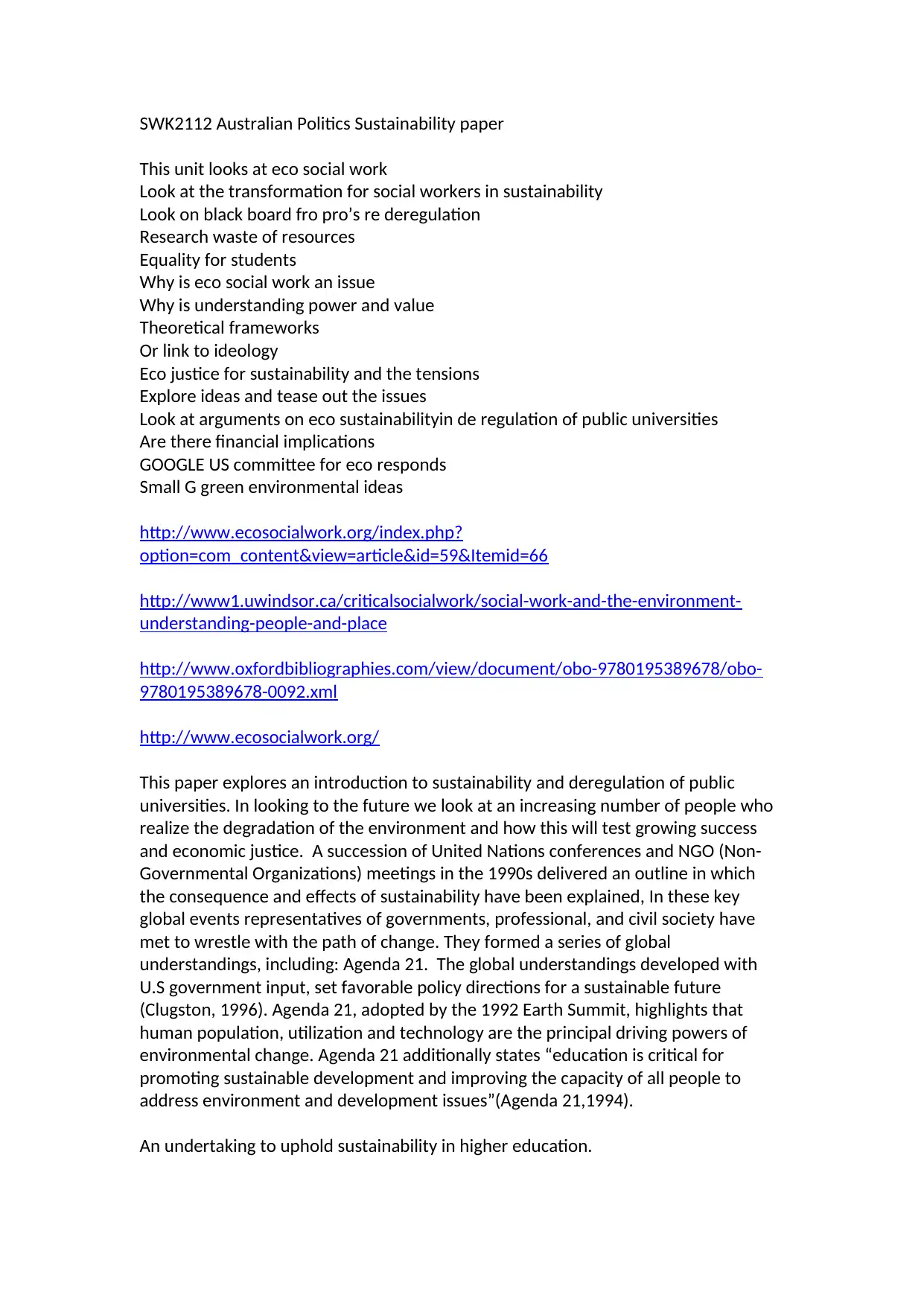
SWK2112 Australian Politics Sustainability paper
This unit looks at eco social work
Look at the transformation for social workers in sustainability
Look on black board fro pro’s re deregulation
Research waste of resources
Equality for students
Why is eco social work an issue
Why is understanding power and value
Theoretical frameworks
Or link to ideology
Eco justice for sustainability and the tensions
Explore ideas and tease out the issues
Look at arguments on eco sustainabilityin de regulation of public universities
Are there financial implications
GOOGLE US committee for eco responds
Small G green environmental ideas
http://www.ecosocialwork.org/index.php?
option=com_content&view=article&id=59&Itemid=66
http://www1.uwindsor.ca/criticalsocialwork/social-work-and-the-environment-
understanding-people-and-place
http://www.oxfordbibliographies.com/view/document/obo-9780195389678/obo-
9780195389678-0092.xml
http://www.ecosocialwork.org/
This paper explores an introduction to sustainability and deregulation of public
universities. In looking to the future we look at an increasing number of people who
realize the degradation of the environment and how this will test growing success
and economic justice. A succession of United Nations conferences and NGO (Non-
Governmental Organizations) meetings in the 1990s delivered an outline in which
the consequence and effects of sustainability have been explained, In these key
global events representatives of governments, professional, and civil society have
met to wrestle with the path of change. They formed a series of global
understandings, including: Agenda 21. The global understandings developed with
U.S government input, set favorable policy directions for a sustainable future
(Clugston, 1996). Agenda 21, adopted by the 1992 Earth Summit, highlights that
human population, utilization and technology are the principal driving powers of
environmental change. Agenda 21 additionally states “education is critical for
promoting sustainable development and improving the capacity of all people to
address environment and development issues”(Agenda 21,1994).
An undertaking to uphold sustainability in higher education.
This unit looks at eco social work
Look at the transformation for social workers in sustainability
Look on black board fro pro’s re deregulation
Research waste of resources
Equality for students
Why is eco social work an issue
Why is understanding power and value
Theoretical frameworks
Or link to ideology
Eco justice for sustainability and the tensions
Explore ideas and tease out the issues
Look at arguments on eco sustainabilityin de regulation of public universities
Are there financial implications
GOOGLE US committee for eco responds
Small G green environmental ideas
http://www.ecosocialwork.org/index.php?
option=com_content&view=article&id=59&Itemid=66
http://www1.uwindsor.ca/criticalsocialwork/social-work-and-the-environment-
understanding-people-and-place
http://www.oxfordbibliographies.com/view/document/obo-9780195389678/obo-
9780195389678-0092.xml
http://www.ecosocialwork.org/
This paper explores an introduction to sustainability and deregulation of public
universities. In looking to the future we look at an increasing number of people who
realize the degradation of the environment and how this will test growing success
and economic justice. A succession of United Nations conferences and NGO (Non-
Governmental Organizations) meetings in the 1990s delivered an outline in which
the consequence and effects of sustainability have been explained, In these key
global events representatives of governments, professional, and civil society have
met to wrestle with the path of change. They formed a series of global
understandings, including: Agenda 21. The global understandings developed with
U.S government input, set favorable policy directions for a sustainable future
(Clugston, 1996). Agenda 21, adopted by the 1992 Earth Summit, highlights that
human population, utilization and technology are the principal driving powers of
environmental change. Agenda 21 additionally states “education is critical for
promoting sustainable development and improving the capacity of all people to
address environment and development issues”(Agenda 21,1994).
An undertaking to uphold sustainability in higher education.

Paraphrase This Document
Need a fresh take? Get an instant paraphrase of this document with our AI Paraphraser
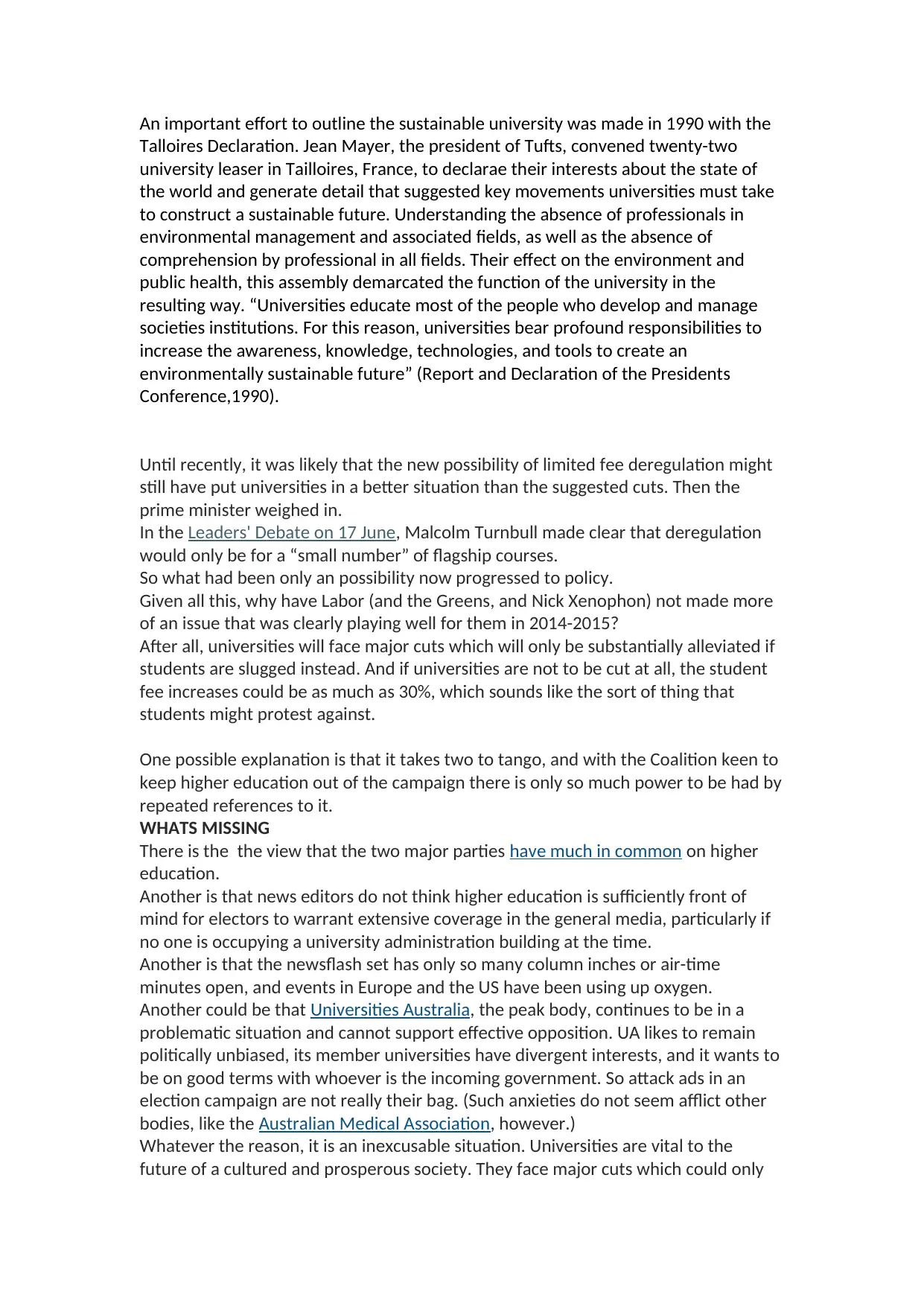
An important effort to outline the sustainable university was made in 1990 with the
Talloires Declaration. Jean Mayer, the president of Tufts, convened twenty-two
university leaser in Tailloires, France, to declarae their interests about the state of
the world and generate detail that suggested key movements universities must take
to construct a sustainable future. Understanding the absence of professionals in
environmental management and associated fields, as well as the absence of
comprehension by professional in all fields. Their effect on the environment and
public health, this assembly demarcated the function of the university in the
resulting way. “Universities educate most of the people who develop and manage
societies institutions. For this reason, universities bear profound responsibilities to
increase the awareness, knowledge, technologies, and tools to create an
environmentally sustainable future” (Report and Declaration of the Presidents
Conference,1990).
Until recently, it was likely that the new possibility of limited fee deregulation might
still have put universities in a better situation than the suggested cuts. Then the
prime minister weighed in.
In the Leaders' Debate on 17 June, Malcolm Turnbull made clear that deregulation
would only be for a “small number” of flagship courses.
So what had been only an possibility now progressed to policy.
Given all this, why have Labor (and the Greens, and Nick Xenophon) not made more
of an issue that was clearly playing well for them in 2014-2015?
After all, universities will face major cuts which will only be substantially alleviated if
students are slugged instead. And if universities are not to be cut at all, the student
fee increases could be as much as 30%, which sounds like the sort of thing that
students might protest against.
One possible explanation is that it takes two to tango, and with the Coalition keen to
keep higher education out of the campaign there is only so much power to be had by
repeated references to it.
WHATS MISSING
There is the the view that the two major parties have much in common on higher
education.
Another is that news editors do not think higher education is sufficiently front of
mind for electors to warrant extensive coverage in the general media, particularly if
no one is occupying a university administration building at the time.
Another is that the newsflash set has only so many column inches or air-time
minutes open, and events in Europe and the US have been using up oxygen.
Another could be that Universities Australia, the peak body, continues to be in a
problematic situation and cannot support effective opposition. UA likes to remain
politically unbiased, its member universities have divergent interests, and it wants to
be on good terms with whoever is the incoming government. So attack ads in an
election campaign are not really their bag. (Such anxieties do not seem afflict other
bodies, like the Australian Medical Association, however.)
Whatever the reason, it is an inexcusable situation. Universities are vital to the
future of a cultured and prosperous society. They face major cuts which could only
Talloires Declaration. Jean Mayer, the president of Tufts, convened twenty-two
university leaser in Tailloires, France, to declarae their interests about the state of
the world and generate detail that suggested key movements universities must take
to construct a sustainable future. Understanding the absence of professionals in
environmental management and associated fields, as well as the absence of
comprehension by professional in all fields. Their effect on the environment and
public health, this assembly demarcated the function of the university in the
resulting way. “Universities educate most of the people who develop and manage
societies institutions. For this reason, universities bear profound responsibilities to
increase the awareness, knowledge, technologies, and tools to create an
environmentally sustainable future” (Report and Declaration of the Presidents
Conference,1990).
Until recently, it was likely that the new possibility of limited fee deregulation might
still have put universities in a better situation than the suggested cuts. Then the
prime minister weighed in.
In the Leaders' Debate on 17 June, Malcolm Turnbull made clear that deregulation
would only be for a “small number” of flagship courses.
So what had been only an possibility now progressed to policy.
Given all this, why have Labor (and the Greens, and Nick Xenophon) not made more
of an issue that was clearly playing well for them in 2014-2015?
After all, universities will face major cuts which will only be substantially alleviated if
students are slugged instead. And if universities are not to be cut at all, the student
fee increases could be as much as 30%, which sounds like the sort of thing that
students might protest against.
One possible explanation is that it takes two to tango, and with the Coalition keen to
keep higher education out of the campaign there is only so much power to be had by
repeated references to it.
WHATS MISSING
There is the the view that the two major parties have much in common on higher
education.
Another is that news editors do not think higher education is sufficiently front of
mind for electors to warrant extensive coverage in the general media, particularly if
no one is occupying a university administration building at the time.
Another is that the newsflash set has only so many column inches or air-time
minutes open, and events in Europe and the US have been using up oxygen.
Another could be that Universities Australia, the peak body, continues to be in a
problematic situation and cannot support effective opposition. UA likes to remain
politically unbiased, its member universities have divergent interests, and it wants to
be on good terms with whoever is the incoming government. So attack ads in an
election campaign are not really their bag. (Such anxieties do not seem afflict other
bodies, like the Australian Medical Association, however.)
Whatever the reason, it is an inexcusable situation. Universities are vital to the
future of a cultured and prosperous society. They face major cuts which could only
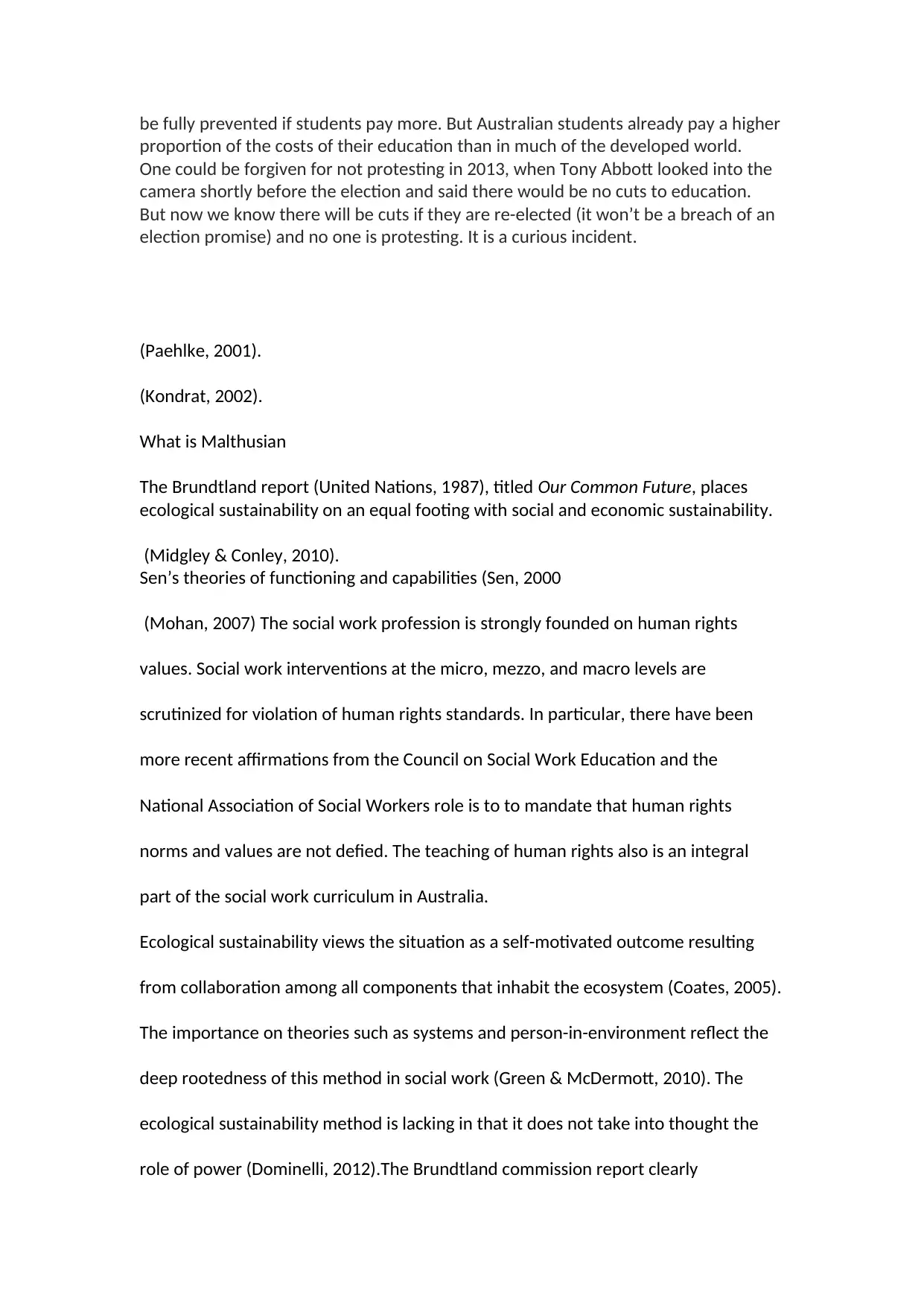
be fully prevented if students pay more. But Australian students already pay a higher
proportion of the costs of their education than in much of the developed world.
One could be forgiven for not protesting in 2013, when Tony Abbott looked into the
camera shortly before the election and said there would be no cuts to education.
But now we know there will be cuts if they are re-elected (it won’t be a breach of an
election promise) and no one is protesting. It is a curious incident.
(Paehlke, 2001).
(Kondrat, 2002).
What is Malthusian
The Brundtland report (United Nations, 1987), titled Our Common Future, places
ecological sustainability on an equal footing with social and economic sustainability.
(Midgley & Conley, 2010).
Sen’s theories of functioning and capabilities (Sen, 2000
(Mohan, 2007) The social work profession is strongly founded on human rights
values. Social work interventions at the micro, mezzo, and macro levels are
scrutinized for violation of human rights standards. In particular, there have been
more recent affirmations from the Council on Social Work Education and the
National Association of Social Workers role is to to mandate that human rights
norms and values are not defied. The teaching of human rights also is an integral
part of the social work curriculum in Australia.
Ecological sustainability views the situation as a self-motivated outcome resulting
from collaboration among all components that inhabit the ecosystem (Coates, 2005).
The importance on theories such as systems and person-in-environment reflect the
deep rootedness of this method in social work (Green & McDermott, 2010). The
ecological sustainability method is lacking in that it does not take into thought the
role of power (Dominelli, 2012).The Brundtland commission report clearly
proportion of the costs of their education than in much of the developed world.
One could be forgiven for not protesting in 2013, when Tony Abbott looked into the
camera shortly before the election and said there would be no cuts to education.
But now we know there will be cuts if they are re-elected (it won’t be a breach of an
election promise) and no one is protesting. It is a curious incident.
(Paehlke, 2001).
(Kondrat, 2002).
What is Malthusian
The Brundtland report (United Nations, 1987), titled Our Common Future, places
ecological sustainability on an equal footing with social and economic sustainability.
(Midgley & Conley, 2010).
Sen’s theories of functioning and capabilities (Sen, 2000
(Mohan, 2007) The social work profession is strongly founded on human rights
values. Social work interventions at the micro, mezzo, and macro levels are
scrutinized for violation of human rights standards. In particular, there have been
more recent affirmations from the Council on Social Work Education and the
National Association of Social Workers role is to to mandate that human rights
norms and values are not defied. The teaching of human rights also is an integral
part of the social work curriculum in Australia.
Ecological sustainability views the situation as a self-motivated outcome resulting
from collaboration among all components that inhabit the ecosystem (Coates, 2005).
The importance on theories such as systems and person-in-environment reflect the
deep rootedness of this method in social work (Green & McDermott, 2010). The
ecological sustainability method is lacking in that it does not take into thought the
role of power (Dominelli, 2012).The Brundtland commission report clearly
⊘ This is a preview!⊘
Do you want full access?
Subscribe today to unlock all pages.

Trusted by 1+ million students worldwide
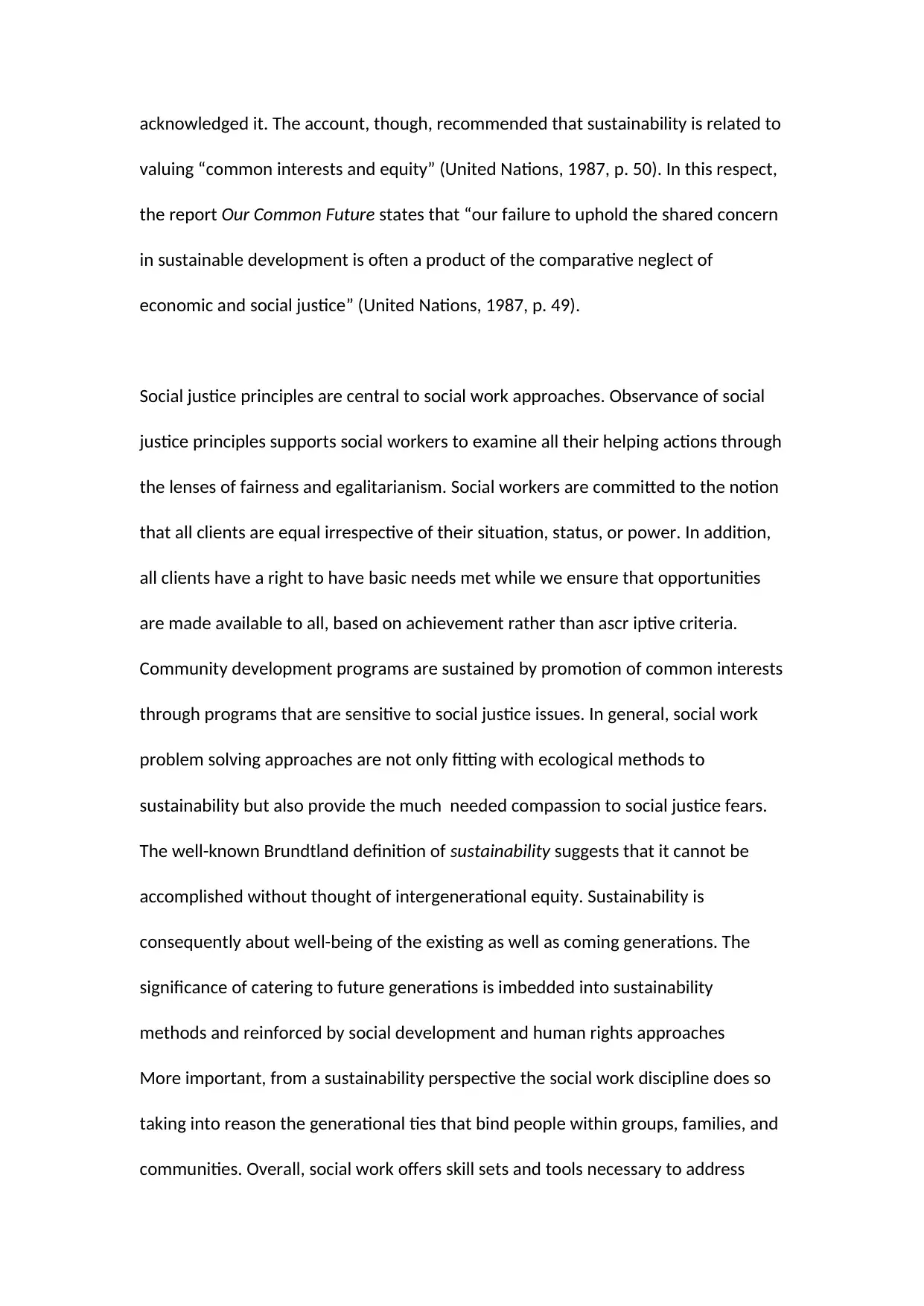
acknowledged it. The account, though, recommended that sustainability is related to
valuing “common interests and equity” (United Nations, 1987, p. 50). In this respect,
the report Our Common Future states that “our failure to uphold the shared concern
in sustainable development is often a product of the comparative neglect of
economic and social justice” (United Nations, 1987, p. 49).
Social justice principles are central to social work approaches. Observance of social
justice principles supports social workers to examine all their helping actions through
the lenses of fairness and egalitarianism. Social workers are committed to the notion
that all clients are equal irrespective of their situation, status, or power. In addition,
all clients have a right to have basic needs met while we ensure that opportunities
are made available to all, based on achievement rather than ascr iptive criteria.
Community development programs are sustained by promotion of common interests
through programs that are sensitive to social justice issues. In general, social work
problem solving approaches are not only fitting with ecological methods to
sustainability but also provide the much needed compassion to social justice fears.
The well-known Brundtland definition of sustainability suggests that it cannot be
accomplished without thought of intergenerational equity. Sustainability is
consequently about well-being of the existing as well as coming generations. The
significance of catering to future generations is imbedded into sustainability
methods and reinforced by social development and human rights approaches
More important, from a sustainability perspective the social work discipline does so
taking into reason the generational ties that bind people within groups, families, and
communities. Overall, social work offers skill sets and tools necessary to address
valuing “common interests and equity” (United Nations, 1987, p. 50). In this respect,
the report Our Common Future states that “our failure to uphold the shared concern
in sustainable development is often a product of the comparative neglect of
economic and social justice” (United Nations, 1987, p. 49).
Social justice principles are central to social work approaches. Observance of social
justice principles supports social workers to examine all their helping actions through
the lenses of fairness and egalitarianism. Social workers are committed to the notion
that all clients are equal irrespective of their situation, status, or power. In addition,
all clients have a right to have basic needs met while we ensure that opportunities
are made available to all, based on achievement rather than ascr iptive criteria.
Community development programs are sustained by promotion of common interests
through programs that are sensitive to social justice issues. In general, social work
problem solving approaches are not only fitting with ecological methods to
sustainability but also provide the much needed compassion to social justice fears.
The well-known Brundtland definition of sustainability suggests that it cannot be
accomplished without thought of intergenerational equity. Sustainability is
consequently about well-being of the existing as well as coming generations. The
significance of catering to future generations is imbedded into sustainability
methods and reinforced by social development and human rights approaches
More important, from a sustainability perspective the social work discipline does so
taking into reason the generational ties that bind people within groups, families, and
communities. Overall, social work offers skill sets and tools necessary to address
Paraphrase This Document
Need a fresh take? Get an instant paraphrase of this document with our AI Paraphraser
issues of intergenerational equity characteristic of ecological approaches to
sustainability.
The significance in managing power at the macro level for human well-being is
evidently acknowledged by social work methods to problem solving. The
empowerment approach as a part of human development (Breton, 1994) is now
advocated also by ecological sustainability movements. Empowerment involves
delivery of information on human rights, involving the client at all levels of decision
making with respect to problem solving, and arriving at a negotiated pace of use of
services either stipulated gratis or at a cost (Lee, 2001). The social work approach is a
strength-based approach, and it enables people to use their own strengths and
accumulate resources necessary for problem solving. Empowerment is perhaps the
most widely used intervention tool in the field of social work. Activities oriented
toward ecological sustainability have become increasingly oriented toward
developing trusteeship and enabling communities and individuals to protect and
maintain local resources. Developing community capacity through empowerment to
preserve and develop local resources is now widel
Predictable Roles for the Profession
Within the ecological sustainability movement there is a slight bias concerning the
whole as opposed to the parts. “A thing is right when it tends to preserve the
reliability, constancy, and attraction of the biotic community. It is wrong when it
inclines otherwise" (Leopold, 1949, pp. 224–225).
(Bredenkamp & Pattillol, 2010), and (3) the current clash of civilizations (Huntington,
1997) for
sustainability.
The significance in managing power at the macro level for human well-being is
evidently acknowledged by social work methods to problem solving. The
empowerment approach as a part of human development (Breton, 1994) is now
advocated also by ecological sustainability movements. Empowerment involves
delivery of information on human rights, involving the client at all levels of decision
making with respect to problem solving, and arriving at a negotiated pace of use of
services either stipulated gratis or at a cost (Lee, 2001). The social work approach is a
strength-based approach, and it enables people to use their own strengths and
accumulate resources necessary for problem solving. Empowerment is perhaps the
most widely used intervention tool in the field of social work. Activities oriented
toward ecological sustainability have become increasingly oriented toward
developing trusteeship and enabling communities and individuals to protect and
maintain local resources. Developing community capacity through empowerment to
preserve and develop local resources is now widel
Predictable Roles for the Profession
Within the ecological sustainability movement there is a slight bias concerning the
whole as opposed to the parts. “A thing is right when it tends to preserve the
reliability, constancy, and attraction of the biotic community. It is wrong when it
inclines otherwise" (Leopold, 1949, pp. 224–225).
(Bredenkamp & Pattillol, 2010), and (3) the current clash of civilizations (Huntington,
1997) for
Clearly, at the macro level the sustainability agenda is wrought with pressures and
conflicts. As social workers we have to clearly associate ourselves with preferred
environmental agencies and systems involved in conveying environmental
sustainability (Hasenfeld, 1987).
Social and economic participation, and social justice as defining desirable aspects of
a sustainable way of life (Sneddon, Howarth, & Norgaardf, 2006).
Arizona State University (School of Sustainability)
ASU School of Sustainability
http://schoolofsustainability.asu.edu/
Periodicals and Journals
The International Journal of Sustainability in Higher Education (IJSHE)
http://info.emeraldinsight.com/products/journals/journals.htm?id=ijshe
“Institutional Motivations and Barriers to the Construction of Green
Buildings on Campus: A Case Study of the University of Waterloo, Ontario”
http://www.emeraldinsight.com/Insight/viewPDF.jsp?Filename=html/Output/
Published/EmeraldFullTextArticle/Pdf/2490080305.pdf
Sustainability: Science, Practice, & Policy (SSPP)
1. http://sspp.proquest.com/
Ted Talks: Chew on This-
Introduction to Sustainability.
http://www.winthrop.edu/cas/sustainability/default.aspx?id=24514
conflicts. As social workers we have to clearly associate ourselves with preferred
environmental agencies and systems involved in conveying environmental
sustainability (Hasenfeld, 1987).
Social and economic participation, and social justice as defining desirable aspects of
a sustainable way of life (Sneddon, Howarth, & Norgaardf, 2006).
Arizona State University (School of Sustainability)
ASU School of Sustainability
http://schoolofsustainability.asu.edu/
Periodicals and Journals
The International Journal of Sustainability in Higher Education (IJSHE)
http://info.emeraldinsight.com/products/journals/journals.htm?id=ijshe
“Institutional Motivations and Barriers to the Construction of Green
Buildings on Campus: A Case Study of the University of Waterloo, Ontario”
http://www.emeraldinsight.com/Insight/viewPDF.jsp?Filename=html/Output/
Published/EmeraldFullTextArticle/Pdf/2490080305.pdf
Sustainability: Science, Practice, & Policy (SSPP)
1. http://sspp.proquest.com/
Ted Talks: Chew on This-
Introduction to Sustainability.
http://www.winthrop.edu/cas/sustainability/default.aspx?id=24514
⊘ This is a preview!⊘
Do you want full access?
Subscribe today to unlock all pages.
Trusted by 1+ million students worldwide

Paraphrase This Document
Need a fresh take? Get an instant paraphrase of this document with our AI Paraphraser


1 out of 8


Your All-in-One AI-Powered Toolkit for Academic Success.
+13062052269
info@desklib.com
Available 24*7 on WhatsApp / Email
![[object Object]](/_next/static/media/star-bottom.7253800d.svg)
Unlock your academic potential
Copyright © 2020–2026 A2Z Services. All Rights Reserved. Developed and managed by ZUCOL.