Comprehensive Report: Sustainable Business Practices and Strategies
VerifiedAdded on 2023/04/11
|21
|4183
|83
Report
AI Summary
This report delves into the multifaceted realm of sustainable business practices, commencing with an exploration of the global sustainability agenda and its implications for national policies and business operations. It examines the UNDP's Sustainable Development Goals (SDGs) and the 2030 Agenda, analyzing their influence on various sectors and the forces driving change in the business environment. The report then transitions to the concept of sustainable business organizations, defining their scope across diverse industries such as business, infrastructure, agriculture, communities, economy, environment, and law. Furthermore, it evaluates the impact of current sustainability issues, including pollution, waste disposal, climate change, and water scarcity, on businesses. Finally, the report investigates sustainable strategic planning, emphasizing the triple bottom line and the process of creating sustainable business plans, providing a comprehensive overview of the subject matter.
Running head: Sustainable Business Practices
Sustainable Business Practices
Name of the Student
Name of the University
Author Note
Sustainable Business Practices
Name of the Student
Name of the University
Author Note

Paraphrase This Document
Need a fresh take? Get an instant paraphrase of this document with our AI Paraphraser
1Sustainable Business Practices
Contents
Introduction:...............................................................................................................................2
Discussion:.................................................................................................................................3
1. Understand the global sustainability agenda...................................................................3
1.1 Analyse the global sustainability agenda and how it relates to national practice............4
1.2 Analyse the forces for change in the sustainable business environment.........................5
1.3 Evaluate the impact of current sustainability issues on businesses..................................6
2. Understand the concept of the sustainable business organization.........................................7
2.1 Determine the scope of the sustainable business organization............................................7
2.2 Evaluate impact on business structure and objectives of becoming a sustainable business
organization................................................................................................................................9
3. Understand sustainable strategic planning...........................................................................11
3.1 Determine change required within business organisations to meet sustainability agenda.11
3.2 Analyse the concept of the triple bottom line and how it is implemented in business
organisations............................................................................................................................12
3.3 Review the process of sustainable strategic business planning.........................................14
Conclusion:..............................................................................................................................16
References:...............................................................................................................................17
Contents
Introduction:...............................................................................................................................2
Discussion:.................................................................................................................................3
1. Understand the global sustainability agenda...................................................................3
1.1 Analyse the global sustainability agenda and how it relates to national practice............4
1.2 Analyse the forces for change in the sustainable business environment.........................5
1.3 Evaluate the impact of current sustainability issues on businesses..................................6
2. Understand the concept of the sustainable business organization.........................................7
2.1 Determine the scope of the sustainable business organization............................................7
2.2 Evaluate impact on business structure and objectives of becoming a sustainable business
organization................................................................................................................................9
3. Understand sustainable strategic planning...........................................................................11
3.1 Determine change required within business organisations to meet sustainability agenda.11
3.2 Analyse the concept of the triple bottom line and how it is implemented in business
organisations............................................................................................................................12
3.3 Review the process of sustainable strategic business planning.........................................14
Conclusion:..............................................................................................................................16
References:...............................................................................................................................17
2Sustainable Business Practices
Introduction:
Sustainable development can be understood as an organising principle which focuses
on both the goals related to human development as well as sustainability and sustenance of
the environment and ecosystem within which humans survive (Carley et al. 2017). The aim is
to develop a society where the living conditions of the people and the usage of resources does
to result in the depletion or exploitation of nature or adversely affect the stability and
integrity of the natural systems (Charles et al. 2017). Sustainable Development therefore is a
type of development principle which address the needs of the present without jeopardising
the wellbeing of our future generations (Nam2015). The modern ideas of Sustainable
Development developed around 1987 with the Brundtland Report that published the
environmental concerns of the 20th century. Since then, the idea of sustenable development
have also added focus on social and economic development apart from the protection of the
environment (Sachs 2015; Bendell 2017).
According to Nam (2015), ‘sustainability’ should be considered as the target for
humanity to achieve a human-ecosystem balance or homeostasis and ‘sustainable
development’ should be considered as the holistic process and temporal approaches that
facilitates the achievement of the sustainability end point (World Health Organization 2016).
The modern world is facing a steep challenge while reconciling the ambitions of supporting
economic development, with that of protecting the ecosystem and the environment, which
according to Nilsson et al. (2016), are essentially conflicting goals or agendas. Welford
(2016) points out that instead of considering the commitments towards environmental
protection in the development plan as challenges, they should be considered as new
opportunities. This principle of economic development forms the basis of Managed
Sustainable Development (MSD) practices (Zhang et al. 2015). Various agendas on
sustainable development have been developed over the time that guides governments,
Introduction:
Sustainable development can be understood as an organising principle which focuses
on both the goals related to human development as well as sustainability and sustenance of
the environment and ecosystem within which humans survive (Carley et al. 2017). The aim is
to develop a society where the living conditions of the people and the usage of resources does
to result in the depletion or exploitation of nature or adversely affect the stability and
integrity of the natural systems (Charles et al. 2017). Sustainable Development therefore is a
type of development principle which address the needs of the present without jeopardising
the wellbeing of our future generations (Nam2015). The modern ideas of Sustainable
Development developed around 1987 with the Brundtland Report that published the
environmental concerns of the 20th century. Since then, the idea of sustenable development
have also added focus on social and economic development apart from the protection of the
environment (Sachs 2015; Bendell 2017).
According to Nam (2015), ‘sustainability’ should be considered as the target for
humanity to achieve a human-ecosystem balance or homeostasis and ‘sustainable
development’ should be considered as the holistic process and temporal approaches that
facilitates the achievement of the sustainability end point (World Health Organization 2016).
The modern world is facing a steep challenge while reconciling the ambitions of supporting
economic development, with that of protecting the ecosystem and the environment, which
according to Nilsson et al. (2016), are essentially conflicting goals or agendas. Welford
(2016) points out that instead of considering the commitments towards environmental
protection in the development plan as challenges, they should be considered as new
opportunities. This principle of economic development forms the basis of Managed
Sustainable Development (MSD) practices (Zhang et al. 2015). Various agendas on
sustainable development have been developed over the time that guides governments,
⊘ This is a preview!⊘
Do you want full access?
Subscribe today to unlock all pages.

Trusted by 1+ million students worldwide
3Sustainable Business Practices
businesses and corporations, influencing national policies and practices, practices of policy
planning and business organizations (Broman and Robèrt 2017; Richteret al. 2017).
The aim of the study is to explore and understand what global sustainability agenda is,
what their effects are and implications on national practices and businesses, understand the
concepts of sustainable business organization and sustainable strategic planning.
Discussion:
1. Understand the global sustainability agenda
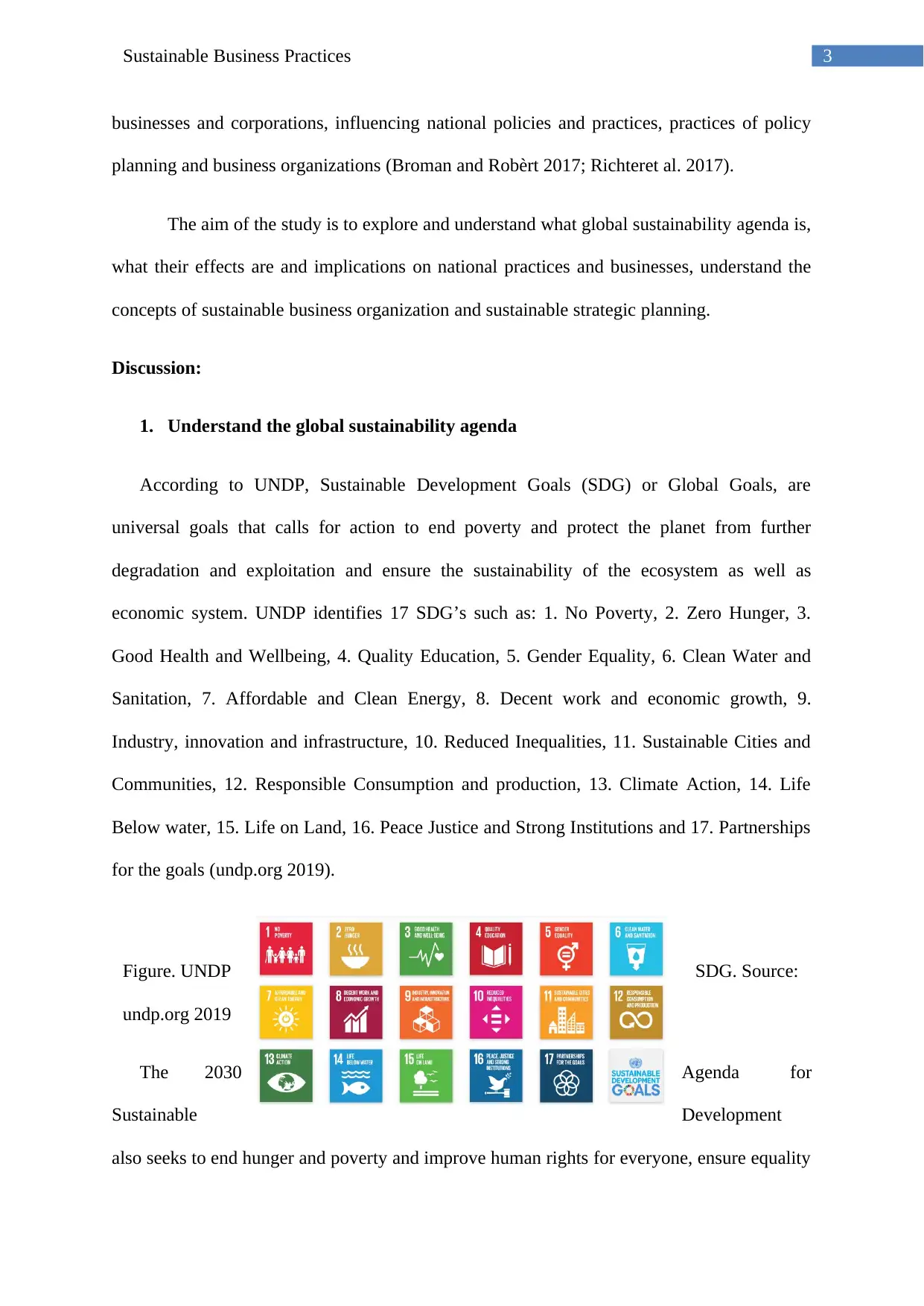
According to UNDP, Sustainable Development Goals (SDG) or Global Goals, are
universal goals that calls for action to end poverty and protect the planet from further
degradation and exploitation and ensure the sustainability of the ecosystem as well as
economic system. UNDP identifies 17 SDG’s such as: 1. No Poverty, 2. Zero Hunger, 3.
Good Health and Wellbeing, 4. Quality Education, 5. Gender Equality, 6. Clean Water and
Sanitation, 7. Affordable and Clean Energy, 8. Decent work and economic growth, 9.
Industry, innovation and infrastructure, 10. Reduced Inequalities, 11. Sustainable Cities and
Communities, 12. Responsible Consumption and production, 13. Climate Action, 14. Life
Below water, 15. Life on Land, 16. Peace Justice and Strong Institutions and 17. Partnerships
for the goals (undp.org 2019).
Figure. UNDP SDG. Source:
undp.org 2019
The 2030 Agenda for
Sustainable Development
also seeks to end hunger and poverty and improve human rights for everyone, ensure equality
businesses and corporations, influencing national policies and practices, practices of policy
planning and business organizations (Broman and Robèrt 2017; Richteret al. 2017).
The aim of the study is to explore and understand what global sustainability agenda is,
what their effects are and implications on national practices and businesses, understand the
concepts of sustainable business organization and sustainable strategic planning.
Discussion:
1. Understand the global sustainability agenda
According to UNDP, Sustainable Development Goals (SDG) or Global Goals, are
universal goals that calls for action to end poverty and protect the planet from further
degradation and exploitation and ensure the sustainability of the ecosystem as well as
economic system. UNDP identifies 17 SDG’s such as: 1. No Poverty, 2. Zero Hunger, 3.
Good Health and Wellbeing, 4. Quality Education, 5. Gender Equality, 6. Clean Water and
Sanitation, 7. Affordable and Clean Energy, 8. Decent work and economic growth, 9.
Industry, innovation and infrastructure, 10. Reduced Inequalities, 11. Sustainable Cities and
Communities, 12. Responsible Consumption and production, 13. Climate Action, 14. Life
Below water, 15. Life on Land, 16. Peace Justice and Strong Institutions and 17. Partnerships
for the goals (undp.org 2019).
Figure. UNDP SDG. Source:
undp.org 2019
The 2030 Agenda for
Sustainable Development
also seeks to end hunger and poverty and improve human rights for everyone, ensure equality
Paraphrase This Document
Need a fresh take? Get an instant paraphrase of this document with our AI Paraphraser
4Sustainable Business Practices
of gender, empower all girls and women and help to protect the environment and ecosystem
as well as the natural resources and integrate the principles of economic, social and
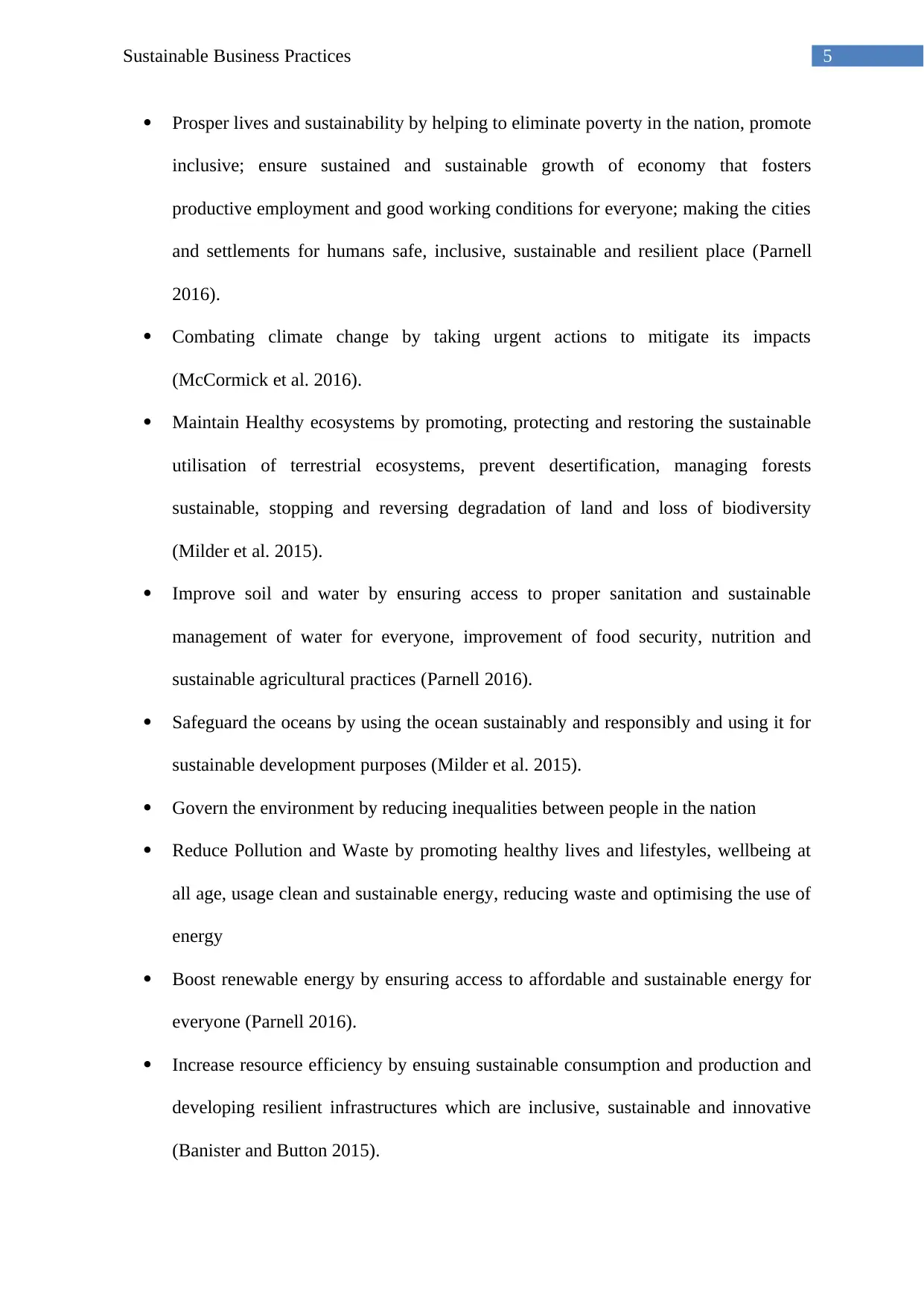
environmental development. Discussed below are some of the aspects of the 2030 Agenda for
Sustainable Development and how it affects national practice and businesses (Nam 2015; Lee
et al. 2016; stainabledevelopment.un.org 2019).
Figure: The 2030 Agenda for Sustainable Development. Source:
stainabledevelopment.un.org 2019
1.1 Analyse the global sustainability agenda and how it relates to national practice
The Environmental Sustainability for the Sustainability Development Goals in the 2030
Agenda includes the following dimensions of Sustainable Development: Finance,
Partnerships, Capacity Building, National Planning, Monitoring, Trade, Technology and
Policy Coherence (Liuet al. 2016; Hák et al. 2016). These dimensions are aimed to Combat
climate change, maintain healthy ecosystems, improve soil and water, safeguard the oceans,
govern the environment, boost renewable energy, increase resource efficiency and prosper
sustainability (Banister and Button 2015). These dimensions and objectives have the
following implications for national practice:
of gender, empower all girls and women and help to protect the environment and ecosystem
as well as the natural resources and integrate the principles of economic, social and
environmental development. Discussed below are some of the aspects of the 2030 Agenda for
Sustainable Development and how it affects national practice and businesses (Nam 2015; Lee
et al. 2016; stainabledevelopment.un.org 2019).
Figure: The 2030 Agenda for Sustainable Development. Source:
stainabledevelopment.un.org 2019
1.1 Analyse the global sustainability agenda and how it relates to national practice
The Environmental Sustainability for the Sustainability Development Goals in the 2030
Agenda includes the following dimensions of Sustainable Development: Finance,
Partnerships, Capacity Building, National Planning, Monitoring, Trade, Technology and
Policy Coherence (Liuet al. 2016; Hák et al. 2016). These dimensions are aimed to Combat
climate change, maintain healthy ecosystems, improve soil and water, safeguard the oceans,
govern the environment, boost renewable energy, increase resource efficiency and prosper
sustainability (Banister and Button 2015). These dimensions and objectives have the
following implications for national practice:
5Sustainable Business Practices
Prosper lives and sustainability by helping to eliminate poverty in the nation, promote
inclusive; ensure sustained and sustainable growth of economy that fosters
productive employment and good working conditions for everyone; making the cities
and settlements for humans safe, inclusive, sustainable and resilient place (Parnell
2016).
Combating climate change by taking urgent actions to mitigate its impacts
(McCormick et al. 2016).
Maintain Healthy ecosystems by promoting, protecting and restoring the sustainable
utilisation of terrestrial ecosystems, prevent desertification, managing forests
sustainable, stopping and reversing degradation of land and loss of biodiversity
(Milder et al. 2015).
Improve soil and water by ensuring access to proper sanitation and sustainable
management of water for everyone, improvement of food security, nutrition and
sustainable agricultural practices (Parnell 2016).
Safeguard the oceans by using the ocean sustainably and responsibly and using it for
sustainable development purposes (Milder et al. 2015).
Govern the environment by reducing inequalities between people in the nation
Reduce Pollution and Waste by promoting healthy lives and lifestyles, wellbeing at
all age, usage clean and sustainable energy, reducing waste and optimising the use of
energy
Boost renewable energy by ensuring access to affordable and sustainable energy for
everyone (Parnell 2016).
Increase resource efficiency by ensuing sustainable consumption and production and
developing resilient infrastructures which are inclusive, sustainable and innovative
(Banister and Button 2015).
Prosper lives and sustainability by helping to eliminate poverty in the nation, promote
inclusive; ensure sustained and sustainable growth of economy that fosters
productive employment and good working conditions for everyone; making the cities
and settlements for humans safe, inclusive, sustainable and resilient place (Parnell
2016).
Combating climate change by taking urgent actions to mitigate its impacts
(McCormick et al. 2016).
Maintain Healthy ecosystems by promoting, protecting and restoring the sustainable
utilisation of terrestrial ecosystems, prevent desertification, managing forests
sustainable, stopping and reversing degradation of land and loss of biodiversity
(Milder et al. 2015).
Improve soil and water by ensuring access to proper sanitation and sustainable
management of water for everyone, improvement of food security, nutrition and
sustainable agricultural practices (Parnell 2016).
Safeguard the oceans by using the ocean sustainably and responsibly and using it for
sustainable development purposes (Milder et al. 2015).
Govern the environment by reducing inequalities between people in the nation
Reduce Pollution and Waste by promoting healthy lives and lifestyles, wellbeing at
all age, usage clean and sustainable energy, reducing waste and optimising the use of
energy
Boost renewable energy by ensuring access to affordable and sustainable energy for
everyone (Parnell 2016).
Increase resource efficiency by ensuing sustainable consumption and production and
developing resilient infrastructures which are inclusive, sustainable and innovative
(Banister and Button 2015).
⊘ This is a preview!⊘
Do you want full access?
Subscribe today to unlock all pages.
Trusted by 1+ million students worldwide
6Sustainable Business Practices
1.2 Analyse the forces for change in the sustainable business environment
Some of the most important and significant forces for change in sustainable business
environments are:
Globalization: One of the biggest impact of the process of globalization is the development of
sustainable business development ideas. This was supported by better sharing of knowledge
and information between nations, leading to collaborative actions. Thus globalisation was a
significant driving force for sustainability (Leonidouet al. 2017).
New Business Opportunities: Through the application of sustainable practice, companies can
develop their businesses further and ensuring their long term success. The development also
creates new scopes and opportunities for the business to grow into, by implementing
sustainable and environmentally friendly practices (Ahmad et al. 2017).
Changing Corporate Governance: Changes in corporate governance and an increase in focus
on sustainable practices across industries is a significant driving force for change as it ensures
that the organization adopts to the sustainable practices and guidelines (Leonidouet al. 2017).
Stricter Policies: The policies of governments have also become stricter in terms of pollution
control and maintenance of sustainable practices. This strictness have obliged many
organizations to start adopting to sustainable practice (Herremans and Nazari 2016).
1.3 Evaluate the impact of current sustainability issues on businesses.
According to Carley and Christie (2017), the key issues of sustainability is eventually
bound to have a significantly adverse impact on global businesses and their growth. The main
impacts, the issues on sustainability can have on businesses are:
1.2 Analyse the forces for change in the sustainable business environment
Some of the most important and significant forces for change in sustainable business
environments are:
Globalization: One of the biggest impact of the process of globalization is the development of
sustainable business development ideas. This was supported by better sharing of knowledge
and information between nations, leading to collaborative actions. Thus globalisation was a
significant driving force for sustainability (Leonidouet al. 2017).
New Business Opportunities: Through the application of sustainable practice, companies can
develop their businesses further and ensuring their long term success. The development also
creates new scopes and opportunities for the business to grow into, by implementing
sustainable and environmentally friendly practices (Ahmad et al. 2017).
Changing Corporate Governance: Changes in corporate governance and an increase in focus
on sustainable practices across industries is a significant driving force for change as it ensures
that the organization adopts to the sustainable practices and guidelines (Leonidouet al. 2017).
Stricter Policies: The policies of governments have also become stricter in terms of pollution
control and maintenance of sustainable practices. This strictness have obliged many
organizations to start adopting to sustainable practice (Herremans and Nazari 2016).
1.3 Evaluate the impact of current sustainability issues on businesses.
According to Carley and Christie (2017), the key issues of sustainability is eventually
bound to have a significantly adverse impact on global businesses and their growth. The main
impacts, the issues on sustainability can have on businesses are:
Paraphrase This Document
Need a fresh take? Get an instant paraphrase of this document with our AI Paraphraser
7Sustainable Business Practices
Pollution: Pollution in air, water and soil can affect the health and wellbeing of people and
therefore their productivity. Pollution can also make the process of hiring and retaining
employees more expensive and unchecked pollution can also draw the interest of investors. In
several businesses, presence of pollution can result in contamination of the products
Disposal of Waste: This factor has a significant inpact on businesses, as it compels the
business to ensure the safe disposal of waste. On the other hand, unsafe disposal of waste can
cause hazards and affect oher businesses,
Climatic Change: Erratic weather patterns and adverse climatic events can cause serious
disruptions to day to day business, and thus can be of a adverse consequence.
Inadequate access to water/Draught: Draughts or incidents of inadequate access to water can
have an adverse impact on the health nd wellbeing of people. Water is among the two most
basic necessities of life, and its shortage can cause health risks and thus also affect
businesses.
(Nam 2015; Sachs 2015)
2. Understand the concept of the sustainable business organization.
Sustainable Business Organizations, also known as Sustainability Organizations are
organizations of likeminded people whose functions are to advocate and advance
sustainability and partake in the development of sustainable methods. Sustainable Business
Organizations differ from generic business organizations as their sustainability strategies
focuses on the development of economic and cultural growth, by focussing on environmental
sustainability instead of just focusing on the profitability and economic growth (Sachs 2015).
Discussed below is the scope of sustainable business organizations.
2.1 Determine the scope of the sustainable business organization.
Pollution: Pollution in air, water and soil can affect the health and wellbeing of people and
therefore their productivity. Pollution can also make the process of hiring and retaining
employees more expensive and unchecked pollution can also draw the interest of investors. In
several businesses, presence of pollution can result in contamination of the products
Disposal of Waste: This factor has a significant inpact on businesses, as it compels the
business to ensure the safe disposal of waste. On the other hand, unsafe disposal of waste can
cause hazards and affect oher businesses,
Climatic Change: Erratic weather patterns and adverse climatic events can cause serious
disruptions to day to day business, and thus can be of a adverse consequence.
Inadequate access to water/Draught: Draughts or incidents of inadequate access to water can
have an adverse impact on the health nd wellbeing of people. Water is among the two most
basic necessities of life, and its shortage can cause health risks and thus also affect
businesses.
(Nam 2015; Sachs 2015)
2. Understand the concept of the sustainable business organization.
Sustainable Business Organizations, also known as Sustainability Organizations are
organizations of likeminded people whose functions are to advocate and advance
sustainability and partake in the development of sustainable methods. Sustainable Business
Organizations differ from generic business organizations as their sustainability strategies
focuses on the development of economic and cultural growth, by focussing on environmental
sustainability instead of just focusing on the profitability and economic growth (Sachs 2015).
Discussed below is the scope of sustainable business organizations.
2.1 Determine the scope of the sustainable business organization.
8Sustainable Business Practices
Sustainable Business Organizations can has a wide scope of implementation, which
allows it to be used in various industries and businesses such as:
Business: In the context of businesses, sustainability practices can influence various processes
in the business related to the design, manufacture, striate, transport, and marketing of
products and services while addressing the profit making needs of the company. Sustainable
business organizations can help the businesses implement sustainable practices within their
own processes (Welford 2016).
Infrastructure and Building: Sustainable Business Organizations can help the infrastructure
and building organizations to develop green building plans and projects, develop a healthy
network of businesses that follow sustainable practices, help in the development and
implementation of sustainable standards, taking into consideration the resources utilised by
the industry (Richter et al. 2017).
Agriculture: In the Agriculture industry, the Sustainable Business Organizations can provide
support in the implementation of alternative farming practices, alternative livestock and crop
rearing strategies and sustainable farming strategies (Zhang et al. 2015).
Communities: In the context of communities, the Sustainable Community Organizations
facilitates collaborations and projects on programs of education that can empower the
community members to understand and implement sustainable practices in their personal
lives (Hák et al. 2016).
Economy: Sustainable Business Organizations can help in the improvement of economy,
through the implementation of sustainable business models within different communities and
supporting the improvement of economic opportunities for everyone. Sustainable Business
Sustainable Business Organizations can has a wide scope of implementation, which
allows it to be used in various industries and businesses such as:
Business: In the context of businesses, sustainability practices can influence various processes
in the business related to the design, manufacture, striate, transport, and marketing of
products and services while addressing the profit making needs of the company. Sustainable
business organizations can help the businesses implement sustainable practices within their
own processes (Welford 2016).
Infrastructure and Building: Sustainable Business Organizations can help the infrastructure
and building organizations to develop green building plans and projects, develop a healthy
network of businesses that follow sustainable practices, help in the development and
implementation of sustainable standards, taking into consideration the resources utilised by
the industry (Richter et al. 2017).
Agriculture: In the Agriculture industry, the Sustainable Business Organizations can provide
support in the implementation of alternative farming practices, alternative livestock and crop
rearing strategies and sustainable farming strategies (Zhang et al. 2015).
Communities: In the context of communities, the Sustainable Community Organizations
facilitates collaborations and projects on programs of education that can empower the
community members to understand and implement sustainable practices in their personal
lives (Hák et al. 2016).
Economy: Sustainable Business Organizations can help in the improvement of economy,
through the implementation of sustainable business models within different communities and
supporting the improvement of economic opportunities for everyone. Sustainable Business
⊘ This is a preview!⊘
Do you want full access?
Subscribe today to unlock all pages.
Trusted by 1+ million students worldwide
9Sustainable Business Practices
Organizations also advocate for sustainable economy and consumption and stabilised
population as a form of ‘steady state economy’ (Banister and Banister 2015)
Environment: The businesses in this context can support in the long term maintenance of the
natural resources, ecosystems and the environment and ensuring that the progress of humans
do no longer adversely affect the nature and instead helping to bring synergy between the two
(Lee et al. 2016).
Law and Enforcement: The sustainable business organizations can support the development
of legislations, laws and policies and also support their monitoring and enforcement through
their insights on legal aspects related to sustainability. Sustainability business organizations
in such a field includes the Global Exchange and Earth Policy Institute (Parnell 2016).
News and Media: Organizations such as Worldwatch Institute works towards the
development of a society that is environmentally sustainable and where the needs of the
people does not jeopardise the the health of nature and ecosystem as well as the natural
environment, thereby preserving the prospects of the generations after, through the effective
usage of news and media to raise awareness, thus showing the scope in the News and Media
industry (Banister and Button 2015).
2.2 Evaluate impact on business structure and objectives of becoming a sustainable
business organization.
The structure and objectives form the most vital components of a successful
Sustainable Business Organization, according to Herremans and Nazari (2016). The structure
and objectives of the business provides the framework of the working process, the structure
of communication and information flow, the hierarchy of power, understanding the roles and
responsibilities and effectively managing the organization (Winnubst 2017; Bustinza et al.
Organizations also advocate for sustainable economy and consumption and stabilised
population as a form of ‘steady state economy’ (Banister and Banister 2015)
Environment: The businesses in this context can support in the long term maintenance of the
natural resources, ecosystems and the environment and ensuring that the progress of humans
do no longer adversely affect the nature and instead helping to bring synergy between the two
(Lee et al. 2016).
Law and Enforcement: The sustainable business organizations can support the development
of legislations, laws and policies and also support their monitoring and enforcement through
their insights on legal aspects related to sustainability. Sustainability business organizations
in such a field includes the Global Exchange and Earth Policy Institute (Parnell 2016).
News and Media: Organizations such as Worldwatch Institute works towards the
development of a society that is environmentally sustainable and where the needs of the
people does not jeopardise the the health of nature and ecosystem as well as the natural
environment, thereby preserving the prospects of the generations after, through the effective
usage of news and media to raise awareness, thus showing the scope in the News and Media
industry (Banister and Button 2015).
2.2 Evaluate impact on business structure and objectives of becoming a sustainable
business organization.
The structure and objectives form the most vital components of a successful
Sustainable Business Organization, according to Herremans and Nazari (2016). The structure
and objectives of the business provides the framework of the working process, the structure
of communication and information flow, the hierarchy of power, understanding the roles and
responsibilities and effectively managing the organization (Winnubst 2017; Bustinza et al.
Paraphrase This Document
Need a fresh take? Get an instant paraphrase of this document with our AI Paraphraser
10Sustainable Business Practices
2015). Discussed below is a brief evaluation of the impact of business structures and
objectives that helps in the development and success of Sustainable Business Organizations:
Supporting better Coordination between departments: A structured organization can help in a
better definition of the departments, and therefore help in the better transfer of information
between them, improving coordination.
Support better Flexibility: Having a clear set of organizational objectives can help employees
and managers understand their roles clearly and also diversify their roles, learning new ones
in time, which can allow them to shift between job roles and thus supporting better flexibility.
Integrating New Elements: A structured approach towards designing an organization also
allows scope for integrating new elements in the future. For example, diversification of
existing business, acquisition of new businesses of starting with a new business.
Guiding the policy making process: The framework of the organizational design and
objectives can act as guidance for the process of making the organizational policies, ensuring
that the policies are able to address and uphold the objectives of the company.
Supports better leadership: A set of organizational objectives can also support better
leadership by clarifying the expectations of the organization and orient them to the
organizational goals.
Supports better communications: Better design of the organization can help in better
communications as the design can implement a structured approach which can be utilised for
the development of communications design.
Supports better productivity: The structures and objectives helps individuals better
understand their roles and responsibilities and helps in the development of professional goals
2015). Discussed below is a brief evaluation of the impact of business structures and
objectives that helps in the development and success of Sustainable Business Organizations:
Supporting better Coordination between departments: A structured organization can help in a
better definition of the departments, and therefore help in the better transfer of information
between them, improving coordination.
Support better Flexibility: Having a clear set of organizational objectives can help employees
and managers understand their roles clearly and also diversify their roles, learning new ones
in time, which can allow them to shift between job roles and thus supporting better flexibility.
Integrating New Elements: A structured approach towards designing an organization also
allows scope for integrating new elements in the future. For example, diversification of
existing business, acquisition of new businesses of starting with a new business.
Guiding the policy making process: The framework of the organizational design and
objectives can act as guidance for the process of making the organizational policies, ensuring
that the policies are able to address and uphold the objectives of the company.
Supports better leadership: A set of organizational objectives can also support better
leadership by clarifying the expectations of the organization and orient them to the
organizational goals.
Supports better communications: Better design of the organization can help in better
communications as the design can implement a structured approach which can be utilised for
the development of communications design.
Supports better productivity: The structures and objectives helps individuals better
understand their roles and responsibilities and helps in the development of professional goals
11Sustainable Business Practices
and objectives. Effective design of the company can also promote efficiency and thus
productivity.
Helps in better management of the organization: Efficient structure and design of the
organization also helps to understand the process of information flow and the organizational
hierarchy, which can aid the management to manage the business.
(Winnubst 2017; Herremans and Nazari 2016)
3. Understand sustainable strategic planning
Sustainable strategic planning is a form of strategic planning that that keeps
sustainability issues at the core of its ideas and policies, thereby developing practices that
facilitate the growth and optimisation of business organization, support long term sustenance
and address the role of protecting the environment from degradation (Robèrt et al. 2017;
Pereverzaet al. 2017)). Strategic planning utilises the benefits of smart and strategic action in
order to achieve its sustainability objectives, discussed below are some important strategic
plans that can help organizations to meet sustainability agenda, analysing how it can be
implemented in business organizations using triple bottom line approach and reviewing the
process of sustainable business planning.
3.1 Determine change required within business organisations to meet sustainability
agenda
In order to implement as well as maintain sustainable practices within businesses,
organizations should implement several changes in the operations and work culture
(Pereverzaet al. 2017). Some of the most important changes that businesses should make
within the organizations in order to meet the agendas on sustainability such as the 2030
Sustainability Agenda:
and objectives. Effective design of the company can also promote efficiency and thus
productivity.
Helps in better management of the organization: Efficient structure and design of the
organization also helps to understand the process of information flow and the organizational
hierarchy, which can aid the management to manage the business.
(Winnubst 2017; Herremans and Nazari 2016)
3. Understand sustainable strategic planning
Sustainable strategic planning is a form of strategic planning that that keeps
sustainability issues at the core of its ideas and policies, thereby developing practices that
facilitate the growth and optimisation of business organization, support long term sustenance
and address the role of protecting the environment from degradation (Robèrt et al. 2017;
Pereverzaet al. 2017)). Strategic planning utilises the benefits of smart and strategic action in
order to achieve its sustainability objectives, discussed below are some important strategic
plans that can help organizations to meet sustainability agenda, analysing how it can be
implemented in business organizations using triple bottom line approach and reviewing the
process of sustainable business planning.
3.1 Determine change required within business organisations to meet sustainability
agenda
In order to implement as well as maintain sustainable practices within businesses,
organizations should implement several changes in the operations and work culture
(Pereverzaet al. 2017). Some of the most important changes that businesses should make
within the organizations in order to meet the agendas on sustainability such as the 2030
Sustainability Agenda:
⊘ This is a preview!⊘
Do you want full access?
Subscribe today to unlock all pages.
Trusted by 1+ million students worldwide

1 out of 21


Related Documents


Your All-in-One AI-Powered Toolkit for Academic Success.
+13062052269
info@desklib.com
Available 24*7 on WhatsApp / Email
![[object Object]](/_next/static/media/star-bottom.7253800d.svg)
Unlock your academic potential
Copyright © 2020–2026 A2Z Services. All Rights Reserved. Developed and managed by ZUCOL.