Research Proposal: Sustainable Development in Construction Industry

Verified

Added on  2022/08/31

|7
|1190
|24
Project
AI Summary
This research proposal explores the integration of sustainable development within the construction industry, focusing on its potential as a competitive advantage. The study investigates the challenges of transitioning from conventional construction models to green construction projects, highlighting the lack of readily available information regarding the cost-benefit analysis of adopting sustainable practices. The research aims to identify the information home builders require to construct cost-effective green homes, examining knowledge acquisition, methods to improve cost-benefit understanding, and strategies to promote sustainable development adoption. The proposal outlines the use of secondary data, including peer-reviewed articles, scholarly books, and government reports, alongside primary data collected through interviews and surveys. The data analysis will employ text analysis techniques, including document clustering, classification, and information extraction. The project timeline spans from January 2020 to January 2021, detailing phases from methodology clarification and data collection to analysis and report writing, providing a comprehensive framework for the investigation.
Document Page
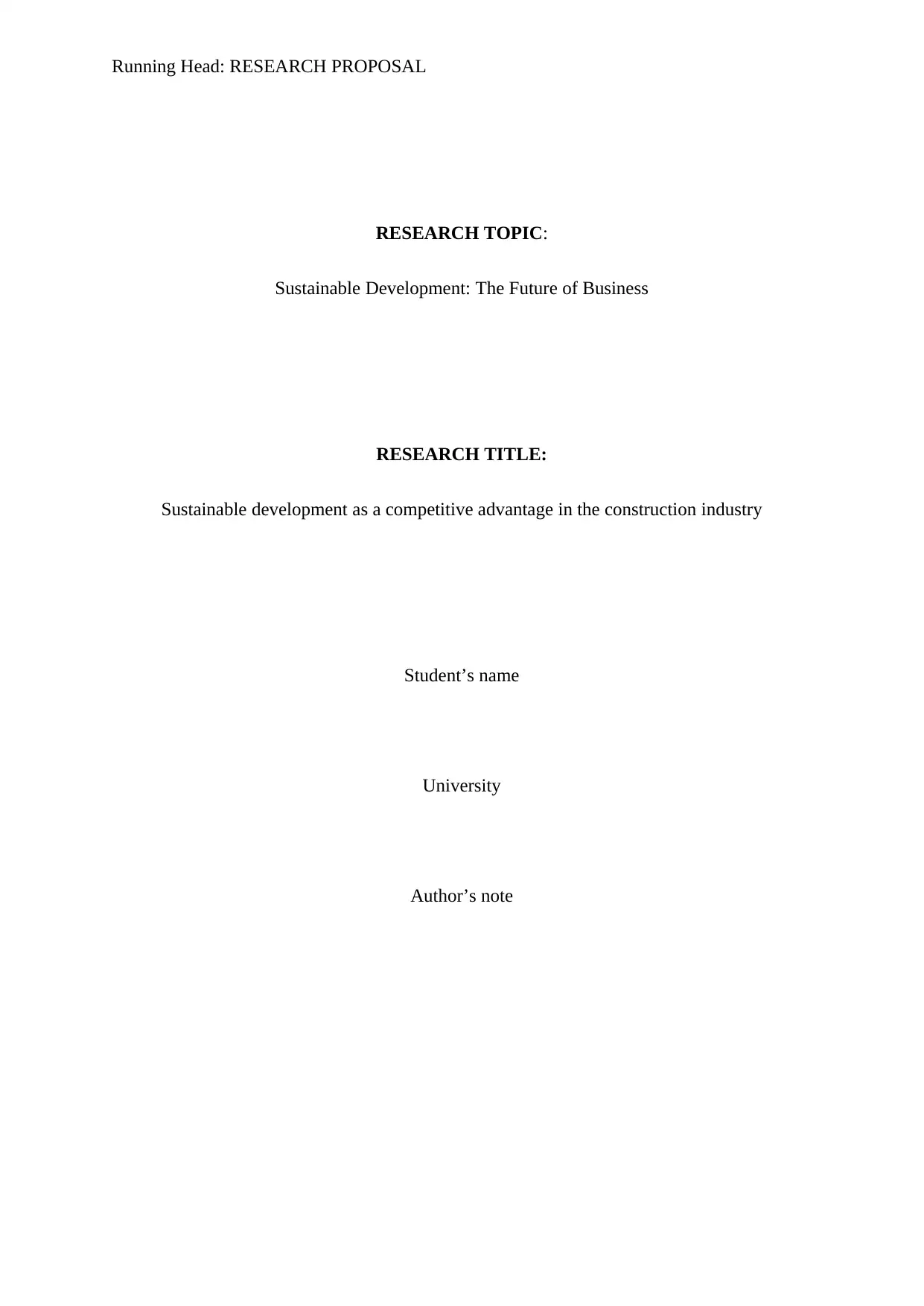
Running Head: RESEARCH PROPOSAL
RESEARCH TOPIC:
Sustainable Development: The Future of Business
RESEARCH TITLE:
Sustainable development as a competitive advantage in the construction industry
Student’s name
University
Author’s note
tabler-icon-diamond-filled.svg

Paraphrase This Document

Need a fresh take? Get an instant paraphrase of this document with our AI Paraphraser
Document Page
RESEARCH PROPOSAL 2
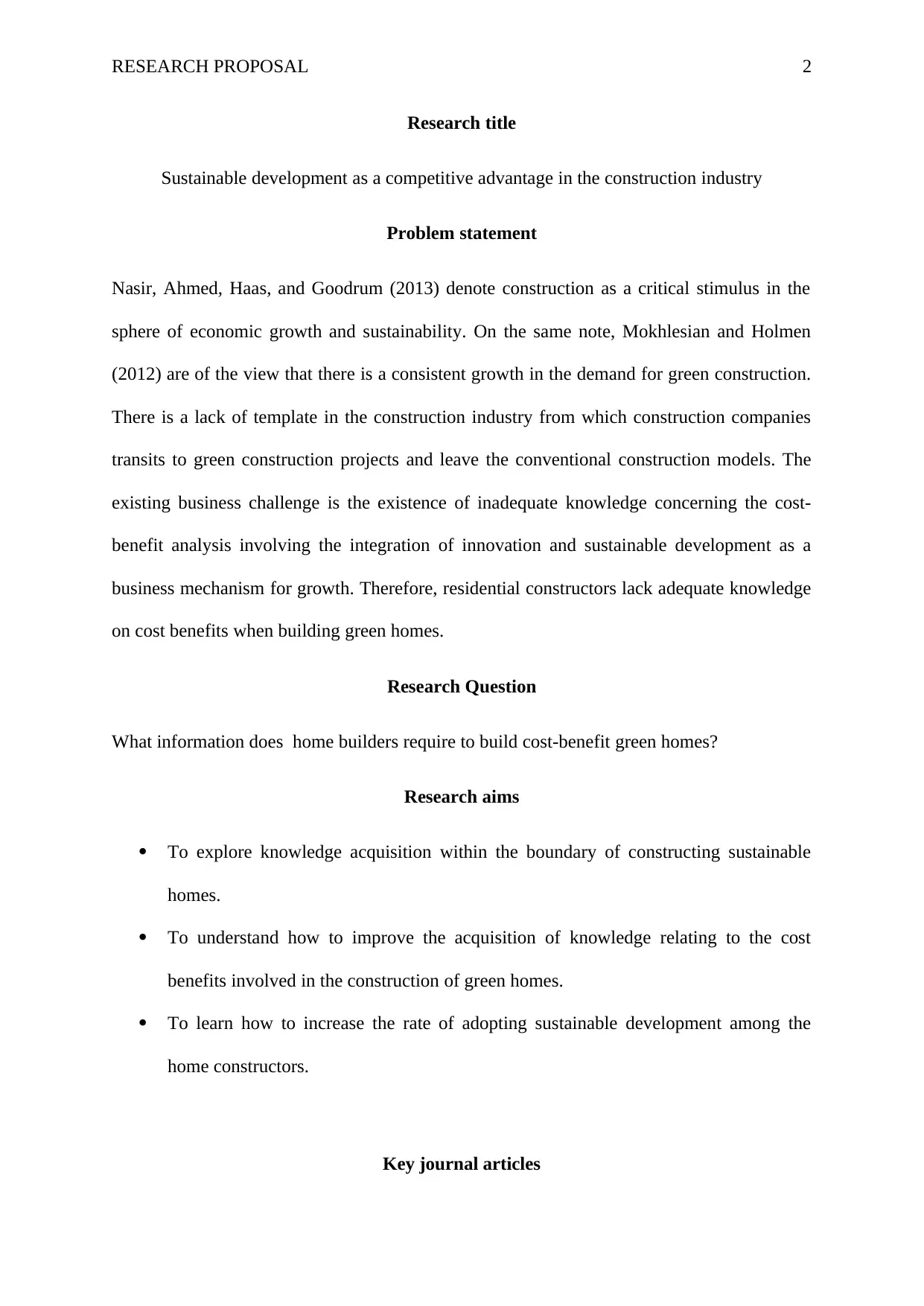
Research title
Sustainable development as a competitive advantage in the construction industry
Problem statement
Nasir, Ahmed, Haas, and Goodrum (2013) denote construction as a critical stimulus in the
sphere of economic growth and sustainability. On the same note, Mokhlesian and Holmen
(2012) are of the view that there is a consistent growth in the demand for green construction.
There is a lack of template in the construction industry from which construction companies
transits to green construction projects and leave the conventional construction models. The
existing business challenge is the existence of inadequate knowledge concerning the cost-
benefit analysis involving the integration of innovation and sustainable development as a
business mechanism for growth. Therefore, residential constructors lack adequate knowledge
on cost benefits when building green homes.
Research Question
What information does home builders require to build cost-benefit green homes?
Research aims
To explore knowledge acquisition within the boundary of constructing sustainable
homes.
To understand how to improve the acquisition of knowledge relating to the cost
benefits involved in the construction of green homes.
To learn how to increase the rate of adopting sustainable development among the
home constructors.
Key journal articles
Document Page
RESEARCH PROPOSAL 3
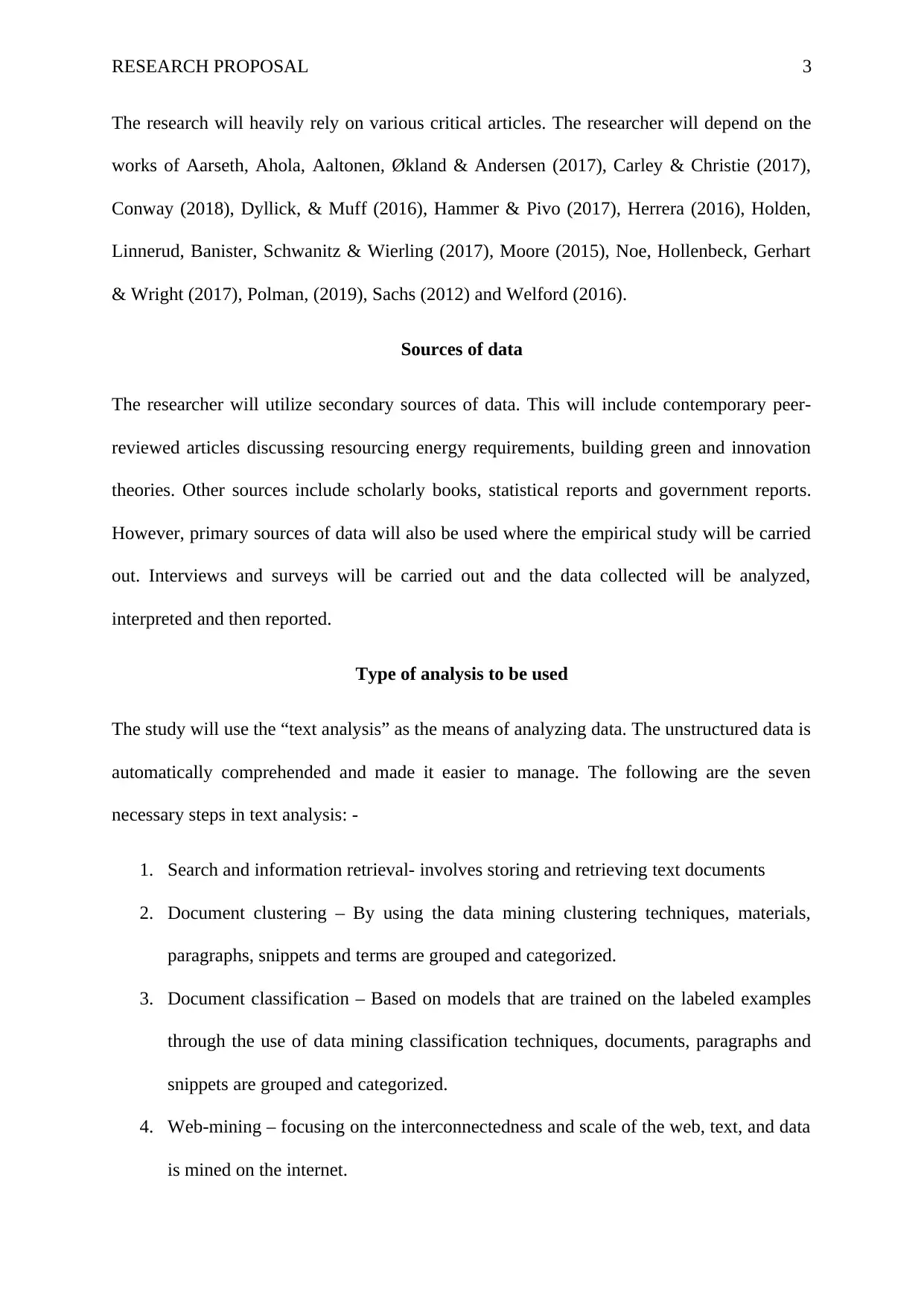
The research will heavily rely on various critical articles. The researcher will depend on the
works of Aarseth, Ahola, Aaltonen, Økland & Andersen (2017), Carley & Christie (2017),
Conway (2018), Dyllick, & Muff (2016), Hammer & Pivo (2017), Herrera (2016), Holden,
Linnerud, Banister, Schwanitz & Wierling (2017), Moore (2015), Noe, Hollenbeck, Gerhart
& Wright (2017), Polman, (2019), Sachs (2012) and Welford (2016).
Sources of data
The researcher will utilize secondary sources of data. This will include contemporary peer-
reviewed articles discussing resourcing energy requirements, building green and innovation
theories. Other sources include scholarly books, statistical reports and government reports.
However, primary sources of data will also be used where the empirical study will be carried
out. Interviews and surveys will be carried out and the data collected will be analyzed,
interpreted and then reported.
Type of analysis to be used
The study will use the “text analysis” as the means of analyzing data. The unstructured data is
automatically comprehended and made it easier to manage. The following are the seven
necessary steps in text analysis: -
1. Search and information retrieval- involves storing and retrieving text documents
2. Document clustering – By using the data mining clustering techniques, materials,
paragraphs, snippets and terms are grouped and categorized.
3. Document classification – Based on models that are trained on the labeled examples
through the use of data mining classification techniques, documents, paragraphs and
snippets are grouped and categorized.
4. Web-mining – focusing on the interconnectedness and scale of the web, text, and data
is mined on the internet.
Document Page
RESEARCH PROPOSAL 4
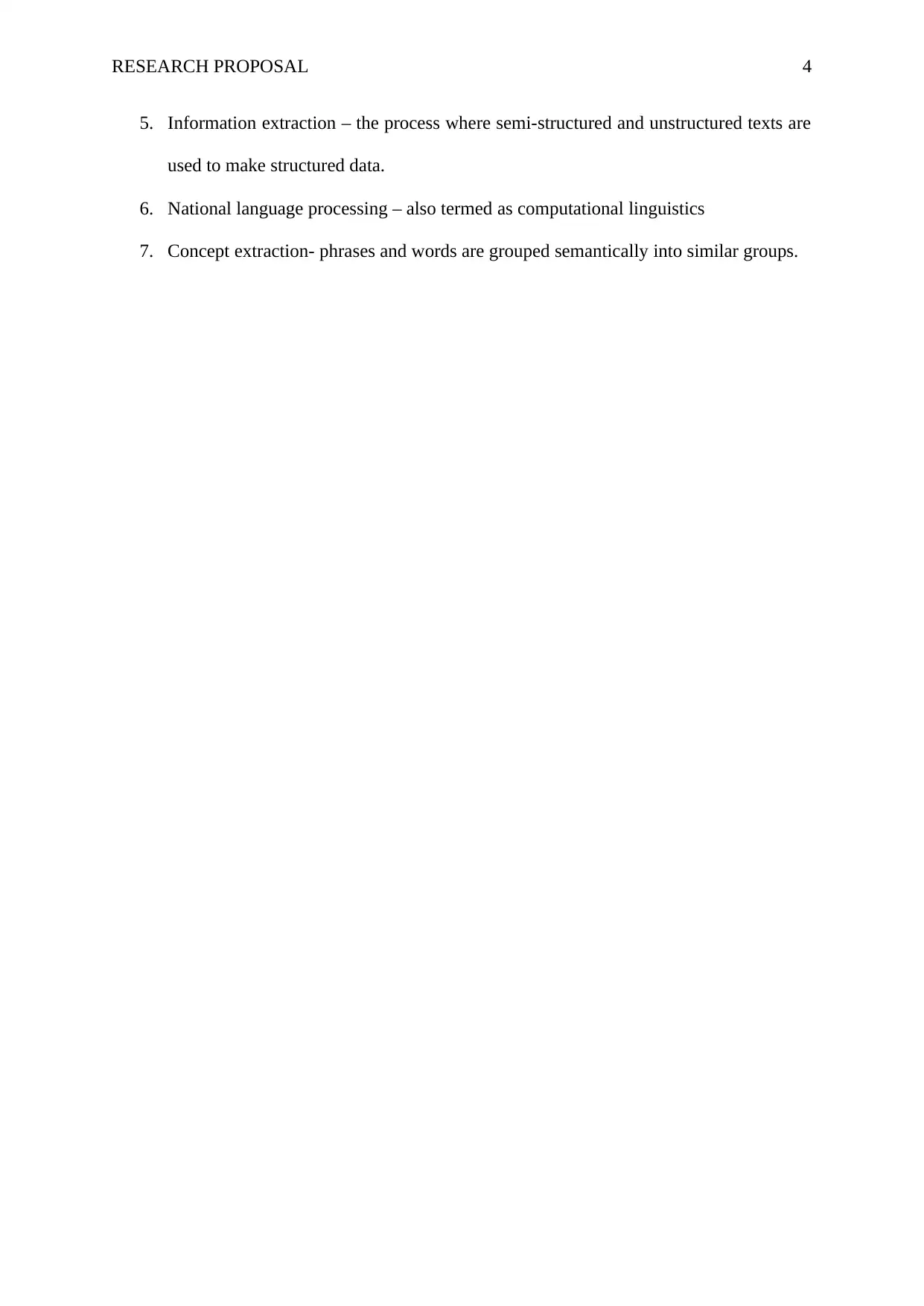
5. Information extraction – the process where semi-structured and unstructured texts are
used to make structured data.
6. National language processing – also termed as computational linguistics
7. Concept extraction- phrases and words are grouped semantically into similar groups.
tabler-icon-diamond-filled.svg

Paraphrase This Document

Need a fresh take? Get an instant paraphrase of this document with our AI Paraphraser
Document Page
RESEARCH PROPOSAL 5
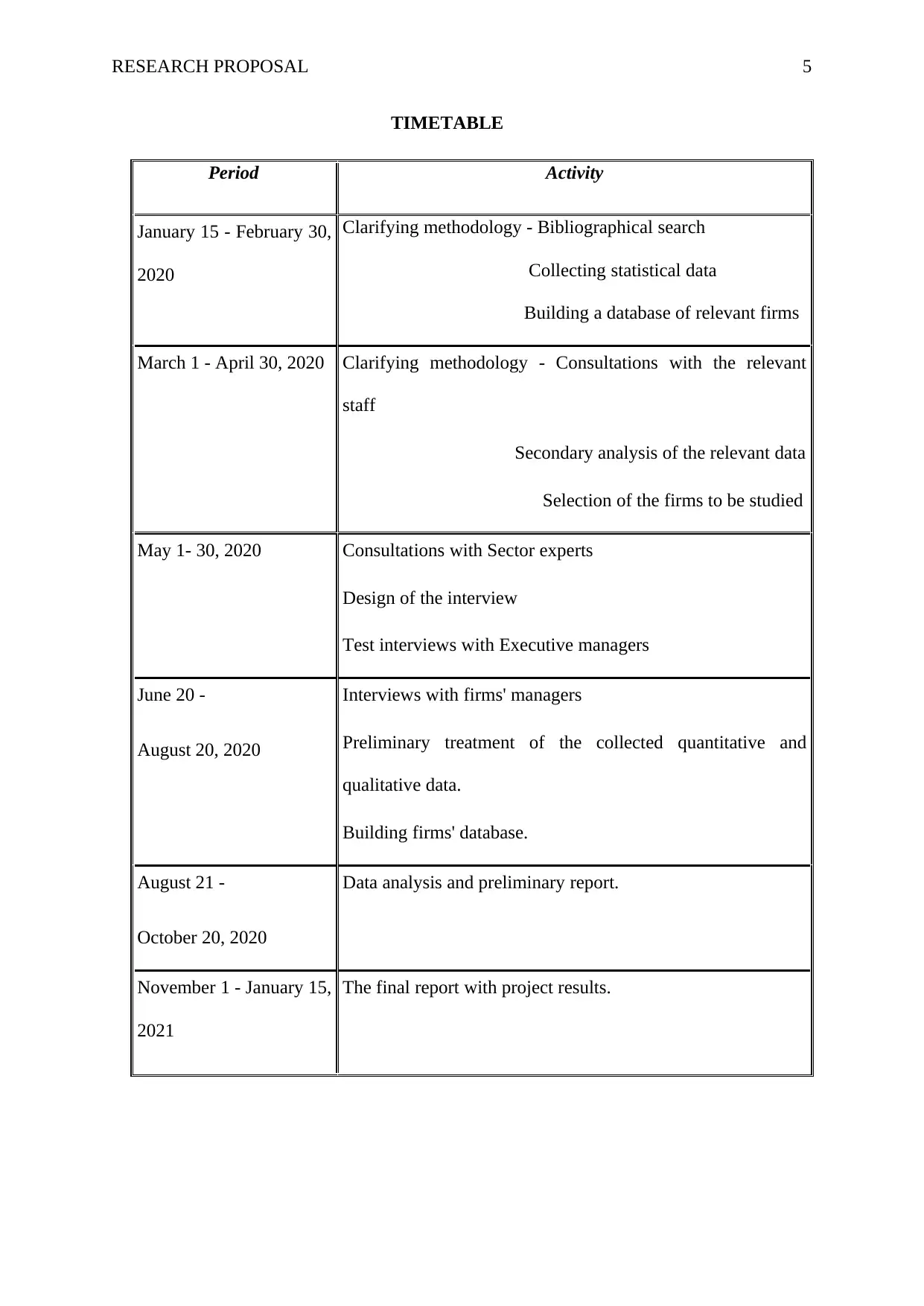
TIMETABLE
Period Activity
January 15 - February 30,
2020
Clarifying methodology - Bibliographical search
Collecting statistical data
Building a database of relevant firms
March 1 - April 30, 2020 Clarifying methodology - Consultations with the relevant
staff
Secondary analysis of the relevant data
Selection of the firms to be studied
May 1- 30, 2020 Consultations with Sector experts
Design of the interview
Test interviews with Executive managers
June 20 -
August 20, 2020
Interviews with firms' managers
Preliminary treatment of the collected quantitative and
qualitative data.
Building firms' database.
August 21 -
October 20, 2020
Data analysis and preliminary report.
November 1 - January 15,
2021
The final report with project results.
Document Page
RESEARCH PROPOSAL 6
References
Aarseth, W., Ahola, T., Aaltonen, K., Økland, A., & Andersen, B. (2017). Project
sustainability strategies: A systematic literature review. International Journal of
Project Management, 35(6), 1071-1083.
Carley, M., & Christie, I. (2017). Managing sustainable development. Routledge.
Conway, E. (2018). Sustainability, the Triple Bottom Line and Corporate Social
Responsibility. In Contemporary Issues in Accounting (pp. 15-35). Palgrave
Macmillan, Cham.
Dyllick, T., & Muff, K. (2016). Clarifying the meaning of sustainable business: Introducing a
typology from business-as-usual to true business sustainability. Organization &
Environment, 29(2), 156-174.
Hammer, J., & Pivo, G. (2017). The triple bottom line and sustainable economic development
theory and practice. Economic Development Quarterly, 31(1), 25-36.
Herrera, M. E. B. (2016). Innovation for impact: Business innovation for inclusive growth.
Journal of Business Research, 69(5), 1725-1730.
Holden, E., Linnerud, K., Banister, D., Schwanitz, V. J., & Wierling, A. (2017). The
imperatives of sustainable development: needs, justice, limits. Routledge.
Mokhlesian, S. & Holmen, M. (2012). Business model changes and green construction
processes. Construction management and economics, 30(9), 761 – 775
Moore, H. L. (2015). Global prosperity and sustainable development goals. Journal of
International Development, 27(6), 801-815.
Document Page
RESEARCH PROPOSAL 7
Nasir, H., Ahmed, H., Haas, C. & Goodrum, P. M. (2013). An analysis of construction
productivity differences between Canada and the United States. Construction
management and economics, 32(2), 595 -607
Noe, R. A., Hollenbeck, J. R., Gerhart, B., & Wright, P. M. (2017). Human resource
management: Gaining a competitive advantage. New York, NY: McGraw-Hill
Education.
Polman, P. (2019). A business model for sustainability. Retrieved 3 December 2019, from
https://www.weforum.org/agenda/2019/01/a-business-model-for-sustainability
Sachs, J. D. (2012). From millennium development goals to sustainable development goals.
The Lancet, 379(9832), 2206-2211.
Welford, R. (2016). Corporate environmental management 3: Towards sustainable
development. Routledge.
chevron_up_icon
1 out of 7
circle_padding
hide_on_mobile
zoom_out_icon
[object Object]