Sustainable Construction: A Comparative Analysis of Development
VerifiedAdded on 2020/04/07
|27
|5991
|423
Report
AI Summary
This report provides an overview of sustainable construction, exploring its objectives and the three pillars it encompasses: environmental, social, and economic factors. It investigates the challenges faced by developing countries in implementing sustainable construction practices, contrasting them with developed nations. The report uses case studies from India and Australia to analyze the differences in approaches and challenges. It examines evolving concepts of ecological design and building practices for cost-effective green building projects. The report also delves into the advantages of sustainable construction, such as increased employment opportunities and reduced environmental pollution, while also addressing challenges like education, governance, financing, and gender inequality. The report concludes by highlighting the need for new development models and the importance of addressing urbanization issues to promote sustainable construction in developing countries.
Sustainable Constructions 1
SUSTAINABLE CONSTRUCTION
(Name)
Name of the Class (Course)
Professor (Tutor)
Name of the School (University)
The City and State where it is located
The Date
SUSTAINABLE CONSTRUCTION
(Name)
Name of the Class (Course)
Professor (Tutor)
Name of the School (University)
The City and State where it is located
The Date

Paraphrase This Document
Need a fresh take? Get an instant paraphrase of this document with our AI Paraphraser
Sustainable Constructions 2
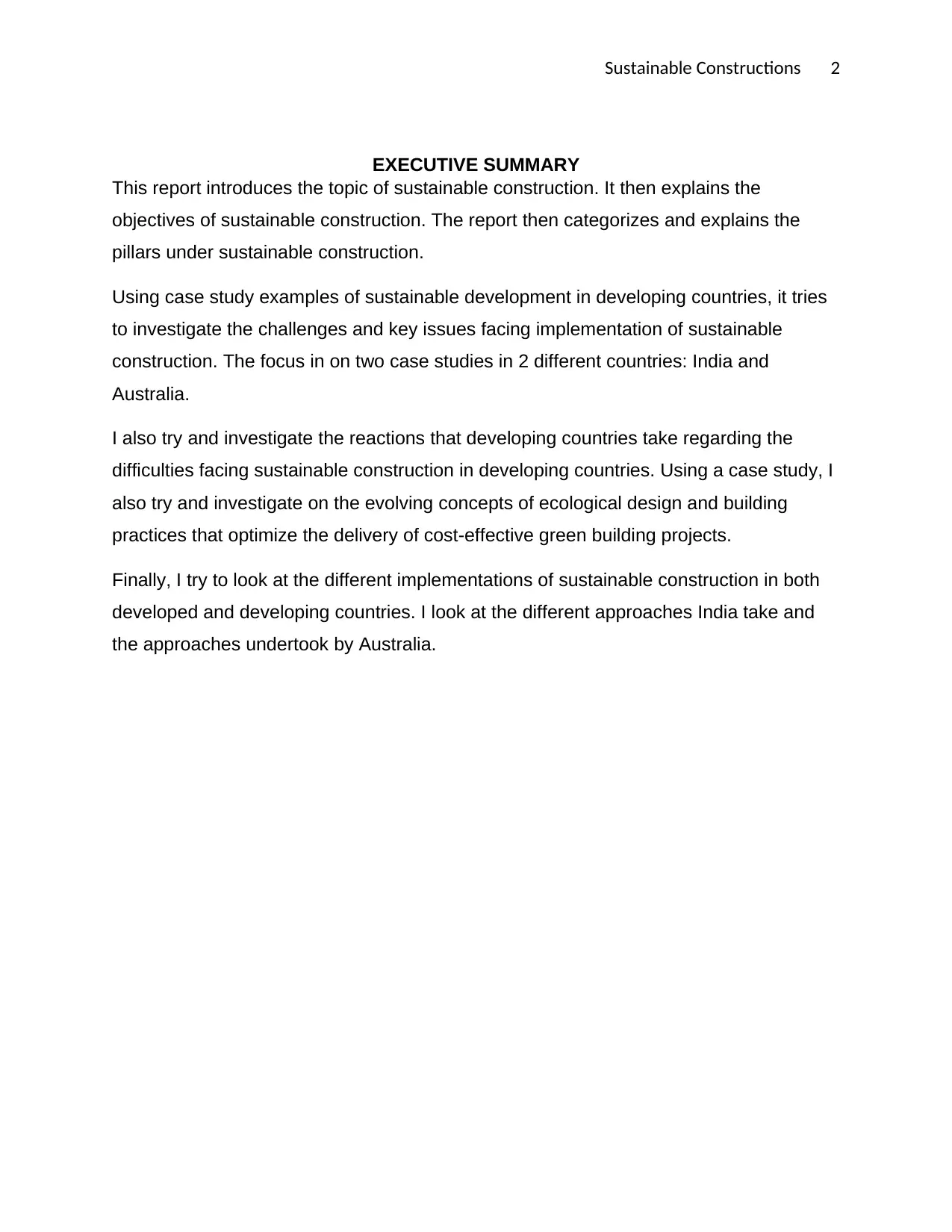
EXECUTIVE SUMMARY
This report introduces the topic of sustainable construction. It then explains the
objectives of sustainable construction. The report then categorizes and explains the
pillars under sustainable construction.
Using case study examples of sustainable development in developing countries, it tries
to investigate the challenges and key issues facing implementation of sustainable
construction. The focus in on two case studies in 2 different countries: India and
Australia.
I also try and investigate the reactions that developing countries take regarding the
difficulties facing sustainable construction in developing countries. Using a case study, I
also try and investigate on the evolving concepts of ecological design and building
practices that optimize the delivery of cost-effective green building projects.
Finally, I try to look at the different implementations of sustainable construction in both
developed and developing countries. I look at the different approaches India take and
the approaches undertook by Australia.
EXECUTIVE SUMMARY
This report introduces the topic of sustainable construction. It then explains the
objectives of sustainable construction. The report then categorizes and explains the
pillars under sustainable construction.
Using case study examples of sustainable development in developing countries, it tries
to investigate the challenges and key issues facing implementation of sustainable
construction. The focus in on two case studies in 2 different countries: India and
Australia.
I also try and investigate the reactions that developing countries take regarding the
difficulties facing sustainable construction in developing countries. Using a case study, I
also try and investigate on the evolving concepts of ecological design and building
practices that optimize the delivery of cost-effective green building projects.
Finally, I try to look at the different implementations of sustainable construction in both
developed and developing countries. I look at the different approaches India take and
the approaches undertook by Australia.
Sustainable Constructions 3
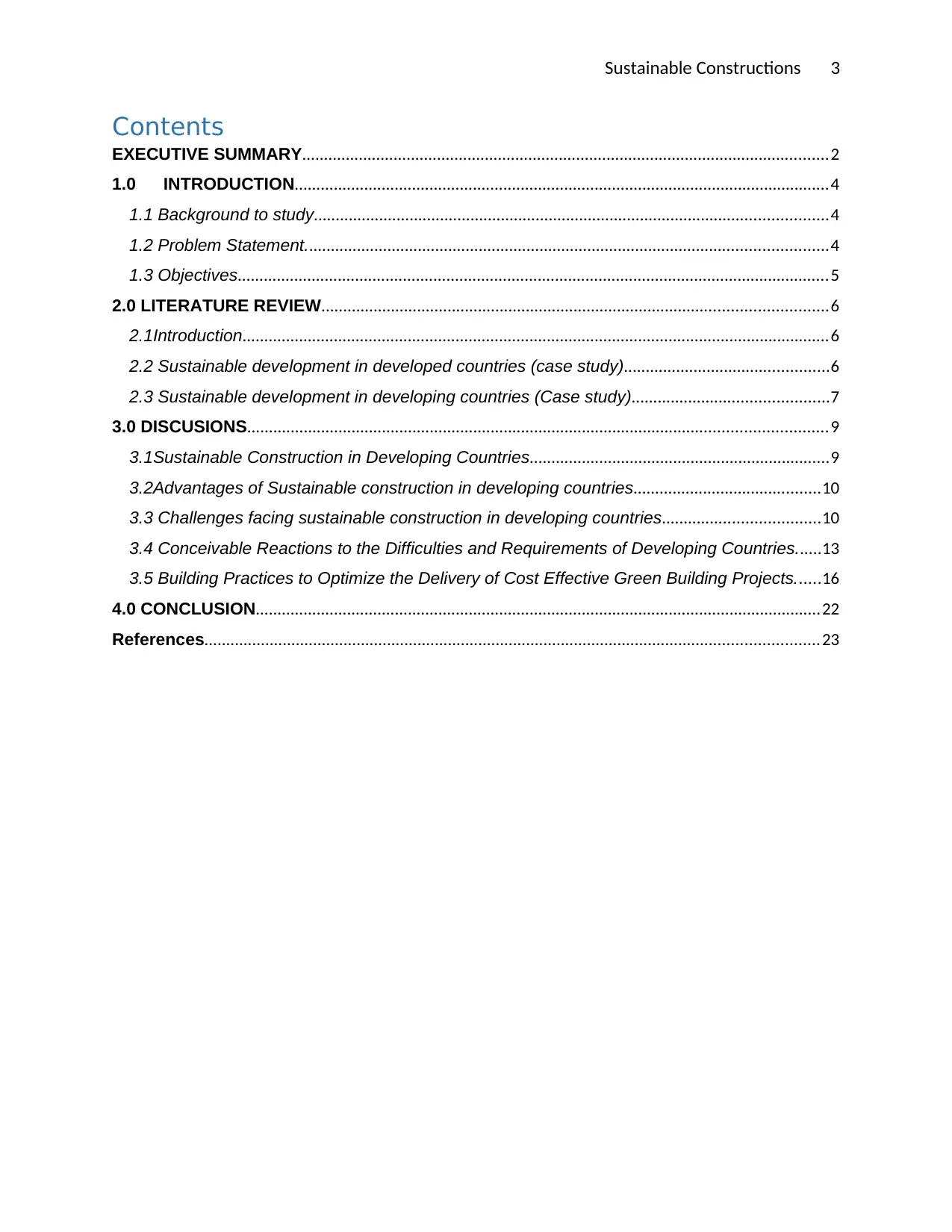
Contents
EXECUTIVE SUMMARY.........................................................................................................................2
1.0 INTRODUCTION...........................................................................................................................4
1.1 Background to study......................................................................................................................4
1.2 Problem Statement........................................................................................................................4
1.3 Objectives........................................................................................................................................5
2.0 LITERATURE REVIEW....................................................................................................................6
2.1Introduction.......................................................................................................................................6
2.2 Sustainable development in developed countries (case study)...............................................6
2.3 Sustainable development in developing countries (Case study).............................................7
3.0 DISCUSIONS.....................................................................................................................................9
3.1Sustainable Construction in Developing Countries.....................................................................9
3.2Advantages of Sustainable construction in developing countries...........................................10
3.3 Challenges facing sustainable construction in developing countries....................................10
3.4 Conceivable Reactions to the Difficulties and Requirements of Developing Countries......13
3.5 Building Practices to Optimize the Delivery of Cost Effective Green Building Projects......16
4.0 CONCLUSION..................................................................................................................................22
References.............................................................................................................................................23
Contents
EXECUTIVE SUMMARY.........................................................................................................................2
1.0 INTRODUCTION...........................................................................................................................4
1.1 Background to study......................................................................................................................4
1.2 Problem Statement........................................................................................................................4
1.3 Objectives........................................................................................................................................5
2.0 LITERATURE REVIEW....................................................................................................................6
2.1Introduction.......................................................................................................................................6
2.2 Sustainable development in developed countries (case study)...............................................6
2.3 Sustainable development in developing countries (Case study).............................................7
3.0 DISCUSIONS.....................................................................................................................................9
3.1Sustainable Construction in Developing Countries.....................................................................9
3.2Advantages of Sustainable construction in developing countries...........................................10
3.3 Challenges facing sustainable construction in developing countries....................................10
3.4 Conceivable Reactions to the Difficulties and Requirements of Developing Countries......13
3.5 Building Practices to Optimize the Delivery of Cost Effective Green Building Projects......16
4.0 CONCLUSION..................................................................................................................................22
References.............................................................................................................................................23
⊘ This is a preview!⊘
Do you want full access?
Subscribe today to unlock all pages.

Trusted by 1+ million students worldwide
Sustainable Constructions 4
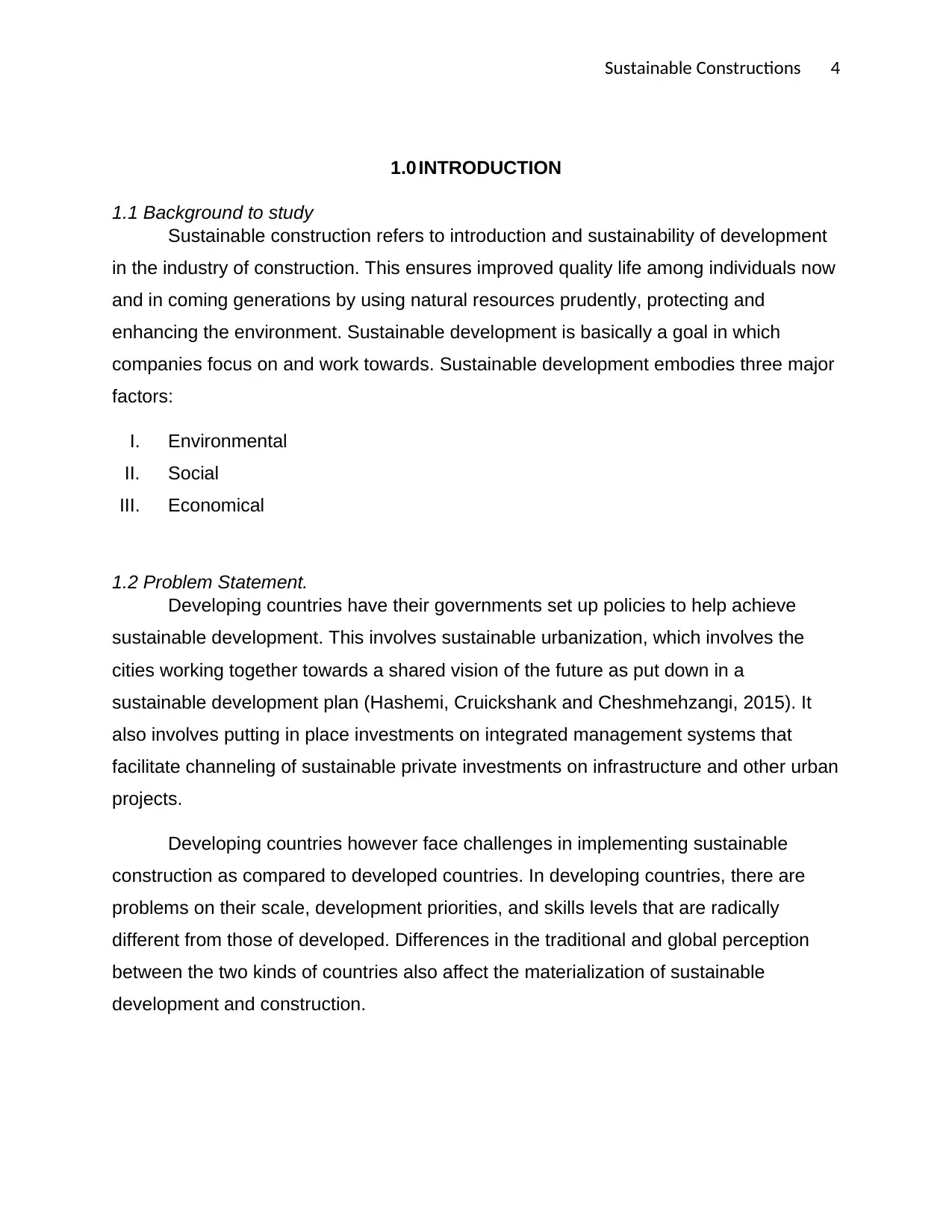
1.0 INTRODUCTION
1.1 Background to study
Sustainable construction refers to introduction and sustainability of development
in the industry of construction. This ensures improved quality life among individuals now
and in coming generations by using natural resources prudently, protecting and
enhancing the environment. Sustainable development is basically a goal in which
companies focus on and work towards. Sustainable development embodies three major
factors:
I. Environmental
II. Social
III. Economical
1.2 Problem Statement.
Developing countries have their governments set up policies to help achieve
sustainable development. This involves sustainable urbanization, which involves the
cities working together towards a shared vision of the future as put down in a
sustainable development plan (Hashemi, Cruickshank and Cheshmehzangi, 2015). It
also involves putting in place investments on integrated management systems that
facilitate channeling of sustainable private investments on infrastructure and other urban
projects.
Developing countries however face challenges in implementing sustainable
construction as compared to developed countries. In developing countries, there are
problems on their scale, development priorities, and skills levels that are radically
different from those of developed. Differences in the traditional and global perception
between the two kinds of countries also affect the materialization of sustainable
development and construction.
1.0 INTRODUCTION
1.1 Background to study
Sustainable construction refers to introduction and sustainability of development
in the industry of construction. This ensures improved quality life among individuals now
and in coming generations by using natural resources prudently, protecting and
enhancing the environment. Sustainable development is basically a goal in which
companies focus on and work towards. Sustainable development embodies three major
factors:
I. Environmental
II. Social
III. Economical
1.2 Problem Statement.
Developing countries have their governments set up policies to help achieve
sustainable development. This involves sustainable urbanization, which involves the
cities working together towards a shared vision of the future as put down in a
sustainable development plan (Hashemi, Cruickshank and Cheshmehzangi, 2015). It
also involves putting in place investments on integrated management systems that
facilitate channeling of sustainable private investments on infrastructure and other urban
projects.
Developing countries however face challenges in implementing sustainable
construction as compared to developed countries. In developing countries, there are
problems on their scale, development priorities, and skills levels that are radically
different from those of developed. Differences in the traditional and global perception
between the two kinds of countries also affect the materialization of sustainable
development and construction.
Paraphrase This Document
Need a fresh take? Get an instant paraphrase of this document with our AI Paraphraser
Sustainable Constructions 5
1.3 Objectives
The main objectives of this study is to look into the differences in the
implementation of sustainable development strategies between developed and
developing counties and the problems facing implementation of sustainable
constructions in developing countries. From this knowledge, recommendations on how
developing countries can improve in the steps towards sustainable constructions can be
drawn. In addition this study will look into the pros and cons associated with
implementing sustainable development.
This Report tries to explain sustainable development as seen in both developed
and developing country. For our case, we will look at India and Australia. The report
focuses on why developed countries have an easier time achieving sustainable
development as compared to developing countries. We will also look at counter
activities that developing countries undertake to ensure the achieved sustainable
development.
1.3 Objectives
The main objectives of this study is to look into the differences in the
implementation of sustainable development strategies between developed and
developing counties and the problems facing implementation of sustainable
constructions in developing countries. From this knowledge, recommendations on how
developing countries can improve in the steps towards sustainable constructions can be
drawn. In addition this study will look into the pros and cons associated with
implementing sustainable development.
This Report tries to explain sustainable development as seen in both developed
and developing country. For our case, we will look at India and Australia. The report
focuses on why developed countries have an easier time achieving sustainable
development as compared to developing countries. We will also look at counter
activities that developing countries undertake to ensure the achieved sustainable
development.
Sustainable Constructions 6
2.0 LITERATURE REVIEW
2.1Introduction
Sustainable development is often described as a balance of the three E’S
(Economy, the environment and social equity). Sustainable development requires
different approaches depending on whether it’s for a developed or developing country.
The aim of sustainable construction is to achieve the present-day goals of housing and
infrastructure whilst not compromising futures individuals meeting their wants.
Sustainable development is however different depending on the type of country. In most
cases developed countries play a major role in implementing and maintaining
sustainable development. This however is not the case in developing countries.
2.2 Sustainable development in developed countries (case study)
Developed countries have a GDP (Gross development per capital) of over
$12,000. These countries don’t really struggle with food shelter or clothes. People living
in developed countries have jobs and thereby can be able to feed their families
(Masthead, 1975). People living in developed countries have high living standard,
thereby don’t really struggle with social problems. Under such conditions, it’s possible
for people to struggle with issues such as: The environment, living more harmoniously
with nature, promotion of an individual’s health, exercise more or eat vegetarian food,
utilize renewable forms energies, how to stay away from polluting construction
materials, reduced open spaces, congestion, noise and endangerment of wildlife.
Sustainable development approaches in developed countries is thereby mostly
focused in environment pillar. Countries such Australia have sustainable development
projects that are focused on the ecological goal of sustainable development. Some of
the objectives on sustainable development goals in Australia are:
• To ensure Equity between individuals and coming generations
• Maintaining important ecological processes and life support systems.
2.0 LITERATURE REVIEW
2.1Introduction
Sustainable development is often described as a balance of the three E’S
(Economy, the environment and social equity). Sustainable development requires
different approaches depending on whether it’s for a developed or developing country.
The aim of sustainable construction is to achieve the present-day goals of housing and
infrastructure whilst not compromising futures individuals meeting their wants.
Sustainable development is however different depending on the type of country. In most
cases developed countries play a major role in implementing and maintaining
sustainable development. This however is not the case in developing countries.
2.2 Sustainable development in developed countries (case study)
Developed countries have a GDP (Gross development per capital) of over
$12,000. These countries don’t really struggle with food shelter or clothes. People living
in developed countries have jobs and thereby can be able to feed their families
(Masthead, 1975). People living in developed countries have high living standard,
thereby don’t really struggle with social problems. Under such conditions, it’s possible
for people to struggle with issues such as: The environment, living more harmoniously
with nature, promotion of an individual’s health, exercise more or eat vegetarian food,
utilize renewable forms energies, how to stay away from polluting construction
materials, reduced open spaces, congestion, noise and endangerment of wildlife.
Sustainable development approaches in developed countries is thereby mostly
focused in environment pillar. Countries such Australia have sustainable development
projects that are focused on the ecological goal of sustainable development. Some of
the objectives on sustainable development goals in Australia are:
• To ensure Equity between individuals and coming generations
• Maintaining important ecological processes and life support systems.
⊘ This is a preview!⊘
Do you want full access?
Subscribe today to unlock all pages.
Trusted by 1+ million students worldwide
Sustainable Constructions 7
• Safeguarding the welfare for future generations by enhancing individual and
community welfare.
• Improve access to affordable, reliable and environmentally sound energy
services
• Come up with other sources of energy aimed at the use of renewable energy.
• Developing cleaner, more efficient and affordable energy technologies.
2.3 Sustainable development in developing countries (Case study)
Developing countries refers to the country that have a GDP (Gross development
per capital) of less than $12,000. These countries have a less developed industrial base
and a low human development index. (Issue information, 2017) Some of the problems
experienced in these nations include:
• Unemployment
• Poor medical services
• High urban population of people looking for jobs
• Discrimination (this includes tribalism, nepotism and racism)
• Street families
• Low income earning
A closer look at these problems can give us an idea of what agendas of sustainable
development are mostly considered in developing countries. Developing countries are
more focused on environment and social equity goals of sustainable development.
India is a good example of a developing country (Report: Slow progress toward
Sustainable Development Goals, 2017). It’s characterized by a huge population of
people who are all looking to meet their need. India has embarked on Sustainable
Development Goals that were set up by the UN (UNDP in India, 2017). This goals
• Safeguarding the welfare for future generations by enhancing individual and
community welfare.
• Improve access to affordable, reliable and environmentally sound energy
services
• Come up with other sources of energy aimed at the use of renewable energy.
• Developing cleaner, more efficient and affordable energy technologies.
2.3 Sustainable development in developing countries (Case study)
Developing countries refers to the country that have a GDP (Gross development
per capital) of less than $12,000. These countries have a less developed industrial base
and a low human development index. (Issue information, 2017) Some of the problems
experienced in these nations include:
• Unemployment
• Poor medical services
• High urban population of people looking for jobs
• Discrimination (this includes tribalism, nepotism and racism)
• Street families
• Low income earning
A closer look at these problems can give us an idea of what agendas of sustainable
development are mostly considered in developing countries. Developing countries are
more focused on environment and social equity goals of sustainable development.
India is a good example of a developing country (Report: Slow progress toward
Sustainable Development Goals, 2017). It’s characterized by a huge population of
people who are all looking to meet their need. India has embarked on Sustainable
Development Goals that were set up by the UN (UNDP in India, 2017). This goals
Paraphrase This Document
Need a fresh take? Get an instant paraphrase of this document with our AI Paraphraser
Sustainable Constructions 8
mainly focusses on root causes of poverty and development that works for all people.
Some of the sustainable development Goals implemented in India include:
• No poverty
• Sustainable consumption and production
• No Hunger
• Sustainable towns and villages
• Climate
• Biological organisms on land
• Aquatic life
• Clean water
• Reduced inequalities
• Industry innovation and infrastructure
• Good health
• Quality Education
• Partnership for the goals
• Affordable and clean energy
mainly focusses on root causes of poverty and development that works for all people.
Some of the sustainable development Goals implemented in India include:
• No poverty
• Sustainable consumption and production
• No Hunger
• Sustainable towns and villages
• Climate
• Biological organisms on land
• Aquatic life
• Clean water
• Reduced inequalities
• Industry innovation and infrastructure
• Good health
• Quality Education
• Partnership for the goals
• Affordable and clean energy
Sustainable Constructions 9
3.0 DISCUSIONS
3.1Sustainable Construction in Developing Countries
Sustainable urbanization is a move by cities in the vision of achieving sustainable
construction as expressed in a sustainable development plan or Agenda
21(Sustainable-environment.org.uk, 2017). As part of the urbanization control, actions
are undertaken that enhance the generalization and utilization of clean techniques and
technologies for construction. Some of these actions include:
Minimum production of non-recyclable waste and pollutants;
Provision of quality and appropriate space for life required for human
development.
Reduced usage of non-renewable natural resources
Limited use of renewable natural resources;
Sustainable construction processes involve a series of stages all the way from
the selection of the raw materials to the construction of the selected materials and the
completed building materials and to the design of the septic systems, garbage dumps,
or street highways. Developing countries may be different (Sustainable-
environment.org.uk, 2017). The have different climatic, economic and cultural conditions
yet they have similar characteristics so long as sustainable development is concerned:
I. The developing countries are lack infrastructure and other basic services
II. Agricultural products and raw materials are the main source of income.
III. Developing countries have high levels of inequity among themselves. This
involves having some part of the country rich of resources whereas some other
deprived of the same.
IV. Developing countries consumes far lesser resources than the developed
countries yet the environmental degradation produced has a greater impact to
the poor living in these countries.
V. There is a strong unutilized grassroots ability for innovations in the use of
building materials and settlement development.
3.0 DISCUSIONS
3.1Sustainable Construction in Developing Countries
Sustainable urbanization is a move by cities in the vision of achieving sustainable
construction as expressed in a sustainable development plan or Agenda
21(Sustainable-environment.org.uk, 2017). As part of the urbanization control, actions
are undertaken that enhance the generalization and utilization of clean techniques and
technologies for construction. Some of these actions include:
Minimum production of non-recyclable waste and pollutants;
Provision of quality and appropriate space for life required for human
development.
Reduced usage of non-renewable natural resources
Limited use of renewable natural resources;
Sustainable construction processes involve a series of stages all the way from
the selection of the raw materials to the construction of the selected materials and the
completed building materials and to the design of the septic systems, garbage dumps,
or street highways. Developing countries may be different (Sustainable-
environment.org.uk, 2017). The have different climatic, economic and cultural conditions
yet they have similar characteristics so long as sustainable development is concerned:
I. The developing countries are lack infrastructure and other basic services
II. Agricultural products and raw materials are the main source of income.
III. Developing countries have high levels of inequity among themselves. This
involves having some part of the country rich of resources whereas some other
deprived of the same.
IV. Developing countries consumes far lesser resources than the developed
countries yet the environmental degradation produced has a greater impact to
the poor living in these countries.
V. There is a strong unutilized grassroots ability for innovations in the use of
building materials and settlement development.
⊘ This is a preview!⊘
Do you want full access?
Subscribe today to unlock all pages.
Trusted by 1+ million students worldwide
Sustainable Constructions 10
3.2Advantages of Sustainable construction in developing countries
Sustainable constructions and generally all constructions require a lot of
resources and questions on the profitability margins as a result of constructions may
arise (Murphy, 2010). Most of the constructions are geared towards infrastructure
(roads, bridges, airports, railways). However with the recent popularity of real estate
concepts, housing has also become an increasing area of focus for government and
private sectors. Some of the advantages that result from sustainable construction
includes;
Increased employment opportunities for many people who work in the
construction sites. In Peru this has been a major contribution to solving the challenges
of high unemployment rates (Ding, 2004). In developing countries this may lead to
increased job opportunities and have a positive social and economic impart to the
people living around.
Sustainable constructions lead to increased business trade and standards in a
country. From the constructions of roads and other infrastructure that link counties and
countries business ties are improved. More exports and imports therefore move
effectively improving the trade and business of developing countries.
Sustainable constructions lead to less pollution of the environment. Pollution is
one of the major problems following industrialization in developing countries. (Nanaimo,
2017). Through government policies that regulate the constructions of many buildings
and factories, developing countries can control and prevent pollution therefore prevent
problems associated with pollution like climate change and health implications.
3.3 Challenges facing sustainable construction in developing countries
From characteristics and strategies developed in implementing sustainable
constructions, we draw major setbacks for sustainable construction in developing
countries;
1) Education
3.2Advantages of Sustainable construction in developing countries
Sustainable constructions and generally all constructions require a lot of
resources and questions on the profitability margins as a result of constructions may
arise (Murphy, 2010). Most of the constructions are geared towards infrastructure
(roads, bridges, airports, railways). However with the recent popularity of real estate
concepts, housing has also become an increasing area of focus for government and
private sectors. Some of the advantages that result from sustainable construction
includes;
Increased employment opportunities for many people who work in the
construction sites. In Peru this has been a major contribution to solving the challenges
of high unemployment rates (Ding, 2004). In developing countries this may lead to
increased job opportunities and have a positive social and economic impart to the
people living around.
Sustainable constructions lead to increased business trade and standards in a
country. From the constructions of roads and other infrastructure that link counties and
countries business ties are improved. More exports and imports therefore move
effectively improving the trade and business of developing countries.
Sustainable constructions lead to less pollution of the environment. Pollution is
one of the major problems following industrialization in developing countries. (Nanaimo,
2017). Through government policies that regulate the constructions of many buildings
and factories, developing countries can control and prevent pollution therefore prevent
problems associated with pollution like climate change and health implications.
3.3 Challenges facing sustainable construction in developing countries
From characteristics and strategies developed in implementing sustainable
constructions, we draw major setbacks for sustainable construction in developing
countries;
1) Education
Paraphrase This Document
Need a fresh take? Get an instant paraphrase of this document with our AI Paraphraser
Sustainable Constructions 11
Lack of information on the sustainable construction can be a barrier to its
implementation. Appropriate measures must be put in place to ensure that the right and
useful information is availed (Un.org, 2017). This involves awareness programs for the
public and special training programs for technicians and government officials. The
training should be based on efficient cost-effective implementations of sustainable
constructions.
2) Governance and Management
When the government fails to implement policies that push for sustainable
construction, no sustainable development will be realized. If the government officials
are corrupt, we will have poor rural housing all because a corrupt official compromised
sustainable development for his own benefit.
3) Financing and Procurement
There is a need to come up with properly implemented means to procure and
hand out government construction tenders. This will ensure that sustainable
development is achieved since only contractors who meet the set guidelines will win the
tenders.
4) Gender inequality
In most developing countries, women are still considered less important in the
society. It’s important that the role of females in the society to be recognized. Women
working at construction sites are discriminated and treated without care. Proper policies
need to set out to allow for women to be treated equally. This will go a big way in
ensuring that women working in the construction industry will realize the full potential
(Un.org, 2017).
5) Urbanization
Many people in developing areas have fled their rural settlements for
opportunities in the city. This has led to urban-decongestion which has resulted in the
growth of improper settlement in the cities. Sustainable development with should involve
Lack of information on the sustainable construction can be a barrier to its
implementation. Appropriate measures must be put in place to ensure that the right and
useful information is availed (Un.org, 2017). This involves awareness programs for the
public and special training programs for technicians and government officials. The
training should be based on efficient cost-effective implementations of sustainable
constructions.
2) Governance and Management
When the government fails to implement policies that push for sustainable
construction, no sustainable development will be realized. If the government officials
are corrupt, we will have poor rural housing all because a corrupt official compromised
sustainable development for his own benefit.
3) Financing and Procurement
There is a need to come up with properly implemented means to procure and
hand out government construction tenders. This will ensure that sustainable
development is achieved since only contractors who meet the set guidelines will win the
tenders.
4) Gender inequality
In most developing countries, women are still considered less important in the
society. It’s important that the role of females in the society to be recognized. Women
working at construction sites are discriminated and treated without care. Proper policies
need to set out to allow for women to be treated equally. This will go a big way in
ensuring that women working in the construction industry will realize the full potential
(Un.org, 2017).
5) Urbanization
Many people in developing areas have fled their rural settlements for
opportunities in the city. This has led to urban-decongestion which has resulted in the
growth of improper settlement in the cities. Sustainable development with should involve
Sustainable Constructions 12
decongesting the city. As people move back to rural settlements they will realize their
value for land.
6) Needing a new model of development
Most of the developing countries have had to design and implement models set
out by the already developed countries. This development model involves having large
scale production and high consumption pattern. This further results in pollution of the
environment and energy loss. Developing countries need to first strategize before
implementing a model. The model must be sustainable before it’s implemented.
7) Sustainability in housing
Housing in developing countries is mainly constituted of houses that are
overcrowded and are not quite environmental friendly. Not many people in developing
countries who live up to the sustainable development goals so long as housing is
concerned.
8) Innovation in building materials and methods
Sustainable construction can be of huge impact to environmental sustainability.
This can be achieved by the reduction of the use of energy intensive materials. This
calls for innovation and input of investment. Developing countries are not willing to go
the extra mile of researching into other alternatives of construction which may hinder
this.
9) Poverty and Poor Urban Investment
According to the World Bank, 70% of poor people live in the cities. This
has been accompanied by an impoverishment of the population and environmental
deterioration. Here we see that poverty levels leads to environmental deterioration
which leads to the vulnerability of the poor. Improper temporary houses are constructed
to meet poor peoples need for housing. This houses have a negative impact to the
community and the global environment as a whole.
decongesting the city. As people move back to rural settlements they will realize their
value for land.
6) Needing a new model of development
Most of the developing countries have had to design and implement models set
out by the already developed countries. This development model involves having large
scale production and high consumption pattern. This further results in pollution of the
environment and energy loss. Developing countries need to first strategize before
implementing a model. The model must be sustainable before it’s implemented.
7) Sustainability in housing
Housing in developing countries is mainly constituted of houses that are
overcrowded and are not quite environmental friendly. Not many people in developing
countries who live up to the sustainable development goals so long as housing is
concerned.
8) Innovation in building materials and methods
Sustainable construction can be of huge impact to environmental sustainability.
This can be achieved by the reduction of the use of energy intensive materials. This
calls for innovation and input of investment. Developing countries are not willing to go
the extra mile of researching into other alternatives of construction which may hinder
this.
9) Poverty and Poor Urban Investment
According to the World Bank, 70% of poor people live in the cities. This
has been accompanied by an impoverishment of the population and environmental
deterioration. Here we see that poverty levels leads to environmental deterioration
which leads to the vulnerability of the poor. Improper temporary houses are constructed
to meet poor peoples need for housing. This houses have a negative impact to the
community and the global environment as a whole.
⊘ This is a preview!⊘
Do you want full access?
Subscribe today to unlock all pages.
Trusted by 1+ million students worldwide

1 out of 27


Related Documents


Your All-in-One AI-Powered Toolkit for Academic Success.
+13062052269
info@desklib.com
Available 24*7 on WhatsApp / Email
![[object Object]](/_next/static/media/star-bottom.7253800d.svg)
Unlock your academic potential
Copyright © 2020–2026 A2Z Services. All Rights Reserved. Developed and managed by ZUCOL.