Construction Project Management: Environmental Sustainability Report
VerifiedAdded on 2021/06/18
|25
|6031
|48
Report
AI Summary
This report delves into the critical aspects of sustainable construction project management, focusing on environmental pollution, control, and design. The introduction highlights the growing importance of sustainability in the construction industry, emphasizing the need for adaptation to address environmental challenges. The report explores the environmental impacts of construction activities, including waste, air, water, and noise pollution, and discusses legislative, management, and technological approaches to mitigate these issues. The first topic examines the natural cyclic system and the need for architects, engineers, and project managers to consider design parameters that promote sustainable development, such as dam design and river course management. The second topic focuses on sustainable design in construction, emphasizing the need for resource efficiency and environmentally responsible practices. It covers topics like carbon reduction, greenhouse gas control, and the use of renewable materials. The report highlights the importance of integrating sustainable practices throughout the construction lifecycle, from design and material selection to construction and demolition. It also emphasizes the role of green building initiatives in reducing energy consumption, managing risks, and improving the overall value of construction projects.
Construction Project Management 1
Construction Project Management
By
(Student’s Name)
Course Name:
Professor Name:
University Name:
Date of Submission:
Construction Project Management
By
(Student’s Name)
Course Name:
Professor Name:
University Name:
Date of Submission:

Paraphrase This Document
Need a fresh take? Get an instant paraphrase of this document with our AI Paraphraser
Construction Project Management 2
Topic 1: Environmental Pollution and Control in Sustainable Development
Introduction
Over the past decades and in the recent days, sustainability concepts have continued to
emerge in all the aspects surrounding the human sphere, and these elements are depicted at both
the construction industry as well as in the present times. However, this sustainability has
continued to raise concerns and thus, calling for various changes and adaptations so as to
ascertain the sustainability presents and the challenges which it has in the long run. This,
therefore, means that various criteria and aspects must be incorporated and looked at in order to
realize and validate sustainability. This course posed on the sustainability concepts, and the
entire problems which one can encounter when there is the existence of unsustainable
development in the local, global as well a regional basis (Ashraf et al. 2015 p.42).
Topic 1: Environmental Pollution and Control in Sustainable Development
Introduction
Over the past decades and in the recent days, sustainability concepts have continued to
emerge in all the aspects surrounding the human sphere, and these elements are depicted at both
the construction industry as well as in the present times. However, this sustainability has
continued to raise concerns and thus, calling for various changes and adaptations so as to
ascertain the sustainability presents and the challenges which it has in the long run. This,
therefore, means that various criteria and aspects must be incorporated and looked at in order to
realize and validate sustainability. This course posed on the sustainability concepts, and the
entire problems which one can encounter when there is the existence of unsustainable
development in the local, global as well a regional basis (Ashraf et al. 2015 p.42).
Construction Project Management 3
Furthermore, this study also explores the environmental impacts which various
construction activities as well as the total measures which can be in place to monitor and curb
these issues in the long run. Also, there are various legislative, management and regulative
approaches which have to be considered when dealing with the sustainable development of
different projects. In addition, the different technological approaches are adopted in various
construction projects worldwide, and therefore it is important to appraise them in line with the
sustainable development (Al-Dahhan 2016).
Thus, this study on the construction and sustainable development mainly aim at
improving the overall aspects as well as providing an in-depth understanding of the key issues
which one must take into account in the construction field. This can be achieved through the use
of systematic reviews and analogies regarding various ideas which are currently developed in the
discipline (Foerstl et al. 2010).
Strength and Weakness
Sustainable development has been widely used since the introduction of the concept at the
Environmental Conference of the United Nations held in 1992, at the Rio de Janeiro. According
to the Brundtland Report (WCED 1987), it is defined as the development which aims at meeting
the present needs of the current generation while at the same time, works in such a manner that
the makeable future generation abilities are not compromised in terms of their over the ability to
meet their own needs. Thus, the sustainable development tends to take an overall concept and
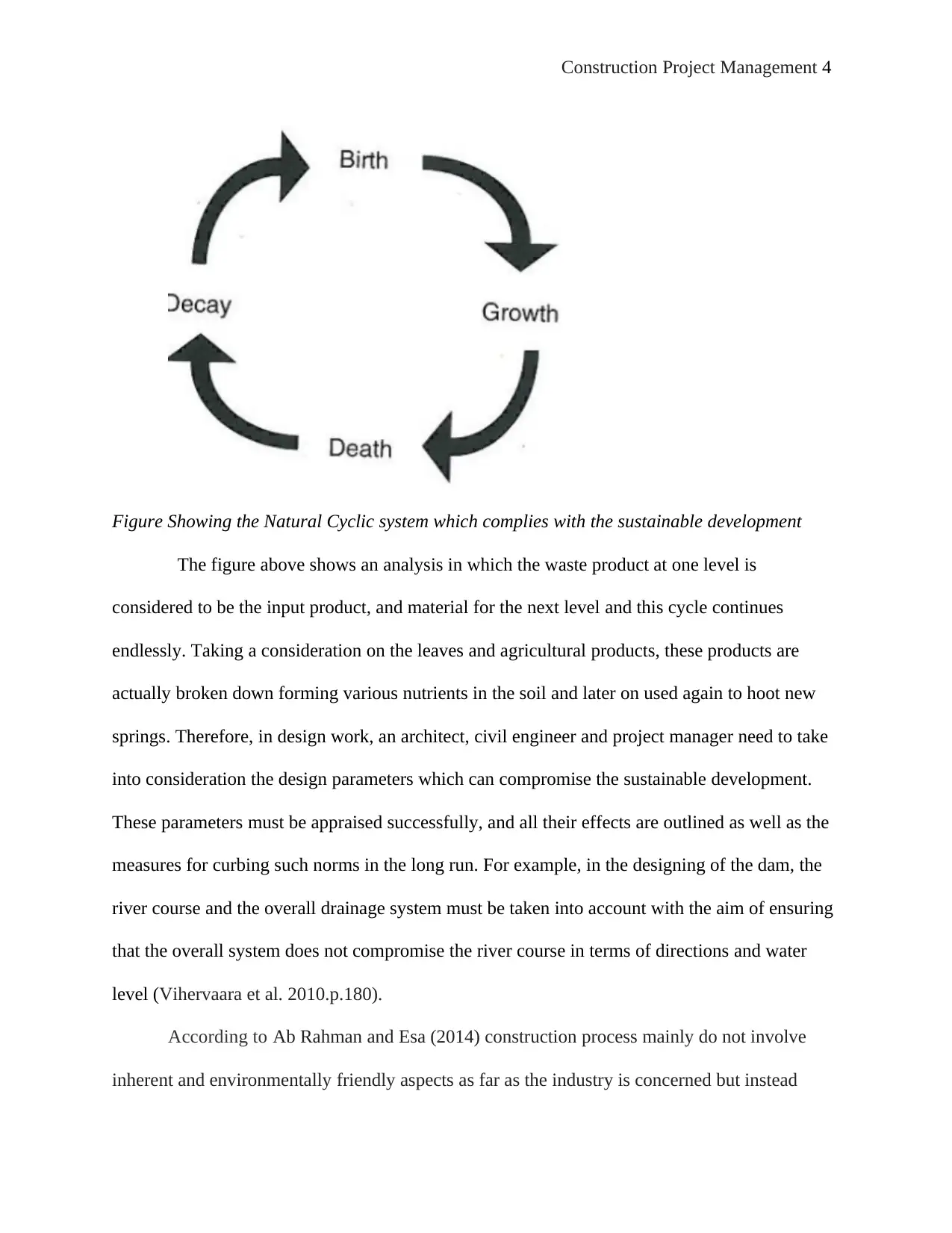
approach of natural cyclic system form as shown in the diagram below (Ravetz 2016).
Furthermore, this study also explores the environmental impacts which various
construction activities as well as the total measures which can be in place to monitor and curb
these issues in the long run. Also, there are various legislative, management and regulative
approaches which have to be considered when dealing with the sustainable development of
different projects. In addition, the different technological approaches are adopted in various
construction projects worldwide, and therefore it is important to appraise them in line with the
sustainable development (Al-Dahhan 2016).
Thus, this study on the construction and sustainable development mainly aim at
improving the overall aspects as well as providing an in-depth understanding of the key issues
which one must take into account in the construction field. This can be achieved through the use
of systematic reviews and analogies regarding various ideas which are currently developed in the
discipline (Foerstl et al. 2010).
Strength and Weakness
Sustainable development has been widely used since the introduction of the concept at the
Environmental Conference of the United Nations held in 1992, at the Rio de Janeiro. According
to the Brundtland Report (WCED 1987), it is defined as the development which aims at meeting
the present needs of the current generation while at the same time, works in such a manner that
the makeable future generation abilities are not compromised in terms of their over the ability to
meet their own needs. Thus, the sustainable development tends to take an overall concept and
approach of natural cyclic system form as shown in the diagram below (Ravetz 2016).
⊘ This is a preview!⊘
Do you want full access?
Subscribe today to unlock all pages.

Trusted by 1+ million students worldwide
Construction Project Management 4
Figure Showing the Natural Cyclic system which complies with the sustainable development
The figure above shows an analysis in which the waste product at one level is
considered to be the input product, and material for the next level and this cycle continues
endlessly. Taking a consideration on the leaves and agricultural products, these products are
actually broken down forming various nutrients in the soil and later on used again to hoot new
springs. Therefore, in design work, an architect, civil engineer and project manager need to take
into consideration the design parameters which can compromise the sustainable development.
These parameters must be appraised successfully, and all their effects are outlined as well as the
measures for curbing such norms in the long run. For example, in the designing of the dam, the
river course and the overall drainage system must be taken into account with the aim of ensuring
that the overall system does not compromise the river course in terms of directions and water
level (Vihervaara et al. 2010.p.180).
According to Ab Rahman and Esa (2014) construction process mainly do not involve
inherent and environmentally friendly aspects as far as the industry is concerned but instead
Figure Showing the Natural Cyclic system which complies with the sustainable development
The figure above shows an analysis in which the waste product at one level is
considered to be the input product, and material for the next level and this cycle continues
endlessly. Taking a consideration on the leaves and agricultural products, these products are
actually broken down forming various nutrients in the soil and later on used again to hoot new
springs. Therefore, in design work, an architect, civil engineer and project manager need to take
into consideration the design parameters which can compromise the sustainable development.
These parameters must be appraised successfully, and all their effects are outlined as well as the
measures for curbing such norms in the long run. For example, in the designing of the dam, the
river course and the overall drainage system must be taken into account with the aim of ensuring
that the overall system does not compromise the river course in terms of directions and water
level (Vihervaara et al. 2010.p.180).
According to Ab Rahman and Esa (2014) construction process mainly do not involve
inherent and environmentally friendly aspects as far as the industry is concerned but instead
Paraphrase This Document
Need a fresh take? Get an instant paraphrase of this document with our AI Paraphraser
Construction Project Management 5
linked the various disruption elements and pollution. In this case, it is noted that construction is
one of the keys and viable contributor of the overall pollution risks which one depict on a daily
basis. Some of the environmental impacts which are linked to the construction mainly include
waste, air as well as water and noise pollution. In fact, this appraisal indicated that construction
mainly associated with various complexes, resource demanding as well as highly dispersed
elements in terms of the activities which are carried out in the process. Industry, on the other
hand, is the main contributor of the overall natural losses of assets, severe stresses, as well as the
imposed impacts in line with the environment (Klebaner 2010 p.450).
Therefore, all the activities in the construction process which failed to follow the
standards and regulation can then cause imminent damages to the lakes, rivers, aquatic life as
well as sensitive ecosystems. This can also include the killing of all the existing fish in various
water bodies. Moreover, the construction activities if not properly managed can lead to the
disruption of not only the groundwater but also the land more so by increasing the land pollution
and disrupting the wildlife habitats. Moreover, the overall environmental risks continue to pose
challenges, and these problems are high when one is working on the steep slopes, highlands as
well as near the lakes and rivers (Ahern 2011 p.340).
Future Generations
Large projects do impact immensely on the land as these projects involve not only the
vegetation removal but also the topographical reshaping. The results of such activities mainly
include soil erosion as the soil is prone to the erosion as a result of the activities conducted on
the land. Moreover, the resulting soil obtained from the excavation process can either create
linked the various disruption elements and pollution. In this case, it is noted that construction is
one of the keys and viable contributor of the overall pollution risks which one depict on a daily
basis. Some of the environmental impacts which are linked to the construction mainly include
waste, air as well as water and noise pollution. In fact, this appraisal indicated that construction
mainly associated with various complexes, resource demanding as well as highly dispersed
elements in terms of the activities which are carried out in the process. Industry, on the other
hand, is the main contributor of the overall natural losses of assets, severe stresses, as well as the
imposed impacts in line with the environment (Klebaner 2010 p.450).
Therefore, all the activities in the construction process which failed to follow the
standards and regulation can then cause imminent damages to the lakes, rivers, aquatic life as
well as sensitive ecosystems. This can also include the killing of all the existing fish in various
water bodies. Moreover, the construction activities if not properly managed can lead to the
disruption of not only the groundwater but also the land more so by increasing the land pollution
and disrupting the wildlife habitats. Moreover, the overall environmental risks continue to pose
challenges, and these problems are high when one is working on the steep slopes, highlands as
well as near the lakes and rivers (Ahern 2011 p.340).
Future Generations
Large projects do impact immensely on the land as these projects involve not only the
vegetation removal but also the topographical reshaping. The results of such activities mainly
include soil erosion as the soil is prone to the erosion as a result of the activities conducted on
the land. Moreover, the resulting soil obtained from the excavation process can either create
Construction Project Management 6
dust pollution or can even be transported by the water agents into the water bodies and thus,
hastening water pollution (Brandon and Lombardi 2010).
Moreover, soil erosion may deteriorate the quality of water in the various water bodies,
and this is mainly caused by the siltation coming from the construction sites. Also, the land
degradation can result in flash and mud floods if the area receives heavy downpour. Therefore,
it is the role and the responsibility of the engineer, the project manager as well as the architects
to ensure that they design systems which comply with the environmental practices and
regulation as far as the sustainable development is concerned (Hawver et al. 2016.)
References
Ahern, J., 2011. From fail-safe to safe-to-fail: Sustainability and resilience in the new urban
world. Landscape and Urban Planning, 100(4), pp.341-343.
Al-Dahhan, M.H., 2016. Trends in Minimizing and Treating Industrial Wastes for Sustainable
Environment. Procedia Engineering, 138, pp.347-368.
Ashraf, M.A., Khan, A.M., Sarfraz, M. and Ahmad, M., 2015. The effectiveness of silica based
sol-gel microencapsulation method for odorants and flavors leading to sustainable environment.
Frontiers in chemistry, 3, p.42.
dust pollution or can even be transported by the water agents into the water bodies and thus,
hastening water pollution (Brandon and Lombardi 2010).
Moreover, soil erosion may deteriorate the quality of water in the various water bodies,
and this is mainly caused by the siltation coming from the construction sites. Also, the land
degradation can result in flash and mud floods if the area receives heavy downpour. Therefore,
it is the role and the responsibility of the engineer, the project manager as well as the architects
to ensure that they design systems which comply with the environmental practices and
regulation as far as the sustainable development is concerned (Hawver et al. 2016.)
References
Ahern, J., 2011. From fail-safe to safe-to-fail: Sustainability and resilience in the new urban
world. Landscape and Urban Planning, 100(4), pp.341-343.
Al-Dahhan, M.H., 2016. Trends in Minimizing and Treating Industrial Wastes for Sustainable
Environment. Procedia Engineering, 138, pp.347-368.
Ashraf, M.A., Khan, A.M., Sarfraz, M. and Ahmad, M., 2015. The effectiveness of silica based
sol-gel microencapsulation method for odorants and flavors leading to sustainable environment.
Frontiers in chemistry, 3, p.42.
⊘ This is a preview!⊘
Do you want full access?
Subscribe today to unlock all pages.
Trusted by 1+ million students worldwide
Construction Project Management 7
Brandon, P.S., and Lombardi, P., 2010. Evaluating sustainable development in the built
environment. John Wiley & Sons.
Foerstl, K., Reuter, C., Hartmann, E. and Blome, C., 2010. Managing supplier sustainability risks
in a dynamically changing environment—Sustainable supplier management in the chemical
industry. Journal of Purchasing and Supply Management, 16(2), pp.118-130.
Hawver, L.A., Giulietti, J.M., Baleja, J.D. and Ng, W.L., 2016. Quorum sensing coordinates
cooperative expression of pyruvate metabolism genes to maintain a sustainable environment for
population stability. MBio, 7(6), pp.e01863-16.
Klebaner, V.S., 2010. Environmental priorities of Russia. Studies on Russian Economic
Development, 21(4), pp.449-454.
Medineckiene, M., Turskis, Z. and Zavadskas, E.K., 2010. Sustainable construction taking into
account the building impact on the environment. Journal of Environmental Engineering and
Landscape Management, 18(2), pp.118-127.
Ravetz, J., 2016. City-region 2020: integrated planning for a sustainable environment.
Routledge.
Vihervaara, P., Kumpula, T., Tanskanen, A. and Burkhard, B., 2010. Ecosystem services–A tool
for sustainable management of human–environment systems. Case study Finnish Forest
Lapland. Ecological Complexity, 7(3), pp.410-420.
Brandon, P.S., and Lombardi, P., 2010. Evaluating sustainable development in the built
environment. John Wiley & Sons.
Foerstl, K., Reuter, C., Hartmann, E. and Blome, C., 2010. Managing supplier sustainability risks
in a dynamically changing environment—Sustainable supplier management in the chemical
industry. Journal of Purchasing and Supply Management, 16(2), pp.118-130.
Hawver, L.A., Giulietti, J.M., Baleja, J.D. and Ng, W.L., 2016. Quorum sensing coordinates
cooperative expression of pyruvate metabolism genes to maintain a sustainable environment for
population stability. MBio, 7(6), pp.e01863-16.
Klebaner, V.S., 2010. Environmental priorities of Russia. Studies on Russian Economic
Development, 21(4), pp.449-454.
Medineckiene, M., Turskis, Z. and Zavadskas, E.K., 2010. Sustainable construction taking into
account the building impact on the environment. Journal of Environmental Engineering and
Landscape Management, 18(2), pp.118-127.
Ravetz, J., 2016. City-region 2020: integrated planning for a sustainable environment.
Routledge.
Vihervaara, P., Kumpula, T., Tanskanen, A. and Burkhard, B., 2010. Ecosystem services–A tool
for sustainable management of human–environment systems. Case study Finnish Forest
Lapland. Ecological Complexity, 7(3), pp.410-420.
Paraphrase This Document
Need a fresh take? Get an instant paraphrase of this document with our AI Paraphraser
Construction Project Management 8
Topic 2: Sustainable Design in Construction
Introduction
The pace of urbanization in major cities and centers of population is alarming and are in a
growing phase. As a result, challenges are facing such centers and creating a growing need
linked to the changes in the living standard that are by far exacerbating the situations. Therefore,
the lack of success stories is inducing some complex design relationships. The future of the
construction industry is intensified with construction material, recycling intensity, rewards for
sustainability, as well as the implementation of carbon emission and use of alternative innovative
and renewable materials. More than that, they involve changes in design that inculcate efficient
use of natural resources like air and sunlight using the more locally manufactured materials and
Topic 2: Sustainable Design in Construction
Introduction
The pace of urbanization in major cities and centers of population is alarming and are in a
growing phase. As a result, challenges are facing such centers and creating a growing need
linked to the changes in the living standard that are by far exacerbating the situations. Therefore,
the lack of success stories is inducing some complex design relationships. The future of the
construction industry is intensified with construction material, recycling intensity, rewards for
sustainability, as well as the implementation of carbon emission and use of alternative innovative
and renewable materials. More than that, they involve changes in design that inculcate efficient
use of natural resources like air and sunlight using the more locally manufactured materials and
Construction Project Management 9
completely avoiding toxic materials. Sustainable structures have strong and reliable foundation
laying, design, maintenance, renovation, operation, construction, as well as demolition (Tan,
Shen and Yao 2011 p.225).
Strength and Weakness
The emblem of construction involves construction procedures and processes that are
environmentally responsible and are resource efficient with less impact on the ecological and
natural impact throughout the lifecycle of the building. This is because such environmentally
responsible structures are known to save on resources and ensure that the wastes are minimized
carefully at every stage of the structure or the building. Therefore, the modern architectural
design in building constructions is taking a carefully modified perspective in order to cater for
some of the important factors. Some of these factors effectively make the designs become
sustainable in-line with the modern challenges and construction dynamisms today. The reason
for such practices includes altruistic objectives. These objectives involve principles or practices
that are concerned with the welfare of others in the society; thus sustainable construction designs
are architecture within the perspective of maintaining the welfare standards of the surrounding
social environment (Sabnis 2015).
The sustainable construction operations involve the adoption of building designs,
methods, and materials that are very friendly as far as the environment is concerned. The
materials and resources in use have supplies that are steady and readily available from various
resources because natural resources are used for conservation purposes. As a forward-thinking
(proactive) building construction fronts, sustainable construction empowers and inspire the
generation that is emerging of construction management and technology users so as to deliver
completely avoiding toxic materials. Sustainable structures have strong and reliable foundation
laying, design, maintenance, renovation, operation, construction, as well as demolition (Tan,
Shen and Yao 2011 p.225).
Strength and Weakness
The emblem of construction involves construction procedures and processes that are
environmentally responsible and are resource efficient with less impact on the ecological and
natural impact throughout the lifecycle of the building. This is because such environmentally
responsible structures are known to save on resources and ensure that the wastes are minimized
carefully at every stage of the structure or the building. Therefore, the modern architectural
design in building constructions is taking a carefully modified perspective in order to cater for
some of the important factors. Some of these factors effectively make the designs become
sustainable in-line with the modern challenges and construction dynamisms today. The reason
for such practices includes altruistic objectives. These objectives involve principles or practices
that are concerned with the welfare of others in the society; thus sustainable construction designs
are architecture within the perspective of maintaining the welfare standards of the surrounding
social environment (Sabnis 2015).
The sustainable construction operations involve the adoption of building designs,
methods, and materials that are very friendly as far as the environment is concerned. The
materials and resources in use have supplies that are steady and readily available from various
resources because natural resources are used for conservation purposes. As a forward-thinking
(proactive) building construction fronts, sustainable construction empowers and inspire the
generation that is emerging of construction management and technology users so as to deliver
⊘ This is a preview!⊘
Do you want full access?
Subscribe today to unlock all pages.
Trusted by 1+ million students worldwide
Construction Project Management 10
developments that are sustainable, both the environment, the society, as well as the financial
pillars of the larger society (Brophy and Lewis 2012).
Among the other factors in the sustainable design and building construction include
designing with carbon reduction in the mind, greenhouse gases control, as well as reduction of
energy consumption. It is understood that various human activities are carried out but have
dangerous eventuality to human settlement and the environment in general. Therefore, any
building design and their various architectural designs must consider the likely atmospheric
effects of such construction to the environment (Sun et al. 2015).
Sustainable design in construction also considers the non-biodegradable waster
generation with the aim of reducing it. Some of the non-biodegradable wastes have become a
constant menace to the environment. Therefore, reducing these wastes is contained in the high
regard for protecting human rights of the future generation as well as making it possible for the
reduction of harmful greenhouse gas emissions initiatives through such construction design.
The green initiatives that have been employed by most of the construction designs in
some parts of the world are made with the mentality of conserving water as well as improving
the air quality. More than that, the global warming initiatives, saving the wild lands, reviving the
oceans, as well as financial incentives have become the paramount initiatives that have formed
the bedrock of modern architectural designs in construction. The key concept of sustainability
follows after an integrated approach with the team of designers, stakeholders, as well as
construction itself. For the construction sustainability to take shape, objectives of the project
must be set, selection of building materials that are appropriate, the system, as well as project
delivery methods (Lechner 2014).
developments that are sustainable, both the environment, the society, as well as the financial
pillars of the larger society (Brophy and Lewis 2012).
Among the other factors in the sustainable design and building construction include
designing with carbon reduction in the mind, greenhouse gases control, as well as reduction of
energy consumption. It is understood that various human activities are carried out but have
dangerous eventuality to human settlement and the environment in general. Therefore, any
building design and their various architectural designs must consider the likely atmospheric
effects of such construction to the environment (Sun et al. 2015).
Sustainable design in construction also considers the non-biodegradable waster
generation with the aim of reducing it. Some of the non-biodegradable wastes have become a
constant menace to the environment. Therefore, reducing these wastes is contained in the high
regard for protecting human rights of the future generation as well as making it possible for the
reduction of harmful greenhouse gas emissions initiatives through such construction design.
The green initiatives that have been employed by most of the construction designs in
some parts of the world are made with the mentality of conserving water as well as improving
the air quality. More than that, the global warming initiatives, saving the wild lands, reviving the
oceans, as well as financial incentives have become the paramount initiatives that have formed
the bedrock of modern architectural designs in construction. The key concept of sustainability
follows after an integrated approach with the team of designers, stakeholders, as well as
construction itself. For the construction sustainability to take shape, objectives of the project
must be set, selection of building materials that are appropriate, the system, as well as project
delivery methods (Lechner 2014).
Paraphrase This Document
Need a fresh take? Get an instant paraphrase of this document with our AI Paraphraser
Construction Project Management 11
Conclusively, the sustainable design in construction looks into key areas of the site,
energy, water, resources, emissions, rich, indoor environment, project management, as well as
programs promoting efficient energy consumption that would benefit the clients. This is why; the
green buildings are taking ground. Such building constructions aim at reducing energy
consumption as noted above, decreasing risk management, increasing the valuation of the
building, increasing the morale, as well as reducing the growth of molds. More than that, they are
built with the aim of decreasing the operational expenses, increasing the values of the building,
increasing rent and occupancy (Bynum, Issa, and Olbina 2012 p.34).
Future Generation
The cycles of sustainability in construction have three basic elements: the social, the
environment, and the economic elements. The truth is that in the event any of the three
mentioned elements is missing, there is every possibility of the construction being weak, thus
becoming unsustainable. The bearable, viable, and equitable aspects of the three elements bring
sustainability. The social elements welcome the community or the social structure that maintain
the social wellbeing and the harmony of the society. The economic facet of sustainability
involves the continued economic prosperity as well as economic production. Lastly, the
environmental element considers the ecosystem and the biosphere that maintain the natural state
or level of resource quality (Komurlu et al. 2015 p.156).
Climatic concerns of the environmental element involve, among others, the emission of
the greenhouse gases, the ozone layer (emissions that damage the ozone layer), resources such as
consumption of fuels, the proportion of renewable energy sources, and the intensity of energy.
The economic element involves the true costs with the level at which the costs of operations are
Conclusively, the sustainable design in construction looks into key areas of the site,
energy, water, resources, emissions, rich, indoor environment, project management, as well as
programs promoting efficient energy consumption that would benefit the clients. This is why; the
green buildings are taking ground. Such building constructions aim at reducing energy
consumption as noted above, decreasing risk management, increasing the valuation of the
building, increasing the morale, as well as reducing the growth of molds. More than that, they are
built with the aim of decreasing the operational expenses, increasing the values of the building,
increasing rent and occupancy (Bynum, Issa, and Olbina 2012 p.34).
Future Generation
The cycles of sustainability in construction have three basic elements: the social, the
environment, and the economic elements. The truth is that in the event any of the three
mentioned elements is missing, there is every possibility of the construction being weak, thus
becoming unsustainable. The bearable, viable, and equitable aspects of the three elements bring
sustainability. The social elements welcome the community or the social structure that maintain
the social wellbeing and the harmony of the society. The economic facet of sustainability
involves the continued economic prosperity as well as economic production. Lastly, the
environmental element considers the ecosystem and the biosphere that maintain the natural state
or level of resource quality (Komurlu et al. 2015 p.156).
Climatic concerns of the environmental element involve, among others, the emission of
the greenhouse gases, the ozone layer (emissions that damage the ozone layer), resources such as
consumption of fuels, the proportion of renewable energy sources, and the intensity of energy.
The economic element involves the true costs with the level at which the costs of operations are
Construction Project Management 12
determined as well as the external costs of damage and safety. Therefore, it becomes apparent
that sustainable project design involves the method of works that are aimed at ensuring the
optimal results for the environment in construction and civil works (Gan et al. 2015).
Kibert (2016) noted that there is successful sustainability in construction and design
programs require that the design and construction team be selected and managed carefully,
sustainable checklist development be kept on the check, to determine the financial incentives, to
avoid overbuilding and setting the preliminary budgets accordingly. In the same way, such
constructions are simple, efficient, designed flexibly, effectively use resources like water, light,
and recycled materials (Ab Rahman and Esa 2014).
References
determined as well as the external costs of damage and safety. Therefore, it becomes apparent
that sustainable project design involves the method of works that are aimed at ensuring the
optimal results for the environment in construction and civil works (Gan et al. 2015).
Kibert (2016) noted that there is successful sustainability in construction and design
programs require that the design and construction team be selected and managed carefully,
sustainable checklist development be kept on the check, to determine the financial incentives, to
avoid overbuilding and setting the preliminary budgets accordingly. In the same way, such
constructions are simple, efficient, designed flexibly, effectively use resources like water, light,
and recycled materials (Ab Rahman and Esa 2014).
References
⊘ This is a preview!⊘
Do you want full access?
Subscribe today to unlock all pages.
Trusted by 1+ million students worldwide

1 out of 25


Related Documents


Your All-in-One AI-Powered Toolkit for Academic Success.
+13062052269
info@desklib.com
Available 24*7 on WhatsApp / Email
![[object Object]](/_next/static/media/star-bottom.7253800d.svg)
Unlock your academic potential
Copyright © 2020–2026 A2Z Services. All Rights Reserved. Developed and managed by ZUCOL.