Smart Computing Solution to Achieve Sustainable Development Goals
VerifiedAdded on 2023/03/31
|10
|685
|356
Report
AI Summary
This report examines the application of smart computing to address Australia's high carbon emissions and contribute to the achievement of Sustainable Development Goals (SDGs). The study highlights Australia's underperformance in environment-related SDGs and proposes a solution utilizing IoT sensors and mobile applications to monitor and report carbon emissions from organizations and individuals. The proposed solution involves government collaboration with mobile operators to implement these applications, enabling real-time emission tracking, carbon tax imposition, and the setting of emission limits. Furthermore, the report suggests that organizations should disclose carbon emission data in their corporate social responsibility reports, which will encourage them to invest in renewable energy sources. The overall goal is to reduce carbon emissions through smart computing practices, helping Australia meet its SDGs.

Smart
Computing
STUDENT NAME
Computing
STUDENT NAME
Paraphrase This Document
Need a fresh take? Get an instant paraphrase of this document with our AI Paraphraser

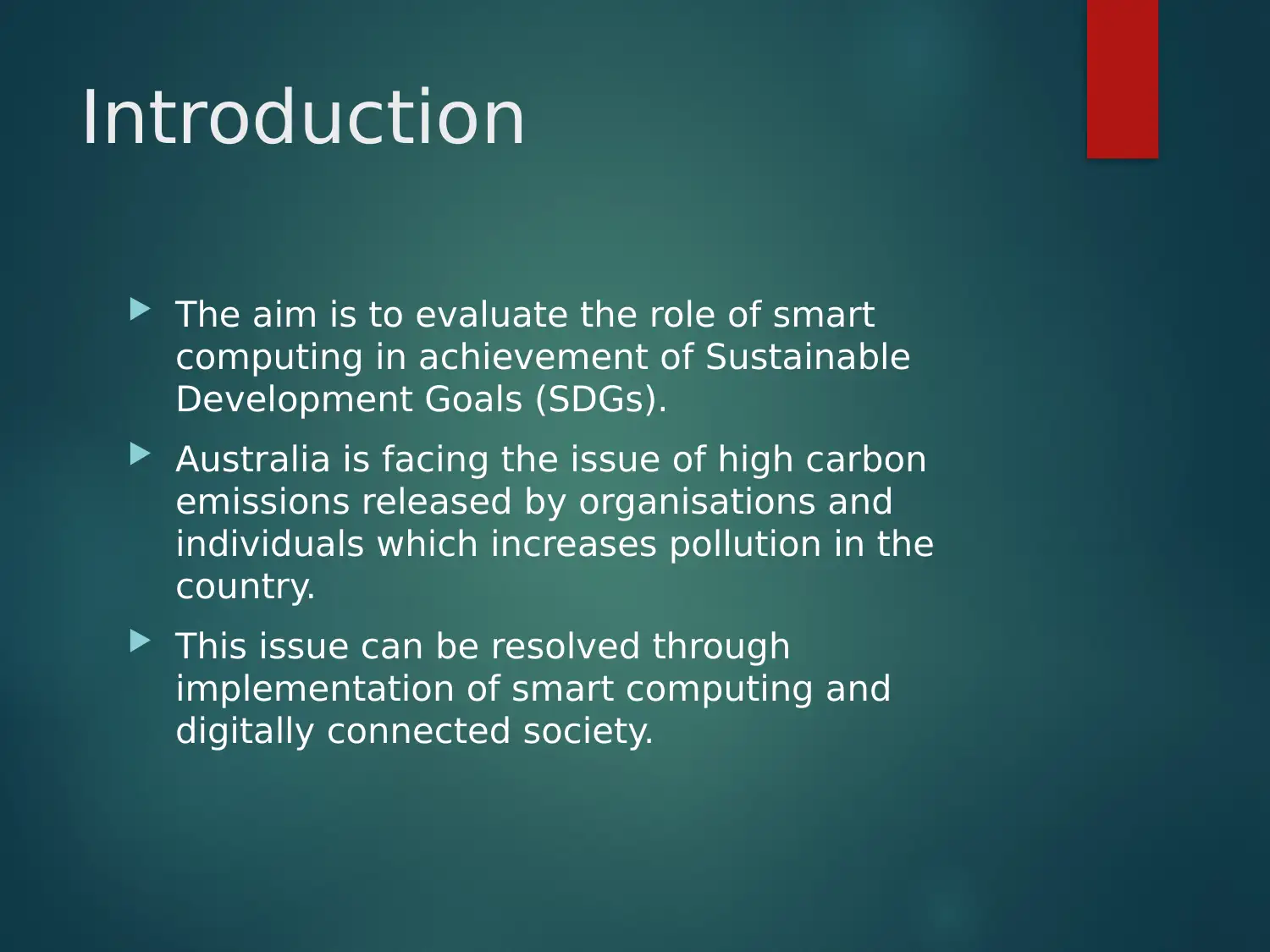
Introduction
The aim is to evaluate the role of smart
computing in achievement of Sustainable
Development Goals (SDGs).
Australia is facing the issue of high carbon
emissions released by organisations and
individuals which increases pollution in the
country.
This issue can be resolved through
implementation of smart computing and
digitally connected society.
The aim is to evaluate the role of smart
computing in achievement of Sustainable
Development Goals (SDGs).
Australia is facing the issue of high carbon
emissions released by organisations and
individuals which increases pollution in the
country.
This issue can be resolved through
implementation of smart computing and
digitally connected society.

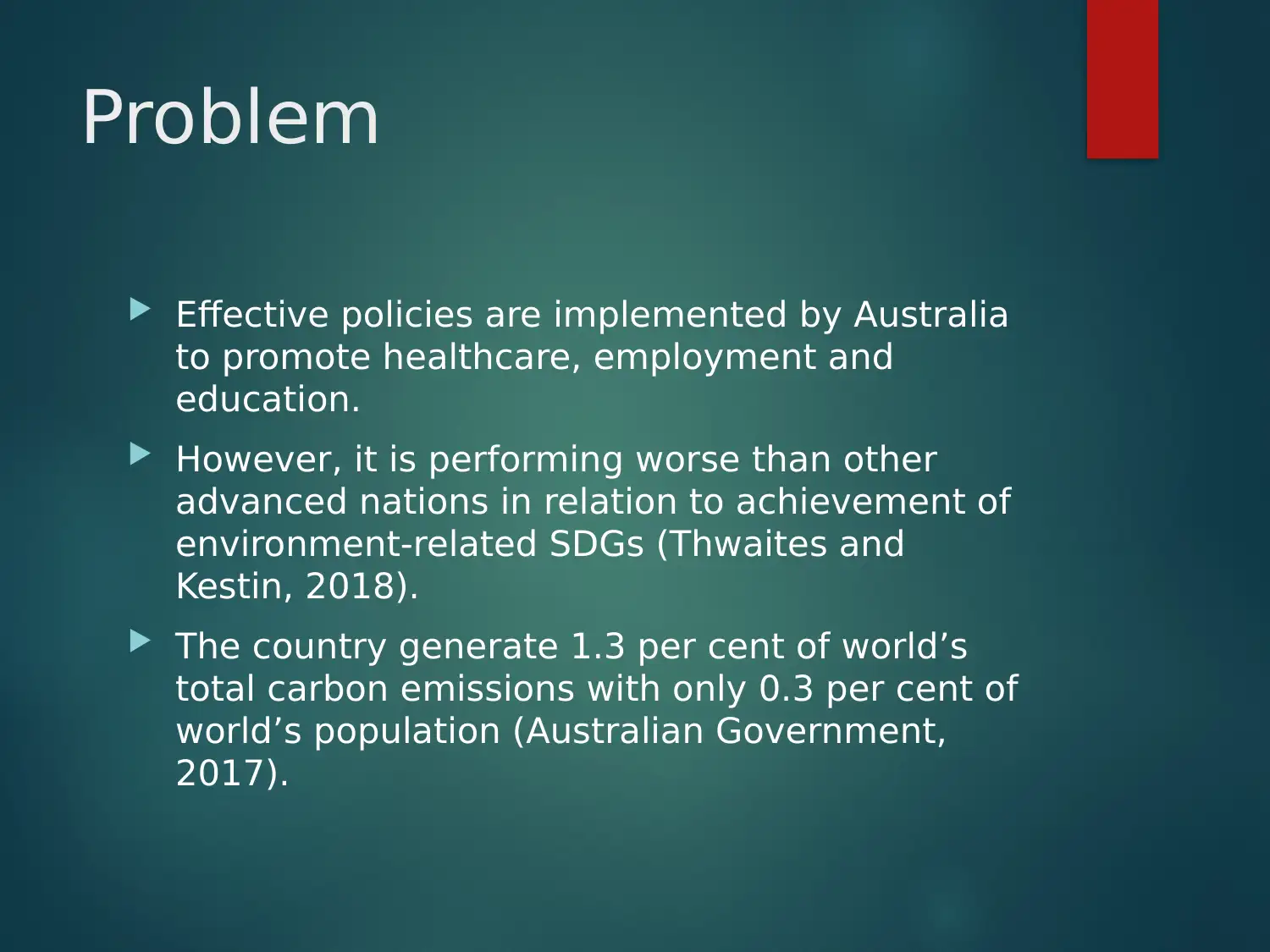
Problem
Effective policies are implemented by Australia
to promote healthcare, employment and
education.
However, it is performing worse than other
advanced nations in relation to achievement of
environment-related SDGs (Thwaites and
Kestin, 2018).
The country generate 1.3 per cent of world’s
total carbon emissions with only 0.3 per cent of
world’s population (Australian Government,
2017).
Effective policies are implemented by Australia
to promote healthcare, employment and
education.
However, it is performing worse than other
advanced nations in relation to achievement of
environment-related SDGs (Thwaites and
Kestin, 2018).
The country generate 1.3 per cent of world’s
total carbon emissions with only 0.3 per cent of
world’s population (Australian Government,
2017).
⊘ This is a preview!⊘
Do you want full access?
Subscribe today to unlock all pages.

Trusted by 1+ million students worldwide

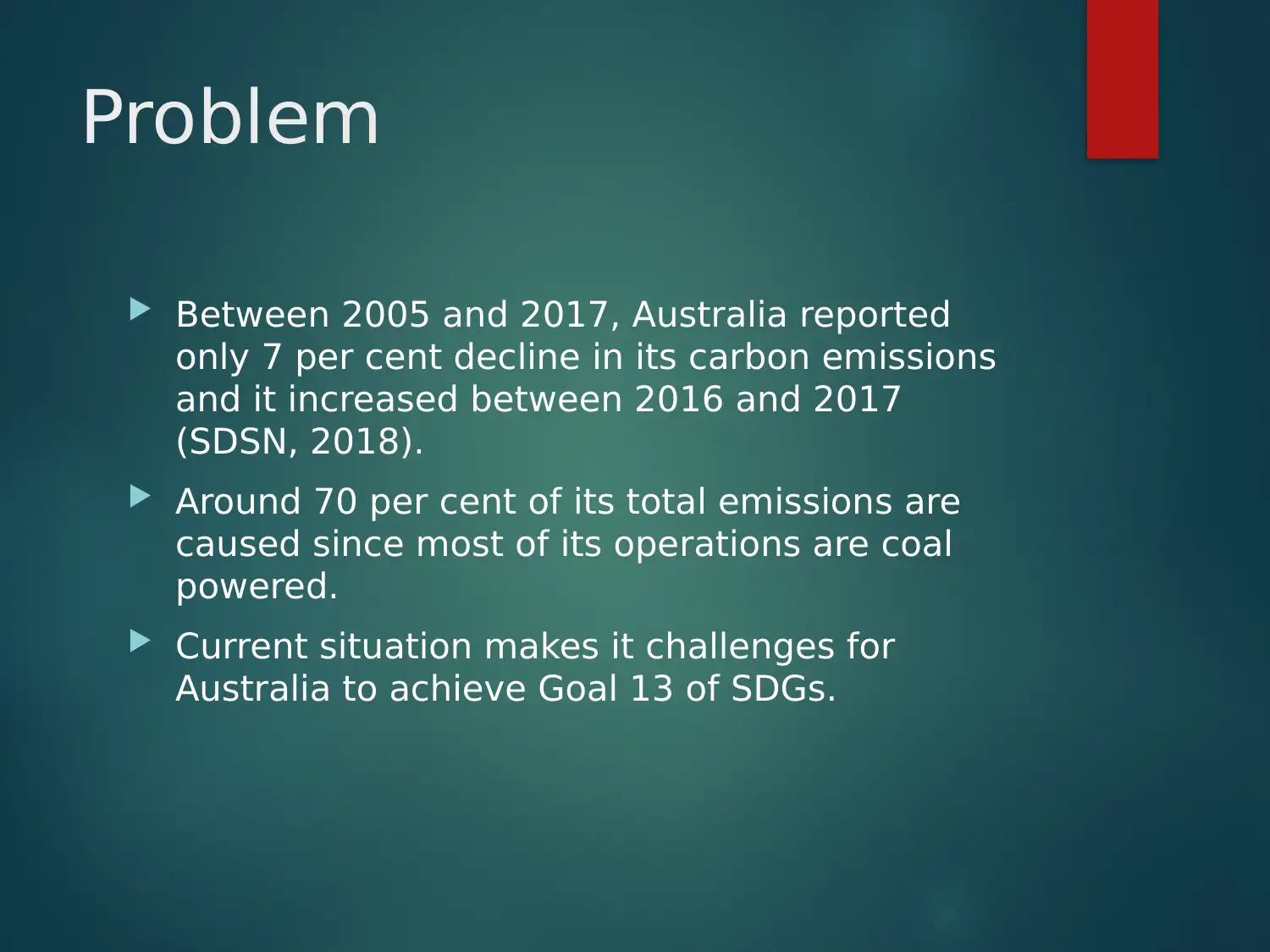
Problem
Between 2005 and 2017, Australia reported
only 7 per cent decline in its carbon emissions
and it increased between 2016 and 2017
(SDSN, 2018).
Around 70 per cent of its total emissions are
caused since most of its operations are coal
powered.
Current situation makes it challenges for
Australia to achieve Goal 13 of SDGs.
Between 2005 and 2017, Australia reported
only 7 per cent decline in its carbon emissions
and it increased between 2016 and 2017
(SDSN, 2018).
Around 70 per cent of its total emissions are
caused since most of its operations are coal
powered.
Current situation makes it challenges for
Australia to achieve Goal 13 of SDGs.
Paraphrase This Document
Need a fresh take? Get an instant paraphrase of this document with our AI Paraphraser

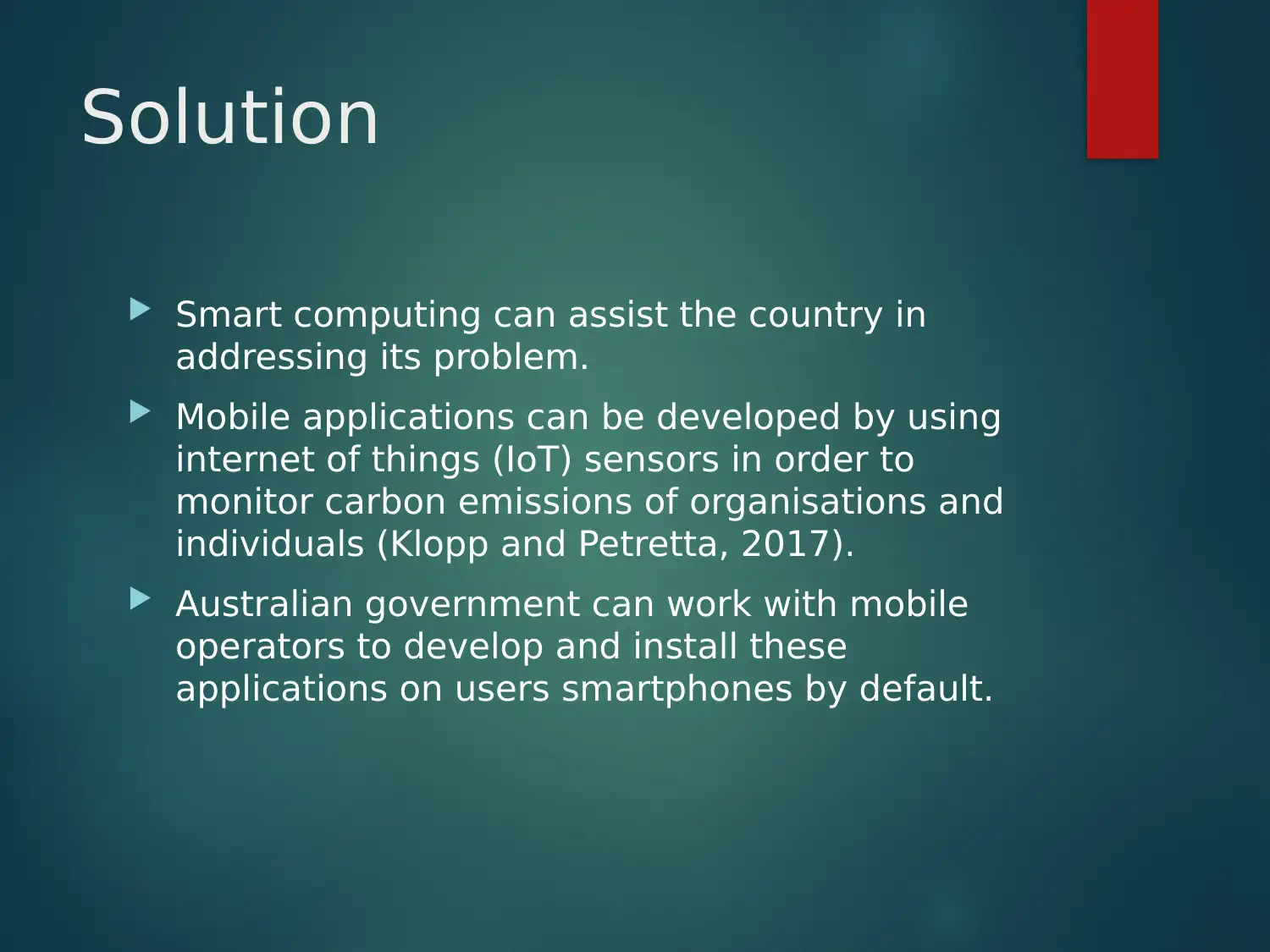
Solution
Smart computing can assist the country in
addressing its problem.
Mobile applications can be developed by using
internet of things (IoT) sensors in order to
monitor carbon emissions of organisations and
individuals (Klopp and Petretta, 2017).
Australian government can work with mobile
operators to develop and install these
applications on users smartphones by default.
Smart computing can assist the country in
addressing its problem.
Mobile applications can be developed by using
internet of things (IoT) sensors in order to
monitor carbon emissions of organisations and
individuals (Klopp and Petretta, 2017).
Australian government can work with mobile
operators to develop and install these
applications on users smartphones by default.

Solution
Organisations can also use IoT sensors and
mobile applications to monitor their carbon
emissions in real-time.
They will be able to directly make reporting
regarding their greenhouse emissions to the
government.
The government will be able to use this data to
identify the territories and organisations which
have the highest carbon emission rate to
implement specific policies to reduce their
greenhouse emissions (Wu et al., 2018).
Organisations can also use IoT sensors and
mobile applications to monitor their carbon
emissions in real-time.
They will be able to directly make reporting
regarding their greenhouse emissions to the
government.
The government will be able to use this data to
identify the territories and organisations which
have the highest carbon emission rate to
implement specific policies to reduce their
greenhouse emissions (Wu et al., 2018).
⊘ This is a preview!⊘
Do you want full access?
Subscribe today to unlock all pages.

Trusted by 1+ million students worldwide

Solution
Based on the available data, the government
will be able to impose a carbon tax.
The government will also introduce specific
limits for companies to make sure that they did
not emit greenhouse gases above a specific
limit (Kim, 2018).
Organisations are more likely to invest in
renewable energy sources to avoid paying
carbon tax which will increase their profitability
in the long run.
Based on the available data, the government
will be able to impose a carbon tax.
The government will also introduce specific
limits for companies to make sure that they did
not emit greenhouse gases above a specific
limit (Kim, 2018).
Organisations are more likely to invest in
renewable energy sources to avoid paying
carbon tax which will increase their profitability
in the long run.
Paraphrase This Document
Need a fresh take? Get an instant paraphrase of this document with our AI Paraphraser

Solution
Organisations will also disclose this data in their
corporate social responsibility (CSR) report
which will increase obligation on the
management to reduce their carbon emissions
(Matisoff, Noonan and O’Brien, 2013).
People will be able to use their smartphones to
track their carbon emissions.
They are more likely to use public
transportations and use renewable energy
sources to avoid carbon tax.
These actions will reduce carbon emissions in
Australia and assist it in achieving SDGs.
Organisations will also disclose this data in their
corporate social responsibility (CSR) report
which will increase obligation on the
management to reduce their carbon emissions
(Matisoff, Noonan and O’Brien, 2013).
People will be able to use their smartphones to
track their carbon emissions.
They are more likely to use public
transportations and use renewable energy
sources to avoid carbon tax.
These actions will reduce carbon emissions in
Australia and assist it in achieving SDGs.

Conclusion
To conclude, the issue of high rate of carbon
emissions is making it difficult for Australia to
achieve SDGs.
This can be resolved through smart computing
practices by developing mobile applications and
IoT sensors to monitor and report the emissions
of companies.
The government will be able to impose a carbon
tax and put a limit on emissions of parties to
achieve SDGs.
To conclude, the issue of high rate of carbon
emissions is making it difficult for Australia to
achieve SDGs.
This can be resolved through smart computing
practices by developing mobile applications and
IoT sensors to monitor and report the emissions
of companies.
The government will be able to impose a carbon
tax and put a limit on emissions of parties to
achieve SDGs.
⊘ This is a preview!⊘
Do you want full access?
Subscribe today to unlock all pages.

Trusted by 1+ million students worldwide

References
Australian Government. (2017) 2017 Review of Climate Change Policies. [Online]
Available at: http://www.environment.gov.au/climate-change/publications/final-report-
review-of-climate-change-policies-2017 [Accessed 29/05/2019].
Kim, K.G. (2018) Implementation of Climate Smart City Planning: Global Climate Smart
City Platform Solution. In Low-Carbon Smart Cities (pp. 285-323). New York City:
Springer, Cham.
Klopp, J.M. and Petretta, D.L. (2017) The urban sustainable development goal:
Indicators, complexity and the politics of measuring cities. Cities, 63, pp.92-97.
Matisoff, D.C., Noonan, D.S. and O'Brien, J.J. (2013) Convergence in environmental
reporting: assessing the Carbon Disclosure Project. Business Strategy and the
Environment, 22(5), pp.285-305.
SDSN. (2018) A new report tracks Australia's progress on the SDGs. [Online] Available
at: http://ap-unsdsn.org/a-new-report-tracks-australias-progress-on-the-sdgs/ [Accessed
29/05/2019].
Thwaites, J. and Kestin, T. (2018) Australia falls further in rankings on progress towards
UN Sustainable Development Goal. [Online] Available at:
https://theconversation.com/australia-falls-further-in-rankings-on-progress-towards-un-
sustainable-development-goals-99737 [Accessed 29/05/2019].
Wu, J., Guo, S., Huang, H., Liu, W. and Xiang, Y. (2018) Information and communications
technologies for sustainable development goals: state-of-the-art, needs and
perspectives. IEEE Communications Surveys & Tutorials, 20(3), pp.2389-2406.
Australian Government. (2017) 2017 Review of Climate Change Policies. [Online]
Available at: http://www.environment.gov.au/climate-change/publications/final-report-
review-of-climate-change-policies-2017 [Accessed 29/05/2019].
Kim, K.G. (2018) Implementation of Climate Smart City Planning: Global Climate Smart
City Platform Solution. In Low-Carbon Smart Cities (pp. 285-323). New York City:
Springer, Cham.
Klopp, J.M. and Petretta, D.L. (2017) The urban sustainable development goal:
Indicators, complexity and the politics of measuring cities. Cities, 63, pp.92-97.
Matisoff, D.C., Noonan, D.S. and O'Brien, J.J. (2013) Convergence in environmental
reporting: assessing the Carbon Disclosure Project. Business Strategy and the
Environment, 22(5), pp.285-305.
SDSN. (2018) A new report tracks Australia's progress on the SDGs. [Online] Available
at: http://ap-unsdsn.org/a-new-report-tracks-australias-progress-on-the-sdgs/ [Accessed
29/05/2019].
Thwaites, J. and Kestin, T. (2018) Australia falls further in rankings on progress towards
UN Sustainable Development Goal. [Online] Available at:
https://theconversation.com/australia-falls-further-in-rankings-on-progress-towards-un-
sustainable-development-goals-99737 [Accessed 29/05/2019].
Wu, J., Guo, S., Huang, H., Liu, W. and Xiang, Y. (2018) Information and communications
technologies for sustainable development goals: state-of-the-art, needs and
perspectives. IEEE Communications Surveys & Tutorials, 20(3), pp.2389-2406.
1 out of 10
Related Documents
Your All-in-One AI-Powered Toolkit for Academic Success.
+13062052269
info@desklib.com
Available 24*7 on WhatsApp / Email
Unlock your academic potential
Copyright © 2020–2026 A2Z Services. All Rights Reserved. Developed and managed by ZUCOL.