Sustainable and Responsible Tourism Management Report: London Tourism
VerifiedAdded on 2022/12/27
|13
|3997
|1
Report
AI Summary
This report provides a comprehensive analysis of sustainable and responsible tourism management, focusing on the case of London. It begins with an introduction to sustainable tourism development and responsible tourism, highlighting the role of stakeholders and the city's infrastructure. The main body delves into the concept of sustainability since 1980, examining the roles of the UNWTO and ABTA. It explores tourism planning, addressing its purpose, principles, associated problems, and challenges, as well as different approaches to achieve sustainable objectives. The report then examines the impacts of tourism from economic, cultural, social, and environmental perspectives, emphasizing the importance of stakeholder engagement and partnerships. Furthermore, it covers the management and development of sustainability, including evaluation and recommendations. The report concludes by summarizing the key findings and emphasizing the importance of sustainable practices in the tourism industry.
SUSTAINABLE AND
RESPONSIBLE TOURISM
MANAGEMENT
RESPONSIBLE TOURISM
MANAGEMENT

Paraphrase This Document
Need a fresh take? Get an instant paraphrase of this document with our AI Paraphraser
Table of Contents
INTRODUCTION...........................................................................................................................3
MAIN BODY...................................................................................................................................3
LO1..................................................................................................................................................3
Concept of sustainability since 1980...........................................................................................3
Role of UNWTO and ABTA.......................................................................................................4
LO2..................................................................................................................................................6
Purpose and Principle of Tourism Planning................................................................................6
Problems and challenges associate with tourism development and planning..............................6
Different approaches to tourism development and planning help to achieve the sustainable
objectives.....................................................................................................................................7
Justify the rationale for measuring and monitoring sustainable performance.............................7
LO3..................................................................................................................................................8
Impacts of tourism activity from economic, cultural, social and environmental........................8
Principles of sustainability to meet stakeholder requirements and expectations.........................9
Contribution of stakeholders in developing sustainable tourism.................................................9
Analysing the value and importance of specific stakeholder engagement and partnerships.....10
LO4................................................................................................................................................10
Managing and developing of sustainability...............................................................................10
Evaluating the success...............................................................................................................10
Recommendation.......................................................................................................................10
CONCLUSION..............................................................................................................................11
REFERENCES................................................................................................................................1
INTRODUCTION...........................................................................................................................3
MAIN BODY...................................................................................................................................3
LO1..................................................................................................................................................3
Concept of sustainability since 1980...........................................................................................3
Role of UNWTO and ABTA.......................................................................................................4
LO2..................................................................................................................................................6
Purpose and Principle of Tourism Planning................................................................................6
Problems and challenges associate with tourism development and planning..............................6
Different approaches to tourism development and planning help to achieve the sustainable
objectives.....................................................................................................................................7
Justify the rationale for measuring and monitoring sustainable performance.............................7
LO3..................................................................................................................................................8
Impacts of tourism activity from economic, cultural, social and environmental........................8
Principles of sustainability to meet stakeholder requirements and expectations.........................9
Contribution of stakeholders in developing sustainable tourism.................................................9
Analysing the value and importance of specific stakeholder engagement and partnerships.....10
LO4................................................................................................................................................10
Managing and developing of sustainability...............................................................................10
Evaluating the success...............................................................................................................10
Recommendation.......................................................................................................................10
CONCLUSION..............................................................................................................................11
REFERENCES................................................................................................................................1
INTRODUCTION
Sustainable tourism development is the development of the tourist places to attract the
travellers to visit the tourist places. The stakeholders which help to develop the infrastructure and
country to attract more of tourist. It impacts to all aspect of country which includes social,
environmental, economical of the tourist place. Responsible tourism is all about the offering
better place to visit by the traveller that improve the infrastructure of tourist place (Pirnar, and
Celebi, 2020).
Responsible tourism focus the factor that minimize negative social, environmental and
economical impacts, generating greater economic performance for the localities and enhance
well-being host community. It also improves the working condition of local people, positive
contribution towards the culture and natural heritage, greater understanding of local culture,
environment and social issues.
London is one of the most popular city in the world for the tourism. The luxury
experience from the Hotels to shopping Malls, infrastructure to heritage places are all offered by
the city for the travellers. Throughout the year, government had implied the action plans which
are mainly focused on the infrastructure that attract more tourism and activities that contributes
towards sustainable development of and responsible tourism.
The report contains the concept of sustainable and responsible tourism and role-played in
tourist places and their Functions and mission. The main purpose and principle tourism
development with challenges and problem that are faced. Explanation on the impacts of tourism
activity. However, implementations on sustainability and several ways to develop tourist
destinations.
MAIN BODY.
LO1
Concept of sustainability since 1980
The development of London city has being involved very rapidly after 1980. With the
change in time and technology, London had developed the city very productively by developing
their infrastructure, maintain historic places very efficiently, technology development in the city
is being adopted frequently (Mody, and et.al., 2017). Government had made the action planes to
develop the city and making hot spot of the country to attract more of tourism. As UK country
had faced many recessions and inflations and the economy is not quite stable for longer time
Sustainable tourism development is the development of the tourist places to attract the
travellers to visit the tourist places. The stakeholders which help to develop the infrastructure and
country to attract more of tourist. It impacts to all aspect of country which includes social,
environmental, economical of the tourist place. Responsible tourism is all about the offering
better place to visit by the traveller that improve the infrastructure of tourist place (Pirnar, and
Celebi, 2020).
Responsible tourism focus the factor that minimize negative social, environmental and
economical impacts, generating greater economic performance for the localities and enhance
well-being host community. It also improves the working condition of local people, positive
contribution towards the culture and natural heritage, greater understanding of local culture,
environment and social issues.
London is one of the most popular city in the world for the tourism. The luxury
experience from the Hotels to shopping Malls, infrastructure to heritage places are all offered by
the city for the travellers. Throughout the year, government had implied the action plans which
are mainly focused on the infrastructure that attract more tourism and activities that contributes
towards sustainable development of and responsible tourism.
The report contains the concept of sustainable and responsible tourism and role-played in
tourist places and their Functions and mission. The main purpose and principle tourism
development with challenges and problem that are faced. Explanation on the impacts of tourism
activity. However, implementations on sustainability and several ways to develop tourist
destinations.
MAIN BODY.
LO1
Concept of sustainability since 1980
The development of London city has being involved very rapidly after 1980. With the
change in time and technology, London had developed the city very productively by developing
their infrastructure, maintain historic places very efficiently, technology development in the city
is being adopted frequently (Mody, and et.al., 2017). Government had made the action planes to
develop the city and making hot spot of the country to attract more of tourism. As UK country
had faced many recessions and inflations and the economy is not quite stable for longer time
⊘ This is a preview!⊘
Do you want full access?
Subscribe today to unlock all pages.

Trusted by 1+ million students worldwide
period. Through developing the infrastructure and memorial places that are the centre point of
attraction towards the city to visit like The British Museum, tower of London, Tower Bridge Big
been, London Eye and the Buckingham Palace (Aquino, Lück, and Schänzel, 2018).
London's government had minimized the negative impacts on social, economic and
environmental factors that affect the country, through proper responsibility and sustainability
locals are helped with the economic development and generate income from the tourism. Also,
through tourism, development of environment is initiated by government and locals to maintain
the local parks and garden that shows the greater involvement of all the stakeholders.
Role of UNWTO and ABTA.
United nation of world Tourism Organization (UNWTO): The united world tourism
organization (UNWTO) is the leading global organization which promote responsible tourism
and the sustainable tourism. The United World Tourism Organization is one of the most
prominent approaches that work in tourist sector through targeting economic growth. UNWTO
work for 5 major issues:
First focuses on innovation to attract tourism smarter through leading the tourism
digitally.
Second, encouraging more investments for development and to attract the traveller
towards the place.
Thirdly, to create more job opportunities and training of employees which are related to
sustainable and responsible tourism.
Fourth, works on the safety and smooth flow of travelling for tourist in city to city. Lastly, protecting the environment and cultural historic places for the tourist attraction.
The UNWTO played role of tourism with sustainable and responsible by considering the three
major section:
1. Economic factor: The sustainable and responsible development in tourism sector is one
of the main sector focuses on (Samaddar, Mondal, and Sharma, 2021). The economic
factor create the development of infrastructure for attracting the traveller to their country.
It helps in to increase the value of foreign currency to sustain.
2. Environmental factor: This factor refers to protection of environment from pollution,
waste and harmful chemical or gas. The natural environment are the core attraction of
tourism which include forest, river, sea, lakes, dessert naturally structured. The actions
attraction towards the city to visit like The British Museum, tower of London, Tower Bridge Big
been, London Eye and the Buckingham Palace (Aquino, Lück, and Schänzel, 2018).
London's government had minimized the negative impacts on social, economic and
environmental factors that affect the country, through proper responsibility and sustainability
locals are helped with the economic development and generate income from the tourism. Also,
through tourism, development of environment is initiated by government and locals to maintain
the local parks and garden that shows the greater involvement of all the stakeholders.
Role of UNWTO and ABTA.
United nation of world Tourism Organization (UNWTO): The united world tourism
organization (UNWTO) is the leading global organization which promote responsible tourism
and the sustainable tourism. The United World Tourism Organization is one of the most
prominent approaches that work in tourist sector through targeting economic growth. UNWTO
work for 5 major issues:
First focuses on innovation to attract tourism smarter through leading the tourism
digitally.
Second, encouraging more investments for development and to attract the traveller
towards the place.
Thirdly, to create more job opportunities and training of employees which are related to
sustainable and responsible tourism.
Fourth, works on the safety and smooth flow of travelling for tourist in city to city. Lastly, protecting the environment and cultural historic places for the tourist attraction.
The UNWTO played role of tourism with sustainable and responsible by considering the three
major section:
1. Economic factor: The sustainable and responsible development in tourism sector is one
of the main sector focuses on (Samaddar, Mondal, and Sharma, 2021). The economic
factor create the development of infrastructure for attracting the traveller to their country.
It helps in to increase the value of foreign currency to sustain.
2. Environmental factor: This factor refers to protection of environment from pollution,
waste and harmful chemical or gas. The natural environment are the core attraction of
tourism which include forest, river, sea, lakes, dessert naturally structured. The actions
Paraphrase This Document
Need a fresh take? Get an instant paraphrase of this document with our AI Paraphraser
which are taken by against the environment cause huge damage in a form of natural
calamity. Wildlife is another factor that attract tourism which have various species such
as animals, birds, flora and fauna.
3. Social factors: This factor is mostly less ignored under the economic and environmental
factor. This factor equally important for the development of sustainable and responsible
tourism are planned in country. Social culture usually impact on locals and religious that
are created during the development of infrastructure. But also, it develops lifestyle of
locals, encourage of local culture are also increased in the world by maintain properly.
Association of British Travel Agent (ABTA): It is UK largest travel association which
represent tour operator and travel agents. The main purpose of ABTA is to design to enforce
standard and insurance for the agents like holiday maker events at period of financial instability
for travel companies. It refers to when traveller is travelling through coach, cruise or rail holiday
with ABTA member it is protected with scheme under ABTA financial problem. The protection
scheme include if selected travel company goes out of business, traveller will entitle with a
refund amount including hotel expense, transportation cost (Huang, 2020).
ABTA had code of conduct which are governed in an area as accurate advertisement,
change in booking, fair terms of trading, consumer complaint, providing right paperwork etc.
The customers are allowed with the facilities like ABTA member cannot cancel the bookings
after the full payment is made by customers, or need to repayment the customers with full
payment or alternative travel arrangements are made from their side. All ABTA member have to
stay in the code of conduct and sanctions from organization if breach of code is being made.
ABTA plays an important role in sustainable and responsible tourism development for
the London city. The visitor which are travelling through cruise or rail on London are well
protected with their financial problems and insured. So, it encourages more traveller to travel
with transportation which are covered under ABTA scheme. The sustainable development is also
maintained by the ABTA organization towards the attraction of tourism. The responsible tourism
help passengers to ensure about the paperwork and financial problem that can be covered under
the scheme and offering more to their customers (Mathew, and Kuriakose, 2018). By attracting
more and more travellers to London, company directly con tribute towards the economic
changes, social impact on London citizen and environmental factor that are affected and develop
calamity. Wildlife is another factor that attract tourism which have various species such
as animals, birds, flora and fauna.
3. Social factors: This factor is mostly less ignored under the economic and environmental
factor. This factor equally important for the development of sustainable and responsible
tourism are planned in country. Social culture usually impact on locals and religious that
are created during the development of infrastructure. But also, it develops lifestyle of
locals, encourage of local culture are also increased in the world by maintain properly.
Association of British Travel Agent (ABTA): It is UK largest travel association which
represent tour operator and travel agents. The main purpose of ABTA is to design to enforce
standard and insurance for the agents like holiday maker events at period of financial instability
for travel companies. It refers to when traveller is travelling through coach, cruise or rail holiday
with ABTA member it is protected with scheme under ABTA financial problem. The protection
scheme include if selected travel company goes out of business, traveller will entitle with a
refund amount including hotel expense, transportation cost (Huang, 2020).
ABTA had code of conduct which are governed in an area as accurate advertisement,
change in booking, fair terms of trading, consumer complaint, providing right paperwork etc.
The customers are allowed with the facilities like ABTA member cannot cancel the bookings
after the full payment is made by customers, or need to repayment the customers with full
payment or alternative travel arrangements are made from their side. All ABTA member have to
stay in the code of conduct and sanctions from organization if breach of code is being made.
ABTA plays an important role in sustainable and responsible tourism development for
the London city. The visitor which are travelling through cruise or rail on London are well
protected with their financial problems and insured. So, it encourages more traveller to travel
with transportation which are covered under ABTA scheme. The sustainable development is also
maintained by the ABTA organization towards the attraction of tourism. The responsible tourism
help passengers to ensure about the paperwork and financial problem that can be covered under
the scheme and offering more to their customers (Mathew, and Kuriakose, 2018). By attracting
more and more travellers to London, company directly con tribute towards the economic
changes, social impact on London citizen and environmental factor that are affected and develop
by government and organization. It also increases the job opportunities for the local people and
increase the lifestyle of that area.
LO2
Purpose and Principle of Tourism Planning
To achieve the tourism planning and management integrated approaches are required for
sustainable tourism. Growing traditional and urban management are needed to develop which
include transportation, planning, economic development, marketing, safety and securities etc.
need to plan for tourism (Radić, Gračan, and Sotošek, 2019).
The main purpose and principle of tourism planning include:
Tourism should offer quality employment to the local community resident and promoting
the local business by the tourism that are offered by them.
Tourism should be initiated with the involvement of local community and maintain
control of tourism.
A code of practise should be maintained for tourism by locals at all level I.e. national,
local and regional considered as internationally standard. Guidelines for tourism
operation, cumulative impact, impact assessment and limited change should be accepted.
Educational training program to manage and improve the natural and heritage resources.
The local people of London need to maintain and control the local culture of city that are
culture of Roman and British empire. The Morden development of convenience of transportation
and safety to all tourist need to be well planned for the tourist sustainability.
Problems and challenges associate with tourism development and planning.
London had faced many challenges for the development of tourist and the main
challenges for London is stable economy in a country. UK country had faced many recessions
and deflation period which affect the whole country and affect in tourism sector. The
development process is affect the most when it comes to recession. The country need to cut its
cost to attract more of tourist and packages are available at a very price from the market. Hotels
and restaurants are cut their price and government is looking for investment in the country.
Tourism sector is most affected sector at this time and government and travel companies offers
to traveller to stays in the city at a very effective cost (Burrai, Buda, and Stanford, 2019).
increase the lifestyle of that area.
LO2
Purpose and Principle of Tourism Planning
To achieve the tourism planning and management integrated approaches are required for
sustainable tourism. Growing traditional and urban management are needed to develop which
include transportation, planning, economic development, marketing, safety and securities etc.
need to plan for tourism (Radić, Gračan, and Sotošek, 2019).
The main purpose and principle of tourism planning include:
Tourism should offer quality employment to the local community resident and promoting
the local business by the tourism that are offered by them.
Tourism should be initiated with the involvement of local community and maintain
control of tourism.
A code of practise should be maintained for tourism by locals at all level I.e. national,
local and regional considered as internationally standard. Guidelines for tourism
operation, cumulative impact, impact assessment and limited change should be accepted.
Educational training program to manage and improve the natural and heritage resources.
The local people of London need to maintain and control the local culture of city that are
culture of Roman and British empire. The Morden development of convenience of transportation
and safety to all tourist need to be well planned for the tourist sustainability.
Problems and challenges associate with tourism development and planning.
London had faced many challenges for the development of tourist and the main
challenges for London is stable economy in a country. UK country had faced many recessions
and deflation period which affect the whole country and affect in tourism sector. The
development process is affect the most when it comes to recession. The country need to cut its
cost to attract more of tourist and packages are available at a very price from the market. Hotels
and restaurants are cut their price and government is looking for investment in the country.
Tourism sector is most affected sector at this time and government and travel companies offers
to traveller to stays in the city at a very effective cost (Burrai, Buda, and Stanford, 2019).
⊘ This is a preview!⊘
Do you want full access?
Subscribe today to unlock all pages.
Trusted by 1+ million students worldwide
Social and environment factors are also affected due to tourism where heritage places are
mostly affected by pollution and increase in wastage, damage to natural resources like forest and
river, wildlife of tourist place are also effected with increase in tourism.
Different approaches to tourism development and planning help to achieve the sustainable
objectives.
For sustainable development tourism strategy are made for long term suitability and
healthy development of tourism industry by applying the following strategies:
1. Providing high quality experience to visitors that attract the other tourist in a country to
maintain the sustainability in planing of tourist. The experience of the visitor is very
important as it showed up directly to internet and review are very much preferred by the
tourist who are willing to travel.
2. Economic benefit to the host country is being involved the major part of tourism. It
allows country to develop their infrastructure more to increase the tourism activities in
the country. It also enables the job opportunities that are generated by the tourism
(Higgins-Desbiolles, 2018).
3. Minimizing the environmental impact and protecting the heritage legitimacy that may be
affected due to increase in tourism. Awareness of society and culture is also an important
part of sustainable-tourism development.
Justify the rationale for measuring and monitoring sustainable performance
The strategies that are followed to achieve the objective of tourist development need to be
measured and monitor with time to time and applied changes that are necessary with the change
in the time and technology. The experience of London tourism should be better than other places
to visit. The review from the tourist which travelled to London city for exploring the new things
that attract them the most. Technology is being updated very rapidly that a person can easily feel
the experience of the places that the centre of place to visit. The revenue generated from tourism
is can be through monitor the activities that need to be developed to attract more of tourist. The
employment opportunities which are generated form the tourist activity are also measured by the
government and travel organization. However, environmental factors that are affected from the
tourist activity and need to be care properly and maintain the originality of heritage places and
environment dimension like forest, river, lack etc. The measuring of sustainable performance of
London is monitor by the government and the organization which are working for development
mostly affected by pollution and increase in wastage, damage to natural resources like forest and
river, wildlife of tourist place are also effected with increase in tourism.
Different approaches to tourism development and planning help to achieve the sustainable
objectives.
For sustainable development tourism strategy are made for long term suitability and
healthy development of tourism industry by applying the following strategies:
1. Providing high quality experience to visitors that attract the other tourist in a country to
maintain the sustainability in planing of tourist. The experience of the visitor is very
important as it showed up directly to internet and review are very much preferred by the
tourist who are willing to travel.
2. Economic benefit to the host country is being involved the major part of tourism. It
allows country to develop their infrastructure more to increase the tourism activities in
the country. It also enables the job opportunities that are generated by the tourism
(Higgins-Desbiolles, 2018).
3. Minimizing the environmental impact and protecting the heritage legitimacy that may be
affected due to increase in tourism. Awareness of society and culture is also an important
part of sustainable-tourism development.
Justify the rationale for measuring and monitoring sustainable performance
The strategies that are followed to achieve the objective of tourist development need to be
measured and monitor with time to time and applied changes that are necessary with the change
in the time and technology. The experience of London tourism should be better than other places
to visit. The review from the tourist which travelled to London city for exploring the new things
that attract them the most. Technology is being updated very rapidly that a person can easily feel
the experience of the places that the centre of place to visit. The revenue generated from tourism
is can be through monitor the activities that need to be developed to attract more of tourist. The
employment opportunities which are generated form the tourist activity are also measured by the
government and travel organization. However, environmental factors that are affected from the
tourist activity and need to be care properly and maintain the originality of heritage places and
environment dimension like forest, river, lack etc. The measuring of sustainable performance of
London is monitor by the government and the organization which are working for development
Paraphrase This Document
Need a fresh take? Get an instant paraphrase of this document with our AI Paraphraser
of tourism like UNWTO and ABTA were focus is to develop the tourist industry in the global
world (Lee, and et.al., 2017)
LO3
Impacts of tourism activity from economic, cultural, social and environmental.
Tourism is the activity of the different people with their different movements from the
home city to another city for the purpose of travelling and exploring the new things with duration
of maximum 6 months when it comes to international border lines. A study on London city for
tourism had being affected by the various activities from economic, social, environmental and
cultural factor and can be described as:
Economic:London is one of the luxury place to be visited by tourist in the world. Tourist
sector contribute £106 billion to British economy and GDP and gives over 2.6 million job for the
local people and UK tourism is being increasing rapidly and predicted to reach £257 billion,
around 10% of UK GDP. The revenue and taxes which are generated from the tourism sector
help UK economy to development and growth of infrastructure. London is the centre eye of
attraction for the tourist to visit for experiencing luxury (.Rasdi, and et.al., 2019).
Cultural: London had a culture of Luxurious things that are following from the British
Roman's and the positive impact of the tourism for the traveller is to known more about the
culture, craft, traditions followed and Historic arts that are shown at international level. It
empowers host communities and work for their culture values by contribution from them.
Social: From the last few years, tourism create many job opportunities and increase in the
income and lifestyle of the London citizen. Various Organization working for UK tourism to
promote the local culture like Handcrafted items, fashionable things that are featured on
international level to attract the tourism towards the UK side. The culture of local and national
religious are the main source of generating income for the locals and developed with the help of
locals.
Environmental: London is the centre of UK with the most tourist attraction which
somewhat affect the environment directly or indirectly. The commitment towards the
environment is made by UK government to reduce the impact on environment, improving
biodiversity and precautions from the tourist side to follow the rules and regulation regarding
environmental issues.
world (Lee, and et.al., 2017)
LO3
Impacts of tourism activity from economic, cultural, social and environmental.
Tourism is the activity of the different people with their different movements from the
home city to another city for the purpose of travelling and exploring the new things with duration
of maximum 6 months when it comes to international border lines. A study on London city for
tourism had being affected by the various activities from economic, social, environmental and
cultural factor and can be described as:
Economic:London is one of the luxury place to be visited by tourist in the world. Tourist
sector contribute £106 billion to British economy and GDP and gives over 2.6 million job for the
local people and UK tourism is being increasing rapidly and predicted to reach £257 billion,
around 10% of UK GDP. The revenue and taxes which are generated from the tourism sector
help UK economy to development and growth of infrastructure. London is the centre eye of
attraction for the tourist to visit for experiencing luxury (.Rasdi, and et.al., 2019).
Cultural: London had a culture of Luxurious things that are following from the British
Roman's and the positive impact of the tourism for the traveller is to known more about the
culture, craft, traditions followed and Historic arts that are shown at international level. It
empowers host communities and work for their culture values by contribution from them.
Social: From the last few years, tourism create many job opportunities and increase in the
income and lifestyle of the London citizen. Various Organization working for UK tourism to
promote the local culture like Handcrafted items, fashionable things that are featured on
international level to attract the tourism towards the UK side. The culture of local and national
religious are the main source of generating income for the locals and developed with the help of
locals.
Environmental: London is the centre of UK with the most tourist attraction which
somewhat affect the environment directly or indirectly. The commitment towards the
environment is made by UK government to reduce the impact on environment, improving
biodiversity and precautions from the tourist side to follow the rules and regulation regarding
environmental issues.
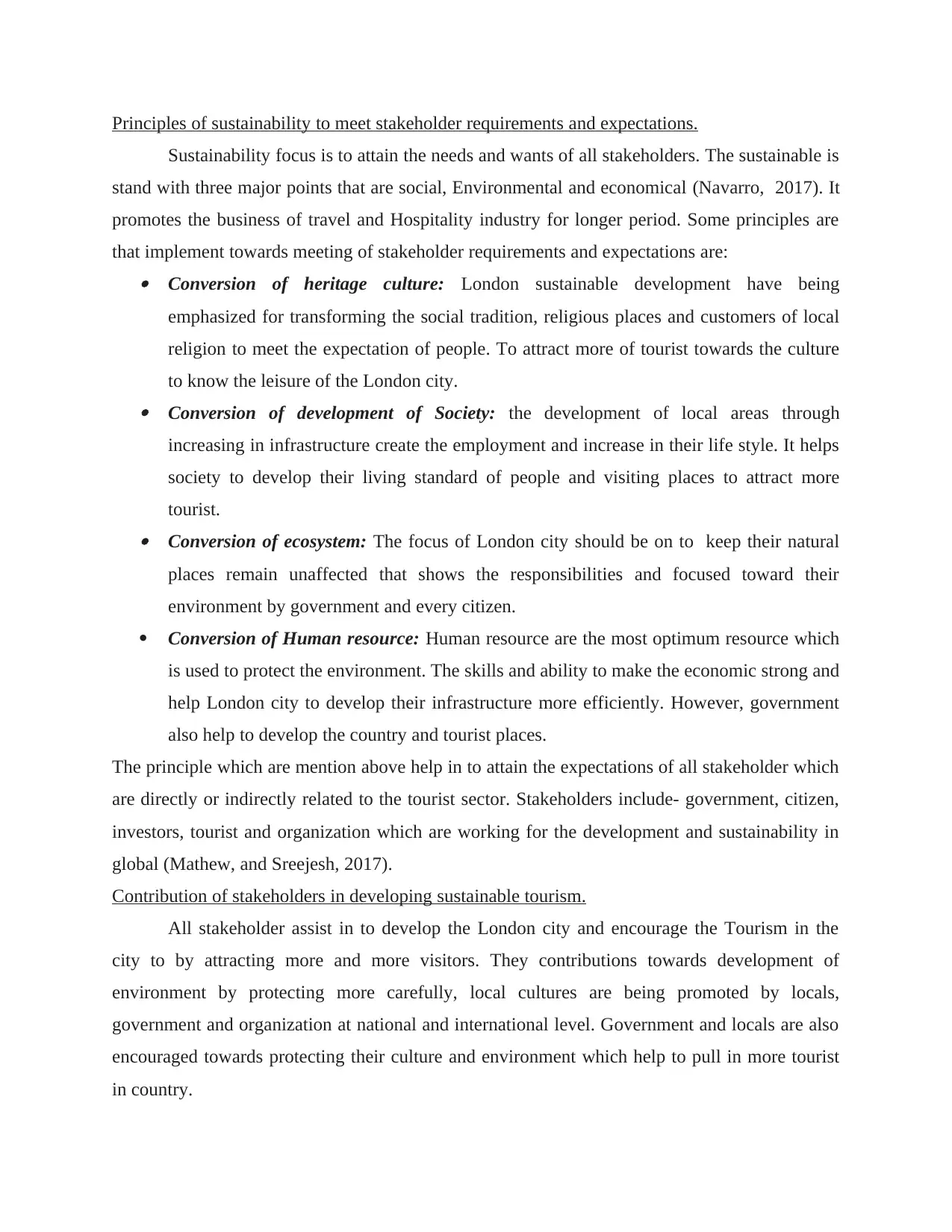
Principles of sustainability to meet stakeholder requirements and expectations.
Sustainability focus is to attain the needs and wants of all stakeholders. The sustainable is
stand with three major points that are social, Environmental and economical (Navarro, 2017). It
promotes the business of travel and Hospitality industry for longer period. Some principles are
that implement towards meeting of stakeholder requirements and expectations are: Conversion of heritage culture: London sustainable development have being
emphasized for transforming the social tradition, religious places and customers of local
religion to meet the expectation of people. To attract more of tourist towards the culture
to know the leisure of the London city. Conversion of development of Society: the development of local areas through
increasing in infrastructure create the employment and increase in their life style. It helps
society to develop their living standard of people and visiting places to attract more
tourist. Conversion of ecosystem: The focus of London city should be on to keep their natural
places remain unaffected that shows the responsibilities and focused toward their
environment by government and every citizen.
Conversion of Human resource: Human resource are the most optimum resource which
is used to protect the environment. The skills and ability to make the economic strong and
help London city to develop their infrastructure more efficiently. However, government
also help to develop the country and tourist places.
The principle which are mention above help in to attain the expectations of all stakeholder which
are directly or indirectly related to the tourist sector. Stakeholders include- government, citizen,
investors, tourist and organization which are working for the development and sustainability in
global (Mathew, and Sreejesh, 2017).
Contribution of stakeholders in developing sustainable tourism.
All stakeholder assist in to develop the London city and encourage the Tourism in the
city to by attracting more and more visitors. They contributions towards development of
environment by protecting more carefully, local cultures are being promoted by locals,
government and organization at national and international level. Government and locals are also
encouraged towards protecting their culture and environment which help to pull in more tourist
in country.
Sustainability focus is to attain the needs and wants of all stakeholders. The sustainable is
stand with three major points that are social, Environmental and economical (Navarro, 2017). It
promotes the business of travel and Hospitality industry for longer period. Some principles are
that implement towards meeting of stakeholder requirements and expectations are: Conversion of heritage culture: London sustainable development have being
emphasized for transforming the social tradition, religious places and customers of local
religion to meet the expectation of people. To attract more of tourist towards the culture
to know the leisure of the London city. Conversion of development of Society: the development of local areas through
increasing in infrastructure create the employment and increase in their life style. It helps
society to develop their living standard of people and visiting places to attract more
tourist. Conversion of ecosystem: The focus of London city should be on to keep their natural
places remain unaffected that shows the responsibilities and focused toward their
environment by government and every citizen.
Conversion of Human resource: Human resource are the most optimum resource which
is used to protect the environment. The skills and ability to make the economic strong and
help London city to develop their infrastructure more efficiently. However, government
also help to develop the country and tourist places.
The principle which are mention above help in to attain the expectations of all stakeholder which
are directly or indirectly related to the tourist sector. Stakeholders include- government, citizen,
investors, tourist and organization which are working for the development and sustainability in
global (Mathew, and Sreejesh, 2017).
Contribution of stakeholders in developing sustainable tourism.
All stakeholder assist in to develop the London city and encourage the Tourism in the
city to by attracting more and more visitors. They contributions towards development of
environment by protecting more carefully, local cultures are being promoted by locals,
government and organization at national and international level. Government and locals are also
encouraged towards protecting their culture and environment which help to pull in more tourist
in country.
⊘ This is a preview!⊘
Do you want full access?
Subscribe today to unlock all pages.
Trusted by 1+ million students worldwide
Analysing the value and importance of specific stakeholder engagement and partnerships.
Various organization agreed on partnership with the government and travel company for
increase the tourism activity in the country. Organization related to environmental protection,
development infrastructure and organization working for enhance the tourism in global is work
and integrate with each other and government. This organization protects the environment by
reducing the emission and harmful gases and chemical released, sustainable waste management,
biodiversity (Petrevska, and Mihalic, 2020). It also increases the foreign currency incoming in
the country that develop the economy. However, it affects the environment, economy and culture
at some point which is ignored by citizen or government.
LO4
Managing and developing of sustainability.
The sustainability is being managed with the help of government and organizations that
are working to carry sustainability in city. Monitoring the growth and analysing of tourist
activity is being done through government. Citizens are also equally important for managing the
sustainability in country that help to attract more tourist. However, development in a country is
being done through investment by infrastructure and hospitality development, maintaining
greenery of natural places. While, infrastructure development affect the environment and culture
directly or indirectly (Shen, Sotiriadis, and Zhou, 2020).
Evaluating the success.
At some point, government and local people are very much success to bring sustainability
and responsible management of tourist sector in London. The infrastructure and environment is
being well maintained by government and citizen of London. The culture is being maintained by
the local religious person.
Recommendation
The London tourism need to convey more tourist to maintain the balance economy and
sustainable. Stakeholders Responsible to neglect negative impact on social, economic and
environmental factor. Better services with correct paperwork to travel abroad help tourist to
attract more towards the particular places. Government and Hospitality industry should offer
more to tourist to develop more towards the infrastructure of country.
Various organization agreed on partnership with the government and travel company for
increase the tourism activity in the country. Organization related to environmental protection,
development infrastructure and organization working for enhance the tourism in global is work
and integrate with each other and government. This organization protects the environment by
reducing the emission and harmful gases and chemical released, sustainable waste management,
biodiversity (Petrevska, and Mihalic, 2020). It also increases the foreign currency incoming in
the country that develop the economy. However, it affects the environment, economy and culture
at some point which is ignored by citizen or government.
LO4
Managing and developing of sustainability.
The sustainability is being managed with the help of government and organizations that
are working to carry sustainability in city. Monitoring the growth and analysing of tourist
activity is being done through government. Citizens are also equally important for managing the
sustainability in country that help to attract more tourist. However, development in a country is
being done through investment by infrastructure and hospitality development, maintaining
greenery of natural places. While, infrastructure development affect the environment and culture
directly or indirectly (Shen, Sotiriadis, and Zhou, 2020).
Evaluating the success.
At some point, government and local people are very much success to bring sustainability
and responsible management of tourist sector in London. The infrastructure and environment is
being well maintained by government and citizen of London. The culture is being maintained by
the local religious person.
Recommendation
The London tourism need to convey more tourist to maintain the balance economy and
sustainable. Stakeholders Responsible to neglect negative impact on social, economic and
environmental factor. Better services with correct paperwork to travel abroad help tourist to
attract more towards the particular places. Government and Hospitality industry should offer
more to tourist to develop more towards the infrastructure of country.
Paraphrase This Document
Need a fresh take? Get an instant paraphrase of this document with our AI Paraphraser
CONCLUSION
The report concludes that Sustainability and responsible tourism is managed by
government and citizen living. The protection towards environment harm and culture that are
protected by the local and religious person. The development is very important for a country to
enable to attract the tourist sector. Tourism also initiate the job opportunities of the country and
increase the life style of the local people. Stakeholders help country to maintain the economy
grow and tourism can be maintained at international and national level.
The report concludes that Sustainability and responsible tourism is managed by
government and citizen living. The protection towards environment harm and culture that are
protected by the local and religious person. The development is very important for a country to
enable to attract the tourist sector. Tourism also initiate the job opportunities of the country and
increase the life style of the local people. Stakeholders help country to maintain the economy
grow and tourism can be maintained at international and national level.
REFERENCES
Books and journals
Aquino, R.S., Lück, M. and Schänzel, H.A., 2018. A conceptual framework of tourism social
entrepreneurship for sustainable community development. Journal of Hospitality and
Tourism Management. 37. pp.23-32.
Burrai, E., Buda, D.M. and Stanford, D., 2019. Rethinking the ideology of responsible
tourism. Journal of Sustainable Tourism.
Higgins-Desbiolles, F., 2018. Sustainable tourism: Sustaining tourism or something
more?. Tourism management perspectives. 25. pp.157-160.
Huang, C.H., 2020. Sustainable strategies of restaurant food surplus platform as a framework for
responsible tourism in the sharing economy. E-review of Tourism Research. 17(4).
Lee, H.Y., and et.al., 2017. Differences in tourist ethical judgement and responsible tourism
intention: An ethical scenario approach. Tourism Management. 60. pp.298-307.
Mathew, P.V. and Kuriakose, V., 2018. Measurement for Responsible Tourism: Development of
a Stakeholder-Based Scale. Asian Journal of Management. 9(1). pp.479-489.
Mathew, P.V. and Sreejesh, S., 2017. Impact of responsible tourism on destination sustainability
and quality of life of community in tourism destinations. Journal of Hospitality and
Tourism Management. 31. pp.83-89.
Mody, M., and et.al., 2017. Integrating country and brand images: Using the product—Country
image framework to understand travelers' loyalty towards responsible tourism
operators. Tourism Management Perspectives. 24. pp.139-150.
Navarro, G., 2017. Sustainable and responsible tourism: analysis of the international normative
and conventional landscape under the criteria of ethics and social responsibility of
organizations (RSO). Estudios Turísticos. (211/212). pp.9-31.
Petrevska, B. and Mihalic, T., 2020. (Un) sustainable and (ir) responsible tourism in Ohrid:
Residents’ perception. UTMS Journal of Economics. 11(2). pp.202-212.
Pirnar, İ. and Celebi, D., 2020. 4 Sustainable festival and event tourism management. Festival
and Event Tourism Impacts, p.53.
Radić, M.N., Gračan, D. and Sotošek, M.B., 2019. Age of migration: A chance for responsible
tourism and new tourism experience. Tourism in South East Europe.... 5. pp.489-505.
Rasdi, and et.al., 2019. Responsible tourism and quality of life: Perspective of local
community. Journal of Tourism, Hospitality and Environment Management. 4(13).
pp.49-56.
Samaddar, K., Mondal, S. and Sharma, S., 2021. Reinforcing Responsible Tourism through
Cultural Involvement: An Empirical Evidence from India. Journal of Quality Assurance
in Hospitality & Tourism, pp.1-23.
Shen, S., Sotiriadis, M. and Zhou, Q., 2020. Could smart tourists be sustainable and responsible
as well? The contribution of social networking sites to improving their sustainable and
responsible behavior. Sustainability. 12(4). p.1470.
1
Books and journals
Aquino, R.S., Lück, M. and Schänzel, H.A., 2018. A conceptual framework of tourism social
entrepreneurship for sustainable community development. Journal of Hospitality and
Tourism Management. 37. pp.23-32.
Burrai, E., Buda, D.M. and Stanford, D., 2019. Rethinking the ideology of responsible
tourism. Journal of Sustainable Tourism.
Higgins-Desbiolles, F., 2018. Sustainable tourism: Sustaining tourism or something
more?. Tourism management perspectives. 25. pp.157-160.
Huang, C.H., 2020. Sustainable strategies of restaurant food surplus platform as a framework for
responsible tourism in the sharing economy. E-review of Tourism Research. 17(4).
Lee, H.Y., and et.al., 2017. Differences in tourist ethical judgement and responsible tourism
intention: An ethical scenario approach. Tourism Management. 60. pp.298-307.
Mathew, P.V. and Kuriakose, V., 2018. Measurement for Responsible Tourism: Development of
a Stakeholder-Based Scale. Asian Journal of Management. 9(1). pp.479-489.
Mathew, P.V. and Sreejesh, S., 2017. Impact of responsible tourism on destination sustainability
and quality of life of community in tourism destinations. Journal of Hospitality and
Tourism Management. 31. pp.83-89.
Mody, M., and et.al., 2017. Integrating country and brand images: Using the product—Country
image framework to understand travelers' loyalty towards responsible tourism
operators. Tourism Management Perspectives. 24. pp.139-150.
Navarro, G., 2017. Sustainable and responsible tourism: analysis of the international normative
and conventional landscape under the criteria of ethics and social responsibility of
organizations (RSO). Estudios Turísticos. (211/212). pp.9-31.
Petrevska, B. and Mihalic, T., 2020. (Un) sustainable and (ir) responsible tourism in Ohrid:
Residents’ perception. UTMS Journal of Economics. 11(2). pp.202-212.
Pirnar, İ. and Celebi, D., 2020. 4 Sustainable festival and event tourism management. Festival
and Event Tourism Impacts, p.53.
Radić, M.N., Gračan, D. and Sotošek, M.B., 2019. Age of migration: A chance for responsible
tourism and new tourism experience. Tourism in South East Europe.... 5. pp.489-505.
Rasdi, and et.al., 2019. Responsible tourism and quality of life: Perspective of local
community. Journal of Tourism, Hospitality and Environment Management. 4(13).
pp.49-56.
Samaddar, K., Mondal, S. and Sharma, S., 2021. Reinforcing Responsible Tourism through
Cultural Involvement: An Empirical Evidence from India. Journal of Quality Assurance
in Hospitality & Tourism, pp.1-23.
Shen, S., Sotiriadis, M. and Zhou, Q., 2020. Could smart tourists be sustainable and responsible
as well? The contribution of social networking sites to improving their sustainable and
responsible behavior. Sustainability. 12(4). p.1470.
1
⊘ This is a preview!⊘
Do you want full access?
Subscribe today to unlock all pages.
Trusted by 1+ million students worldwide

1 out of 13


Related Documents


Your All-in-One AI-Powered Toolkit for Academic Success.
+13062052269
info@desklib.com
Available 24*7 on WhatsApp / Email
![[object Object]](/_next/static/media/star-bottom.7253800d.svg)
Unlock your academic potential
Copyright © 2020–2026 A2Z Services. All Rights Reserved. Developed and managed by ZUCOL.