Comprehensive Report on Sustainable Operations in Tourism Sector
VerifiedAdded on 2022/10/02
|13
|3049
|458
Report
AI Summary
This report provides a comprehensive overview of sustainable operations within the tourism sector. It begins by exploring the concept of sustainable travel and tourism, emphasizing its importance in corporate social responsibility and the Triple Bottom Line framework. The report delves into the Sustainable Development Goals (SDGs) adopted by the United Nations, highlighting their significance and impact, especially for people with disabilities. It then examines the Triple Bottom Line (TBL) framework, detailing its three pillars: economic, environmental, and social. The Butler Model is analyzed to understand the growth and development of tourist resorts, and the concept of responsible production and consumption is discussed in relation to sustainable development. Finally, the report defines sustainable tourism, outlining its goals and emphasizing the role of the Global Sustainable Tourism Council (GSTC) in setting global standards. The report provides valuable insights into various aspects of sustainable operations, offering a holistic view of the topic.
SUSTAINABLE OPERATIONS
NAME OF STUDENT
NAME OF COLLEGE
AUTHORS NOTE
SUSTAINABLE OPERATIONS
1
NAME OF STUDENT
NAME OF COLLEGE
AUTHORS NOTE
SUSTAINABLE OPERATIONS
1

Paraphrase This Document
Need a fresh take? Get an instant paraphrase of this document with our AI Paraphraser
SUSTAINABLE OPERATIONS
Contents
Introduction......................................................................................................................................3
Discussion........................................................................................................................................3
Conclusion.....................................................................................................................................10
References......................................................................................................................................11
2
Contents
Introduction......................................................................................................................................3
Discussion........................................................................................................................................3
Conclusion.....................................................................................................................................10
References......................................................................................................................................11
2
SUSTAINABLE OPERATIONS
Introduction
The concept of sustainable travel and tourism is gaining popularity with each passing day due to
rising focus of companies towards corporate social responsibility and due to increasing
popularity of the framework like Triple Bottom Line. The idea of sustainable travel and tourism
states that the activities which are related to travel for a particular destination should not only
prevent harming the local environment of the region, but should even help in providing
employment opportunities to the host communities belonging to that region and should promote
their culture and belief. The current report focuses on the various ideas and concepts which are
associated with sustainable travel and tourism.
Discussion
Sustainable Development Goals
In September 2015, the United Nations, General Assembly endured 2030 Agenda regarding
Sustainable Development which involves 17 Sustainable Development Goals (SDGs). This new
propaganda embraced by the General Assembly ensures development based on the principle of
leaving no individual behind while progressing towards future development. The new agenda
adopted by the General Assembly focuses on a holistic approach for attaining sustainable
development for everyone across the world. The 2030 Agenda which is newly implemented in
context of Sustainable Development has helped in the development of hope among person with
disabilities as it promises development for disabled people everywhere across the world. As
opined by Lanfranchi, Giannetto & De Pascale (2014) the Sustainable Development Goals which
were a part of the new agenda were implemented in 2016 and the SDG agenda which has been
termed as Envision2030 will help in promoting mainstreaming of disability and will also help in
promotion of implementation of the sustainable development goals throughout its life span of 15
years.
The goals of the New Agenda are as follows:
Developing awareness regarding the 2030 Agenda and regarding
fulfilment of sustainable development goal for people with disabilities.
3
Introduction
The concept of sustainable travel and tourism is gaining popularity with each passing day due to
rising focus of companies towards corporate social responsibility and due to increasing
popularity of the framework like Triple Bottom Line. The idea of sustainable travel and tourism
states that the activities which are related to travel for a particular destination should not only
prevent harming the local environment of the region, but should even help in providing
employment opportunities to the host communities belonging to that region and should promote
their culture and belief. The current report focuses on the various ideas and concepts which are
associated with sustainable travel and tourism.
Discussion
Sustainable Development Goals
In September 2015, the United Nations, General Assembly endured 2030 Agenda regarding
Sustainable Development which involves 17 Sustainable Development Goals (SDGs). This new
propaganda embraced by the General Assembly ensures development based on the principle of
leaving no individual behind while progressing towards future development. The new agenda
adopted by the General Assembly focuses on a holistic approach for attaining sustainable
development for everyone across the world. The 2030 Agenda which is newly implemented in
context of Sustainable Development has helped in the development of hope among person with
disabilities as it promises development for disabled people everywhere across the world. As
opined by Lanfranchi, Giannetto & De Pascale (2014) the Sustainable Development Goals which
were a part of the new agenda were implemented in 2016 and the SDG agenda which has been
termed as Envision2030 will help in promoting mainstreaming of disability and will also help in
promotion of implementation of the sustainable development goals throughout its life span of 15
years.
The goals of the New Agenda are as follows:
Developing awareness regarding the 2030 Agenda and regarding
fulfilment of sustainable development goal for people with disabilities.
3
⊘ This is a preview!⊘
Do you want full access?
Subscribe today to unlock all pages.

Trusted by 1+ million students worldwide
SUSTAINABLE OPERATIONS
Promotion of an agile discourse between stakeholders regarding
sustainable development goals with an intention of creating an
advanced world for persons with disabilities.
Establishing a continuous live web resource regarding individual
sustainability development goal and disability.
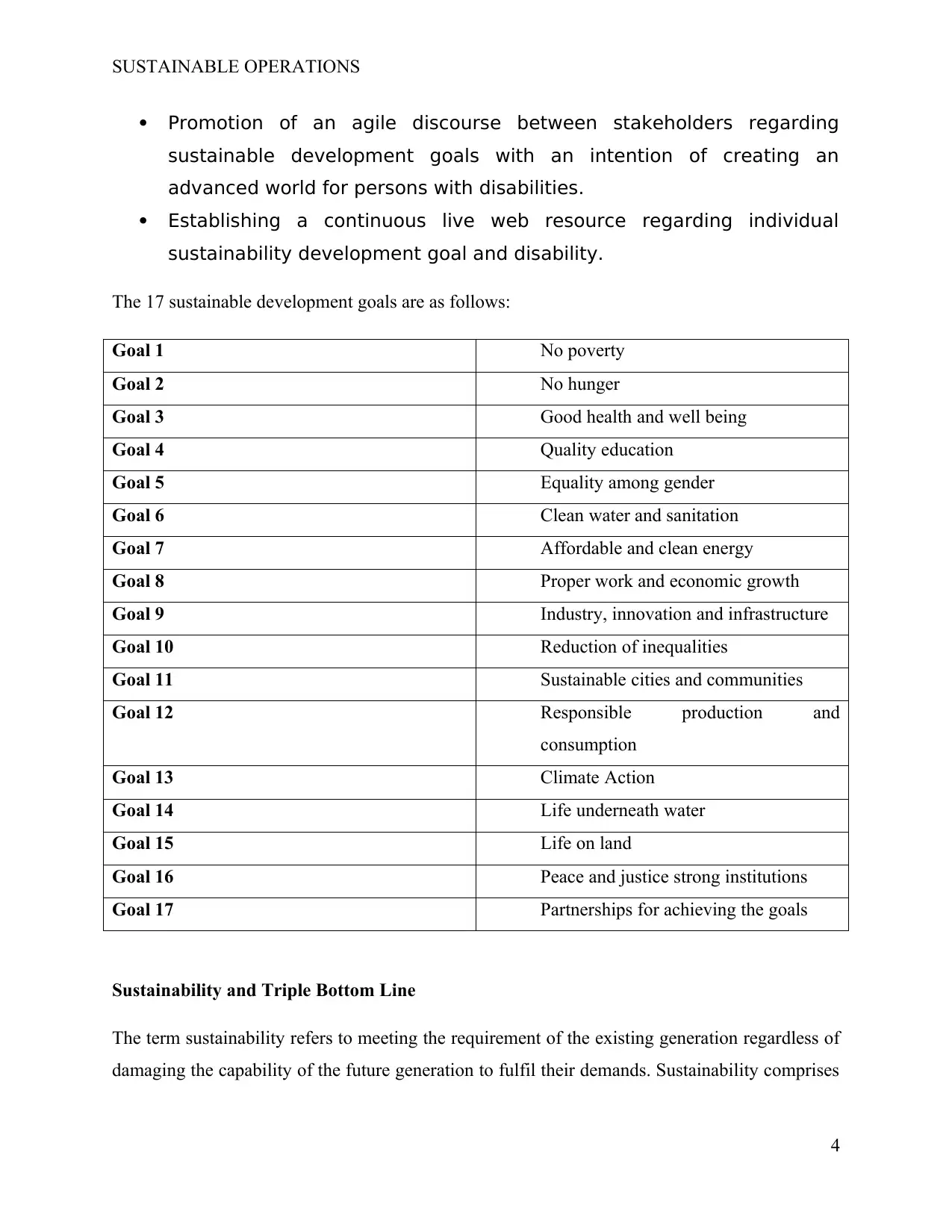
The 17 sustainable development goals are as follows:
Goal 1 No poverty
Goal 2 No hunger
Goal 3 Good health and well being
Goal 4 Quality education
Goal 5 Equality among gender
Goal 6 Clean water and sanitation
Goal 7 Affordable and clean energy
Goal 8 Proper work and economic growth
Goal 9 Industry, innovation and infrastructure
Goal 10 Reduction of inequalities
Goal 11 Sustainable cities and communities
Goal 12 Responsible production and
consumption
Goal 13 Climate Action
Goal 14 Life underneath water
Goal 15 Life on land
Goal 16 Peace and justice strong institutions
Goal 17 Partnerships for achieving the goals
Sustainability and Triple Bottom Line
The term sustainability refers to meeting the requirement of the existing generation regardless of
damaging the capability of the future generation to fulfil their demands. Sustainability comprises
4
Promotion of an agile discourse between stakeholders regarding
sustainable development goals with an intention of creating an
advanced world for persons with disabilities.
Establishing a continuous live web resource regarding individual
sustainability development goal and disability.
The 17 sustainable development goals are as follows:
Goal 1 No poverty
Goal 2 No hunger
Goal 3 Good health and well being
Goal 4 Quality education
Goal 5 Equality among gender
Goal 6 Clean water and sanitation
Goal 7 Affordable and clean energy
Goal 8 Proper work and economic growth
Goal 9 Industry, innovation and infrastructure
Goal 10 Reduction of inequalities
Goal 11 Sustainable cities and communities
Goal 12 Responsible production and
consumption
Goal 13 Climate Action
Goal 14 Life underneath water
Goal 15 Life on land
Goal 16 Peace and justice strong institutions
Goal 17 Partnerships for achieving the goals
Sustainability and Triple Bottom Line
The term sustainability refers to meeting the requirement of the existing generation regardless of
damaging the capability of the future generation to fulfil their demands. Sustainability comprises
4
Paraphrase This Document
Need a fresh take? Get an instant paraphrase of this document with our AI Paraphraser
SUSTAINABLE OPERATIONS
of three main pillars mainly economic, environmental and social which are also referred
respectively as people, planet and profit.
As opined by Lasso & Dahles (2018) the Triple Bottom Line or the TBL can be defined as a
framework or theory which states that organizations should commit to focus on environmental
concerns and social concerns in the same way they concentrate on profits. The theory of Triple
Bottom Line states that instead of one bottom line, there should be provision of three bottom
lines namely the bottom line of people, planet and the profit. A Triple Bottom Line Framework
helps in measuring the commitment level of an organization towards corporate social
responsibility and the impact of the firm on the environment over time. According to the theory
of TBL, business organization should work continuously on three bottom lines namely profit
which is the basic measurement of a company’s profit by analysing their profit and loss account,
people which helps in measuring the level of social responsibility of a firm through their
operations and planet which helps in measuring the commitment of a business towards the
environment. As opined by Cisneros-Martínez, McCabe & Fernández-Morales (2018) the theory
of TBL also states that a business which only concentrates on its profits, by ignoring the
environment and people in society, cannot account for the full costs which are associated with
doing a business.
Butler Model explained and interpreted
As opined by Bramwell, Higham, Lane & Miller (2017) the main goal of the Butler model is to
analyze and observe the growth and development of tourists resorts in tourism industry. Like all
other industry, the tourism industry is also vigorous and continuously modifying, therefore the
Butler model helps in the study and analysis of tourists resorts regarding how they alter with time
in co-relation to fluctuation in demands of tourists. The changes which are noticed in the tourists
resorts can later be contrasted to estimation as depicted by model.
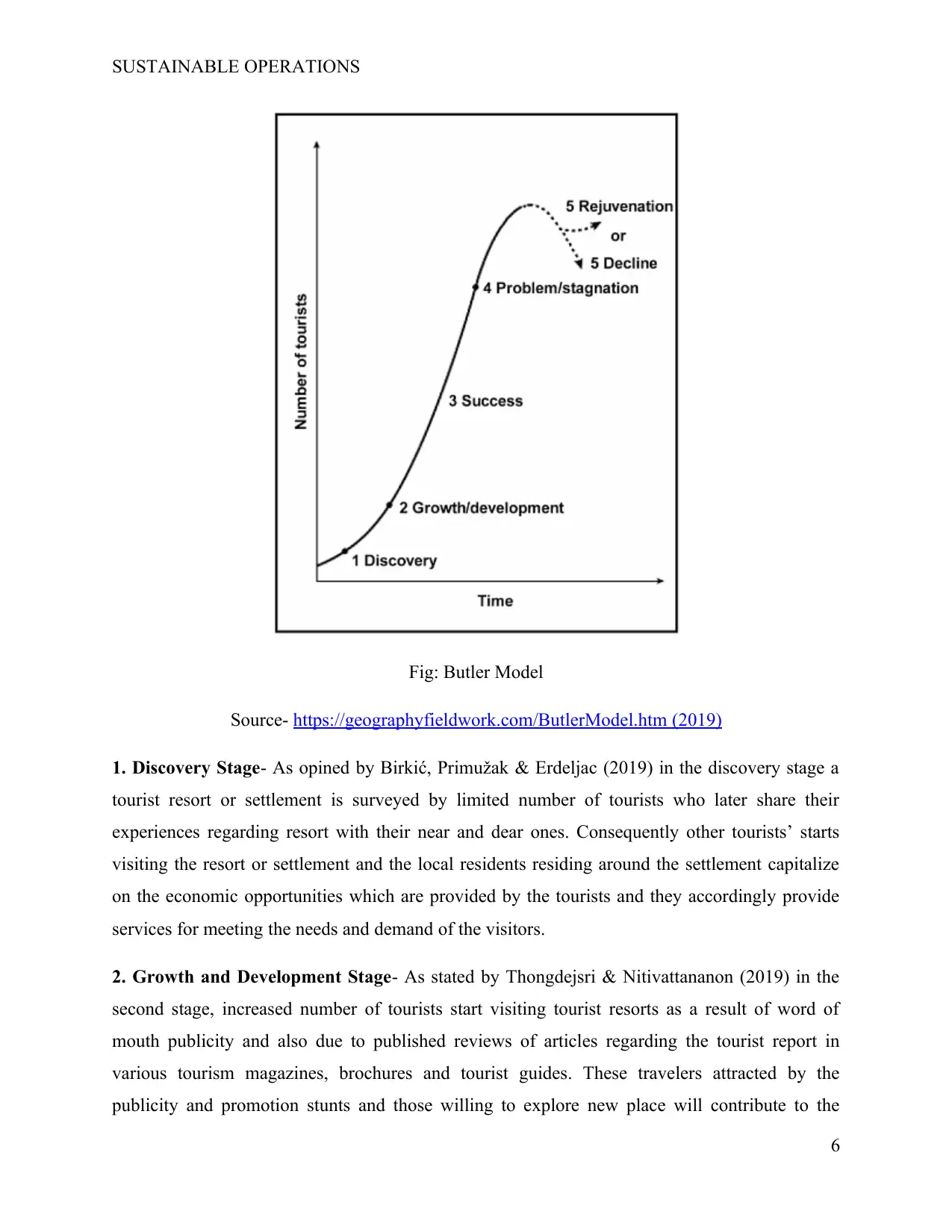
The Butler Model which is illustrated below helps in breaking down of the development of
tourist resort into five diverse levels which are depicted as under:
5
of three main pillars mainly economic, environmental and social which are also referred
respectively as people, planet and profit.
As opined by Lasso & Dahles (2018) the Triple Bottom Line or the TBL can be defined as a
framework or theory which states that organizations should commit to focus on environmental
concerns and social concerns in the same way they concentrate on profits. The theory of Triple
Bottom Line states that instead of one bottom line, there should be provision of three bottom
lines namely the bottom line of people, planet and the profit. A Triple Bottom Line Framework
helps in measuring the commitment level of an organization towards corporate social
responsibility and the impact of the firm on the environment over time. According to the theory
of TBL, business organization should work continuously on three bottom lines namely profit
which is the basic measurement of a company’s profit by analysing their profit and loss account,
people which helps in measuring the level of social responsibility of a firm through their
operations and planet which helps in measuring the commitment of a business towards the
environment. As opined by Cisneros-Martínez, McCabe & Fernández-Morales (2018) the theory
of TBL also states that a business which only concentrates on its profits, by ignoring the
environment and people in society, cannot account for the full costs which are associated with
doing a business.
Butler Model explained and interpreted
As opined by Bramwell, Higham, Lane & Miller (2017) the main goal of the Butler model is to
analyze and observe the growth and development of tourists resorts in tourism industry. Like all
other industry, the tourism industry is also vigorous and continuously modifying, therefore the
Butler model helps in the study and analysis of tourists resorts regarding how they alter with time
in co-relation to fluctuation in demands of tourists. The changes which are noticed in the tourists
resorts can later be contrasted to estimation as depicted by model.
The Butler Model which is illustrated below helps in breaking down of the development of
tourist resort into five diverse levels which are depicted as under:
5
SUSTAINABLE OPERATIONS
Fig: Butler Model
Source- https://geographyfieldwork.com/ButlerModel.htm (2019)
1. Discovery Stage- As opined by Birkić, Primužak & Erdeljac (2019) in the discovery stage a
tourist resort or settlement is surveyed by limited number of tourists who later share their
experiences regarding resort with their near and dear ones. Consequently other tourists’ starts
visiting the resort or settlement and the local residents residing around the settlement capitalize
on the economic opportunities which are provided by the tourists and they accordingly provide
services for meeting the needs and demand of the visitors.
2. Growth and Development Stage- As stated by Thongdejsri & Nitivattananon (2019) in the
second stage, increased number of tourists start visiting tourist resorts as a result of word of
mouth publicity and also due to published reviews of articles regarding the tourist report in
various tourism magazines, brochures and tourist guides. These travelers attracted by the
publicity and promotion stunts and those willing to explore new place will contribute to the
6
Fig: Butler Model
Source- https://geographyfieldwork.com/ButlerModel.htm (2019)
1. Discovery Stage- As opined by Birkić, Primužak & Erdeljac (2019) in the discovery stage a
tourist resort or settlement is surveyed by limited number of tourists who later share their
experiences regarding resort with their near and dear ones. Consequently other tourists’ starts
visiting the resort or settlement and the local residents residing around the settlement capitalize
on the economic opportunities which are provided by the tourists and they accordingly provide
services for meeting the needs and demand of the visitors.
2. Growth and Development Stage- As stated by Thongdejsri & Nitivattananon (2019) in the
second stage, increased number of tourists start visiting tourist resorts as a result of word of
mouth publicity and also due to published reviews of articles regarding the tourist report in
various tourism magazines, brochures and tourist guides. These travelers attracted by the
publicity and promotion stunts and those willing to explore new place will contribute to the
6
⊘ This is a preview!⊘
Do you want full access?
Subscribe today to unlock all pages.
Trusted by 1+ million students worldwide
SUSTAINABLE OPERATIONS
development of new hotels, restaurants, shops and services for catering to the inflow of visitors
and tourists.
3. Success Stage- As stated by Muangasame & McKercher (2015) in the success stage more and
more visitors starts visiting the tourist destination which leads to full utilization of the facilities
As more people visit the resort, the amenities are now completely used and the original economic
function of the settlement is substituted by mass tourism in the destination which may lead to
development of some sort of resentment among the local residents of the town who may not have
gained by the development of the new industry surrounding the resort or have faced the loss of
unique image which the destination held earlier. At this stage it may resemble that the local
culture is being lowered by a more cosmopolitan and non-unique culture in comparison to what
might have existed earlier.
4. Problem – Stagnation Stage- As opined by Moon & Batle (2018) in the problem and
stagnation stage it is observed that the popularity of the resort can be short lived in nature as
visitors and tourists may get bored with the region once the initial attraction starts to fade way.
As a result of the increased exploration by visitors, very less of the original natural surroundings
of the destination will remain and unfavorable review regarding what the place used to be earlier
may result into visitors searching for new destination or resort to be explored. As a result of the
decline in tourist volume, the destination becomes outdated which results to economic downfall
of location and also leads to under- utilization of the tourism and ultimate closing of some
businesses in the region which will result to increase in unemployment index of region.
5. Decline or Rejuvenation- As stated by Ternel & Greyling (2018) the last phase is decline or
rejuvenation stage in which there are two options which are available for the tourist resort, the
first option is to either o to into decline and the other option is to rejuvenate by developing and
implementing sustainable approaches based on the dropping levels of travelers of resort.
Responsible Production and Consumption
As stated by Javed & Tučková (2018) responsible production and consumption is one of the
sustainable development goal adopted by the United Nations for promoting sustainable. The goal
of responsible production and consumption is all about promoting efficiency regarding energy
and resources, infrastructure which is sustainable in nature and facilitation of access to basic
7
development of new hotels, restaurants, shops and services for catering to the inflow of visitors
and tourists.
3. Success Stage- As stated by Muangasame & McKercher (2015) in the success stage more and
more visitors starts visiting the tourist destination which leads to full utilization of the facilities
As more people visit the resort, the amenities are now completely used and the original economic
function of the settlement is substituted by mass tourism in the destination which may lead to
development of some sort of resentment among the local residents of the town who may not have
gained by the development of the new industry surrounding the resort or have faced the loss of
unique image which the destination held earlier. At this stage it may resemble that the local
culture is being lowered by a more cosmopolitan and non-unique culture in comparison to what
might have existed earlier.
4. Problem – Stagnation Stage- As opined by Moon & Batle (2018) in the problem and
stagnation stage it is observed that the popularity of the resort can be short lived in nature as
visitors and tourists may get bored with the region once the initial attraction starts to fade way.
As a result of the increased exploration by visitors, very less of the original natural surroundings
of the destination will remain and unfavorable review regarding what the place used to be earlier
may result into visitors searching for new destination or resort to be explored. As a result of the
decline in tourist volume, the destination becomes outdated which results to economic downfall
of location and also leads to under- utilization of the tourism and ultimate closing of some
businesses in the region which will result to increase in unemployment index of region.
5. Decline or Rejuvenation- As stated by Ternel & Greyling (2018) the last phase is decline or
rejuvenation stage in which there are two options which are available for the tourist resort, the
first option is to either o to into decline and the other option is to rejuvenate by developing and
implementing sustainable approaches based on the dropping levels of travelers of resort.
Responsible Production and Consumption
As stated by Javed & Tučková (2018) responsible production and consumption is one of the
sustainable development goal adopted by the United Nations for promoting sustainable. The goal
of responsible production and consumption is all about promoting efficiency regarding energy
and resources, infrastructure which is sustainable in nature and facilitation of access to basic
7
Paraphrase This Document
Need a fresh take? Get an instant paraphrase of this document with our AI Paraphraser
SUSTAINABLE OPERATIONS
services and facilities, providing employment opportunities for all which are green and
sustainable and ensuring a better quality of life for all individuals in society. The implementation
of idea or responsible production and consumption will help in the achievement of overall
development plans, reduction of costs related to economy, environment and society in the future,
enhancement of competitiveness in the economy and reduction of poverty.
As stated by Angheluţă, , Păduraru & Diaconu (2017) as the idea of responsible production and
consumption aims to do more and better with less, the total well-being profits from economic
practices can enhance as a result of reduction in the use of resources, reduction in depletion and
pollution in the complete life cycle while enhancing the quality of life at the same time. There is
also a need for vital focus regarding operating on a supply chain which includes everyone right
from the manufacturer to the end consumer. As opined by Johnston (2014) the idea of
responsible production and consumption involves creating awareness among individuals
regarding consumption and lifestyle which is sustainable in nature and also providing them with
required information by the use of standards and labels in products and services and involving
the customers in sustainable public procurement.
Sustainable Tourism
As opined by Hall (2019) the World Tourism Organization described sustainable tourism as a
tourism which owns complete responsibility of its present and future impacts in context of the
economy, society and environment, while fulfilling the requirement of the tourists, the sector, the
ecology and the host society.
The goals of sustainable tourism are as follows:
1) Making favourable utilisation of environmental resources which comprise significant factor in
growth of tourism, maintenance of vital environmental processes and taking steps to conserve
natural diversity.
2) Respecting the host society’s socio-cultural practices, protecting their built and existing
cultural heritage and conventional beliefs, and contributing towards contemplating between
various culture and improving acceptance among various cultures.
8
services and facilities, providing employment opportunities for all which are green and
sustainable and ensuring a better quality of life for all individuals in society. The implementation
of idea or responsible production and consumption will help in the achievement of overall
development plans, reduction of costs related to economy, environment and society in the future,
enhancement of competitiveness in the economy and reduction of poverty.
As stated by Angheluţă, , Păduraru & Diaconu (2017) as the idea of responsible production and
consumption aims to do more and better with less, the total well-being profits from economic
practices can enhance as a result of reduction in the use of resources, reduction in depletion and
pollution in the complete life cycle while enhancing the quality of life at the same time. There is
also a need for vital focus regarding operating on a supply chain which includes everyone right
from the manufacturer to the end consumer. As opined by Johnston (2014) the idea of
responsible production and consumption involves creating awareness among individuals
regarding consumption and lifestyle which is sustainable in nature and also providing them with
required information by the use of standards and labels in products and services and involving
the customers in sustainable public procurement.
Sustainable Tourism
As opined by Hall (2019) the World Tourism Organization described sustainable tourism as a
tourism which owns complete responsibility of its present and future impacts in context of the
economy, society and environment, while fulfilling the requirement of the tourists, the sector, the
ecology and the host society.
The goals of sustainable tourism are as follows:
1) Making favourable utilisation of environmental resources which comprise significant factor in
growth of tourism, maintenance of vital environmental processes and taking steps to conserve
natural diversity.
2) Respecting the host society’s socio-cultural practices, protecting their built and existing
cultural heritage and conventional beliefs, and contributing towards contemplating between
various culture and improving acceptance among various cultures.
8
SUSTAINABLE OPERATIONS
3) As opined by Towner & Orams (2016) ensuring of economic operations for the long term
which are viable in nature, ensuring provision of socio-economic benefits for all involved
stakeholders, provisioning stable income ad employment opportunities to the host communities,
and working towards reduction of poverty in the host communities.
As opined by Jankauskaitė (2017) the development of sustainable tourism needs knowledgeable
involvement of all significant stakeholders in tourism industry in addition to strong political
leaderships for ensuring large scale participation and for building consensus. The achievement of
sustainable tourism is considered as a continued procedure which needs continuous tracking of
the associated effects, introduction of essential corrective actions for addressing impacts if
needed. Sustainable tourism should also work towards maintaining greater tourist fulfilment
levels and help in ensuring that they enjoy a meaningful experience by developing their
awareness regarding issues of sustainability and by promoting tourism practices among them
which are sustainable in nature.
Global Sustainable Tourism Council
The Global Sustainable Tourism Council (GSTC) helps in management of GSTC Criteria, which
is considered as the world baseline standards regarding sustainable travel and tourism. This
Council acts as the global accreditation body regarding certification of sustainable tourism and
helps in establishing and managing universal sustainable benchmarks, which are termed as
GSTC Criteria.
The Global Sustainable Tourism Council is a self-supporting and fair-minded enterprise, which
is legally registered in the USA as a 501(c) 3, non-profit firm which helps in representing diverse
and global membership, which includes bodies of the UN, NGO’s, national and state
governments, reputed travel and tourism firms, hotels, tour operators, individuals and
communities who all strive to attain best approaches in context of sustainable tourism. As opined
by Higham & Miller (2018) the main role of GSTC involves development of international
sustainable tourism standards, serving as an accreditation organization for sustainable travel and
tourism, development of sustainable destinations, promotion of market access and increasing
knowledge of sustainable travel and tourism among the stakeholders.
9
3) As opined by Towner & Orams (2016) ensuring of economic operations for the long term
which are viable in nature, ensuring provision of socio-economic benefits for all involved
stakeholders, provisioning stable income ad employment opportunities to the host communities,
and working towards reduction of poverty in the host communities.
As opined by Jankauskaitė (2017) the development of sustainable tourism needs knowledgeable
involvement of all significant stakeholders in tourism industry in addition to strong political
leaderships for ensuring large scale participation and for building consensus. The achievement of
sustainable tourism is considered as a continued procedure which needs continuous tracking of
the associated effects, introduction of essential corrective actions for addressing impacts if
needed. Sustainable tourism should also work towards maintaining greater tourist fulfilment
levels and help in ensuring that they enjoy a meaningful experience by developing their
awareness regarding issues of sustainability and by promoting tourism practices among them
which are sustainable in nature.
Global Sustainable Tourism Council
The Global Sustainable Tourism Council (GSTC) helps in management of GSTC Criteria, which
is considered as the world baseline standards regarding sustainable travel and tourism. This
Council acts as the global accreditation body regarding certification of sustainable tourism and
helps in establishing and managing universal sustainable benchmarks, which are termed as
GSTC Criteria.
The Global Sustainable Tourism Council is a self-supporting and fair-minded enterprise, which
is legally registered in the USA as a 501(c) 3, non-profit firm which helps in representing diverse
and global membership, which includes bodies of the UN, NGO’s, national and state
governments, reputed travel and tourism firms, hotels, tour operators, individuals and
communities who all strive to attain best approaches in context of sustainable tourism. As opined
by Higham & Miller (2018) the main role of GSTC involves development of international
sustainable tourism standards, serving as an accreditation organization for sustainable travel and
tourism, development of sustainable destinations, promotion of market access and increasing
knowledge of sustainable travel and tourism among the stakeholders.
9
⊘ This is a preview!⊘
Do you want full access?
Subscribe today to unlock all pages.
Trusted by 1+ million students worldwide
SUSTAINABLE OPERATIONS
Conclusion
Hence, it can be concluded that concept of sustainable travel and tourism will not only help in
upholding the three pillars of sustainability but will even help in enhancement of travel and
tourism experiences amongst the visitors and tourists. Also the idea of sustainable travel and
tourism not only helps in protection of the natural environment from damages and degradation,
but also helps in providing adequate employment opportunities for the host communities which
contributes towards their development and helps in protecting the cultural links and beliefs.
10
Conclusion
Hence, it can be concluded that concept of sustainable travel and tourism will not only help in
upholding the three pillars of sustainability but will even help in enhancement of travel and
tourism experiences amongst the visitors and tourists. Also the idea of sustainable travel and
tourism not only helps in protection of the natural environment from damages and degradation,
but also helps in providing adequate employment opportunities for the host communities which
contributes towards their development and helps in protecting the cultural links and beliefs.
10
Paraphrase This Document
Need a fresh take? Get an instant paraphrase of this document with our AI Paraphraser
SUSTAINABLE OPERATIONS
References
Angheluţă, ,P.S., Păduraru, D., & Diaconu, I. (2017). The Relationship Between Sustainable
Tourism And Sustainable Development In The Context Of Environmental Protection.
Babes Bolyai University: Cluj-Napoca. Retrieved from
https://search.proquest.com/docview/2014441080?accountid=30552
Birkić, D., Primužak, A., & Erdeljac, N. (2019). Sustainable tourism development of coastal
destination- the role and the significance of local residents. Tourism in South East
Europe ..., 5, 101-119. doi:http://dx.doi.org/10.20867/tosee.05.21
Bramwell, B., Higham, J., Lane, B., & Miller, G. (2017). Twenty-five years of sustainable
tourism and the journal of sustainable tourism: Looking back and moving forward. Journal
of Sustainable Tourism, 25(1), 1-9. doi:http://dx.doi.org/10.1080/09669582.2017.1251689
Cisneros-Martínez, J. D., McCabe, S., & Fernández-Morales, A. (2018). The contribution of
social tourism to sustainable tourism: A case study of seasonally adjusted
programs. Journal of Sustainable Tourism, 26(1), 85-107.
doi:http://dx.doi.org/10.1080/09669582.2017.1319844
Hall, C. M. (2019). Constructing sustainable tourism development: The 2030 agenda and the
managerial ecology of sustainable tourism. Journal of Sustainable Tourism, 27(7), 1044-
1060. doi:http://dx.doi.org/10.1080/09669582.2018.1560456
Higham, J., & Miller, G. (2018). Transforming societies and transforming tourism: Sustainable
tourism in times of change. Journal of Sustainable Tourism, 26(1), 1-8.
doi:http://dx.doi.org/10.1080/09669582.2018.1407519
Jankauskaitė, D. (2017). (Un)sustainable consumer behavior in sustainable
tourism. International Journal on Global Business Management & Research, 6(1), 1-10.
Retrieved from https://search.proquest.com/docview/1939705566?accountid=30552
11
References
Angheluţă, ,P.S., Păduraru, D., & Diaconu, I. (2017). The Relationship Between Sustainable
Tourism And Sustainable Development In The Context Of Environmental Protection.
Babes Bolyai University: Cluj-Napoca. Retrieved from
https://search.proquest.com/docview/2014441080?accountid=30552
Birkić, D., Primužak, A., & Erdeljac, N. (2019). Sustainable tourism development of coastal
destination- the role and the significance of local residents. Tourism in South East
Europe ..., 5, 101-119. doi:http://dx.doi.org/10.20867/tosee.05.21
Bramwell, B., Higham, J., Lane, B., & Miller, G. (2017). Twenty-five years of sustainable
tourism and the journal of sustainable tourism: Looking back and moving forward. Journal
of Sustainable Tourism, 25(1), 1-9. doi:http://dx.doi.org/10.1080/09669582.2017.1251689
Cisneros-Martínez, J. D., McCabe, S., & Fernández-Morales, A. (2018). The contribution of
social tourism to sustainable tourism: A case study of seasonally adjusted
programs. Journal of Sustainable Tourism, 26(1), 85-107.
doi:http://dx.doi.org/10.1080/09669582.2017.1319844
Hall, C. M. (2019). Constructing sustainable tourism development: The 2030 agenda and the
managerial ecology of sustainable tourism. Journal of Sustainable Tourism, 27(7), 1044-
1060. doi:http://dx.doi.org/10.1080/09669582.2018.1560456
Higham, J., & Miller, G. (2018). Transforming societies and transforming tourism: Sustainable
tourism in times of change. Journal of Sustainable Tourism, 26(1), 1-8.
doi:http://dx.doi.org/10.1080/09669582.2018.1407519
Jankauskaitė, D. (2017). (Un)sustainable consumer behavior in sustainable
tourism. International Journal on Global Business Management & Research, 6(1), 1-10.
Retrieved from https://search.proquest.com/docview/1939705566?accountid=30552
11
SUSTAINABLE OPERATIONS
Javed, M., & Tučková, Z. (2018). Factors of sustainable tourism and their application. Academic
Conferences International Limited. Retrieved from
https://search.proquest.com/docview/2288610193?accountid=30552
Johnston, C. S. (2014). Towards a theory of sustainability, sustainable development and
sustainable tourism: neighborhoods and sustainable tourism. Journal of Sustainable
Tourism, 22(2), 195. Retrieved from https://search.proquest.com/docview/1498234112?
accountid=30552
Lanfranchi, M., Giannetto, C., & De Pascale, A. (2014).Rural tourism: A kind of sustainable
tourism in the face of global economic crisis. International Journal for Responsible
Tourism, 3(2), 15-28. Retrieved from https://search.proquest.com/docview/1648506458?
accountid=30552
Lasso, A., & Dahles, H. (2018). Are tourism livelihoods sustainable? Tourism development and
economic transformation. Asia Pacific Journal of Tourism Research, 23(5), 473-485.
doi:http://dx.doi.org/10.1080/10941665.2018.1467939
Moon, C. J., & Batle, J. (2018). Mass tourism vs. sustainable tourism in the Balearic islands?
Measuring social and environmental impact. Academic Conferences International Limited.
Retrieved from https://search.proquest.com/docview/2288614472?accountid=30552
Muangasame, K., & McKercher, B. (2015). The challenge of implementing sustainable tourism
policy: A 360-degree assessment of "7 greens sustainable tourism policy". Journal of
Sustainable Tourism, 23(4), 497. Retrieved from
https://search.proquest.com/docview/1658870987?accountid=30552
Ternel, M., & Greyling, L. (2018). An assessment of sustainable tourism and its opportunities.
Academic Conferences International Limited. Retrieved from
https://search.proquest.com/docview/2288614166?accountid=30552
Thongdejsri, M., & Nitivattananon, V. (2019). Assessing impacts of implementing low-carbon
tourism program for sustainable tourism in a world heritage city. Tourism Review of AIEST
- International Association of Scientific Experts in Tourism, 74(2), 138-156.
doi:http://dx.doi.org/10.1108/TR-04-2017-0082
12
Javed, M., & Tučková, Z. (2018). Factors of sustainable tourism and their application. Academic
Conferences International Limited. Retrieved from
https://search.proquest.com/docview/2288610193?accountid=30552
Johnston, C. S. (2014). Towards a theory of sustainability, sustainable development and
sustainable tourism: neighborhoods and sustainable tourism. Journal of Sustainable
Tourism, 22(2), 195. Retrieved from https://search.proquest.com/docview/1498234112?
accountid=30552
Lanfranchi, M., Giannetto, C., & De Pascale, A. (2014).Rural tourism: A kind of sustainable
tourism in the face of global economic crisis. International Journal for Responsible
Tourism, 3(2), 15-28. Retrieved from https://search.proquest.com/docview/1648506458?
accountid=30552
Lasso, A., & Dahles, H. (2018). Are tourism livelihoods sustainable? Tourism development and
economic transformation. Asia Pacific Journal of Tourism Research, 23(5), 473-485.
doi:http://dx.doi.org/10.1080/10941665.2018.1467939
Moon, C. J., & Batle, J. (2018). Mass tourism vs. sustainable tourism in the Balearic islands?
Measuring social and environmental impact. Academic Conferences International Limited.
Retrieved from https://search.proquest.com/docview/2288614472?accountid=30552
Muangasame, K., & McKercher, B. (2015). The challenge of implementing sustainable tourism
policy: A 360-degree assessment of "7 greens sustainable tourism policy". Journal of
Sustainable Tourism, 23(4), 497. Retrieved from
https://search.proquest.com/docview/1658870987?accountid=30552
Ternel, M., & Greyling, L. (2018). An assessment of sustainable tourism and its opportunities.
Academic Conferences International Limited. Retrieved from
https://search.proquest.com/docview/2288614166?accountid=30552
Thongdejsri, M., & Nitivattananon, V. (2019). Assessing impacts of implementing low-carbon
tourism program for sustainable tourism in a world heritage city. Tourism Review of AIEST
- International Association of Scientific Experts in Tourism, 74(2), 138-156.
doi:http://dx.doi.org/10.1108/TR-04-2017-0082
12
⊘ This is a preview!⊘
Do you want full access?
Subscribe today to unlock all pages.
Trusted by 1+ million students worldwide

1 out of 13


Related Documents


Your All-in-One AI-Powered Toolkit for Academic Success.
+13062052269
info@desklib.com
Available 24*7 on WhatsApp / Email
![[object Object]](/_next/static/media/star-bottom.7253800d.svg)
Unlock your academic potential
Copyright © 2020–2026 A2Z Services. All Rights Reserved. Developed and managed by ZUCOL.