Analyzing Sustainable Tourism Development in the Philippines
VerifiedAdded on 2023/04/10
|23
|5603
|339
Report
AI Summary
This report provides a detailed analysis of sustainable tourism development in the Philippines, focusing on the roles of stakeholders, the importance of public and private sector partnerships, and various approaches to tourism development planning. It examines the significance of interactive planning in addressing challenges like infrastructure and socio-cultural depreciation, and explores methods for measuring the social, economic, and environmental impacts of tourism. The study emphasizes the need for effective planning processes to ensure that the tourism industry fulfills its objectives while protecting the environment and benefiting local communities. The report also highlights the benefits and drawbacks of private sector involvement in tourism development and the importance of considering factors such as safety, education, and sanitation for sustainable tourism in the Philippines. Desklib offers this and other solved assignments to aid students in their studies.
Sustainable Tourism
Development
Development

Paraphrase This Document
Need a fresh take? Get an instant paraphrase of this document with our AI Paraphraser
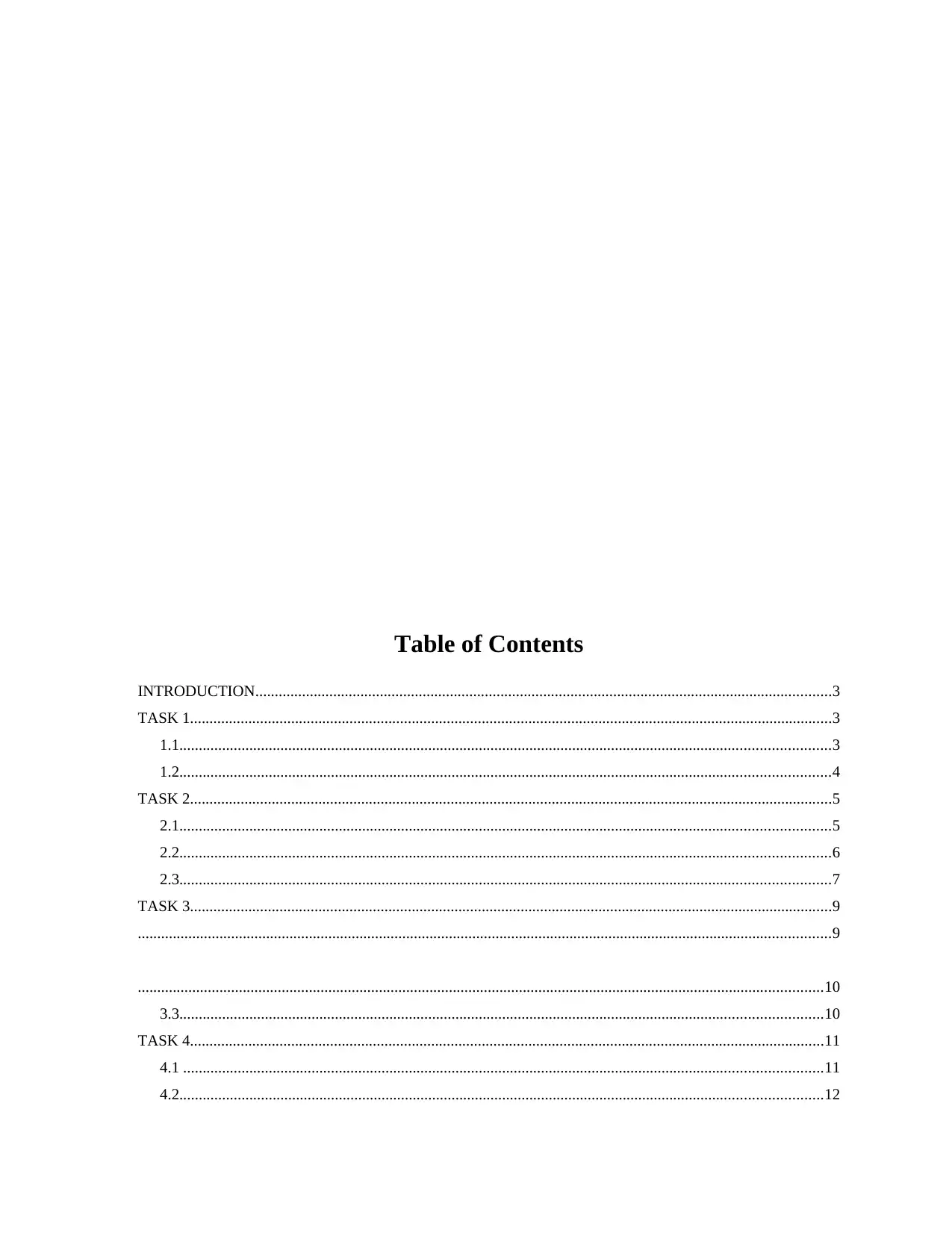
Table of Contents
INTRODUCTION....................................................................................................................................................3
TASK 1.....................................................................................................................................................................3
1.1.......................................................................................................................................................................3
1.2.......................................................................................................................................................................4
TASK 2.....................................................................................................................................................................5
2.1.......................................................................................................................................................................5
2.2.......................................................................................................................................................................6
2.3.......................................................................................................................................................................7
TASK 3.....................................................................................................................................................................9
..................................................................................................................................................................................9
................................................................................................................................................................................10
3.3.....................................................................................................................................................................10
TASK 4...................................................................................................................................................................11
4.1 ....................................................................................................................................................................11
4.2.....................................................................................................................................................................12
INTRODUCTION....................................................................................................................................................3
TASK 1.....................................................................................................................................................................3
1.1.......................................................................................................................................................................3
1.2.......................................................................................................................................................................4
TASK 2.....................................................................................................................................................................5
2.1.......................................................................................................................................................................5
2.2.......................................................................................................................................................................6
2.3.......................................................................................................................................................................7
TASK 3.....................................................................................................................................................................9
..................................................................................................................................................................................9
................................................................................................................................................................................10
3.3.....................................................................................................................................................................10
TASK 4...................................................................................................................................................................11
4.1 ....................................................................................................................................................................11
4.2.....................................................................................................................................................................12

4.3.....................................................................................................................................................................13
TASK 5...................................................................................................................................................................14
5.1.....................................................................................................................................................................14
5.2.....................................................................................................................................................................15
CONCLUSION .....................................................................................................................................................16
REFERENCES ......................................................................................................................................................17
TASK 5...................................................................................................................................................................14
5.1.....................................................................................................................................................................14
5.2.....................................................................................................................................................................15
CONCLUSION .....................................................................................................................................................16
REFERENCES ......................................................................................................................................................17
⊘ This is a preview!⊘
Do you want full access?
Subscribe today to unlock all pages.

Trusted by 1+ million students worldwide
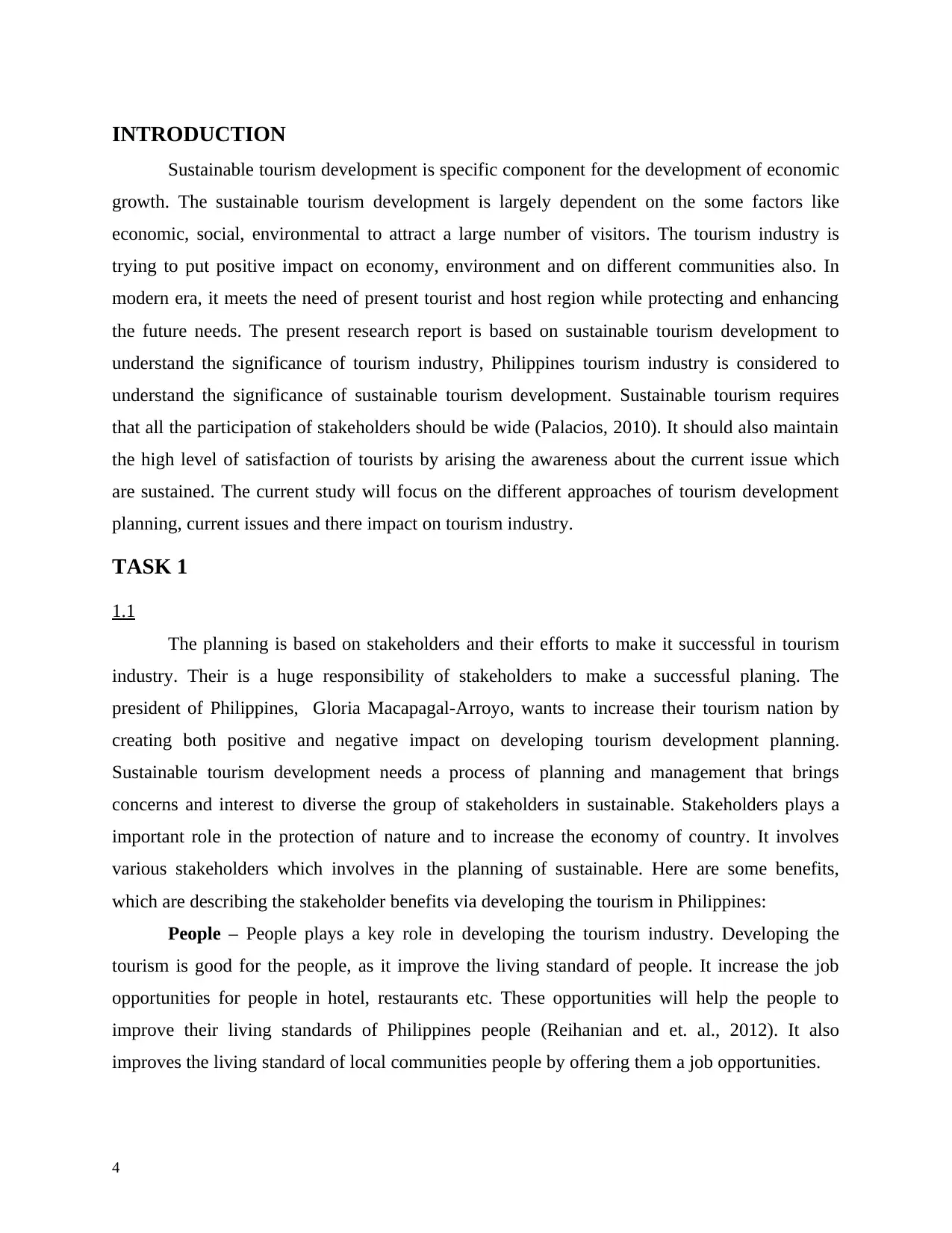
INTRODUCTION
Sustainable tourism development is specific component for the development of economic
growth. The sustainable tourism development is largely dependent on the some factors like
economic, social, environmental to attract a large number of visitors. The tourism industry is
trying to put positive impact on economy, environment and on different communities also. In
modern era, it meets the need of present tourist and host region while protecting and enhancing
the future needs. The present research report is based on sustainable tourism development to
understand the significance of tourism industry, Philippines tourism industry is considered to
understand the significance of sustainable tourism development. Sustainable tourism requires
that all the participation of stakeholders should be wide (Palacios, 2010). It should also maintain
the high level of satisfaction of tourists by arising the awareness about the current issue which
are sustained. The current study will focus on the different approaches of tourism development
planning, current issues and there impact on tourism industry.
TASK 1
1.1
The planning is based on stakeholders and their efforts to make it successful in tourism
industry. Their is a huge responsibility of stakeholders to make a successful planing. The
president of Philippines, Gloria Macapagal-Arroyo, wants to increase their tourism nation by
creating both positive and negative impact on developing tourism development planning.
Sustainable tourism development needs a process of planning and management that brings
concerns and interest to diverse the group of stakeholders in sustainable. Stakeholders plays a
important role in the protection of nature and to increase the economy of country. It involves
various stakeholders which involves in the planning of sustainable. Here are some benefits,
which are describing the stakeholder benefits via developing the tourism in Philippines:
People – People plays a key role in developing the tourism industry. Developing the
tourism is good for the people, as it improve the living standard of people. It increase the job
opportunities for people in hotel, restaurants etc. These opportunities will help the people to
improve their living standards of Philippines people (Reihanian and et. al., 2012). It also
improves the living standard of local communities people by offering them a job opportunities.
4
Sustainable tourism development is specific component for the development of economic
growth. The sustainable tourism development is largely dependent on the some factors like
economic, social, environmental to attract a large number of visitors. The tourism industry is
trying to put positive impact on economy, environment and on different communities also. In
modern era, it meets the need of present tourist and host region while protecting and enhancing
the future needs. The present research report is based on sustainable tourism development to
understand the significance of tourism industry, Philippines tourism industry is considered to
understand the significance of sustainable tourism development. Sustainable tourism requires
that all the participation of stakeholders should be wide (Palacios, 2010). It should also maintain
the high level of satisfaction of tourists by arising the awareness about the current issue which
are sustained. The current study will focus on the different approaches of tourism development
planning, current issues and there impact on tourism industry.
TASK 1
1.1
The planning is based on stakeholders and their efforts to make it successful in tourism
industry. Their is a huge responsibility of stakeholders to make a successful planing. The
president of Philippines, Gloria Macapagal-Arroyo, wants to increase their tourism nation by
creating both positive and negative impact on developing tourism development planning.
Sustainable tourism development needs a process of planning and management that brings
concerns and interest to diverse the group of stakeholders in sustainable. Stakeholders plays a
important role in the protection of nature and to increase the economy of country. It involves
various stakeholders which involves in the planning of sustainable. Here are some benefits,
which are describing the stakeholder benefits via developing the tourism in Philippines:
People – People plays a key role in developing the tourism industry. Developing the
tourism is good for the people, as it improve the living standard of people. It increase the job
opportunities for people in hotel, restaurants etc. These opportunities will help the people to
improve their living standards of Philippines people (Reihanian and et. al., 2012). It also
improves the living standard of local communities people by offering them a job opportunities.
4
Paraphrase This Document
Need a fresh take? Get an instant paraphrase of this document with our AI Paraphraser
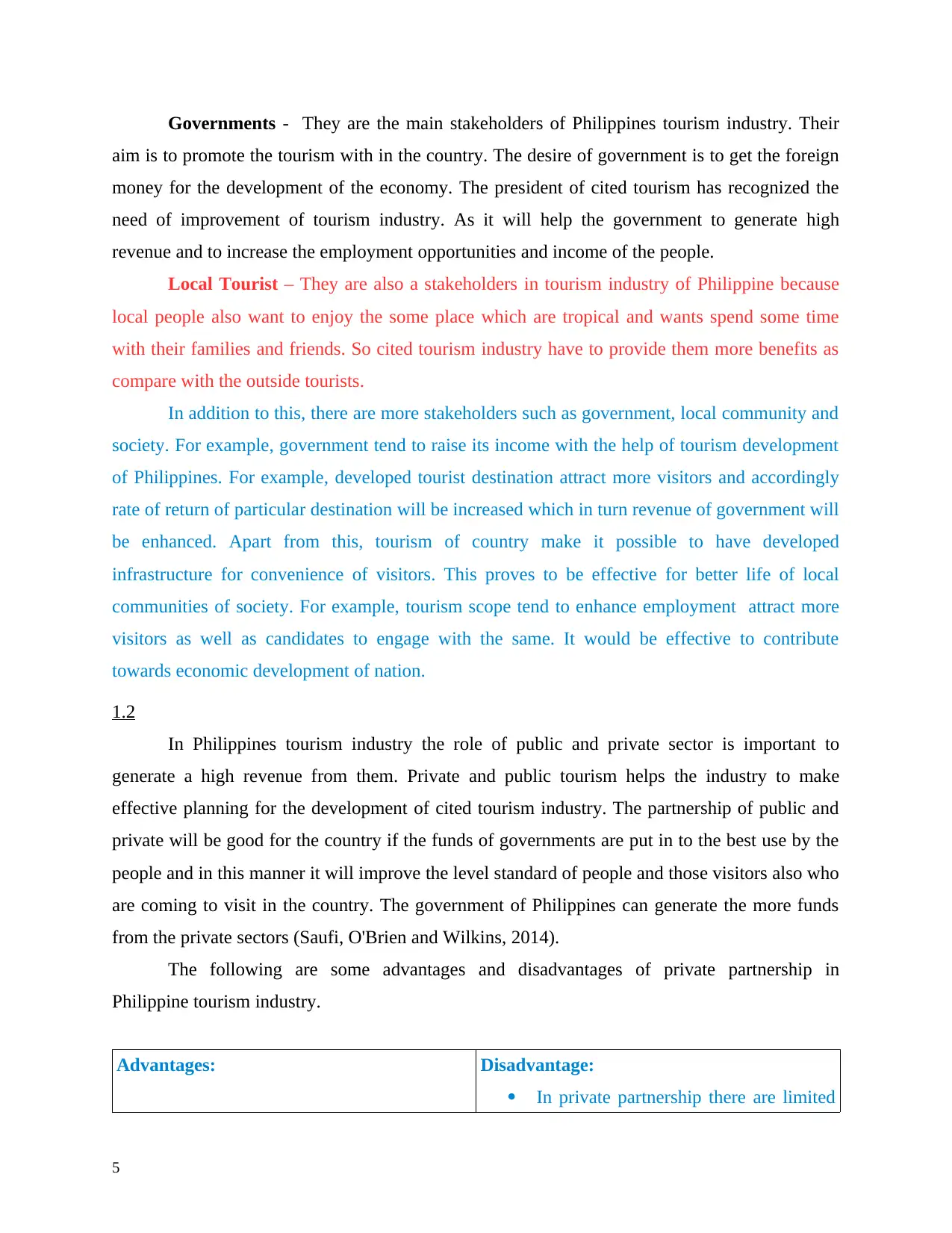
Governments - They are the main stakeholders of Philippines tourism industry. Their
aim is to promote the tourism with in the country. The desire of government is to get the foreign
money for the development of the economy. The president of cited tourism has recognized the
need of improvement of tourism industry. As it will help the government to generate high
revenue and to increase the employment opportunities and income of the people.
Local Tourist – They are also a stakeholders in tourism industry of Philippine because
local people also want to enjoy the some place which are tropical and wants spend some time
with their families and friends. So cited tourism industry have to provide them more benefits as
compare with the outside tourists.
In addition to this, there are more stakeholders such as government, local community and
society. For example, government tend to raise its income with the help of tourism development
of Philippines. For example, developed tourist destination attract more visitors and accordingly
rate of return of particular destination will be increased which in turn revenue of government will
be enhanced. Apart from this, tourism of country make it possible to have developed
infrastructure for convenience of visitors. This proves to be effective for better life of local
communities of society. For example, tourism scope tend to enhance employment attract more
visitors as well as candidates to engage with the same. It would be effective to contribute
towards economic development of nation.
1.2
In Philippines tourism industry the role of public and private sector is important to
generate a high revenue from them. Private and public tourism helps the industry to make
effective planning for the development of cited tourism industry. The partnership of public and
private will be good for the country if the funds of governments are put in to the best use by the
people and in this manner it will improve the level standard of people and those visitors also who
are coming to visit in the country. The government of Philippines can generate the more funds
from the private sectors (Saufi, O'Brien and Wilkins, 2014).
The following are some advantages and disadvantages of private partnership in
Philippine tourism industry.
Advantages: Disadvantage:
In private partnership there are limited
5
aim is to promote the tourism with in the country. The desire of government is to get the foreign
money for the development of the economy. The president of cited tourism has recognized the
need of improvement of tourism industry. As it will help the government to generate high
revenue and to increase the employment opportunities and income of the people.
Local Tourist – They are also a stakeholders in tourism industry of Philippine because
local people also want to enjoy the some place which are tropical and wants spend some time
with their families and friends. So cited tourism industry have to provide them more benefits as
compare with the outside tourists.
In addition to this, there are more stakeholders such as government, local community and
society. For example, government tend to raise its income with the help of tourism development
of Philippines. For example, developed tourist destination attract more visitors and accordingly
rate of return of particular destination will be increased which in turn revenue of government will
be enhanced. Apart from this, tourism of country make it possible to have developed
infrastructure for convenience of visitors. This proves to be effective for better life of local
communities of society. For example, tourism scope tend to enhance employment attract more
visitors as well as candidates to engage with the same. It would be effective to contribute
towards economic development of nation.
1.2
In Philippines tourism industry the role of public and private sector is important to
generate a high revenue from them. Private and public tourism helps the industry to make
effective planning for the development of cited tourism industry. The partnership of public and
private will be good for the country if the funds of governments are put in to the best use by the
people and in this manner it will improve the level standard of people and those visitors also who
are coming to visit in the country. The government of Philippines can generate the more funds
from the private sectors (Saufi, O'Brien and Wilkins, 2014).
The following are some advantages and disadvantages of private partnership in
Philippine tourism industry.
Advantages: Disadvantage:
In private partnership there are limited
5
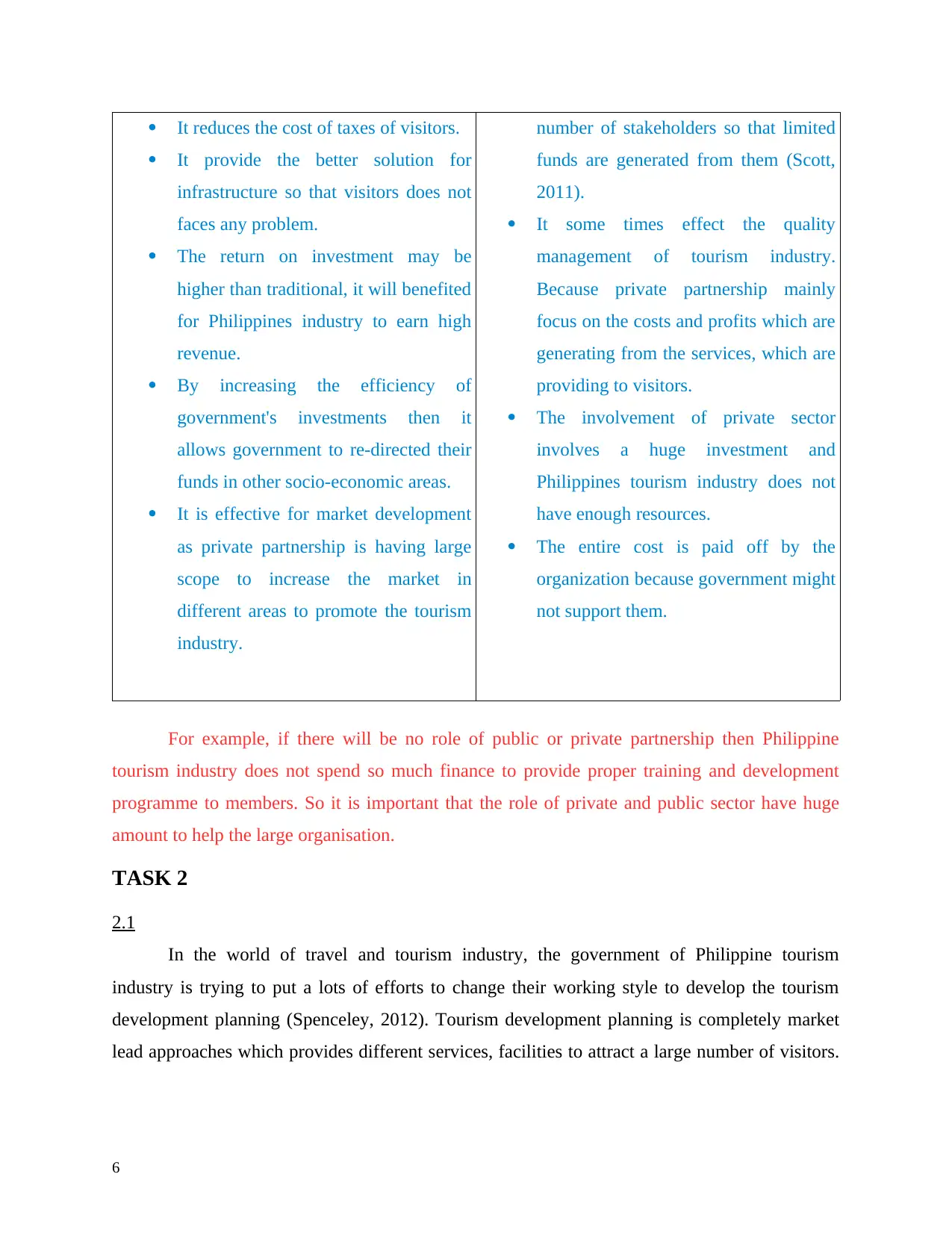
It reduces the cost of taxes of visitors.
It provide the better solution for
infrastructure so that visitors does not
faces any problem.
The return on investment may be
higher than traditional, it will benefited
for Philippines industry to earn high
revenue.
By increasing the efficiency of
government's investments then it
allows government to re-directed their
funds in other socio-economic areas.
It is effective for market development
as private partnership is having large
scope to increase the market in
different areas to promote the tourism
industry.
number of stakeholders so that limited
funds are generated from them (Scott,
2011).
It some times effect the quality
management of tourism industry.
Because private partnership mainly
focus on the costs and profits which are
generating from the services, which are
providing to visitors.
The involvement of private sector
involves a huge investment and
Philippines tourism industry does not
have enough resources.
The entire cost is paid off by the
organization because government might
not support them.
For example, if there will be no role of public or private partnership then Philippine
tourism industry does not spend so much finance to provide proper training and development
programme to members. So it is important that the role of private and public sector have huge
amount to help the large organisation.
TASK 2
2.1
In the world of travel and tourism industry, the government of Philippine tourism
industry is trying to put a lots of efforts to change their working style to develop the tourism
development planning (Spenceley, 2012). Tourism development planning is completely market
lead approaches which provides different services, facilities to attract a large number of visitors.
6
It provide the better solution for
infrastructure so that visitors does not
faces any problem.
The return on investment may be
higher than traditional, it will benefited
for Philippines industry to earn high
revenue.
By increasing the efficiency of
government's investments then it
allows government to re-directed their
funds in other socio-economic areas.
It is effective for market development
as private partnership is having large
scope to increase the market in
different areas to promote the tourism
industry.
number of stakeholders so that limited
funds are generated from them (Scott,
2011).
It some times effect the quality
management of tourism industry.
Because private partnership mainly
focus on the costs and profits which are
generating from the services, which are
providing to visitors.
The involvement of private sector
involves a huge investment and
Philippines tourism industry does not
have enough resources.
The entire cost is paid off by the
organization because government might
not support them.
For example, if there will be no role of public or private partnership then Philippine
tourism industry does not spend so much finance to provide proper training and development
programme to members. So it is important that the role of private and public sector have huge
amount to help the large organisation.
TASK 2
2.1
In the world of travel and tourism industry, the government of Philippine tourism
industry is trying to put a lots of efforts to change their working style to develop the tourism
development planning (Spenceley, 2012). Tourism development planning is completely market
lead approaches which provides different services, facilities to attract a large number of visitors.
6
⊘ This is a preview!⊘
Do you want full access?
Subscribe today to unlock all pages.
Trusted by 1+ million students worldwide
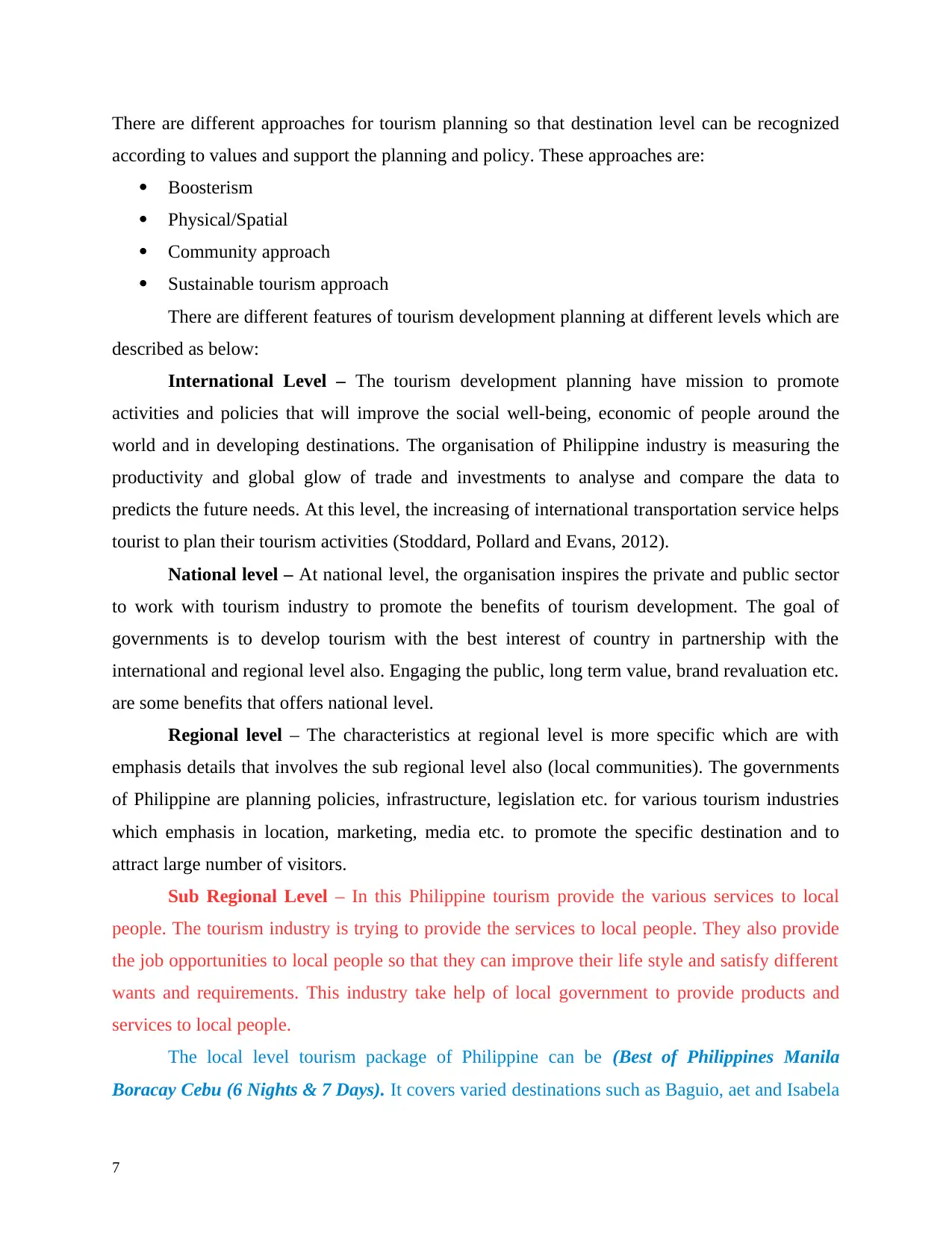
There are different approaches for tourism planning so that destination level can be recognized
according to values and support the planning and policy. These approaches are:
Boosterism
Physical/Spatial
Community approach
Sustainable tourism approach
There are different features of tourism development planning at different levels which are
described as below:
International Level – The tourism development planning have mission to promote
activities and policies that will improve the social well-being, economic of people around the
world and in developing destinations. The organisation of Philippine industry is measuring the
productivity and global glow of trade and investments to analyse and compare the data to
predicts the future needs. At this level, the increasing of international transportation service helps
tourist to plan their tourism activities (Stoddard, Pollard and Evans, 2012).
National level – At national level, the organisation inspires the private and public sector
to work with tourism industry to promote the benefits of tourism development. The goal of
governments is to develop tourism with the best interest of country in partnership with the
international and regional level also. Engaging the public, long term value, brand revaluation etc.
are some benefits that offers national level.
Regional level – The characteristics at regional level is more specific which are with
emphasis details that involves the sub regional level also (local communities). The governments
of Philippine are planning policies, infrastructure, legislation etc. for various tourism industries
which emphasis in location, marketing, media etc. to promote the specific destination and to
attract large number of visitors.
Sub Regional Level – In this Philippine tourism provide the various services to local
people. The tourism industry is trying to provide the services to local people. They also provide
the job opportunities to local people so that they can improve their life style and satisfy different
wants and requirements. This industry take help of local government to provide products and
services to local people.
The local level tourism package of Philippine can be (Best of Philippines Manila
Boracay Cebu (6 Nights & 7 Days). It covers varied destinations such as Baguio, aet and Isabela
7
according to values and support the planning and policy. These approaches are:
Boosterism
Physical/Spatial
Community approach
Sustainable tourism approach
There are different features of tourism development planning at different levels which are
described as below:
International Level – The tourism development planning have mission to promote
activities and policies that will improve the social well-being, economic of people around the
world and in developing destinations. The organisation of Philippine industry is measuring the
productivity and global glow of trade and investments to analyse and compare the data to
predicts the future needs. At this level, the increasing of international transportation service helps
tourist to plan their tourism activities (Stoddard, Pollard and Evans, 2012).
National level – At national level, the organisation inspires the private and public sector
to work with tourism industry to promote the benefits of tourism development. The goal of
governments is to develop tourism with the best interest of country in partnership with the
international and regional level also. Engaging the public, long term value, brand revaluation etc.
are some benefits that offers national level.
Regional level – The characteristics at regional level is more specific which are with
emphasis details that involves the sub regional level also (local communities). The governments
of Philippine are planning policies, infrastructure, legislation etc. for various tourism industries
which emphasis in location, marketing, media etc. to promote the specific destination and to
attract large number of visitors.
Sub Regional Level – In this Philippine tourism provide the various services to local
people. The tourism industry is trying to provide the services to local people. They also provide
the job opportunities to local people so that they can improve their life style and satisfy different
wants and requirements. This industry take help of local government to provide products and
services to local people.
The local level tourism package of Philippine can be (Best of Philippines Manila
Boracay Cebu (6 Nights & 7 Days). It covers varied destinations such as Baguio, aet and Isabela
7
Paraphrase This Document
Need a fresh take? Get an instant paraphrase of this document with our AI Paraphraser
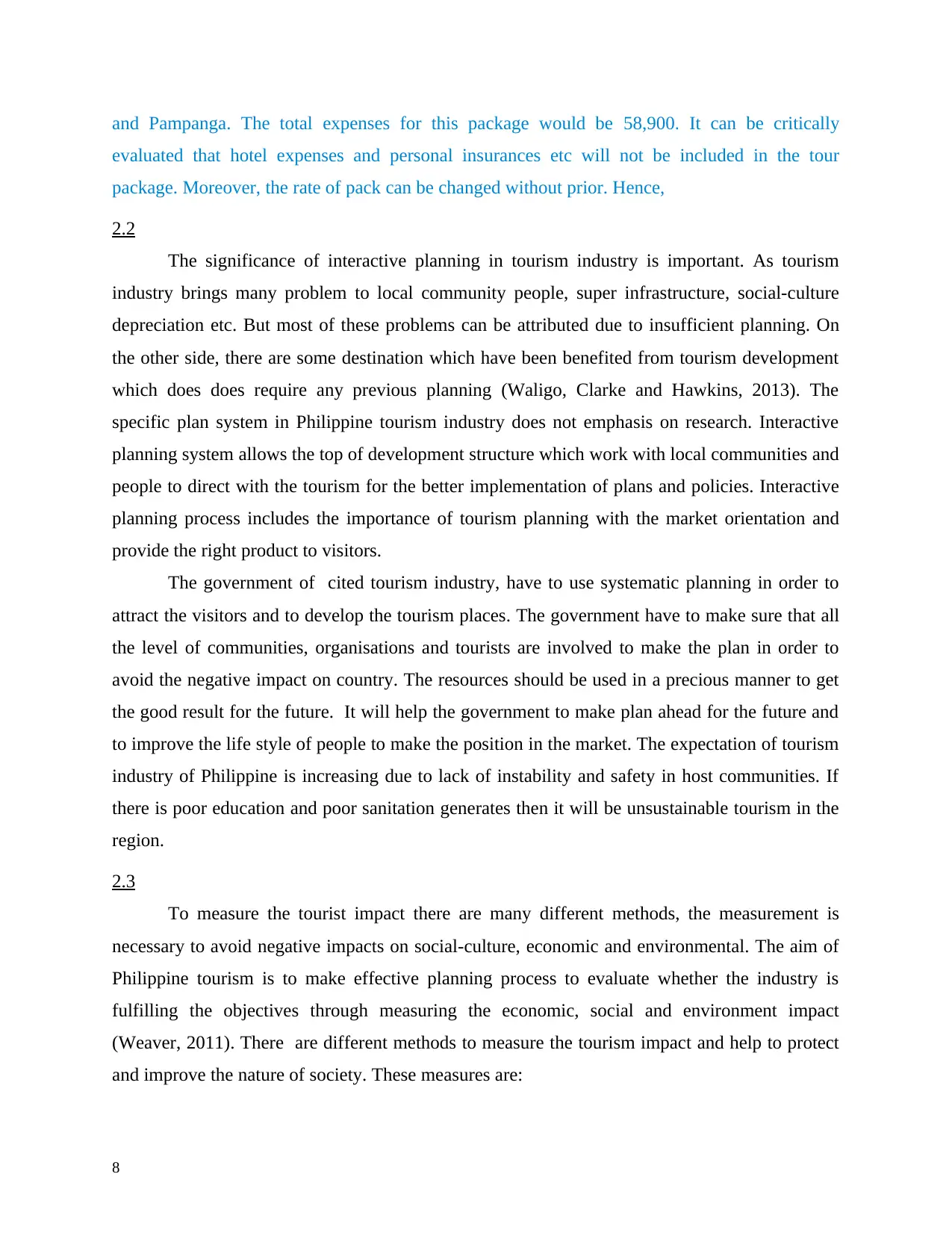
and Pampanga. The total expenses for this package would be 58,900. It can be critically
evaluated that hotel expenses and personal insurances etc will not be included in the tour
package. Moreover, the rate of pack can be changed without prior. Hence,
2.2
The significance of interactive planning in tourism industry is important. As tourism
industry brings many problem to local community people, super infrastructure, social-culture
depreciation etc. But most of these problems can be attributed due to insufficient planning. On
the other side, there are some destination which have been benefited from tourism development
which does does require any previous planning (Waligo, Clarke and Hawkins, 2013). The
specific plan system in Philippine tourism industry does not emphasis on research. Interactive
planning system allows the top of development structure which work with local communities and
people to direct with the tourism for the better implementation of plans and policies. Interactive
planning process includes the importance of tourism planning with the market orientation and
provide the right product to visitors.
The government of cited tourism industry, have to use systematic planning in order to
attract the visitors and to develop the tourism places. The government have to make sure that all
the level of communities, organisations and tourists are involved to make the plan in order to
avoid the negative impact on country. The resources should be used in a precious manner to get
the good result for the future. It will help the government to make plan ahead for the future and
to improve the life style of people to make the position in the market. The expectation of tourism
industry of Philippine is increasing due to lack of instability and safety in host communities. If
there is poor education and poor sanitation generates then it will be unsustainable tourism in the
region.
2.3
To measure the tourist impact there are many different methods, the measurement is
necessary to avoid negative impacts on social-culture, economic and environmental. The aim of
Philippine tourism is to make effective planning process to evaluate whether the industry is
fulfilling the objectives through measuring the economic, social and environment impact
(Weaver, 2011). There are different methods to measure the tourism impact and help to protect
and improve the nature of society. These measures are:
8
evaluated that hotel expenses and personal insurances etc will not be included in the tour
package. Moreover, the rate of pack can be changed without prior. Hence,
2.2
The significance of interactive planning in tourism industry is important. As tourism
industry brings many problem to local community people, super infrastructure, social-culture
depreciation etc. But most of these problems can be attributed due to insufficient planning. On
the other side, there are some destination which have been benefited from tourism development
which does does require any previous planning (Waligo, Clarke and Hawkins, 2013). The
specific plan system in Philippine tourism industry does not emphasis on research. Interactive
planning system allows the top of development structure which work with local communities and
people to direct with the tourism for the better implementation of plans and policies. Interactive
planning process includes the importance of tourism planning with the market orientation and
provide the right product to visitors.
The government of cited tourism industry, have to use systematic planning in order to
attract the visitors and to develop the tourism places. The government have to make sure that all
the level of communities, organisations and tourists are involved to make the plan in order to
avoid the negative impact on country. The resources should be used in a precious manner to get
the good result for the future. It will help the government to make plan ahead for the future and
to improve the life style of people to make the position in the market. The expectation of tourism
industry of Philippine is increasing due to lack of instability and safety in host communities. If
there is poor education and poor sanitation generates then it will be unsustainable tourism in the
region.
2.3
To measure the tourist impact there are many different methods, the measurement is
necessary to avoid negative impacts on social-culture, economic and environmental. The aim of
Philippine tourism is to make effective planning process to evaluate whether the industry is
fulfilling the objectives through measuring the economic, social and environment impact
(Weaver, 2011). There are different methods to measure the tourism impact and help to protect
and improve the nature of society. These measures are:
8
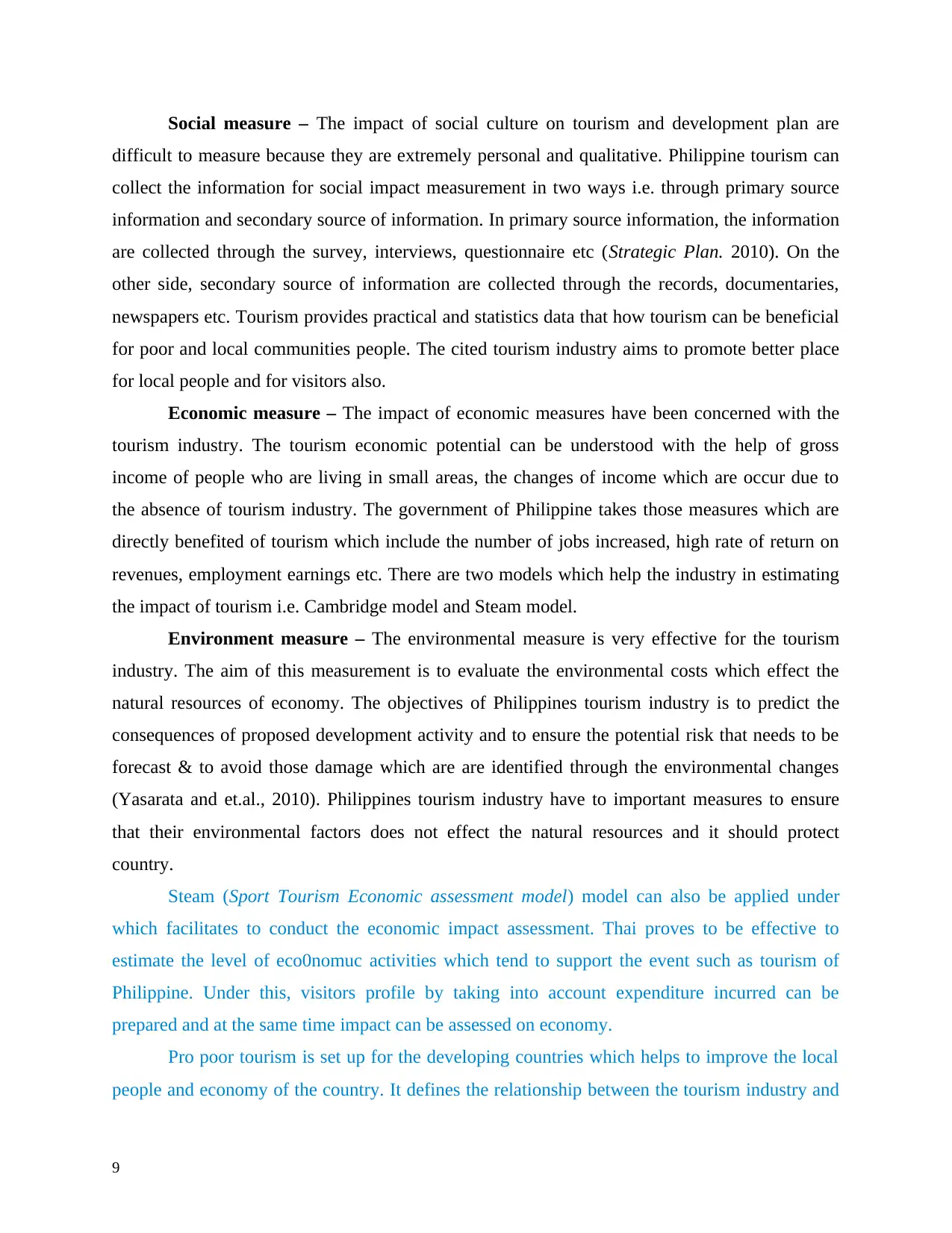
Social measure – The impact of social culture on tourism and development plan are
difficult to measure because they are extremely personal and qualitative. Philippine tourism can
collect the information for social impact measurement in two ways i.e. through primary source
information and secondary source of information. In primary source information, the information
are collected through the survey, interviews, questionnaire etc (Strategic Plan. 2010). On the
other side, secondary source of information are collected through the records, documentaries,
newspapers etc. Tourism provides practical and statistics data that how tourism can be beneficial
for poor and local communities people. The cited tourism industry aims to promote better place
for local people and for visitors also.
Economic measure – The impact of economic measures have been concerned with the
tourism industry. The tourism economic potential can be understood with the help of gross
income of people who are living in small areas, the changes of income which are occur due to
the absence of tourism industry. The government of Philippine takes those measures which are
directly benefited of tourism which include the number of jobs increased, high rate of return on
revenues, employment earnings etc. There are two models which help the industry in estimating
the impact of tourism i.e. Cambridge model and Steam model.
Environment measure – The environmental measure is very effective for the tourism
industry. The aim of this measurement is to evaluate the environmental costs which effect the
natural resources of economy. The objectives of Philippines tourism industry is to predict the
consequences of proposed development activity and to ensure the potential risk that needs to be
forecast & to avoid those damage which are are identified through the environmental changes
(Yasarata and et.al., 2010). Philippines tourism industry have to important measures to ensure
that their environmental factors does not effect the natural resources and it should protect
country.
Steam (Sport Tourism Economic assessment model) model can also be applied under
which facilitates to conduct the economic impact assessment. Thai proves to be effective to
estimate the level of eco0nomuc activities which tend to support the event such as tourism of
Philippine. Under this, visitors profile by taking into account expenditure incurred can be
prepared and at the same time impact can be assessed on economy.
Pro poor tourism is set up for the developing countries which helps to improve the local
people and economy of the country. It defines the relationship between the tourism industry and
9
difficult to measure because they are extremely personal and qualitative. Philippine tourism can
collect the information for social impact measurement in two ways i.e. through primary source
information and secondary source of information. In primary source information, the information
are collected through the survey, interviews, questionnaire etc (Strategic Plan. 2010). On the
other side, secondary source of information are collected through the records, documentaries,
newspapers etc. Tourism provides practical and statistics data that how tourism can be beneficial
for poor and local communities people. The cited tourism industry aims to promote better place
for local people and for visitors also.
Economic measure – The impact of economic measures have been concerned with the
tourism industry. The tourism economic potential can be understood with the help of gross
income of people who are living in small areas, the changes of income which are occur due to
the absence of tourism industry. The government of Philippine takes those measures which are
directly benefited of tourism which include the number of jobs increased, high rate of return on
revenues, employment earnings etc. There are two models which help the industry in estimating
the impact of tourism i.e. Cambridge model and Steam model.
Environment measure – The environmental measure is very effective for the tourism
industry. The aim of this measurement is to evaluate the environmental costs which effect the
natural resources of economy. The objectives of Philippines tourism industry is to predict the
consequences of proposed development activity and to ensure the potential risk that needs to be
forecast & to avoid those damage which are are identified through the environmental changes
(Yasarata and et.al., 2010). Philippines tourism industry have to important measures to ensure
that their environmental factors does not effect the natural resources and it should protect
country.
Steam (Sport Tourism Economic assessment model) model can also be applied under
which facilitates to conduct the economic impact assessment. Thai proves to be effective to
estimate the level of eco0nomuc activities which tend to support the event such as tourism of
Philippine. Under this, visitors profile by taking into account expenditure incurred can be
prepared and at the same time impact can be assessed on economy.
Pro poor tourism is set up for the developing countries which helps to improve the local
people and economy of the country. It defines the relationship between the tourism industry and
9
⊘ This is a preview!⊘
Do you want full access?
Subscribe today to unlock all pages.
Trusted by 1+ million students worldwide
poor people. So that poverty can be reduced and poor people are also able to participate in the
tourism activities. Philippine tourism industry sometimes help the poor people to participate
them in tourism activities.
On the other side, responsible tourism is tell about to make better place for the tourists to
visit them properly. Responsible tourism requires that governments, operators, local people
should take the responsibility to make tourism more sustainable. However, here, management
ensures that all tourism activities are completed effectively with optimum utilization of limited
resources.
10
tourism activities. Philippine tourism industry sometimes help the poor people to participate
them in tourism activities.
On the other side, responsible tourism is tell about to make better place for the tourists to
visit them properly. Responsible tourism requires that governments, operators, local people
should take the responsibility to make tourism more sustainable. However, here, management
ensures that all tourism activities are completed effectively with optimum utilization of limited
resources.
10
Paraphrase This Document
Need a fresh take? Get an instant paraphrase of this document with our AI Paraphraser
TASK 3
11
11
12
⊘ This is a preview!⊘
Do you want full access?
Subscribe today to unlock all pages.
Trusted by 1+ million students worldwide

1 out of 23


Related Documents


Your All-in-One AI-Powered Toolkit for Academic Success.
+13062052269
info@desklib.com
Available 24*7 on WhatsApp / Email
![[object Object]](/_next/static/media/star-bottom.7253800d.svg)
Unlock your academic potential
Copyright © 2020–2026 A2Z Services. All Rights Reserved. Developed and managed by ZUCOL.