Analysis of Tourism Planning Failures and Strategies for Improvement
VerifiedAdded on 2020/02/03
|11
|3924
|355
Report
AI Summary
This report delves into the failures of tourism planning, examining both internal and external factors that contribute to these setbacks. It explores how issues such as natural disasters, political instability, and poor infrastructure can negatively impact a destination's appeal and sustainability. The report highlights the importance of sustainable tourism practices, emphasizing the need for responsible resource management, preservation of cultural and historical sites, and effective communication. It also discusses the role of government, local communities, and the hospitality industry in mitigating planning failures and promoting long-term tourism success. The analysis covers impacts of tourism development, including environmental damage and congestion, and suggests strategies for improvement, such as enhanced transportation, improved services, and effective promotion of a destination's unique attributes to attract tourists and boost the local economy while ensuring sustainability.
SUSTAINABLE TOURISM
DEVELOPMENT AND PLANNING
DEVELOPMENT AND PLANNING

Paraphrase This Document
Need a fresh take? Get an instant paraphrase of this document with our AI Paraphraser
TOURISM PLANNING FAILURE AND WAYS TO OVERCOME
From the view point of Liburd and Edwards (2010) failure of plans in tourism industry is
not a new concept as it is exactly the same that sometimes how business ventures are not able to
meet their expectations. Sometimes, plans get wrong and as a result of the same mistakes and
various shortcomings come under the planning process. Cai and Wang (2010) argued that, due to
their bad environment and working policies, country is not able to attract more of the audience
and due to this their popularity is decreasing subsequently. Natural disaster, calamities, flood and
different happening and non-happening event impact the tourism planning failure.
According to Lee (2013) sustainable tourism is a concept of visiting a venue or location
as a tourist and emphasize on making a positive impact on environment, society as well as
economy. Sustainable tourism is a broader concept regarding the tourism development and
achieving this objective is a major subject of debate for the individuals. Further, author has also
described that without travel, there will be no tourism and idea of sustainable tourism is linked
up with the concept of sustainable mobility. However, government is also taking necessary steps
to promote tourism so that goodwill of the country can be enhanced and people can get more of
the attraction towards the natural beauty of city. It is because local body is focusing on various
infrastructural and construction work so that travellers won't face any sort of problem in order to
cover distance from one place to another.
From the view point of Yasarata and et.al., (2010), tourism is a scope of success and with
more tourists, there will be more GDP and earnings for the country. People will tend to spend
more if their income level is high and they will come to see the natural beauty, historical
monuments and other specialties of city. By this, more employment will be generated which will
contribute towards the development of society as well as nation. However, Briassoulis and
Straaten (2013) argued that there exists many reasons behind the tourism planning failure and
due to this, popularity of particular city or location gets faded. In relation to this, less tourists
prefer to go to that destination and it influences the earning as well as development of that place.
Further, tourism will never be completely sustainable if each and every industry will have its
impact on it. Therefore, these industries can contribute their best in order give the best result to
their nation and with that sustainability will be maintained with ease and comfort.
However, failure of plans within the tourism industry is not a rare instance as many
times, plans can go wrong and due to this, there exists a huge impact on external environment of
2
From the view point of Liburd and Edwards (2010) failure of plans in tourism industry is
not a new concept as it is exactly the same that sometimes how business ventures are not able to
meet their expectations. Sometimes, plans get wrong and as a result of the same mistakes and
various shortcomings come under the planning process. Cai and Wang (2010) argued that, due to
their bad environment and working policies, country is not able to attract more of the audience
and due to this their popularity is decreasing subsequently. Natural disaster, calamities, flood and
different happening and non-happening event impact the tourism planning failure.
According to Lee (2013) sustainable tourism is a concept of visiting a venue or location
as a tourist and emphasize on making a positive impact on environment, society as well as
economy. Sustainable tourism is a broader concept regarding the tourism development and
achieving this objective is a major subject of debate for the individuals. Further, author has also
described that without travel, there will be no tourism and idea of sustainable tourism is linked
up with the concept of sustainable mobility. However, government is also taking necessary steps
to promote tourism so that goodwill of the country can be enhanced and people can get more of
the attraction towards the natural beauty of city. It is because local body is focusing on various
infrastructural and construction work so that travellers won't face any sort of problem in order to
cover distance from one place to another.
From the view point of Yasarata and et.al., (2010), tourism is a scope of success and with
more tourists, there will be more GDP and earnings for the country. People will tend to spend
more if their income level is high and they will come to see the natural beauty, historical
monuments and other specialties of city. By this, more employment will be generated which will
contribute towards the development of society as well as nation. However, Briassoulis and
Straaten (2013) argued that there exists many reasons behind the tourism planning failure and
due to this, popularity of particular city or location gets faded. In relation to this, less tourists
prefer to go to that destination and it influences the earning as well as development of that place.
Further, tourism will never be completely sustainable if each and every industry will have its
impact on it. Therefore, these industries can contribute their best in order give the best result to
their nation and with that sustainability will be maintained with ease and comfort.
However, failure of plans within the tourism industry is not a rare instance as many
times, plans can go wrong and due to this, there exists a huge impact on external environment of
2
that particular city. These failures can arise either through internal or external impact. Some of
the external causes are threat of terrorism, environmental disasters, health concerns, weather
conditions, etc. If terrorist attack on world trade centre (WTC) Twin Tower, New York is taken
into consideration, then one can feel that it has negative impact on country's growth and
development. Mistakes are also seen at the time of planning process as wrong planning can
impact the environment as well as working of individuals who are contributing their best for the
development of particular territorial division (Failure of Plans in Tourism: reasons and
consequences, 2014). Another instance which can be taken into consideration is of Egypt where
Ancient Pyramids is centre of attraction and people from around the globe come to see the
beauty of the nation. But due to current political instability, it has an external impact on the
country growth and development and the volume of tourist has also reduced.
According to Ruhanen (2013), more regions and countries are focusing in developing
their tourism industry so it results into significant impact on natural resources, pollution level,
consumption patterns and different others. Further, resources are limited in nature and due to
this, residents along with government need to take relevant steps in order to utilize these
resources with best of the efforts and minimum wastage. Apart from it, lack of tourism planning
can lead towards various impacts which can hamper the image of nation. There are some impacts
of tourism development like damage or permanent alteration to physical environment by cutting
of trees, wastage of water, increasing air pollution, etc.
Furthermore, damage of historical as well as cultural landmarks and resources also leads
towards poor tourism planning. Tourist usually comes to see the natural beauty of nation and if
they see the bad condition of attractive tourist places then it will have negative impact on their
mind and they will spread the same thing to the people of their country.
Increasing population of city makes the city as more congested place and due to this,
travellers less prefer to go there. The lanes have been congested and travellers who came from
cities like which has less population feels hectic and they do not prefer to go to such places.
Pollution and traffic problems are another issues which are distracting individuals to not
visit that place as it will affect their health to a great extent. The traffic problem has significantly
increased and travellers can get frustrate if they are stuck in traffic for longer time period.
Further, Liburd and Edwards (2010) argued that environment of one nation differs from
another and local body of particular country needs to take relevant steps in order to improve the
3
the external causes are threat of terrorism, environmental disasters, health concerns, weather
conditions, etc. If terrorist attack on world trade centre (WTC) Twin Tower, New York is taken
into consideration, then one can feel that it has negative impact on country's growth and
development. Mistakes are also seen at the time of planning process as wrong planning can
impact the environment as well as working of individuals who are contributing their best for the
development of particular territorial division (Failure of Plans in Tourism: reasons and
consequences, 2014). Another instance which can be taken into consideration is of Egypt where
Ancient Pyramids is centre of attraction and people from around the globe come to see the
beauty of the nation. But due to current political instability, it has an external impact on the
country growth and development and the volume of tourist has also reduced.
According to Ruhanen (2013), more regions and countries are focusing in developing
their tourism industry so it results into significant impact on natural resources, pollution level,
consumption patterns and different others. Further, resources are limited in nature and due to
this, residents along with government need to take relevant steps in order to utilize these
resources with best of the efforts and minimum wastage. Apart from it, lack of tourism planning
can lead towards various impacts which can hamper the image of nation. There are some impacts
of tourism development like damage or permanent alteration to physical environment by cutting
of trees, wastage of water, increasing air pollution, etc.
Furthermore, damage of historical as well as cultural landmarks and resources also leads
towards poor tourism planning. Tourist usually comes to see the natural beauty of nation and if
they see the bad condition of attractive tourist places then it will have negative impact on their
mind and they will spread the same thing to the people of their country.
Increasing population of city makes the city as more congested place and due to this,
travellers less prefer to go there. The lanes have been congested and travellers who came from
cities like which has less population feels hectic and they do not prefer to go to such places.
Pollution and traffic problems are another issues which are distracting individuals to not
visit that place as it will affect their health to a great extent. The traffic problem has significantly
increased and travellers can get frustrate if they are stuck in traffic for longer time period.
Further, Liburd and Edwards (2010) argued that environment of one nation differs from
another and local body of particular country needs to take relevant steps in order to improve the
3
⊘ This is a preview!⊘
Do you want full access?
Subscribe today to unlock all pages.

Trusted by 1+ million students worldwide
conditions which are prevailing there. Conditions are the same which has been discussed in
above topic like increasing population, traffic, political instability, etc. Further, there exists less
accessibility to some of the destinations and this distracts travellers as they need to cover long
distance due to bad transportation facilities. This lack in transportation facilities act as a planning
failure. Government of nation has to take necessary step in order improve the transportation
facility by development of new roads, bridges, routes, etc. as this will give more satisfaction to
the travellers.
Apart from it, situation also arises in which local residents dislike tourists because they
impact the natural beauty and environment. Travellers comes from different country and they are
not familiar of rules and regulations of country in which they are travelling. Therefore, travellers
need to maintain the dignity of the same and should consider the tradition and culture of nation
where they are travelling too.
Further, individuals do not have effective skills who are giving their services in the
hospitality sector and due to this, there exists lack of communication between the travellers and
employees. With this, people who stay in hotel become unsatisfied and they do not prefer to
come back to country again.
Moreover, there is one major cause that relates with lack of awareness of the benefits of
tourism as a destination area. Government of country needs to take initiative in order to promote
natural beauty and other historic monuments of the country in order to attract more of the tourist
for the same. This will contribute in increase in GDP and also in growth and development of
nation
Bramwell and Lane (2010) stated that apart from development point of view, some
countries do not have effective attractions as well as events and due to this, travellers do not
concentrate on visiting that place at all. This is considered as an issue only because if country do
not have anything to promote then they will not be able to attract tourists for the same. Further,
sometimes tourists stay for less time period and due to this, they are not able to see the whole
natural beauty of a particular nation. Seasonality also impacts the visit of travellers as with bad
monsoon or whether, they focus less on visiting that place. Apart from it, if individuals get poor
or bad quality of services and facilities then it will influence them to not visit that city again.
This also declines the image of particular city or nation in the eyes of travellers and country from
where they come to visit as after travelling, they will talk about the negativity of tourist
4
above topic like increasing population, traffic, political instability, etc. Further, there exists less
accessibility to some of the destinations and this distracts travellers as they need to cover long
distance due to bad transportation facilities. This lack in transportation facilities act as a planning
failure. Government of nation has to take necessary step in order improve the transportation
facility by development of new roads, bridges, routes, etc. as this will give more satisfaction to
the travellers.
Apart from it, situation also arises in which local residents dislike tourists because they
impact the natural beauty and environment. Travellers comes from different country and they are
not familiar of rules and regulations of country in which they are travelling. Therefore, travellers
need to maintain the dignity of the same and should consider the tradition and culture of nation
where they are travelling too.
Further, individuals do not have effective skills who are giving their services in the
hospitality sector and due to this, there exists lack of communication between the travellers and
employees. With this, people who stay in hotel become unsatisfied and they do not prefer to
come back to country again.
Moreover, there is one major cause that relates with lack of awareness of the benefits of
tourism as a destination area. Government of country needs to take initiative in order to promote
natural beauty and other historic monuments of the country in order to attract more of the tourist
for the same. This will contribute in increase in GDP and also in growth and development of
nation
Bramwell and Lane (2010) stated that apart from development point of view, some
countries do not have effective attractions as well as events and due to this, travellers do not
concentrate on visiting that place at all. This is considered as an issue only because if country do
not have anything to promote then they will not be able to attract tourists for the same. Further,
sometimes tourists stay for less time period and due to this, they are not able to see the whole
natural beauty of a particular nation. Seasonality also impacts the visit of travellers as with bad
monsoon or whether, they focus less on visiting that place. Apart from it, if individuals get poor
or bad quality of services and facilities then it will influence them to not visit that city again.
This also declines the image of particular city or nation in the eyes of travellers and country from
where they come to visit as after travelling, they will talk about the negativity of tourist
4
Paraphrase This Document
Need a fresh take? Get an instant paraphrase of this document with our AI Paraphraser
destination to the people of their country. Further, if bad or improper information is given to the
travellers then it will adversely affect the growth of nation and due to this, tourists will not
emphasize on staying for long time period in that country.
These are the main reasons which lead towards the tourism planning failure and due to
this, less travellers tend to visit these places. Cai and Wang (2010) argued that tourism industry
is also much more complex and diverse. Therefore, hospitality ventures along with government
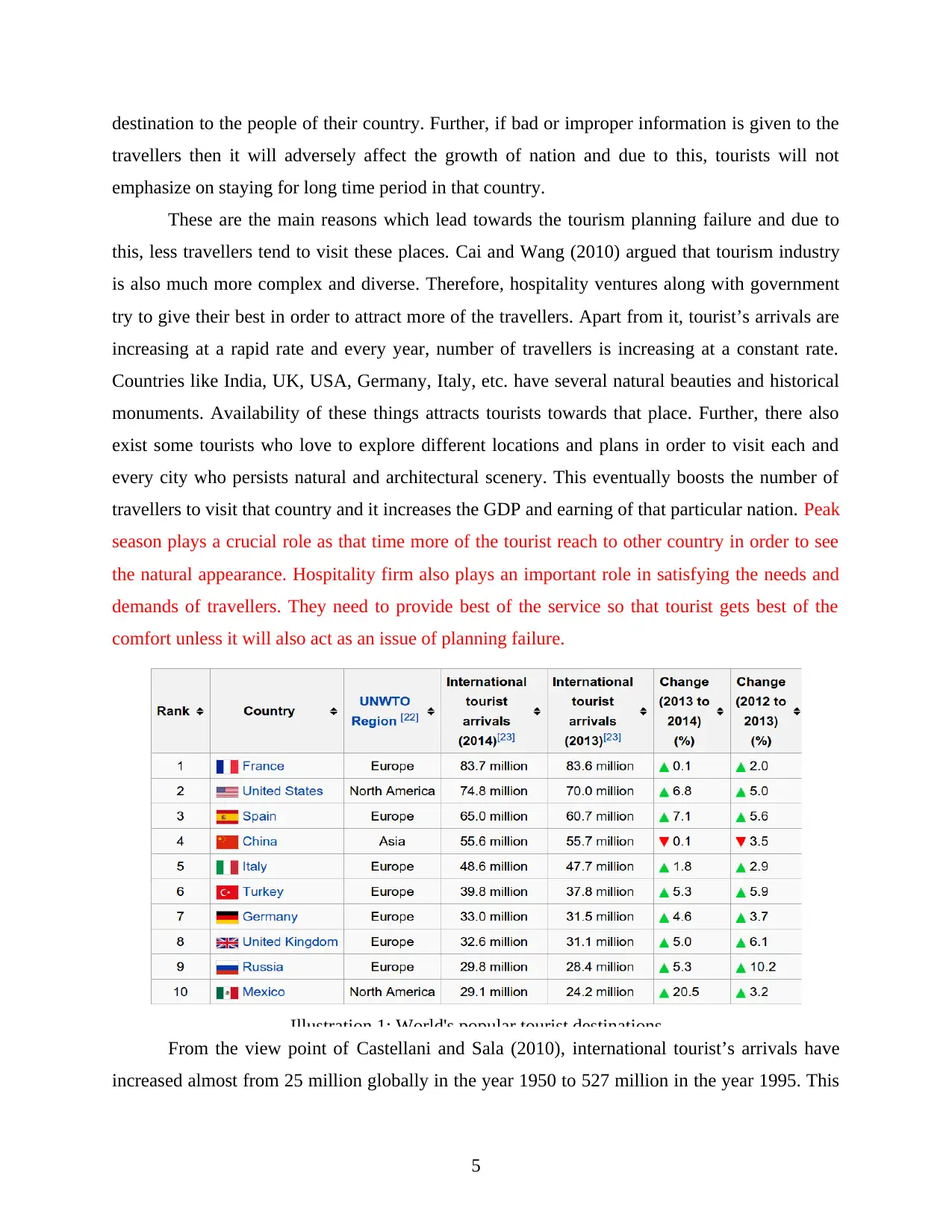
try to give their best in order to attract more of the travellers. Apart from it, tourist’s arrivals are
increasing at a rapid rate and every year, number of travellers is increasing at a constant rate.
Countries like India, UK, USA, Germany, Italy, etc. have several natural beauties and historical
monuments. Availability of these things attracts tourists towards that place. Further, there also
exist some tourists who love to explore different locations and plans in order to visit each and
every city who persists natural and architectural scenery. This eventually boosts the number of
travellers to visit that country and it increases the GDP and earning of that particular nation. Peak
season plays a crucial role as that time more of the tourist reach to other country in order to see
the natural appearance. Hospitality firm also plays an important role in satisfying the needs and
demands of travellers. They need to provide best of the service so that tourist gets best of the
comfort unless it will also act as an issue of planning failure.
Illustration 1: World's popular tourist destinations
From the view point of Castellani and Sala (2010), international tourist’s arrivals have
increased almost from 25 million globally in the year 1950 to 527 million in the year 1995. This
5
travellers then it will adversely affect the growth of nation and due to this, tourists will not
emphasize on staying for long time period in that country.
These are the main reasons which lead towards the tourism planning failure and due to
this, less travellers tend to visit these places. Cai and Wang (2010) argued that tourism industry
is also much more complex and diverse. Therefore, hospitality ventures along with government
try to give their best in order to attract more of the travellers. Apart from it, tourist’s arrivals are
increasing at a rapid rate and every year, number of travellers is increasing at a constant rate.
Countries like India, UK, USA, Germany, Italy, etc. have several natural beauties and historical
monuments. Availability of these things attracts tourists towards that place. Further, there also
exist some tourists who love to explore different locations and plans in order to visit each and
every city who persists natural and architectural scenery. This eventually boosts the number of
travellers to visit that country and it increases the GDP and earning of that particular nation. Peak
season plays a crucial role as that time more of the tourist reach to other country in order to see
the natural appearance. Hospitality firm also plays an important role in satisfying the needs and
demands of travellers. They need to provide best of the service so that tourist gets best of the
comfort unless it will also act as an issue of planning failure.
Illustration 1: World's popular tourist destinations
From the view point of Castellani and Sala (2010), international tourist’s arrivals have
increased almost from 25 million globally in the year 1950 to 527 million in the year 1995. This
5
figure is expected to reach around 1.8 billion by the year 2030. Further, average international
tourist receipt increased more than US$ 700/ person and tourists spent more than $1.4 trillion on
travelling. Further, with the help of it, global travel and tourism industry puts emphasize on
creating approx. 11% of world's employment. Furthermore, hospitality firms are the one which
enjoy major share of the traveller’s spending as people invest more of their money for food and
accommodation. Charges of these differ from one hospitality firm to another and also from one
country to other. With more of the travellers, more electricity, water and other resources are
consumed which are literally scare in nature. Proper precautions are needed to be taken by the
hospitality venture to improve their revenue and profits.
Apart from it, Buckley (2012) stated that various tour operating firms are also giving
their best output to promote the natural beauty of nation. Organizations like Thomas Cook, Trip
advisor etc. emphasize on generating tour packages for their travellers and focus on giving them
the best of comfort. Further, this makes easy for tourists as they only have to pay for once and
then, they do not have to take care of their accommodation or food facility. After that, it becomes
the responsibility of those people who arrange the trip. However, before planning any of the
holiday package, these organizations take care of the internal and external environment
prevailing in that country and as per that review, they emphasize on attracting the individuals so
that they can get the best responses from the travellers. Moreover, Lozano-Oyola and et.al (2012)
also supported that different hotels and restaurants throughout the world have tie up with these
cities and organization contacts them when they plan any tour package for that country. Different
sorts of discounts are also allowed to the tour operating firms and this results in earning for both
the hospitality ventures as well as tour operators.
However, it is also evaluated that strategic and integrated tourism planning has five
important purposes. First of all is that it identifies alternative approaches related to the
marketing, development, tourism awareness, support different activities and services etc.
Secondly, tourism planning focuses on unexpected general economic conditions, values and life
styles, external environment of the country, etc. Thirdly, it leads to make uniqueness in the
natural features and resources, local culture and architecture, historical monuments and
landmarks, parks and outdoor sporting arena and different other characteristics of the destination
area (Sustainable Tourism, 2014). Next purpose is related to create high level of consciousness
of both the awareness as well as benefit of tourism, clear and positive image of area as a tourism
6
tourist receipt increased more than US$ 700/ person and tourists spent more than $1.4 trillion on
travelling. Further, with the help of it, global travel and tourism industry puts emphasize on
creating approx. 11% of world's employment. Furthermore, hospitality firms are the one which
enjoy major share of the traveller’s spending as people invest more of their money for food and
accommodation. Charges of these differ from one hospitality firm to another and also from one
country to other. With more of the travellers, more electricity, water and other resources are
consumed which are literally scare in nature. Proper precautions are needed to be taken by the
hospitality venture to improve their revenue and profits.
Apart from it, Buckley (2012) stated that various tour operating firms are also giving
their best output to promote the natural beauty of nation. Organizations like Thomas Cook, Trip
advisor etc. emphasize on generating tour packages for their travellers and focus on giving them
the best of comfort. Further, this makes easy for tourists as they only have to pay for once and
then, they do not have to take care of their accommodation or food facility. After that, it becomes
the responsibility of those people who arrange the trip. However, before planning any of the
holiday package, these organizations take care of the internal and external environment
prevailing in that country and as per that review, they emphasize on attracting the individuals so
that they can get the best responses from the travellers. Moreover, Lozano-Oyola and et.al (2012)
also supported that different hotels and restaurants throughout the world have tie up with these
cities and organization contacts them when they plan any tour package for that country. Different
sorts of discounts are also allowed to the tour operating firms and this results in earning for both
the hospitality ventures as well as tour operators.
However, it is also evaluated that strategic and integrated tourism planning has five
important purposes. First of all is that it identifies alternative approaches related to the
marketing, development, tourism awareness, support different activities and services etc.
Secondly, tourism planning focuses on unexpected general economic conditions, values and life
styles, external environment of the country, etc. Thirdly, it leads to make uniqueness in the
natural features and resources, local culture and architecture, historical monuments and
landmarks, parks and outdoor sporting arena and different other characteristics of the destination
area (Sustainable Tourism, 2014). Next purpose is related to create high level of consciousness
of both the awareness as well as benefit of tourism, clear and positive image of area as a tourism
6
⊘ This is a preview!⊘
Do you want full access?
Subscribe today to unlock all pages.
Trusted by 1+ million students worldwide
destination, effective marketing and introduction of travel information programme. At last,
tourism planning should focus on avoiding unnecessary competition among individual tour
operators as this can pamper the image of city or nation. Further, loss of market share and
cultural identities are other drastic factors.
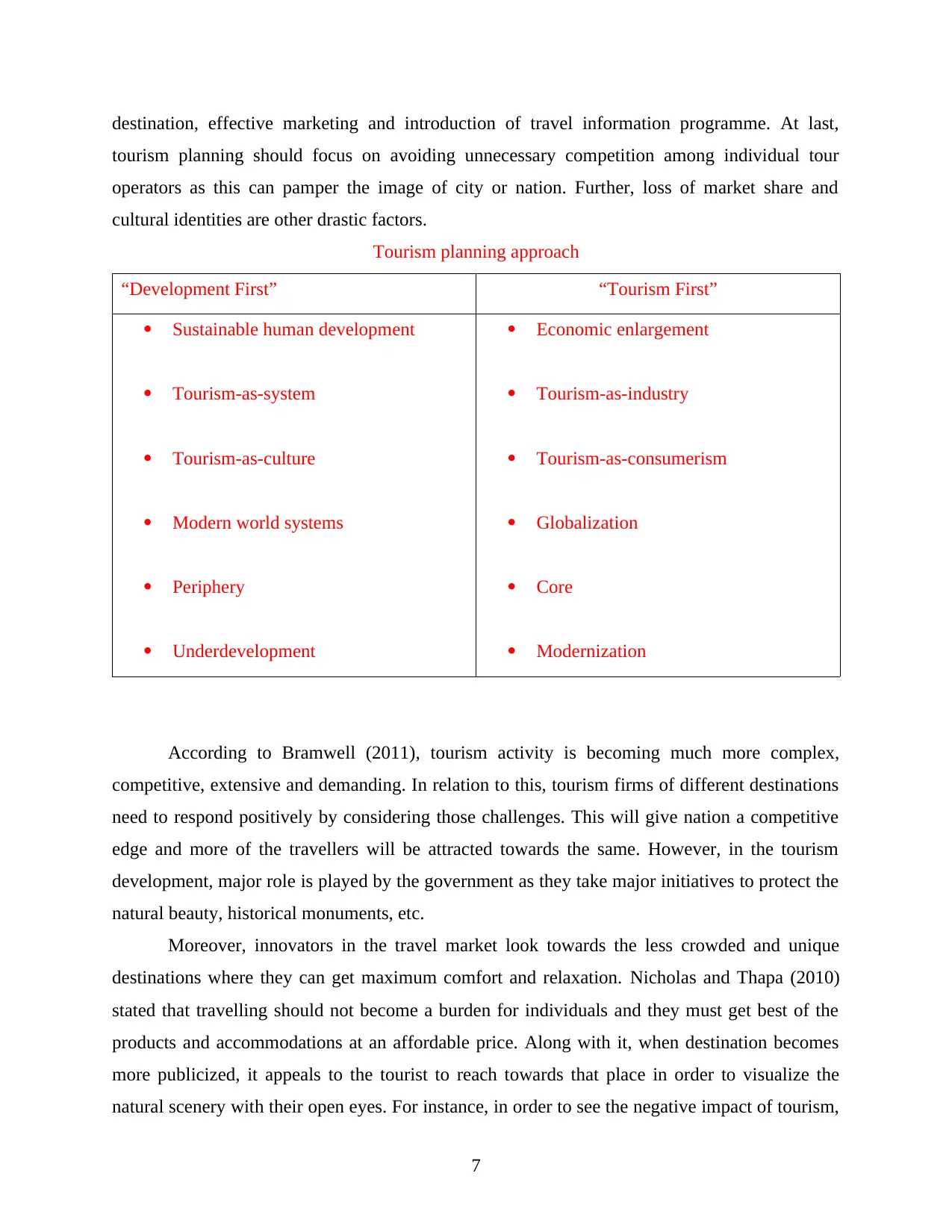
Tourism planning approach
“Development First” “Tourism First”
Sustainable human development
Tourism-as-system
Tourism-as-culture
Modern world systems
Periphery
Underdevelopment
Economic enlargement
Tourism-as-industry
Tourism-as-consumerism
Globalization
Core
Modernization
According to Bramwell (2011), tourism activity is becoming much more complex,
competitive, extensive and demanding. In relation to this, tourism firms of different destinations
need to respond positively by considering those challenges. This will give nation a competitive
edge and more of the travellers will be attracted towards the same. However, in the tourism
development, major role is played by the government as they take major initiatives to protect the
natural beauty, historical monuments, etc.
Moreover, innovators in the travel market look towards the less crowded and unique
destinations where they can get maximum comfort and relaxation. Nicholas and Thapa (2010)
stated that travelling should not become a burden for individuals and they must get best of the
products and accommodations at an affordable price. Along with it, when destination becomes
more publicized, it appeals to the tourist to reach towards that place in order to visualize the
natural scenery with their open eyes. For instance, in order to see the negative impact of tourism,
7
tourism planning should focus on avoiding unnecessary competition among individual tour
operators as this can pamper the image of city or nation. Further, loss of market share and
cultural identities are other drastic factors.
Tourism planning approach
“Development First” “Tourism First”
Sustainable human development
Tourism-as-system
Tourism-as-culture
Modern world systems
Periphery
Underdevelopment
Economic enlargement
Tourism-as-industry
Tourism-as-consumerism
Globalization
Core
Modernization
According to Bramwell (2011), tourism activity is becoming much more complex,
competitive, extensive and demanding. In relation to this, tourism firms of different destinations
need to respond positively by considering those challenges. This will give nation a competitive
edge and more of the travellers will be attracted towards the same. However, in the tourism
development, major role is played by the government as they take major initiatives to protect the
natural beauty, historical monuments, etc.
Moreover, innovators in the travel market look towards the less crowded and unique
destinations where they can get maximum comfort and relaxation. Nicholas and Thapa (2010)
stated that travelling should not become a burden for individuals and they must get best of the
products and accommodations at an affordable price. Along with it, when destination becomes
more publicized, it appeals to the tourist to reach towards that place in order to visualize the
natural scenery with their open eyes. For instance, in order to see the negative impact of tourism,
7
Paraphrase This Document
Need a fresh take? Get an instant paraphrase of this document with our AI Paraphraser
case of Egypt can be taken into consideration as Egyptians pyramids have attracted a large
number of tourists towards it (Wheeler and Beatley, 2014). Further, it was one of the major
tourism destinations for many centuries as it has given major source of revenue to both the local
business ventures and government of Egypt. However, political stability in Egypt has become a
major problem and it has impacted the tourism industry to a higher extent. This political unrest
has reduced the number of tourists over 33% within a year as compared with the previous year.
Further, with the political unrest, the parties are not stable and it having high damaging impact
on the tourism industry.
According to Moscardo (2011), every city has their own natural beauty and it differs
from one nation to other. Majorly, individuals who have high income and old age people love to
travel more because they have more to spend. Further, with the availability of more travellers in
a city, more GDP can be generated and it will also give employment to the individuals who are
without jobs. Further, good behaviour of guides will also promote the natural beauty as it will
give the best guidance to the tourists who are coming from far places. These tourists do not have
much information about the country but still they travel and therefore, guide plays a crucial role
in extending their knowledge regarding particular country. The good behaviour of guides will
satisfy the tourist as they have been treated good and this will surely increase the popularity of
the nation.
Furthermore, Spenceley (2012) stated that sustainable tourism is all about reinforcing and
adapting new things. Further, a balance needs to be found between the limits and usage so that
continuous changing and planning can be done for effective tourism management. Long term
planning is also required and change must be gradual, cumulative and irreversible. Travellers
who are coming from different countries also need to perform their social responsibility in order
to protect and preserve the environment. Sustainable tourism can reduce this impact in many
different ways and some of them have been studied further. In this context, tourists can be
informed regarding the culture, economy and tradition which prevail in the country. Further,
supporting the integrity of local culture by the organizations who work on conserving the
cultural, heritage and different traditional values. Major aim should be on reducing the harmful
waste which hampers the environment as well as nation.
On the contrary side, Weaver (2012) argued that many governments as well as supportive
organizations act as the stakeholders for country and their main aim is to preserve and protect the
8
number of tourists towards it (Wheeler and Beatley, 2014). Further, it was one of the major
tourism destinations for many centuries as it has given major source of revenue to both the local
business ventures and government of Egypt. However, political stability in Egypt has become a
major problem and it has impacted the tourism industry to a higher extent. This political unrest
has reduced the number of tourists over 33% within a year as compared with the previous year.
Further, with the political unrest, the parties are not stable and it having high damaging impact
on the tourism industry.
According to Moscardo (2011), every city has their own natural beauty and it differs
from one nation to other. Majorly, individuals who have high income and old age people love to
travel more because they have more to spend. Further, with the availability of more travellers in
a city, more GDP can be generated and it will also give employment to the individuals who are
without jobs. Further, good behaviour of guides will also promote the natural beauty as it will
give the best guidance to the tourists who are coming from far places. These tourists do not have
much information about the country but still they travel and therefore, guide plays a crucial role
in extending their knowledge regarding particular country. The good behaviour of guides will
satisfy the tourist as they have been treated good and this will surely increase the popularity of
the nation.
Furthermore, Spenceley (2012) stated that sustainable tourism is all about reinforcing and
adapting new things. Further, a balance needs to be found between the limits and usage so that
continuous changing and planning can be done for effective tourism management. Long term
planning is also required and change must be gradual, cumulative and irreversible. Travellers
who are coming from different countries also need to perform their social responsibility in order
to protect and preserve the environment. Sustainable tourism can reduce this impact in many
different ways and some of them have been studied further. In this context, tourists can be
informed regarding the culture, economy and tradition which prevail in the country. Further,
supporting the integrity of local culture by the organizations who work on conserving the
cultural, heritage and different traditional values. Major aim should be on reducing the harmful
waste which hampers the environment as well as nation.
On the contrary side, Weaver (2012) argued that many governments as well as supportive
organizations act as the stakeholders for country and their main aim is to preserve and protect the
8
natural beauty of e nation. If this is maintained effectively then large number of travellers will
focus on visiting the city every year. This will result into more of the tourist's attraction and
people who are visiting in such countries will promote to the nation at their home country.
Different problems need to be overcome as well within specific time period as delaying them
will pamper the goodwill of nation. Further, traffic and increasing population are the major
concerns for the government of developing countries (Scott, 2011). Local body should take
active participation in the construction of elevated roads as it will reduce the traffic within the
city and it will give tourists a better position to roam within the city without any sort of problem
and consequence. Government can see this as development of point of view and it can be linked
with the tourism planning. Popularity of nation can be done by promoting the country's natural
heritage and culture.
Therefore, from the above report, it is clearly evident that there exists many reasons
behind the tourism planning failure and these need to be overcome within specific time period in
order to maintain the image of city and nation in the eyes of travellers. Government should also
take relative steps to protect and conserve the natural beauties.
9
focus on visiting the city every year. This will result into more of the tourist's attraction and
people who are visiting in such countries will promote to the nation at their home country.
Different problems need to be overcome as well within specific time period as delaying them
will pamper the goodwill of nation. Further, traffic and increasing population are the major
concerns for the government of developing countries (Scott, 2011). Local body should take
active participation in the construction of elevated roads as it will reduce the traffic within the
city and it will give tourists a better position to roam within the city without any sort of problem
and consequence. Government can see this as development of point of view and it can be linked
with the tourism planning. Popularity of nation can be done by promoting the country's natural
heritage and culture.
Therefore, from the above report, it is clearly evident that there exists many reasons
behind the tourism planning failure and these need to be overcome within specific time period in
order to maintain the image of city and nation in the eyes of travellers. Government should also
take relative steps to protect and conserve the natural beauties.
9
⊘ This is a preview!⊘
Do you want full access?
Subscribe today to unlock all pages.
Trusted by 1+ million students worldwide
REFERENCES
Journals and Books
Bramwell, B. and Lane, B., 2010. Sustainable tourism and the evolving roles of government
planning. Journal of Sustainable Tourism. 18(1). pp.1-5.
Bramwell, B., 2011. Governance, the state and sustainable tourism: A political economy
approach. Journal of Sustainable Tourism. 19(4-5). pp.459-477.
Briassoulis, H. and Straaten, J., 2013. Tourism and the environment: regional, economic,
cultural and policy issues. Springer Science & Business Media.
Buckley, R., 2012. Sustainable tourism: Research and reality. Annals of Tourism Research.
39(2). pp.528-546.
Cai, M. and WANG, Y. M., 2010. Low-carbon Tourism: A New Mode of Tourism Development
[J]. Tourism Tribune. 1(5). pp.13-17.
Castellani, V. and Sala, S., 2010. Sustainable performance index for tourism policy development.
Tourism management. 31(6). pp.871-880.
Lee, T. H., 2013. Influence analysis of community resident support for sustainable tourism
development. Tourism Management. 34. pp.37-46.
Liburd, J. J. and Edwards, D., 2010. Understanding the sustainable development of tourism.
Oxford: Goodfellow.
Lozano-Oyola, M. and et.al., 2012. Sustainable tourism indicators as planning tools in cultural
destinations. Ecological Indicators. 18. pp.659-675.
Moscardo, G., 2011. Exploring social representations of tourism planning: Issues for governance.
Journal of Sustainable Tourism. 19(4-5). pp.423-436.
Nicholas, L. and Thapa, B., 2010. Visitor perspectives on sustainable tourism development in the
pitons management area world heritage site, St. Lucia. Environment, Development and
Sustainability. 12(5). pp.839-857.
Ruhanen, L., 2013. Local government: facilitator or inhibitor of sustainable tourism
development?. Journal of Sustainable Tourism, 21(1). pp.80-98.
Scott, D., 2011. Why sustainable tourism must address climate change. Journal of Sustainable
Tourism. 19(1). pp.17-34.
Spenceley, A., 2012. Responsible tourism: Critical issues for conservation and development.
Routledge.
Weaver, D. B., 2012. Organic, incremental and induced paths to sustainable mass tourism
convergence. Tourism Management. 33(5). pp.1030-1037.
10
Journals and Books
Bramwell, B. and Lane, B., 2010. Sustainable tourism and the evolving roles of government
planning. Journal of Sustainable Tourism. 18(1). pp.1-5.
Bramwell, B., 2011. Governance, the state and sustainable tourism: A political economy
approach. Journal of Sustainable Tourism. 19(4-5). pp.459-477.
Briassoulis, H. and Straaten, J., 2013. Tourism and the environment: regional, economic,
cultural and policy issues. Springer Science & Business Media.
Buckley, R., 2012. Sustainable tourism: Research and reality. Annals of Tourism Research.
39(2). pp.528-546.
Cai, M. and WANG, Y. M., 2010. Low-carbon Tourism: A New Mode of Tourism Development
[J]. Tourism Tribune. 1(5). pp.13-17.
Castellani, V. and Sala, S., 2010. Sustainable performance index for tourism policy development.
Tourism management. 31(6). pp.871-880.
Lee, T. H., 2013. Influence analysis of community resident support for sustainable tourism
development. Tourism Management. 34. pp.37-46.
Liburd, J. J. and Edwards, D., 2010. Understanding the sustainable development of tourism.
Oxford: Goodfellow.
Lozano-Oyola, M. and et.al., 2012. Sustainable tourism indicators as planning tools in cultural
destinations. Ecological Indicators. 18. pp.659-675.
Moscardo, G., 2011. Exploring social representations of tourism planning: Issues for governance.
Journal of Sustainable Tourism. 19(4-5). pp.423-436.
Nicholas, L. and Thapa, B., 2010. Visitor perspectives on sustainable tourism development in the
pitons management area world heritage site, St. Lucia. Environment, Development and
Sustainability. 12(5). pp.839-857.
Ruhanen, L., 2013. Local government: facilitator or inhibitor of sustainable tourism
development?. Journal of Sustainable Tourism, 21(1). pp.80-98.
Scott, D., 2011. Why sustainable tourism must address climate change. Journal of Sustainable
Tourism. 19(1). pp.17-34.
Spenceley, A., 2012. Responsible tourism: Critical issues for conservation and development.
Routledge.
Weaver, D. B., 2012. Organic, incremental and induced paths to sustainable mass tourism
convergence. Tourism Management. 33(5). pp.1030-1037.
10
Paraphrase This Document
Need a fresh take? Get an instant paraphrase of this document with our AI Paraphraser
Wheeler, S. M. and Beatley, T., 2014. Sustainable Urban Development Reader. Routledge.
Yasarata, M. and et.al., 2010. Politics and sustainable tourism development–Can they co-exist?
Voices from North Cyprus. Tourism Management. 31(3). pp.345-356.
Online
Failure of Plans in Tourism: reasons and consequences. 2014. [Online]. Available through:
<http://research-methodology.net/failure-of-plans-in-tourism-reasons-and-
consequences/>. [Accessed on 7th April 2016].
Sustainable Tourism. 2014. [Online]. Available through: <http://www.sustainabletourism.net/>.
[Accessed on 7th April 2016].
11
Yasarata, M. and et.al., 2010. Politics and sustainable tourism development–Can they co-exist?
Voices from North Cyprus. Tourism Management. 31(3). pp.345-356.
Online
Failure of Plans in Tourism: reasons and consequences. 2014. [Online]. Available through:
<http://research-methodology.net/failure-of-plans-in-tourism-reasons-and-
consequences/>. [Accessed on 7th April 2016].
Sustainable Tourism. 2014. [Online]. Available through: <http://www.sustainabletourism.net/>.
[Accessed on 7th April 2016].
11

1 out of 11


Related Documents


Your All-in-One AI-Powered Toolkit for Academic Success.
+13062052269
info@desklib.com
Available 24*7 on WhatsApp / Email
![[object Object]](/_next/static/media/star-bottom.7253800d.svg)
Unlock your academic potential
Copyright © 2020–2026 A2Z Services. All Rights Reserved. Developed and managed by ZUCOL.