Data Science and System Analysis: Homework Assignment - Fall 2024
VerifiedAdded on  2022/08/29
|5
|884
|39
Homework Assignment
AI Summary
This document provides solutions to a system analysis and design assignment, addressing key concepts such as the influence of multiple stakeholders on design acquisition strategies in new systems and the importance of security requirements in architecture design. It further explores the differences between logical and physical data flow diagrams, outlining the processes, data storage, and system controls associated with each. The assignment also includes a discussion on techniques for optimizing database performance, including indexing, defragmentation, and hardware considerations like CPU and disk types. The solutions are supported by references to relevant academic literature.

Running head: SYSTEM ANALYSIS AND DESIGN
SYSTEM ANALYSIS AND DESIGN
Name of the Student
Name of the University
Author Note
SYSTEM ANALYSIS AND DESIGN
Name of the Student
Name of the University
Author Note
Paraphrase This Document
Need a fresh take? Get an instant paraphrase of this document with our AI Paraphraser

1SYSTEM ANALYSIS AND DESIGN
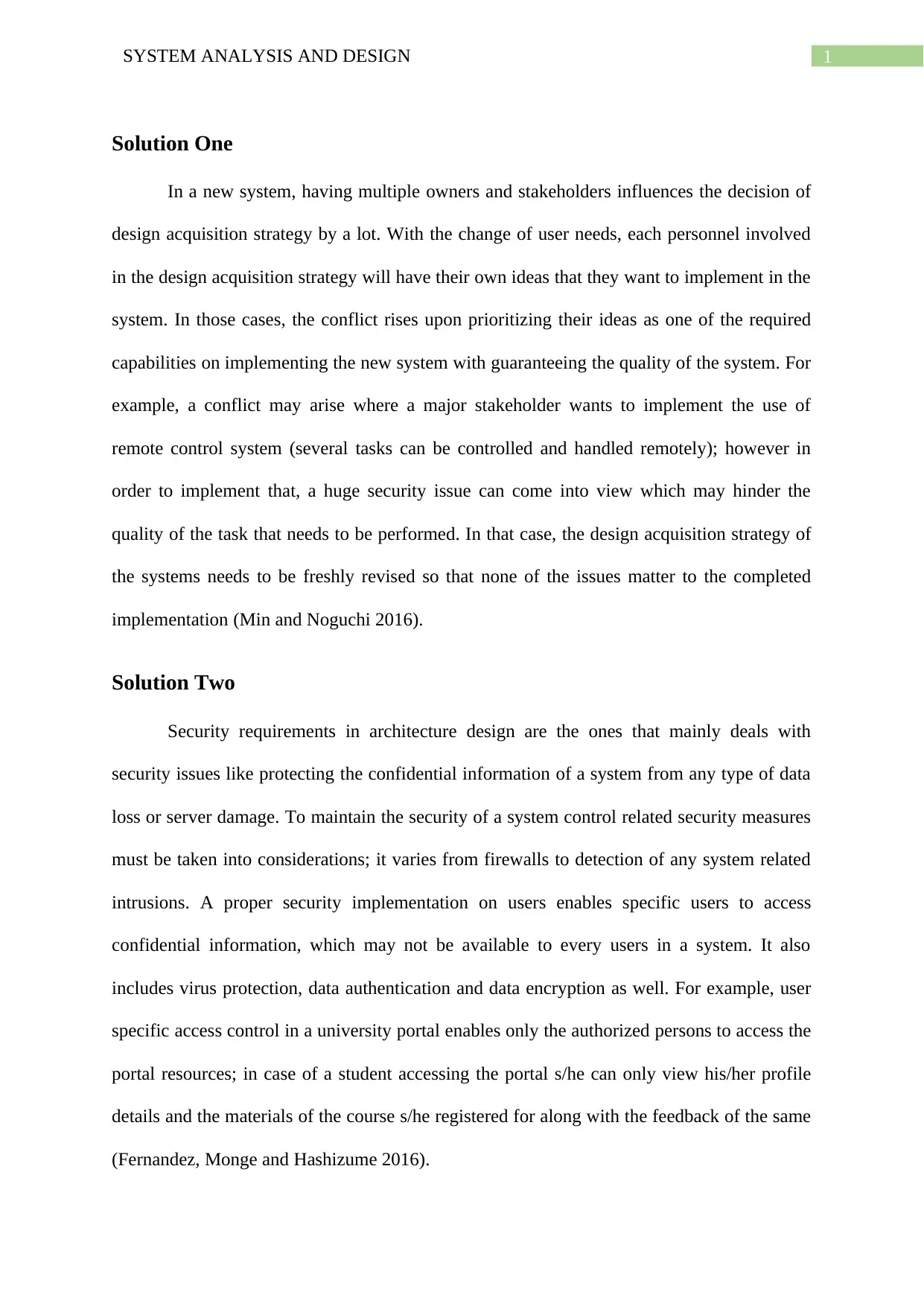
Solution One
In a new system, having multiple owners and stakeholders influences the decision of
design acquisition strategy by a lot. With the change of user needs, each personnel involved
in the design acquisition strategy will have their own ideas that they want to implement in the
system. In those cases, the conflict rises upon prioritizing their ideas as one of the required
capabilities on implementing the new system with guaranteeing the quality of the system. For
example, a conflict may arise where a major stakeholder wants to implement the use of
remote control system (several tasks can be controlled and handled remotely); however in
order to implement that, a huge security issue can come into view which may hinder the
quality of the task that needs to be performed. In that case, the design acquisition strategy of
the systems needs to be freshly revised so that none of the issues matter to the completed
implementation (Min and Noguchi 2016).
Solution Two
Security requirements in architecture design are the ones that mainly deals with
security issues like protecting the confidential information of a system from any type of data
loss or server damage. To maintain the security of a system control related security measures
must be taken into considerations; it varies from firewalls to detection of any system related
intrusions. A proper security implementation on users enables specific users to access
confidential information, which may not be available to every users in a system. It also
includes virus protection, data authentication and data encryption as well. For example, user
specific access control in a university portal enables only the authorized persons to access the
portal resources; in case of a student accessing the portal s/he can only view his/her profile
details and the materials of the course s/he registered for along with the feedback of the same
(Fernandez, Monge and Hashizume 2016).
Solution One
In a new system, having multiple owners and stakeholders influences the decision of
design acquisition strategy by a lot. With the change of user needs, each personnel involved
in the design acquisition strategy will have their own ideas that they want to implement in the
system. In those cases, the conflict rises upon prioritizing their ideas as one of the required
capabilities on implementing the new system with guaranteeing the quality of the system. For
example, a conflict may arise where a major stakeholder wants to implement the use of
remote control system (several tasks can be controlled and handled remotely); however in
order to implement that, a huge security issue can come into view which may hinder the
quality of the task that needs to be performed. In that case, the design acquisition strategy of
the systems needs to be freshly revised so that none of the issues matter to the completed
implementation (Min and Noguchi 2016).
Solution Two
Security requirements in architecture design are the ones that mainly deals with
security issues like protecting the confidential information of a system from any type of data
loss or server damage. To maintain the security of a system control related security measures
must be taken into considerations; it varies from firewalls to detection of any system related
intrusions. A proper security implementation on users enables specific users to access
confidential information, which may not be available to every users in a system. It also
includes virus protection, data authentication and data encryption as well. For example, user
specific access control in a university portal enables only the authorized persons to access the
portal resources; in case of a student accessing the portal s/he can only view his/her profile
details and the materials of the course s/he registered for along with the feedback of the same
(Fernandez, Monge and Hashizume 2016).

2SYSTEM ANALYSIS AND DESIGN
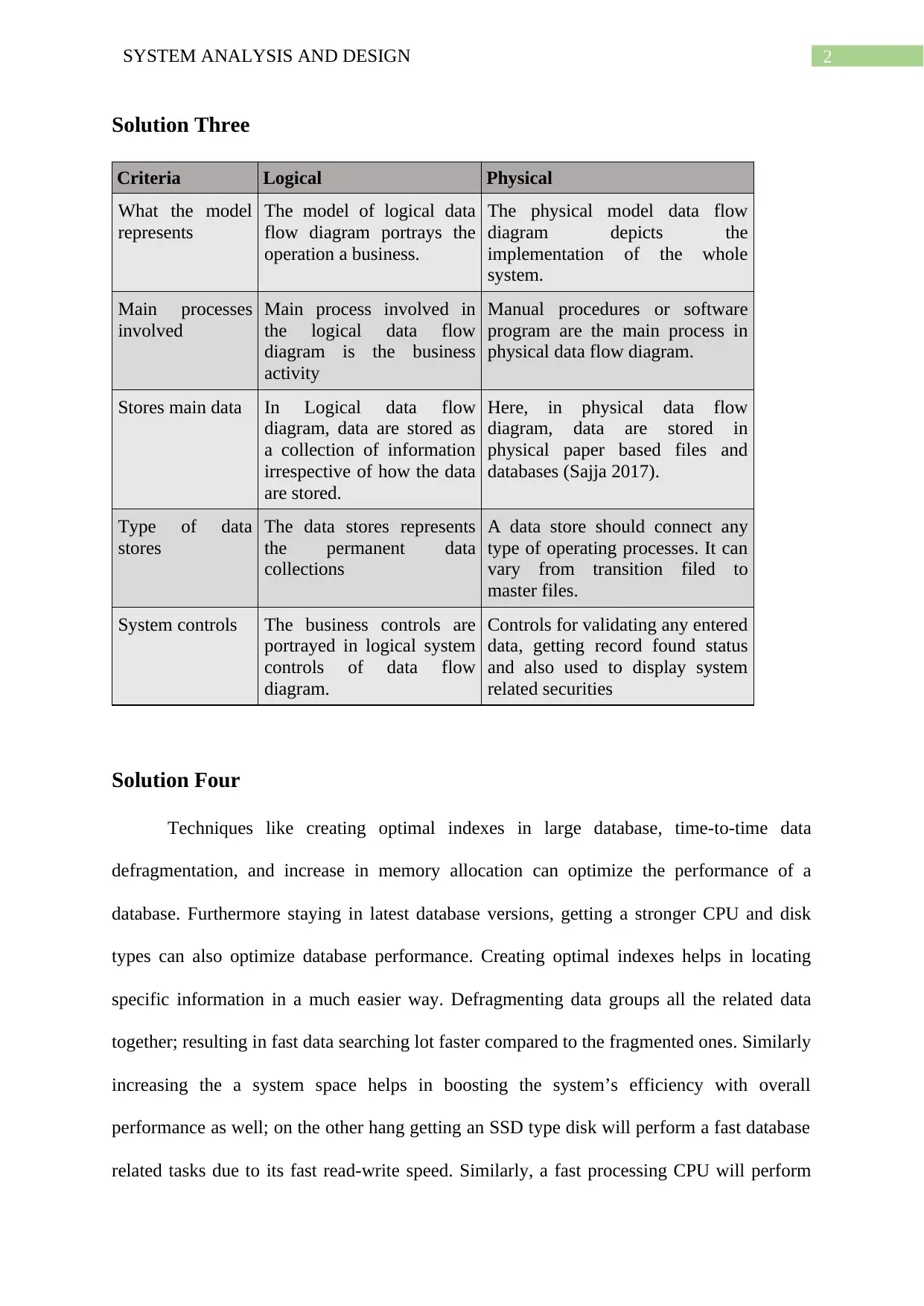
Solution Three
Criteria Logical Physical
What the model
represents
The model of logical data
flow diagram portrays the
operation a business.
The physical model data flow
diagram depicts the
implementation of the whole
system.
Main processes
involved
Main process involved in
the logical data flow
diagram is the business
activity
Manual procedures or software
program are the main process in
physical data flow diagram.
Stores main data In Logical data flow
diagram, data are stored as
a collection of information
irrespective of how the data
are stored.
Here, in physical data flow
diagram, data are stored in
physical paper based files and
databases (Sajja 2017).
Type of data
stores
The data stores represents
the permanent data
collections
A data store should connect any
type of operating processes. It can
vary from transition filed to
master files.
System controls The business controls are
portrayed in logical system
controls of data flow
diagram.
Controls for validating any entered
data, getting record found status
and also used to display system
related securities
Solution Four
Techniques like creating optimal indexes in large database, time-to-time data
defragmentation, and increase in memory allocation can optimize the performance of a
database. Furthermore staying in latest database versions, getting a stronger CPU and disk
types can also optimize database performance. Creating optimal indexes helps in locating
specific information in a much easier way. Defragmenting data groups all the related data
together; resulting in fast data searching lot faster compared to the fragmented ones. Similarly
increasing the a system space helps in boosting the system’s efficiency with overall
performance as well; on the other hang getting an SSD type disk will perform a fast database
related tasks due to its fast read-write speed. Similarly, a fast processing CPU will perform
Solution Three
Criteria Logical Physical
What the model
represents
The model of logical data
flow diagram portrays the
operation a business.
The physical model data flow
diagram depicts the
implementation of the whole
system.
Main processes
involved
Main process involved in
the logical data flow
diagram is the business
activity
Manual procedures or software
program are the main process in
physical data flow diagram.
Stores main data In Logical data flow
diagram, data are stored as
a collection of information
irrespective of how the data
are stored.
Here, in physical data flow
diagram, data are stored in
physical paper based files and
databases (Sajja 2017).
Type of data
stores
The data stores represents
the permanent data
collections
A data store should connect any
type of operating processes. It can
vary from transition filed to
master files.
System controls The business controls are
portrayed in logical system
controls of data flow
diagram.
Controls for validating any entered
data, getting record found status
and also used to display system
related securities
Solution Four
Techniques like creating optimal indexes in large database, time-to-time data
defragmentation, and increase in memory allocation can optimize the performance of a
database. Furthermore staying in latest database versions, getting a stronger CPU and disk
types can also optimize database performance. Creating optimal indexes helps in locating
specific information in a much easier way. Defragmenting data groups all the related data
together; resulting in fast data searching lot faster compared to the fragmented ones. Similarly
increasing the a system space helps in boosting the system’s efficiency with overall
performance as well; on the other hang getting an SSD type disk will perform a fast database
related tasks due to its fast read-write speed. Similarly, a fast processing CPU will perform
⊘ This is a preview!⊘
Do you want full access?
Subscribe today to unlock all pages.

Trusted by 1+ million students worldwide

3SYSTEM ANALYSIS AND DESIGN
database related task faster compared to that of the old versions (slower ones). Finally an
updated database comes with a lot of patches and bug fixes from the older versions resulting
in increase of efficiency in later versions (Sen and Ramachandra 2018).
database related task faster compared to that of the old versions (slower ones). Finally an
updated database comes with a lot of patches and bug fixes from the older versions resulting
in increase of efficiency in later versions (Sen and Ramachandra 2018).
Paraphrase This Document
Need a fresh take? Get an instant paraphrase of this document with our AI Paraphraser

4SYSTEM ANALYSIS AND DESIGN
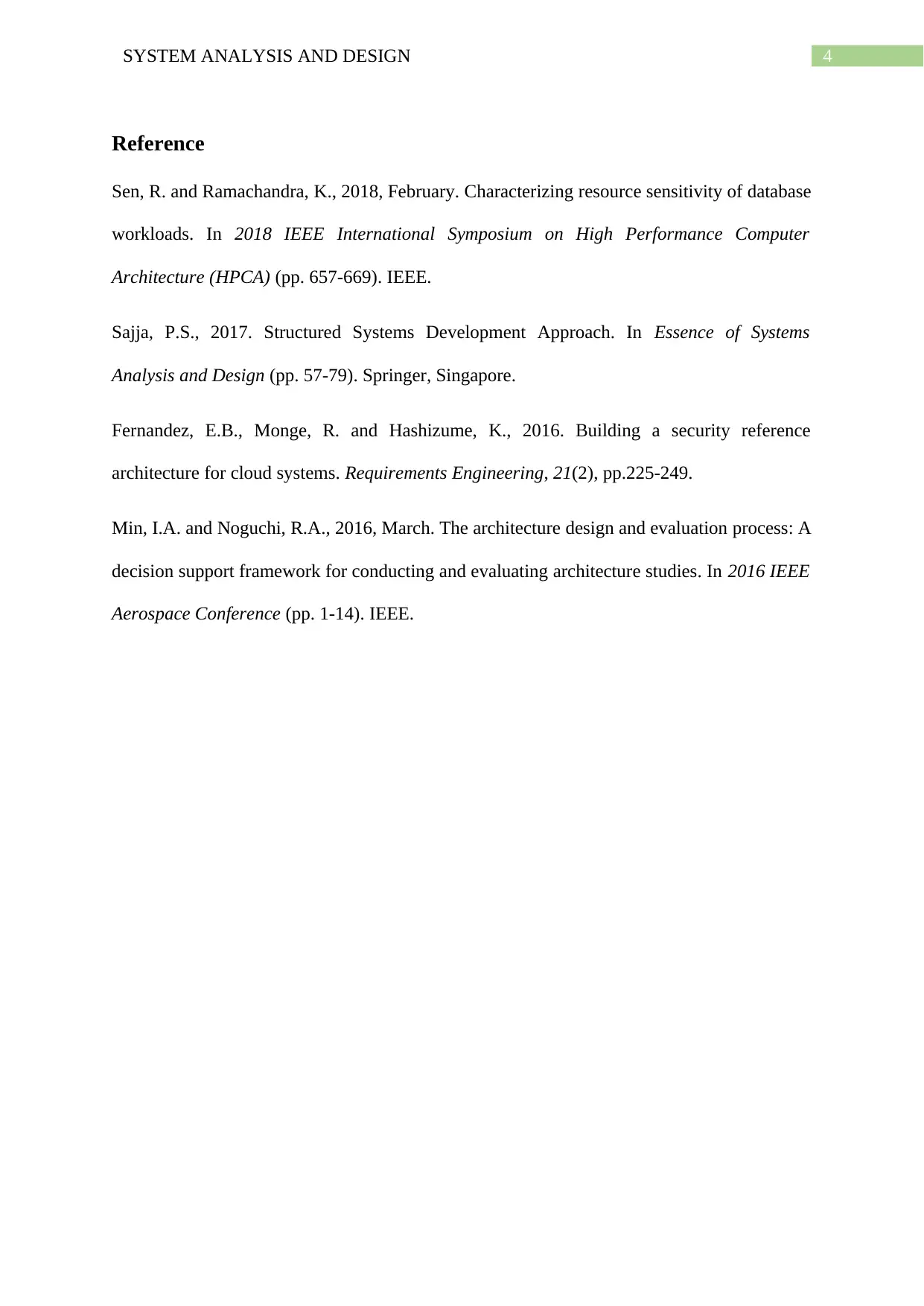
Reference
Sen, R. and Ramachandra, K., 2018, February. Characterizing resource sensitivity of database
workloads. In 2018 IEEE International Symposium on High Performance Computer
Architecture (HPCA) (pp. 657-669). IEEE.
Sajja, P.S., 2017. Structured Systems Development Approach. In Essence of Systems
Analysis and Design (pp. 57-79). Springer, Singapore.
Fernandez, E.B., Monge, R. and Hashizume, K., 2016. Building a security reference
architecture for cloud systems. Requirements Engineering, 21(2), pp.225-249.
Min, I.A. and Noguchi, R.A., 2016, March. The architecture design and evaluation process: A
decision support framework for conducting and evaluating architecture studies. In 2016 IEEE
Aerospace Conference (pp. 1-14). IEEE.
Reference
Sen, R. and Ramachandra, K., 2018, February. Characterizing resource sensitivity of database
workloads. In 2018 IEEE International Symposium on High Performance Computer
Architecture (HPCA) (pp. 657-669). IEEE.
Sajja, P.S., 2017. Structured Systems Development Approach. In Essence of Systems
Analysis and Design (pp. 57-79). Springer, Singapore.
Fernandez, E.B., Monge, R. and Hashizume, K., 2016. Building a security reference
architecture for cloud systems. Requirements Engineering, 21(2), pp.225-249.
Min, I.A. and Noguchi, R.A., 2016, March. The architecture design and evaluation process: A
decision support framework for conducting and evaluating architecture studies. In 2016 IEEE
Aerospace Conference (pp. 1-14). IEEE.
1 out of 5
Related Documents
Your All-in-One AI-Powered Toolkit for Academic Success.
 +13062052269
info@desklib.com
Available 24*7 on WhatsApp / Email
Unlock your academic potential
Copyright © 2020–2025 A2Z Services. All Rights Reserved. Developed and managed by ZUCOL.