System Dynamics for Waste & Wasteful Practices in Manufacturing
VerifiedAdded on 2023/01/04
|26
|6638
|51
Report
AI Summary
This report explores the application of System Dynamics, utilizing archetypes and causal loop diagrams, to assess wasteful practices and waste generation within a plastic bottle manufacturing company. It reviews System Dynamics as a method for understanding complex, nonlinear system behaviors over time, emphasizing the importance of waste management due to its environmental and economic impacts. The report discusses the System Dynamics methodology, its evolution, and its application in various fields, including environmental management and waste reduction. It also compares different System Dynamics software tools and their features. Furthermore, the report identifies specific wasteful practices within the company, such as overproduction, inefficient resource use, and improper waste disposal, highlighting the need for improved waste management strategies, including recycling, reuse, and reduction, to mitigate environmental and health risks. The goal is to find ways of redesigning the organization to implement the circular economy and then reduce the production of wastes.
Running Head: SYSTEM DYNAMICS OF WASTE MANAGEMENT
System Dynamics to Analyze the Problem of Waste and Wasteful Practices in the Company
Name
Institutional affiliation
System Dynamics to Analyze the Problem of Waste and Wasteful Practices in the Company
Name
Institutional affiliation

Paraphrase This Document
Need a fresh take? Get an instant paraphrase of this document with our AI Paraphraser
Waste Management using System Dynamics 2
INTRODUCTION
This research paper investigates the use of System Dynamics through identification of
Archetypes and causal loop diagrams to evaluate the problem of wasteful practices and wastes
within the organization. From this assessment, there will of redesigning the organization to
implement the circular economy and then reduce the production of wastes. System Dynamics can
be defined as a method of understanding the nonlinear behavior of systems that are complex over
time by the use of time delays, table functions, internal feedback loop, flows, and stocks. In the
recent past waste has been a problem to various environments whereby the practice of different
approaches has implemented to counter the problem (Richardson, 2011). The effects of these
wastes on the economy cannot be overlooked, also managing them has become problematic.
Study has shown that waste management is the disposal, transport, or collection of wastes
thereafter managing and monitoring of the waste materials. System dynamics is the approach that
is used widely in analyzing situations that has the capability of changing over time. It is for this
reason why this methodology is used in analyzing numerous systems. The company under
evaluation is Plastic Manufacturing Company located in the outside of the city with 153
employees and producing 16 different types of plastic bottles.
LITERATURE REVIEW
SYSTEM DYNAMIC
System Dynamics can be defined as an approach for analyzing complex problems and systems
over time with the assistance of computer simulation software. The steps that should be followed
during system dynamics include making a loop diagram, variable connections, and then
determining the relation between the variable. System Dynamics was introduced at the
INTRODUCTION
This research paper investigates the use of System Dynamics through identification of
Archetypes and causal loop diagrams to evaluate the problem of wasteful practices and wastes
within the organization. From this assessment, there will of redesigning the organization to
implement the circular economy and then reduce the production of wastes. System Dynamics can
be defined as a method of understanding the nonlinear behavior of systems that are complex over
time by the use of time delays, table functions, internal feedback loop, flows, and stocks. In the
recent past waste has been a problem to various environments whereby the practice of different
approaches has implemented to counter the problem (Richardson, 2011). The effects of these
wastes on the economy cannot be overlooked, also managing them has become problematic.
Study has shown that waste management is the disposal, transport, or collection of wastes
thereafter managing and monitoring of the waste materials. System dynamics is the approach that
is used widely in analyzing situations that has the capability of changing over time. It is for this
reason why this methodology is used in analyzing numerous systems. The company under
evaluation is Plastic Manufacturing Company located in the outside of the city with 153
employees and producing 16 different types of plastic bottles.
LITERATURE REVIEW
SYSTEM DYNAMIC
System Dynamics can be defined as an approach for analyzing complex problems and systems
over time with the assistance of computer simulation software. The steps that should be followed
during system dynamics include making a loop diagram, variable connections, and then
determining the relation between the variable. System Dynamics was introduced at the
Waste Management using System Dynamics 3
Massachusetts Institute of Technology in 1960s by Jay Forrester as a simulation and modeling
methodology for the analysis of long-term decision-making of problems faced by organization
management (Richardson, 2011). The methodology of System Dynamics provides a basis for
computer model construction so as to attain what human min cannot attain such as to analyze
rationally the mode or behavior, interactions, and structure of complex environmental and
technological systems. Therefore, System Dynamics has been applied in numerous areas such as
environmental management in developing countries, waste management solutions and challenges
for safe living of human beings, and global environmental sustainability for population
abatement or control (Phonphoton & Pharino, 2019).
System Dynamics Modelling can assist in building the communication and also in the
identification of the feedbacks among different components related in a system which promote
the policies of decision making in different cases. For example, the taxing policy on the materials
used for packaging can assist in reducing the generation of solid waste. The methodology of
System Dynamics focuses on the manner in which a single quantity can influence other through
the flow of physical information and entities. Such flows normally return to the original quantity
resulting into a feedback loop. The system behavior is controlled by these feedback loops
(Sukholthaman & Sharp, 2016).
System dynamics is specifically suitable for the simulation of complex systems like waste
management and generation as a modeling method. The model has the ability of dealing with
assumptions concerning structures of the system, and specifically for monitoring the impacts of
variations in sub-systems and their relations. Before discussing further the application of System
Dynamic Modeling in the management of solid waste, there is need of first discussing various
software together with their advantages and disadvantages. The major software tools used
Massachusetts Institute of Technology in 1960s by Jay Forrester as a simulation and modeling
methodology for the analysis of long-term decision-making of problems faced by organization
management (Richardson, 2011). The methodology of System Dynamics provides a basis for
computer model construction so as to attain what human min cannot attain such as to analyze
rationally the mode or behavior, interactions, and structure of complex environmental and
technological systems. Therefore, System Dynamics has been applied in numerous areas such as
environmental management in developing countries, waste management solutions and challenges
for safe living of human beings, and global environmental sustainability for population
abatement or control (Phonphoton & Pharino, 2019).
System Dynamics Modelling can assist in building the communication and also in the
identification of the feedbacks among different components related in a system which promote
the policies of decision making in different cases. For example, the taxing policy on the materials
used for packaging can assist in reducing the generation of solid waste. The methodology of
System Dynamics focuses on the manner in which a single quantity can influence other through
the flow of physical information and entities. Such flows normally return to the original quantity
resulting into a feedback loop. The system behavior is controlled by these feedback loops
(Sukholthaman & Sharp, 2016).
System dynamics is specifically suitable for the simulation of complex systems like waste
management and generation as a modeling method. The model has the ability of dealing with
assumptions concerning structures of the system, and specifically for monitoring the impacts of
variations in sub-systems and their relations. Before discussing further the application of System
Dynamic Modeling in the management of solid waste, there is need of first discussing various
software together with their advantages and disadvantages. The major software tools used
⊘ This is a preview!⊘
Do you want full access?
Subscribe today to unlock all pages.

Trusted by 1+ million students worldwide
Waste Management using System Dynamics 4
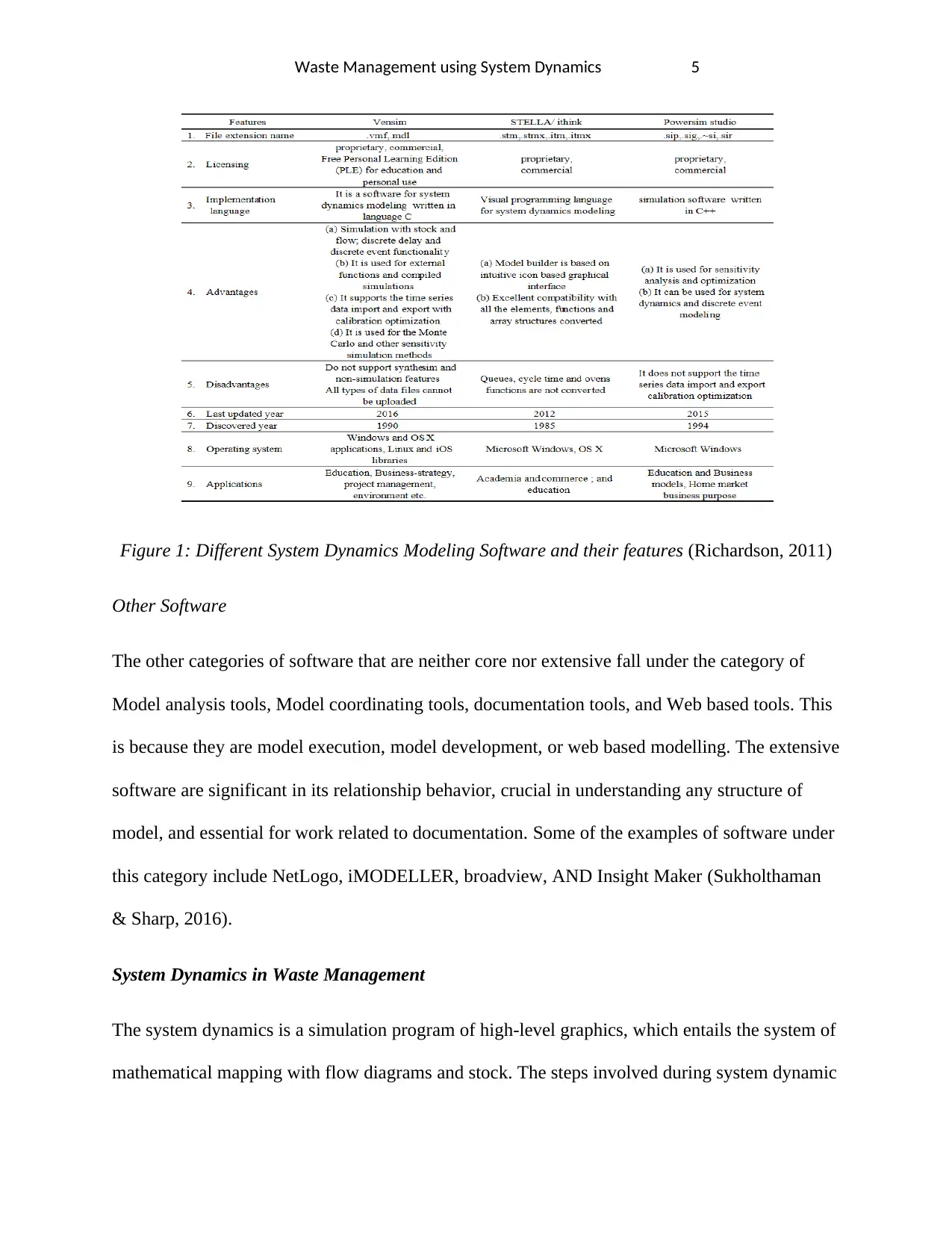
include Powersim Studio 8, System Thinking for Education and Research, and Ventana
Simulation. The system dynamics software tools are categorized into numerous categories
depending on their areas of application as explained below:
Extensive Software
Extensive software entails a huge work potion since they are significant during simulation and
building purposes of the system dynamic modelling. However, these software can support the
other model that uses differential equation forms, diagrammatic representations and other form
of modelling. Some of the examples of extensive software include Simgua, Simile, Doldsim,
Berkeley Madonna, and Dynaplan (Richardson, 2011).
Core Software
The term core means important or essential, therefore, core software is the software which is
significant and applied in most of the work. These software are used in simulating and making
the system dynamic models. Some of the examples of core software tools include Powersin
Studio, Vensim, and STELLA.
include Powersim Studio 8, System Thinking for Education and Research, and Ventana
Simulation. The system dynamics software tools are categorized into numerous categories
depending on their areas of application as explained below:
Extensive Software
Extensive software entails a huge work potion since they are significant during simulation and
building purposes of the system dynamic modelling. However, these software can support the
other model that uses differential equation forms, diagrammatic representations and other form
of modelling. Some of the examples of extensive software include Simgua, Simile, Doldsim,
Berkeley Madonna, and Dynaplan (Richardson, 2011).
Core Software
The term core means important or essential, therefore, core software is the software which is
significant and applied in most of the work. These software are used in simulating and making
the system dynamic models. Some of the examples of core software tools include Powersin
Studio, Vensim, and STELLA.
Paraphrase This Document
Need a fresh take? Get an instant paraphrase of this document with our AI Paraphraser
Waste Management using System Dynamics 5
Figure 1: Different System Dynamics Modeling Software and their features (Richardson, 2011)
Other Software
The other categories of software that are neither core nor extensive fall under the category of
Model analysis tools, Model coordinating tools, documentation tools, and Web based tools. This
is because they are model execution, model development, or web based modelling. The extensive
software are significant in its relationship behavior, crucial in understanding any structure of
model, and essential for work related to documentation. Some of the examples of software under
this category include NetLogo, iMODELLER, broadview, AND Insight Maker (Sukholthaman
& Sharp, 2016).
System Dynamics in Waste Management
The system dynamics is a simulation program of high-level graphics, which entails the system of
mathematical mapping with flow diagrams and stock. The steps involved during system dynamic
Figure 1: Different System Dynamics Modeling Software and their features (Richardson, 2011)
Other Software
The other categories of software that are neither core nor extensive fall under the category of
Model analysis tools, Model coordinating tools, documentation tools, and Web based tools. This
is because they are model execution, model development, or web based modelling. The extensive
software are significant in its relationship behavior, crucial in understanding any structure of
model, and essential for work related to documentation. Some of the examples of software under
this category include NetLogo, iMODELLER, broadview, AND Insight Maker (Sukholthaman
& Sharp, 2016).
System Dynamics in Waste Management
The system dynamics is a simulation program of high-level graphics, which entails the system of
mathematical mapping with flow diagrams and stock. The steps involved during system dynamic
Waste Management using System Dynamics 6
simulation include problem identification, identification of important stocks and the flows
changing the levels of stock, information sources identification which impact the flows, main
feedback loop identification, construction of casual loop diagram linking sources of information,
flows, and stocks, stating the equation that determines the flows, conditions and parameters
estimation by statistical method such as relevant information sources and market research data,
and lastly model simulation and result analysis (Waldir, 2016).
System Dynamics Modelling applied in numerous studies shows its significance in decision
making or the future of the organization. For example, an increased price elasticity of demand
for the materials to assist in decreasing the materials used per for a specific product and the
packaging materials consumption; the separation at the source influences the collection services
efficiency, cost, waste to landfilling, recyclable and organic waste; the funding policies for
prevention of waste affect the landfilling and cost of recycling; solid waste generation increases
with an increase in income and population; and recycling of solid waste decreases the increase of
illegal management and disposal significantly (Inghels & Wout, 2010).
Causal loop diagrams
A causal loop diagram represents a system or problem such as mechanical system, ecosystem, or
waste management system in the system dynamics methodology. This is a simple map of a
system with all its basic components together with their interactions. A causal loop diagram
portrays the system structure by including feedback loops and causal loop diagrams. It becomes
easy to ascertain the behavior of a system over a certain period of time by understanding the
structure of the system (Schaffernicht, 2010).
Flow and Stock Diagrams
simulation include problem identification, identification of important stocks and the flows
changing the levels of stock, information sources identification which impact the flows, main
feedback loop identification, construction of casual loop diagram linking sources of information,
flows, and stocks, stating the equation that determines the flows, conditions and parameters
estimation by statistical method such as relevant information sources and market research data,
and lastly model simulation and result analysis (Waldir, 2016).
System Dynamics Modelling applied in numerous studies shows its significance in decision
making or the future of the organization. For example, an increased price elasticity of demand
for the materials to assist in decreasing the materials used per for a specific product and the
packaging materials consumption; the separation at the source influences the collection services
efficiency, cost, waste to landfilling, recyclable and organic waste; the funding policies for
prevention of waste affect the landfilling and cost of recycling; solid waste generation increases
with an increase in income and population; and recycling of solid waste decreases the increase of
illegal management and disposal significantly (Inghels & Wout, 2010).
Causal loop diagrams
A causal loop diagram represents a system or problem such as mechanical system, ecosystem, or
waste management system in the system dynamics methodology. This is a simple map of a
system with all its basic components together with their interactions. A causal loop diagram
portrays the system structure by including feedback loops and causal loop diagrams. It becomes
easy to ascertain the behavior of a system over a certain period of time by understanding the
structure of the system (Schaffernicht, 2010).
Flow and Stock Diagrams
⊘ This is a preview!⊘
Do you want full access?
Subscribe today to unlock all pages.
Trusted by 1+ million students worldwide
Waste Management using System Dynamics 7
Causal loop diagrams assist in the visualization of the behavior and structure of a system and
evaluating qualitatively the system. A casual loop diagram is transformed to a flow and stock
diagram to perform a more detailed quantitative analysis. A model of flow and stock assist in
analyzing and studying the system in a quantitative manner and such models are normally
simulated and built by the use of computer software.
WASTE AND WASTEFUL PRACTICES
Currently, the generation of solid wastes is a global concern that is majorly caused by fast
industrialization and urbanization. The major solid waste generated by this Plastic Bottle
Manufacturing Company include food wastes, paper, plastics, metals, consumer electronics, oil,
packaging wastes, construction materials, hazardous wastes such as chemicals, biomedical
wastes, scrap materials, and industrial process wastes (Shumin, 2018). As a company dealing in
the manufacture of plastic bottles, there is generation of large quantity of materials that are
thrown away, the management of waste entails collecting the waste materials for the purpose of
recycling and as a result reducing their impacts on the environment, surroundings and human
health (Nguyen & Hung, 2014).
Wasteful practices that are majorly practices by the company include over production of plastic
bottles, wasteful use of water, food scraps, unnecessary importation of chemicals, spillage of
chemicals during transportation, destruction of bottles during transportation, unnecessary
importation of chemicals, and manufacture of large quantity of plastic bottles. The management
of waste is a problem that must be dealt with on a daily basis by the company to regulate the
large quantity of waste that are being generated. There are numerous systems of resource
recovery that have been implemented in other companies and facilities to deal with this issue.
Causal loop diagrams assist in the visualization of the behavior and structure of a system and
evaluating qualitatively the system. A casual loop diagram is transformed to a flow and stock
diagram to perform a more detailed quantitative analysis. A model of flow and stock assist in
analyzing and studying the system in a quantitative manner and such models are normally
simulated and built by the use of computer software.
WASTE AND WASTEFUL PRACTICES
Currently, the generation of solid wastes is a global concern that is majorly caused by fast
industrialization and urbanization. The major solid waste generated by this Plastic Bottle
Manufacturing Company include food wastes, paper, plastics, metals, consumer electronics, oil,
packaging wastes, construction materials, hazardous wastes such as chemicals, biomedical
wastes, scrap materials, and industrial process wastes (Shumin, 2018). As a company dealing in
the manufacture of plastic bottles, there is generation of large quantity of materials that are
thrown away, the management of waste entails collecting the waste materials for the purpose of
recycling and as a result reducing their impacts on the environment, surroundings and human
health (Nguyen & Hung, 2014).
Wasteful practices that are majorly practices by the company include over production of plastic
bottles, wasteful use of water, food scraps, unnecessary importation of chemicals, spillage of
chemicals during transportation, destruction of bottles during transportation, unnecessary
importation of chemicals, and manufacture of large quantity of plastic bottles. The management
of waste is a problem that must be dealt with on a daily basis by the company to regulate the
large quantity of waste that are being generated. There are numerous systems of resource
recovery that have been implemented in other companies and facilities to deal with this issue.
Paraphrase This Document
Need a fresh take? Get an instant paraphrase of this document with our AI Paraphraser
Waste Management using System Dynamics 8
Natural system of recovery uses green waste, organic and food wastes and are handled through
in-vessel compos system within the company.
Manual and automated methods are used in sorting materials from sites under construction like
concrete, tiles, and bricks after being sorted can be re-used for construction materials and road
base. Electronic wastes comes from components such as old computers and can be managed by
recovering components such as plastics, glass, copper, aluminum, and cabling. The problem of
waste management has increased at a high rate within the company in direct response to
increased company production, number of employees, large quantity of output, and
industrialization. This has even deteriorate with option of quick to discard and quick to use habits
of the company which produces an endless stream of solid and liquid waste (Sasao, 2014).
Until recently, this Bottle manufacturing company had not been concerned with the proper
disposal of solid waste, their major concern had not gone beyond removal of waste physically
from the company. It is still a common and has been a practice to dispose of refuse by the most
available expedient approach. The management of industrial waste has conventionally consisted
of disposal after collection. A processing level may follow collection, depending on the type of
waste being collected. This processing may be to minimize the volume of waste for more
efficient disposal, produce energy from the waste, recover material for recycling, and minimize
the hazard of waste. The method of disposal normally widely vary. The most common disposal
method of waste materials by the company is landfills (Aivalioti, Cossu, & Gidarakos, 2014).
The company uses proper technical knowledge, large amount of manpower, and capital for solid
waste management. The poor management of solid waste may result in serious environmental
and health problems. The piles of untreated and uncollected waste get accumulated in different
places around the company and also dumping sites, resulting in environmental degradation and
Natural system of recovery uses green waste, organic and food wastes and are handled through
in-vessel compos system within the company.
Manual and automated methods are used in sorting materials from sites under construction like
concrete, tiles, and bricks after being sorted can be re-used for construction materials and road
base. Electronic wastes comes from components such as old computers and can be managed by
recovering components such as plastics, glass, copper, aluminum, and cabling. The problem of
waste management has increased at a high rate within the company in direct response to
increased company production, number of employees, large quantity of output, and
industrialization. This has even deteriorate with option of quick to discard and quick to use habits
of the company which produces an endless stream of solid and liquid waste (Sasao, 2014).
Until recently, this Bottle manufacturing company had not been concerned with the proper
disposal of solid waste, their major concern had not gone beyond removal of waste physically
from the company. It is still a common and has been a practice to dispose of refuse by the most
available expedient approach. The management of industrial waste has conventionally consisted
of disposal after collection. A processing level may follow collection, depending on the type of
waste being collected. This processing may be to minimize the volume of waste for more
efficient disposal, produce energy from the waste, recover material for recycling, and minimize
the hazard of waste. The method of disposal normally widely vary. The most common disposal
method of waste materials by the company is landfills (Aivalioti, Cossu, & Gidarakos, 2014).
The company uses proper technical knowledge, large amount of manpower, and capital for solid
waste management. The poor management of solid waste may result in serious environmental
and health problems. The piles of untreated and uncollected waste get accumulated in different
places around the company and also dumping sites, resulting in environmental degradation and
Waste Management using System Dynamics 9
health problems. However, the adaptation of any of the four R’s (namely, reduction, recovery,
reuse, and recycle) of the management of solid waste could be applied in the reduction of the risk
of human health and environment. Therefore, an appropriate solid waste management requires
suitable technology that is environmentally friendly, socially accepted and economically
affordable (Swapan & Bhattacharyya, 2015).
The need of appropriate management of waste in this plastic bottle manufacturing company is
significant for numerous reasons, namely to recycle wastes that are hazardous from further
contamination, to conserve environmental resources from the contamination, to stop spreading of
infectious diseases, and to control different types of pollution. The general objective of solid
waste management if to attain an improved life quality through creation of supportable company
and employees capable of managing resources available efficiently with an innovating economic
potential to ensure prosperity and by environmental protection. There is need of short-term steps
that should be implemented by the company when tackling issues of operation in the
management of solid waste, maintaining long-term perspective of solid waste management
(Yang, Fujiwara, Matsuoka, & Wang, 2014).
The major challenges in relation with the long-term management of waste may affect energy use,
climate change, linking waste management with the enhancement of energy recovery and
minimization of Greenhouse Gas is significant. There is also a provision of smart waste
management. Smart management of waste has two purposes, namely waste reduction and
operational efficiency, and it may reclaim regions covered by trash and moderate the dependency
of landfills (Oguchi, Tasaki, & Moriguchi, 2010).
The following are some of the methods used in the collection of waste:
health problems. However, the adaptation of any of the four R’s (namely, reduction, recovery,
reuse, and recycle) of the management of solid waste could be applied in the reduction of the risk
of human health and environment. Therefore, an appropriate solid waste management requires
suitable technology that is environmentally friendly, socially accepted and economically
affordable (Swapan & Bhattacharyya, 2015).
The need of appropriate management of waste in this plastic bottle manufacturing company is
significant for numerous reasons, namely to recycle wastes that are hazardous from further
contamination, to conserve environmental resources from the contamination, to stop spreading of
infectious diseases, and to control different types of pollution. The general objective of solid
waste management if to attain an improved life quality through creation of supportable company
and employees capable of managing resources available efficiently with an innovating economic
potential to ensure prosperity and by environmental protection. There is need of short-term steps
that should be implemented by the company when tackling issues of operation in the
management of solid waste, maintaining long-term perspective of solid waste management
(Yang, Fujiwara, Matsuoka, & Wang, 2014).
The major challenges in relation with the long-term management of waste may affect energy use,
climate change, linking waste management with the enhancement of energy recovery and
minimization of Greenhouse Gas is significant. There is also a provision of smart waste
management. Smart management of waste has two purposes, namely waste reduction and
operational efficiency, and it may reclaim regions covered by trash and moderate the dependency
of landfills (Oguchi, Tasaki, & Moriguchi, 2010).
The following are some of the methods used in the collection of waste:
⊘ This is a preview!⊘
Do you want full access?
Subscribe today to unlock all pages.
Trusted by 1+ million students worldwide
Waste Management using System Dynamics 10
Compactor: The compactor is used for the purposes of compaction and compression of waste
and also in breaking up fragile and large waste components. This process if normally carried out
after collection of disposed plastic bottles before they are recycled. After compacting the
collected plastic bottles, they can then be remanufactured through melting process and
production of new bottles.
Direct labor: This method is majorly applied by the company in collection of their waste within
the company. The collection of waste is done from places designated such as dustbins, compost
pits or within the company surrounding. Direct labor can also be applied in the collection of
disposed plastic bottles from dumping sites and also the process of recycling where labor will be
used.
Bulldozer: This equipment is used to remove plastic components that have been covered with
soil as a result of flooding in the region or if they are covered by other disposed materials
collected around the city and dumped at dumping sites. The function of bulldozer is to remove
the dumped waste from the pit an enable removal of dumped plastic bottles and then they can be
transported back to the company for reuse, recycling, or remanufacturing.
Refuse truck: The refuse truck is normally used by the company to pick dumped plastic bottles
along the main roads or dumping sites. This can be done by people charged with the collection of
garbage in various regions within the country. The collected plastic bottles are then separated
from the source awaiting for the arrival of company vehicles for collection purposes.
Hook loader: The hook loaders are positioned at designated locations where the company vehicle
can pick them and exchange them with others. These hook loaders are normally positioned near
Compactor: The compactor is used for the purposes of compaction and compression of waste
and also in breaking up fragile and large waste components. This process if normally carried out
after collection of disposed plastic bottles before they are recycled. After compacting the
collected plastic bottles, they can then be remanufactured through melting process and
production of new bottles.
Direct labor: This method is majorly applied by the company in collection of their waste within
the company. The collection of waste is done from places designated such as dustbins, compost
pits or within the company surrounding. Direct labor can also be applied in the collection of
disposed plastic bottles from dumping sites and also the process of recycling where labor will be
used.
Bulldozer: This equipment is used to remove plastic components that have been covered with
soil as a result of flooding in the region or if they are covered by other disposed materials
collected around the city and dumped at dumping sites. The function of bulldozer is to remove
the dumped waste from the pit an enable removal of dumped plastic bottles and then they can be
transported back to the company for reuse, recycling, or remanufacturing.
Refuse truck: The refuse truck is normally used by the company to pick dumped plastic bottles
along the main roads or dumping sites. This can be done by people charged with the collection of
garbage in various regions within the country. The collected plastic bottles are then separated
from the source awaiting for the arrival of company vehicles for collection purposes.
Hook loader: The hook loaders are positioned at designated locations where the company vehicle
can pick them and exchange them with others. These hook loaders are normally positioned near
Paraphrase This Document
Need a fresh take? Get an instant paraphrase of this document with our AI Paraphraser
Waste Management using System Dynamics 11
wholesalers dealing of plastic bottles, outside shopping centers, near populated households, and
near institutions.
CAUSAL LOOP DIAGRAM
A causal loop diagram represents a system or problem such as mechanical system, ecosystem, or
waste management system in the system dynamics methodology. This is a simple map of a
system with all its basic components together with their interactions. A causal loop diagram
portrays the system structure by including feedback loops and causal loop diagrams (Shahar &
Shahar, 2010).
Significant element of waste management
Waste management budget: This is the total yearly allocation by the Plastic manufacturing
company for the management of waste. This entails the budget of management of waste for the
entire company.
Waste management costs: This is the total yearly cost of management of waste by the company.
This includes cost of wastewater treatment, aftercare, landfill maintenance, and tipping fee or
land filling.
Waste collection: The collection of waste refers to residual waste that is gathered around the
company for ultimate disposal. The quantity of waste increases through the generation of waste
by the company and is reduced through the littering streams, backyard burning waste collection,
and recycling.
wholesalers dealing of plastic bottles, outside shopping centers, near populated households, and
near institutions.
CAUSAL LOOP DIAGRAM
A causal loop diagram represents a system or problem such as mechanical system, ecosystem, or
waste management system in the system dynamics methodology. This is a simple map of a
system with all its basic components together with their interactions. A causal loop diagram
portrays the system structure by including feedback loops and causal loop diagrams (Shahar &
Shahar, 2010).
Significant element of waste management
Waste management budget: This is the total yearly allocation by the Plastic manufacturing
company for the management of waste. This entails the budget of management of waste for the
entire company.
Waste management costs: This is the total yearly cost of management of waste by the company.
This includes cost of wastewater treatment, aftercare, landfill maintenance, and tipping fee or
land filling.
Waste collection: The collection of waste refers to residual waste that is gathered around the
company for ultimate disposal. The quantity of waste increases through the generation of waste
by the company and is reduced through the littering streams, backyard burning waste collection,
and recycling.
Waste Management using System Dynamics 12
Population: This is the number of employees working in this Plastic manufacturing company in a
particular year and also the number of visitors visiting the company for the purposes of
purchasing or any inquiry.
Generation rate: This is the quantity of waste produced by the company or every employee
within the company daily. The generation rate is generally expressed as kg/year.
Waste generation: The generation of waste is the total quantity of waste generated by the
company per unit of time. In the System Dynamic Model, it is the product of population and
generation rate and is denoted as ton/year.
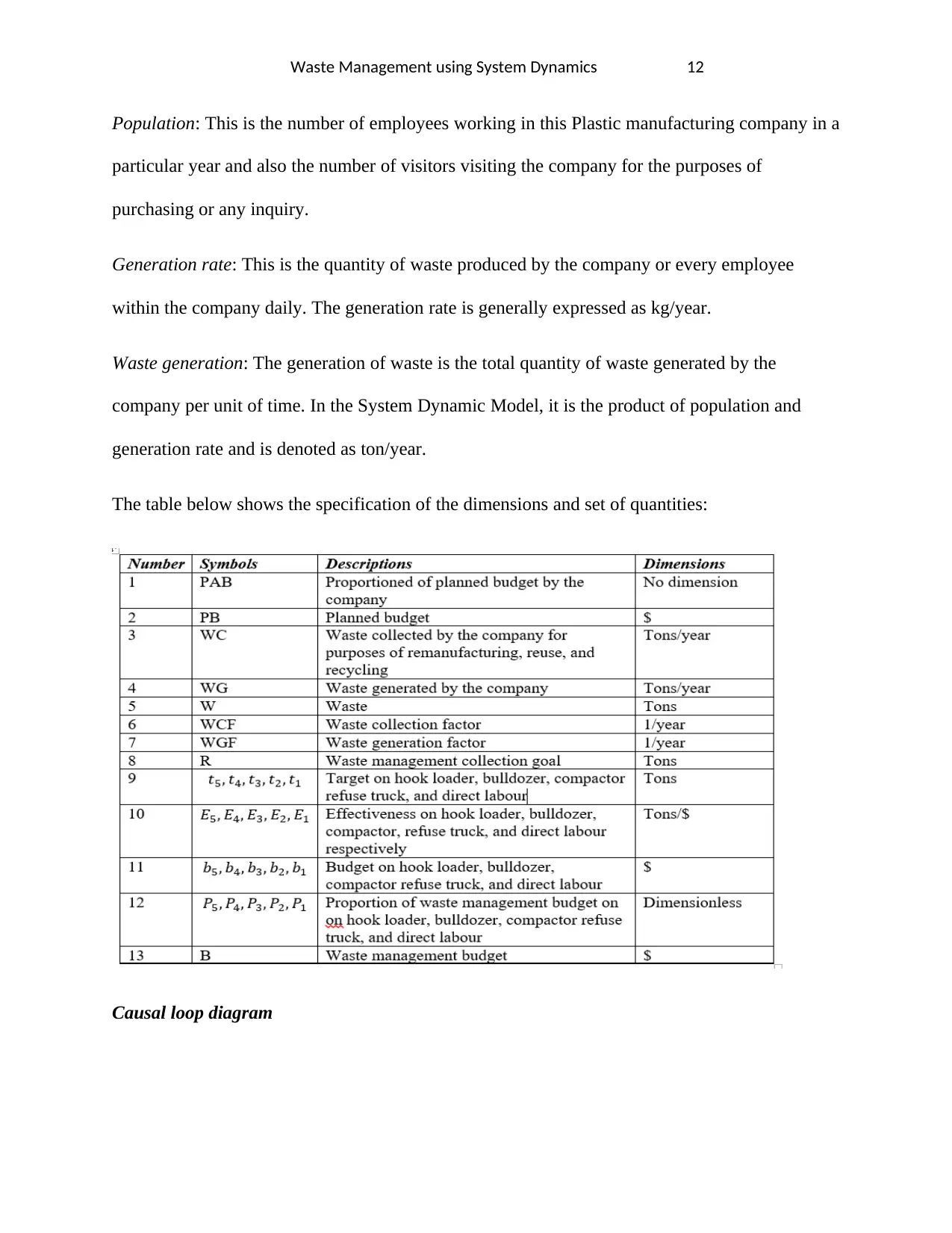
The table below shows the specification of the dimensions and set of quantities:
Causal loop diagram
Population: This is the number of employees working in this Plastic manufacturing company in a
particular year and also the number of visitors visiting the company for the purposes of
purchasing or any inquiry.
Generation rate: This is the quantity of waste produced by the company or every employee
within the company daily. The generation rate is generally expressed as kg/year.
Waste generation: The generation of waste is the total quantity of waste generated by the
company per unit of time. In the System Dynamic Model, it is the product of population and
generation rate and is denoted as ton/year.
The table below shows the specification of the dimensions and set of quantities:
Causal loop diagram
⊘ This is a preview!⊘
Do you want full access?
Subscribe today to unlock all pages.
Trusted by 1+ million students worldwide

1 out of 26


Related Documents


Your All-in-One AI-Powered Toolkit for Academic Success.
+13062052269
info@desklib.com
Available 24*7 on WhatsApp / Email
![[object Object]](/_next/static/media/star-bottom.7253800d.svg)
Unlock your academic potential
Copyright © 2020–2026 A2Z Services. All Rights Reserved. Developed and managed by ZUCOL.