System Engineering and Project Management: A Comprehensive Report

Verified

Added on  2020/02/24

|2
|401
|144
Report
AI Summary
This report provides a comprehensive analysis of the relationship between system engineering and project management. It begins by exploring the fundamentals of system thinking and its application within project and portfolio management contexts. The report delves into the significance of system engineering transformations, driven by the increasing complexities of modern systems and stakeholder requirements. It examines the role of SEBoK, detailing its users and their respective roles in system engineering. Furthermore, the report discusses the concepts of system engineering, project management, and portfolio management, highlighting the shared advancements in life-cycle structures and project executions. The report also references key resources such as Kerzner's work and the SEBoK wiki to support its findings.
Document Page
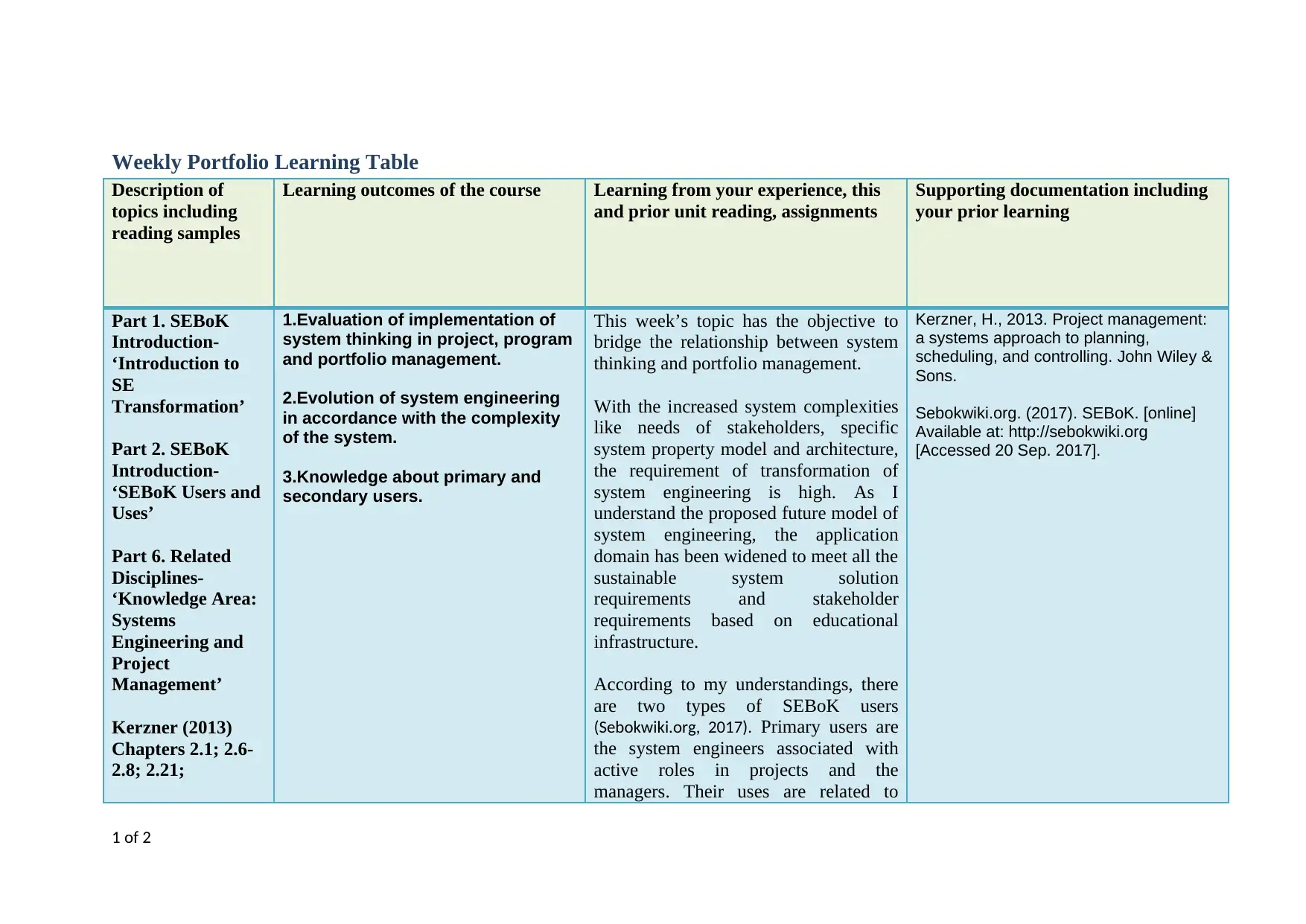
Weekly Portfolio Learning Table
Description of
topics including
reading samples
Learning outcomes of the course Learning from your experience, this
and prior unit reading, assignments
Supporting documentation including
your prior learning
Part 1. SEBoK
Introduction-
‘Introduction to
SE
Transformation’
Part 2. SEBoK
Introduction-
‘SEBoK Users and
Uses’
Part 6. Related
Disciplines-
‘Knowledge Area:
Systems
Engineering and
Project
Management’
Kerzner (2013)
Chapters 2.1; 2.6-
2.8; 2.21;
1.Evaluation of implementation of
system thinking in project, program
and portfolio management.
2.Evolution of system engineering
in accordance with the complexity
of the system.
3.Knowledge about primary and
secondary users.
This week’s topic has the objective to
bridge the relationship between system
thinking and portfolio management.
With the increased system complexities
like needs of stakeholders, specific
system property model and architecture,
the requirement of transformation of
system engineering is high. As I
understand the proposed future model of
system engineering, the application
domain has been widened to meet all the
sustainable system solution
requirements and stakeholder
requirements based on educational
infrastructure.
According to my understandings, there
are two types of SEBoK users
(Sebokwiki.org, 2017). Primary users are
the system engineers associated with
active roles in projects and the
managers. Their uses are related to
Kerzner, H., 2013. Project management:
a systems approach to planning,
scheduling, and controlling. John Wiley &
Sons.
Sebokwiki.org. (2017). SEBoK. [online]
Available at: http://sebokwiki.org
[Accessed 20 Sep. 2017].
1 of 2
tabler-icon-diamond-filled.svg

Paraphrase This Document

Need a fresh take? Get an instant paraphrase of this document with our AI Paraphraser
Document Page
Description of
topics including
reading samples
Learning outcomes of the course Learning from your experience, this
and prior unit reading, assignments
Supporting documentation including
your prior learning
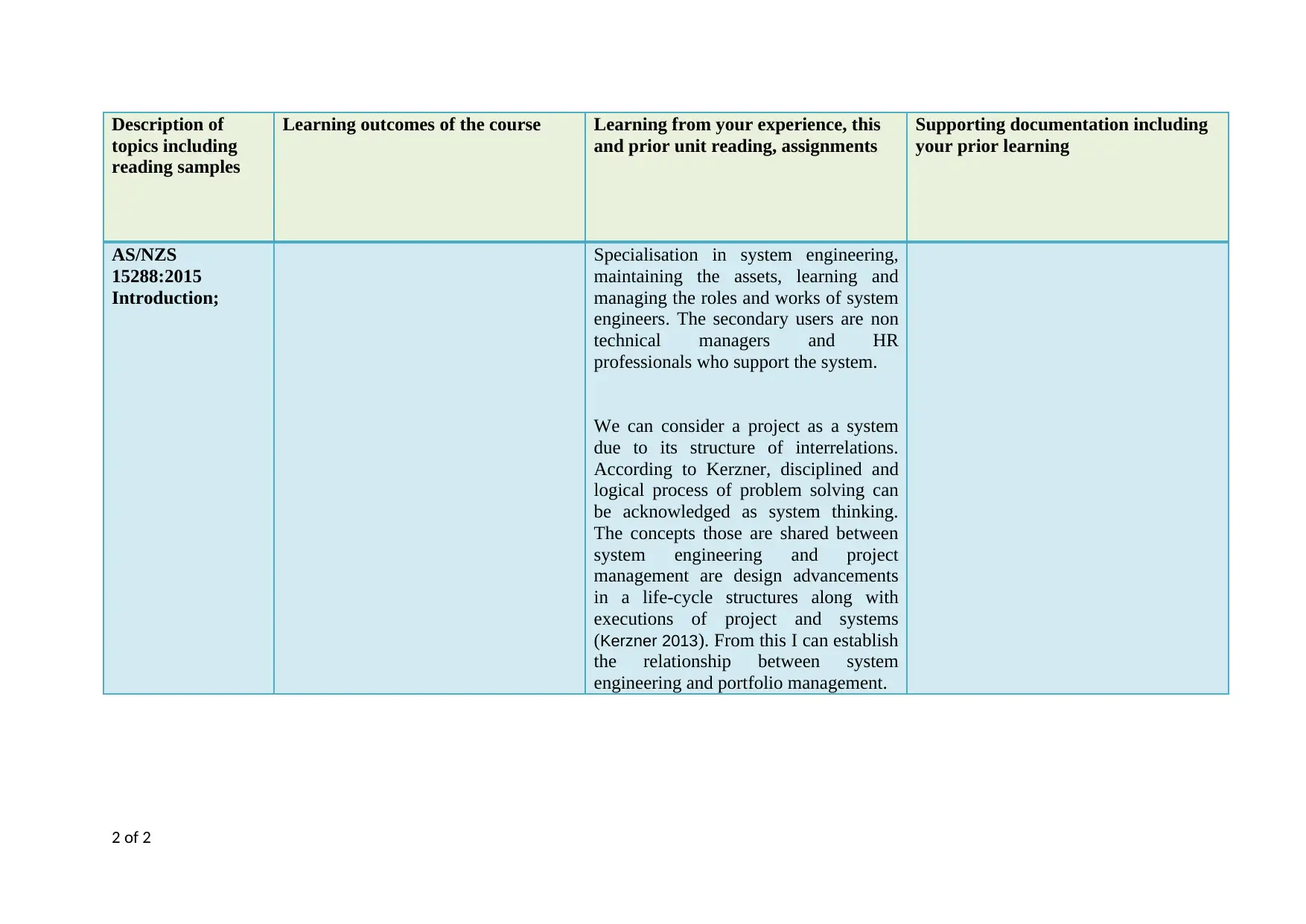
AS/NZS
15288:2015
Introduction;
Specialisation in system engineering,
maintaining the assets, learning and
managing the roles and works of system
engineers. The secondary users are non
technical managers and HR
professionals who support the system.
We can consider a project as a system
due to its structure of interrelations.
According to Kerzner, disciplined and
logical process of problem solving can
be acknowledged as system thinking.
The concepts those are shared between
system engineering and project
management are design advancements
in a life-cycle structures along with
executions of project and systems
(Kerzner 2013). From this I can establish
the relationship between system
engineering and portfolio management.
2 of 2
chevron_up_icon
1 out of 2
circle_padding
hide_on_mobile
zoom_out_icon
[object Object]