Taco Time Case Study: Marketing Analysis & Strategy - MRK106

Verified

Added on  2023/06/03

|10
|2044
|347
Case Study
AI Summary
This case study delves into Taco Time's marketing strategy, focusing on its ambition to dominate the Canadian Mexican restaurant chain market. It examines the company's situation analysis, marketing concept, SWOT analysis, and market research methodologies, including customer focus groups. The study highlights Taco Time's competitive assessment against QSR giants like McDonald's and Wendy's, emphasizing the importance of the four Ps (Product, Price, Place, Promotion) and product lifecycle management. Recommendations include pursuing expansion plans, rebranding efforts, and leveraging sales promotions, advertising, and social media. The analysis also underscores the significance of socially responsible marketing and personal selling strategies to achieve sustainable growth. Desklib provides similar case studies and resources for students.
Document Page
Running head; marketing 1
Marketing
Student name
Institution affiliation
tabler-icon-diamond-filled.svg

Paraphrase This Document

Need a fresh take? Get an instant paraphrase of this document with our AI Paraphraser
Document Page
Marketing 2
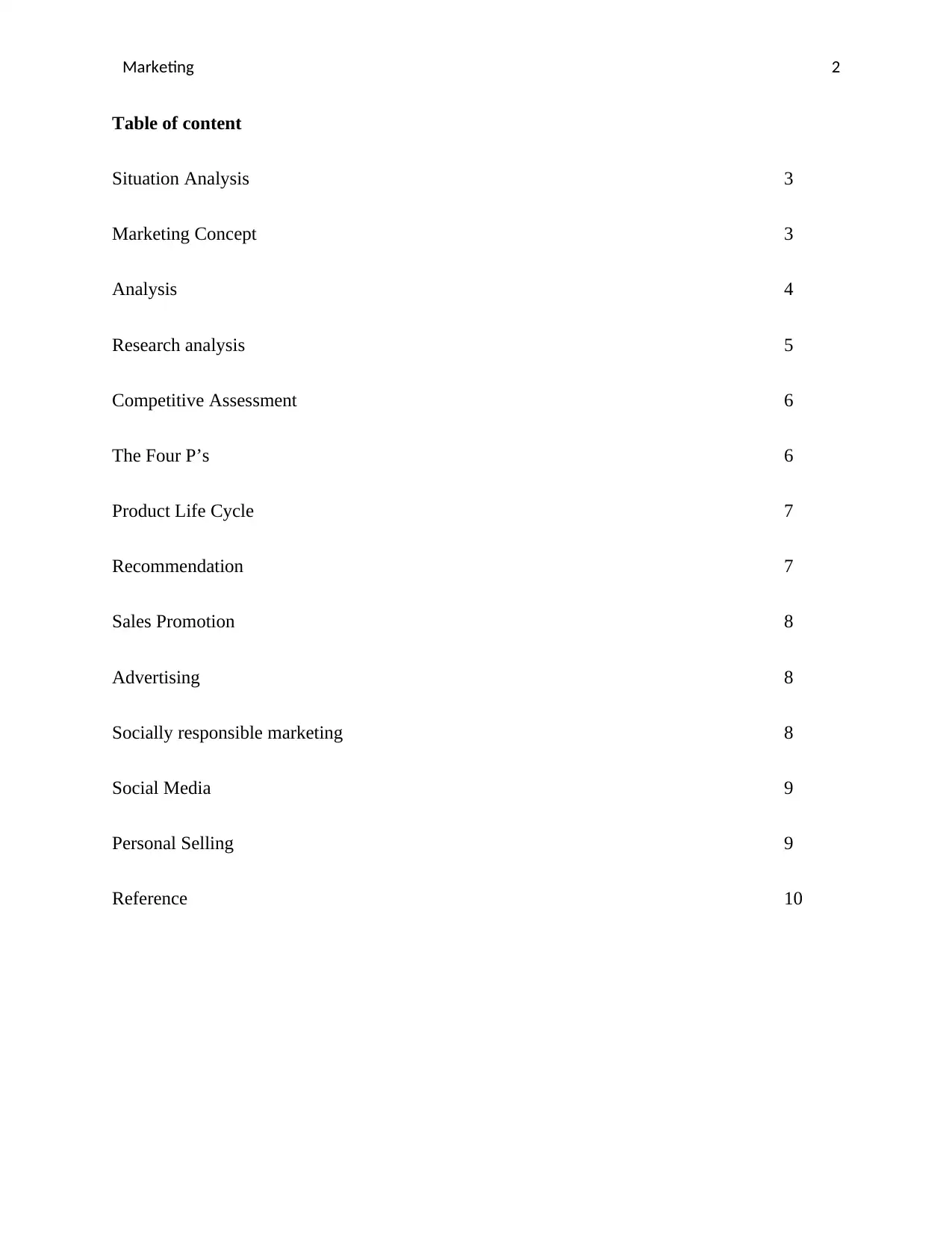
Table of content
Situation Analysis 3
Marketing Concept 3
Analysis 4
Research analysis 5
Competitive Assessment 6
The Four P’s 6
Product Life Cycle 7
Recommendation 7
Sales Promotion 8
Advertising 8
Socially responsible marketing 8
Social Media 9
Personal Selling 9
Reference 10
Document Page
Marketing 3
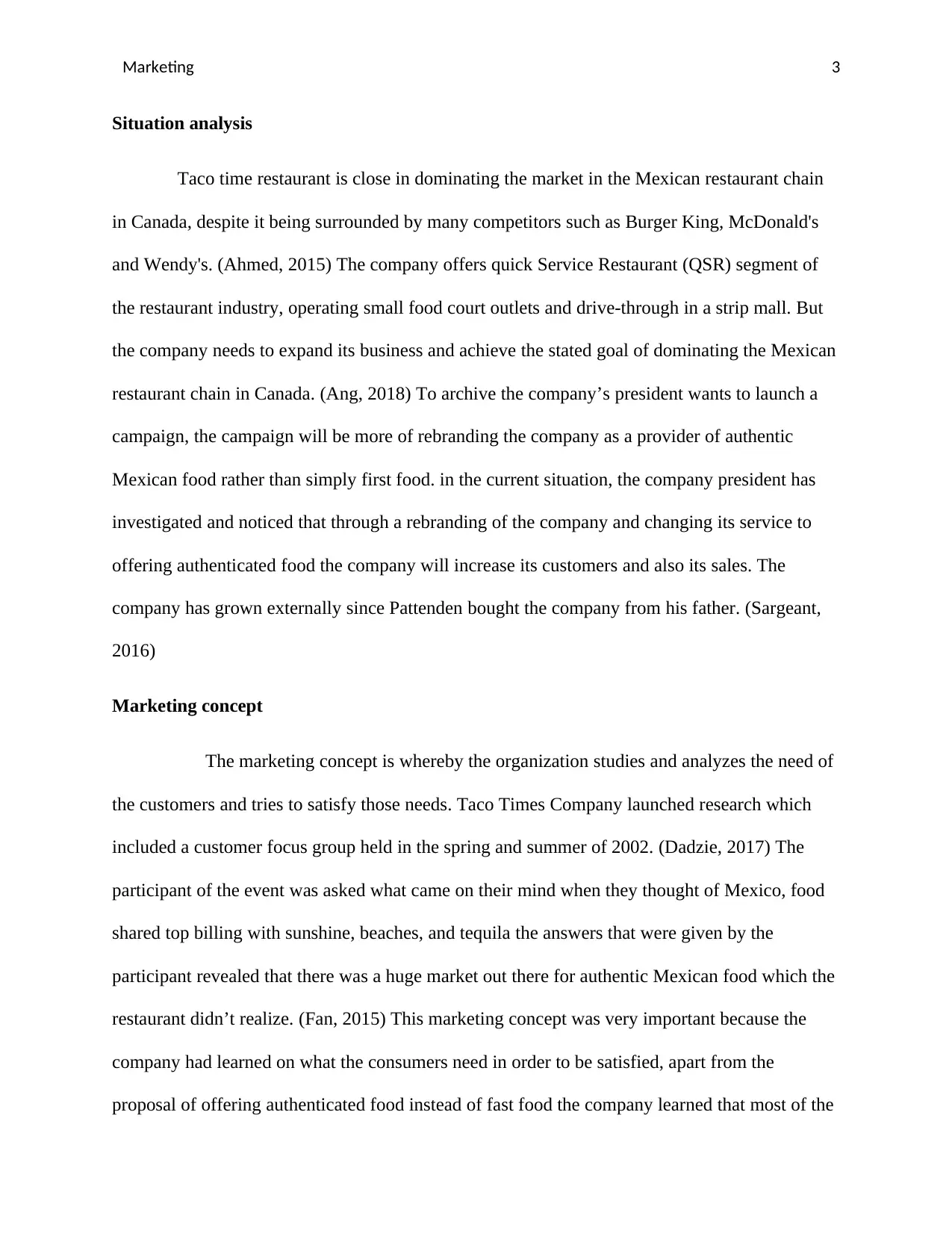
Situation analysis
Taco time restaurant is close in dominating the market in the Mexican restaurant chain
in Canada, despite it being surrounded by many competitors such as Burger King, McDonald's
and Wendy's. (Ahmed, 2015) The company offers quick Service Restaurant (QSR) segment of
the restaurant industry, operating small food court outlets and drive-through in a strip mall. But
the company needs to expand its business and achieve the stated goal of dominating the Mexican
restaurant chain in Canada. (Ang, 2018) To archive the company’s president wants to launch a
campaign, the campaign will be more of rebranding the company as a provider of authentic
Mexican food rather than simply first food. in the current situation, the company president has
investigated and noticed that through a rebranding of the company and changing its service to
offering authenticated food the company will increase its customers and also its sales. The
company has grown externally since Pattenden bought the company from his father. (Sargeant,
2016)
Marketing concept
The marketing concept is whereby the organization studies and analyzes the need of
the customers and tries to satisfy those needs. Taco Times Company launched research which
included a customer focus group held in the spring and summer of 2002. (Dadzie, 2017) The
participant of the event was asked what came on their mind when they thought of Mexico, food
shared top billing with sunshine, beaches, and tequila the answers that were given by the
participant revealed that there was a huge market out there for authentic Mexican food which the
restaurant didn’t realize. (Fan, 2015) This marketing concept was very important because the
company had learned on what the consumers need in order to be satisfied, apart from the
proposal of offering authenticated food instead of fast food the company learned that most of the
Document Page
Marketing 4
company’s consumer dislike the means that the company uses when serving the customers. The
focus group suggested that when food is served using plastic plates rather than wax papers it
implied that really the food is authentic and of good quality. (Awan, 2015) Through this study,
the organization had learned what the consumers need and what to be improved in order to
achieve the organization goal.
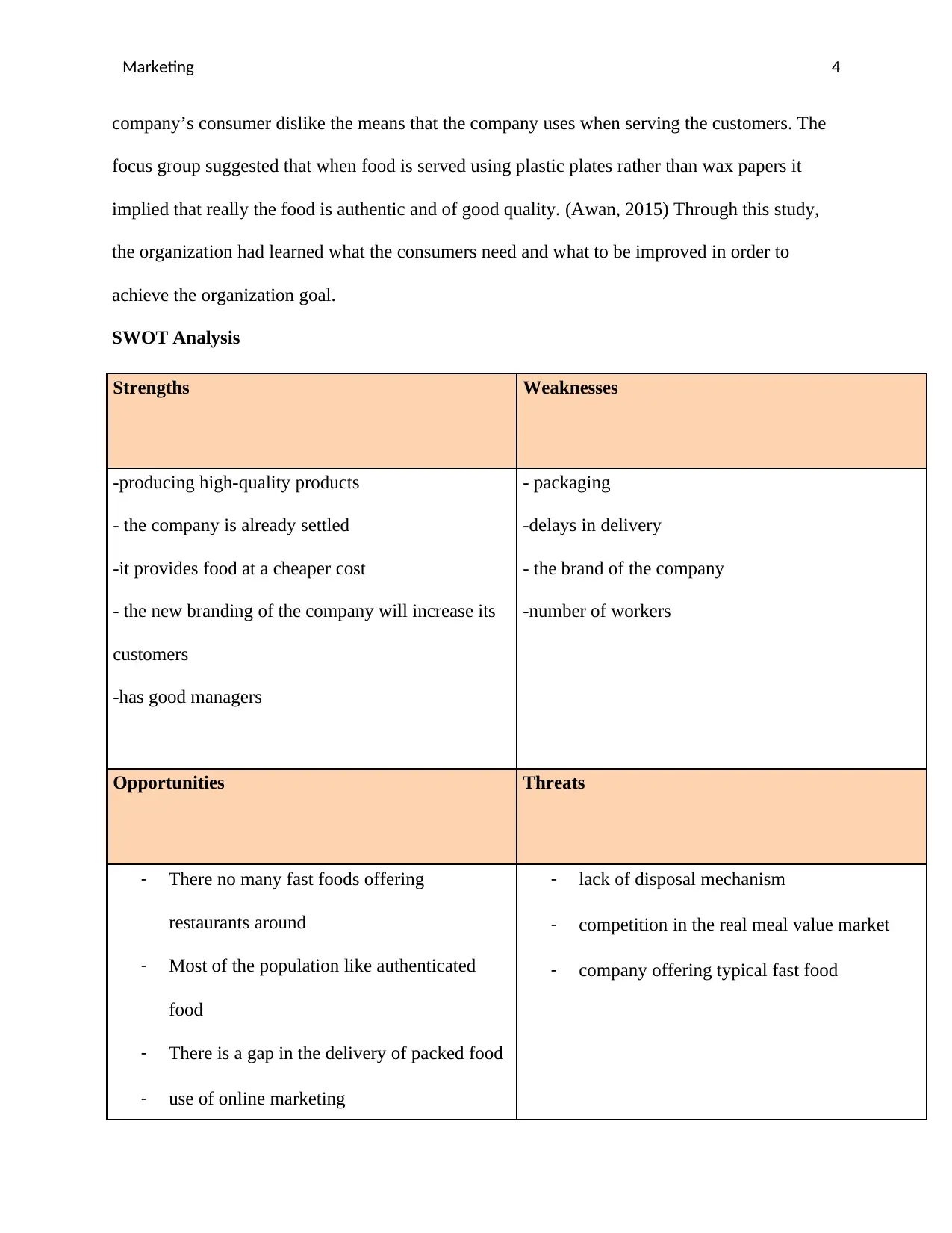
SWOT Analysis
Strengths Weaknesses
-producing high-quality products
- the company is already settled
-it provides food at a cheaper cost
- the new branding of the company will increase its
customers
-has good managers
- packaging
-delays in delivery
- the brand of the company
-number of workers
Opportunities Threats
- There no many fast foods offering
restaurants around
- Most of the population like authenticated
food
- There is a gap in the delivery of packed food
- use of online marketing
- lack of disposal mechanism
- competition in the real meal value market
- company offering typical fast food
tabler-icon-diamond-filled.svg

Paraphrase This Document

Need a fresh take? Get an instant paraphrase of this document with our AI Paraphraser
Document Page
Marketing 5
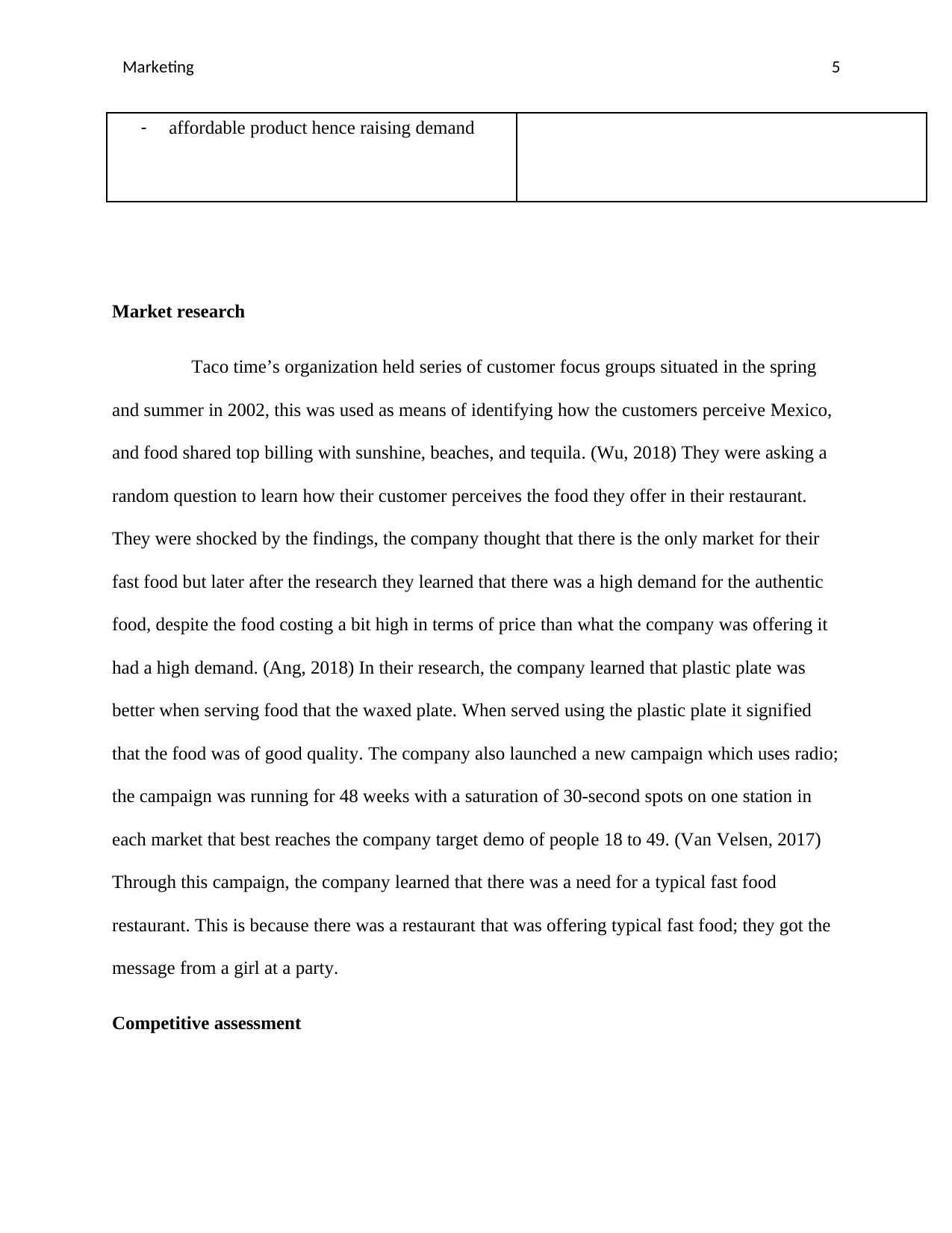
- affordable product hence raising demand
Market research
Taco time’s organization held series of customer focus groups situated in the spring
and summer in 2002, this was used as means of identifying how the customers perceive Mexico,
and food shared top billing with sunshine, beaches, and tequila. (Wu, 2018) They were asking a
random question to learn how their customer perceives the food they offer in their restaurant.
They were shocked by the findings, the company thought that there is the only market for their
fast food but later after the research they learned that there was a high demand for the authentic
food, despite the food costing a bit high in terms of price than what the company was offering it
had a high demand. (Ang, 2018) In their research, the company learned that plastic plate was
better when serving food that the waxed plate. When served using the plastic plate it signified
that the food was of good quality. The company also launched a new campaign which uses radio;
the campaign was running for 48 weeks with a saturation of 30-second spots on one station in
each market that best reaches the company target demo of people 18 to 49. (Van Velsen, 2017)
Through this campaign, the company learned that there was a need for a typical fast food
restaurant. This is because there was a restaurant that was offering typical fast food; they got the
message from a girl at a party.
Competitive assessment
Document Page
Marketing 6
Taco time restaurant is faced with competition from two QSL giant, these giants are
McDonald's and Wendy their companies are involved in the same industry , (Lovelock, 2015)
they offer almost the same services to customer the difference is the two giant companies settled
first and gained market first compared to taco time restaurant another advantage the two giant
companies have is that they have gained popularity over time compared to taco time company,
the two giant companies are faced with the lack of aggressive manger as found in taco time
restaurant , the companies have not conducted any campaign to learn how the needs of the new
market. (Fan, 2015) Taco time restaurant has an advantage over the two giant because it is
exploring new markets and its aim is to dominate the markets.
Four Ps
The four Ps includes helps in making a choice one the organization wants to bring new
product in the market. Hence the four Ps helps the organization to define its marketing options in
terms of price, product, promotion, and place so that it offers and meets a specific customer need
or demand. (Fan, 2015) They include price, product, place, and lastly promotion, Taco time
restaurant should be able to set the price in which it will sell its new targeted product, where to
place its stores, and the authentic food that the company is targeting and lastly how will the
company promote its new product in the market. (Dadzie, 2017) During the restaurant focus
group the company learned that there is a market for authentic food, this was the new product.
Hence the company had to come up with a model to fix the price of the new product and launch a
campaign for promoting its products. (Sargeant, 2016)
Product lifecycle
Document Page
Marketing 7
Product life cycle is the concept whereby the product is thought of implemented, and
it reaches the target it was set, Taco time product lifecycle started when the company realized
that there was a market for authenticated food. First, the company was offering fast food. Hence
the owner of the restaurant thought of providing authenticated fast food due to the fact that there
was a readily available market and its earning were high compared to the current products the
company was offering. (Ahmed, 2015) The restaurant is on the intermediate product life cycle in
expanding its business in Toronto, America, and part of Canada the owner is hoping to fulfill his
dream of transforming a little taco franchise into Canada's largest Mexican restaurant chain
offering authenticated food. (Ariffin, 2017)
Recommendation
Although the organization is faced with competition from well-settled business,
taco time restaurant should take a position of pursuing their dream of becoming Canada largest
Mexican restaurant chain offering authenticated food, the idea of opening 50 to 70 stores in
Toronto in very short period of time should be implemented because the organization will
expand create more awareness of its product, this will also increase sales and be able to beat its
rivals from the market. (Wu, 2018) The company should continue with rebranding the restaurant
with will attract customers and create awareness also.
Sales promotion
tabler-icon-diamond-filled.svg

Paraphrase This Document

Need a fresh take? Get an instant paraphrase of this document with our AI Paraphraser
Document Page
Marketing 8
Elements of sale promotion that can be used by to time restaurant are consumer sale
promotion and trade sale promotion; an example is whereby the company offers a discount when
selling their product hence increasing sales the company also can create awareness by promoting
sales in the promotion explores and also brand its layout. (Dadzie, 2017)
Advertisement
The two types of advertisement elements the company can use are visual impact
and perfect placement, when someone sees an attracting advert he/she will tend to explore more
of the product hence by creating visual impact the company will be able to gain customer in their
competing market, the placement of the advert should in a strategic place where consumers can
view the advert. (Sargeant, 2016) Example taco time restaurant by branding and mounting
posters on its wall attracted customers this sign that the two elements are applicable in attracting
consumers.
Socially responsible market
The two social responsible market elements should be taken into consideration are
economic and ethical, the restaurant should strive to maximize the income of the shareholder and
also should operate with the society expects, as seen earlier consumers prefer served using
plastic plates rather than a waxed plate. (Dadzie, 2017)
Social media
The organization should take into consideration both listening and engagement
elements in social media this by listening to the consumer's needs and requirements engaging
them in order to satisfy the consumer fully, for example, taco time company engaged with the
consumer in a campaign and learned that there is a high demand for authentic food. (Wu, 2018).
Document Page
Marketing 9
Personal selling
one element that should be taken into consideration when it comes to personal selling
is knowledge of the market, example the taco time restaurant launched a campaign of promoting
its product and learned that there was a need of offering typical food. (Ariffin, 2017)
References
Ahmed, S. &. (2015). The effects of the marketing mix on consumer satisfaction. retrieved from
www.apers.ssrn.com.
Ang, C. &. (2018). The Impact of Marketing Mix 4Ps and Consumer Behavior toward Purchase Decision of
Adidas Products. obtained from publication.petra.ac.id.
Ariffin, H. F. (2017). Restaurant’s atmospheric elements: what the customer wants. Journal of Asian
behavioral studies, 85-94.
Document Page
Marketing 10
Awan, W. A. (2015). The impact of marketing mix (5 Ps) elements on sales of UPS: A case of Karachi
Market–Buyer’s perspective. retrieved from www.vfast.org.
Dadzie, K. Q. (2017). How Firms Implement Marketing Strategies in Emerging Markets: An Empirical
Assessment of The 4A Marketing Mix Framework. Journal of Marketing Theory and Practice,
234-256.
Fan, S. L.-3. (2015). Demystifying big data analytics for business intelligence through the lens of the
marketing mix. Elsevier.
Lovelock, C. &. (2015). . Services marketing. obtained from booksgoogle.com.
Sargeant, A. &. (2016). Marketing for nonprofit organizations. Routledge.
Van Velsen, J. (2017). The extended-case method and situational analysis. Routledge.
Wu, Y. L. (2018). Marketing mix, customer value, and customer loyalty in social commerce. retrieved
from www.emeraldinsight.com.
chevron_up_icon
1 out of 10
circle_padding
hide_on_mobile
zoom_out_icon
[object Object]