Talent Management: Key Concepts, Models, and Analysis - Unit 5
VerifiedAdded on 2023/06/12
|5
|1583
|443
Homework Assignment
AI Summary
This assignment solution provides answers to questions related to talent management, covering topics such as the definition of talent management, critical people for succession planning, competency models, and elements of an effective job description. It also discusses Maslow's hierarchy of needs, elements of a talent profile, and components for talent assessment. Furthermore, the solution explains the phases of the shared management model, successful succession planning, Daniel Goleman’s emotional intelligence model, and the differences between Herzberg's motivational and maintenance factors. The document references various books and journals, offering a comprehensive overview of talent management concepts and their practical applications. Desklib is a platform where students can find similar solved assignments and past papers.
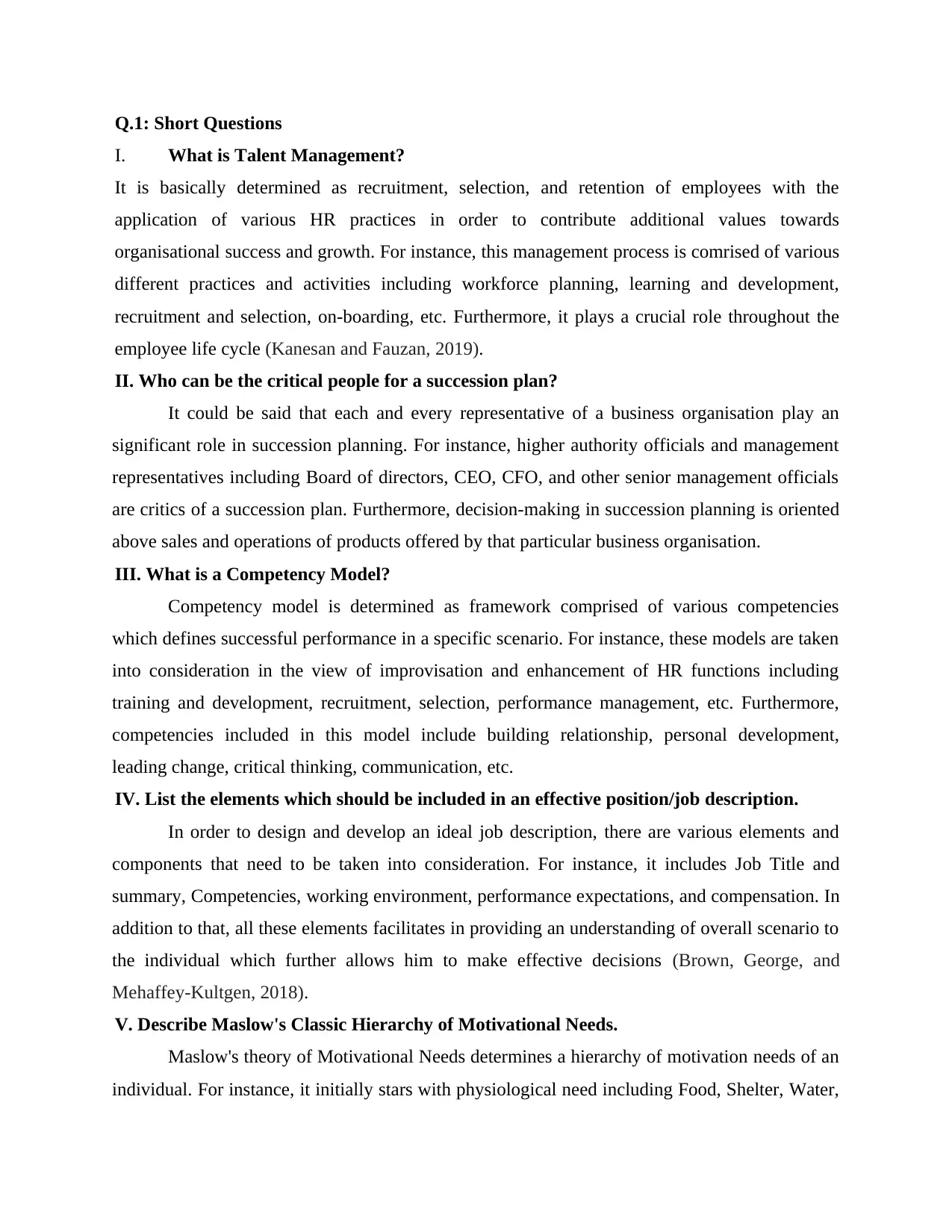
Q.1: Short Questions
I. What is Talent Management?
It is basically determined as recruitment, selection, and retention of employees with the
application of various HR practices in order to contribute additional values towards
organisational success and growth. For instance, this management process is comrised of various
different practices and activities including workforce planning, learning and development,
recruitment and selection, on-boarding, etc. Furthermore, it plays a crucial role throughout the
employee life cycle (Kanesan and Fauzan, 2019).
II. Who can be the critical people for a succession plan?
It could be said that each and every representative of a business organisation play an
significant role in succession planning. For instance, higher authority officials and management
representatives including Board of directors, CEO, CFO, and other senior management officials
are critics of a succession plan. Furthermore, decision-making in succession planning is oriented
above sales and operations of products offered by that particular business organisation.
III. What is a Competency Model?
Competency model is determined as framework comprised of various competencies
which defines successful performance in a specific scenario. For instance, these models are taken
into consideration in the view of improvisation and enhancement of HR functions including
training and development, recruitment, selection, performance management, etc. Furthermore,
competencies included in this model include building relationship, personal development,
leading change, critical thinking, communication, etc.
IV. List the elements which should be included in an effective position/job description.
In order to design and develop an ideal job description, there are various elements and
components that need to be taken into consideration. For instance, it includes Job Title and
summary, Competencies, working environment, performance expectations, and compensation. In
addition to that, all these elements facilitates in providing an understanding of overall scenario to
the individual which further allows him to make effective decisions (Brown, George, and
Mehaffey-Kultgen, 2018).
V. Describe Maslow's Classic Hierarchy of Motivational Needs.
Maslow's theory of Motivational Needs determines a hierarchy of motivation needs of an
individual. For instance, it initially stars with physiological need including Food, Shelter, Water,
I. What is Talent Management?
It is basically determined as recruitment, selection, and retention of employees with the
application of various HR practices in order to contribute additional values towards
organisational success and growth. For instance, this management process is comrised of various
different practices and activities including workforce planning, learning and development,
recruitment and selection, on-boarding, etc. Furthermore, it plays a crucial role throughout the
employee life cycle (Kanesan and Fauzan, 2019).
II. Who can be the critical people for a succession plan?
It could be said that each and every representative of a business organisation play an
significant role in succession planning. For instance, higher authority officials and management
representatives including Board of directors, CEO, CFO, and other senior management officials
are critics of a succession plan. Furthermore, decision-making in succession planning is oriented
above sales and operations of products offered by that particular business organisation.
III. What is a Competency Model?
Competency model is determined as framework comprised of various competencies
which defines successful performance in a specific scenario. For instance, these models are taken
into consideration in the view of improvisation and enhancement of HR functions including
training and development, recruitment, selection, performance management, etc. Furthermore,
competencies included in this model include building relationship, personal development,
leading change, critical thinking, communication, etc.
IV. List the elements which should be included in an effective position/job description.
In order to design and develop an ideal job description, there are various elements and
components that need to be taken into consideration. For instance, it includes Job Title and
summary, Competencies, working environment, performance expectations, and compensation. In
addition to that, all these elements facilitates in providing an understanding of overall scenario to
the individual which further allows him to make effective decisions (Brown, George, and
Mehaffey-Kultgen, 2018).
V. Describe Maslow's Classic Hierarchy of Motivational Needs.
Maslow's theory of Motivational Needs determines a hierarchy of motivation needs of an
individual. For instance, it initially stars with physiological need including Food, Shelter, Water,
Paraphrase This Document
Need a fresh take? Get an instant paraphrase of this document with our AI Paraphraser

Clothing, and other necessary elements and goes all the way till self-actualisation needs which
Brown, L., George, B. and Mehaffey-Kultgen, C., 2018. The development of a competency
model and its implementation in a power utility cooperative: an action research study. Industrial
and Commercial Training.includes social recognition and appreciation. It facilitates in
understanding of needs and requirements of individuals in order to motivate and encourage them.
VI. Outline the elements which should be included in an individual’s talent profile.
The primary and major elements to be mentioned in talent profile include
Accomplishments or achievements, qualifications, work history, Job interest, language spoken,
etc. For instance, all these elements or components provides an understanding to respective
business organisation in order to decide for selection of that particular individual. Furthermore, it
also facilitates in checking eligibility of that applicant for job position (Desarno, and et. al.,
2021).
VII. What are the three components for conducting a talent assessment?
In order to conduct an efficient talent assessment, there are various components
including A systematic and structured interview, Personality tests, and Job trial. For
instance, structured interview facilitates in acquiring sufficient information or
knowledge about the individual. On the other hand, job trial will further determine core
competencies of that particular applicant in completion of assigned work.
Q: 2: Discuss the different phases of the shared management model.
This management model is aimed at providing employees with an internal manager of
their own with consideration of various phases which are as follows:
Preparation: This phase includes setting up of standards and choice of appropriate
canBrown, L., George, B. and Mehaffey-Kultgen, C., 2018. The development of a
competency model and its implementation in a power utility cooperative: an action
research study. Industrial and Commercial Training.didate or individual for the job.
Activation: This phase is about initiation of guidance and activities in order to turn
employees into their own motivators.
Ongoing Evaluation: This phase is aimed at performance management of participants
with their existing performance.
Formal Evaluation: In this stage, these participants learn about performance reviews in
order to manage and review their performance.
Brown, L., George, B. and Mehaffey-Kultgen, C., 2018. The development of a competency
model and its implementation in a power utility cooperative: an action research study. Industrial
and Commercial Training.includes social recognition and appreciation. It facilitates in
understanding of needs and requirements of individuals in order to motivate and encourage them.
VI. Outline the elements which should be included in an individual’s talent profile.
The primary and major elements to be mentioned in talent profile include
Accomplishments or achievements, qualifications, work history, Job interest, language spoken,
etc. For instance, all these elements or components provides an understanding to respective
business organisation in order to decide for selection of that particular individual. Furthermore, it
also facilitates in checking eligibility of that applicant for job position (Desarno, and et. al.,
2021).
VII. What are the three components for conducting a talent assessment?
In order to conduct an efficient talent assessment, there are various components
including A systematic and structured interview, Personality tests, and Job trial. For
instance, structured interview facilitates in acquiring sufficient information or
knowledge about the individual. On the other hand, job trial will further determine core
competencies of that particular applicant in completion of assigned work.
Q: 2: Discuss the different phases of the shared management model.
This management model is aimed at providing employees with an internal manager of
their own with consideration of various phases which are as follows:
Preparation: This phase includes setting up of standards and choice of appropriate
canBrown, L., George, B. and Mehaffey-Kultgen, C., 2018. The development of a
competency model and its implementation in a power utility cooperative: an action
research study. Industrial and Commercial Training.didate or individual for the job.
Activation: This phase is about initiation of guidance and activities in order to turn
employees into their own motivators.
Ongoing Evaluation: This phase is aimed at performance management of participants
with their existing performance.
Formal Evaluation: In this stage, these participants learn about performance reviews in
order to manage and review their performance.

Q: 3: Write a note on “Successful succession planning”.
Succession planning in Human resourDesarno, J., Perez, M., Rivas, R., Sandate, I.,
Reed, C. and Fonseca, I., 2021. Succession planning within the health care
organization:: Human resources management and human capital management
considerations. Nurse Leader, 19(4), pp.411-415.ce management is focused at growth of
particular business organisation with ensuring cost-effectiveness in order to develop
existing workforce instead of hiring new applicants. For instance, it facilitates in saving
cost of organising training and development programs with consideration of existing
employees for higher job positions. Furthermore, it is determined at providing
employees with a clear path of success in their career with respect to future
circumstances. Therefore, with the consideration of succession planning in HRM, it
facilitates particular business organisation with getting employees ready to take over
prior to fall of operations into disarray (Anlesinya, and Amponsah-Tawiah, K., 2020).
Q: 4: Discuss the Daniel Goleman’s emotional intelligence model.
Emotional Intelligence is determined at individual ability to understand and manage
emotions in a positive manner in order to empathize with co-people and communicate
effectively.
Goleman's emotional intelligence model is determined at providing learning and
understanding of primary components of emotional intelligence including empathy,
social skills, self-regulation, self-awareness, and motivation. For instance, all these
components of emotional intelligence further facilitates in achievement of desired goals
and objectives with elimination of possible barriers and conflicts. In addition to that,
individuals with efficient emotional intelligence are benefited with mental stability and
enhanced ability to manage pressure in their personal as well as professional routines or
schedules. Therefore, all these components of emotional intelligence contribute towards
self-management and further facilitates in ensuring personal growth and development.
Q: 5: What are the differences between Herzberg's motivational and maintenance
factors?
The theory of Herzberg determines that maintenance and motivation factors plays a
significant role in a workplace. Brown, L., George, B. and Mehaffey-Kultgen, C., 2018. The
development of a competency model and its implementation in a power utility cooperative: an
Succession planning in Human resourDesarno, J., Perez, M., Rivas, R., Sandate, I.,
Reed, C. and Fonseca, I., 2021. Succession planning within the health care
organization:: Human resources management and human capital management
considerations. Nurse Leader, 19(4), pp.411-415.ce management is focused at growth of
particular business organisation with ensuring cost-effectiveness in order to develop
existing workforce instead of hiring new applicants. For instance, it facilitates in saving
cost of organising training and development programs with consideration of existing
employees for higher job positions. Furthermore, it is determined at providing
employees with a clear path of success in their career with respect to future
circumstances. Therefore, with the consideration of succession planning in HRM, it
facilitates particular business organisation with getting employees ready to take over
prior to fall of operations into disarray (Anlesinya, and Amponsah-Tawiah, K., 2020).
Q: 4: Discuss the Daniel Goleman’s emotional intelligence model.
Emotional Intelligence is determined at individual ability to understand and manage
emotions in a positive manner in order to empathize with co-people and communicate
effectively.
Goleman's emotional intelligence model is determined at providing learning and
understanding of primary components of emotional intelligence including empathy,
social skills, self-regulation, self-awareness, and motivation. For instance, all these
components of emotional intelligence further facilitates in achievement of desired goals
and objectives with elimination of possible barriers and conflicts. In addition to that,
individuals with efficient emotional intelligence are benefited with mental stability and
enhanced ability to manage pressure in their personal as well as professional routines or
schedules. Therefore, all these components of emotional intelligence contribute towards
self-management and further facilitates in ensuring personal growth and development.
Q: 5: What are the differences between Herzberg's motivational and maintenance
factors?
The theory of Herzberg determines that maintenance and motivation factors plays a
significant role in a workplace. Brown, L., George, B. and Mehaffey-Kultgen, C., 2018. The
development of a competency model and its implementation in a power utility cooperative: an
⊘ This is a preview!⊘
Do you want full access?
Subscribe today to unlock all pages.

Trusted by 1+ million students worldwide

action research study. Industrial and Commercial Training.For instance, both of the theories
determines various factors which results in affecting satisfaction of employees in a workplace.
Theory of maintenance determines that presence of maintenance factors does not affect
satisfaction of employees, but their absence affects employees with dissatisfaction. In addition to
that, there are various maintenancBrown, L., George, B. and Mehaffey-Kultgen, C., 2018. The
development of a competency model and its implementation in a power utility cooperative: an
action research study. Industrial and Commercial Training.e factors including job security, job
position, company policy, working conditions, etc. which results in affecting employees in a
workplace (Taylor, S., 2018).
On the other hand, theory of motivation are further related to job characteristics which
impact upon employees in their motivation. Moreover, these factors include authority,
recognition, growth, etc. Therefore, presence of these factors facilitates in satisfaction of
employees in workplace.Taylor, S., 2018. Resourcing and talent management. Kogan Page
Publishers.Brown, L., George, B. and Mehaffey-Kultgen, C., 2018. The development of a
competency model and its implementation in a power utility cooperative: an action research
study. Industrial and Commercial Training.
determines various factors which results in affecting satisfaction of employees in a workplace.
Theory of maintenance determines that presence of maintenance factors does not affect
satisfaction of employees, but their absence affects employees with dissatisfaction. In addition to
that, there are various maintenancBrown, L., George, B. and Mehaffey-Kultgen, C., 2018. The
development of a competency model and its implementation in a power utility cooperative: an
action research study. Industrial and Commercial Training.e factors including job security, job
position, company policy, working conditions, etc. which results in affecting employees in a
workplace (Taylor, S., 2018).
On the other hand, theory of motivation are further related to job characteristics which
impact upon employees in their motivation. Moreover, these factors include authority,
recognition, growth, etc. Therefore, presence of these factors facilitates in satisfaction of
employees in workplace.Taylor, S., 2018. Resourcing and talent management. Kogan Page
Publishers.Brown, L., George, B. and Mehaffey-Kultgen, C., 2018. The development of a
competency model and its implementation in a power utility cooperative: an action research
study. Industrial and Commercial Training.
Paraphrase This Document
Need a fresh take? Get an instant paraphrase of this document with our AI Paraphraser

REFERENCES
Books and Journals
Anlesinya, A. and Amponsah-Tawiah, K., 2020. Towards a responsible talent management
model. European Journal of Training and Development.
Brown, L., George, B. and Mehaffey-Kultgen, C., 2018. The development of a competency
model and its implementation in a power utility cooperative: an action research
study. Industrial and Commercial Training.
Desarno, and et. al., 2021. Succession planning within the health care organization:: Human
resources management and human capital management considerations. Nurse
Leader, 19(4), pp.411-415.
Kanesan, P. and Fauzan, N., 2019. Models of emotional intelligence: A review. e-Bangi, 16,
pp.1-9.
Taylor, S., 2018. Resourcing and talent management. Kogan Page Publishers.
Books and Journals
Anlesinya, A. and Amponsah-Tawiah, K., 2020. Towards a responsible talent management
model. European Journal of Training and Development.
Brown, L., George, B. and Mehaffey-Kultgen, C., 2018. The development of a competency
model and its implementation in a power utility cooperative: an action research
study. Industrial and Commercial Training.
Desarno, and et. al., 2021. Succession planning within the health care organization:: Human
resources management and human capital management considerations. Nurse
Leader, 19(4), pp.411-415.
Kanesan, P. and Fauzan, N., 2019. Models of emotional intelligence: A review. e-Bangi, 16,
pp.1-9.
Taylor, S., 2018. Resourcing and talent management. Kogan Page Publishers.
1 out of 5
Related Documents
Your All-in-One AI-Powered Toolkit for Academic Success.
+13062052269
info@desklib.com
Available 24*7 on WhatsApp / Email
Unlock your academic potential
Copyright © 2020–2025 A2Z Services. All Rights Reserved. Developed and managed by ZUCOL.