Report: HR Roles, Responsibilities, and Talent Management Strategies

Verified

Added on  2022/12/29

|7
|553
|83
Report
AI Summary
This report delves into the multifaceted roles and responsibilities of Human Resources (HR) within an organization, emphasizing their critical impact on talent management and the achievement of business objectives. It outlines the key functions of HR, including attracting potential candidates, candidate selection, performance appraisal, and compensation, highlighting their significance in building a strong workforce. Furthermore, the report details the responsibilities of HR in human resource planning and providing career assistance, ensuring optimal employee utilization and development. The core of the report examines the crucial link between talent management and business objectives, demonstrating how effective talent management, which involves hiring and retaining top talent, directly contributes to improved overall performance and profitability. The report also references relevant academic sources to support the findings.
Document Page
HR and Talent Management
tabler-icon-diamond-filled.svg

Paraphrase This Document

Need a fresh take? Get an instant paraphrase of this document with our AI Paraphraser
Document Page
Table of Contents
Roles and responsibilities of HR.................................................................................................3
Talent management and achievement of business objectives.....................................................3
REFERENCES...............................................................................................................................4
Books and journals......................................................................................................................4
Document Page
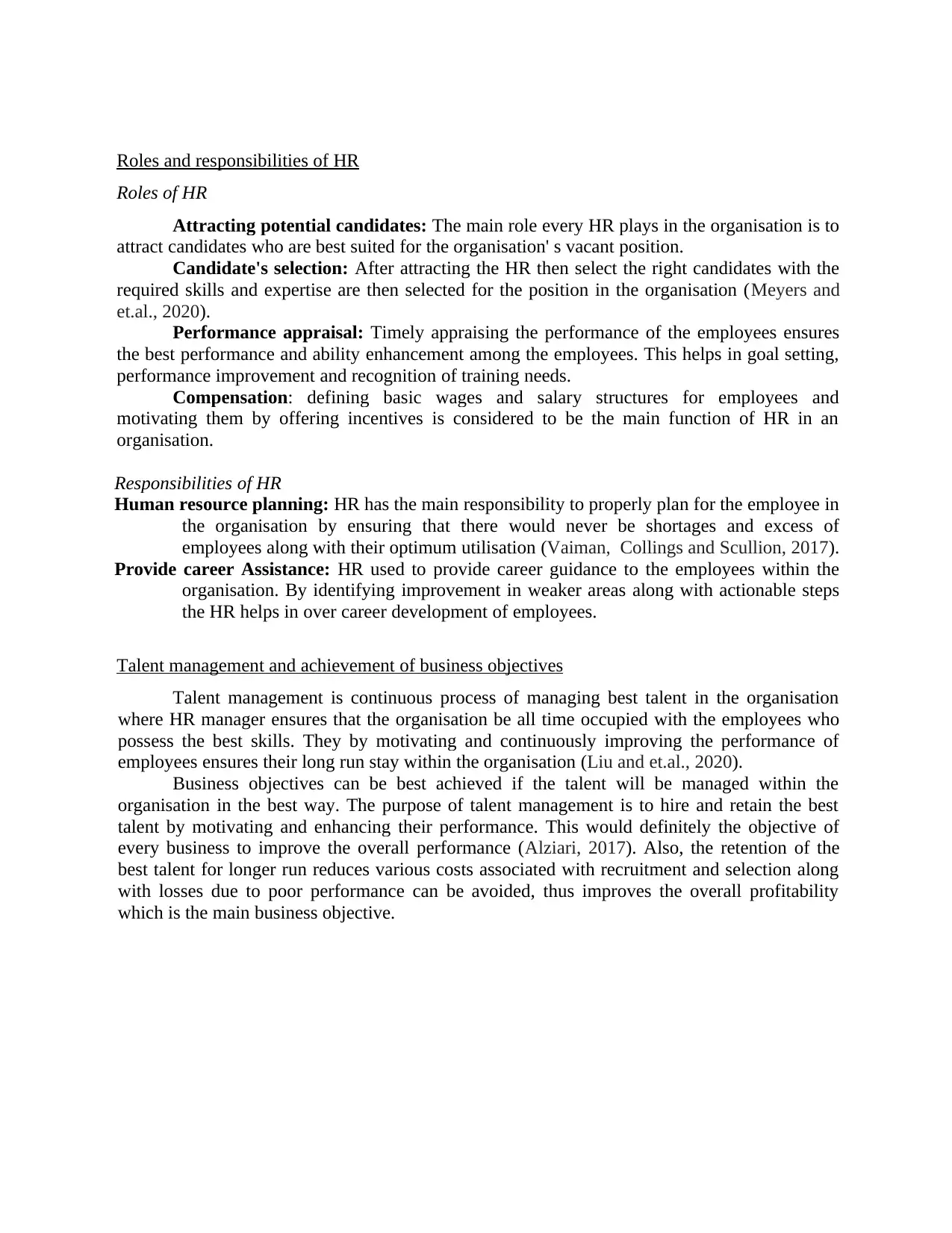
Roles and responsibilities of HR
Roles of HR
Attracting potential candidates: The main role every HR plays in the organisation is to
attract candidates who are best suited for the organisation' s vacant position.
Candidate's selection: After attracting the HR then select the right candidates with the
required skills and expertise are then selected for the position in the organisation (Meyers and
et.al., 2020).
Performance appraisal: Timely appraising the performance of the employees ensures
the best performance and ability enhancement among the employees. This helps in goal setting,
performance improvement and recognition of training needs.
Compensation: defining basic wages and salary structures for employees and
motivating them by offering incentives is considered to be the main function of HR in an
organisation.
Responsibilities of HR
Human resource planning: HR has the main responsibility to properly plan for the employee in
the organisation by ensuring that there would never be shortages and excess of
employees along with their optimum utilisation (Vaiman, Collings and Scullion, 2017).
Provide career Assistance: HR used to provide career guidance to the employees within the
organisation. By identifying improvement in weaker areas along with actionable steps
the HR helps in over career development of employees.
Talent management and achievement of business objectives
Talent management is continuous process of managing best talent in the organisation
where HR manager ensures that the organisation be all time occupied with the employees who
possess the best skills. They by motivating and continuously improving the performance of
employees ensures their long run stay within the organisation (Liu and et.al., 2020).
Business objectives can be best achieved if the talent will be managed within the
organisation in the best way. The purpose of talent management is to hire and retain the best
talent by motivating and enhancing their performance. This would definitely the objective of
every business to improve the overall performance (Alziari, 2017). Also, the retention of the
best talent for longer run reduces various costs associated with recruitment and selection along
with losses due to poor performance can be avoided, thus improves the overall profitability
which is the main business objective.
Document Page
REFERENCES
Books and journals
Meyers, M. C., and et.al., 2020. HR managers’ talent philosophies: prevalence and relationships
with perceived talent management practices. The International Journal of Human
Resource Management. 31(4). pp.562-588.
Vaiman, V., Collings, D. G. and Scullion, H., 2017. Contextualising talent
management. Journal of Organizational Effectiveness: People and Performance.
Liu, Y., and et.al., 2020. Talent management and the HR function in cross-cultural mergers and
acquisitions: The role and impact of bi-cultural identity. Human Resource Management
Review, p.100744.
Alziari, L., 2017. A chief HR officer’s perspective on talent management. Journal of
Organizational Effectiveness: People and Performance.
tabler-icon-diamond-filled.svg

Paraphrase This Document

Need a fresh take? Get an instant paraphrase of this document with our AI Paraphraser
Document Page
Document Page
Document Page
chevron_up_icon
1 out of 7
circle_padding
hide_on_mobile
zoom_out_icon
[object Object]