HND Research Project: Talent Management Strategy in Ramada Hotel

Verified

Added on  2022/09/12

|14
|1370
|13
Project
AI Summary
This project focuses on developing an effective talent management strategy for the Ramada Hotel. It aims to enhance employee skills and improve service quality. The project includes a project management plan outlining the scope, risks, and mitigation strategies. Data collection methods involve qualitative analysis of journals and articles, interviews, and observations, along with quantitative methods such as surveys and sampling. Secondary research highlights the importance of talent retention in the hospitality industry, while primary research involves interviews and online surveys. The project evaluates the validity and reliability of research methods and analyzes both qualitative and quantitative data. Findings indicate the significance of talented employees and the need for strategic talent management. Recommendations include implementing skill development programs, identifying unique talents, and conducting appreciation programs. The research tools are deemed authentic and accurate, with the project demonstrating practical outcomes and supporting sustainable performance. The project improved punctuality, budgeting skills, and provided valuable learnings for future endeavors, emphasizing the importance of quality research in achieving objectives. The references include key literature on talent management in the hospitality sector.
Document Page
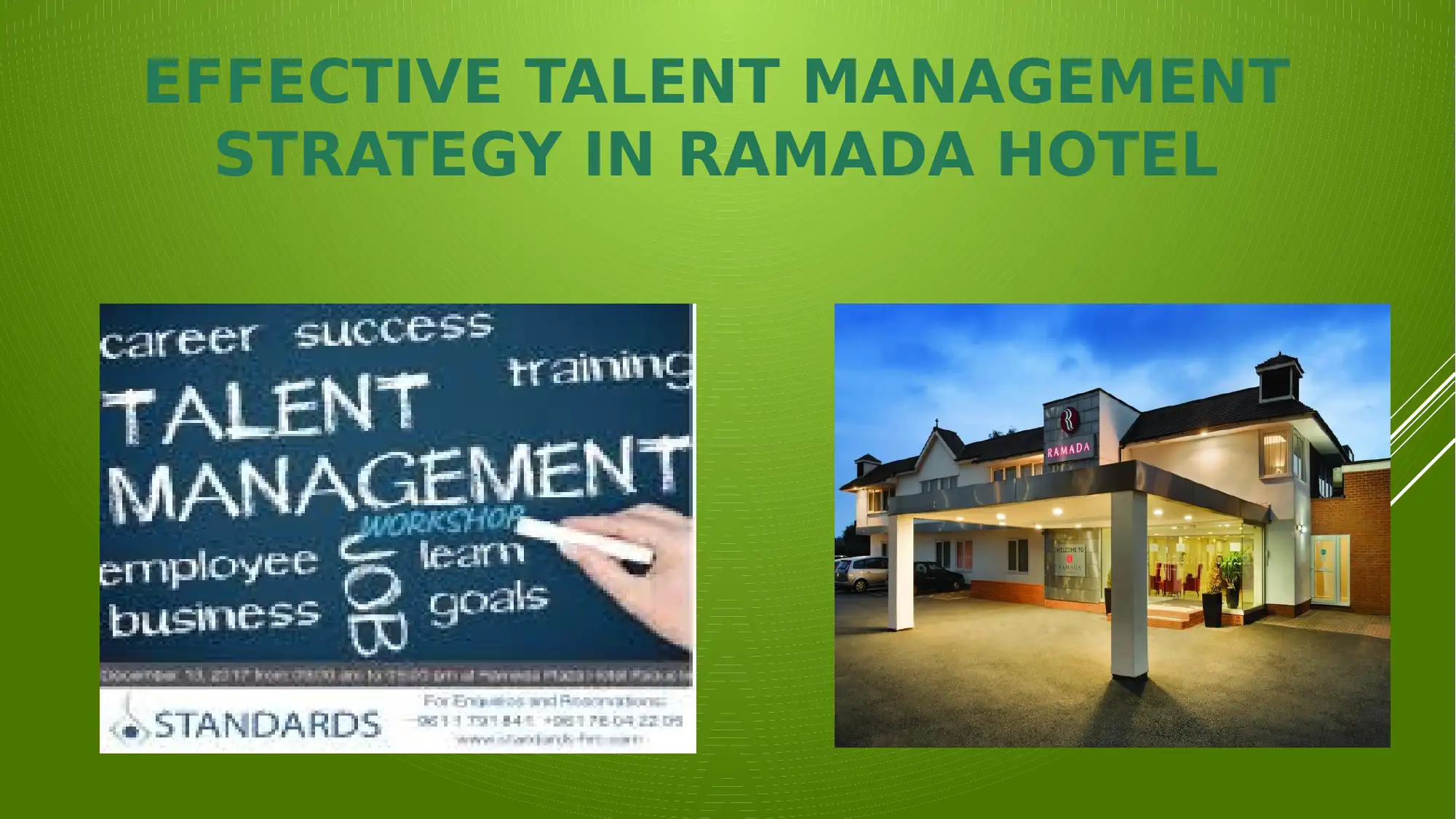
EFFECTIVE TALENT MANAGEMENT
STRATEGY IN RAMADA HOTEL
tabler-icon-diamond-filled.svg

Paraphrase This Document

Need a fresh take? Get an instant paraphrase of this document with our AI Paraphraser
Document Page
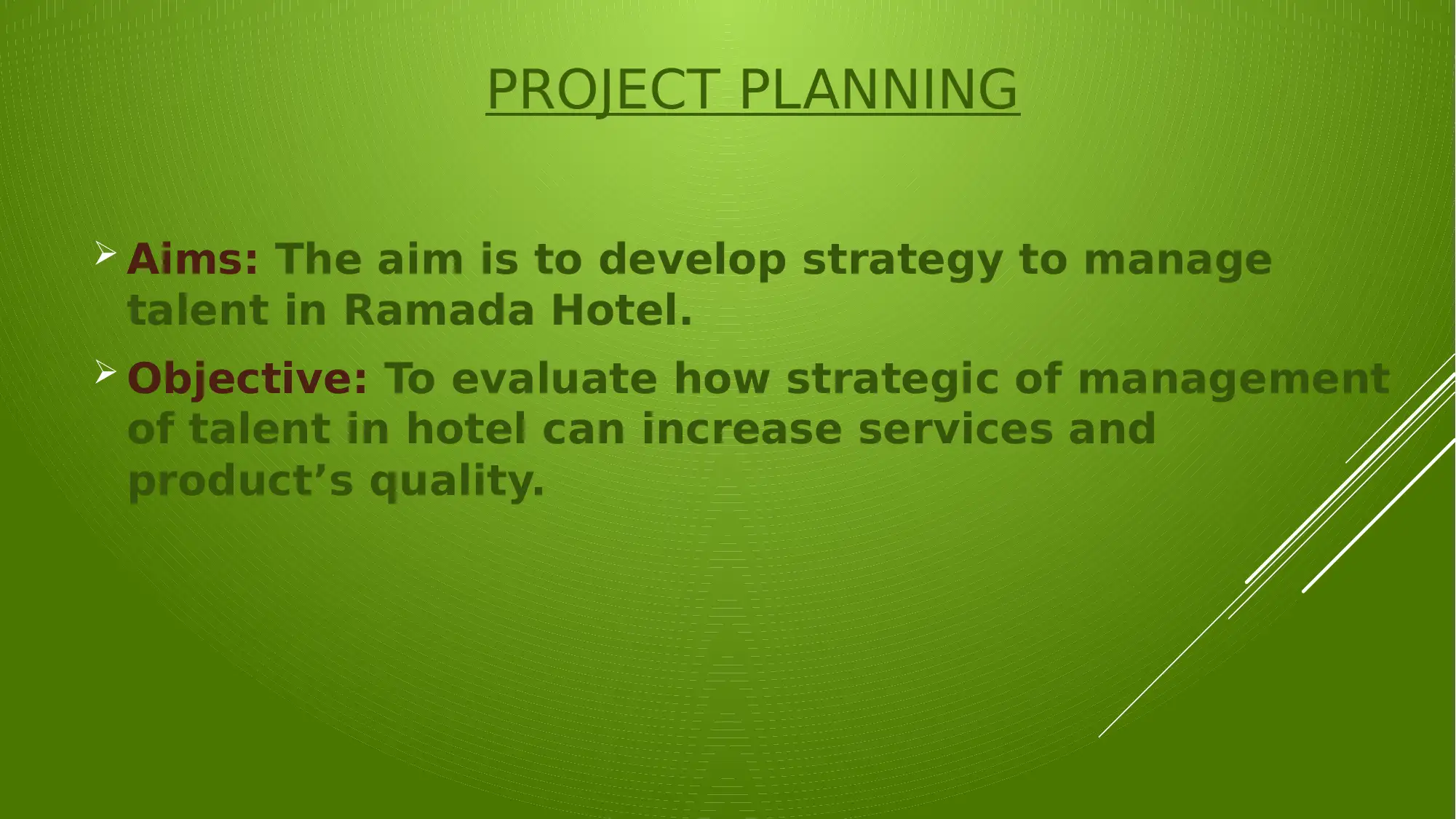
PROJECT PLANNING
Aims: The aim is to develop strategy to manage
talent in Ramada Hotel.
Objective: To evaluate how strategic of management
of talent in hotel can increase services and
product’s quality.
Document Page
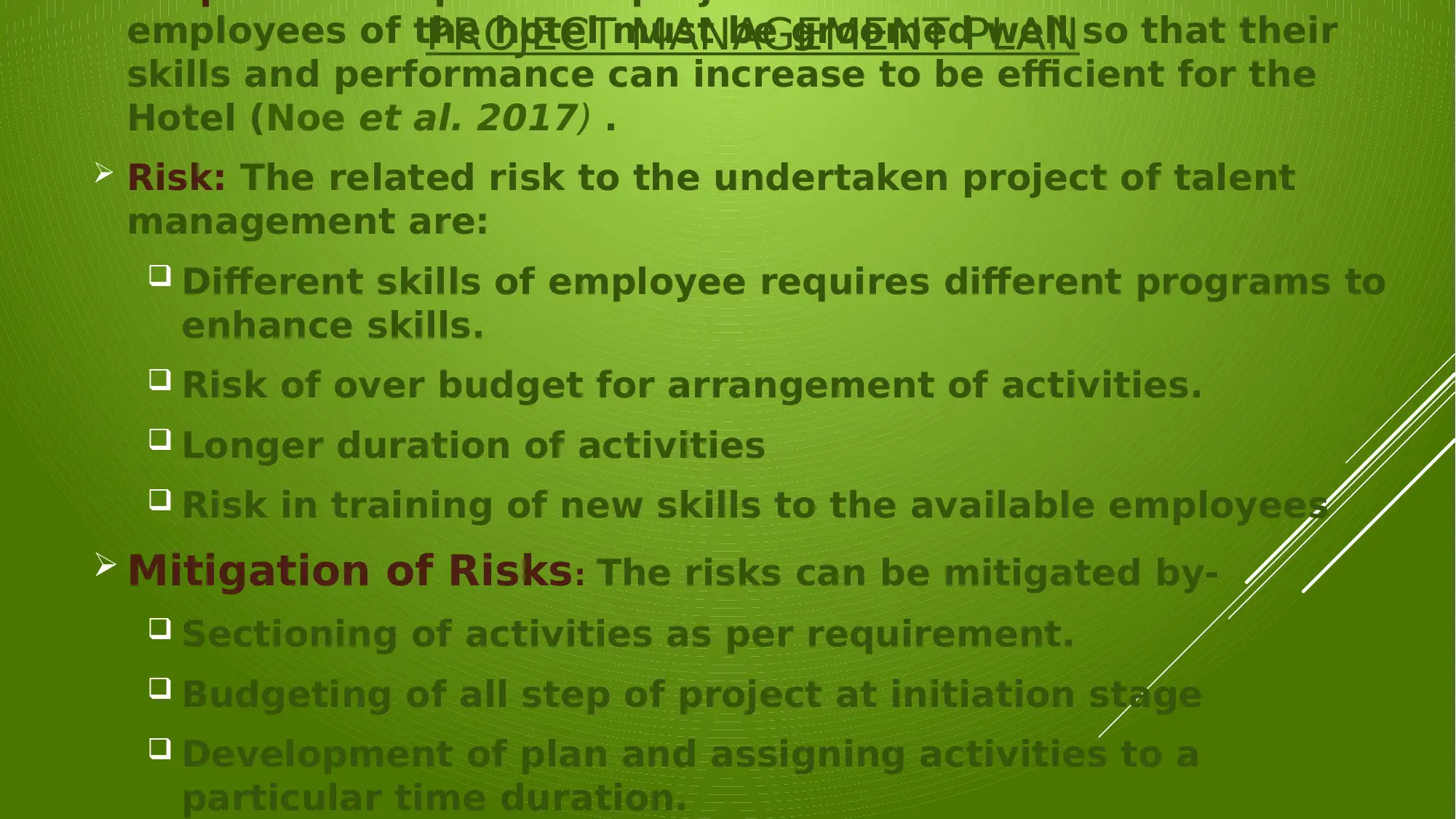
PROJECT MANAGEMENT PLANemployees of the hotel must be groomed well so that their
skills and performance can increase to be efficient for the
Hotel (Noe et al. 2017) .
Risk: The related risk to the undertaken project of talent
management are:
Different skills of employee requires different programs to
enhance skills.
Risk of over budget for arrangement of activities.
Longer duration of activities
Risk in training of new skills to the available employees
Mitigation of Risks: The risks can be mitigated by-
Sectioning of activities as per requirement.
Budgeting of all step of project at initiation stage
Development of plan and assigning activities to a
particular time duration.
Document Page
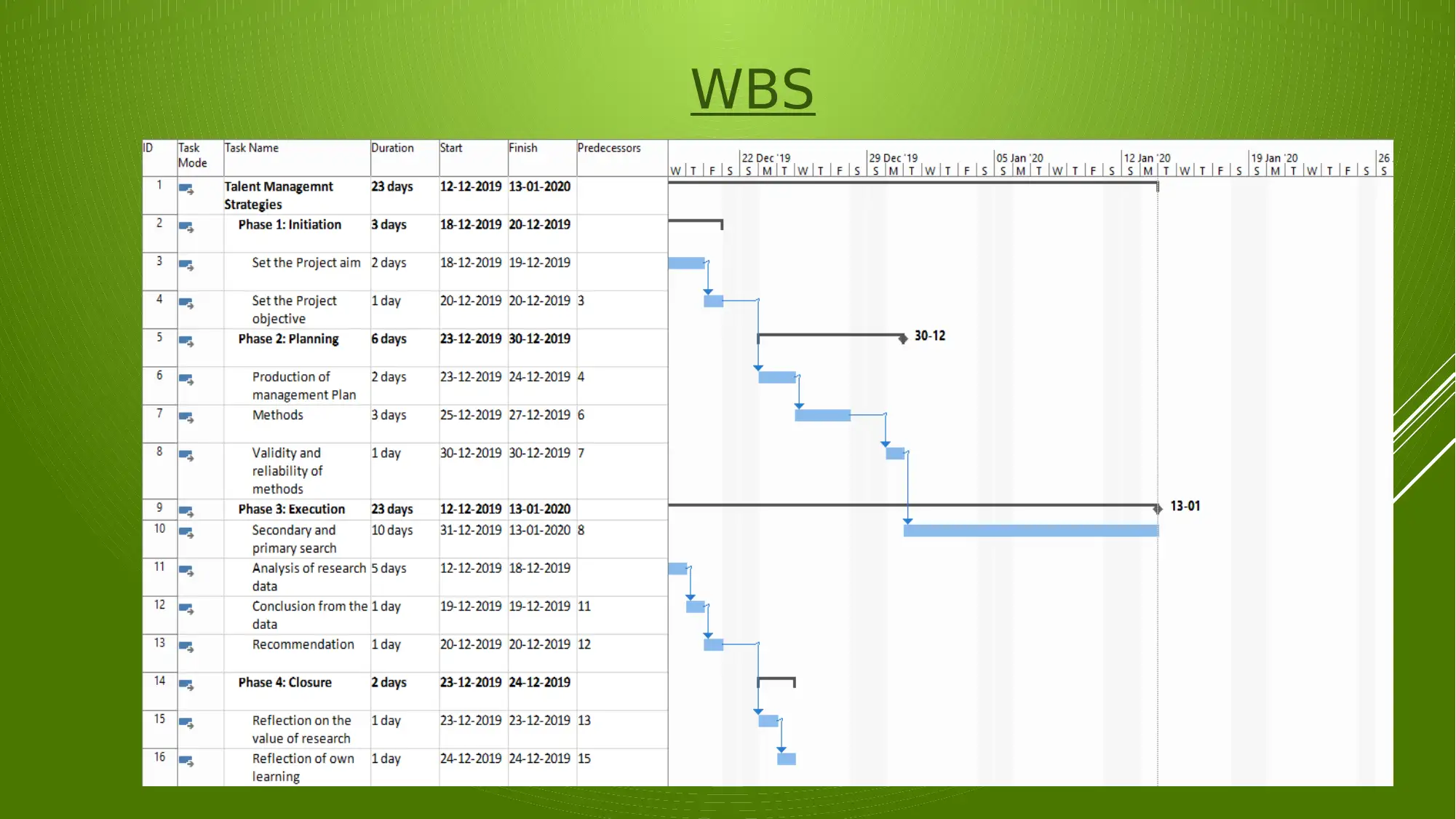
WBS
tabler-icon-diamond-filled.svg

Paraphrase This Document

Need a fresh take? Get an instant paraphrase of this document with our AI Paraphraser
Document Page
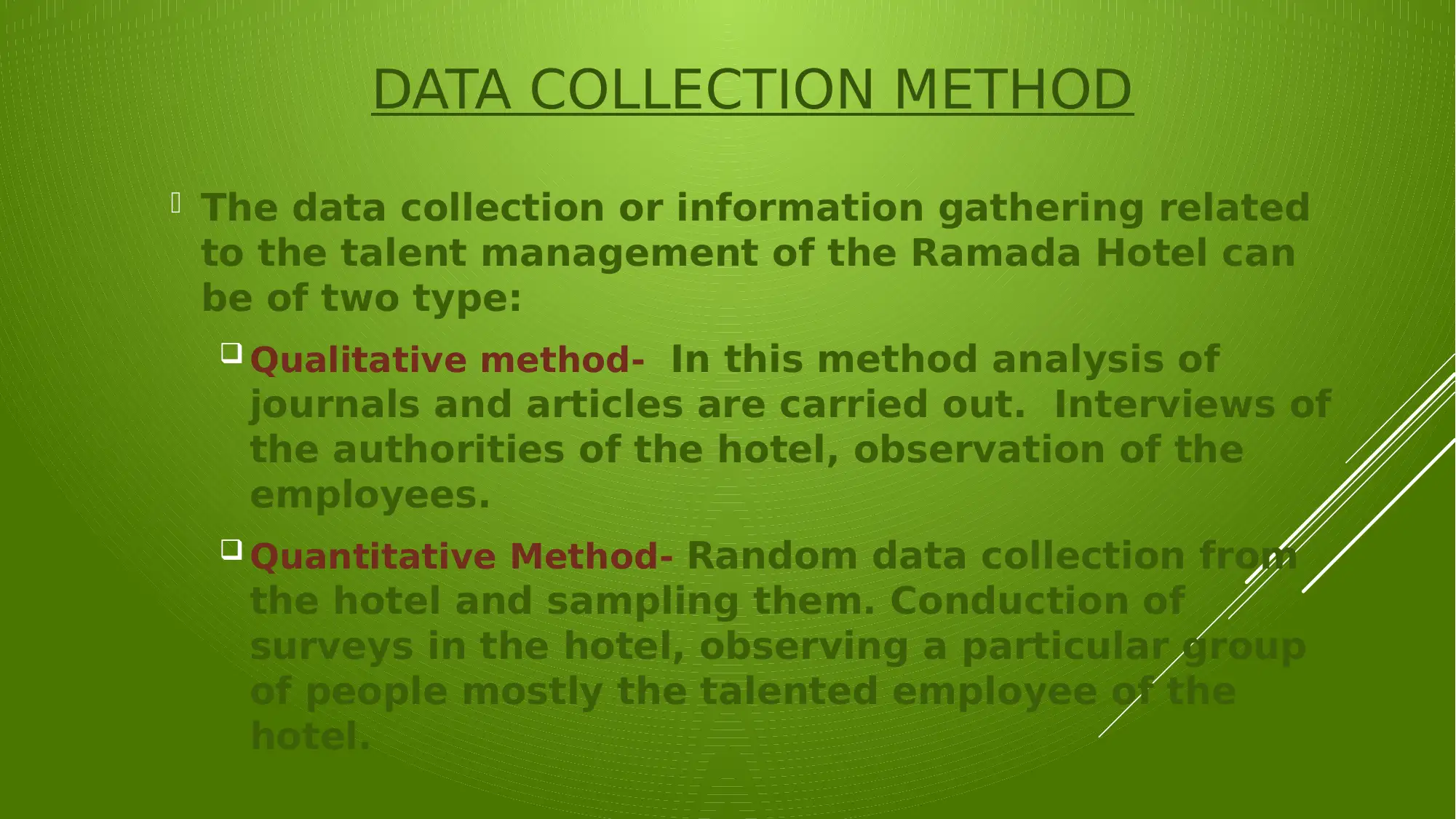
DATA COLLECTION METHOD
The data collection or information gathering related
to the talent management of the Ramada Hotel can
be of two type:
Qualitative method- In this method analysis of
journals and articles are carried out. Interviews of
the authorities of the hotel, observation of the
employees.
Quantitative Method- Random data collection from
the hotel and sampling them. Conduction of
surveys in the hotel, observing a particular group
of people mostly the talented employee of the
hotel.
Document Page
PROJECT EXECUTION
Secondary Research: The retention of talented staff is a huge
requirement in hospitality industry
The employee turnover has enhanced the performance of
organization.
It also involves facing issues like emotional aspects, stress,
exhaustion and personal dimensions (Collings 2014).
Strategies will be analyzing the Hotel profit, Increasing
customer Satisfaction and enhanced work efficiency and
quality.
Primary Research: The strategies of managing talent is based
on the data available to consultancy about the Ramada hotel and
its requirements. Conduction of interviews with the managers
and the employees (McDonnell et al. 2017). Online surveys on the
services availed by the customers.
Document Page
METHOD EVALUATION : VALIDITY & RELIABILITY
The sources for primary research are real-time.
Surveys are conducted on customers experienced
their stay at the hotel recently (Gannon et al.
2015). There are also many researches on talent
management in the hospitality industry only.
The reliability of the taken sources to use the
method are practical as data can be get from the
online sources of hotel reviews and customer
ratings of their stay at any hotel (Thunnissen,
Boselie and Fruytier 2013).
tabler-icon-diamond-filled.svg

Paraphrase This Document

Need a fresh take? Get an instant paraphrase of this document with our AI Paraphraser
Document Page
PROJECT FINDING
Analysis of Data: The qualitative analysis of data shows that
several famous journals and articles reflect the importance of
talent management in the hospitality industry and mostly for
Hotels (Vasquez 2014). The quantitative data can be obtained
from the reviews about the hotel and its services such as their
staffing has got the highest rating “ 8.6” from all the other
facilities.
Conclusion of the data analysis: It can be clearly
concluded that the research data shows that talented
employees are the asset of any industry and management of
them in more important with suitable strategies.
The online ratings and reviews of the customer clearly reflects
the existence of talented staffs of the hotel. This encourages
the consultancy to implement strategies for retaining the
talented staffs and enhancing their skills for better outcome.
Document Page
RECOMMENDATION
It can be recommended that the data got from the
research of the importance of talent management
must be utilized by the consultancy.
The arrangement of programs for developing new
skill of the talented staff.
Identifying the unique talents from the existing
staffs and introducing new people if required.
It can be recommended to the HR team of the hotel
to conduct appreciation program for delivering
uniqueness in their work field.
Document Page
AUTHENTICITY AND ACCURACY OF RESEARCH
TOOLS
The research tools used for conducting the research
of effective talent management in the Ramadan Hotel
is basic survey of the reviews and ratings of the
customer for their stay in the hotel (Maderaet al.
2017).
Therefore, it appears that the reviews are authentic
as only the authentic customers can only give the
rating at the time of checking out from the hotel.
This also validates that the data are accurate in their
own perspectives.
tabler-icon-diamond-filled.svg

Paraphrase This Document

Need a fresh take? Get an instant paraphrase of this document with our AI Paraphraser
Document Page
PERFORMANCE REVIEW
Value of undertaking research:
The project went as per the plan.
The outcomes were quite practical.
The local business can incorporate the outcomes of this project.
The time frame for each activity changed for the variable process
of data collection
The objectives were achieved through the planned processes only.
Own learning and performance:
Yes, it supports the sustainability performance.
Project management planning is most crucial.
It increased my behavior of punctuality.
Budgeting helped me to utilize money is efficient way.
It provides several learnings for future project.
Document Page
REFERENCE
Collings, D.G., 2014. Toward mature talent management: Beyond shareholder
value. Human Resource Development Quarterly, 25(3), pp.301-319.
Deery, M. and Jago, L., 2015. Revisiting talent management, work-life balance and
retention strategies. International Journal of Contemporary Hospitality
Management, 27(3), pp.453-472.
Gannon, J.M., Roper, A. and Doherty, L., 2015. Strategic human resource
management: Insights from the international hotel industry. International Journal
of Hospitality Management, 47, pp.65-75.
Kaliappen, N. and Chee, H.Y., 2018, October. Analysis of Investment Opportunities
and Key Performance Indicators (KPI) in Malaysian Tourism and Hospitality.
In Global Conference on Business, Hospitality, and Tourism Research (GLOSEARCH
2018).
Madera, J.M., Dawson, M., Guchait, P. and Belarmino, A.M., 2017. Strategic human
resources management research in hospitality and tourism: A review of current
literature and suggestions for the future. International Journal of Contemporary
Hospitality Management, 29(1), pp.48-67.
McDonnell, A., Collings, D.G., Mellahi, K. and Schuler, R., 2017. Talent
management: a systematic review and future prospects. European Journal of
International Management, 11(1), pp.86-128.
chevron_up_icon
1 out of 14
circle_padding
hide_on_mobile
zoom_out_icon
[object Object]