BUSM4307: Talent Management Strategic Resourcing Report Analysis
VerifiedAdded on 2023/02/03
|13
|3063
|54
Report
AI Summary
This report, submitted on April 10, 2018, for the BUSM4307 course, delves into the critical aspects of talent management and strategic resourcing within the context of the Indian employment market. The report begins by analyzing the current employment conditions in India, considering factors such as population, GDP, unemployment rates, and the prevalence of various sectors and business practices. It examines the impact of these conditions on future organizational workforce talent, including potential migration, employee morale, and the attractiveness of the market to investors. The report then justifies the use of external and internal resourcing strategies, evaluating their impacts on developing a future-fit workforce. This includes a discussion on the benefits of each strategy, such as access to a wider talent pool and opportunities for employee career growth, and the importance of positioning the organization as an employer of choice. Finally, the report critically evaluates the talent hunt and cultivation strategy, outlining the operational practices, such as performance management, that should be put in place to support its effective implementation. The report highlights the importance of identifying and attracting qualified candidates, providing them with training and development opportunities, and fostering a positive work environment to ensure organizational success and succession planning.

Talent Management
Strategic Resourcing and Talent
Management-BUSM4307
Student Number:17016808
Date of Submission:10-April-2018
Assignment Number:001
1
Strategic Resourcing and Talent
Management-BUSM4307
Student Number:17016808
Date of Submission:10-April-2018
Assignment Number:001
1

Paraphrase This Document
Need a fresh take? Get an instant paraphrase of this document with our AI Paraphraser
Talent Management
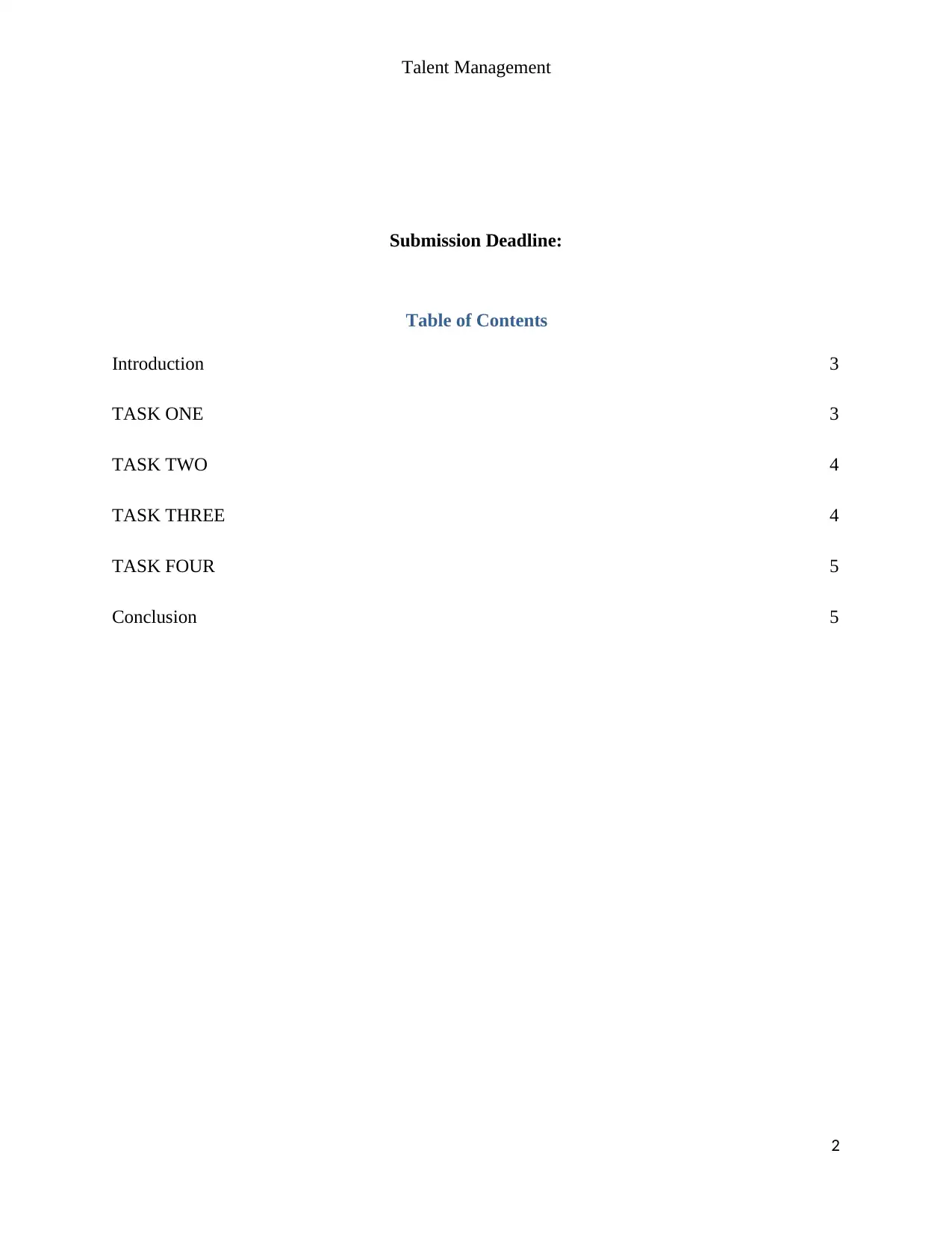
Submission Deadline:
Table of Contents
Introduction 3
TASK ONE 3
TASK TWO 4
TASK THREE 4
TASK FOUR 5
Conclusion 5
2
Submission Deadline:
Table of Contents
Introduction 3
TASK ONE 3
TASK TWO 4
TASK THREE 4
TASK FOUR 5
Conclusion 5
2
Talent Management
Introduction
Employee resourcing and talent management is an important aspect of effective human resource
practice (Bass and Avolio, 2013). It ensures that the company employees the right people for the
right job and that are able to execute their work well. Effective resourcing will enable a company
to address issues for example whom to employ in the first place and how to engage and motivate
them to achieve the set goals. Talent management plays an important role in succession planning
and provides an opportunity for workers to grow their potential (Bass and Riggio, 2016). This
report will analyse the current employment market of India and the impact it has on future. The
report will also analyse talent management strategy and operational systems that should be put in
place to support the strategy.
TASK ONE
Analysing the current conditions of employment market in India and its possible impact on future
organizational workforce talent
Human resource manager have a responsibility of ensuring that they understand the market
condition where their businesses operate and understand the market dynamics (Den Hartog and
Belschak, 2012). India is one of the most densely populated countries in the world with an
estimated population of 1.3 billion people and a GDP of 7.1%. Unemployment rate stands at
3.5% and it is estimated that by the year 2019 18.9 million people in India are expected to be
unemployed and the numbers are likely to increase. There are several organisations that operate
3
Introduction
Employee resourcing and talent management is an important aspect of effective human resource
practice (Bass and Avolio, 2013). It ensures that the company employees the right people for the
right job and that are able to execute their work well. Effective resourcing will enable a company
to address issues for example whom to employ in the first place and how to engage and motivate
them to achieve the set goals. Talent management plays an important role in succession planning
and provides an opportunity for workers to grow their potential (Bass and Riggio, 2016). This
report will analyse the current employment market of India and the impact it has on future. The
report will also analyse talent management strategy and operational systems that should be put in
place to support the strategy.
TASK ONE
Analysing the current conditions of employment market in India and its possible impact on future
organizational workforce talent
Human resource manager have a responsibility of ensuring that they understand the market
condition where their businesses operate and understand the market dynamics (Den Hartog and
Belschak, 2012). India is one of the most densely populated countries in the world with an
estimated population of 1.3 billion people and a GDP of 7.1%. Unemployment rate stands at
3.5% and it is estimated that by the year 2019 18.9 million people in India are expected to be
unemployed and the numbers are likely to increase. There are several organisations that operate
3
⊘ This is a preview!⊘
Do you want full access?
Subscribe today to unlock all pages.

Trusted by 1+ million students worldwide
Talent Management
in the country in different sectors that offer employment to the population and majority of the
people in the country are business men and self-employed. The country has highly qualified
workforce and expertise but the job opportunities are not enough to accommodate the entire
workforce. The current prime minister promised to create 10 million jobs but this has not been
the case. The country is known as a cheap source of labour and employees are exploited by both
local and foreign investors. The country has also been accused of child labour and has faced
several employee unrests because of the poor working conditions. A good example is the Nivea
scandal where the company was accused of employing children and exploiting them. The
government of India has not put in place sufficient measures in the employment market to curb
employee exploitations and case of child labour. The country is developing very fast and
exporting labour to other countries across the world. Majority of the employees that operate in
the country have been accused of not adhering to the employment laws and regulations
(Hackman and Johnson, 2009). The number of people that are educated in India is increasing but
job opportunities are limited and this is likely to affect the employment rate at the country. The
government has put in place measures that are aimed at curbing the high rate of unemployment
for example giving investors initiatives to encourage them to invest in the country. The
government has also put more efforts towards infrastructural developments and this is aimed at
improving the employment conditions in the country.
Impact on future organizational workforce talent
The rate of unemployment in India will in future affect the workforce talent in the country. This
is because the number of educated workforce in the country will migrate to other countries to
seek employment and green pastures. Employees will also continue to seek for better
opportunities and where they can get better working conditions and pay (Kumar, 2014). The
4
in the country in different sectors that offer employment to the population and majority of the
people in the country are business men and self-employed. The country has highly qualified
workforce and expertise but the job opportunities are not enough to accommodate the entire
workforce. The current prime minister promised to create 10 million jobs but this has not been
the case. The country is known as a cheap source of labour and employees are exploited by both
local and foreign investors. The country has also been accused of child labour and has faced
several employee unrests because of the poor working conditions. A good example is the Nivea
scandal where the company was accused of employing children and exploiting them. The
government of India has not put in place sufficient measures in the employment market to curb
employee exploitations and case of child labour. The country is developing very fast and
exporting labour to other countries across the world. Majority of the employees that operate in
the country have been accused of not adhering to the employment laws and regulations
(Hackman and Johnson, 2009). The number of people that are educated in India is increasing but
job opportunities are limited and this is likely to affect the employment rate at the country. The
government has put in place measures that are aimed at curbing the high rate of unemployment
for example giving investors initiatives to encourage them to invest in the country. The
government has also put more efforts towards infrastructural developments and this is aimed at
improving the employment conditions in the country.
Impact on future organizational workforce talent
The rate of unemployment in India will in future affect the workforce talent in the country. This
is because the number of educated workforce in the country will migrate to other countries to
seek employment and green pastures. Employees will also continue to seek for better
opportunities and where they can get better working conditions and pay (Kumar, 2014). The
4
Paraphrase This Document
Need a fresh take? Get an instant paraphrase of this document with our AI Paraphraser
Talent Management
conditions on the country employment market will limit development opportunities for
employees and this will limit their career growth. The conditions in the market will affect
companies that are operating in the country in relation to succession planning and this will affect
future performance. The current conditions in the employment market in India will affect the
morale of employees and limit them from acquiring additional knowledge. The conditions in the
employment in future will increase the rate of employee unrest in the country due to
disagreements among the employees and employers and this will affect the country economic
development. The rate of unemployment will also attract investors into the country and this is
because they will be able to get cheap labour in the country (Bass, 2010). This will also affect the
rate at which future workforce talent will be paid and this will affect recruitment and selection.
Employees will also be provided with flexible working conditions that will enable employees
balance work and life (Katz, 2005). This will motivate them and ensure that they perform well
and it will ensure that the company is able to get the best workforce in future. The company will
be able to access a pool of qualified talent and this will ensure that they perform their work well.
TASK TWO
Justifying the resourcing strategy and evaluating its impacts on development of future fit
workforce
The resourcing strategy that will be used by the organization is external and internal resourcing
strategy. The external resourcing strategy will enable the company to get a pool of qualified and
most suitable candidates for the position that exists in the company (KirkPatrick and Locke,
2011). The organization will be required to come up with the job description for the candidates
and invite them to apply for the position. The recruitment and selection team will analyse all
5
conditions on the country employment market will limit development opportunities for
employees and this will limit their career growth. The conditions in the market will affect
companies that are operating in the country in relation to succession planning and this will affect
future performance. The current conditions in the employment market in India will affect the
morale of employees and limit them from acquiring additional knowledge. The conditions in the
employment in future will increase the rate of employee unrest in the country due to
disagreements among the employees and employers and this will affect the country economic
development. The rate of unemployment will also attract investors into the country and this is
because they will be able to get cheap labour in the country (Bass, 2010). This will also affect the
rate at which future workforce talent will be paid and this will affect recruitment and selection.
Employees will also be provided with flexible working conditions that will enable employees
balance work and life (Katz, 2005). This will motivate them and ensure that they perform well
and it will ensure that the company is able to get the best workforce in future. The company will
be able to access a pool of qualified talent and this will ensure that they perform their work well.
TASK TWO
Justifying the resourcing strategy and evaluating its impacts on development of future fit
workforce
The resourcing strategy that will be used by the organization is external and internal resourcing
strategy. The external resourcing strategy will enable the company to get a pool of qualified and
most suitable candidates for the position that exists in the company (KirkPatrick and Locke,
2011). The organization will be required to come up with the job description for the candidates
and invite them to apply for the position. The recruitment and selection team will analyse all
5
Talent Management
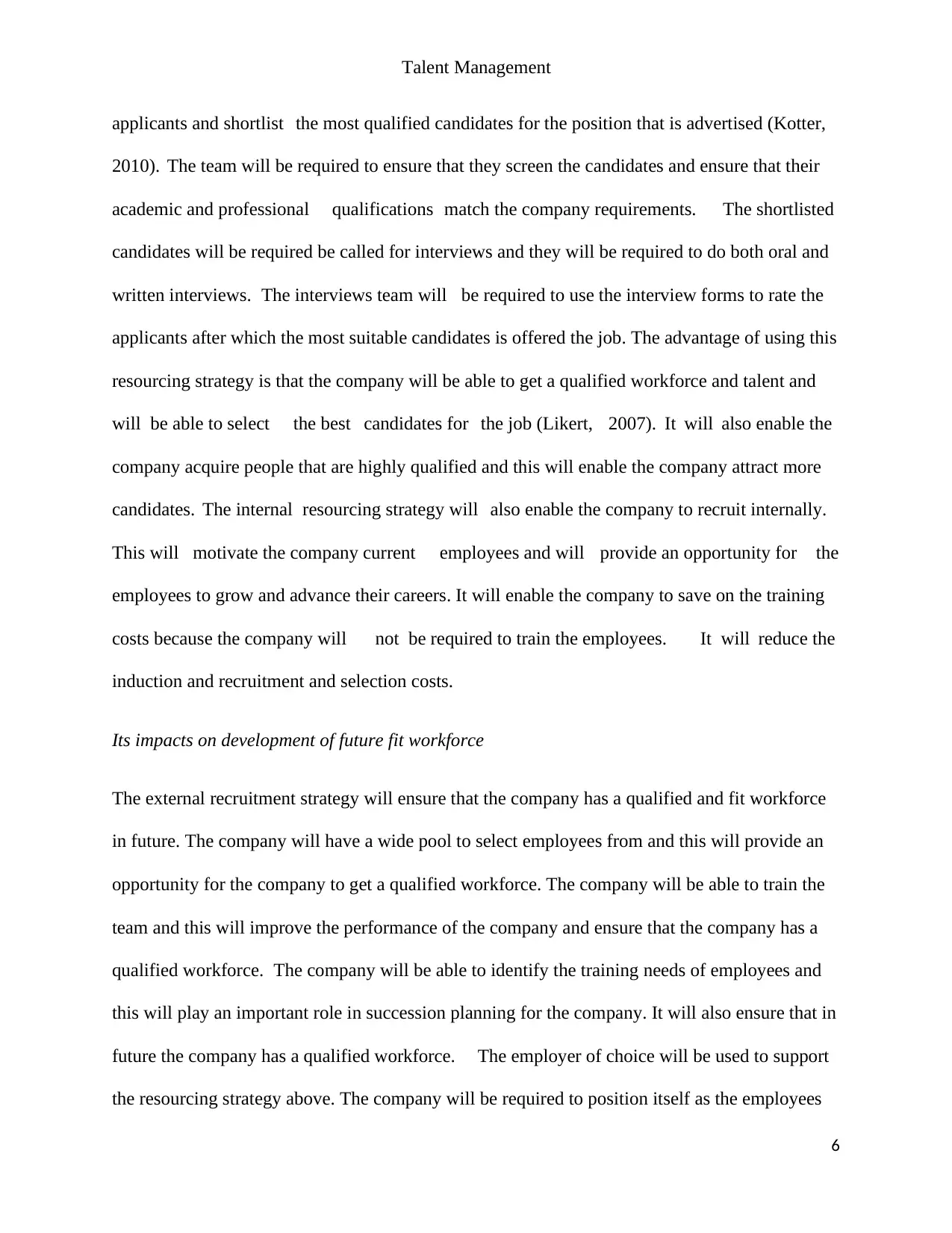
applicants and shortlist the most qualified candidates for the position that is advertised (Kotter,
2010). The team will be required to ensure that they screen the candidates and ensure that their
academic and professional qualifications match the company requirements. The shortlisted
candidates will be required be called for interviews and they will be required to do both oral and
written interviews. The interviews team will be required to use the interview forms to rate the
applicants after which the most suitable candidates is offered the job. The advantage of using this
resourcing strategy is that the company will be able to get a qualified workforce and talent and
will be able to select the best candidates for the job (Likert, 2007). It will also enable the
company acquire people that are highly qualified and this will enable the company attract more
candidates. The internal resourcing strategy will also enable the company to recruit internally.
This will motivate the company current employees and will provide an opportunity for the
employees to grow and advance their careers. It will enable the company to save on the training
costs because the company will not be required to train the employees. It will reduce the
induction and recruitment and selection costs.
Its impacts on development of future fit workforce
The external recruitment strategy will ensure that the company has a qualified and fit workforce
in future. The company will have a wide pool to select employees from and this will provide an
opportunity for the company to get a qualified workforce. The company will be able to train the
team and this will improve the performance of the company and ensure that the company has a
qualified workforce. The company will be able to identify the training needs of employees and
this will play an important role in succession planning for the company. It will also ensure that in
future the company has a qualified workforce. The employer of choice will be used to support
the resourcing strategy above. The company will be required to position itself as the employees
6
applicants and shortlist the most qualified candidates for the position that is advertised (Kotter,
2010). The team will be required to ensure that they screen the candidates and ensure that their
academic and professional qualifications match the company requirements. The shortlisted
candidates will be required be called for interviews and they will be required to do both oral and
written interviews. The interviews team will be required to use the interview forms to rate the
applicants after which the most suitable candidates is offered the job. The advantage of using this
resourcing strategy is that the company will be able to get a qualified workforce and talent and
will be able to select the best candidates for the job (Likert, 2007). It will also enable the
company acquire people that are highly qualified and this will enable the company attract more
candidates. The internal resourcing strategy will also enable the company to recruit internally.
This will motivate the company current employees and will provide an opportunity for the
employees to grow and advance their careers. It will enable the company to save on the training
costs because the company will not be required to train the employees. It will reduce the
induction and recruitment and selection costs.
Its impacts on development of future fit workforce
The external recruitment strategy will ensure that the company has a qualified and fit workforce
in future. The company will have a wide pool to select employees from and this will provide an
opportunity for the company to get a qualified workforce. The company will be able to train the
team and this will improve the performance of the company and ensure that the company has a
qualified workforce. The company will be able to identify the training needs of employees and
this will play an important role in succession planning for the company. It will also ensure that in
future the company has a qualified workforce. The employer of choice will be used to support
the resourcing strategy above. The company will be required to position itself as the employees
6
⊘ This is a preview!⊘
Do you want full access?
Subscribe today to unlock all pages.
Trusted by 1+ million students worldwide
Talent Management
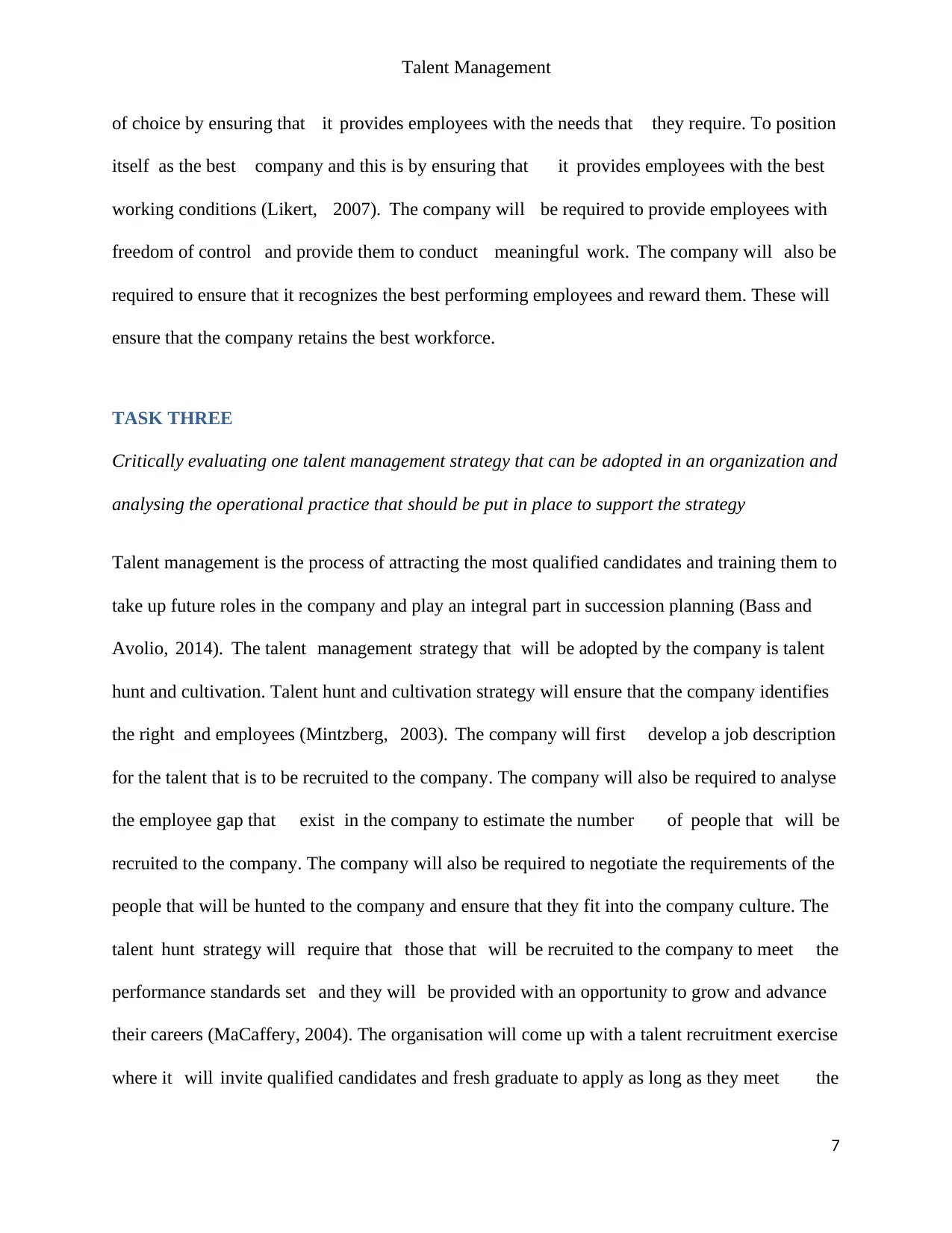
of choice by ensuring that it provides employees with the needs that they require. To position
itself as the best company and this is by ensuring that it provides employees with the best
working conditions (Likert, 2007). The company will be required to provide employees with
freedom of control and provide them to conduct meaningful work. The company will also be
required to ensure that it recognizes the best performing employees and reward them. These will
ensure that the company retains the best workforce.
TASK THREE
Critically evaluating one talent management strategy that can be adopted in an organization and
analysing the operational practice that should be put in place to support the strategy
Talent management is the process of attracting the most qualified candidates and training them to
take up future roles in the company and play an integral part in succession planning (Bass and
Avolio, 2014). The talent management strategy that will be adopted by the company is talent
hunt and cultivation. Talent hunt and cultivation strategy will ensure that the company identifies
the right and employees (Mintzberg, 2003). The company will first develop a job description
for the talent that is to be recruited to the company. The company will also be required to analyse
the employee gap that exist in the company to estimate the number of people that will be
recruited to the company. The company will also be required to negotiate the requirements of the
people that will be hunted to the company and ensure that they fit into the company culture. The
talent hunt strategy will require that those that will be recruited to the company to meet the
performance standards set and they will be provided with an opportunity to grow and advance
their careers (MaCaffery, 2004). The organisation will come up with a talent recruitment exercise
where it will invite qualified candidates and fresh graduate to apply as long as they meet the
7
of choice by ensuring that it provides employees with the needs that they require. To position
itself as the best company and this is by ensuring that it provides employees with the best
working conditions (Likert, 2007). The company will be required to provide employees with
freedom of control and provide them to conduct meaningful work. The company will also be
required to ensure that it recognizes the best performing employees and reward them. These will
ensure that the company retains the best workforce.
TASK THREE
Critically evaluating one talent management strategy that can be adopted in an organization and
analysing the operational practice that should be put in place to support the strategy
Talent management is the process of attracting the most qualified candidates and training them to
take up future roles in the company and play an integral part in succession planning (Bass and
Avolio, 2014). The talent management strategy that will be adopted by the company is talent
hunt and cultivation. Talent hunt and cultivation strategy will ensure that the company identifies
the right and employees (Mintzberg, 2003). The company will first develop a job description
for the talent that is to be recruited to the company. The company will also be required to analyse
the employee gap that exist in the company to estimate the number of people that will be
recruited to the company. The company will also be required to negotiate the requirements of the
people that will be hunted to the company and ensure that they fit into the company culture. The
talent hunt strategy will require that those that will be recruited to the company to meet the
performance standards set and they will be provided with an opportunity to grow and advance
their careers (MaCaffery, 2004). The organisation will come up with a talent recruitment exercise
where it will invite qualified candidates and fresh graduate to apply as long as they meet the
7
Paraphrase This Document
Need a fresh take? Get an instant paraphrase of this document with our AI Paraphraser
Talent Management
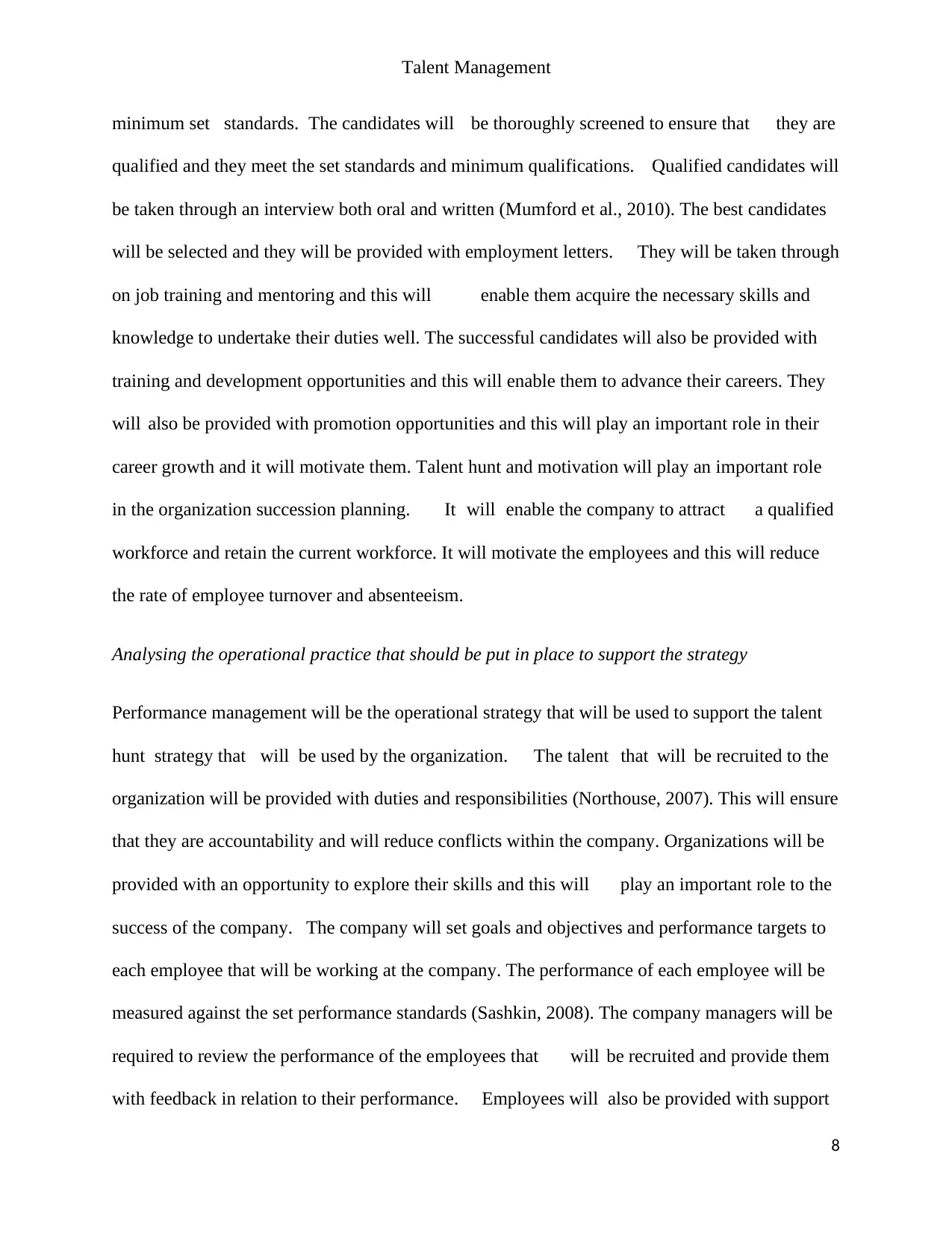
minimum set standards. The candidates will be thoroughly screened to ensure that they are
qualified and they meet the set standards and minimum qualifications. Qualified candidates will
be taken through an interview both oral and written (Mumford et al., 2010). The best candidates
will be selected and they will be provided with employment letters. They will be taken through
on job training and mentoring and this will enable them acquire the necessary skills and
knowledge to undertake their duties well. The successful candidates will also be provided with
training and development opportunities and this will enable them to advance their careers. They
will also be provided with promotion opportunities and this will play an important role in their
career growth and it will motivate them. Talent hunt and motivation will play an important role
in the organization succession planning. It will enable the company to attract a qualified
workforce and retain the current workforce. It will motivate the employees and this will reduce
the rate of employee turnover and absenteeism.
Analysing the operational practice that should be put in place to support the strategy
Performance management will be the operational strategy that will be used to support the talent
hunt strategy that will be used by the organization. The talent that will be recruited to the
organization will be provided with duties and responsibilities (Northouse, 2007). This will ensure
that they are accountability and will reduce conflicts within the company. Organizations will be
provided with an opportunity to explore their skills and this will play an important role to the
success of the company. The company will set goals and objectives and performance targets to
each employee that will be working at the company. The performance of each employee will be
measured against the set performance standards (Sashkin, 2008). The company managers will be
required to review the performance of the employees that will be recruited and provide them
with feedback in relation to their performance. Employees will also be provided with support
8
minimum set standards. The candidates will be thoroughly screened to ensure that they are
qualified and they meet the set standards and minimum qualifications. Qualified candidates will
be taken through an interview both oral and written (Mumford et al., 2010). The best candidates
will be selected and they will be provided with employment letters. They will be taken through
on job training and mentoring and this will enable them acquire the necessary skills and
knowledge to undertake their duties well. The successful candidates will also be provided with
training and development opportunities and this will enable them to advance their careers. They
will also be provided with promotion opportunities and this will play an important role in their
career growth and it will motivate them. Talent hunt and motivation will play an important role
in the organization succession planning. It will enable the company to attract a qualified
workforce and retain the current workforce. It will motivate the employees and this will reduce
the rate of employee turnover and absenteeism.
Analysing the operational practice that should be put in place to support the strategy
Performance management will be the operational strategy that will be used to support the talent
hunt strategy that will be used by the organization. The talent that will be recruited to the
organization will be provided with duties and responsibilities (Northouse, 2007). This will ensure
that they are accountability and will reduce conflicts within the company. Organizations will be
provided with an opportunity to explore their skills and this will play an important role to the
success of the company. The company will set goals and objectives and performance targets to
each employee that will be working at the company. The performance of each employee will be
measured against the set performance standards (Sashkin, 2008). The company managers will be
required to review the performance of the employees that will be recruited and provide them
with feedback in relation to their performance. Employees will also be provided with support
8
Talent Management
that they require to perform their work diligently. Employer of the best choice will be adopted
for the strategy (Zaccaro et al., 2004). This will ensure that the organization provides employees
with good working conditions that will portray the company have the best employer. The
company will ensure that it provides employees will their needs and this will motivate the
qualified workforce. Employees will be provided with freedom to explore their work and this
will ensure that they offer meaningful work. Employees will also be provided with freedom of
control and the best employees will be recognised and rewarded. Employees will also be
provided with flexible working conditions that will enable employees balance work and life. This
will motivate them and ensure that they perform well. This will enable the company to position
itself as the best employer or the employee of choice.
TASK FOUR
Coherent resourcing and talent management strategy by creating an implementation table
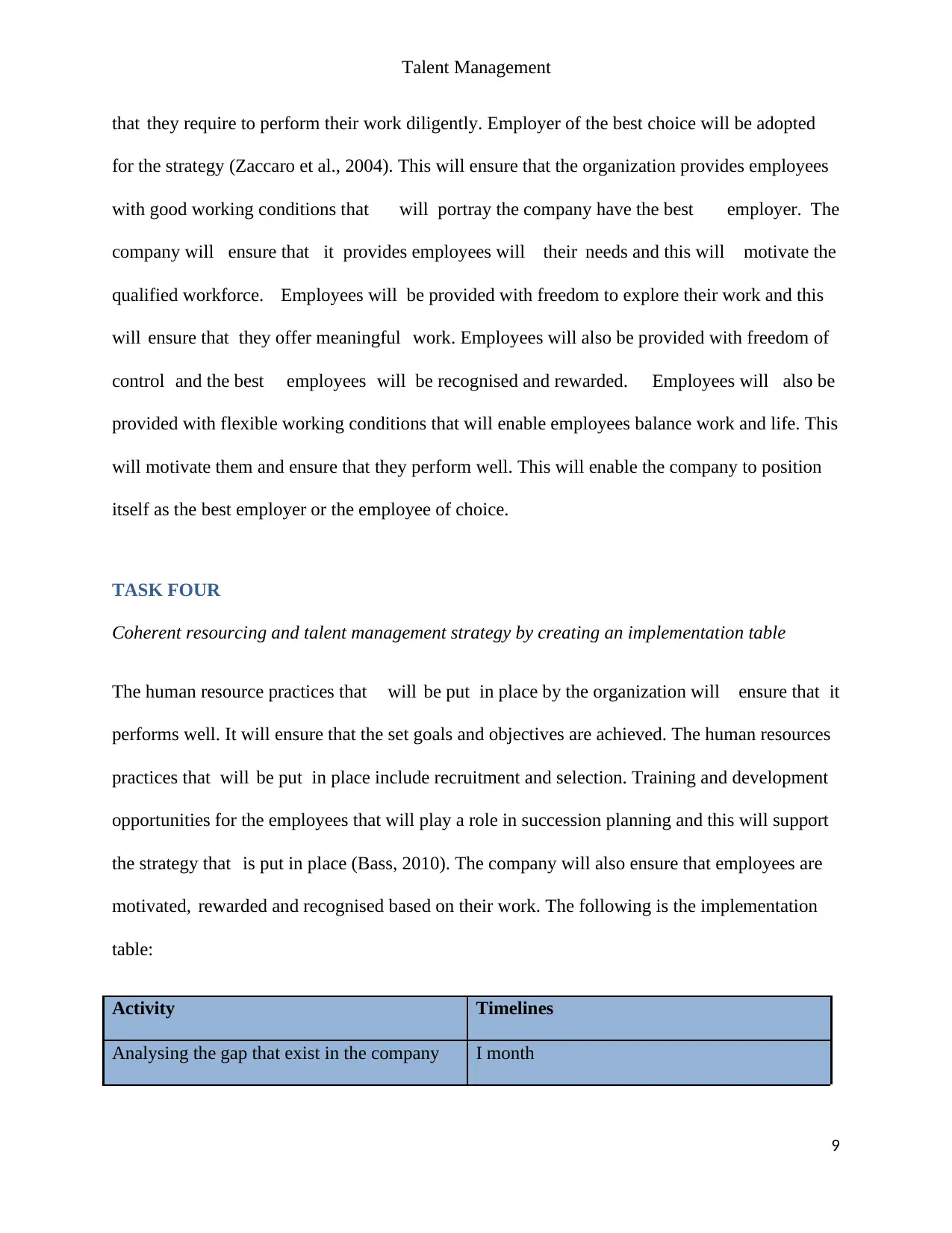
The human resource practices that will be put in place by the organization will ensure that it
performs well. It will ensure that the set goals and objectives are achieved. The human resources
practices that will be put in place include recruitment and selection. Training and development
opportunities for the employees that will play a role in succession planning and this will support
the strategy that is put in place (Bass, 2010). The company will also ensure that employees are
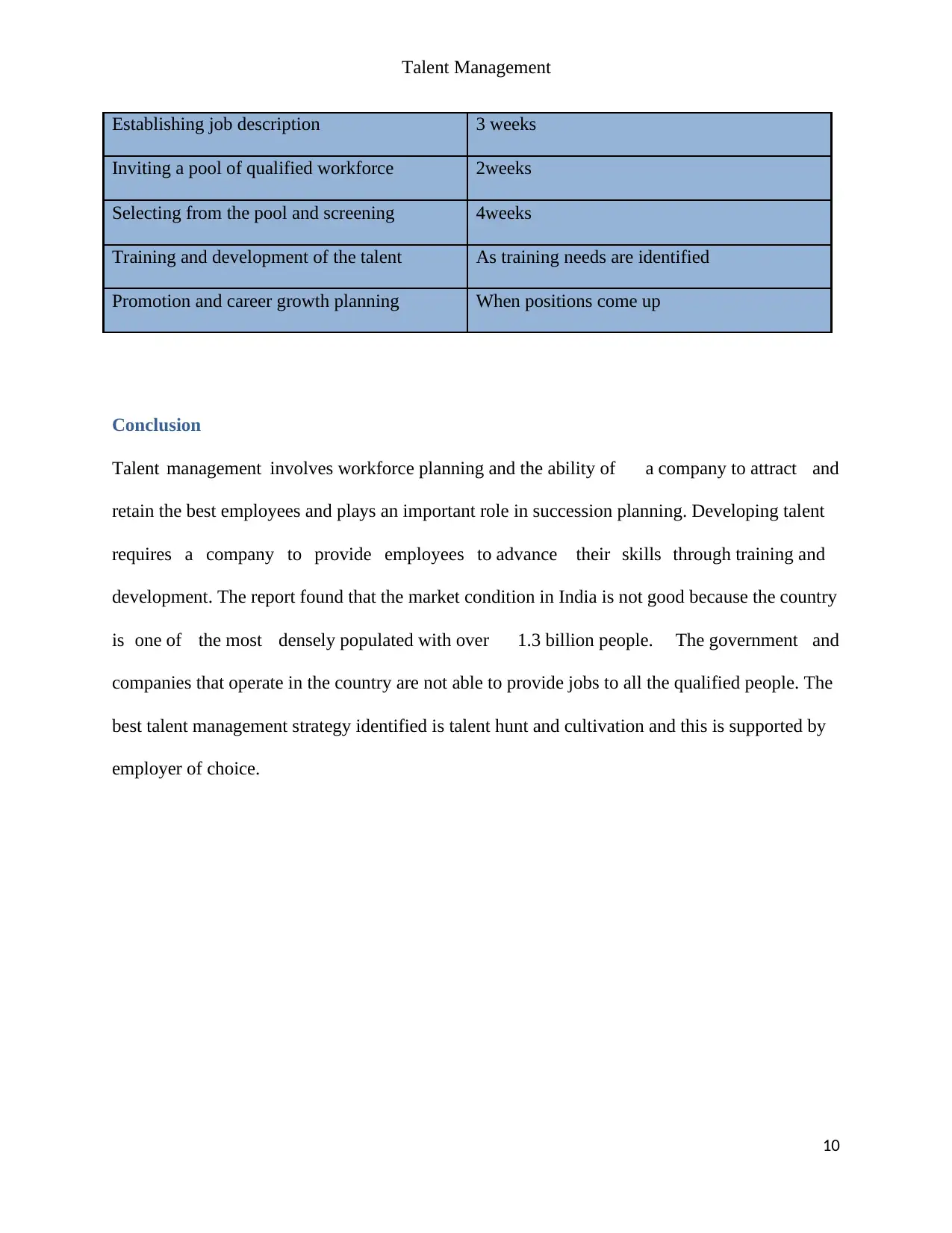
motivated, rewarded and recognised based on their work. The following is the implementation
table:
Activity Timelines
Analysing the gap that exist in the company I month
9
that they require to perform their work diligently. Employer of the best choice will be adopted
for the strategy (Zaccaro et al., 2004). This will ensure that the organization provides employees
with good working conditions that will portray the company have the best employer. The
company will ensure that it provides employees will their needs and this will motivate the
qualified workforce. Employees will be provided with freedom to explore their work and this
will ensure that they offer meaningful work. Employees will also be provided with freedom of
control and the best employees will be recognised and rewarded. Employees will also be
provided with flexible working conditions that will enable employees balance work and life. This
will motivate them and ensure that they perform well. This will enable the company to position
itself as the best employer or the employee of choice.
TASK FOUR
Coherent resourcing and talent management strategy by creating an implementation table
The human resource practices that will be put in place by the organization will ensure that it
performs well. It will ensure that the set goals and objectives are achieved. The human resources
practices that will be put in place include recruitment and selection. Training and development
opportunities for the employees that will play a role in succession planning and this will support
the strategy that is put in place (Bass, 2010). The company will also ensure that employees are
motivated, rewarded and recognised based on their work. The following is the implementation
table:
Activity Timelines
Analysing the gap that exist in the company I month
9
⊘ This is a preview!⊘
Do you want full access?
Subscribe today to unlock all pages.
Trusted by 1+ million students worldwide
Talent Management
Establishing job description 3 weeks
Inviting a pool of qualified workforce 2weeks
Selecting from the pool and screening 4weeks
Training and development of the talent As training needs are identified
Promotion and career growth planning When positions come up
Conclusion
Talent management involves workforce planning and the ability of a company to attract and
retain the best employees and plays an important role in succession planning. Developing talent
requires a company to provide employees to advance their skills through training and
development. The report found that the market condition in India is not good because the country
is one of the most densely populated with over 1.3 billion people. The government and
companies that operate in the country are not able to provide jobs to all the qualified people. The
best talent management strategy identified is talent hunt and cultivation and this is supported by
employer of choice.
10
Establishing job description 3 weeks
Inviting a pool of qualified workforce 2weeks
Selecting from the pool and screening 4weeks
Training and development of the talent As training needs are identified
Promotion and career growth planning When positions come up
Conclusion
Talent management involves workforce planning and the ability of a company to attract and
retain the best employees and plays an important role in succession planning. Developing talent
requires a company to provide employees to advance their skills through training and
development. The report found that the market condition in India is not good because the country
is one of the most densely populated with over 1.3 billion people. The government and
companies that operate in the country are not able to provide jobs to all the qualified people. The
best talent management strategy identified is talent hunt and cultivation and this is supported by
employer of choice.
10
Paraphrase This Document
Need a fresh take? Get an instant paraphrase of this document with our AI Paraphraser
Talent Management
References
Bass, B. M. (2010). From transactional to transformational leadership: Learning to share the
vision, Organizational Dynamics 18, 19-31
Bass, B. M., and Avolio, B. J. (2013), Transformation al leadership: A response to critiques,
In M. M. Chemers & R. Ayman (Eds.), Leadership theory and research: Perspectives and
directions (pp. 49-80). New York: Academic Press.
Bass, B. M. and Avolio, B. J. (Eds.), (2014), Improving Organizational Effectiveness
Through Transformational Leadership, Thousand Oaks, CA: Sage Publications
Bass, B. M., and Riggio, R. E. (2016), Transformational Leadership, Mahwah, NJ: Lawrence
Erlbaum
Den Hartog, D. N. and Belschak, F. D. (2012) When does transformational leadership
enhance employee proactive behavior? The role of autonomy and role breadth self-
efficacy, Journal of Applied Psychology, 97(1), 194-202
Hackman, M. Z., and Johnson, C. E. (2009), Leadership: A Communication Perspective
(5thEd.), Long Grove, IL: Waveland Press
Katz, R. L. (2005), Skills of an effective administrator, Harvard Business review, 33 (1), 33-42
Kirkpatrick, S. and Locke, E. (2011), Leadership: Do traits matter? Academy of Management
Executive, May, 48-60.
11
References
Bass, B. M. (2010). From transactional to transformational leadership: Learning to share the
vision, Organizational Dynamics 18, 19-31
Bass, B. M., and Avolio, B. J. (2013), Transformation al leadership: A response to critiques,
In M. M. Chemers & R. Ayman (Eds.), Leadership theory and research: Perspectives and
directions (pp. 49-80). New York: Academic Press.
Bass, B. M. and Avolio, B. J. (Eds.), (2014), Improving Organizational Effectiveness
Through Transformational Leadership, Thousand Oaks, CA: Sage Publications
Bass, B. M., and Riggio, R. E. (2016), Transformational Leadership, Mahwah, NJ: Lawrence
Erlbaum
Den Hartog, D. N. and Belschak, F. D. (2012) When does transformational leadership
enhance employee proactive behavior? The role of autonomy and role breadth self-
efficacy, Journal of Applied Psychology, 97(1), 194-202
Hackman, M. Z., and Johnson, C. E. (2009), Leadership: A Communication Perspective
(5thEd.), Long Grove, IL: Waveland Press
Katz, R. L. (2005), Skills of an effective administrator, Harvard Business review, 33 (1), 33-42
Kirkpatrick, S. and Locke, E. (2011), Leadership: Do traits matter? Academy of Management
Executive, May, 48-60.
11
Talent Management
Kotter, J. P.(2010), Force for change: How leadership differs from management. New York: The
Free Press
Kumar, M. P. (2004), Augmenting subordinates’ competencies, Journal of Management
Research, 4(3), 164-167
Likert, R. (2007), New patterns of management, New York: McGraw-Hill.
McCaffery, P. (2004), The higher education manager's handbook: Effective leadership and
management in universities and colleges, London: Routledge Farmer
Mintzberg, H. (2003), The nature of managerial work, New York: Harper and Row
Mumford, M. D., Zaccaro, S. J., Connelly, M. S., and Marks, M. A. (2010), Leadership skills:
conclusions and future directions, Leadership Quarterly, 11 (1), 155-70
Northouse, P. G. (2007), Leadership: theory and practice, 4th ed. Thousand Oaks, CA: Sage
Publications
Sashkin, M. (2008), The visionary leader, In J. A. Conger and R. N. Kanungo (Eds.).
Charismatic leadership: The elusive factor in organizational effectiveness (pp. 122-160). San
Francisco: Jossey Bass
Zaccaro, S. J., Kemp, C., and Bader, P. (2004), Leader traits and attributes, In J. Antonakis, A. T.
Cianciolo, & R. J. Sternberg (Eds.), The nature of leadership (pp. 101-124). Thousand Oaks,
CA: Sage
12
Kotter, J. P.(2010), Force for change: How leadership differs from management. New York: The
Free Press
Kumar, M. P. (2004), Augmenting subordinates’ competencies, Journal of Management
Research, 4(3), 164-167
Likert, R. (2007), New patterns of management, New York: McGraw-Hill.
McCaffery, P. (2004), The higher education manager's handbook: Effective leadership and
management in universities and colleges, London: Routledge Farmer
Mintzberg, H. (2003), The nature of managerial work, New York: Harper and Row
Mumford, M. D., Zaccaro, S. J., Connelly, M. S., and Marks, M. A. (2010), Leadership skills:
conclusions and future directions, Leadership Quarterly, 11 (1), 155-70
Northouse, P. G. (2007), Leadership: theory and practice, 4th ed. Thousand Oaks, CA: Sage
Publications
Sashkin, M. (2008), The visionary leader, In J. A. Conger and R. N. Kanungo (Eds.).
Charismatic leadership: The elusive factor in organizational effectiveness (pp. 122-160). San
Francisco: Jossey Bass
Zaccaro, S. J., Kemp, C., and Bader, P. (2004), Leader traits and attributes, In J. Antonakis, A. T.
Cianciolo, & R. J. Sternberg (Eds.), The nature of leadership (pp. 101-124). Thousand Oaks,
CA: Sage
12
⊘ This is a preview!⊘
Do you want full access?
Subscribe today to unlock all pages.
Trusted by 1+ million students worldwide

1 out of 13


Related Documents


Your All-in-One AI-Powered Toolkit for Academic Success.
+13062052269
info@desklib.com
Available 24*7 on WhatsApp / Email
![[object Object]](/_next/static/media/star-bottom.7253800d.svg)
Unlock your academic potential
Copyright © 2020–2026 A2Z Services. All Rights Reserved. Developed and managed by ZUCOL.