Talent Management: Leadership Development and Strategies

Verified

Added on  2020/04/21

|5
|941
|70
Report
AI Summary
This report delves into the critical aspects of talent management, emphasizing its role in organizational success. It highlights the importance of developing effective talent management initiatives aligned with an organization's future needs. The report underscores the integration of learning with talent management, focusing on performance management, compensation reviews, succession management, leadership development, and recruitment. It explores strategies for developing non-leaders, including improvements in recruitment, performance management, and succession planning. The report also discusses the significance of talent-driven learning over performance-driven learning and emphasizes developing techniques for reframing mental models around leadership, such as implementing competency models. The report concludes by stressing the necessity of leadership development for business success and provides insights into the cost-effectiveness of retaining internal talent versus recruiting externally.
Document Page
Running head: TALENT MANAGEMENT
Talent Management
Name
Institution
tabler-icon-diamond-filled.svg

Paraphrase This Document

Need a fresh take? Get an instant paraphrase of this document with our AI Paraphraser
Document Page
TALENT MANAGEMENT 2
Introduction
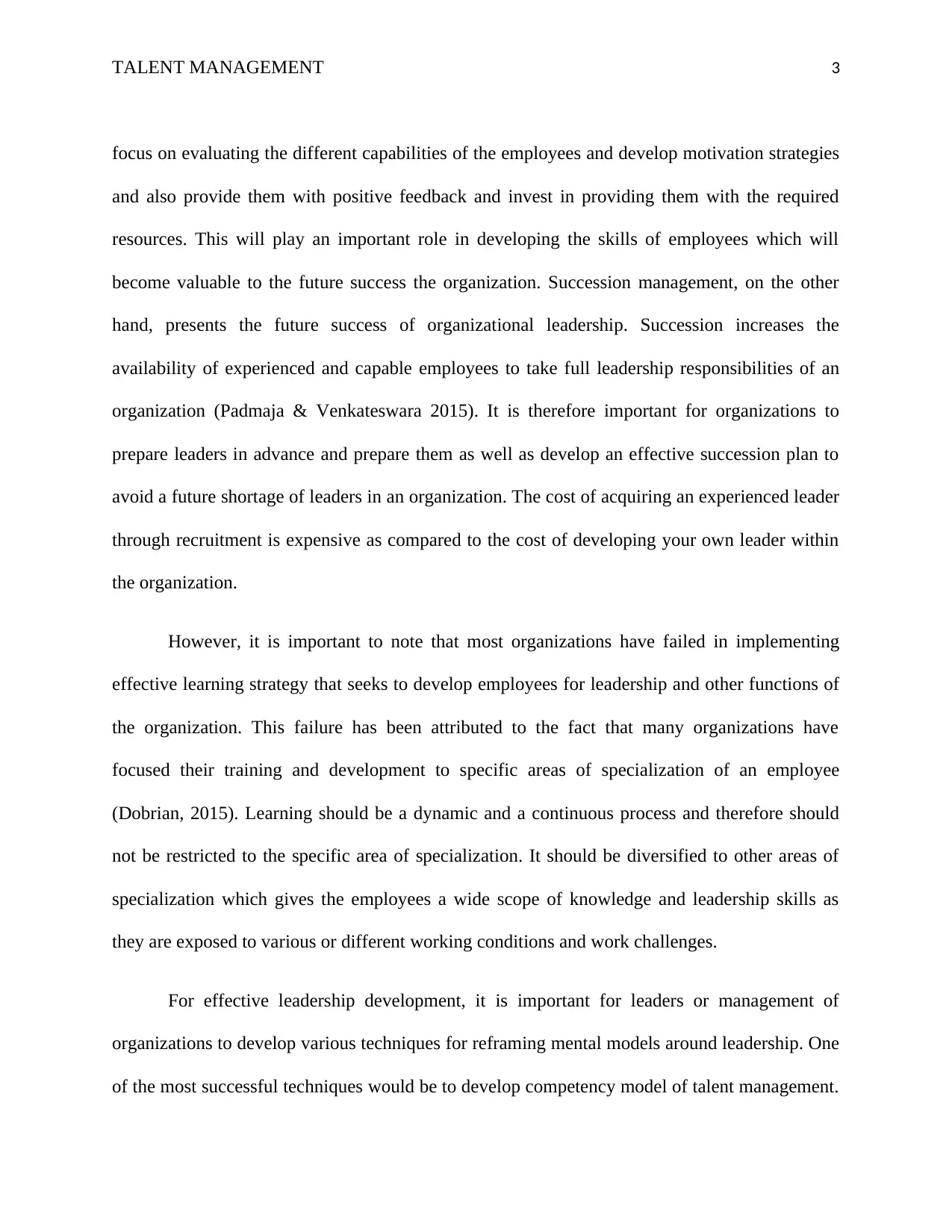
Talent management initiative is a strategy that is designed to enhance organizational
human resource development functions in line with the future human resource needs or goals of
an organization. With the changing business or organizational environments, many organizations
have therefore fallen short of meeting their employee’s expectations and hence it has become for
many organizations to retain or develop their own talented leaders for future growth of the
organizations (Spofford, 2017). Therefore, organizations are required to develop an effective
talent management initiative by creating environment that will foster organizational leadership,
learning, and development. For this to be achieved the organization needs to focus on the
integration of learning with talent management. This has been seen as one of the most important
and successful strategies for future success of an organization. This involves learning processes
on performance management, compensation reviews, succession management, leadership
development and recruitment (Silzer & Dowell, 2010). Developing these areas will play an
important role in talent management, for example, leadership development will enhance
leadership succession in the organization as well as promote strong organizational leadership
which starts with the employees to the top management or an organization.
In developing the talent of non-leaders in an organization some changes are required in
organizational policies with regard to recruitment, performance management as well as
succession management. In organization recruitment, it is important that for an organization to
look at candidates who have leadership capabilities and leadership experiences (Craig, 2015).
This will help them identify training strategies for candidates with leadership qualities and invest
in developing their leadership skills. In case of performance management, the leaders should
Document Page
TALENT MANAGEMENT 3
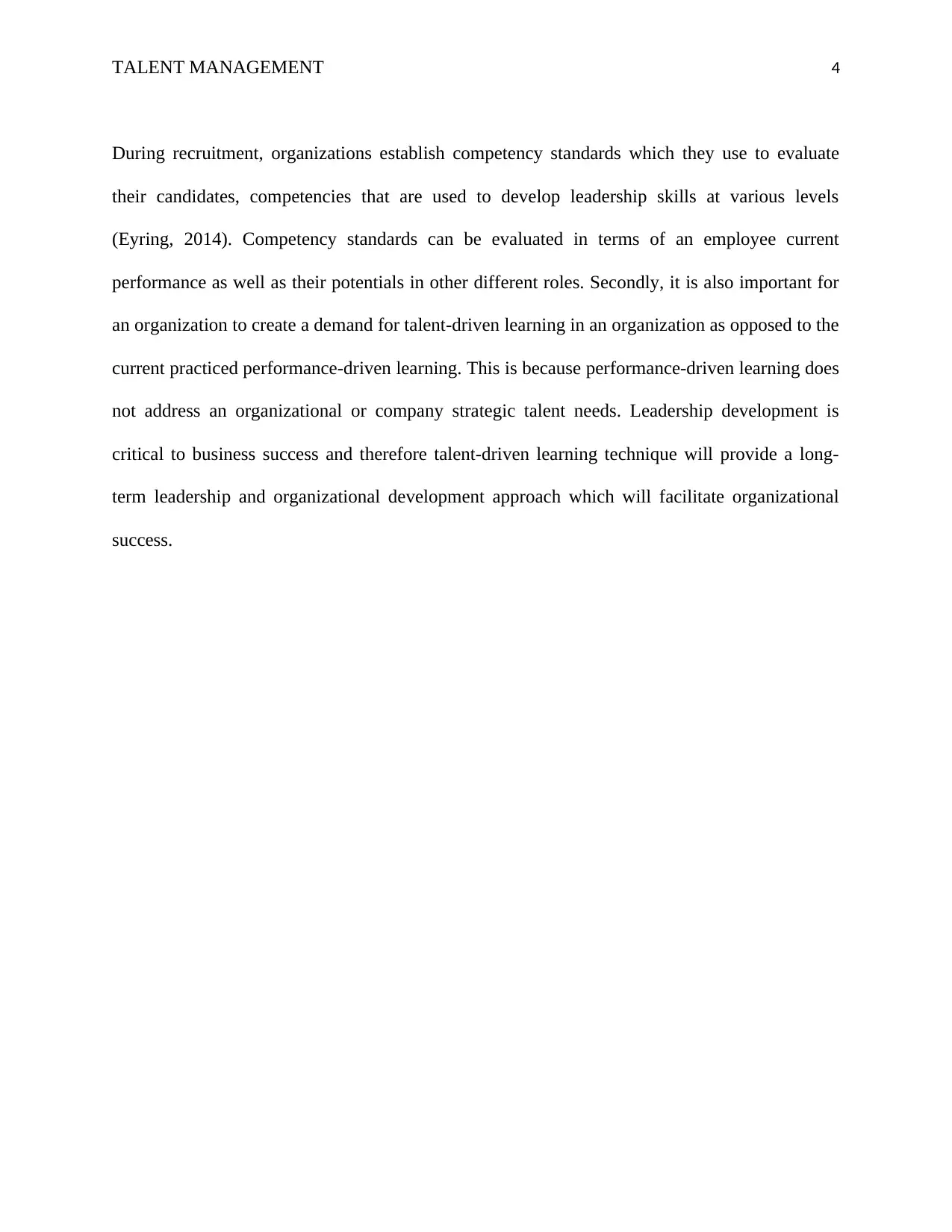
focus on evaluating the different capabilities of the employees and develop motivation strategies
and also provide them with positive feedback and invest in providing them with the required
resources. This will play an important role in developing the skills of employees which will
become valuable to the future success the organization. Succession management, on the other
hand, presents the future success of organizational leadership. Succession increases the
availability of experienced and capable employees to take full leadership responsibilities of an
organization (Padmaja & Venkateswara 2015). It is therefore important for organizations to
prepare leaders in advance and prepare them as well as develop an effective succession plan to
avoid a future shortage of leaders in an organization. The cost of acquiring an experienced leader
through recruitment is expensive as compared to the cost of developing your own leader within
the organization.
However, it is important to note that most organizations have failed in implementing
effective learning strategy that seeks to develop employees for leadership and other functions of
the organization. This failure has been attributed to the fact that many organizations have
focused their training and development to specific areas of specialization of an employee
(Dobrian, 2015). Learning should be a dynamic and a continuous process and therefore should
not be restricted to the specific area of specialization. It should be diversified to other areas of
specialization which gives the employees a wide scope of knowledge and leadership skills as
they are exposed to various or different working conditions and work challenges.
For effective leadership development, it is important for leaders or management of
organizations to develop various techniques for reframing mental models around leadership. One
of the most successful techniques would be to develop competency model of talent management.
Document Page
TALENT MANAGEMENT 4
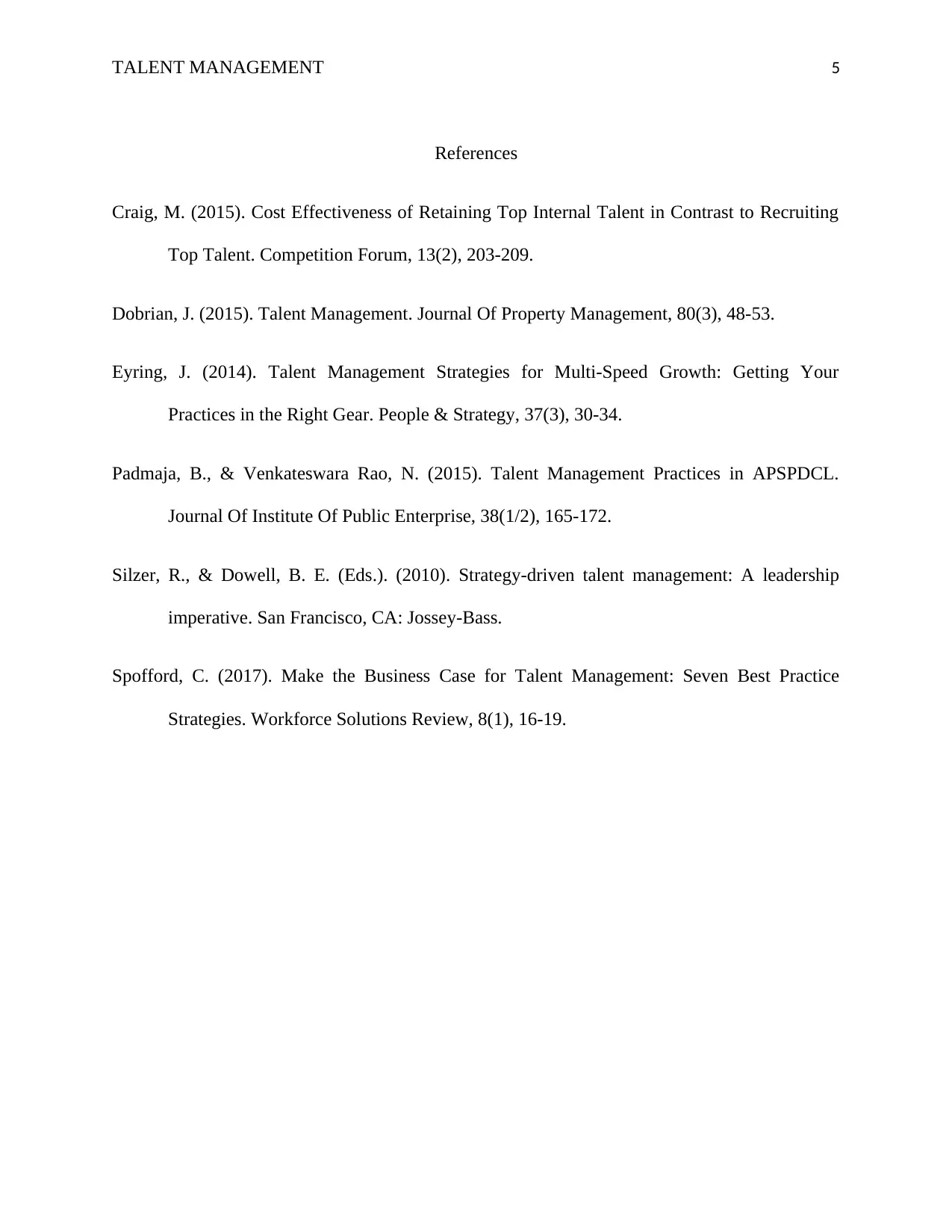
During recruitment, organizations establish competency standards which they use to evaluate
their candidates, competencies that are used to develop leadership skills at various levels
(Eyring, 2014). Competency standards can be evaluated in terms of an employee current
performance as well as their potentials in other different roles. Secondly, it is also important for
an organization to create a demand for talent-driven learning in an organization as opposed to the
current practiced performance-driven learning. This is because performance-driven learning does
not address an organizational or company strategic talent needs. Leadership development is
critical to business success and therefore talent-driven learning technique will provide a long-
term leadership and organizational development approach which will facilitate organizational
success.
tabler-icon-diamond-filled.svg

Paraphrase This Document

Need a fresh take? Get an instant paraphrase of this document with our AI Paraphraser
Document Page
TALENT MANAGEMENT 5
References
Craig, M. (2015). Cost Effectiveness of Retaining Top Internal Talent in Contrast to Recruiting
Top Talent. Competition Forum, 13(2), 203-209.
Dobrian, J. (2015). Talent Management. Journal Of Property Management, 80(3), 48-53.
Eyring, J. (2014). Talent Management Strategies for Multi-Speed Growth: Getting Your
Practices in the Right Gear. People & Strategy, 37(3), 30-34.
Padmaja, B., & Venkateswara Rao, N. (2015). Talent Management Practices in APSPDCL.
Journal Of Institute Of Public Enterprise, 38(1/2), 165-172.
Silzer, R., & Dowell, B. E. (Eds.). (2010). Strategy-driven talent management: A leadership
imperative. San Francisco, CA: Jossey-Bass.
Spofford, C. (2017). Make the Business Case for Talent Management: Seven Best Practice
Strategies. Workforce Solutions Review, 8(1), 16-19.
chevron_up_icon
1 out of 5
circle_padding
hide_on_mobile
zoom_out_icon
[object Object]